In the high-stakes world of luxury retail, high-value liquids like vintage wines, premium spirits, and designer fragrances are prime targets for shrinkage. As we approach 2026, the industry is transitioning from traditional loss prevention to 'intelligent security.' This article dives into the critical comparison between RFID and EAS systems, helping brands balance ironclad protection with a seamless, high-end customer experience. We explore how technology is evolving to protect liquid assets without compromising the prestige of the packaging.
The Evolution of Luxury Bottle Security: Setting the Stage for 2026

By 2026, luxury bottle security will have completed its transition from a binary 'protected or unprotected' model to a sophisticated digital ecosystem. This evolution is driven by the convergence of high-shrinkage threats—such as Organized Retail Crime (ORC)—and the demand for friction-free customer experiences. While traditional Electronic Article Surveillance (EAS) remains a foundational deterrent, the industry is rapidly adopting Radio Frequency Identification (RFID) to transform security hardware into a multi-purpose business intelligence tool that provides real-time visibility and item-level authentication.
The luxury sector, specifically high-end spirits, fragrances, and limited-edition vintages, faces a unique challenge: balancing high-theft risk with premium brand aesthetics. For decades, bulky plastic tags were the norm, often detracting from the bottle's design and frustrating the consumer. As we look toward 2026, the 'Next-Gen Liquidity' trend emphasizes 'invisible' security—ultra-thin sensors and embedded NFC/RFID chips that secure the asset without compromising the shelf presence or the unboxing ritual.
| Feature | Legacy EAS (Pre-2023) | Next-Gen RFID/Hybrid (2026+) |
|---|---|---|
| Primary Goal | Loss Prevention (Theft Deterrence) | Brand Intelligence & Inventory Precision |
| Form Factor | Hard Tags/Clamps (External) | Inlays, Smart Caps & Embedded Sensors |
| Data Capacity | Simple Alarm Trigger | Serial Numbers, Batch Info, Authenticity |
| Customer Experience | High Friction (Manual Removal) | Zero Friction (Self-Checkout/Invisible) |
Why is the luxury sector moving away from EAS-only solutions?
EAS lacks the granular data needed for modern supply chains. While it alarms at the door, it cannot tell a retailer which specific vintage was stolen or if a bottle on the shelf is a sophisticated counterfeit. RFID bridge this gap by providing item-level tracking.
What role does 'Organized Retail Crime' play in 2026 strategy?
ORC syndicates have learned to bypass basic EAS. Luxury retailers are now deploying 'Hybrid' systems that use RFID to identify exactly what is leaving the store in real-time, allowing for better law enforcement collaboration and shrinkage analytics.
Can security tech actually improve brand loyalty?
Yes. By using NFC-enabled RFID caps, brands can offer 'Post-Purchase Engagement.' A customer can tap the bottle with their phone to verify authenticity and unlock exclusive digital content, turning a security feature into a marketing channel.
Expert Insight: The 'Digital Cork' Revolution. A critical trend we are seeing for 2026 is the integration of the security sensor into the bottle's closure system itself. This 'Digital Cork' doesn't just prevent theft; it detects 'Gray Market' diversion and tampering. If a bottle of ultra-premium cognac is opened or refilled, the embedded sensor records the breach. My tip for luxury CTOs: Stop viewing security as a cost center for loss prevention and start viewing it as the foundational layer for your Digital Product Passport (DPP) compliance.
EAS (Electronic Article Surveillance): The Reliable Guardian of High-Value Stock
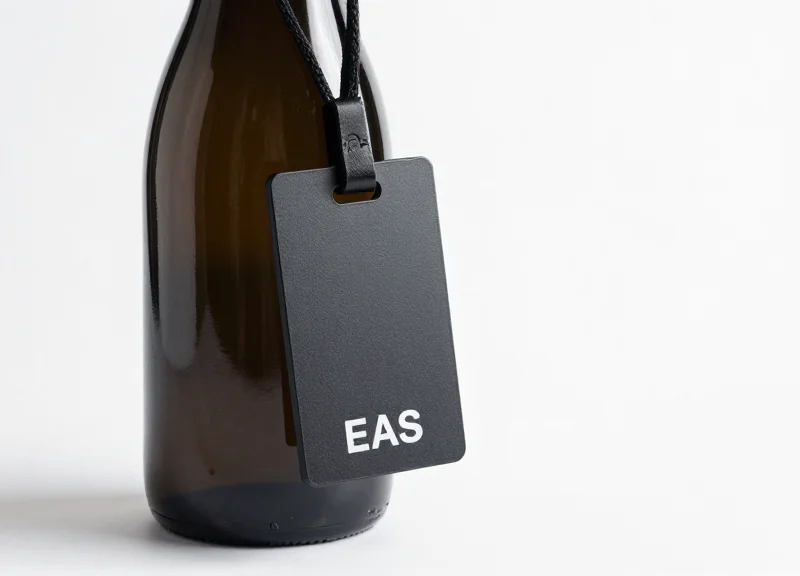
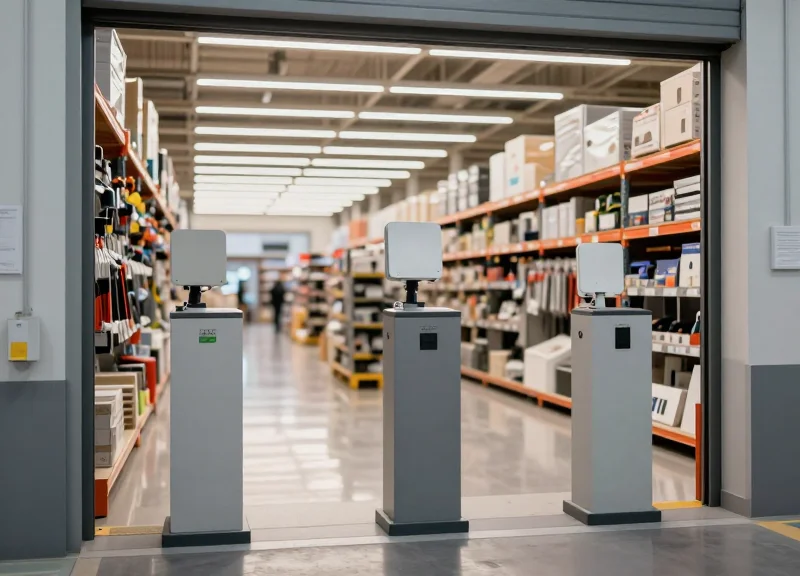
Electronic Article Surveillance (EAS) is a foundational loss prevention technology that utilizes electromagnetic fields or acousto-magnetic waves to detect unauthorized removal of items from a retail environment. In the context of 2026 luxury retail, EAS serves as the 'proactive deterrent'—a physical and psychological barrier that signals to potential shoplifters that a bottle is actively protected. Unlike data-rich RFID, EAS is designed for one primary mission: immediate alarm response at the point of exit.
| Feature | AM (Acousto-Magnetic) | RF (Radio Frequency) |
|---|---|---|
| Operating Frequency | 58 kHz | 8.2 MHz |
| Liquid Interference | Minimal (Excellent for Bottles) | High (Signal Absorbed by Liquid) |
| Detection Range | Wide Exits (Up to 2.4m) | Standard Exits (Up to 1.8m) |
| Tag Discretion | Thicker 3D Design | Thin, Flat Labels |
The Luxury Insight: Why AM Dominates the Bottle Market. In the luxury sector, particularly for high-end spirits and fragrances, Acousto-Magnetic (AM) systems are the industry standard. This is because high-frequency RF signals are often 'detuned' or absorbed by the high dielectric constant of liquids. Our 2026 outlook suggests that while RFID captures the data, AM EAS remains the 'muscle' of the operation, ensuring that high-liquidity assets stay on the shelf unless a transaction occurs.
- Visual Deterrence ROI: A visible bottle neck tag acts as a psychological stop sign. For luxury brands, the mere presence of a high-quality EAS tag can reduce 'grab-and-run' theft by up to 60% compared to unprotected or covertly protected stock.
- Cost-Effective Scalability: EAS tags are significantly less expensive than RFID sensors, allowing retailers to protect 100% of their inventory without the massive overhead of individual serialized chips for low-to-mid tier luxury lines.
- False Alarm Resilience: Modern 2026 EAS controllers use AI-driven signal processing to distinguish between a genuine tag and environmental noise (like high-voltage lighting or metal carts), nearly eliminating the 'customer embarrassment' factor.
Will EAS tags damage the premium packaging of luxury bottles?
No. 2026-era bottle tags utilize soft-clamping mechanisms and velvet-lined interiors to ensure no residue or indentation is left on gold-leaf labels or fragile glass.
Can EAS be used alongside RFID?
Yes, this is the 'Dual-Shield' strategy. Many retailers now use hybrid tags that contain both an EAS element for security and an RFID chip for inventory management.
Is EAS still relevant in 2026?
Absolutely. While RFID provides the 'what' and 'when', EAS provides the 'don't touch.' It remains the most reliable method for physical stop-and-search intervention.
RFID (Radio Frequency Identification): Beyond Security to Real-Time Intelligence

In the context of 2026 luxury retail, RFID (Radio Frequency Identification) is no longer just a digital lock; it is a sophisticated data-capturing ecosystem. Unlike traditional EAS which merely signals a 'pass/fail' state at the door, RFID uses electromagnetic fields to identify and track unique tags attached to individual bottles. This 'item-level' visibility allows retailers to distinguish between a $500 vintage cognac and a $50 entry-level spirit in real-time, enabling a transition from reactive loss prevention to proactive, intelligence-led inventory management.
- 99% Inventory Accuracy: RFID enables automated cycle counts that can be performed in minutes rather than days, maintaining near-perfect stock records and preventing 'phantom inventory' issues.
- Omnichannel Fulfillment: With bottle-level precision, luxury brands can confidently offer 'Buy Online, Pick Up In-Store' (BOPIS) services without the risk of stockouts or misplaced high-value items.
- Anti-Counterfeiting and Authentication: Unique digital signatures on RFID chips allow retailers and consumers to verify the provenance of rare spirits or perfumes, combatting the $500 billion global counterfeit market.
- Smart Shelf Integration: RFID sensors can detect when a specific bottle is removed from a display, triggering digital signage or alerting staff to provide high-touch service to a high-intent customer.
Expert Insight: The 'Security-as-a-Service' Pivot. A common mistake in luxury retail is viewing RFID as a cost center for security. In reality, by 2026, the industry is shifting toward 'Security-as-a-Service.' By embedding RFID tags at the point of manufacture, brands are creating a 'Digital Twin' for every bottle. This ensures that the security investment pays for itself through the reduction of grey-market diversion and the recovery of lost sales due to out-of-stock scenarios.
| Feature | Traditional EAS | Next-Gen RFID |
|---|---|---|
| Primary Function | Theft Deterrence | Business Intelligence & Security |
| Data Granularity | None (Alarm Only) | Unique Item ID (SKU, Batch, Origin) |
| Line of Sight | Not Required | Not Required (Mass Reading Enabled) |
| Supply Chain Value | Low (Store Level Only) | High (Factory to Consumer) |
| Inventory Speed | Manual / Barcode | Automated (Thousands of items/sec) |
Does RFID replace the need for security guards?
No, RFID acts as a force multiplier. It provides guards with specific data—exactly which bottle was taken and when—allowing for more targeted and professional interventions.
Can RFID tags be hidden in luxury packaging?
Yes. Modern 'on-metal' and 'liquid-friendly' RFID tags are thin enough to be embedded behind labels or inside bottle caps without compromising the aesthetic of luxury packaging.
What is the biggest barrier to RFID adoption in 2026?
While the cost per tag has plummeted, the primary hurdle remains the integration of legacy ERP systems with real-time RFID data streams.
Head-to-Head: Comparing RFID vs. EAS for Premium Bottle Protection
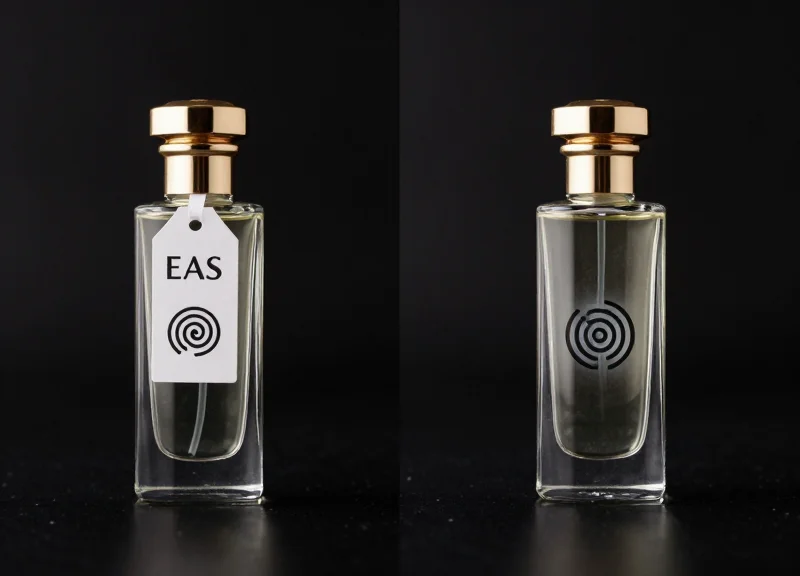
The primary difference between RFID and EAS for premium bottle protection lies in their functionality: EAS (Electronic Article Surveillance) acts as a specialized deterrent through Acoustic Magnetic (AM) or Radio Frequency (RF) gates, whereas RFID (Radio Frequency Identification) provides unique item-level identification and real-time data visibility. For 2026 luxury retail, the choice is no longer just about stopping theft; it is about the trade-off between the superior signal penetration of EAS in high-moisture environments and the massive data-harvesting capabilities of RFID.
| Feature | EAS (Acoustic Magnetic) | RFID (UHF Gen2) | |||
|---|---|---|---|---|---|
| Primary Purpose | Theft Deterrence Only | Inventory Intelligence + Security | |||
| Liquid Performance | Excellent (Low attenuation) | Challenging (Requires Waveguides) | Data Capacity | None (Bit-level) | High (Unique Serial/EPC) |
| Read Range | Up to 2.0m (Pedestals) | Up to 10m (Overhead Readers) | |||
| Foil/Metal Interference | High (Shielding effect) | High (Detuning effect) |
In the context of 'Liquidity,' the physics of the bottle contents dictate the hardware choice. Alcohol and perfumes are polar liquids that absorb UHF RFID signals, a phenomenon known as dielectric loading. While EAS AM systems operate at 58 kHz and pass through liquids with ease, they offer zero visibility into which specific bottle was moved. By 2026, the industry is shifting toward 'Flag-Tagging' or 'On-Metal' RFID spacers that create a physical air gap between the liquid and the antenna, allowing luxury brands to achieve the 99% read accuracy required for automated checkout and grey-market tracking.
Which technology is more cost-effective for 2026?
EAS tags remain cheaper per unit for pure loss prevention. However, RFID offers a higher Return on Investment (ROI) by reducing labor costs associated with manual stock takes and enabling omnichannel fulfillment.
Can RFID and EAS be combined?
Yes. Many luxury retailers are adopting 'Dual-Technology' tags that house both an AM EAS strip and an RFID inlay in a single housing, providing the 'Gold Standard' of security and intelligence.
Does RFID handle metallic foils on bottle necks?
Metal is the enemy of both systems. However, EAS tags are more easily shielded by 'booster bags.' Next-gen RFID tags use the foil itself as an antenna extension, turning a physical weakness into a signal strength.
Expert Insight: The 2026 'Data Liquidity' Trend. In Silicon Valley's retail labs, we are seeing a move toward 'Sensing RFID.' Beyond security, these tags can detect if a bottle has been opened (tamper-evident digital seals) or if the liquid temperature has exceeded luxury storage standards. If your goal is strictly to stop a bottle from leaving the store, EAS is your workhorse. If your goal is to manage a global vintage spirits portfolio with zero-touch precision, RFID is the only viable path forward.
The Aesthetic Challenge: Keeping Luxury Visuals Intact with Stealth Tagging
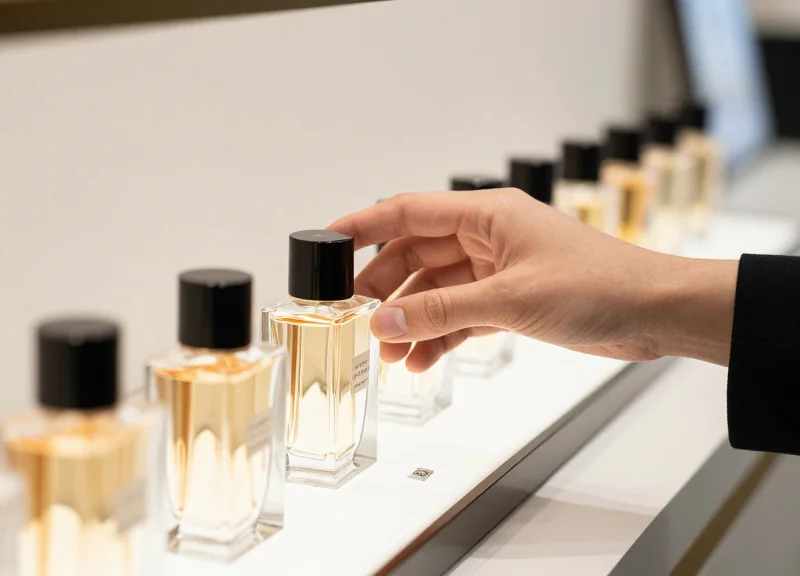
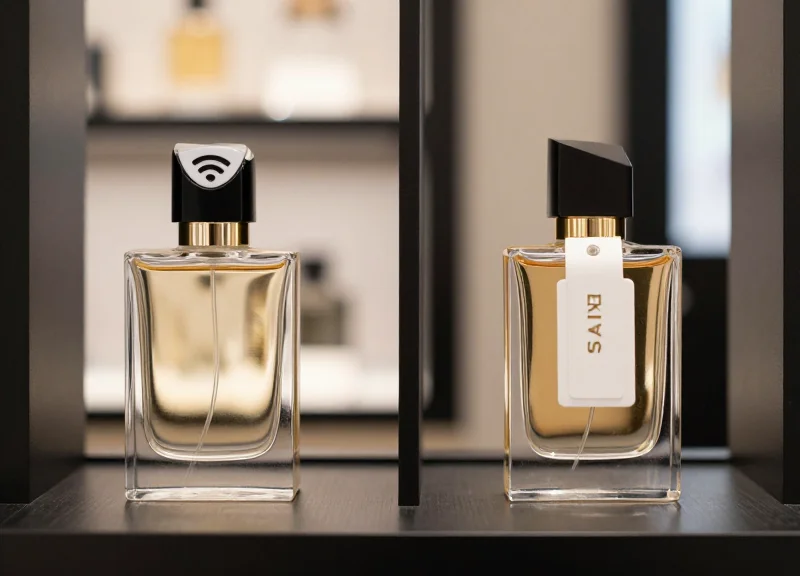
In the luxury retail sector, the bottle is more than a container; it is a physical manifestation of brand heritage. Stealth tagging refers to the integration of security technology—such as ultra-thin RFID inlays or miniaturized EAS resonators—directly into the product packaging, ensuring the security device is invisible to the consumer. For 2026, the industry is moving away from external plastic 'clamshells' or bulky neck tags in favor of 'Sub-Surface Security' where the technology is hidden behind the label, inside the closure, or within the glass itself to preserve the 'unboxing' experience and the brand's visual identity.
| Feature | Legacy Security (Visible) | 2026 Stealth Tagging (Invisible) |
|---|---|---|
| Brand Perception | Suggests mistrust; disrupts bottle symmetry | Reinforces luxury; tech is hidden from the eye |
| Application Point | Applied in-store or at DC | Integrated during manufacturing (Source Tagging) |
| Consumer Experience | Clunky removal process at POS | Seamless checkout with instant deactivation |
| Placement | Neck collars or external stickers | Under-label, cap liners, or glass-embedded |
Expert Insight: The Tactile Audit. For 2026, stealth is no longer just about being invisible to the eye; it is about being undetectable to the hand. Luxury consumers often judge quality by the texture of a label or the weight of a bottle. Modern stealth RFID uses 'die-cut' antennas that are so thin they do not create a 'bump' under high-end paper stocks. If a customer can feel the tag, the luxury illusion is broken. This is the new benchmark for premium spirits and fragrances.
- Design-Integrated Antennae: Utilizing metallic foils already present in luxury label designs to double as RFID antennas, effectively 'hiding' the security in the artwork.
- Closure Concealment: Embedding the security chip within the cork or the underside of a heavy-duty zamak cap, making it impossible to remove without destroying the product seal.
- In-Mold Labeling (IML): Fusing the tag into the packaging material during the molding process, ensuring it becomes a permanent, tamper-proof part of the bottle's structure.
Will stealth tagging interfere with the metallic finishes common in luxury bottles?
By 2026, specialized 'On-Metal' RFID spacers and ferrite-backed EAS tags will be standard, allowing stealth tags to function perfectly even when placed against gold leaf or metallic inks.
Does hidden tagging increase the risk of accidental alarms?
No, because these tags are calibrated for high-precision deactivation at the point of sale. Their fixed position inside the packaging actually reduces the risk of 'tag shielding' caused by improper manual application.
Is source-integrated stealth tagging cost-effective?
While the per-unit cost of an integrated tag is higher, the ROI is found in reduced labor costs for in-store tagging and the preservation of brand equity which drives higher sell-through rates.
Dual-Technology Solutions: The Rise of Hybrid RFID+EAS Tags
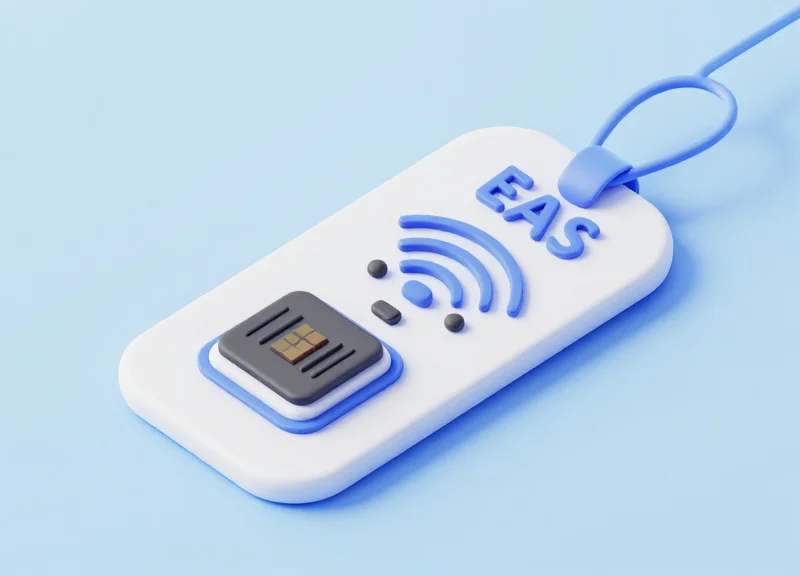
Hybrid RFID+EAS tags represent the next evolution in retail protection, integrating a traditional Electronic Article Surveillance (EAS) element for gate-based theft deterrence with a Radio Frequency Identification (RFID) chip for item-level tracking within a single housing. For luxury bottle retailers, this dual-layer approach solves the 'visibility-security paradox'—providing the immediate acoustic or electromagnetic alarm needed to stop shoplifters while simultaneously feeding real-time stock data into the supply chain. By 2026, these hybrid solutions are expected to become the industry standard for premium spirits and fragrances, as they eliminate the need for redundant tagging processes and reduce the physical footprint on aesthetic bottle designs.
| Feature | Standalone EAS | Standalone RFID | Hybrid RFID+EAS |
|---|---|---|---|
| Primary Function | Loss Prevention (Alarms) | Inventory Intelligence | Comprehensive Asset Protection |
| Detection Range | Restricted to Exit Gates | Wide-Area (Storewide) | Gate Alarms + Zonal Tracking |
| Data Capacity | None (Bit-based) | High (EPC, Serial Number) | Full Item Metadata |
| Labor Efficiency | Manual Tagging Required | Enables Fast Stock-taking | One-time Application for All Needs |
Expert Insight: The 'Active Prevention' Shift. Traditional security reacts when a bottle passes the gate. Our research into 2026 trends suggests that hybrid tags enable what we call 'Active Prevention.' By utilizing the RFID component, smart shelves can detect when a high-value bottle is moved or handled in an unusual pattern—such as 'shelf sweeping'—and alert staff via wearable tech before the individual even reaches the exit. This transforms the tag from a passive alarm into a proactive intelligence tool.
Can hybrid tags work with existing AM/RF gate systems?
Yes, hybrid tags are designed to be backward compatible. The EAS component functions exactly like a standard tag, triggering existing pedestals, while the RFID component interacts with modern handheld or overhead readers.
Do hybrid tags cause more interference with liquids?
No, leading 2026 designs utilize specialized 'on-metal/liquid' spacers or specific antenna geometries that mitigate detuning, ensuring that both the EAS coil and RFID chip function optimally even on glass bottles containing alcohol.
What is the ROI on hybrid tags compared to cheaper EAS-only tags?
While the unit cost is higher, the ROI is realized through a 90% reduction in inventory labor costs, a significant decrease in out-of-stock scenarios, and the prevention of high-value shrink that standard EAS often fails to track at the item level.
- Phase 1: Source Tagging Integration: LVMH and other luxury conglomerates are moving toward applying hybrid tags during the bottling process, ensuring protection from factory to shelf.
- Phase 2: Point-of-Sale Optimization: At checkout, a single scan deactivates the EAS alarm and updates the global inventory system simultaneously.
- Phase 3: Circular Lifecycle Tracking: Post-sale, the RFID element can be used for authenticity verification or even to manage recycling programs, adding value beyond the retail floor.
Combating Counterfeits: How RFID Protects Brand Integrity in 2026
In 2026, RFID protects brand integrity by assigning a non-clonable digital identity to every luxury bottle, enabling real-time authentication throughout the global supply chain and providing consumers with a tamper-proof guarantee of provenance. Unlike traditional security measures that merely alert to theft, RFID's encrypted unique identifiers (UIDs) allow brands to verify a product's origin, batch history, and distribution path, effectively neutralizing the multi-billion dollar counterfeit market in high-end spirits and perfumes.
As we approach 2026, the luxury sector is moving toward 'Contextual Authentication.' This involves RFID tags that do more than just broadcast an ID; they are integrated with conductive 'tamper-evident' loops. If a bottle is opened or the seal is broken, the RFID chip's memory state changes permanently. This prevents the 'Ghost Bottle' phenomenon—where authentic discarded luxury bottles are refilled with cheap liquid and resold as new—by providing a digital red flag that cannot be reset.
| Feature | Legacy EAS Systems | 2026 RFID Ecosystem |
|---|---|---|
| Primary Goal | Loss Prevention (Shoplifting) | Brand Protection & Traceability |
| Data Capacity | None (Bit only) | Encrypted Unique Serial Numbers |
| Verification | Visual/Gate Alarm only | Smartphone/Reader Authentication |
| Counterfeit Resistance | Low (Easy to replicate tags) | High (Cryptographic Handshakes) |
| Grey Market Tracking | Not Possible | Real-time Geo-fencing |
- Origin Encoding: Each bottle receives a unique Tag Identifier (TID) at the point of bottling, locked with a cryptographic key that links it to the brand's secure database.
- Supply Chain Validation: As the product moves from the distillery to the distributor, automated RFID tunnels verify the shipment without opening boxes, ensuring no fakes are injected into the stream.
- Retail Authentication: Sales associates use handheld readers to prove authenticity to high-net-worth clients, turning security into a premium customer service feature.
- Consumer Empowerment: Via NFC-compatible RFID chips, customers tap their smartphones on the bottle to access a Digital Product Passport (DPP) confirming its 1/1 status.
Expert Tip: By 2026, the European Union's Digital Product Passport (DPP) mandates will make RFID nearly essential for luxury brands. To stay ahead, brands should look for 'Dual-Frequency' tags that allow for both UHF (for warehouse logistics) and NFC (for consumer engagement) on the same silicon, ensuring a single source of truth for every bottle produced.
Can RFID tags be cloned by counterfeiters?
While basic RFID chips can be copied, 2026-spec luxury tags utilize AES-128 cryptographic authentication. This requires a 'handshake' with a private key held by the brand, making cloning economically and technically unfeasible.
Does this work for online luxury resales?
Yes. Secondary markets can use the RFID's digital signature to verify the bottle's history before listing, significantly increasing the resale value of authentic items.
How does RFID stop the 'Refill' scam?
New 'Cap-Track' RFID inlays break a physical circuit when the bottle is uncorked. Once broken, the digital record updates to 'Opened,' preventing the bottle from ever being verified as 'New/Sealed' again.
Cost vs. ROI: Calculating the Long-Term Value for Luxury Brands
In the 2026 luxury retail landscape, the Return on Investment (ROI) for bottle security is no longer calculated by simply subtracting the cost of a tag from the price of a recovered item. Instead, forward-thinking brands use the 'Inventory Efficiency Multiplier.' While Electronic Article Surveillance (EAS) remains a cost-effective deterrent for low-to-mid range spirits, the high-precision data from RFID provides a significant ROI by reducing 'phantom inventory' and labor costs, often breaking even within 12 to 18 months despite a 3x higher initial capital expenditure.
| Financial Metric | Traditional EAS | Next-Gen RFID (2026) |
|---|---|---|
| Average Tag Cost (USD) | $0.03 - $0.08 | $0.15 - $0.45 |
| Infrastructure Cost | Low (Pedestals only) | High (Readers, Software, Cloud) |
| Shrinkage Reduction | 15% - 25% | 40% - 65% |
| Inventory Labor Savings | Negligible | Up to 90% faster counts |
| Primary Value Driver | Loss Prevention | Omnichannel Agility |
For a luxury brand selling bottles priced at $500 and above, the 'opportunity cost' of an out-of-stock item is far greater than the cost of an RFID tag. If a customer enters a boutique for a specific vintage and it is missing due to inaccurate records, the brand loses not just the sale, but the lifetime value of that client. RFID enables real-time stock visibility that EAS simply cannot match, turning a security tool into a revenue-generating asset.
Is RFID too expensive for large-scale bottle deployments?
While the per-unit cost is higher, the ROI is found in the 'Total Cost of Ownership.' RFID reduces the need for manual cycle counts and virtually eliminates human error in shipping, which often saves brands more in operational overhead than the tags cost.
How does EAS provide value in a modern luxury environment?
EAS is best utilized as a psychological deterrent. For high-volume luxury showrooms where inventory is managed via other means, EAS provides a low-cost 'security-first' layer that protects against casual shoplifting without complex software integration.
What is the 'Hidden ROI' of RFID in 2026?
The hidden ROI lies in data analytics. RFID tags on luxury bottles allow brands to track 'dwell time'—how long a bottle stays on a shelf or is handled by customers—providing marketing insights that EAS cannot provide.
Expert Insight: The Liquidity-Adjusted ROI. A unique factor for 2026 is the 'Liquidity-Adjusted ROI.' Because luxury liquids (perfumes and spirits) interfere with traditional RF signals, standard ROI models often fail. Brands must invest in specialized 'On-Metal/On-Liquid' tags. While these carry a 20% premium over standard RFID, their read-rate accuracy is nearly 100% compared to 60% for generic tags. In the luxury sector, 40% more data accuracy equates to a 12% increase in net profit margins through optimized supply chain velocity.
Implementing Future-Proof Security: A Strategic Roadmap for Retailers
Implementing future-proof security in luxury retail requires a shift from reactive loss prevention to a proactive, data-driven ecosystem that balances asset protection with seamless customer experiences. By 2026, the industry standard will move toward 'Hybrid Interoperability,' where retailers deploy dual-purpose hardware capable of reading both legacy 8.2MHz/58KHz EAS signals and high-performance UHF RFID data. A successful roadmap begins with auditing current 'dark spots' in the supply chain and ends with an integrated cloud platform that treats every bottle as a unique, traceable digital asset.
- Infrastructure Audit and Signal Mapping: Analyze the physical retail environment for potential RFID interference from metal shelving or liquid-heavy displays. Map out 'Gate' and 'Transition' zones to determine where overhead readers or floor mats will be most effective without disrupting the store's luxury aesthetic.
- Source Tagging Integration: Move tagging upstream to the manufacturing or bottling phase. By 2026, luxury brands should demand 'Source-to-Shelf' visibility, ensuring that tags are applied behind labels or within caps before the product ever reaches the distribution center.
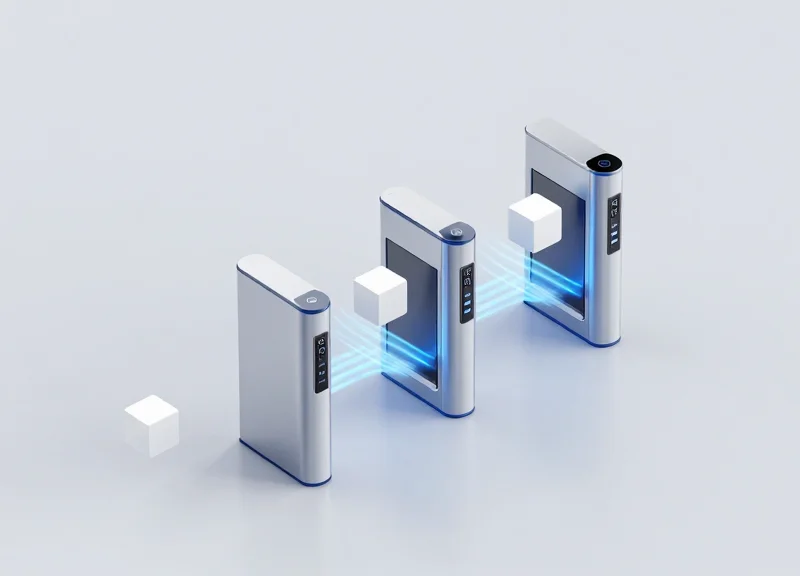
- Pilot Hybrid Gateways: Install hybrid pedestals that support both EAS (for immediate theft deterrence) and RFID (for inventory data). This 'bridge' strategy allows retailers to utilize existing EAS inventory while slowly transitioning the entire stock to RFID-only tracking.
- Edge Intelligence Deployment: Implement edge computing software at the storefront to process tag data locally. This reduces latency and ensures that security alerts are triggered in real-time, providing staff with the exact SKU and price of the item moving toward the exit.
| Implementation Phase | Key Milestone | Retailer Benefit |
|---|---|---|
| Phase 1: Foundation | Cloud-based Inventory Sync | Real-time stock accuracy (99%+) across all channels. |
| Phase 2: Hybridization | Dual RFID/EAS Hardware Install | Reduced shrinkage without abandoning legacy tag investments. |
| Phase 3: Intelligence | AI-Driven Predictive Analytics | Detection of 'ORC' (Organized Retail Crime) patterns before theft occurs. |
Expert Insight: In 2026, the most successful retailers will adopt what we call 'The Ghost Stock Protocol.' Unlike EAS, which only tells you that something was stolen, a future-proof RFID roadmap allows you to identify exactly which individual bottle is missing from the shelf in real-time. This eliminates 'Ghost Stock'—items that show as 'in-stock' on your website but have actually been stolen—thereby preventing lost sales and customer frustration.
Can we retrofit our existing luxury displays with RFID readers?
Yes, modern RFID antennas can be embedded into marble, wood, or glass shelving, making the security infrastructure completely invisible to the high-end consumer.
What is the biggest hurdle in the 2026 security transition?
Staff culture. Moving from 'security guards' to 'data-informed associates' requires training on how to use handheld RFID devices for cyclical counting and alert management.
How does this roadmap impact the checkout process?
It streamlines it. RFID allows for 'Bulk Checkout,' where an entire basket of luxury bottles can be scanned and the security tags deactivated in milliseconds without removing items from their packaging.