Rare coins and stamps represent some of the most concentrated forms of wealth on the planet, making them prime targets for shoplifting and internal shrink. However, unlike standard retail goods, these high-value paper and metal assets are incredibly fragile. A single adhesive residue or a heavy-handed tag can destroy a stamp's value or a coin's grade instantly. Selecting an Electronic Article Surveillance (EAS) system for this niche market requires a sophisticated approach that prioritizes asset integrity as much as security. In this guide, we explore the five essential criteria for selecting an EAS system designed specifically to shield your most precious collectibles from the threat of theft.
The Unique Vulnerabilities of Rare Coins and Philatelic Items
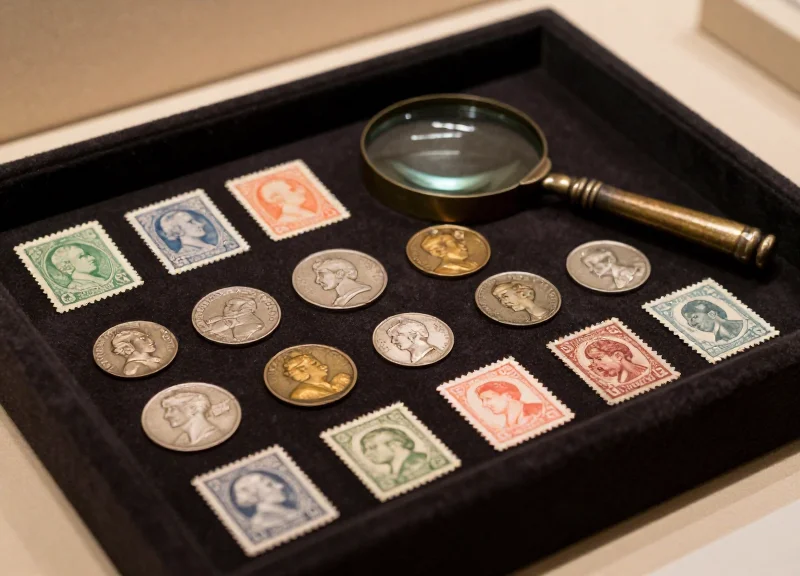
High-value paper assets like rare stamps and numismatic coins are uniquely vulnerable because they combine extreme 'value density'—significant monetary worth in a pocketable form—with a delicate physical state where even minor adhesive residue or surface friction from a security tag can depreciate their market value by over 50%. Unlike bulkier luxury goods, these assets are easily concealed and bypass traditional mechanical security, requiring specialized Electronic Article Surveillance (EAS) that respects their chemical and structural integrity.
| Vulnerability Factor | Rare Coins | Philatelic (Stamps) |
|---|---|---|
| Size-to-Value Ratio | Extreme: High-grade coins can fit in a palm but be worth $1M+. | Maximum: A single stamp can be worth millions and hidden in a wallet. |
| Condition Sensitivity | Sensitive to surface contact (hairlines) and oxygen (toning). | Hypersensitive to moisture, light, and adhesive 'bleeding'. |
| Liquidity Risk | Very High: Hard to track once removed from original slabs. | High: Easy to transport across borders undetected. |
| Handling Risks | Oils from skin can cause irreversible oxidation. | Forceps/Tweezers only; paper fibers are easily crushed. |
A critical, often overlooked vulnerability is the 'Chemical Migration Factor'. Traditional EAS stickers utilize acrylic-based adhesives that, over time, can off-gas or migrate through philatelic paper fibers or interact with the metallurgy of a coin. This creates a catch-22 for collectors: applying a security tag directly to the asset to prevent theft may actually cause more financial loss through 'chemical' damage than the risk of theft itself. Therefore, the security strategy must focus on non-invasive proximity shielding.
Why can't I use standard retail RF tags for stamps?
Standard RF tags are too large and contain adhesives that permanently stain or tear paper fibers. For stamps, any security device must be integrated into the mount or protective sleeve, never the asset itself.
What makes coins a target for 'Signal Shielding'?
Because coins are metallic, they can naturally interfere with EAS signals (the Faraday cage effect). Professional thieves often use foil-lined pouches to exploit this, requiring high-frequency systems that can penetrate or detect shielding.
How does 'Value Density' affect security protocols?
Value density refers to the immense monetary value per square inch. This means the 'dwell time' a thief needs to steal $100k of stamps is seconds, compared to minutes for electronics, necessitating near-instantaneous EAS triggering.
Criterion 1: Non-Invasive Tagging and Chemical Compatibility
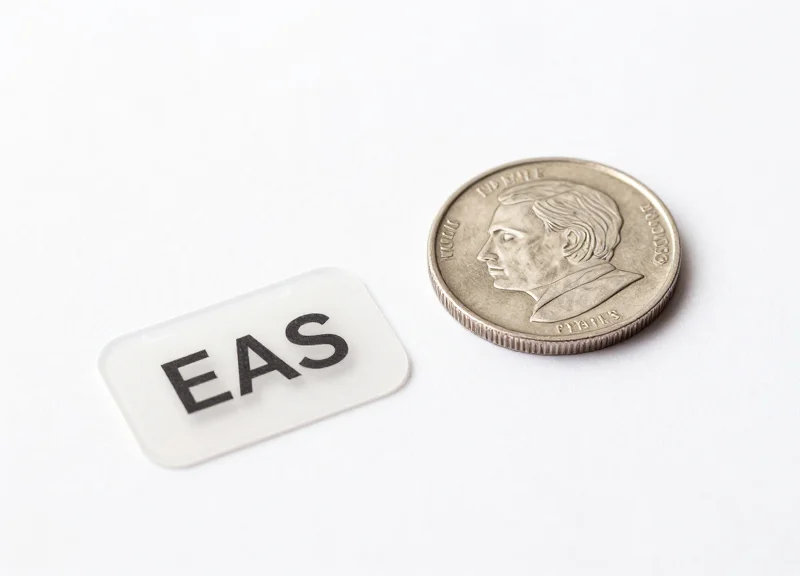
Non-invasive tagging for high-value paper assets is defined as the application of Electronic Article Surveillance (EAS) labels that utilize pH-neutral, archival-grade adhesives specifically formulated to prevent chemical outgassing, adhesive migration, or physical surface marring. Unlike standard retail tags, these specialized labels must maintain structural integrity without reacting with the delicate cellulose of rare stamps or the metallic surfaces of uncirculated coins. For philatelic and numismatic professionals, the priority is a 'zero-footprint' security solution that ensures the item's grade remains unchanged even after long-term contact with the security sensor.
| Feature | Standard EAS Label | Archival-Grade Specialty Label |
|---|---|---|
| Adhesive Type | High-tack synthetic rubber | Acid-free, pH-neutral acrylic |
| Residue Risk | High (leaving 'ghost' marks) | Zero (clean peel or barrier-only) |
| Chemical Stability | May outgas VOCs over time | Chemically inert; no outgassing |
| Pressure Sensitivity | Requires firm press to bond | Low-pressure contact or sleeve-integration |
A critical, often overlooked technical detail is 'The Outgassing Factor.' Standard security labels contain volatile organic compounds (VOCs) within their adhesive and plastic housing. Over time, particularly in enclosed display cases, these compounds can create a micro-environment that triggers 'foxing' on paper or 'toning' on metal. When selecting an EAS system, insist on labels that meet ISO 18916 (Photographic Activity Test) standards, even for non-photographic items, as this is the gold standard for verifying that a material will not chemically react with its neighbors. For the highest-value items, the most effective strategy is 'indirect tagging,' where the EAS label is applied to a primary protective sleeve or a rigid acrylic slab, ensuring the security hardware never touches the asset itself.
Can I use standard RF stickers on stamp glassines?
No. Standard RF stickers often use adhesives that can migrate through thin glassine or paper over time, causing permanent translucent staining or 'oil spots' on the asset.
How do I prevent 'indentation' marks on paper money?
Utilize Acousto-Magnetic (AM) labels housed in rigid plastic holders. AM labels are thicker than RF stickers; placing them directly on paper can cause pressure indentations if items are stacked.
What is the safest way to tag a rare coin?
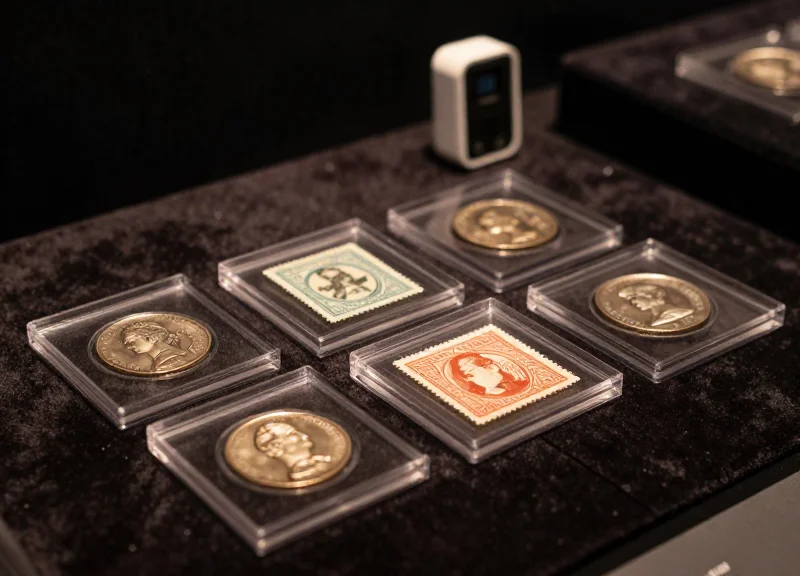
The industry standard is to tag the 'flip' or the slab. If using a raw coin tray, use a 'frequency-tuned' tag hidden beneath the velvet lining rather than attaching anything to the coin's surface.
Criterion 2: Detection Sensitivity for Small Metal and Paper Profiles
Detection sensitivity for rare coins and stamps refers to an EAS antenna's capacity to identify micro-labels—often as small as 10mm x 10mm—across a standard entryway without triggering false alarms. Unlike general retail security, high-value paper asset protection requires a system that can isolate the weak signal of a miniature tag from the 'environmental noise' of a crowded showroom or the metallic mass of the coins themselves.
| Feature | Acousto-Magnetic (AM) 58kHz | Radio Frequency (RF) 8.2MHz |
|---|---|---|
| Detection Range | Superior for wider exits | Moderate; narrows with micro-tags |
| Tag Size Compatibility | Excellent for 3D/slabs | Best for ultra-thin paper labels |
| Metal Interference | High immunity to metal coins | Higher risk of signal 'shielding' |
| Sensitivity Logic | Time-of-flight pulse | Swept-frequency resonance |
A critical challenge in this niche is the 'Orientation Dead Zone.' Because stamps and coins are often carried in breast pockets or thin folders, the EAS tag might pass through the pedestals edge-on. Standard systems often fail here. To ensure total security, look for antennas equipped with '3D Detection Logic' or multi-phase coils. These technologies ensure that whether the coin slab is vertical, horizontal, or tilted, the flux lines of the antenna will still energize the micro-tag's internal circuit.
- Expert Tip: The Shadow Effect: A unique insight for numismatic dealers is the 'Shadow Effect.' High-grade silver or gold coins can actually shield a security tag if the tag is placed directly behind the coin relative to the antenna. To mitigate this, high-sensitivity systems must use Digital Signal Processing (DSP) to 'see' through the metallic mass of the coin and pick up the specific resonance of the security film.
- Why is 'Signal-to-Noise Ratio' important?: In urban environments with heavy electrical interference, a system with a low signal-to-noise ratio will frequently false alarm or miss small tags. High-end EAS controllers filter out external electrical noise, focusing specifically on the signature frequency of your micro-labels.
- Step 1: Aperture Calibration: Measure your exit width. For micro-tags, an aperture wider than 4 feet typically requires a split-system or high-powered AM controller to maintain sensitivity.
- Step 2: Frequency Synchronization: Ensure the EAS system is synchronized with local power grids to prevent 'jitter,' which can mask the faint signal of a stamp-sized label.
- Step 3: Tag Placement Testing: Conduct a '9-point test' by passing a tagged coin through the top, middle, and bottom of the pedestals at three different angles.
Criterion 3: Balancing Visual Deterrence with Boutique Aesthetics

In high-value philatelic and numismatic environments, balancing visual deterrence with boutique aesthetics involves deploying Electronic Article Surveillance (EAS) hardware that utilizes high-transparency materials, such as polished acrylic, or architectural integration to maintain a premium customer experience while signaling a robust security posture. The objective is to ensure that the security system acts as a psychological 'hard target' for professional thieves without creating a clinical or industrial atmosphere that diminishes the perceived value of the rare assets on display.
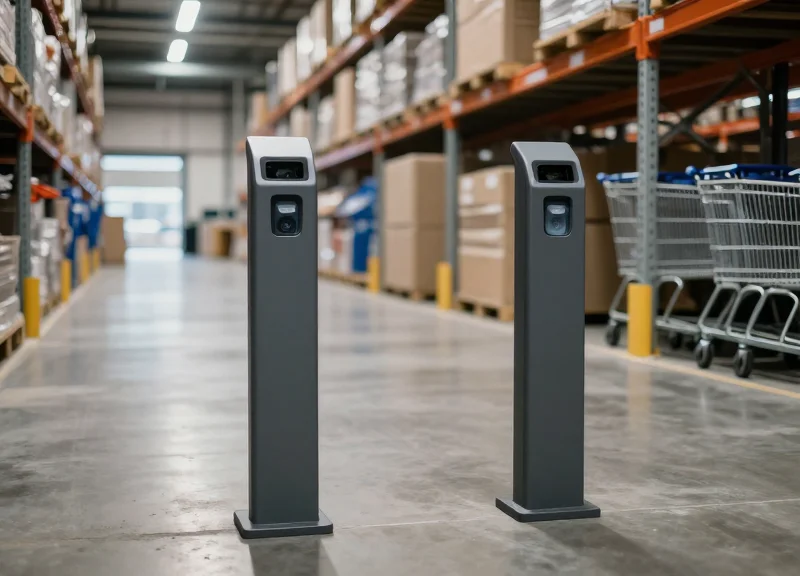
For rare coin and stamp dealers, the physical store is often a curated gallery where the 'vibe' dictates the price point. Standard gray plastic pedestals found in big-box retail are anathema to this environment. However, opting for entirely invisible systems can be equally risky; professional shoplifters often look for 'soft targets' where security is perceived to be absent. The most effective boutique systems leverage 'Elegant Security,' where the pedestals look like high-end architectural features rather than bulky barriers.
| System Type | Visual Impact | Deterrence Rating | Ideal Application |
|---|---|---|---|
| Clear Acrylic Pedestals | Minimalist/Modern | High | Contemporary galleries with glass storefronts. |
| In-Frame Antennas | Virtually Invisible | Medium | High-end boutiques with custom door frames. |
| Under-Floor Loops | Zero Visibility | Low | Historical buildings where hardware can't be mounted. |
| Wood-Clad Systems | Warm/Traditional | High | Classic auction houses and traditional coin shops. |
One often overlooked aspect is the 'Ambient Deterrence' effect. Expert Tip: Integrating LED lighting into the base of acrylic pedestals allows you to change the glow to match your brand colors. This turns a security necessity into a design focal point that communicates to visitors—and potential thieves—that every detail of the shop is monitored and controlled.
Does hidden security actually encourage theft?
It can. While invisible systems (like floor loops) protect the aesthetic, they remove the psychological deterrent. For rare collectibles, a visible but elegant system is usually preferred to prevent the 'grab-and-run' attempt before it starts.
Can EAS pedestals be customized to match custom cabinetry?
Yes. Modern high-end EAS providers offer ultra-slim antennas that can be wrapped in wood veneers or stone finishes to blend perfectly with bespoke interior designs.
What is the most durable material for boutique pedestals?
High-grade, scratch-resistant acrylic is the industry standard for boutiques because it provides the transparency of glass with significantly higher impact resistance and lower weight.
Criterion 4: Integrating EAS with RFID for Real-Time Inventory Control

A hybrid EAS-RFID system represents the pinnacle of high-value asset protection by merging the immediate deterrent of Electronic Article Surveillance (EAS) with the granular identification capabilities of Radio Frequency Identification (RFID). Unlike traditional EAS, which only signals that something is crossing a threshold, an integrated RFID system identifies exactly which rare coin or stamp is moving, providing collectors and dealers with instantaneous inventory updates and preventing 'shrinkage by substitution'—a common tactic where high-value items are swapped for fakes.
For rare coin and stamp dealers, the challenge isn't just theft; it is the labor-intensive process of daily audits. Manually checking every slabbed coin or stamp stock book is prone to human error. By utilizing UHF (Ultra-High Frequency) RFID tags that are thin enough to be embedded in protective sleeves or under certification labels, dealers can conduct a full inventory sweep in seconds rather than hours.
| Feature | Standard EAS | RFID Systems | Hybrid EAS-RFID |
|---|---|---|---|
| Primary Function | Loss Prevention (Alarms) | Inventory Visibility | Security + Visibility |
| Item Identification | No (Generic Alarm) | Yes (Unique ID) | Yes (Unique ID + Alarm) |
| Audit Capability | None | High-Speed/Bulk | High-Speed/Real-Time |
| Primary Benefit | Deterrence | Accuracy | Total Asset Control |
- Select UHF RFID Compatibility: Choose systems that operate on UHF Gen2 standards to ensure the signal can penetrate through plastic coin slabs without interference from the metal within the coin.
- Map Your Database: Link each RFID tag's unique hexadecimal ID to your specific asset record, including certification numbers (PCGS/NGC/ASDA) and current market value.
- Deploy Smart Shelving or Portals: Install fixed RFID readers at display cases or 'smart mats' on appraisal tables to track item movement within the showroom in real-time.
Expert Insight: The 'Digital Twin' Strategy. In my two decades of high-security consulting, the most effective implementations involve 'Digital Twinning.' By encoding the RFID tag with the asset’s specific certification number and a link to its high-resolution provenance photography, you create a digital lock. If an item is moved to an unauthorized zone, the system doesn't just alarm—it pushes the high-res image of that specific item to the manager's mobile device, allowing for immediate visual verification and response.
Does RFID interfere with EAS signals?
Modern hybrid systems are designed to operate on different frequencies (e.g., 58kHz for AM EAS and 860-960MHz for RFID) to prevent signal 'clobbering' or interference.
Can RFID tags be small enough for stamps?
Yes, current 'inlay' RFID tags are as thin as paper and can be smaller than 10mm, making them ideal for placement inside archival-grade stamp mounts without adding bulk.
Is the investment worth it for small collections?
The ROI is typically realized through reduced insurance premiums and the elimination of manual inventory hours, making it viable for any collection valued over $100,000.
Criterion 5: False Alarm Mitigation in Metal-Heavy Environments
In the world of rare coin and stamp trading, the environment is inherently 'metal-heavy,' featuring everything from leaded glass display cases and steel safes to the metallic content of the coins themselves. False alarm mitigation is the process of using Acousto-Magnetic (AM) technology and Digital Signal Processing (DSP) to filter out electromagnetic interference (EMI) and 'ghost' signals caused by these metallic objects. Without high-grade mitigation, the constant 'phantom' chirping of an EAS system creates 'alarm fatigue,' leading staff to ignore genuine theft events or, worse, disabling the system entirely.
| Feature | Radio Frequency (RF) Systems | Acousto-Magnetic (AM) Systems |
|---|---|---|
| Metal Interference | High; metal objects can shield tags or cause detuning. | Low; signals easily penetrate metal-heavy environments. |
| Detection Range | Narrower; affected by nearby metallic displays. | Wider; more stable in corridors with steel fixtures. |
| False Alarm Rate | Frequent in 'noisy' electronic environments. | Low; uses 58kHz frequency which is rarely duplicated by nature. |
Expert Insight: The 'Metal-Free Zone' (MFZ) Fallacy. Most generic EAS installers will tell you to keep all metal three feet away from the pedestals. In a boutique coin shop, this is often impossible. The professional differentiator is Backfield Suppression Technology. High-end AM controllers allow technicians to 'phase out' specific metallic interference behind the pedestal while maintaining 100% sensitivity in the walkthrough zone. Always ask your provider if their DSP supports 'software-defined phasing' to map your shop's unique metallic footprint.
- Baseline Noise Mapping: Before installation, use an oscilloscope or the system's internal tuning software to measure the ambient electromagnetic noise in the shop.
- Synchronization of Pulsed Frequencies: Ensure the EAS system is synced with the building's power phase to prevent the 60Hz hum from lights and displays from triggering false alarms.
- Strategic Antenna Grounding: Properly ground the EAS pedestals to the building's structural steel to drain static and prevent 'ghost' signals from nearby motorized security shutters.
Will my large steel floor safe trigger the alarm?
No, if the system is properly phased. Large, stationary metal objects are constant; modern DSP algorithms 'learn' these static signals and filter them out during the calibration process.
Can coin slabs cause the alarm to fail?
Individual coins won't, but a bulk 'slab box' of 50+ silver coins can create a shielding effect (Faraday cage). This is why AM technology is preferred, as its magnetic field wraps around metallic objects better than RF waves.
What causes the most false alarms in these shops?
Often it is 'Tag-at-Pedestal'—merchandise placed too close to the sensors. Maintaining a strict 18-inch 'dead zone' for inventory is the most effective low-tech solution.
AM vs. RF Technology: Which is Superior for Numismatics?
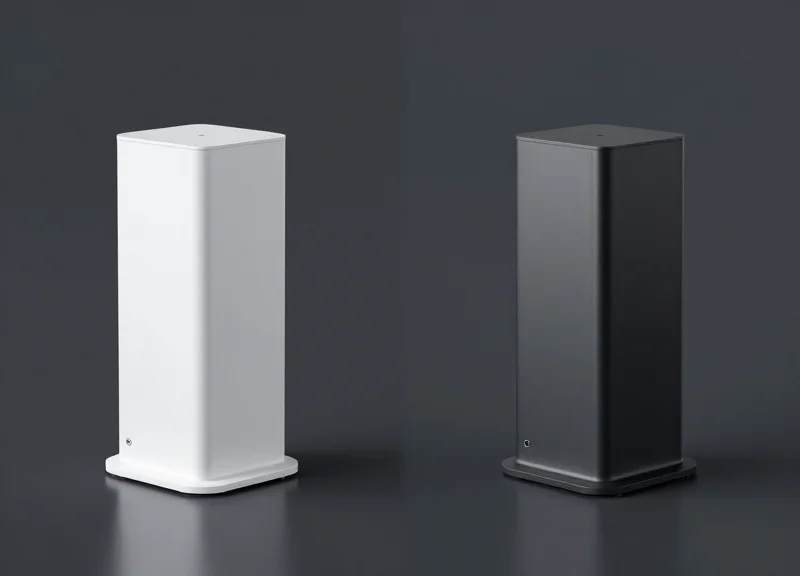
For numismatics and high-value philately, the clear technical winner is Acousto-Magnetic (AM) technology. While Radio Frequency (RF) systems are ubiquitous in general retail, they struggle in environments with high concentrations of metal. AM systems operate at a frequency of 58 kHz, which provides a longer wavelength that can effectively navigate around metallic coin slabs and dense storage cabinets. In contrast, RF systems (typically 8.2 MHz) are easily 'detuned' or shielded by the presence of conductive metals, leading to significant dead zones in a coin shop or gallery setting.
| Feature | AM (Acousto-Magnetic) | RF (Radio Frequency) |
|---|---|---|
| Frequency | 58 kHz (Low Frequency) | 8.2 MHz (High Frequency) |
| Metal Tolerance | High (Ideal for coins/foils) | Low (Shielding occurs easily) |
| Tag Profile | Narrow, 3D strips | Flat, paper-thin stickers |
| Detection Range | Wide (Up to 2.4m) | Standard (Up to 1.8m) |
| False Alarms | Lower in electronic environments | Higher near LED/Metal displays |
A critical nuance for coin dealers is the 'Proximity Detuning' effect. Because RF tags rely on a flat inductor circuit, placing a silver or gold coin directly against the tag can change its capacitance, essentially 'cloaking' the item from the security gate. AM tags use magnetostrictive material that maintains its resonant frequency even when placed in close proximity to precious metals. For philatelists, AM tags offer the benefit of being smaller in footprint (though slightly thicker), allowing them to be hidden within the edge of a protective binder or a thick archival sleeve without obscuring the stamp's visual details.
Can RF tags work if they are not touching the coin?
While RF tags can work if spaced away from the metal, the high-density nature of coin trays usually makes this impossible. The metal in neighboring coins will still cause interference, leading to inconsistent detection.
Is AM more expensive to install?
Generally, yes. AM hardware and tags carry a higher initial price point than RF. However, for high-value assets where a single missed detection could cost thousands, the ROI on AM's reliability far outweighs the initial cost gap.
Expert Tip: What is the 'Vault Effect'?
In numismatics, many dealers experience the 'Vault Effect' where large safes or metal cabinets near the exit reflect RF signals, causing phantom alarms. AM systems are much easier to calibrate to ignore these static metal masses.
Expert Insight: One often overlooked advantage of AM for rare coin dealers is the ability to 'Deactivate and Reactivate.' Unlike RF stickers, which are usually killed permanently upon sale, many AM hard tags or high-end labels can be reactivated. This is invaluable for dealers who frequently move inventory between a secure showroom and trade show floors, allowing for a sustainable, multi-use security cycle for rotating stock.
Strategic Placement: Optimizing Pedestals for High-Traffic Boutique Layouts

Strategic placement of EAS (Electronic Article Surveillance) pedestals in a high-traffic boutique involves balancing the 'Detection Sweet Spot' with the 'Customer Flow Zone' to ensure 100% tag capture without creating a claustrophobic entrance. For high-value paper assets like rare stamps and coins, pedestals must be positioned exactly 3.0 to 5.5 feet apart (depending on frequency) to penetrate the specialized shielding often found in numismatic cases while maintaining an inviting, open-door aesthetic for elite clientele.
| Placement Metric | Acousto-Magnetic (AM) 58kHz | Radio Frequency (RF) 8.2MHz | Strategic Benefit |
|---|---|---|---|
| Max Detection Width | Up to 6.0 ft | Up to 5.0 ft | Wider entrances for luxury feel |
| Wall Offset | 6 - 12 inches | 12 - 18 inches | Reduces signal bounce/interference |
| Proximity to Metal | High Tolerance | Moderate Tolerance | Crucial for boutiques with metal trim |
In boutique environments, the 'Threshold Effect' is a critical psychological factor. If pedestals are placed too close to the door, they can trigger false alarms from passing traffic or metal doors (RFI). Conversely, placing them too deep into the store allows a thief to conceal an item before reaching the detection field. The optimal 'Boutique Funnel' positioning places pedestals 24 inches behind the primary door swing, ensuring the system stabilizes before a customer exits.
Can I hide pedestals behind decorative millwork?
Yes, provided the material is non-metallic (wood, high-grade plastic, or stone). However, you must account for 'Signal Attenuation,' which may reduce the effective detection width by 10-15%.
How do I prevent 'dead zones' in corner entrances?
Use a 'Master-Slave-Slave' configuration. Placing a secondary antenna at a 45-degree angle to the corner prevents the 'sideways tag' exploit where thieves turn a coin slab perpendicular to the signal.
Should pedestals be bolted or adhesive-mounted?
For high-traffic areas, floor-bolted mounting is mandatory. Vibration from foot traffic can shift adhesive-mounted pedestals over time, leading to 'Phasing Issues' and ghost alarms.
Expert Insight: The 'Lead-In' Calibration Strategy. Most installers calibrate systems for a static environment. However, in coin and stamp boutiques, the presence of metal-heavy safes and display cases creates a dynamic electromagnetic field. I recommend the 'Lead-In' method: calibrate your pedestals while your largest metallic display case is open. This ensures that the EAS system treats the surge in metal interference as the 'baseline,' preventing the system from desensitizing when you are showing items to a customer near the exit.
The ROI of Specialized EAS Systems for Collectibles
The Return on Investment (ROI) for specialized Electronic Article Surveillance (EAS) in the collectibles sector is fundamentally different from high-volume retail; it is measured by the mitigation of high-impact risk and the substantial reduction in annual insurance overhead. For dealers of rare coins and stamps, where a single missing item can represent 20% or more of the annual profit margin, the payback period for a specialized EAS system is often realized the moment a single 'theft attempt' is deterred or detected. Beyond simple loss prevention, these systems serve as a critical component of institutional risk management that preserves the liquidity and documented provenance of high-value paper and metallic assets.
| ROI Metric | Traditional Retail EAS | Specialized Collectibles EAS |
|---|---|---|
| Primary Value Driver | Shrinkage volume reduction | High-value asset preservation |
| Insurance Impact | Minimal to none | 5% to 15% premium discounts |
| Payback Period | 12-24 Months | Potentially immediate (single loss) |
| Asset Impact | General inventory | Provenance & grade protection |
How does specialized EAS impact insurance compliance?
Many specialty insurers for numismatic and philatelic assets categorize 'active exit detection' as a tier-one security requirement. Implementing a specialized EAS can lead to annual premium reductions of 10-15%, effectively allowing the system to pay for itself within two to three years through insurance savings alone.
What is the ROI of 'Clean Provenance'?
In the high-end collectibles market, an item's history is as valuable as the item itself. A theft event—even if the item is later recovered—can create a permanent 'black mark' on its provenance, potentially lowering its auction value. EAS acts as a preventative ROI tool by ensuring the item never leaves the chain of custody.
Does EAS improve operational efficiency?
Yes. By securing items at the exit point, staff can focus more on high-touch sales interactions rather than constant 'helicoptering' over customers, which has been shown to increase close rates in boutique environments by up to 25%.
A unique insight often overlooked by general security consultants is the 'Residual Grade Protection' factor. In the rare coin and stamp market, physical condition is the ultimate arbiter of price. Generic security tags use aggressive adhesives or high-acidity papers that can leach into a stamp's fibers or cause 'toning' on a coin's surface. A specialized EAS system utilizes pH-neutral, non-migratory adhesives and specialized housings that ensure the item retains its original grade. The financial difference between a 'MS-65' and a 'MS-64' coin can be thousands of dollars; by using specialized tags that protect the item's physical integrity, the EAS system provides a direct, measurable ROI in asset value preservation.