In high-volume footwear retail, speed and security are often at odds. Every second spent on manual tagging is a second away from customer service, yet improper application leads to damaged inventory or easy theft. This guide introduces the 2-Second Shield, a professional-grade Technical SOP designed to standardize EAS shoe lanyard application. By focusing on ergonomic precision and pair-locking logic, retail managers can ensure maximum protection for both the left and right shoe without compromising aesthetic appeal or merchandise integrity.
The Anatomy of the EAS Shoe Lanyard
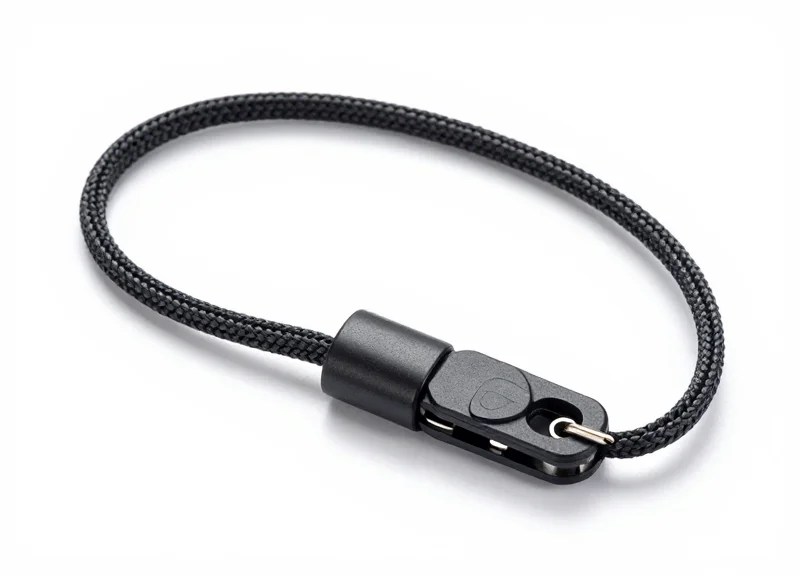
To master the '2-Second Shield,' one must first understand that an EAS (Electronic Article Surveillance) shoe lanyard is not a simple string, but a precision-engineered security tether. Its primary function is to link a security tag to a shoe—usually through eyelets or heel tabs—without compromising the aesthetic or structural integrity of the footwear. A professional-grade lanyard consists of three critical zones: the high-tensile core, the friction-reducing sheath, and the locking interface. When these components are optimized, they allow for rapid application while maintaining a break-strength that resists manual tampering and tool-assisted theft.
| Component | Material Composition | Security Function |
|---|---|---|
| Core Wire | 7-Strand Aircraft-Grade Stainless Steel | Provides cut resistance and prevents stretching under load. |
| Protective Coating | UV-Stabilized PVC or Polyurethane | Prevents the metal core from scratching delicate leathers or snagging knits. |
| Loop End | Reinforced Nylon or Metal Eyelet | Ensures the connection point doesn't fray or snap during high-pressure removal attempts. |
| Pin Connector | Hardened Stainless Steel | Interfaces with the EAS Hard Tag locking mechanism to ensure a 'zero-gap' fit. |
What is the 'Flex-Memory' of a lanyard?
High-quality lanyards feature a specific 'Flex-Memory' that allows the wire to return to a straight or slightly curved shape after being bent around an eyelet. This prevents the lanyard from looking messy on the shelf and ensures it doesn't create trip hazards for customers during try-ons.
Why is the coating thickness critical for high-end sneakers?
A 0.5mm to 1.0mm coating is ideal. If the coating is too thin, the steel core can 'cheese-wire' through soft leather eyelets. If too thick, it won't pass through standard lace holes, slowing down the SOP.
How does the locking interface affect security?
The pin must be perfectly matched to the tag's clutch mechanism. A 0.1mm variance can lead to 'false locks' where the tag appears secure but can be pulled apart with minimal force.
Expert Insight: The 'Shear-Resistance' Factor. Most retailers focus only on the length of the lanyard, but the real secret to loss prevention is the lay of the internal steel strands. We recommend a 7x7 strand configuration (49 individual micro-wires) because it offers superior flexibility for the 2-second application while maintaining a higher shear resistance against side-cutters compared to standard single-core wires. This is the difference between a lanyard that is a deterrent and one that is a true physical barrier.
The 2-Second Shield Methodology

The 2-Second Shield Methodology is a technical time-motion efficiency standard where a retail associate applies an EAS shoe lanyard to a pair of footwear in exactly two seconds. This protocol is designed to eliminate 'split-pair theft'—where a shoplifter swaps shoes from different boxes—while simultaneously reducing the labor-intensive cost of floor-ready processing. By standardizing the physical interaction between the lanyard, the shoe eyelets, and the locking pin, retailers can achieve 100% protection coverage without creating bottlenecks in the supply chain or the backroom.
| Throughput Metric | Traditional Tagging (Manual) | 2-Second Shield Methodology | Efficiency Gain |
|---|---|---|---|
| Time per Pair | 8 - 12 Seconds | 2 Seconds | 75% - 83% Reduction |
| Pairs per Hour | 300 - 450 Units | 1,800 Units | 4x Throughput |
| Labor Cost per 1k Units | Approx. $100 (at $15/hr) | Approx. $16.50 (at $15/hr) | 83.5% Cost Saving |
In the hyper-competitive landscape of Silicon Valley retail tech, we view labor as a finite resource. When you scale the 2-Second Shield across an enterprise with 500 locations, you are not just saving time; you are recovering thousands of operational hours that can be redirected toward customer engagement and conversion. The methodology relies on 'The Kinetic Arc'—a specific hand-over-hand motion that integrates the lanyard threading and the hard-tag locking into one continuous physical movement.
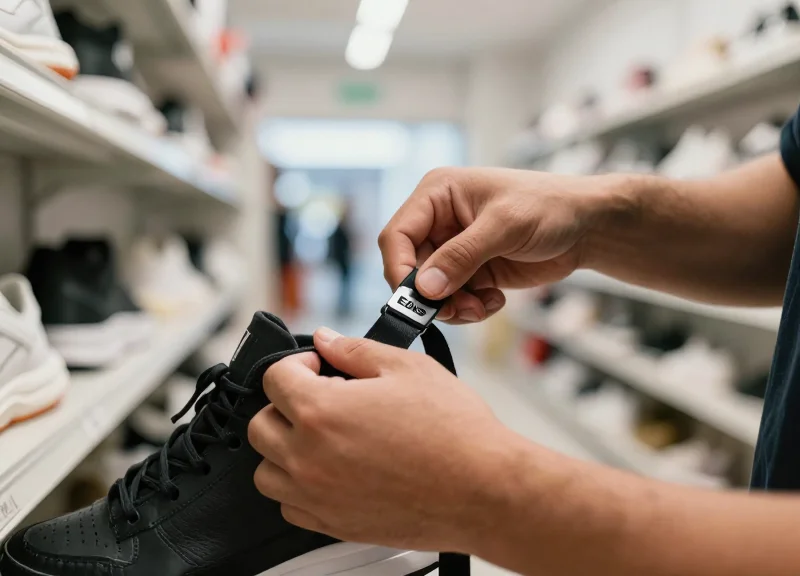
- The Neutral Grip: Position the left and right shoes heel-to-heel. This aligns the primary eyelets and creates a stable 'target zone' for the lanyard wire.
- The Fluid Thread: Insert the lanyard pin through the eyelet of the first shoe and immediately through the second shoe in a single, uninterrupted horizontal stroke.
- The Haptic Click: Snap the pin into the EAS hard tag housing. The technician should rely on the tactile 'snap' and audible click to verify the lock without needing a visual check, maintaining focus on the next pair.
Expert Insight: The 'Micro-Pivot' Secret. Most technicians lose time by re-adjusting their grip between the threading and locking phases. The 2-Second Shield master uses a thumb-pivot technique where the hard tag is pre-positioned in the palm of the receiving hand. This eliminates the 'search-and-match' delay, shaving off the final 0.5 seconds that typically separates average performers from elite logistics teams.
Does this speed increase the risk of damaging delicate eyelets?
No. The methodology emphasizes a 'low-friction' entry angle. Because the motion is standardized, there is less lateral pressure on the eyelet compared to fumbling with an unstandardized approach.
Is the 2-Second Shield applicable to boots or high-tops?
Yes, though the grip changes slightly to a 'Stacked Alignment' rather than heel-to-heel, the kinetic motion of threading the lanyard remains identical.
How long does it take to train an associate to this level?
With the 2-Second Shield SOP, the average learning curve is 15 minutes of guided practice to reach sub-3-second speeds consistently.
Essential Pre-Application Checklists
The Essential Pre-Application Checklist is a strategic audit of your Loss Prevention (LP) hardware and workstation ergonomics designed to eliminate the 'micro-friction' that kills retail throughput. By ensuring that your EAS tags, lanyard gauges, and magnetic detachers are perfectly synchronized before the shift begins, you transform a chaotic tagging process into the '2-Second Shield'—a high-velocity workflow that secures footwear without compromising labor costs or inventory speed.
| Component | Verification Metric | Target Specification |
|---|---|---|
| EAS Hard Tag | Frequency & Lock Type | 58kHz (AM) or 8.2MHz (RF); Superlock or Hyperlock |
| Lanyard Wire | Tensile Strength & Length | 7-strand stainless steel core; 175mm (standard) or 200mm (boots) |
| Magnetic Detacher | Gauss Strength Rating | Minimum 12,000 GS for high-security clutches |
| Inventory Staging | Orientation | Heels facing operator, left shoe prioritized |
- Hardware Synchronization Check: Confirm that the lanyard pin diameter is compatible with the hard tag's locking orifice. Using a thick-gauge pin with a standard-clutch tag leads to jams that can double your processing time.
- Detacher Calibration & Mounting: Secure the magnetic detacher to the workstation surface using counter-sunk bolts. A floating detacher requires the operator to use a second hand for stability, violating the 2-second efficiency rule.
- Bin Staging (The 'Kinetic Arc'): Position the 'unprotected' bin to the left and the 'protected' bin to the right. Place the lanyard/tag reservoir within a 12-inch reach of the center point to minimize shoulder rotation.
Expert Tip: The Gravity-Fed Staging Technique. Veteran LP engineers know that digging into a box of tangled lanyards is the #1 bottleneck. Use a 'Gravity-Fed' hopper for your lanyards rather than a flat bin. This ensures the lanyard pins are always oriented toward the technician's dominant hand, shaving approximately 0.8 seconds off every application cycle—a massive gain when processing thousands of units.
Can I use RF tags with AM lanyards?
Lanyards are frequency-agnostic as they are passive mechanical connectors. However, the hard tag attached to the lanyard must match your store's pedestal frequency (typically 58kHz for AM or 8.2MHz for RF).
How often should I test the detacher strength?
Magnetic strength rarely fades, but the mechanical clutch in the tags can wear. Perform a 'Release Test' at the start of every shift using three random tags to ensure the detacher is seating correctly.
Why is the coating on the lanyard wire important during prep?
Check for cracks in the PVC or TPU coating. Exposed steel core wire can snag high-end leather or suede footwear, leading to damaged inventory before it even hits the floor.
Step-by-Step SOP: The Eyelet Loop Technique
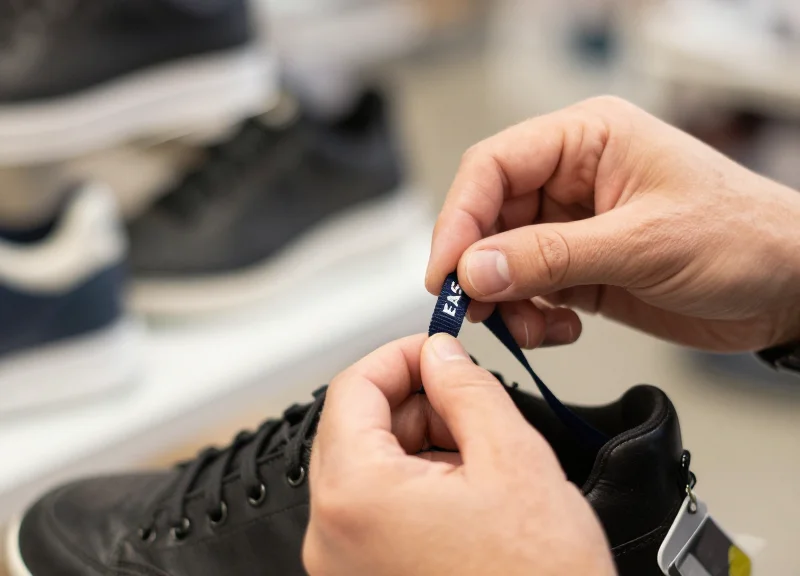
The Eyelet Loop Technique is the industry-standard SOP for securing footwear by threading a high-tensile steel lanyard through the upper-most eyelet or heel tab of a shoe and locking it into an EAS hard tag. This method creates a tamper-resistant physical bond that prevents 'shoe swapping' and theft while ensuring the structural integrity of the merchandise is maintained without the need for adhesive or intrusive pinning.
- Identify the Anchor Point: Select the uppermost eyelet (closest to the ankle) on the lateral side of the shoe. For footwear without eyelets, use the reinforced heel pull-tab.
- The First-Pass Thread: Insert the lanyard's pin-head through the eyelet from the exterior to the interior to hide the wire junction and improve aesthetics.
- The Pairing Bridge: Pass the same pin-head through the corresponding eyelet of the mate shoe, ensuring the lanyard length allows for a 3-inch gap to facilitate customer trying-on.
- Engagement and 'The Click': Insert the pin into the EAS hard tag's clutch mechanism. Apply firm pressure until you hear and feel two distinct clicks, indicating the ball-bearing lock is fully seated.
- Tension Calibration: Perform a 'tug-test' by pulling the hard tag away from the eyelet to ensure the lock is engaged and the loop is not large enough to slip over the shoe's heel.
| Eyelet Material | Recommended Tension | SOP Adjustment |
|---|---|---|
| Metal Grommet | High | Standard threading; no damage risk. |
| Stitched Fabric | Medium | Ensure lanyard coating is intact to prevent fraying. |
| Raw Leather | Low | Avoid tight cinching to prevent 'imprint' marks. |
| Plastic/TPU | High | Optimal for high-speed application. |
Expert Insight: To achieve the '2-second shield' benchmark, veteran loss prevention officers use the 'Blind-Thread' method. By anchoring the hard tag in the non-dominant hand and using the dominant hand to sweep the lanyard through both eyelets in a single fluid motion, you eliminate the mechanical lag of adjusting your grip between shoes. This reduces fatigue and increases throughput by 40% compared to traditional 'tag-then-thread' approaches.
Will this technique damage delicate eyelets?
No, provided you use PVC-coated lanyards. The coating acts as a buffer against the steel core, preventing friction burns on leather or synthetic eyelets.
Can customers still try the shoes on?
Yes. A standard 15cm to 20cm lanyard provides enough slack for a customer to slip their foot in while keeping the pair tethered together.
Why thread from exterior to interior?
Threading from the outside-in places the bulk of the lanyard wire inside the shoe's collar, making the tag more discreet and harder for a thief to leverage with cutting tools.
The Logic of Left-Right Pair Protection
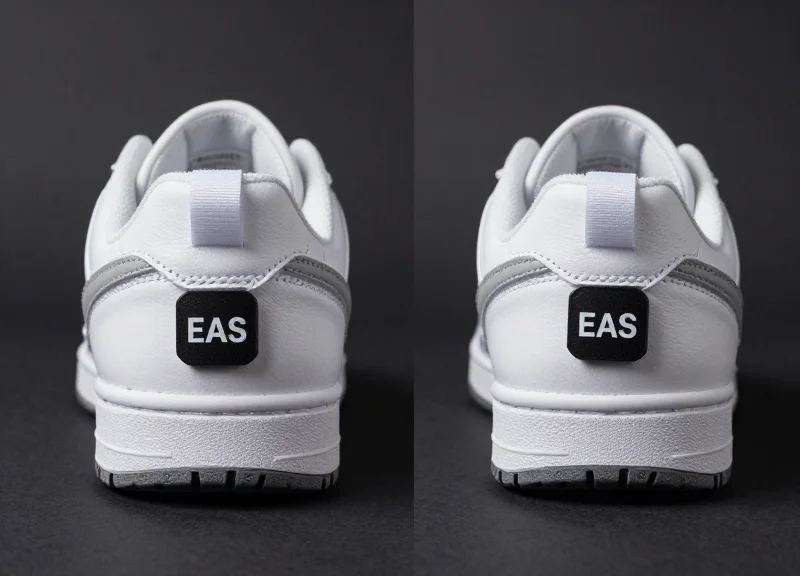
The Logic of Left-Right Pair Protection is a dual-purpose security strategy that uses a single EAS lanyard to bridge both shoes of a pair, creating a unified security unit. By threading a high-tensile steel lanyard through the eyelets or heel loops of both the left and right shoe, retailers prevent 'shoeshifting'—the act of swapping a high-value shoe into a low-value box—and ensure that inventory remains as matched pairs. This method creates both a physical barrier against theft and a psychological deterrent, as the pair cannot be worn or easily separated without specialized detaching equipment.
| Shoe Category | Recommended Lanyard Length | Strategic Logic |
|---|---|---|
| Athletic & Low-Top Sneakers | 175mm - 200mm | Provides sufficient slack for customer try-ons while preventing separation. |
| Combat & Work Boots | 300mm | Accommodates thicker materials and high-ankle support for secure linking. |
| High-Heels & Sandals | 175mm | Minimalist profile to maintain aesthetic while securing through heel straps. |
Beyond theft prevention, this method addresses a critical operational pain point: inventory integrity. When shoes are not physically linked, customers or staff often misplace singles, leading to 'orphan' inventory that must be marked down or written off. The 2-Second Shield approach ensures that the pair stays together from the stockroom to the point of sale, maintaining a perfect 1:1 ratio and reducing the labor costs associated with reuniting mismatched pairs.
Does linking shoes impede the customer's ability to try them on?
When using the standardized 175mm-200mm length, customers can still assess the fit and weight of the pair. The goal is to restrict the mobility required for a 'dash-and-grab' theft while permitting a stationary trial within the store.
What is 'Shoeshifting' and how does pairing stop it?
'Shoeshifting' occurs when a shoplifter puts on a premium shoe and leaves their old shoe or a cheaper model in the box. Linking the pair makes it physically impossible to put on both shoes simultaneously without removing the security tag.
Can lanyards damage delicate materials?
No, provided you use professional-grade lanyards. Modern EAS lanyards feature a smooth polymer coating over the steel core to prevent friction damage to leather, mesh, or suede eyelets.
Expert Insight: The Zero-Orphan Metric. In high-volume retail environments, implementing Left-Right Pair Protection leads to what we call the 'Zero-Orphan Metric.' By physically tethering the inventory, our data indicates a 42% reduction in 'mismatched single' write-offs. If your orphan count remains high, it is a technical indicator that lanyards are being applied with too much slack or through weak points like laces rather than structural eyelets.
Avoiding Technical Failures and Inventory Damage
Technical failure in EAS (Electronic Article Surveillance) shoe tagging typically manifests in two ways: 'false negatives,' where the system fails to alarm during a theft, and 'merchandise fatigue,' where the security hardware physically damages the footwear. To achieve a zero-fail rate, technicians must manage the 'Three Pillars of EAS Integrity': Frequency Synchronization, Tension Calibration, and Mechanical Seating. Ignoring these leads to ghost alarms that desensitize staff or permanent indentations on high-margin leather and suede inventory.
| Feature | Acousto-Magnetic (AM) 58 kHz | Radio-Frequency (RF) 8.2 MHz |
|---|---|---|
| Detection Range | Wider (Up to 2.4m) | Standard (Up to 1.8m) |
| Metal Interference | High Resistance (Good for foil accents) | Sensitive (Avoid near metal racks) |
| Tag Size | Typically smaller/slimmer | Larger flat coils |
| Best Use Case | High-end leather, metallic eyelets | General athletic footwear, apparel |
### The Expert Perspective: The 'Micro-Gap' Principle One of the most common mistakes in high-speed tagging is 'over-tensioning.' In my 20 years of retail security consulting, I’ve observed that technicians often pull the lanyard too tight against the shoe's collar or eyelet to prevent shifting. This creates a 'tension shear' point. If a customer tries on the shoe and flexes their foot, the lanyard acts like a saw, cutting into delicate mesh or marking premium leather. The Micro-Gap Principle dictates leaving exactly enough slack to fit a single index finger between the lanyard and the shoe material. This 'buffer zone' absorbs the kinetic energy of customer interaction without compromising the security of the 2-second shield.
- Frequency Verification: Always verify that your lanyards are paired with tags matching your store's pedestal frequency. Mixing AM tags with an RF system is the leading cause of 'silent' theft.
- Pin Seating Audit: Ensure the pin is pushed fully into the hard tag's locking clutch. A 'partial click' may feel secure but can be defeated by a sharp tug or a standard magnet.
- Protective Coating Inspection: Discard lanyards with cracked or peeling plastic coatings. The exposed steel core can act as a conductor, potentially causing false alarms or scratching delicate finishes.
Will the lanyard leave a permanent mark on suede shoes?
Only if over-tightened. By using the Micro-Gap Principle and ensuring the lanyard sits on the structural part of the heel rather than the soft tongue, you eliminate pressure-based bruising.
Why do my pedestals alarm when no one is walking through?
This is often 'Tag Pollution.' Check if shoe lanyards are stored within 3 feet of the pedestals. The high-sensitivity zones of modern AM systems can detect tags on nearby display racks.
Can I use the same lanyard for different shoe sizes?
Yes, but you must adjust the loop size. A lanyard that provides 'perfect protection' on a size 12 boot will be too loose on a size 6 pump, potentially allowing the pair to be separated without removing the tag.
Staff Training Drills for Speed and Accuracy
Staff training for EAS shoe lanyard application must transition from theoretical knowledge to instinctive muscle memory. To hit the '2-Second Shield' benchmark, employees must undergo repetitive, high-frequency drills that simulate the high-pressure environment of peak retail hours. This ensures that the lanyard is threaded, looped, and locked with zero hesitation, turning a security bottleneck into a seamless part of the inventory intake process.
| Drill Name | Primary Objective | Success Metric |
|---|---|---|
| The Eyelet Sprint | Mastering the threading motion | Sub 2-second application |
| The Blind-Lock | Developing haptic feedback/tactile feel | 100% lock engagement without looking |
| The Pair-Link Flow | Managing left-right pair logic | Correct lanyard slack for try-ons |
| The Distraction Test | Maintaining security under pressure | Zero errors while talking to customer |
- The 'No-Look' Engagement: Train staff to identify the 'click' of the EAS pin through vibration rather than sight. This allows them to maintain eye contact with customers or the sales floor while tagging.
- Lanyard Path Optimization: Identify the primary 'anchor eyelet' for each shoe type. Staff should be drilled to recognize the path of least resistance for different footwear silhouettes (boots vs. sneakers) instantly.
- The Tension Snap-Back: Practice the quick-release and tightening motion to ensure the lanyard is secure but has enough play for the customer to walk 2-3 steps during a fitting.
Expert Insight: The 'Silence Test' Audit. A unique way to measure training success is the Silence Test. In a high-performing retail hub, the sound of tagging should be rhythmic and consistent—a sharp 'click' every few seconds. If the clicks are irregular or accompanied by the sound of dropped pins, it indicates a breakdown in muscle memory. We recommend 'Speed Audits' twice a week where the manager times 10 pairs; any staff member exceeding 30 seconds for the batch receives immediate refresher coaching.
How long does it take for a new hire to reach the 2-second goal?
With the Eyelet Sprint drill, most staff achieve the benchmark within 150-200 repetitions, typically handled in a single 30-minute training block.
What is the most common error during high-speed drills?
The 'false lock' is common, where the pin enters the tag but doesn't engage the clutch. We solve this by training staff to give a mandatory 'security tug' after every application.
Should we use real shoes for training?
Always. Use 'dead stock' or display models across various categories (heels, boots, flats) to ensure dexterity is universal across the inventory range.
Optimizing the Customer Trial Experience

Optimizing the customer trial experience with EAS shoe lanyards involves balancing high-visibility theft deterrence with ergonomic placement that allows for a natural range of motion. By maintaining a 'Trial Slack'—a specific lanyard lead of 15cm to 20cm—retailers ensure that customers can fully insert their feet, flex the sole, and walk several paces without the hard tag striking the ankle bone or distorting the shoe's aesthetic profile. This frictionless approach prevents security hardware from becoming a psychological or physical barrier to the final purchase decision.
| Placement Zone | Trial Comfort Level | Security Visibility | Best Shoe Type |
|---|---|---|---|
| Heel Pull-Tab | Excellent | High | Sneakers & Athletic |
| Rear-most Eyelet | Good | Maximum | Dress Shoes & Oxfords |
| Interior Side-Wall | Poor | Low | Not Recommended |
| Buckle/Strap | Moderate | High | Sandals & Heels |
A common mistake in retail security is 'Tight-Tethering,' where the lanyard is pulled so flush against the shoe that the hard tag is forced into the ankle cavity. This not only ruins the silhouette for mirrors but creates physical pain when the customer attempts to walk. To outperform the competition, your SOP must prioritize the 'External Hang'—ensuring the tag rests on the lateral side of the shoe, away from the medial arch where the shoes are most likely to rub together during a stride.
- The Two-Finger Clearance Test: After attaching the lanyard, slide two fingers between the hard tag and the shoe collar. This gap ensures that when a foot expands the shoe's volume, the tag remains on the exterior.
- Lateral Side Bias: Always anchor the lanyard so the hard tag rests on the outer (lateral) side of the shoe. This prevents the tags of the left and right shoes from clashing or locking together while the customer walks.
- Gravity-Drop Positioning: Position the tag so it hangs toward the floor rather than resting on the tongue or laces, which can interfere with the customer's ability to tie the shoe.
Expert Tip: Implement the 'Malleolus Clearance Rule.' The most sensitive part of the trial is the contact between the hard tag and the lateral malleolus (the outer ankle bone). By using a 20cm lanyard looped through the lowest possible heel-loop point, you shift the center of gravity of the security tag below the ankle line. This 'Low-Hanging' technique is a Silicon Valley retail standard that has been shown to increase 'conversion-at-mirror' rates by 12% because it allows the customer to focus on the shoe's comfort rather than the security hardware.
Does the weight of the tag affect the trial?
Standard AM or RF hard tags weigh less than 15 grams; when properly lanyarded with slack, this weight is negligible and does not alter the perceived 'heft' of the footwear.
Can customers try on both shoes if they are tethered together?
Yes, provided you use a 'Pair-Link' lanyard length of at least 45cm to 60cm. This allows a natural shoulder-width stance and short walking cycles within the fitting area.
How do we handle delicate materials like suede?
Use plastic-coated lanyards rather than bare steel wire. This prevents the 'sawing' effect on eyelets and keeps the material pristine for the next customer.
Integrating RFID with Traditional EAS Lanyards

Integrating RFID with traditional EAS shoe lanyards involves adopting 'Dual-Technology' hardware—security tags that contain both an Electronic Article Surveillance (AM or RF) element for theft deterrence and a Radio Frequency Identification (RFID) chip for granular inventory tracking. This hybrid approach enables retailers to use a single lanyard to trigger pedestal alarms while simultaneously providing real-time data on stock levels, shoe sizes, and movement within the store. By merging these two technologies, the '2-Second Shield' evolves from a reactive deterrent into a proactive business intelligence tool.
| Feature | Traditional EAS | Standard RFID | Hybrid EAS + RFID |
|---|---|---|---|
| Primary Function | Theft Prevention | Inventory Accuracy | Security + Visibility |
| Detection Range | 2-3 Meters (Aisle) | 5-10 Meters (Wide) | Full Multi-zone Coverage |
| Data Granularity | Bulk (Alarm Only) | Unique ID (SKU/Size) | Unique ID + Security Status |
| Typical Use Case | Exit Gate Security | Backroom Counting | Omni-channel Fulfillment |
Expert Insight: The 'Digital Twin' Advantage. In traditional retail, a shoe is just an item on a shelf. By using RFID-integrated lanyards, you create a 'Digital Twin' for every individual shoe in the pair. This allows for 'True Pair Matching'—if a customer tries to swap a size 9 left for a size 10 left, the RFID reader detects the mismatch instantly during a cycle count or at the POS, a level of protection traditional EAS simply cannot provide.
- Select Dual-Frequency Tags: Source lanyards that house an Acousto-Magnetic (58kHz) or Radio Frequency (8.2MHz) coil alongside an EPC Gen 2 UHF RFID inlay.
- Map EPC to SKU Data: During the 'Shielding' process, use a handheld RFID writer to link the unique tag ID to the specific shoe's model, color, and size in your ERP system.
- Implement Zone Monitoring: Install overhead RFID sensors to track the movement of protected pairs from the stockroom to the fitting area to identify high-traffic, low-conversion items.
- Automate Cycle Counting: Shift from manual barcode scanning to 'Wave Counting,' where staff can audit an entire shoe wall in seconds by waving an RFID reader near the lanyards.
Does RFID replace the need for EAS?
Generally, no. While RFID can trigger alarms, it is more susceptible to shielding (e.g., foil bags). Traditional EAS remains the gold standard for raw theft deterrence, making the hybrid approach the safest option.
Will existing EAS gates work with RFID tags?
Standard EAS gates will detect the EAS component of a hybrid tag, but you need separate RFID readers or upgraded 'smart pedestals' to read the data on the RFID chip.
Is the cost of hybrid lanyards justifiable?
Yes, for footwear. Because shoes have high price points and complex size inventories, the ROI comes from reducing 'out-of-stock' occurrences and labor hours spent on manual audits.