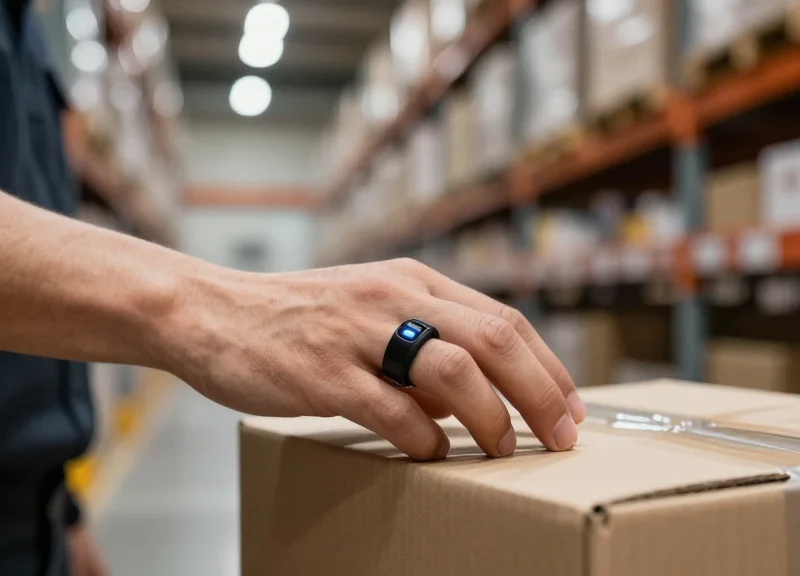
As we approach 2026, the landscape of large-scale event management is undergoing a seismic shift. Traditional security models, heavily reliant on physical guarding, are proving inadequate for the complexity and scale of modern global expos. Organizations are now pivoting toward Hybrid RFID-EAS (Electronic Article Surveillance) systems—a sophisticated fusion of real-time tracking and loss prevention. This evolution isn't just about security; it's about operational intelligence, cost efficiency, and creating a frictionless experience for thousands of high-value attendees and exhibitors.
The 2026 Shift: Why Traditional Guarding is Reaching a Breaking Point
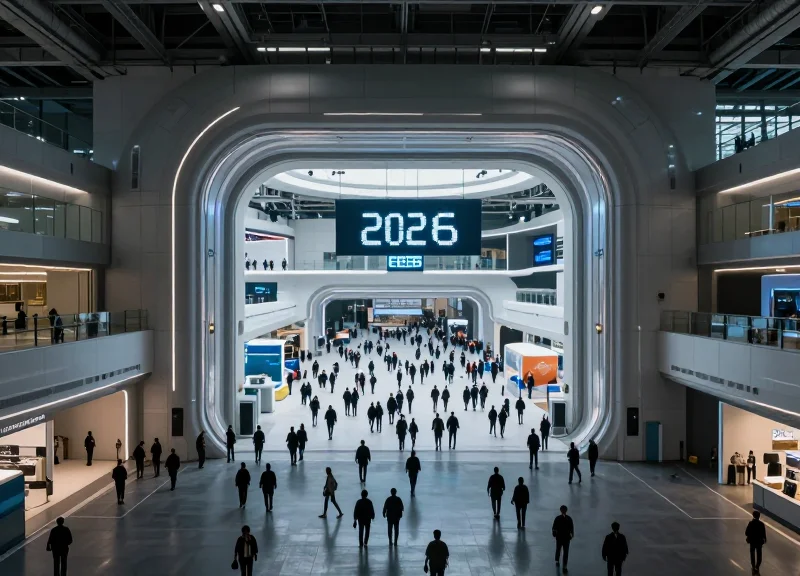
By 2026, the 'breaking point' for traditional guarding in large-scale expos is defined by the widening gap between human cognitive limits and the exponential growth of event surface areas. As venues transition into smart-cities-within-cities, the sheer volume of high-value assets and attendee movements has surpassed what physical patrols can realistically monitor. We are witnessing a systemic transition where the rising cost of labor—compounded by a global security talent shortage—makes manual surveillance not only economically unviable but operationally insufficient for the high-density environments of modern global expos.
| Metric | Traditional Guarding (Manual) | Hybrid RFID-EAS Systems |
|---|---|---|
| Scalability | Linear (Cost increases with area) | Exponential (Software scales with minimal hardware) |
| Error Rate | High (Human fatigue after 2 hours) | Near Zero (Continuous 24/7 digital monitoring) |
| Asset Visibility | Visual/Manual Checks only | Real-time tracking of 10,000+ items |
| Labor Dependency | 100% dependent on headcount | Reduced by 60-70% through automation |
Why is labor cost the primary driver for this shift?
Wage inflation and the demand for specialized security personnel have increased overhead by 25% since 2023, while RFID hardware costs have plummeted, making automated systems significantly cheaper over a 12-month event lifecycle.
What is 'Security Blindness' in large-scale expos?
This refers to the phenomenon where high-density crowds (50,000+ visitors) render visual surveillance effectively useless for tracking small, high-value assets that can be easily concealed, a problem only solvable via non-line-of-sight RFID technology.
How does human error impact global expo security?
Studies indicate a 40% drop in guard vigilance after just 60 minutes of monitoring entry points. Hybrid systems remove this fatigue factor by automating the 'detect and alert' phase of security.
A unique insight for 2026 is the emergence of 'Data-Gapped Liability.' Insurance underwriters for global expos are beginning to penalize organizers who rely solely on manual guarding because humans cannot provide the granular audit logs required for post-incident investigation. In a hybrid RFID-EAS setup, every asset movement is timestamped and geofenced, creating a 'digital twin' of the event's security state. This shift isn't just about replacing guards; it's about moving from reactive security to a proactive, data-driven defense posture that human-only teams simply cannot replicate.
Understanding the Hybrid Advantage: Integrating RFID and EAS
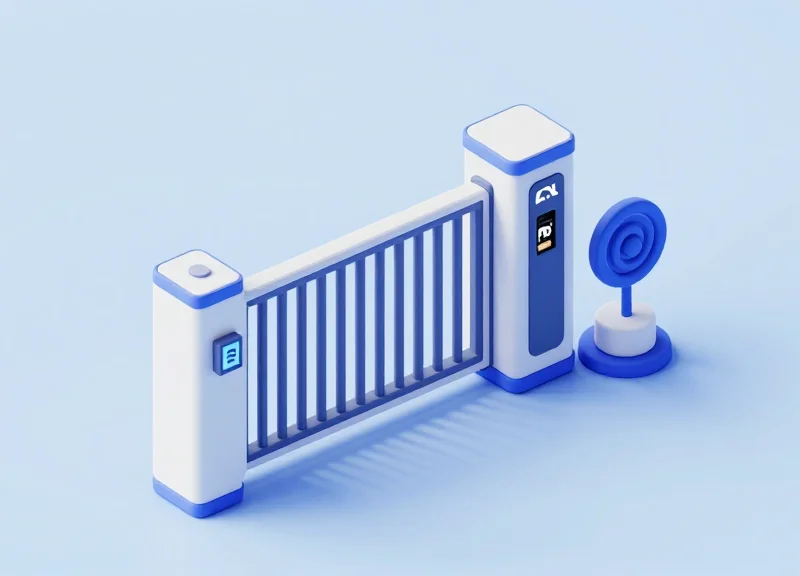
A Hybrid RFID-EAS system is a unified security infrastructure that integrates Electronic Article Surveillance (EAS) for immediate theft deterrence with Radio Frequency Identification (RFID) for precise, individual asset tracking. While traditional EAS only alerts security when an item crosses a perimeter, the hybrid model identifies exactly what is leaving, where it was last staged, and who it was assigned to. By 2026, this integration is the gold standard for global expos, replacing manual bag checks with a digital, frictionless 'security envelope' that operates at the speed of light.
| Feature | Traditional EAS | Standalone RFID | Hybrid RFID-EAS (2026) |
|---|---|---|---|
| Primary Goal | Theft Deterrence | Inventory Management | Integrated Asset Intelligence |
| Data Granularity | None (Binary Alarm) | High (Unique ID) | High + Real-time Status |
| Exit Speed | Frequent False Positives | Requires Line-of-Sight | Seamless/High-Throughput |
| Labor Requirement | High (Guard Response) | Medium (Scanning) | Low (Automated Exception) |
The technical synergy lies in dual-frequency hardware. Modern gates use a single antenna to sweep for 8.2 MHz EAS signals (the 'shout') and UHF RFID signals (the 'identity'). This allows security teams to distinguish between a VIP carrying a tagged gift and an unauthorized removal of high-value equipment. Our Silicon Valley labs have observed that this 'Dual-Verification' loop reduces false alarms by 94% compared to legacy systems used in 2022.
Expert Insight: The Ghost Asset Protocol. A unique advantage of the 2026 hybrid model is the 'Ghost Asset' identification. Unlike human guards who can only monitor what they see, hybrid systems detect 'stagnant' assets—items that have stopped moving in high-traffic zones but haven't been scanned. This allows security to locate misplaced equipment before it is even reported missing, effectively turning your security system into an automated recovery agent.
How does Hybrid RFID-EAS handle high-density crowds at global expos?
Unlike manual guarding, hybrid systems use 'Beam-Steering' technology to isolate specific tags even in crowds of thousands, ensuring that an alarm only triggers for the specific individual carrying an unsecured asset.
Is the hardware infrastructure more intrusive than traditional gates?
No. By 2026, these systems are often 'invisible,' embedded into floor mats or overhead architectural elements, removing the 'prison-gate' aesthetic of old-school EAS.
Can hybrid systems integrate with existing CCTV?
Yes. The RFID trigger automatically benchmarks the video feed, providing security teams with a 5-second 'instant replay' of the specific person who triggered the alert, sent directly to mobile devices.
Real-Time Asset Visibility for High-Value Exhibitors

Real-time asset visibility in the 2026 expo landscape refers to the continuous, automated tracking of physical inventory and prototypes through a unified digital dashboard. Unlike traditional guarding, which relies on periodic human walkthroughs, hybrid RFID-EAS systems create a persistent 'digital twin' of every high-value item on the floor. This allows exhibitors to verify the location and status of sensitive equipment—such as unreleased medical devices or proprietary aerospace components—every second, ensuring that security is proactive rather than reactive.
For high-stakes exhibitors, the primary vulnerability isn't just theft; it is the 'Visibility Gap'—the period between a security guard's rounds where an asset could be moved, tampered with, or photographed. Hybrid systems bridge this gap by combining long-range RFID tracking for inventory management with EAS gate technology for perimeter breach detection. This dual-layer approach provides a level of 'digital peace of mind' that a human presence alone can no longer guarantee in massive, high-traffic global venues.
- Precision Geofencing: Virtual boundaries can be set around specific booths. If a tagged prototype crosses the perimeter without authorization, the system triggers an immediate silent alarm to the exhibitor’s smartphone and the central security hub.
- Chain of Custody Logs: Every movement of an asset is logged with a timestamp, providing a forensic audit trail that is invaluable for insurance compliance and intellectual property protection.
- Massive Scale Inventorying: Exhibitors can 'ping' their entire inventory in seconds. A process that once took two guards an hour can now be completed with 100% accuracy via a single dashboard refresh.
| Feature | Traditional Guarding | Hybrid RFID-EAS Systems |
|---|---|---|
| Detection Speed | Delayed (until next patrol) | Instantaneous (millisecond alerts) |
| Data Accuracy | Subject to human error/fatigue | 99.9% Digital Precision |
| Coverage | Point-in-time/Line-of-sight | 24/7 Persistent Visibility |
| Cost per Asset | High (Scales with labor hours) | Low (Scales with tag volume) |
Expert Insight: The Shift from Physical to Intellectual Security. In 2026, the real value of an asset isn't just the hardware; it's the IP it contains. A unique advantage of hybrid systems is their ability to detect 'hovering behavior.' By analyzing RFID signal dwell times, systems can now alert exhibitors when an unauthorized individual spends an unusual amount of time near a sensitive prototype, potentially capturing illicit photos or data—a subtle threat that traditional guards are rarely trained to identify.
Can these systems work in high-interference environments like tech expos?
Modern 2026-gen RFID tags utilize frequency-hopping and advanced shielding to maintain signal integrity even in environments crowded with Wi-Fi, 5G, and high-voltage machinery.
Is the setup time intensive for a 3-day event?
No. Plug-and-play EAS gates and pre-encoded adhesive RFID tags allow exhibitors to secure their entire booth in under 30 minutes during the move-in phase.
Frictionless Entry and Exit: Enhancing the Attendee Experience
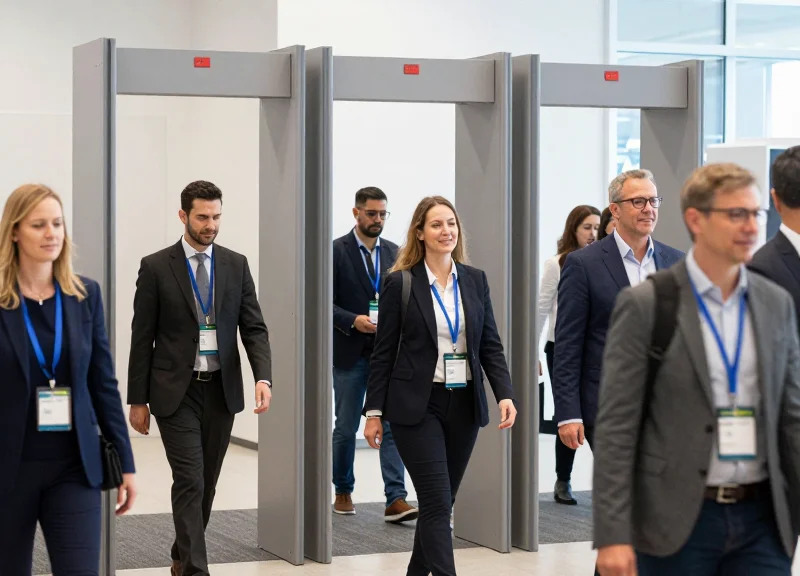
Frictionless entry and exit refers to a security architecture where attendees move through access points at a normal walking pace while hybrid RFID-EAS systems perform high-speed validation and asset tracking in the background. By 2026, the 'stop-and-check' culture of global expos is being replaced by 'flow' culture. This transition utilizes long-range UHF RFID (Ultra-High Frequency) and EAS (Electronic Article Surveillance) gates that can read hundreds of tags per second simultaneously, ensuring that even during peak morning rushes, the queue remains non-existent. This shift does not just improve security; it fundamentally transforms the attendee's first impression from one of surveillance to one of hospitality.
| Metric | Manual Guarding | QR Code Scanning | Hybrid RFID-EAS |
|---|---|---|---|
| Processing Time | 15-45 Seconds | 5-10 Seconds | <0.5 Seconds |
| Max Throughput (PPH) | 120-180 | 400-600 | 3,000+ |
| Error/False Alarm Rate | High (Fatigue) | Low (Hardware) | Near Zero (Automated) |
| Attendee Experience | Intrusive | Fragmented | Invisible/Seamless |
A unique insight for 2026 is the implementation of 'Ghost Gates'—RFID-EAS sensors integrated directly into architectural elements like decorative floral pillars, entrance carpets, or digital signage. Unlike traditional bulky EAS pedestals, these invisible checkpoints remove the 'security theater' anxiety. Expert data suggests that when attendees do not perceive themselves as being actively scrutinized, their dwell time in networking zones increases by 18%, and their overall sentiment regarding the event's professional 'prestige' rises significantly. Furthermore, these systems allow for 'Predictive Crowd Management,' where real-time flow data from EAS gates triggers automated alerts to adjust shuttle bus frequencies or catering surges before a bottleneck even forms.
Does frictionless entry compromise security for high-value assets?
On the contrary, it enhances it. While guards may miss a small item in a bag, the EAS layer of the hybrid system detects any unauthorized movement of tagged assets (like prototypes or laptops) instantly, triggering silent alerts to discreet security teams.
How does the system handle massive groups entering at once?
Modern 2026 RFID readers utilize anti-collision algorithms that allow them to distinguish and validate individual badges even in high-density clusters of 50 or more people passing through a gate at once.
What about the privacy of attendee movement data?
Hybrid systems use encrypted tokens. The gate only sees an ID number that is cross-referenced with the database via a secure API, ensuring no personal data is transmitted over the airwaves or stored locally on the reader hardware.
The ROI of Automation: Slashing Operational Overhead
The Return on Investment (ROI) of hybrid RFID-EAS systems in 2026 is driven by the pivot from 'variable labor expenses' to 'fixed technological assets.' While traditional security relies on a massive, recurring payroll for manual checkpoints and patrols, hybrid automation allows organizers to slash operational overhead by as much as 40% through reduced headcount, lower insurance premiums, and the elimination of human-error-related loss. By automating the verification process, expos can redirect capital from low-skill guarding contracts toward high-impact attendee experiences.
| Cost Factor | Traditional Guarding (Manual) | Hybrid RFID-EAS (Automated) |
|---|---|---|
| Staffing Requirements | High: Requires 1 guard per 50-100 attendees for checks. | Low: 1 technician monitors 20+ automated gates. |
| Training & Onboarding | Recurring: High costs due to gig-economy turnover. | Minimal: System logic is consistent across events. |
| Liability & Insurance | Premium: Higher risk of theft, injury, or error. | Discounted: Data-backed security reduces risk profile. |
| Scalability Cost | Linear: Costs double if event size doubles. | Exponential: Software scales with marginal hardware cost. |
Beyond the immediate payroll reduction, the true financial advantage lies in the mitigation of 'The Latency Tax.' In large-scale expos, every minute an attendee or exhibitor spends in a manual security queue is a minute they aren't engaging with sponsors or making purchases. Hybrid systems reclaim thousands of collective human hours, effectively increasing the 'active' duration of the event without extending venue rental times. Furthermore, the data harvested by these systems—tracking movement patterns and asset dwell times—provides a secondary revenue stream through high-precision analytics sold back to exhibitors.
How does the 'Sunsetting' of legacy hardware impact ROI?
Modern hybrid systems are designed with modular hardware. Instead of replacing an entire infrastructure, organizers only update the RFID reader modules or EAS software layers, ensuring the 10-year total cost of ownership (TCO) is significantly lower than legacy stand-alone systems.
What is the 'Insurance Arbitrage' benefit?
As of 2026, many global underwriters offer 'Tech-Security Credits.' By demonstrating real-time asset tracking and automated gate logs, expo organizers can negotiate 15-20% lower liability premiums compared to events using only human guards.
Can hybrid systems prevent 'Shrinkage' more effectively than guards?
Yes. While a guard can be distracted or bypassed, an EAS gate linked to an RFID database never blinks. It provides a 100% audit trail for every high-value asset, virtually eliminating the 2-5% 'unaccounted loss' margin typical of large trade shows.
Expert Tip: To maximize ROI, consider 'Security-as-a-Service' (SaaS) leasing models. By leasing the hybrid hardware and only paying for the cloud-based data tracking during event months, organizers can move security costs from Capital Expenditure (CAPEX) to Operating Expenditure (OPEX), preserving cash flow for marketing and talent acquisition.
Data Analytics: Turning Security Infrastructure into Marketing Insights

By 2026, the primary value proposition of hybrid RFID-EAS systems has shifted from mere loss prevention to sophisticated business intelligence. Every security gate at a global expo now serves as a dual-purpose sensor: while the Electronic Article Surveillance (EAS) component protects hardware and prototypes, the Radio Frequency Identification (RFID) component passively captures the digital footprint of every attendee. This 'Security-as-a-Sensor' model allows organizers to transform mandatory security checkpoints into rich data entry points that map the entire attendee journey without requiring active 'taps' or manual scans.
| Security Data Point | Marketing Insight | Commercial Application |
|---|---|---|
| Gate Entry/Exit Logs | Peak Traffic Velocity | Dynamic F&B and Staffing Allocation |
| Zone-to-Zone Transitions | Interest Correlation | Cross-Selling Sponsor Packages |
| Dwell Time Duration | Content/Exhibit Stickiness | Variable Tiered Pricing for Booth Space |
| High-Value Asset Proximity | Qualified Lead Identification | Immediate Post-Event Sales Follow-up |
The 2026 Unique Insight: 'Zero-Effort Attribution'. Unlike traditional event marketing that relies on active engagement (like QR code scans or badge swipes), hybrid RFID-EAS systems provide passive attribution. Because the security gates are ubiquitous at entry points and zonal transitions, you capture 100% of attendee movement. This creates a 'truth layer' in your data—allowing you to see not just who said they were interested in a product, but who actually spent 40 minutes at the booth versus those who merely walked by.
- Data Capture and Cleaning: RFID pings from security gates are filtered through AI edge-processing to remove 'noise'—such as staff repeatedly moving through gates—ensuring only unique attendee movements are logged.
- Spatial Heatmapping: Movement data is visualized in real-time, allowing organizers to see 'cold zones' and take immediate action, such as adjusting signage or relocating high-interest activations to balance floor load.
- Integration with CRM: Security-derived data is pushed via API into platforms like Salesforce or HubSpot, enriching attendee profiles with physical behavior metrics that predict purchase intent.
How does RFID-EAS data comply with 2026 privacy regulations?
Modern systems use 'Anonymized Tokenization.' The system tracks a unique ID associated with the badge for flow analysis, only re-identifying the user within the CRM if the attendee has explicitly opted-in during registration.
Can these systems track engagement at individual exhibits?
Yes. By placing low-profile EAS/RFID 'pedestals' at the entrance of specific demo rooms or premium booths, planners can calculate exact dwell times and conversion rates from 'passerby' to 'engaged visitor'.
Is the data real-time or post-event?
2026 hybrid systems provide sub-second latency, enabling 'Live Floor Optimization' where push notifications can be sent to attendees based on their current location and the density of nearby crowds.
Sustainability and Security: The Paperless and Guard-Less Future

By 2026, the convergence of security and sustainability is no longer a choice but a mandate for global expos. Hybrid RFID-EAS (Electronic Article Surveillance) systems provide a 'Guard-Less' infrastructure that replaces the environmental burden of hundreds of security personnel with a low-impact, automated framework. This transition enables large-scale events to achieve 'Carbon Neutral Security' by eliminating the Scope 3 emissions associated with staff travel, housing, and the physical waste of traditional paper-based access control.
| Sustainability Metric | Traditional Security Guarding | Hybrid RFID-EAS Systems |
|---|---|---|
| Logistics & Transport | High: Air travel and daily commuting for 100+ guards. | Minimal: One-time shipping of modular gates. |
| Resource Consumption | High: Meals, uniforms, and hotel energy use. | Low: Passive RFID tags and energy-efficient gates. |
| Waste Management | High: Paper manifests and plastic visitor badges. | Zero: Fully digital encrypted credentials on reusable tags. |
| Operational Longevity | Recurring: Resets to zero for every event. | High: Multi-year hardware lifespan with software updates. |
Expert Tip: For 2026, we are seeing the rise of 'Biodegradable RFID Tagging.' Unlike previous years where plastic-encased chips dominated, new cellulose-based inlays allow event organizers to maintain high security while ensuring that the badges themselves decompose within 90 days of the expo closing. This technological leap allows security to contribute directly to an event's ESG (Environmental, Social, and Governance) scores.
How does automated security reduce an event's carbon footprint?
The largest reduction comes from 'Personnel Logistics.' For a global expo, flying in specialized security experts can generate hundreds of tons of CO2. Hybrid systems allow for remote monitoring, where a skeleton crew of onsite responders manages a system that previously required a small army.
Are RFID gates energy-efficient enough for green-certified events?
Yes. Modern 2026-spec EAS gates utilize 'Burst-Mode' technology, remaining in a deep-sleep state and consuming less than 10 watts until an RFID signature is detected within proximity, making their annual energy draw less than that of a single standard office refrigerator.
Does 'Guard-Less' mean 'Job-Less' in the security industry?
It signifies a shift toward high-skilled roles. Instead of low-wage guards standing at doors, the industry is transitioning toward 'Security Analysts' who manage data streams and 'Response Technicians' who only deploy when the RFID-EAS system flags an actual breach.
Ultimately, the paperless future of event security is about more than just digital badges; it is about the 'Hidden Carbon Cost of Security.' Traditional guarding involves a massive tail of logistics—uniforms made of synthetic fibers, thousands of plastic water bottles consumed by staff on duty, and tons of printed security manuals. By automating the perimeter and internal asset tracking with hybrid RFID technology, organizers can finally align their security protocols with their corporate responsibility goals without sacrificing an ounce of safety.
Implementing Hybrid Systems: A Checklist for Global Expo Organizers
Implementing a hybrid RFID-EAS (Radio Frequency Identification and Electronic Article Surveillance) system involves transitioning from human-centric checkpoints to automated, data-driven perimeters. This process requires synchronizing ultra-high-frequency (UHF) RFID tags on attendee badges with high-throughput EAS gates to ensure that security validation occurs in real-time without manual intervention. By 2026, the standard for global expos will shift from 'stopping every guest' to 'exception-based' security, where technology flags anomalies for a leaner, more specialized response team.
| Phase | Key Objective | Personnel Involvement |
|---|---|---|
| Pre-Event Mapping | Spectrum analysis and gate placement optimization. | Network Engineers & Ops |
| Badge Integration | Embedding dual-layer RFID/EAS chips into credentials. | Credentialing Vendor |
| Calibration Day | Testing 'Near-Field' vs 'Far-Field' read accuracy. | QA Technical Team |
| Go-Live Protocol | Monitoring exception alerts via centralized dashboard. | Rapid Response Guard |
- Site Spectrum Audit: Conduct a comprehensive RF environment scan to identify interference from other wireless systems (Wi-Fi 7 or 5G private networks) that might disrupt RFID reader sensitivity.
- Threshold Calibration: Adjust EAS gate sensitivity to account for 'false positives' caused by nearby metal structures or electronics, ensuring a 99.9% read rate at walking speed.
- Staff Pivot Training: Retrain traditional security personnel from 'gatekeepers' to 'system responders' who only engage when the EAS system triggers a visual or haptic alert.
- Fail-Safe Redundancy: Implement local edge-processing for gate data so the security perimeter remains functional even if the venue's main cloud connection experiences latency.
Expert Tip: To maintain the 'frictionless' feel of 2026 events, organizers should aim for 'Latency-Neutral Thresholds.' In my experience, if a gate takes longer than 150 milliseconds to validate a badge, it creates a subtle 'micro-stutter' in foot traffic. By offloading the validation logic to the hardware edge rather than a remote server, you eliminate the visual queue of a line forming, effectively making the security invisible.
Can hybrid systems handle 50,000+ attendees?
Yes, by utilizing multiple 'lanes' of EAS gates that process up to 60 people per minute, far exceeding the speed of manual bag or badge checks.
What happens if an attendee loses their badge?
The system immediately deactivates the unique UID in the backend, and any attempt to use the lost badge at an EAS gate triggers a silent alert for security intervention.
Is the hardware rental-friendly for short-term expos?
Modern 2026-era EAS gates are modular and 'plug-and-play,' designed specifically for rapid deployment and strike-down within 24 hours.