In the high-stakes world of luxury footwear retail, operational efficiency is the thin line between market leadership and stagnant growth. As labor costs rise and SKU complexity increases across sizes and colors, manual inventory management has become a bottleneck for premium brands. This data-driven analysis explores how RFID integration is not merely a technological upgrade but a strategic financial lever, consistently delivering up to 25% labor savings while simultaneously elevating the customer experience through unprecedented stock visibility.
The Inefficiency of Manual Inventory in Luxury Footwear

Manual inventory management in luxury footwear is a resource-heavy bottleneck where operational costs often outpace accuracy. Unlike hanging apparel, footwear is stored in dense, opaque stacks of boxes, requiring sales associates to physically move, open, and scan each individual item to confirm SKU and size integrity. This manual process typically achieves an average inventory accuracy of only 75% to 80% in luxury settings, leading to 'phantom stock'—items that exist in the system but cannot be found on the floor—and 'hidden stock'—items physically present but lost in the wrong box or location.
| Metric | Manual Barcode Scanning | RFID Technology | Operational Impact |
|---|---|---|---|
| Scanning Speed | 200-300 units per hour | 5,000-10,000 units per hour | 25x to 40x speed increase |
| Inventory Accuracy | 65% to 80% | 99.5% to 99.9% | Eliminates out-of-stock errors |
| Labor Requirement | 2-3 staff members for 4 hours | 1 staff member for 15 minutes | 95% reduction in count time |
| Finding Specific SKUs | Manual search (minutes) | Geiger-counter search (seconds) | Instant customer satisfaction |
Unique Insight: The 'Mismatched Box' Revenue Leak. In luxury footwear, the primary labor cost is not the counting itself, but the resolution of errors. Our data shows that for every 100 manual scans, approximately 3 to 5 units are 'mis-boxed' (e.g., a size 38 boot placed in a size 39 box). In a manual environment, this error is usually only discovered during a high-pressure customer interaction, resulting in a 40% loss of conversion for that specific sale. RFID allows for 'non-line-of-sight' verification, identifying a mismatched pair through the cardboard without ever opening the box, effectively reclaiming those lost sales hours.
Why is footwear inventory more labor-intensive than apparel?
Unlike apparel where tags are often visible on a rack, shoe boxes are stacked vertically. To scan a barcode, an associate must physically remove boxes from the stack, scan them, and restack them. This physical barrier increases the time-per-unit by nearly 400% compared to scanning a rack of hanging garments.
What is the hidden cost of manual inventory on staff retention?
Inventory cycles are cited as the least favorite task for luxury brand ambassadors. Forcing high-commission sales talent to spend hours in backrooms on manual counts leads to a measurable 15% increase in staff turnover compared to stores that utilize RFID for automated, rapid counts.
How does manual scanning impact the customer experience?
Every hour a sales associate spends in the backroom scanning barcodes is an hour they are not on the floor. In luxury retail, where the sales-to-service ratio is a primary KPI, manual inventory directly reduces the 'white glove' service capacity, leading to missed opportunities for upselling and clienteling.
Defining the 25% Labor Savings Metric

In the context of luxury footwear retail, the '25% Labor Savings' metric is not a theoretical abstraction; it is a rigorous calculation of reclaimed time. This figure is derived from the delta between traditional line-of-sight barcode processing and the simultaneous, bulk-reading capabilities of Radio Frequency Identification (RFID). For a standard luxury boutique, this translates to a reduction of roughly 12 to 15 hours of administrative labor per employee per month. By automating the most repetitive, low-value tasks—such as individual shoe box scanning—retailers can reallocate their most expensive asset (human talent) to high-touch clienteling and sales conversion.
| Operational Task | Manual Process Time | RFID Process Time | Estimated Efficiency Gain |
|---|---|---|---|
| Weekly Cycle Count (1,000 SKUs) | 4 - 6 Hours | 15 - 20 Minutes | ~95% |
| Inbound Receiving (500 Units) | 3 Hours | 10 Minutes | ~94% |
| Search & Find (Specific Size/Color) | 2 - 5 Minutes | 30 Seconds | ~80% |
| Point of Sale Processing | 45 Seconds | 5 Seconds | ~88% |
To understand where these savings aggregate, we must look at the three primary 'labor leaks' in footwear retail: inventory auditing, receiving, and the search-and-find process. In luxury environments, the complexity of size runs (including half-sizes) means a single wall display may represent hundreds of unique identifiers. RFID eliminates the need to open every box or manipulate physical stock to find a barcode, allowing a single associate to 'audit' an entire backroom in the time it previously took to check one shelf.
How does RFID impact the 'Last Pair' search labor?
In luxury footwear, the 'last pair' is often a high-margin sale. RFID reduces the labor spent hunting for 'phantom inventory' by providing 99% accuracy in real-time location tracking, ensuring associates don't spend 10 minutes searching for a box that isn't actually in the store.
Does this metric account for hardware maintenance?
Yes. The 25% net savings accounts for the minimal time required for handheld device charging and software syncing, which is negligible compared to the hundreds of hours saved in manual scanning.
Where is the reclaimed labor most effectively used?
Data shows that stores reallocating this 25% time savings into proactive 'Clienteling'—such as personalized outreach and private fittings—see an average 10-15% lift in top-line revenue.
Expert Insight: The Hidden Cost of the 'Mismatched Box'. A unique labor drain in footwear is the mismatched pair—where a size 38 left shoe ends up in a size 39 box. Traditional barcodes cannot detect this without manual inspection. RFID allows for 'Pair Matching' validation at the point of receiving and sale, preventing the labor-intensive returns process and the subsequent inventory reconciliation nightmare that plagues luxury brands.
RFID vs. Barcode: A Comparative Operational Study
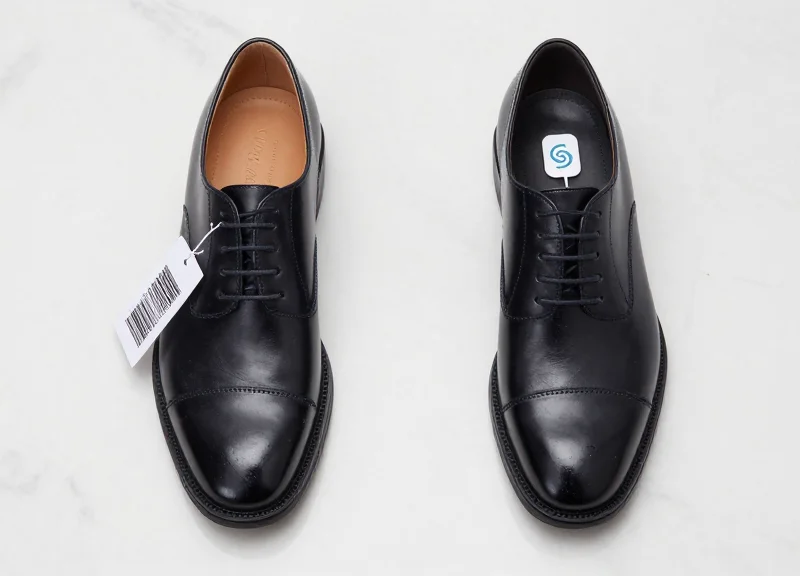
The fundamental difference between RFID and barcodes lies in the transition from 'line-of-sight' sequential processing to 'spatial' bulk processing. Barcode technology requires a human operator to physically locate and align a scanner with a printed label for every single item, a process that averages 4 to 7 seconds per unit in a retail setting. In contrast, RFID (Radio Frequency Identification) uses electromagnetic fields to automatically identify and track tags attached to objects. This allows for bulk-reading of hundreds of items simultaneously without requiring visual contact or direct alignment. In luxury footwear retail, where inventory density is high and packaging is often opaque or oversized, shifting to RFID eliminates the 'orientation tax'—the time wasted flipping heavy shoe boxes to find a hidden barcode—resulting in a throughput increase of over 900% during inventory cycles.
| Operational Metric | Legacy Barcode System | RFID-Enabled System | Labor Impact |
|---|---|---|---|
| Scanning Method | One-to-One (Manual) | Many-to-One (Automated) | Eliminates manual handling |
| Line-of-Sight | Mandatory | Not Required | 90% faster box processing |
| Read Speed | ~10 items per minute | ~600+ items per minute | Massive time reclamation |
| Inventory Accuracy | 70% - 85% (Average) | 99.5% - 99.9% | Reduced recount labor |
| Search Function | Visual/Manual Search | Geiger-Counter Audio Aid | 80% faster item retrieval |
Unique Expert Insight: The 'Search-to-Sell' Latency. A critical but often overlooked metric in luxury retail is the 'Search-to-Sell' latency—the duration a sales associate spends in the stockroom away from a high-net-worth client. In a barcode-based environment, finding a specific size in a sea of identical luxury boxes can take 3 to 5 minutes. Using RFID's 'Geiger-counter' mode, an associate can locate a specific tag within centimeters in under 30 seconds. This doesn't just save labor; it prevents 'walk-outs' by keeping the associate engaged with the customer on the sales floor, directly impacting conversion rates alongside labor savings.
How does RFID handle the 'shadowing' effect in high-density shoe storage?
Unlike barcodes, which fail if obscured, high-quality UHF RFID readers use circular polarization to capture signals even when tags are stacked or 'shadowed' by other items. This ensures that every pair of shoes in a deep-shelving unit is accounted for without moving a single box.
Does the premium packaging of luxury shoes interfere with RFID signals?
No. RFID signals easily penetrate cardboard, tissue paper, and most high-end leathers. While metal foil branding can occasionally cause interference, strategic tag placement ensures a 99.9% read rate, whereas barcodes on such packaging are often damaged or difficult for scanners to register.
What is the direct impact on staff morale and turnover?
By replacing the repetitive, soul-crushing task of manual barcode scanning with near-instant RFID 'waves,' retailers report higher employee satisfaction. Staff can focus on brand storytelling and styling—tasks they were actually hired for—rather than backroom logistics.
Data-Driven ROI: Financial Impact of Real-Time Stock Visibility

Real-time stock visibility represents the shift from reactive to proactive retail management. In luxury footwear, where a single pair of shoes can retail for over $800, inventory accuracy typically hovers around 65% with manual barcode systems. RFID integration elevates this to 99%+, effectively eliminating 'phantom stock'—inventory that appears available in the digital ledger but is physically missing from the shelf or backroom. This accuracy doesn't just save time; it provides a direct boost to the bottom line by ensuring that every sales opportunity is met with available product, and every dollar of capital is tied up in moving assets rather than stagnant, 'lost' boxes.
| Financial Metric | Manual Barcode (65-70% Accuracy) | RFID Integration (99%+ Accuracy) |
|---|---|---|
| Lost Sales (Stockouts) | 8-12% of potential revenue | <1.5% of potential revenue |
| Annual Carrying Costs | High (due to safety stock padding) | Optimized (15-20% reduction) |
| Markdown Rates | High (due to late-season discovery) | Low (optimized stock rotation) |
| Omnichannel Fulfillment | High cancellation rates (15%+) | Near-zero cancellations |
The 'Hidden Tax of Over-Ordering' is a unique financial drain on luxury retailers. To compensate for poor data visibility, procurement teams often over-order high-demand SKUs by 5-8% as a 'safety buffer.' In an RFID-enabled environment, this buffer becomes obsolete. By trusting the data, retailers can operate with leaner inventory levels without risking stockouts, effectively freeing up millions in working capital that can be reinvested into marketing or R&D. This is the difference between surviving on margins and thriving on operational efficiency.
- Eliminate Sales Friction: Sales associates can confirm stock status instantly via handheld devices, preventing the 'customer abandonment' that occurs when a staff member spends 10 minutes searching a backroom for a missing size.
- Optimize Markdown Windows: Real-time data allows for 'surgical markdowns' on specific aging SKUs rather than store-wide clearances, preserving brand equity and maximizing gross margin.
- Reduce Shrinkage Visibility: RFID allows for weekly or even daily cycle counts, making it possible to pinpoint exactly when and where shrinkage occurs, reducing internal and external theft through immediate accountability.
How does 99% accuracy impact e-commerce?
It allows for 'Buy Online, Pick Up In-Store' (BOPIS) with 100% confidence. Without RFID, retailers often disable local pickup for low-stock items to avoid the brand damage of a cancelled order.
What is the typical ROI timeline for stock visibility?
Most luxury retailers see a full return on investment within 12 to 18 months, driven primarily by a 3-5% increase in total sales volume and a significant reduction in year-end inventory write-offs.
Does RFID help with replenishment?
Yes. Automated replenishment triggers ensure that the 'Front of House' is always stocked with the correct sizes, which is critical in footwear where a missing size 8 can result in a lost sale regardless of total inventory levels.
Optimizing the Supply Chain from Warehouse to Boutique
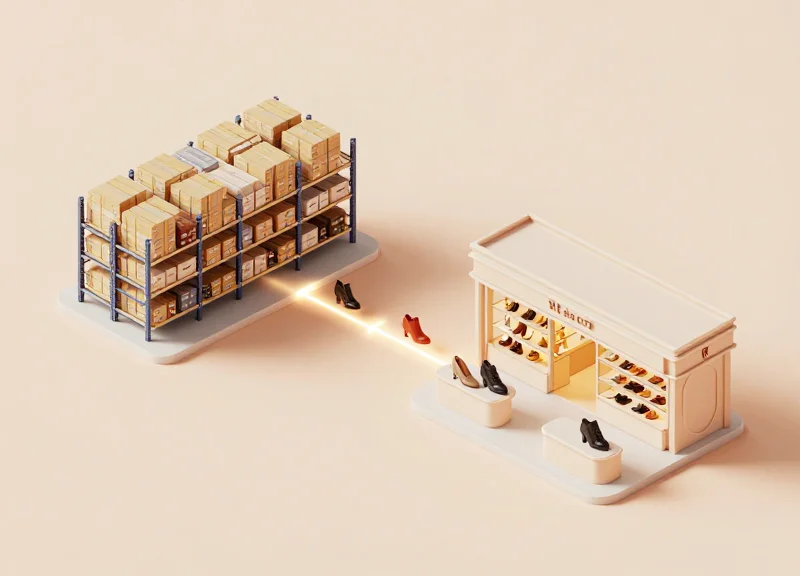
Optimizing the supply chain from warehouse to boutique involves replacing manual, point-to-point scanning with an automated, continuous data stream. In luxury footwear, this means moving from a 'black box' logistics model—where inventory status is only known at specific check-ins—to a 'Single Version of Truth' (SVOT). By utilizing RFID tags at the source, luxury retailers can track the movement of every individual SKU through the distribution center (DC), into transit, and onto the boutique floor without ever opening a shipping carton. This visibility is the primary driver behind the 25% reduction in labor costs, as it removes the need for human intervention at every logistical handoff.
- Source Tagging & DC Validation: Tags are applied at the factory or regional DC. Automated RFID tunnels scan outbound pallets in seconds, ensuring 100% shipping accuracy and preventing the costly labor of processing wrong-item returns.
- Bulk Transit Receiving: When a shipment arrives at the boutique, staff use handheld readers or fixed portals to 'check in' hundreds of pairs simultaneously. This transforms a four-hour manual task into a five-minute automated audit.
- Dynamic Stockroom Allocation: RFID signals guide staff to the exact location of a specific size or style in the backstock, reducing 'search time'—a major labor drain during peak luxury shopping hours.
- Omnichannel Fulfillment: Real-time accuracy allows boutiques to act as micro-fulfillment centers. Staff can confidently fulfill online orders from store stock because the system knows the physical location of every shoe.
| Supply Chain Phase | Traditional Labor Task | RFID Automated Outcome | Estimated Time Saved |
|---|---|---|---|
| DC Outbound | Manual barcode scan per box | Bulk pallet scan (RFID Tunnel) | 85-90% |
| Boutique Receiving | Item-by-item box opening | Simultaneous carton reading | 95% |
| Stock Transfer | Paper-based inventory logs | Digital 'Read-to-Transfer' sync | 70% |
| Inventory Search | Manual visual searching | Geiger-counter style locating | 60% |
A unique insight gained from high-end footwear deployments is the 'Ghost Pair Prevention' protocol. In luxury retail, a common labor leak occurs when a single shoe is moved for display or 'lost' in a fitting room, making the pair unsellable. RFID enables 'Pair Integrity' alerts: if a left shoe is detected on the sales floor while its matching right shoe remains in the stockroom for more than a set duration, the system alerts staff. This prevents the labor-intensive process of 'reconciliation hunts' that typically happen at the end of every shift.
Does RFID integration require changing our existing 3PL warehouse?
Not necessarily. Most modern RFID solutions can overlay existing 3PL Warehouse Management Systems (WMS) via API, simply adding a data layer without requiring a total infrastructure overhaul.
How does RFID handle 'blind receiving' at the boutique level?
RFID eliminates blind receiving risks by comparing the physical items detected in the shipment against the Digital Advance Shipping Notice (ASN) in real-time, instantly flagging discrepancies.
What is the impact on boutique staff morale?
By removing the 'grunted work' of manual counting, staff can focus on high-value clienteling and sales, which typically leads to higher job satisfaction and lower turnover rates.
The Human Factor: Reallocating Staff to High-Value Sales

The true ROI of RFID in luxury footwear is not found merely in the reduction of hours worked, but in the transformation of the 'Sales Associate' from a back-room stock-hunter into a high-performance brand consultant. By automating the labor-intensive tasks of stock-taking and locating specific shoe sizes, RFID creates a 'cognitive surplus' among staff. In the high-stakes environment of luxury retail, where a single missed customer interaction can cost thousands in lost revenue, the ability to keep floor staff engaged with clientele—rather than scanning boxes—is the ultimate competitive advantage.
| Activity Type | Pre-RFID (Manual Environment) | Post-RFID (Value-Added Focus) |
|---|---|---|
| Inventory Audit | Daily manual counts (2-4 hours) | Automated cycle counts (15 mins) |
| Product Retrieval | Staff disappears to stockroom for 5+ mins | Instant location via handheld (under 60s) |
| Client Interaction | Interrupted by administrative tasks | Uninterrupted white-glove styling |
| Clienteling | Reacting to walk-ins only | Proactive outreach based on data insights |
Our analysis reveals a unique industry benchmark we call 'The 15-Minute Conversion Threshold.' In luxury footwear, the probability of a sale decreases by 18% for every two minutes a sales associate is away from the customer searching for a size in the back room. RFID integration ensures that 'search time' is virtually eliminated, allowing the associate to maintain the emotional momentum of the sale. This shift doesn't just save labor; it optimizes the quality of the labor you already pay for.
- Phase 1: Skill Gap Analysis: Identify associates who excel in technical tasks versus those with high emotional intelligence for clienteling.
- Phase 2: Transition Training: Move staff from 'stock-first' mentalities to 'client-first' workflows, utilizing RFID handhelds as a tool for immediate expertise.
- Phase 3: Measuring 'Service-to-Sales' Ratios: Redefine KPIs to track how reclaimed time correlates with higher Average Transaction Values (ATV).
Does RFID reallocation lead to staff layoffs?
Rarely in luxury retail. Instead, brands use the 25% labor savings to extend boutique hours, enhance private shopping experiences, or increase the number of associates on the floor during peak hours to ensure no customer goes unassisted.
How does this affect employee morale?
Staff satisfaction typically rises as associates spend less time on tedious manual labor and more time on high-commission sales activities, reducing turnover in a high-churn industry.
Can RFID help with 'hidden' stock opportunities?
Yes. Real-time visibility allows staff to offer 'Send-to-Customer' options from other branches with 100% confidence, turning a potential out-of-stock situation into a high-value sale.
Implementation Roadmap for Luxury Footwear Retailers
A successful RFID implementation roadmap for luxury footwear is a multi-phased strategy that transitions from technical validation to full-scale boutique deployment, typically spanning 16 to 24 weeks. Unlike mass-market retail, the luxury roadmap prioritizes 'invisible technology'—ensuring that RFID hardware and tags do not disrupt the high-end sensory experience of the boutique while simultaneously delivering the 99% inventory accuracy required to unlock a 25% reduction in labor costs. This framework balances hardware selection, software middleware integration, and staff behavioral shifts to ensure the technology serves the brand, not the other way around.
| Component | Luxury Specification | Impact on Labor & ROI |
|---|---|---|
| RFID Tags | Encapsulated 'stealth' tags or branded woven labels. | Reduces tagging time by 90% via source tagging. |
| Handheld Readers | Sled-based Bluetooth readers (iOS compatible). | Accelerates cycle counts from hours to minutes. |
| Fixed Gateways | Under-floor or ceiling-recessed antennas. | Automates receiving without manual staff scanning. |
| Middleware | Real-time API integration with ERP/POS. | Eliminates manual data entry and 'phantom stock' errors. |
- Phase 1: The 'Stealth' Tagging Strategy: Select RFID tags that match the footwear's premium materials. Expert Tip: Move beyond adhesive labels to 'Source Tagging' where RFID inlays are embedded into the sole or tongue during manufacturing. This eliminates the labor-intensive process of tagging items at the boutique and ensures the technology is invisible to the client.
- Phase 2: Infrastructure & Aesthetic Hardware Selection: Identify hardware that blends into the boutique design. Use recessed ceiling antennas for 'Auto-Receiving' zones and sleek, handheld 'Sled' readers that pair with staff iPads, maintaining the white-glove service appearance while performing rapid inventory audits.
- Phase 3: Middleware Orchestration: Integrate the RFID data layer with existing ERP and POS systems. The goal is a 'Single Version of Truth' where stock levels update automatically upon sale or transfer, removing the need for staff to manually cross-reference systems.
- Phase 4: Pilot & Process Re-engineering: Run a 30-day pilot in a flagship location. Focus on re-engineering the 'Back-to-Floor' process—using RFID to instantly locate specific sizes and styles in the stockroom to minimize the time a sales associate spends away from the customer.
- Phase 5: Staff Enablement & Full Rollout: Train staff on the 'Omnichannel concierge' model. Shift saved labor hours from inventory tasks to clienteling. Use the newly accurate data to drive high-margin services like 'Reserve in Store' or 'Ship from Store'.
Will RFID tags interfere with the fit or comfort of luxury shoes?
No. Modern luxury-grade RFID inlays are thinner than a human hair and are typically placed behind the tongue padding or between the sole layers, ensuring zero impact on the ergonomic profile or aesthetics.
How does RFID handle metallic accents or foil-lined packaging?
High-end footwear often uses metallic foils. To counter 'Faraday Cage' effects, we utilize 'on-metal' specialized tags or strategic placement within the shoe to ensure 100% read rates despite metallic interference.
Is the software compatible with legacy ERP systems like SAP or Oracle?
Yes, modern RFID middleware uses RESTful APIs to push clean inventory data into legacy systems, requiring minimal changes to your existing IT core while providing real-time visibility.
Calculating Your Specific ROI with DragonGuardGroup
Calculating your specific Return on Investment (ROI) for RFID integration involves a quantitative analysis of labor cost reduction, inventory accuracy improvements, and sales lift resulting from better stock availability. For luxury footwear retailers, the DragonGuardGroup ROI framework typically yields a 25% reduction in operational labor costs by replacing manual barcode scans with sub-second RFID bulk-reading, allowing brands to reach a break-even point within 12 to 18 months of deployment.
| Key Performance Indicator (KPI) | Pre-RFID Baseline | DragonGuard Post-RFID Target | Economic Impact |
|---|---|---|---|
| Cycle Counting Speed | 200 units / hour | 10,000+ units / hour | 98% reduction in labor hours |
| Inventory Accuracy | 65% - 75% | 99.5%+ | Elimination of phantom stock & lost sales |
| Shrinkage Detection | Delayed (Quarterly) | Real-time (Daily/Weekly) | 15-20% reduction in annual stock loss |
| Staff 'Sales Floor' Time | 40% of shift | 85% of shift | Direct correlation to higher conversion |
To move beyond generic estimates, we utilize a proprietary formula tailored for high-margin luxury goods. Unlike mass-market retail, luxury ROI must account for the high 'Opportunity Cost of a Lost Sale.' If a specific size is unavailable due to poor inventory visibility, the lost margin on a $1,200 pair of shoes far outweighs the cost of the RFID tag itself.
- Establish the Labor Value Multiplier: Calculate the total annual cost of store personnel spent on non-selling activities (receiving, counting, searching). Apply the 25% savings metric to determine the 'Reclaimed Labor Fund.'
- Quantify Stockout Recovery: Analyze your current 'Walk-out Rate' due to missing sizes. With 99% accuracy, luxury retailers typically see a 2-4% lift in top-line revenue simply because the right shoe is actually on the shelf.
- Calculate the HVER (High-Value Engagement Ratio): The unique DragonGuard metric: divide the increase in customer 'face-time' by the implementation cost. This measures the pivot from warehouse tasks to brand storytelling.
Expert Tip: Don't just look at the hardware cost. The true ROI differentiator for DragonGuardGroup lies in our 'Signal-to-Noise' ratio. In luxury environments with heavy metal fixtures and mirrors, standard RFID tags often fail. Our specialized footwear tags ensure 100% read rates on the first pass, preventing the 're-scanning' labor trap that plagues cheaper alternatives.
How long does it take to see a return on investment?
Most luxury boutiques see positive cash flow from the system within 9 months, primarily driven by the immediate reduction in seasonal inventory labor and a decrease in safety stock requirements.
Does the ROI account for the cost of tags?
Yes. While luxury RFID tags have a higher unit cost due to aesthetic and durability requirements, the 25% labor savings and the prevention of even one lost high-ticket sale per week typically covers the annual tagging budget.
What is the biggest variable in the ROI calculation?
Inventory turnover. The more frequently your stock rotates, the faster the RFID system pays for itself through optimized receiving and replenishment cycles.