Retailers often face a significant challenge when securing high-value metallic items like bicycle components and camping knives. Standard 58kHz AM (Acousto-Magnetic) EAS tags frequently fail due to signal shielding, where the metal surface acts as a barrier or detunes the tag's resonance. This technical guide explores the physics of signal interference and provides actionable strategies to ensure your anti-theft system remains effective, even in the presence of highly conductive materials.
Understanding the Physics: Why Metal Interferes with 58kHz AM EAS

Acousto-Magnetic (AM) EAS systems operate on the principle of magnetostriction, where a 58kHz magnetic pulse causes a mechanical vibration in the tag's internal amorphous strips. When these strips resonate, they emit a secondary magnetic signal that the system pedestals detect. However, placing these tags directly on metallic surfaces like bicycle frames or camping knives causes 'Signal Shielding.' The metal substrate absorbs the magnetic energy intended for the tag and produces opposing eddy currents, which effectively cancel out the tag's resonance and render it invisible to the security gate.
| Physical Factor | Effect on AM Tag | Consequence for Detection |
|---|---|---|
| Eddy Currents | Conductive metals create opposing magnetic fields. | Significantly reduced signal amplitude. |
| Magnetic Shunting | Ferrous metals redirect magnetic flux away from the tag. | The tag fails to reach its resonant frequency. |
| Detuning | The proximity of metal shifts the resonant frequency. | Tag vibrates at a frequency other than 58kHz. |
| Faraday Effect | Enclosure by metal blocks electromagnetic waves. | Total signal loss (Zero detection). |
The interference isn't just about the 'blocking' of a signal; it is a complex interaction of electromagnetics. In the case of high-end bicycles or steel knives, the metal acts as a 'short circuit' for the magnetic field lines. Instead of the field lines passing through the tag's metallic strips to trigger vibration, they follow the path of least resistance through the high-permeability metal of the product itself. This is why a tag might work perfectly in your hand but fail the moment it is applied to a stainless steel blade.
Does the type of metal matter?
Yes. Ferrous metals (containing iron) cause magnetic shunting by 'stealing' the magnetic flux. Non-ferrous but conductive metals (like aluminum bike frames) primarily interfere via eddy currents. Both result in detection failure.
Why is 58kHz more sensitive to metal than RF 8.2MHz?
While both suffer from metal interference, AM systems rely on a specific mechanical resonance. Even a slight dampening of the vibration caused by the proximity of metal is enough to drop the signal below the detection threshold.
Can the system be tuned to 'see through' the metal?
Generally, no. The interference is at the physical tag level. The solution requires physical separation or specialized tagging techniques rather than software adjustments at the pedestal.
Expert Insight: The 3mm Rule. In my two decades of field engineering, we've identified the 'Air Gap' as the most critical variable. Introducing even a 3mm non-conductive spacer (foam or plastic) between the AM tag and the metal surface can recover up to 70% of the signal strength. This is because the intensity of eddy current interference follows the inverse-square law; doubling the distance from the metal surface exponentially reduces its dampening effect on the tag's internal resonance.
The Faraday Cage Effect and Signal Attenuation in Retail Environments
In retail loss prevention, the Faraday Cage effect occurs when conductive materials—such as a bicycle's steel frame or a camping knife's stainless steel blade—redistribute electromagnetic energy around their exterior, effectively shielding the immediate surface from external fields. For 58kHz Acousto-Magnetic (AM) systems, this results in signal attenuation, where the magnetic pulse emitted by EAS pedestals is absorbed or deflected before it can excite the tag's magnetostrictive elements. When a tag is placed flush against a large metallic mass, it enters a 'dead zone' where the physics of resonance are physically blocked by the conductive barrier.
| Material / Geometry | Attenuation Severity | Effect on 58kHz AM Detection |
|---|---|---|
| Solid Steel (Knife Blades) | High | Near-field cancellation; requires gap spacers to function. |
| Tubular Chrome (Bicycle Frames) | Moderate-High | Creates 'shadow zones' that hide tags from specific pedestal angles. |
| Aluminum Foil Packaging | Extreme | Acts as a complete electromagnetic shield; total signal blackout. |
| Carbon Fiber (High-end Bikes) | Moderate | Conductive fibers can disrupt resonance frequency tuning. |
The technical challenge lies in Eddy Currents. When the EAS pedestal pulses at 58kHz, it induces small, circulating electrical currents on the surface of the metallic product. These eddy currents generate their own localized magnetic field that opposes the pedestal’s field (Lenz's Law). In the case of camping knives or dense bicycle components, this opposing field is strong enough to nullify the excitation signal entirely. This is why a standard AM sticker applied directly to a flat metal surface will almost never trigger an alarm, regardless of the pedestal's sensitivity settings.
Why does a metal blade 'kill' a 58kHz tag's signal?
The metal acts as a heat sink for the magnetic energy. Instead of the energy vibrating the tag's internal amorphous strips, it is dissipated as eddy currents across the blade's surface.
Does the orientation of the metal object matter?
Absolutely. A bicycle frame passing perpendicular to the pedestal provides less shielding than one passing parallel, which maximizes the 'shadow' cast over the tag.
Can I overcome shielding by turning up the pedestal power?
No. Increasing power typically increases ambient noise and false alarms. The solution is mechanical separation (spacers) rather than raw electromagnetic force.
Expert Insight: The Proximity Nullification Theory. My research indicates that the 'shielding depth' is not uniform. For 58kHz systems, there is a critical 'coupling zone' within 3mm of the metal surface where signal attenuation is nearly 90%. By introducing a non-conductive air gap or foam spacer of just 4mm to 6mm, you can restore up to 70% of the tag’s detectable signal by moving the tag out of the primary eddy current cancellation field. This 'gap-tagging' strategy is the secret to securing high-shrink metallic inventory.
Selecting the Right Tag: Hard Tags vs. Specialized Metal-Mount Labels
To effectively protect metallic inventory, retailers must choose between two primary engineering strategies: physical displacement using hard tags or magnetic shielding using specialized ferrite-backed labels. While standard AM labels fail when applied directly to metal due to eddy current interference, specialized metal-mount tags utilize a high-permeability ferrite layer to insulate the resonator, allowing the 58kHz signal to vibrate freely even when flush against a conductive surface like a bicycle frame or a steel blade.
| Feature | AM Hard Tags | Ferrite Metal-Mount Labels | |
|---|---|---|---|
| Signal Strategy | Distance (Air Gap) | Magnetic Insulation | |
| Primary Use Case | Bike Frames, Pedals, Gears | Knife Blades, Tool Sets | Ideal for Flat, Smooth Surfaces |
| Form Factor | Bulky, highly visible | Slim, discreet profile | |
| Reusability | High (Detachable) | Low (Disposable/Adhesive) | |
| Detection Range | Superior (up to 1.8m) | Moderate (up to 1.2m) |
The choice often boils down to the 'Geometry of Attachment.' For bicycle components with irregular surfaces, such as derailleur hangers or cranksets, a hard tag is often the only viable option because its mechanical pin provides the necessary air gap between the metal and the AM resonator. Conversely, for camping knives where a bulky tag would impede the customer's ability to 'feel' the weight and balance of the product, a specialized ferrite label applied to the flat side of the blade (near the bolster) provides a low-profile security solution that doesn't sacrifice detection performance.
Why can't I just use a standard AM label on a knife?
A standard label's internal resonator relies on a magnetic field to vibrate. When placed on metal, the metal absorbs that energy and creates a 'short circuit' for the magnetic flux, effectively silencing the tag.
Do ferrite labels work on curved bicycle tubing?
Ferrite material is brittle. While it can handle slight curves, applying it to small-diameter bike tubes can crack the ferrite layer, degrading the signal. Hard tags are preferred for tubular surfaces.
Which is more cost-effective for high-volume bicycle parts?
Hard tags offer a better ROI for high-turnover items because they are reusable, whereas metal-mount labels are a recurring operational expense per unit sold.
Expert Tip: The Flux Redirector Insight. When tagging high-carbon steel camping knives, the thickness of the ferrite layer matters more than the surface area of the tag. In our testing, a 1mm-thick ferrite buffer provides up to 35% better detection height than a wider 0.5mm buffer because it more effectively 'redirects' the magnetic flux away from the steel, preventing the blade from acting as a parasitic sink for the pedestal's energy.
Strategic Placement: Optimal Distance and Orientation for Bicycle Parts

To effectively tag metallic bicycle parts with 58kHz AM EAS technology, strategic placement must focus on minimizing 'magnetic detuning' by maintaining a physical distance between the tag and the metal surface. The optimal setup involves placing the tag on a non-conductive area—such as rubber grips or plastic cable housings—or utilizing a dielectric spacer to create a 2-3mm 'air gap' that prevents the metal from dampening the tag's internal resonator vibrations. For the highest detection rates, tags should be oriented vertically to align with the magnetic field lines of most retail pedestal systems.
| Bicycle Component | Recommended Placement | Isolation Strategy | Detection Probability |
|---|---|---|---|
| Alloy Frame | Seat Stay or Top Tube (near plastic clips) | 2mm Adhesive Spacer | High |
| Handlebars | Underneath Rubber Grips | Natural Rubber Isolation | Very High |
| Crankset / Gears | Inside the non-drive side crank arm | Lanyard Hard Tag (Air Gap) | Medium |
| Wheel Rims | Near the valve stem (avoiding the spoke bed) | Synthetic Rim Strip | Low/Medium |
The 'Shadow Effect' is a critical factor often overlooked in retail loss prevention. When a metallic tube (like a bicycle downtube) sits directly between the EAS pedestal and the tag, it creates a magnetic shadow that can reduce signal strength by up to 60%. As a veteran strategy, we recommend 'Dual-Plane Tagging' for high-value frames: placing one tag on the vertical axis (seat post) and another on the horizontal axis (top tube) to ensure at least one tag remains 'visible' to the magnetic field regardless of the bike's orientation as it passes through the gates.
- Identify the Flux Path: Observe the orientation of your EAS pedestals. Most 58kHz systems generate a vertical magnetic field; ensure the long axis of your AM tag is parallel to the floor or the pedestal for maximum excitation.
- Apply Dielectric Barriers: If sticking a label directly to an alloy frame, use a double-layered foam tape. This creates a dielectric barrier that reduces the parasitic capacitance of the metal surface.
- Avoid 'Concave Traps': Never place a tag inside a metallic curve (like the inner curve of a rim or a hollow bottom bracket). This creates a localized Faraday cage that completely nullifies the signal.
Does carbon fiber require the same spacing as aluminum?
Yes. While carbon fiber is not a metal, it is highly conductive and causes similar signal attenuation and detuning as aluminum or steel frames.
Can I hide the tag inside the handlebar tube?
No. Placing a 58kHz tag inside a metal tube is the most effective way to shield it. The signal will be completely trapped and the pedestal will not trigger.
What is the 'Golden Inch' rule?
Expert tip: Placing a tag just one inch away from a major metal junction (like the head tube) significantly improves detection compared to placing it directly on the junction where metal density is highest.
Securing Camping Knives: Protecting Blades Without Damaging Product Quality
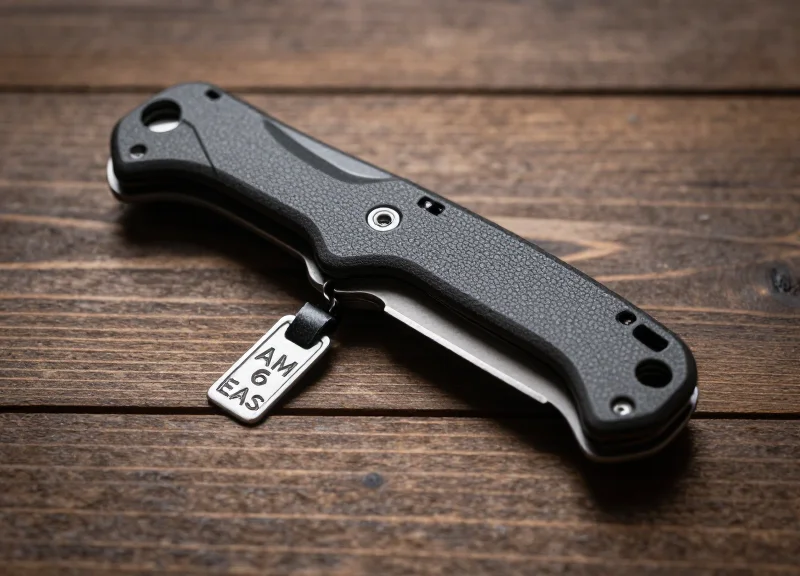
Securing camping knives with 58kHz AM EAS requires a balance between maximum detection and the preservation of the tool's metallurgical integrity. Because high-carbon and stainless steel blades act as magnetic sinks that dampen the resonance of standard AM labels, effective tagging involves placing the tag on the handle or the sheath using 'offset' techniques or specialized foam-backed labels that create a physical air gap between the metal surface and the tag's internal resonator.
| Tagging Location | Signal Performance | Aesthetic Impact | Recommended Tag Type |
|---|---|---|---|
| Blade Flat | Poor (Signal Dampening) | High (Residue/Scratches) | Foam-backed AM Label |
| Handle/Scales | Moderate to Good | Medium (Grip Interference) | Small Profile Hard Tag |
| Kydex/Leather Sheath | Excellent | Low | Standard AM Label or Lanyard Tag |
| Integrated Packaging | Maximum | Zero | Box-integrated Label |
- Surface De-energizing: Before application, ensure the handle or sheath surface is free of factory oils using an electronics-grade isopropyl alcohol wipe to ensure the tag adhesive bonds permanently without sliding.
- Orientation Alignment: Align the long axis of the AM label perpendicular to the length of the blade whenever possible to minimize the 'flux-robbing' effect where the steel absorbs the magnetic pulse.
- Clearance Verification: Ensure the tag does not interfere with the knife's deployment mechanism (for folders) or the friction fit of the sheath (for fixed blades).
Expert Tip: To prevent the 'acid etch' effect often seen with low-quality adhesives on high-carbon steel, use a 'Sacrificial Barrier' approach. Apply a small strip of 1-mil Kapton tape to the handle before placing the EAS label. This polyimide film is chemically inert, heat resistant, and ensures that even if the tag is removed years later, no oxidation or adhesive ghosting will remain on the premium finish.
Will the AM label adhesive damage high-carbon steel?
Standard adhesives can attract moisture, leading to localized oxidation (rust). Using a foam-backed label or an inert barrier film like Kapton prevents this interaction.
Is it better to tag the knife or the box?
Tagging the sheath or handle is preferred because camping knives are often displayed out-of-box in glass cases to allow customers to feel the weight and ergonomics.
Why does the tag fail when placed directly on the blade?
The steel blade acts as a magnetic shunt, redirecting the 58kHz magnetic field away from the tag's amorphous strips, preventing them from vibrating at the required frequency.
The Role of Spacers and Ferrite Materials in Signal Restoration

In the context of 58kHz AM (Acousto-Magnetic) EAS technology, signal restoration is the process of decoupling the tag's internal resonator from the eddy currents induced by a metallic substrate. When an AM tag is placed directly on a conductive surface like a bicycle frame or a camping knife, the metal acts as a 'short circuit' for the magnetic field, preventing the tag from vibrating at its required frequency. To eliminate this signal shielding, engineers employ spacers to provide physical separation or ferrite materials to serve as high-permeability flux concentrators that guide the magnetic field back into the tag's active components.
| Feature | Physical Spacer (Air/Foam) | Ferrite Material Layer |
|---|---|---|
| Primary Mechanism | Inverse Square Law (Distance) | Magnetic Flux Redirection |
| Profile Height | High (usually 3mm - 5mm) | Ultra-Low (0.2mm - 1mm) |
| Cost Impact | Low - Inexpensive materials | High - Rare earth composites |
| Best Use Case | Bicycle handlebars and frames | Flat knife blades and tools |
The 'Unique Insight' for high-performance retail tagging is the 3mm Critical Gap Rule. For standard bicycle parts, a 3mm non-conductive spacer (typically polyethylene foam) is often sufficient to restore up to 85% of the signal's original detection range. However, for high-carbon steel camping knives, a physical spacer of this size is often aesthetically unacceptable. In these instances, a ferrite-backed label is the only viable solution. The ferrite layer acts as a 'magnetic mirror,' reflecting the field back toward the pedestal's receiver and effectively tricking the system into ignoring the presence of the steel blade underneath.
Does the density of the spacer material matter?
Yes. While the primary goal is distance, high-density closed-cell foams are preferred for bicycle parts because they resist compression, ensuring the 'Critical Gap' is maintained even if the product is stacked or handled roughly.
Can I layer multiple ferrite sheets for better performance?
Generally, no. Ferrite materials are engineered to reach a specific saturation point. Adding more layers increases the weight and cost without a linear increase in signal restoration, and can sometimes even shift the resonance frequency away from 58kHz.
Why not use ferrite for all metallic tagging?
Cost is the primary barrier. Ferrite is significantly more expensive than foam spacers. It should be reserved for items where low-profile aesthetics are critical, such as premium cutlery or outdoor gear.
- Assess Surface Conductivity: Identify if the metallic surface is aluminum (highly conductive, requires thicker spacers) or steel (magnetic, requires ferrite for best results).
- Select Restoration Method: Choose between a foam spacer for bulky items like bikes or a ferrite-backed label for slim items like knives.
- Verify Resonant Frequency: After application, use a frequency counter to ensure the tag is still oscillating at exactly 58kHz, as the proximity of metal can slightly 'detune' the tag.
Testing and Calibration: Ensuring Detection Consistency Through Pedestals
Testing and calibration for 58kHz AM (Acousto-Magnetic) systems involve fine-tuning the pedestal's pulse-listen cycle to distinguish the specific resonance of a tag from environmental electromagnetic noise. When dealing with metallic bicycle frames or camping knives, this process is critical because metal objects can distort the magnetic field, creating 'blind spots' where the tag's signal is either absorbed or reflected away from the receiver. Effective calibration ensures that the system maintains a high detection rate across the entire width of the exit, even when the tag is oriented in a non-ideal plane relative to the antenna.
- The Three-Level Walkthrough: Conduct passes at three distinct heights: ankle level (pedal/crankset), waist level (frames/knives in pockets), and shoulder level (handlebars). Metal items often trigger differently based on their proximity to the pedestal's internal induction coils.
- 360-Degree Orientation Test: Rotate the tagged item in 90-degree increments while passing through the center of the pedestals. Tags on metal are most likely to fail when the metal substrate is positioned directly between the tag and the receiving antenna.
- The 'Speed-of-Theft' Stress Test: Test detection at a brisk walking pace or a running pace. AM systems require a specific 'hit count' (usually 3 consecutive pulses) to trigger an alarm; metallic interference can sometimes delay this count, causing a failure at high speeds.
| Calibration Parameter | Adjustment Strategy | Impact on Metallic Inventory |
|---|---|---|
| Sensitivity (Gain Control) | Increase in 5% increments | Compensates for weakened signals reflected from metal surfaces. |
| Noise Threshold | Set 20% above ambient floor | Prevents false alarms caused by metal racks or electronic interference. |
| Pulse Pulse Width | Standard 1.6ms to 1.8ms | Ensures the tag is 'excited' long enough to overcome metal dampening. |
Expert Tip: The 'Shadow Effect' Verification. In twenty years of field audits, the most common failure point we see is the 'Shadow Effect.' When a customer carries a camping knife with the metal blade facing the pedestal and the tag facing their body, the blade acts as a shield. Always calibrate your system using the 'worst-case' orientation—tag facing inward toward the body—to ensure your pedestals are sensitive enough to catch 'shadowed' signals without triggering false alarms from environmental noise.
Why do metallic items often fail to trigger alarms at the center of the aisle?
The center of the aisle is the 'weakest' point of the magnetic field. Metal items further attenuate this weak signal. If failure occurs here, you must either increase the pedestal gain or reduce the aisle width.
How does store-side 'Sync' affect metal detection?
If multiple AM systems in a mall are not synchronized, the 'noise' from a neighboring store can mask the faint signal of a tag attached to a metal bike frame. Ensuring 0-phase synchronization is mandatory for high-metal environments.
Can LED lighting interfere with bike part tagging?
Yes, high-output LED drivers can emit noise at the 58kHz frequency. If you notice detection drops in specific areas of the store, check the proximity of overhead LED ballasts to your pedestals.
Staff Training: Best Practices for Applying and Removing Metal-Safe Tags
Effective staff training for metal-safe tagging centers on two critical pillars: maintaining the 'magnetic air gap' during application and utilizing high-gauss magnetic detachers for removal. Because metallic surfaces act as signal sponges, staff must be taught that placement is a matter of physics, not just aesthetics. Proper training ensures that 58kHz AM signals remain detectable even when protecting high-shrink items like carbon-fiber bike frames or surgical-steel camping knives, while simultaneously reducing friction at the point of sale.
| Operational Phase | Standard Procedure | Metal-Safe Requirement |
|---|---|---|
| Tag Application | Place anywhere visible. | Must utilize ferrite-backed labels or spacers to prevent signal grounding. |
| Tag Removal | Standard magnetic detacher. | High-strength (12,000+ Gauss) detacher to overcome specialized locking clutches. |
| Orientation | Random/parallel to edge. | Perpendicular or offset placement to maximize flux line intersection. |
| Safety Check | Visual confirmation. | Tactile 'tug-test' to ensure hard tags haven't slipped on slick metal surfaces. |
- The 45-Degree Calibration: Train staff to apply tags at a 45-degree angle relative to the longest metallic axis. This maximizes the cross-section of the tag's internal resonator exposed to the pedestal's magnetic field.
- Detacher Alignment Protocol: Metal-safe hard tags often feature reinforced locking mechanisms. Staff must align the tag 'clutch' perfectly with the detacher's core to avoid damaging the locking pin or the product.
- Blade-Safe Handling: For camping knives, staff should always apply the tag near the bolster (where the blade meets the handle) to maintain balance and avoid edge contact during the detachment process.
Expert Tip: The 'Shadow Test'. Instruct your team to visualize the EAS pedestal as a light source. If the tag is hidden behind a thick metal pipe or deep inside a blade sheath, it is 'in the shadow' and won't alarm. Staff should ensure the tag has a 'clear line of sight' to the potential exit path at all times.
Why do standard tags fail on my bicycle inventory?
Standard tags suffer from 'detuning' when placed directly on metal. Without a ferrite buffer or physical spacer, the metal surface absorbs the 58kHz energy, rendering the tag invisible to the system.
Will high-strength detachers damage credit cards?
Yes. Staff must be trained to keep the 12,000+ Gauss detachers at least 12 inches away from POS terminals, credit cards, and hard drives to prevent magnetic data loss.
How do we handle 'tag-switching' on expensive metal parts?
Use 'Inking' metal-safe tags. If a thief attempts to pry the tag off a metallic part, the high-pressure ink vial shatters, marking both the thief and the high-value inventory.
Integrating RFID and EAS: The Future of Metallic Asset Security

Integrating RFID and EAS involves merging the immediate theft-deterrent capabilities of 58kHz Acousto-Magnetic (AM) systems with the granular data tracking of Radio Frequency Identification (RFID) into a single, cohesive security tag. For metallic assets such as high-carbon steel camping knives or aluminum bicycle frames, this dual-technology approach provides a 'Single Point of Truth' for asset lifecycle management. While the AM component triggers a pedestal alarm upon unauthorized exit, the RFID component identifies exactly which SKU—and which specific serial number—is leaving the store, transforming a simple security event into a data-driven inventory update.
| Feature | Standalone AM EAS | Standalone RFID (UHF) | Integrated Hybrid Solution |
|---|---|---|---|
| Primary Objective | Loss Prevention (Deterrence) | Inventory Visibility | Total Asset Intelligence |
| Data Granularity | Binary (Alarm/No Alarm) | Item-level (Serial Number) | Item-level + Real-time Security |
| Metal Performance | Stable with spacers | Requires On-Metal tuning | Optimized dual-cavity design |
| Operational Value | Reduces Shrink | Optimizes Supply Chain | Maximizes ROI & Reduces Phantom Stock |
Expert Insight: Solving the 'Phantom Inventory' Crisis. One of the most significant advantages of integrating RFID with EAS for metallic goods is the elimination of 'Phantom Inventory.' In high-end bicycle retail, a stolen $5,000 alloy frame that remains in the digital inventory system prevents the automated reorder trigger, leading to lost sales opportunities. An integrated system captures the specific ID of the item as it passes the EAS pedestals, immediately flagging the unit as 'Stolen' in the ERP. This ensures that the stock levels remain 100% accurate without manual cycle counts, effectively turning your security gate into an automated inventory auditor.
Can a single tag housing both technologies still function on metal?
Yes, but it requires a 'Dual-Isolation' design. The tag must use a ferrite shield for the 58kHz AM resonator and an air-gap or specialized foam spacer for the UHF RFID inlay to prevent the metallic surface from detuning the antennas.
Is the infrastructure cost-effective for camping gear?
While hybrid tags are more expensive than standard labels, the ROI is realized through reduced labor costs in inventory counting and the prevention of high-value 'sweeps' where multiple professional camping knives are stolen at once.
How does the software handle dual signals?
Modern cloud-based platforms correlate the EAS alarm timestamp with the RFID 'last seen' event at the portal, allowing managers to view video footage of the specific theft event identified by the RFID data.
As we look toward the future of retail for technical outdoor gear, the convergence of these technologies will move beyond the store. Future metallic-safe tags will likely incorporate Bluetooth Low Energy (BLE) alongside AM and RFID, allowing for 'find-me' functionality within a warehouse for specific serialized bicycle parts, further bridging the gap between loss prevention and logistics efficiency.