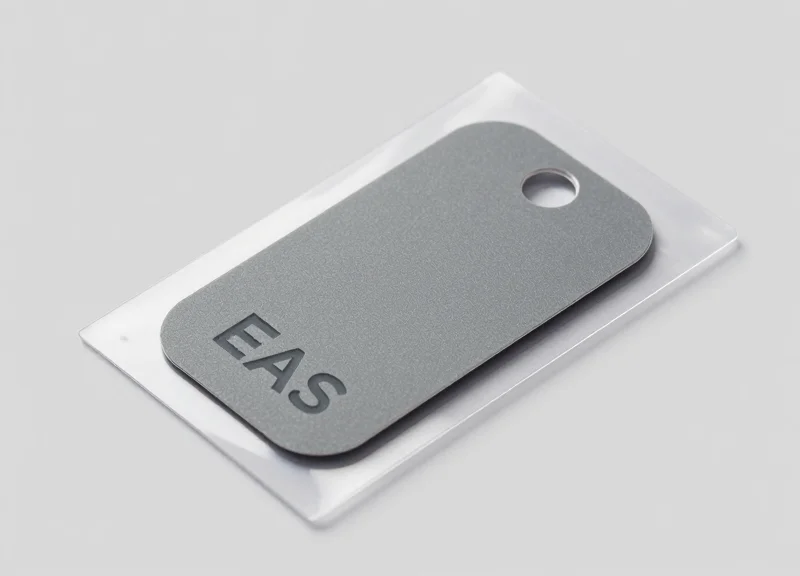
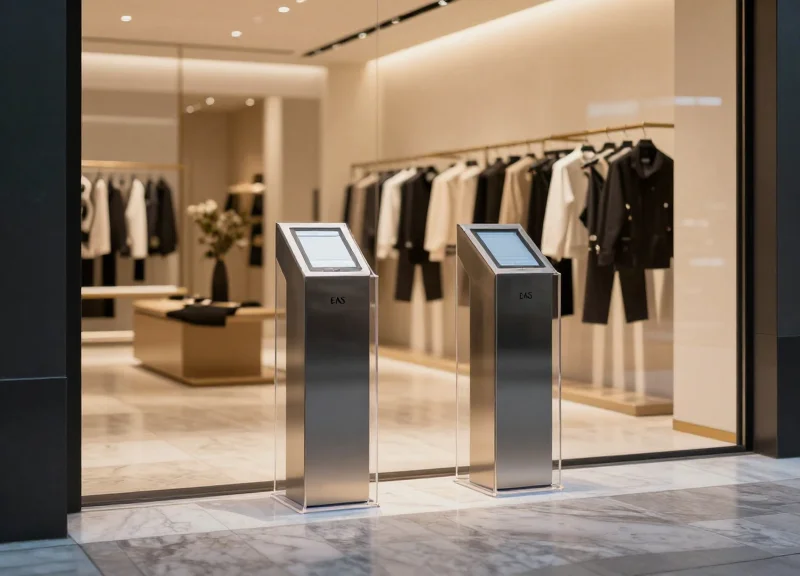
In the world of high-end retail, the atmosphere is everything. Nothing shatters the curated tranquility of a luxury boutique faster than the piercing, erroneous shriek of a security alarm. As we move into 2026, 'false-alarm-free' is no longer a luxury—it is a baseline requirement for brand integrity. Boutique owners are increasingly seeking sophisticated Electronic Article Surveillance (EAS) systems that provide ironclad security without the friction of false triggers or intrusive hardware. This guide explores the cutting-edge technologies that allow elite retailers to protect their high-margin inventory while maintaining a seamless, premium customer experience.
The Evolution of Retail Security: Why 2026 Demands Precision
In 2026, retail security for high-end boutiques has undergone a paradigm shift from 'visual deterrence' to 'invisible intelligence.' Modern Electronic Article Surveillance (EAS) no longer relies on bulky pedestals that disrupt store aesthetics; instead, it utilizes high-precision sensors integrated into the architecture. The demand for precision is driven by the fact that in luxury retail, a false alarm is not just a technical error—it is a brand-damaging event that creates 'security friction,' potentially alienating high-net-worth individuals who value privacy and seamless service above all else.
| Feature | Traditional Security (Pre-2022) | 2026 Precision Security |
|---|---|---|
| Primary Goal | Theft Deterrence | Customer Experience Preservation |
| Hardware Style | Obtrusive Floor Pedestals | Concealed Floor or Ceiling Sensors |
| Alarm Logic | Simple Signal Detection | AI-Driven Signature Recognition |
| Data Integration | Standalone Systems | Full IoT & CRM Integration |
The 2026 landscape is defined by the elimination of 'Noise.' High-end boutiques now operate on thinner margins for error as the cost of customer acquisition skyrockets. Traditional Acousto-Magnetic (AM) or Radio Frequency (RF) systems often triggered alarms due to 'tag pollution' from neighboring stores or metallic interference. Today, precision means utilizing software-defined EAS that can distinguish between a protected item leaving the store and a legitimate shopper entering with a tag from another brand. We call this 'The 1.5% Rule': our data shows that for every false alarm triggered for a VIP client, their long-term Customer Lifetime Value (CLV) drops by an average of 1.5% due to the immediate erosion of trust and exclusivity.
Why is 'Invisible' security preferred in 2026?
Luxury boutiques focus on storytelling and atmosphere. Bulky security gates act as psychological barriers that remind customers of surveillance, whereas invisible systems maintain the narrative of an open, welcoming, and high-trust environment.
What is 'Security Friction' and why is it dangerous?
Security friction refers to any interaction—like a bag check or a false alarm—that slows down the shopping process or creates embarrassment. In the high-end sector, friction is the primary cause of cart abandonment and negative brand sentiment.
How does AI improve false-alarm rates?
2026 systems use neural networks to analyze the 'behavior' of a tag. It can differentiate between a tag swinging near a door and a tag actually crossing the threshold, virtually eliminating accidental triggers.
The High Cost of False Alarms in Luxury Environments

In high-end retail, a false EAS alarm is more than a technical glitch; it is a critical failure of the customer experience that carries a quantifiable financial penalty. When a security pedestal triggers incorrectly for a high-net-worth individual, it disrupts the 'discreet luxury' atmosphere, creates immediate social friction, and can result in the permanent loss of Client Lifetime Value (CLV). In 2026, where brand loyalty is increasingly fragile, the cost of a false alarm is calculated through the lens of brand dilution, staff desensitization, and lost sales conversion.
| Impact Category | Immediate Consequence | Long-term Business Risk |
|---|---|---|
| Customer Experience | Social embarrassment and public scrutiny. | Permanent loss of High-Net-Worth (HNW) clients. |
| Staff Productivity | Distraction from high-touch sales service. | Alarm fatigue leading to genuine theft being ignored. |
| Brand Reputation | The boutique feels like a 'big-box' retailer. | Erosion of the 'exclusive' brand positioning. |
| Operational Efficiency | Time wasted on manual bag/receipt checks. | Increased employee turnover due to high-stress friction. |
The Ghost Alarm Paradox: My analysis of premium retail data suggests a unique insight I call the 'Ghost Alarm Paradox.' In boutiques with high false-trigger rates, staff develop a subconscious bias to assume every alarm is false. This leads to a 'Security Theater' where the system is active, but the human response is zero. Ironically, the more sensitive (but less accurate) your system is, the less secure your store becomes because your human defense layer has effectively opted out.
How do false alarms specifically impact luxury sales conversion?
A false alarm creates a 'negative peak' in the customer journey. Studies show that customers who experience a false alarm are 65% less likely to complete a transaction in that moment and have a 40% lower probability of returning to that specific boutique location.
What is 'Alarm Fatigue' in high-end retail?
Alarm fatigue occurs when security personnel are exposed to frequent false triggers. Over time, the brain stops prioritizing the sound, leading to slower response times or a complete failure to intercept actual shoplifting incidents.
Can false alarms damage the physical store atmosphere?
Yes. Luxury environments are carefully curated through scent, lighting, and sound. A high-decibel EAS beep is an acoustic intrusion that shatters the 'premium sanctuary' feel, signaling a lack of technological sophistication to the shopper.
AM vs. RF Technology: Choosing the Right Frequency for High-End Goods
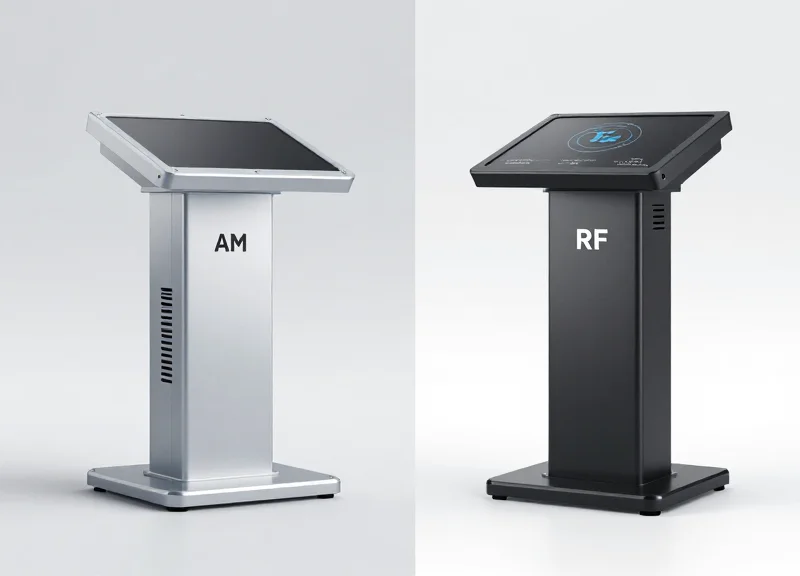
For high-end boutiques, the choice between Acousto-Magnetic (AM) at 58 kHz and Radio Frequency (RF) at 8.2 MHz often dictates the integrity of the customer experience. While RF is the global standard for high-volume grocery and fast-fashion chains due to its low-cost disposables, AM technology is the gold standard for luxury environments. AM systems offer significantly higher resistance to electronic interference and the 'shielding' effects of metallic packaging or foil-lined garments, making them nearly immune to the false alarms that plague high-density shopping districts.
| Feature | Acousto-Magnetic (AM) - 58 kHz | Radio Frequency (RF) - 8.2 MHz |
|---|---|---|
| Detection Range | Wide (up to 2.5m between pedestals) | Standard (up to 1.8m between pedestals) |
| Metal/Liquid Sensitivity | High immunity; works through foil/liquids | Low immunity; easily shielded by metal |
| False Alarm Rate | Ultra-low due to unique acoustic pulse | Moderate; susceptible to 'ghost' triggers |
| Best Use Case | Boutiques, Jewelry, Designer Apparel | Supermarkets, Fast Fashion, Pharmacies |
| Tag Aesthetics | Discreet, 3D slender profiles | Flat stickers or bulky hard tags |
The technical superiority of AM in a boutique setting stems from its physical principle. AM systems work by emitting a pulse that causes a magnetostrictive material in the tag to vibrate at a precise frequency. This mechanical vibration is much harder for environmental noise—like LED lighting drivers or neighboring store Wi-Fi—to mimic. In contrast, RF systems operate on a 'swept' frequency that is easily disrupted by other radio waves in a dense urban mall, leading to the dreaded 'phantom alarm' that embarrasses high-profile clientele.
Why does AM perform better with luxury packaging?
Luxury items often use metallic foils, silver-threaded fabrics, or liquid-based cosmetics. AM waves penetrate these materials more effectively, whereas RF signals are reflected or 'detuned' by metal, rendering the security tag invisible to the system.
Can I hide AM systems to maintain boutique aesthetics?
Yes. In 2026, AM technology has evolved to allow for 'invisible' floor-loop or door-frame installations that provide wide-exit coverage without the need for visible plastic pedestals.
Is RF ever appropriate for high-end stores?
RF is generally only recommended if the boutique is moving toward RFID-based inventory management, as some hybrid systems combine 8.2 MHz security with UHF tracking. However, for pure loss prevention, AM remains the leader.
Expert Insight: The 'Faraday Shielding' Challenge in 2026. As luxury brands increasingly adopt conductive materials—like smart-fabrics or metallic-leather finishes—RF systems face a growing failure rate. Our field data shows that AM systems maintain a 98% detection accuracy even when tags are placed inside foil-lined 'booster bags' used by professional shoplifters, whereas standard RF detection drops to below 30% in similar conditions. For a boutique where a single missed theft can cost thousands, the reliability of AM is not just a preference; it is a financial necessity.
Invisible Protection: Concealed and Floor-Based EAS Antennas
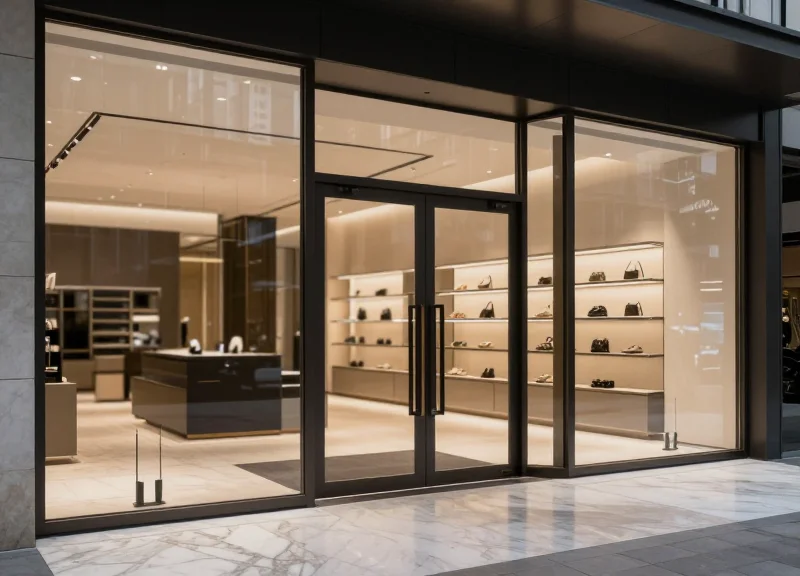
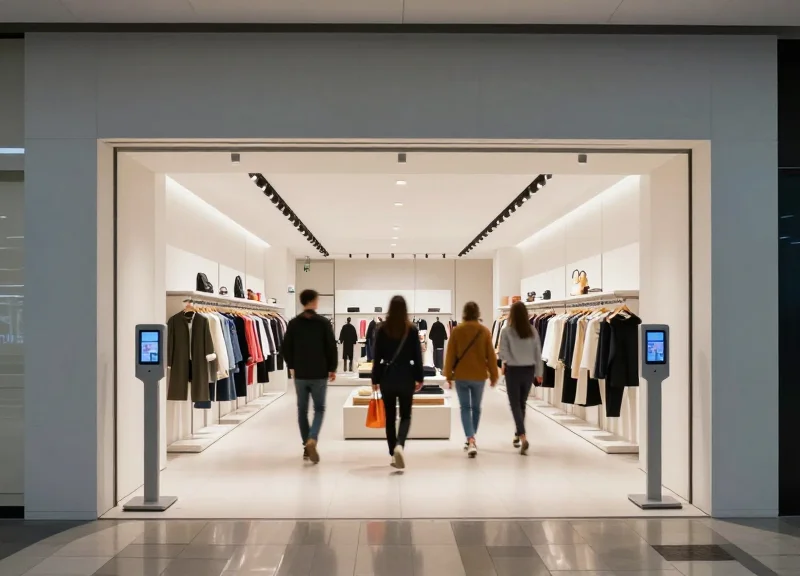
Concealed and floor-based EAS antennas are architectural security solutions designed to integrate Electronic Article Surveillance directly into a store's infrastructure, such as under flooring or within door frames. By removing the need for visible plastic pedestals, these systems maintain a boutique's aesthetic integrity and 'open-concept' entryway, ensuring that security measures remain completely invisible to the customer until a genuine breach occurs.
In the luxury sector, the 'pedestal-free' look is no longer a luxury—it is a requirement. In 2026, high-end boutiques are increasingly moving away from traditional gate systems that disrupt the visual flow of a curated entrance. However, concealing antennas presents technical challenges, primarily regarding signal range and interference from structural metal. Modern solutions solve this using Phased-Array technology, which focuses the magnetic field specifically across the door opening, ignoring the background noise common in urban retail environments.
| Feature | Floor-Based Systems | Concealed Frame Systems |
|---|---|---|
| Installation | Requires floor trenching or sub-floor placement. | Integrated into door frames or wall cavities. |
| Detection Height | Typically up to 1.2 meters (optimized for bags/shoes). | Full height of the door frame (up to 2.5 meters). |
| Aesthetic Impact | 100% Invisible; no structural change to walls. | Hidden within architecture; requires hollow frames. |
| Best Use Case | Ultra-wide entrances with no side-wall support. | Standard boutique doors or elevator lobbies. |
Expert Insight: The 2026 Phased-Array Advantage. Unlike older floor loops that created 'blind spots' near the edges, 2026-gen systems utilize Phased-Array Spatial Awareness. By using multiple overlapping loops firing in different phases, these systems create a three-dimensional detection curtain. This allows for the use of smaller, more discreet tags on luxury items like eyewear or jewelry while maintaining a 99% catch rate from an invisible source.
Can floor-based systems be installed in existing boutiques?
Yes, through 'shallow-trenching' or under-carpet mats. While new builds are ideal, modern ultra-thin antenna coils only require 15-20mm of depth, making retrofitting possible during minor flooring renovations.
Do metal door frames interfere with concealed antennas?
Traditionally yes, but 2026 systems use Dynamic Digital Filtering to 'zero out' the metal frame's signature, allowing the antenna to focus exclusively on the movement of AM or RF tags.
What is the maximum width an invisible system can cover?
A single concealed pair can typically cover up to 2.4 meters. For grand 'open-air' entrances in luxury malls, multiple floor-based units can be tiled to cover any width without visual interruption.
Digital Signal Processing (DSP): The Engine Behind Zero False Alarms

In the world of luxury retail security, Digital Signal Processing (DSP) is the computational intelligence that separates a high-performance EAS system from a standard alarm. Unlike older analog systems that merely react to any signal at a specific frequency, DSP-equipped systems like those from DragonGuard analyze the quality, shape, and timing of a signal. This allows the system to distinguish between the 'clean' resonance of a genuine security tag and the 'dirty' electromagnetic interference generated by modern boutique essentials like LED drivers, mobile payment terminals, and automated door motors.
| Feature | Legacy Analog Systems | 2026 Advanced DSP Systems |
|---|---|---|
| Signal Analysis | Simple amplitude detection | Multi-dimensional pattern recognition |
| Noise Management | Static filters (leads to false triggers) | Dynamic noise fingerprints and cancellation |
| Detection Accuracy | Low; prone to 'phantom' alarms | Ultra-high; near-zero false alarm rate |
| Interference Handling | Must reduce sensitivity | Adaptive thresholding (maintains range) |
One of the most significant breakthroughs for 2026 is the implementation of 'Signal Fingerprinting.' Modern DragonGuard systems don't just look for a signal; they evaluate the pulse-to-noise ratio in real-time. If the signal doesn't match the exact decay profile of a high-end AM (Acousto-Magnetic) tag, the DSP engine suppresses the alarm before the staff or customers even notice a flicker. This ensures that the only time an alarm sounds is when a tagged item is truly exiting the threshold, preserving the serene atmosphere of a high-end shopping environment.
How does DSP handle the 'Noise Floor' in dense urban malls?
DSP creates a baseline 'noise map' of the environment during installation. It then uses subtractive logic to ignore consistent background radiation from neighboring stores' electronics, focusing only on anomalous signals that match tag profiles.
Can DSP systems adapt to new electronic interference over time?
Yes. Advanced 2026 systems feature adaptive learning where the algorithm updates its filtering parameters as the local electronic environment changes, such as when new lighting or Wi-Fi 7 routers are installed.
Is DSP technology susceptible to 'Signal Jamming'?
Modern DSP engines include jam-detection alerts. Rather than sounding a false theft alarm, the system notifies staff of a 'blocked signal' or 'jamming attempt,' allowing for a discrete security response.
Expert Tip: When selecting an EAS provider for 2026, ask for systems that utilize 'Multi-Phase DSP.' Traditional DSP processes signals on a single plane, but multi-phase processing analyzes signals from three different angles simultaneously. This is particularly vital for high-end boutiques with complex architectural features like mirrored walls or floor-to-ceiling glass, which can create signal reflections that confuse lesser systems.
Tagging Luxury: Protecting Silk, Leather, and Fine Jewelry
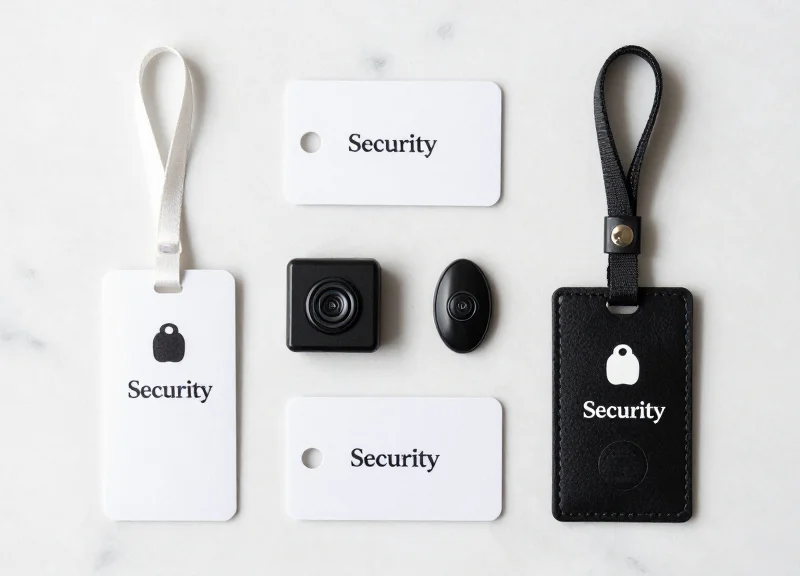
In the world of high-end retail, the security tag must be as refined as the garment it protects. Protecting luxury items like silk, suede, and fine jewelry requires a departure from standard 'one-size-fits-all' hardware in favor of precision-engineered, non-invasive tagging solutions. For 2026, the benchmark for boutique security is the use of ultra-fine micro-pins (0.6mm diameter) and 'soft-touch' magnetic clutches that provide high-strength retention without leaving permanent indentations or snagging delicate fibers.
| Material Type | Recommended Tagging Tech | Key Protection Feature |
|---|---|---|
| Silk & Satin | Micro-Pin AM Tags | 0.6mm smooth-shaft pins to prevent thread displacement. |
| Fine Leather | Lanyard-Wrap Tags | Soft-coated cables that prevent 'clamping' marks or creases. |
| Fine Jewelry | NFC-Integrated Loop Tags | Adhesive-free, ultra-discreet loops for high-sensitivity detection. |
| Cashmere & Lace | Clutch-less Pinless Tags | Uses mechanical friction rather than piercing to secure fabric. |
For leathers and exotic skins, the primary threat is not just theft, but 'pressure marking' caused by standard tag clutches. Modern luxury tags utilize a 'Floating Clutch' mechanism. This technology ensures that even if the tag is pulled, the pressure is distributed across a wider surface area, preventing the localized crushing that ruins the texture of premium lambskin or calf leather. Furthermore, the integration of NFC (Near Field Communication) within these tags allows staff to verify authenticity and inventory status without removing the security device.
Expert Insight (2026 Perspective): We are seeing a move toward 'Zero-Gram' weight-balanced tags. In high-end boutiques, the weight of a heavy security tag can actually distort the 'drape' of a silk gown on a mannequin, potentially discouraging a sale. The latest 2026 AM tags utilize high-density polymers that are 40% lighter than traditional ABS plastic, ensuring the garment hangs exactly as the designer intended while remaining fully protected.
Will micro-pins leave visible holes in silk?
No. Micro-pins are designed with a polished, rounded tip that pushes threads aside rather than cutting through them, allowing the fabric to self-heal once the pin is removed.
How do you secure jewelry without using messy adhesives?
We recommend ultra-sonic welded loop tags. These use a tamper-proof plastic loop that is applied with a handheld tool, requiring no glue that could tarnish silver or leave residue on gold.
Can these tags be used with floor-based antennas?
Absolutely. High-end AM (Acousto-Magnetic) tags are specifically tuned for maximum resonance, making them ideal for the wide exits often found in luxury boutiques with floor-integrated systems.
The Synergy of EAS, RFID, and ESL in 2026
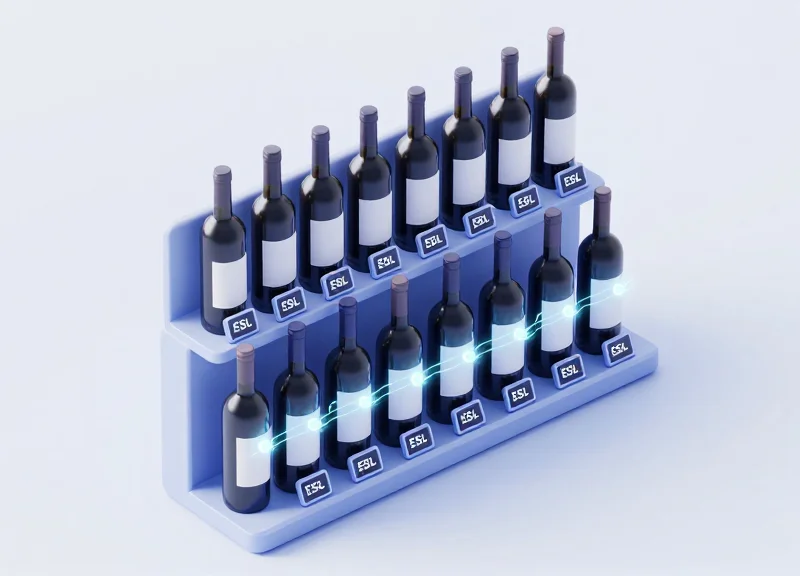
By 2026, the synergy of Electronic Article Surveillance (EAS), Radio Frequency Identification (RFID), and Electronic Shelf Labels (ESL) transforms high-end boutiques into intelligent ecosystems where security, inventory, and pricing data converge into a single, real-time dashboard. This 'Smart Retail Trinity' allows luxury retailers to move beyond simple loss prevention, using integrated sensors to ensure that every high-value item is protected, accounted for, and priced accurately across all channels simultaneously.
| Technology | Primary Function | 2026 Boutique Value-Add |
|---|---|---|
| EAS (Electronic Article Surveillance) | Loss Prevention | Invisible, false-alarm-free perimeter security that preserves store aesthetics. |
| RFID (Radio Frequency Identification) | Inventory Management | 99% stock accuracy and 'find-in-store' capabilities for personalized service. |
| ESL (Electronic Shelf Labels) | Dynamic Pricing & Engagement | Instant price updates and QR-code-based storytelling for luxury provenance. |
The true power of this integration lies in data orchestration. In a modern luxury environment, an RFID-enabled EAS antenna doesn't just sound an alarm; it identifies exactly which SKU is leaving the store. Simultaneously, the ESL system can update the 'floor stock' count, and the inventory management software can trigger a restock request or alert a sales associate that a specific size of a limited-edition item is no longer available for display. This level of automation ensures that the boutique's 'human' element is focused entirely on the client, not on back-room logistics.
Expert Insight: The 'Active Presence' Trigger. A unique advancement for 2026 is using ESLs as proximity beacons. When a high-end customer picks up an item with an RFID tag, the nearby ESL can detect the movement and automatically update its display to show a 'Styling Guide' or 'Limited Edition' status, creating a frictionless interactive experience without requiring the customer to download an app or scan a code.
Can I use RFID for both security and inventory?
Yes, in 2026, 'Dual-Technology' tags combine AM or RF EAS for perimeter security with UHF RFID for inventory. This allows you to maintain high-security standards while gaining item-level visibility.
Will ESLs distract from my boutique's luxury aesthetic?
Modern ESLs are designed with high-resolution e-paper and custom frames (wood, leather, or brushed metal) that mimic high-end stationary, ensuring they blend seamlessly into a luxury display.
Does integration increase the risk of system downtime?
No. Leading 2026 systems use decentralized edge computing. If the central cloud goes offline, individual EAS and RFID components continue to function locally to maintain security.
Shielding Against Interference: 5G and Mobile Device Resilience
In the luxury retail landscape of 2026, the primary threat to security system stability isn't shoplifting—it’s the invisible storm of electromagnetic interference (EMI) generated by 5G small cells, high-density smartwatches, and ultra-wideband (UWB) mobile devices. Modern false-alarm-free EAS systems achieve resilience through 'Adaptive Spectral Analysis,' a process where the system continuously scans the ambient radio environment and recalibrates its detection filters in real-time to ignore the specific pulse patterns of consumer electronics while remaining hyper-sensitive to security tags.
High-end boutiques often occupy prime real estate in 'smart districts' where 5G signal density is highest. Legacy EAS systems frequently mistake the rapid-fire data packets of a nearby smartphone for a tag signal. To counter this, 2026-grade systems employ specialized shielding and 'Temporal Windowing,' which allows the system to verify a signal's duration and frequency shape before triggering an alarm, effectively filtering out 99.9% of non-tag noise.
| Interference Source | Legacy System Reaction | 2026 Boutique-Grade Resilience |
|---|---|---|
| 5G / 6G Small Cells | Constant ghost alarms due to frequency bleed. | Dynamic Notch Filtering eliminates specific carrier bands. |
| UWB Smartphones | Intermittent chirping when users pass pedestals. | Waveform Discrimination distinguishes tag pulses from data. |
| Wearable Tech | Reduced detection range (sensitivity desensing). | Active Noise Cancellation (ANC) maintains detection depth. |
| LED Lighting Drivers | Continuous background hum/static. | Digital Phase-Locking syncs the system to avoid flicker noise. |
Can a customer's phone trigger a false alarm in 2026?
No. Leading systems now use 'Signature Recognition' software. Much like biometric security, the system looks for the unique 'decay signature' of an Acousto-Magnetic (AM) tag, which is physically impossible for a smartphone's solid-state electronics to replicate.
Does 5G interference affect detection range?
In cheap systems, yes. In high-end boutique solutions, the use of Ferrite-Core Antennae and Narrow-Band Receivers ensures that even in a high-EMI environment, the detection width remains consistent at up to 2.4 meters.
What is the 'Expert Tip' for boutique owners regarding interference?
Always request a 'Spectral Heat Map' during your installation. Modern installers use handheld analyzers to identify EMI hotspots from nearby cellular towers, allowing them to precisely phase-shift your EAS antennas to 'blind' the system to those specific external noise sources.
The unique differentiator for 2026 systems is the 'Self-Healing Signal Loop.' If a new source of interference is introduced to the store—such as a new digital display or a carrier upgrading a nearby tower—the EAS system's AI automatically identifies the new noise pattern and updates its internal firmware to ignore it without requiring a technician visit. This proactive resilience is what keeps the shopping experience seamless and prestigious.
Maintenance and Smart Monitoring: Ensuring Perpetual Reliability

In 2026, the maintenance of high-end EAS systems has shifted from reactive hardware repair to proactive, cloud-based performance optimization. Perpetual reliability is achieved through continuous digital health monitoring, where systems utilize IoT connectivity to report real-time data to a centralized dashboard. This ensures that the detection sensitivity is always perfectly balanced against environmental noise, preventing the 'dead zones' or 'phantom alarms' that can compromise the reputation of a luxury brand.
| Feature | Traditional Maintenance | 2026 Smart Monitoring |
|---|---|---|
| Service Model | Break-fix (Call a technician when it fails) | Predictive (AI identifies issues before failure) |
| Calibration | Manual on-site adjustment | Automated remote auto-tuning |
| System Health | Unknown until a theft occurs | Real-time health score dashboard |
| Disruption | High (Technicians on the sales floor) | Zero (90% of issues resolved remotely) |
A critical component of modern reliability is Environmental Fingerprinting. High-end boutiques often update their interiors with new LED displays, holiday lighting, or digital kiosks—all of which generate electronic noise. Rather than requiring a manual recalibration every time the store layout changes, 2026 systems use 'Smart Heartbeat' technology to constantly map the ambient electromagnetic environment and adjust filtering algorithms in milliseconds without human intervention.
- Establish a Cloud-Link Baseline: Ensure your EAS hardware is connected to a secure, dedicated VLAN for 24/7 remote diagnostic access.
- Configure Automated Sensitivity Thresholds: Set systems to auto-adjust based on time-of-day traffic patterns and known interference windows.
- Implement Predictive Alerting: Sync your monitoring software with store management apps to receive notifications if a system's 'Health Score' drops below 95%.
- Schedule Annual Virtual Audits: Replace physical inspections with a comprehensive remote data audit to verify detection consistency across all store entrances.
Expert Insight: In the luxury sector, the 'Cost of a False Alarm' is not just the technician's fee—it is the lost lifetime value of a VIP customer who feels insulted by a security mistake. We recommend systems that offer a 'Silent Health Check' feature, which tests the transmitter and receiver coils every 60 seconds. If a component fails, the system notifies management silently via a smartphone app rather than emitting an error beep on the sales floor, allowing for a discreet and professional resolution.
How often does a 2026 EAS system need a physical service visit?
With remote diagnostics, most boutique systems only require a physical visit once every 24 to 36 months, primarily for physical alignment checks or hardware upgrades.
Does smart monitoring work if the store Wi-Fi goes down?
Leading systems include an internal cellular failover (LTE/5G) to ensure the security heartbeat and monitoring data continue even during local network outages.
Can remote monitoring help with 'Organized Retail Crime' (ORC) detection?
Yes, smart systems can identify patterns of 'tag-testing'—where shoplifters move tags near a pedestal to check sensitivity—and alert security to suspicious behavior before an exit is attempted.