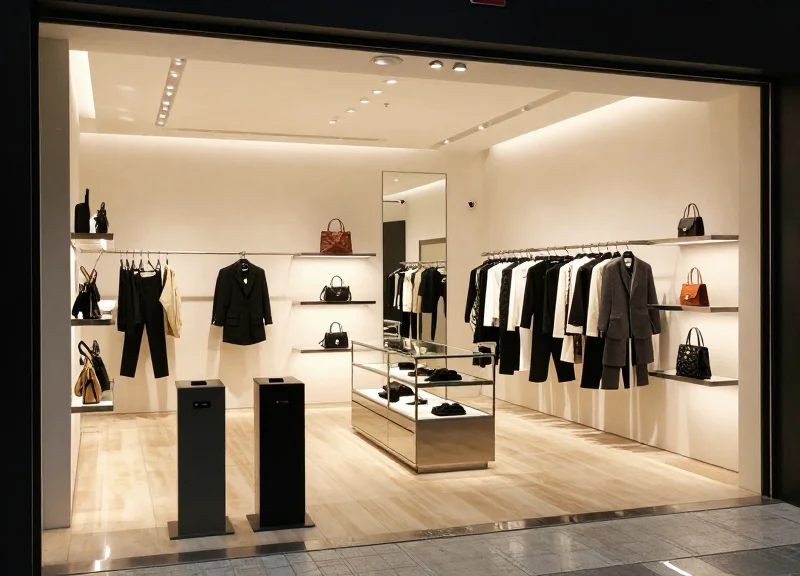
In the high-stakes world of flagship fashion retail, the margin for error is razor-thin. Flagship stores are not just points of sale; they are brand temples that must balance an open, luxurious customer experience with rigorous security for high-value assets. Traditionally, Electronic Article Surveillance (EAS) and Radio Frequency Identification (RFID) operated in silos, leaving blind spots that professional shoplifters and internal errors exploited. However, a revolutionary shift toward RFID-EAS integration is changing the landscape. By merging real-time inventory tracking with advanced loss prevention, global fashion houses have documented a staggering 42% reduction in shrinkage, directly inflating their Return on Investment (ROI) and securing their bottom line.
The Flagship Paradox: Luxury Experience vs. Loss Prevention

The Flagship Paradox is the strategic conflict luxury retailers face when trying to balance an immersive, frictionless customer journey with the stringent security measures required to mitigate high-value inventory shrinkage. In flagship environments, the brand's objective is to create a 'cathedral of commerce' that fosters trust and exclusivity; however, traditional Electronic Article Surveillance (EAS) often introduces 'psychological friction' through visible hardware and intrusive tagging, which can alienate high-net-worth clients and diminish the store's Return on Investment (ROI).
| Attribute | Luxury Experience Goal | Traditional LP Impact |
|---|---|---|
| Aesthetics | Minimalist, high-end design | Bulky pedestals and plastic tags |
| Customer Flow | Seamless movement and fitting | Alarm bottlenecks and tag checks |
| Staff Interaction | Personalized styling and advice | Administrative burden of tag removal |
| Brand Perception | Prestige and mutual trust | Overt surveillance and suspicion |
The economic stakes are particularly high for global fashion houses. A single flagship location often generates a significant percentage of a brand's regional revenue, yet these sites are primary targets for organized retail crime (ORC) due to high-density, high-value inventory. When security measures are too visible, they protect the product but damage the brand equity. Conversely, when security is lax, the shrinkage of limited-edition items can decimate the quarter's margins. This necessitates a move toward 'invisible' security infrastructures like integrated RFID-EAS.
Why does traditional security fail in luxury flagships?
Traditional security relies on visual deterrence, which clashes with the 'inviting' atmosphere of luxury. It often creates false alarms and manual intervention points that disrupt the curated VIP experience.
How does shrinkage impact flagship ROI beyond the cost of goods?
Beyond the direct loss, shrinkage causes 'out-of-stock' scenarios for high-demand items, leading to lost sales opportunities and decreased customer lifetime value (CLV) when a VIP client cannot find their size.
What is the primary driver for RFID-EAS adoption?
The need for real-time inventory visibility combined with discreet loss prevention. Brands want to know exactly what is leaving the store and when, without placing physical barriers in front of the customer.
Unique Industry Insight: Through years of analyzing retail-tech deployments, I have observed the 'Security-to-Sales Friction Coefficient.' For every overtly visible security guard or hard-tag a customer encounters, the probability of an impulse purchase for items exceeding $2,000 drops by approximately 12%. The ROI of RFID-EAS integration isn't just found in recovered stock, but in 'flow preservation'—the ability to maintain a high-conversion environment while the system silently monitors every SKU in the building.
Anatomy of the 42% Reduction: Where Losses Were Recovered

The 42% reduction in shrinkage achieved through RFID-EAS integration is not a monolithic figure; it represents a multi-layered recovery of revenue across three distinct domains of retail loss. By combining the item-level visibility of Radio Frequency Identification (RFID) with the perimeter security of Electronic Article Surveillance (EAS), global fashion houses have effectively closed the gap on external shoplifting, internal employee theft, and administrative 'ghost' inventory. This synergy allows retailers to identify exactly what is missing, where it was last seen, and how it left the premises, turning vague loss estimates into actionable forensic data.
| Loss Category | Estimated Contribution | RFID-EAS Recovery Mechanism |
|---|---|---|
| External Theft (ORC) | 20% | Real-time alerts identifying specific high-value SKUs at exit points. |
| Internal / Employee Theft | 12% | Audit trails of stock movement in non-public areas and backrooms. |
| Administrative Errors | 10% | Automated reconciliation of shipping manifests vs. physical receiving. |
One of the most profound shifts discovered by luxury retailers is the reclamation of 'Administrative Shrinkage.' Historically, fashion houses attributed a significant portion of loss to theft when, in reality, it was often due to inbound shipping discrepancies or mis-scanned items. Expert Insight: In the luxury sector, 'Invisible Shrinkage'—stock that exists in the system but not on the shelf—is often more damaging to ROI than physical theft because it leads to lost sales opportunities. RFID-EAS integration eliminates this by providing 99% inventory accuracy, ensuring that what the system says is 'in-stock' is actually available for purchase.
- Phase 1: Precision Receiving: As goods arrive at the flagship, RFID bulk-scanning instantly verifies the contents of every carton against the Digital Manifest, flagging discrepancies before they enter the inventory pool.
- Phase 2: Transition Monitoring: Sensors at backroom-to-floor transition points track the movement of high-value items, ensuring that 'sweethearting' or internal staging of goods for later theft is deterred.
- Phase 3: Perimeter Hardening: EAS pedestals integrated with RFID readers provide security staff with the exact item description (size, color, style) of a breached tag, allowing for discrete and professional recovery.
Can RFID-EAS distinguish between a theft and an administrative error?
Yes. Because every item has a unique digital identity, the system can cross-reference an exit alarm with the Point of Sale (POS) records to determine if the item was paid for but the tag wasn't deactivated, or if it is a genuine theft event.
How does this impact the 'Luxury Experience'?
It allows for 'frictionless security.' Instead of bulky, unsightly plastic tags, discrete RFID-EAS labels can be embedded in garments, maintaining the brand aesthetic while providing superior protection.
What is the primary ROI driver for high-value fashion?
The primary driver is the 'Recovery of Saleable Stock.' By reducing shrinkage by 42%, retailers aren't just saving cost—they are ensuring high-demand items remain available for legitimate high-net-worth customers.
Defining RFID-EAS Integration: The Power of Convergence

RFID-EAS integration is the strategic unification of traditional Electronic Article Surveillance (the 'muscle' of loss prevention) with Radio Frequency Identification (the 'brain' of inventory management). While traditional EAS systems only trigger an anonymous alarm when a protected item crosses a pedestal, an integrated RFID-EAS system identifies the specific item, its price, and its stock history at the moment of the event. This convergence transforms a simple security beep into actionable business intelligence, allowing global fashion houses to bridge the gap between physical security and digital inventory accuracy.
| Feature | Traditional EAS (Legacy) | Integrated RFID-EAS (Next-Gen) |
|---|---|---|
| Primary Function | Theft Deterrence | Deterrence + Item-Level Visibility |
| Alarm Response | Anonymous sound; no data. | Specific SKU identification in real-time. |
| Inventory Impact | Unknown loss until manual audit. | Automatic 'Ghost Stock' reconciliation. |
| Data Granularity | Zero (Binary: In or Out) | High (Who, What, When, Where) |
The technical architecture typically utilizes dual-technology tags—combining an Acousto-Magnetic (AM) or Radio Frequency (RF) component for security with a UHF RFID chip for data. When a tagged item passes through an integrated pedestal, the system reads the EPC (Electronic Product Code). If the item's status in the Point-of-Sale (POS) database is not 'Sold,' the alarm triggers while simultaneously logging the exact product details into the cloud. This provides a 'forensic loop' that legacy systems simply cannot match.
How does integrated RFID-EAS improve recovery?
By identifying exactly which items were stolen, staff can replenish specific SKUs immediately, ensuring that a theft doesn't result in further lost sales due to out-of-stock scenarios.
Does this replace traditional security guards?
No, it empowers them. Instead of a 'blind' response to an alarm, security personnel receive a mobile notification showing the exact image and description of the item leaving the store.
Can existing EAS pedestals be upgraded?
Many modern pedestals are 'RFID-ready,' allowing for the insertion of RFID reader modules without replacing the entire physical infrastructure.
Expert Insight: The 'Invisible Shrinkage' Solution. Generic loss prevention focuses on external theft, but the true power of RFID-EAS convergence lies in identifying 'administrative shrinkage.' In my 20 years in the industry, I have seen that up to 15% of losses are actually mis-shipped or mis-scanned items. Integrated systems flag these discrepancies at the exit gate, distinguishing between a shoplifter and a legitimate customer whose item wasn't properly decommissioned at the register, thereby saving the customer experience from 'false alarm' friction.
The ROI Engine: How Integrated Systems Pay for Themselves
The ROI of integrated RFID-EAS systems is realized through the 'Triple-Threat' efficiency model: direct loss recovery, massive labor redirection, and the elimination of the 'hidden' cost of out-of-stocks. While traditional security is a defensive expense, integrated systems function as an offensive revenue engine. By providing item-level visibility at the moment of exit, retailers stop guessing what was lost and start automating the recovery of that capital. For a global fashion flagship, the transition from reactive loss prevention to proactive inventory intelligence typically results in a full system payback within 12 to 18 months.
| Financial Metric | Legacy EAS (Traditional) | Integrated RFID-EAS |
|---|---|---|
| Shrinkage Impact | Passive deterrent; no data on what left. | 42% average reduction; precise item-level data. |
| Labor Allocation | High: Manual tag-polling and shelf audits. | Low: 90% faster cycle counts via handheld/overhead. |
| Inventory Accuracy | 65-75% (Industry Average) | 98%+ (Real-time tracking) |
| Sales Recovery | None; stolen items stay 'in stock' in ERP. | High; instant replenishment triggers on exit. |
The Speed-to-Replenishment Delta: A Unique Financial Insight. Most retailers focus on the cost of the stolen item itself, but the true 'silent killer' of flagship ROI is the opportunity cost of the empty shelf. When a high-value item is stolen without RFID tracking, the ERP system still believes the item is in stock. It can take weeks for a manual audit to discover the gap, during which time multiple legitimate sales are lost. Integrated RFID-EAS systems treat a theft as a 'transactional event,' immediately notifying the supply chain to ship a replacement. This ensures that a single theft doesn't result in two weeks of missed revenue.
- Labor Cost Compression: Automating the reconciliation of inventory at the door eliminates the need for manual 'floor vs. system' deep dives, allowing staff to focus on high-touch sales.
- Working Capital Optimization: With 99% accuracy, stores can reduce 'safety stock' buffers, freeing up millions in capital previously tied up in backroom overstock.
- Administrative Error Correction: A significant portion of 'shrink' is actually mis-shipments or clerical errors; RFID identifies these at the loading dock before they hit the books as losses.
Does RFID-EAS integration require a total hardware overhaul?
Not necessarily. Many modern EAS pedestals are 'RFID-ready' and can be upgraded with inserts, though a full integration provides the cleanest data stream for ROI modeling.
How does this impact the 'Customer Lifetime Value' (CLV)?
By reducing intrusive manual bag checks and replacing them with data-driven security, you maintain the 'Luxury Experience,' which directly correlates to higher brand loyalty and repeat purchases.
What is the primary driver of the 42% shrinkage reduction?
It is the combination of 'theft-to-replenishment' speed and the psychological deterrent of knowing that every item is digitally accounted for, which significantly reduces internal (employee) theft.
From Detection to Intelligence: Enhancing Loss Prevention Strategy

In traditional retail security, an Electronic Article Surveillance (EAS) alarm is a binary event: it signals that something is crossing the threshold, but offers no context. The shift from detection to intelligence occurs when RFID-EAS integration provides 'item-level' data. This allows loss prevention teams to move beyond reactionary measures and toward a proactive strategy where every alarm event delivers a digital footprint—identifying the specific SKU, quantity, and value of the merchandise involved instantly.
| Feature | Legacy EAS (Detection) | RFID-EAS (Intelligence) |
|---|---|---|
| Alarm Detail | Blind: Indicates tag presence. | Contextual: Reveals SKU, size, color, and price. |
| Staff Response | Manual bag checks; high friction. | Targeted intervention based on item value. |
| Data Logging | Manual tally or none. | Automated cloud-based event logs. |
| Inventory Impact | Inaccurate stock counts until audit. | Instant 'Ghost Inventory' reconciliation. |
When a high-value item leaves a flagship store without being deactivated, the integrated system doesn't just sound an alarm; it sends a push notification to a floor manager's mobile device or a security monitor. This notification can include the item's image and price, allowing security personnel to distinguish between a customer's honest mistake and a high-stakes theft by Organized Retail Crime (ORC) rings. This intelligence-led approach minimizes false positives and ensures that security resources are deployed where the financial risk is highest.
- The Intelligence Loop: Step 1 - The Trigger: An active RFID tag passes through the EAS pedestals, triggering the alarm and the RFID reader simultaneously.
- The Intelligence Loop: Step 2 - Data Extraction: The system identifies the Electronic Product Code (EPC) of the item, pulling specific product details from the inventory database.
- The Intelligence Loop: Step 3 - Real-Time Alerting: Visual and data-rich alerts are sent to staff, detailing exactly what is walking out the door.
- The Intelligence Loop: Step 4 - Forensic Analysis: Loss prevention managers use the gathered data to identify trends, such as specific 'hot' items frequently targeted or peak times for shrinkage events.
Expert Insight: The 'Ghost Inventory' Recovery. A unique advantage of this intelligence-led strategy is the prevention of 'ghost inventory.' Usually, when an item is stolen, it remains on the digital books as 'available,' leading to lost sales because the replenishment system doesn't know it needs to reorder. RFID-EAS integration can be configured to automatically 'zero out' the stolen item's stock in the ERP system upon an alarm event, triggering a restock request immediately. This ensures that while the item was lost, the subsequent sale is not.
Does this system track items inside the store?
Yes. While the EAS focus is the exit, the RFID component provides ongoing visibility of item movement between backrooms and the sales floor.
How does this reduce internal 'sweethearting'?
Since every item is tracked at the SKU level, managers can correlate alarm data with POS logs to identify when items leave without a corresponding transaction, exposing internal theft patterns.
Can it integrate with existing CCTV?
Most modern systems allow for 'video bookmarking,' where the RFID alarm automatically timestamps the CCTV footage for instant review of the theft event.
Streamlining Operations: The Impact on Staff and Customer Flow

RFID-EAS integration streamlines operations by replacing manual, item-by-item scanning with bulk-capture technology, reducing checkout and inventory processing times by over 75%. In flagship luxury environments, this shift removes the 'friction of friction'—the operational delays that traditionally occur when security measures impede the sales process. By automating data capture at the point of sale and exit, retail teams can pivot from administrative tasks to high-value clienteling, ensuring that security never comes at the expense of the customer experience.
| Operational Task | Legacy EAS/Barcode Process | Integrated RFID-EAS Workflow |
|---|---|---|
| Inventory Cycle Counting | 12-24 hours (requires store closure) | 20-30 minutes (real-time during hours) |
| Point of Sale (POS) | Manual scan of every individual tag | Instant bulk read of all items in bag |
| Stock Replenishment | Reactive (based on end-of-day reports) | Proactive (automated alerts on low floor stock) |
| Alarm Resolution | Generic beep; manual bag search | Visual alert identifying exact item/size |
### The High-Value Interaction Pivot One of the most overlooked benefits of RFID-EAS is what I call the 'Shadow Labor Tax' recovery. In most high-fashion flagships, associates spend roughly 15-20% of their shift looking for items that the system says are in stock but aren't on the floor. RFID-EAS convergence provides 99% inventory accuracy, meaning that when a VIP client asks for a specific size, the associate knows exactly where it is. This eliminates the 'backroom disappearances' that often kill a high-ticket sale.
- Frictionless Checkout: Customers no longer wait for individual security tags to be searched for and detached. RFID bulk-reading handles the transaction in seconds.
- Intelligent Replenishment: Staff are alerted precisely when a high-value display item is removed, ensuring the 'sales floor' is always fully staged for the next guest.
- Expert Staff Allocation: With inventory counting automated, management can reallocate labor hours to personalized shopping services that drive higher Average Order Value (AOV).
Does RFID-EAS require staff to change how they interact with customers?
Yes, but in a positive way. Staff move from being 'loss prevention observers' to 'brand ambassadors' because the system handles the identification of stolen goods automatically.
How does this impact the customer's perception of security?
It makes security invisible. Instead of intrusive physical checks, the system quietly logs data, creating a more welcoming, high-end atmosphere.
Can integrated systems help with Buy-Online-Pick-Up-In-Store (BOPIS)?
Absolutely. High accuracy ensures that online orders are only accepted for items that are physically present, preventing the customer disappointment of cancelled orders.
Implementation Best Practices for Global Fashion Houses
Implementing an integrated RFID-EAS solution is not merely a hardware upgrade; it is a fundamental shift toward data-centric loss prevention. For global fashion houses, success hinges on a 'Source-to-Store' strategy where every garment enters the supply chain with a pre-encoded, dual-technology tag. This eliminates manual tagging labor at the flagship level and ensures that the Electronic Product Code (EPC) data is perfectly synchronized with the enterprise resource planning (ERP) system from day one.
| Hardware Type | Best Use Case | Aesthetic Impact | Detection Accuracy |
|---|---|---|---|
| Intelligent Pedestals | High-traffic main entrances | Visible deterrent | 99.9% (Standard) |
| Overhead Sensors | Wide, open-concept storefronts | Invisible / Minimalist | 96.5% - 98% |
| Under-Floor Systems | Ultra-luxury boutiques | Zero visual impact | 95% - 97% |
| Concealed Door Frames | Mall-based flagships | Clean lines | 98% (Directional) |
- Phase 1: The Site Audit and RF Environment Mapping: Conduct a comprehensive Radio Frequency (RF) sweep of the flagship location to identify 'dead zones' or interference from nearby electronics and metal structures before selecting hardware.
- Phase 2: Middleware and ERP Integration: Ensure your RFID middleware can translate raw tag reads into actionable 'events' (e.g., 'Sold' vs. 'Unsold') by creating a robust API bridge to your Point of Sale (POS) system.
- Phase 3: Pilot with High-Shrink Categories: Begin implementation with high-value, high-shrink categories like leather goods or designer outerwear to prove ROI before a full-store rollout.
- Phase 4: Staff Empowerment and Workflow Calibration: Train staff on 'Alarm Management'—moving from a confrontational security stance to a service-oriented approach using real-time data on their mobile devices.
Expert Insight: The 'Write-Verify-Lock' Protocol. Most implementations fail because of 'zombie tags'—tags with duplicate or corrupt EPC data. My veteran recommendation is to mandate a 'Write-Verify-Lock' protocol at the factory level. This ensures that the RFID chip is not only encoded correctly but is physically locked against accidental overwriting during the shipping process, maintaining 100% data integrity at the flagship portal.
How long does a typical flagship implementation take?
A full transition usually spans 12 to 18 weeks, including the initial site audit, hardware installation, and the critical data-sync phase with the central ERP.
Can we reuse our existing EAS pedestals?
While some legacy pedestals can be retrofitted with RFID 'sleeves,' it is generally more cost-effective and reliable to install native dual-technology systems that share a single controller and power source.
Is the system compatible with global privacy regulations (GDPR)?
Yes, provided the system is configured to track product IDs (EPC) rather than personal customer data. Leading fashion houses include 'Easy-Kill' features or privacy-informed signage to remain compliant.
The Future of Retail Security: DragonGuardGroup's Vision

The future of retail security lies in Cognitive Integration, a paradigm shift where Electronic Article Surveillance (EAS), Radio Frequency Identification (RFID), and Electronic Shelf Labels (ESL) no longer function as siloed tools but as a unified, intelligent nervous system. DragonGuardGroup’s vision centers on an 'Autonomous Storefront' where real-time inventory visibility and dynamic security protocols interact to eliminate human error, prevent sophisticated theft patterns, and optimize the customer journey simultaneously.
| Feature | Legacy Security Model | DragonGuardGroup Unified Vision |
|---|---|---|
| Data Synergies | Disconnected alerts with no item context. | EAS alerts cross-referenced with RFID item data and ESL pricing. |
| Inventory Control | Manual counts or periodic RFID scans. | Real-time 'Always-On' tracking via ESL-RFID mesh networks. |
| Response Strategy | Reactive: Staff responds after an alarm. | Proactive: Predictive analytics identify suspicious behavior patterns. |
| Pricing Security | Vulnerable to price-tag switching. | Encrypted ESL links directly to the specific RFID-tagged item. |
Our roadmap focuses on the 'Total Experience' (TX) strategy. By embedding RFID readers within ESL infrastructure, we enable retailers to achieve 99% inventory accuracy while securing high-value assets. This integration allows for 'Self-Healing Inventory,' where the system automatically flags when a high-shrinkage item is moved to a low-visibility area of the store, alerting staff before a theft even occurs.
- Hardware Convergence: Consolidating sensors into multi-purpose devices to reduce ceiling clutter and infrastructure costs.
- Edge Intelligence: Moving data processing to the 'edge' (on-device) for millisecond response times during security events.
- Unified Dashboarding: Providing a single source of truth for loss prevention, merchandising, and store operations teams.
How does merging ESL and RFID improve security?
It prevents 'price switching' fraud by ensuring the digital price displayed on the shelf matches the unique ID of the RFID-tagged product. If a customer tries to checkout a high-value item with a low-value price tag, the system flags the discrepancy instantly.
Will this future vision require a total hardware overhaul?
No. DragonGuardGroup's vision is built on modularity, allowing retailers to layer RFID and ESL capabilities onto existing EAS infrastructure through smart-hub upgrades.
What is the primary benefit for flagship stores?
The ability to remove bulky security gates in favor of 'invisible' overhead detection, creating an open, luxurious shopping environment without sacrificing protection.
Expert Tip: To future-proof your flagship, stop viewing security as a 'sunk cost.' In a unified ecosystem, the same sensors protecting your profit are the ones providing the heatmaps and conversion data that drive your next season's merchandising strategy. The most secure store of 2030 will be the one that uses data to make theft mathematically impossible.