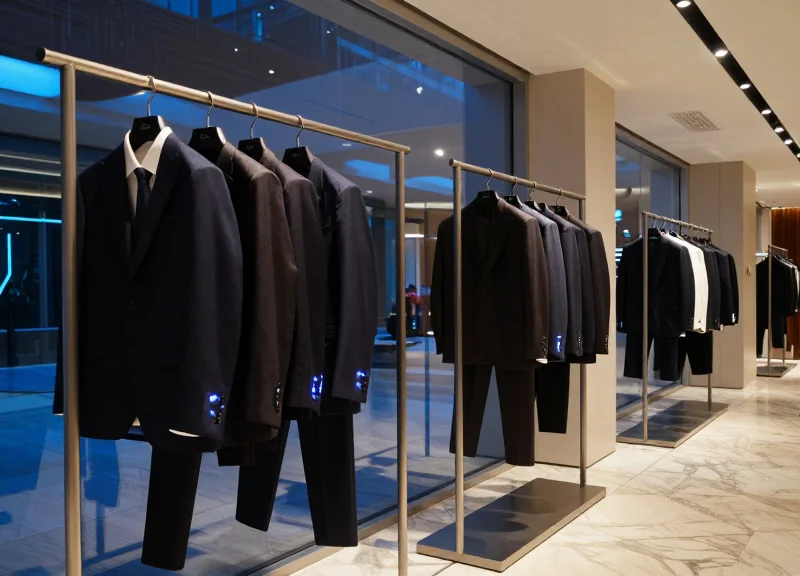
As we approach 2026, the menswear retail landscape is undergoing a radical transformation driven by high-velocity fashion cycles and the rise of hyper-personalized omnichannel experiences. Traditional Electronic Article Surveillance (EAS) systems, while effective at deterring theft, are no longer sufficient for the data-hungry modern retailer. The emergence of Hybrid RFID-EAS technology marks a pivotal shift, offering a dual-purpose solution that protects high-value garments while providing the granular inventory intelligence necessary to thrive. This article explores why the menswear sector is leading the charge in adopting these integrated systems to bridge the gap between loss prevention and operational excellence.
The Evolution of Menswear Retail: From Security to Intelligence

The evolution of menswear retail represents a fundamental shift from 'Loss Prevention' as a defensive cost center to 'Inventory Intelligence' as a strategic revenue driver. Historically, retailers focused solely on Electronic Article Surveillance (EAS) to prevent theft. However, as we approach 2026, the complexity of menswear—characterized by deep SKU counts (sizes, fits, fabrics) and the rise of omnichannel fulfillment—demands a hybrid approach. This evolution integrates traditional security with Radio Frequency Identification (RFID) to provide real-time visibility into every garment, transforming the security tag from a silent gatekeeper into a powerful data point.
| Feature | Legacy EAS (Traditional) | Hybrid RFID-EAS (2026 Standard) |
|---|---|---|
| Primary Goal | Theft Deterrence | Theft Prevention + Inventory Accuracy |
| Data Granularity | None (Binary on/off signal) | Item-level (Unique ID per garment) |
| Inventory Counting | Manual / Barcode-based | Automated / Real-time |
| Omnichannel Support | Poor (Inaccurate stock levels) | Excellent (99% stock accuracy) |
In the luxury menswear segment, the stakes are higher. A missed sale due to a 'ghost inventory' error—where the system shows a suit in stock that isn't actually on the floor—can cost thousands in lost customer lifetime value. Traditional EAS tags provide no insight into whether a specific size or color is missing from the display. By contrast, Hybrid technology allows retailers to perform 'Smart Restocking,' ensuring the sales floor reflects the true depth of the backroom inventory instantly.
Why is traditional EAS insufficient for 2026 menswear trends?
Traditional EAS only alerts you when an item leaves the store; it doesn't tell you what left or help you manage the 40+ SKU variations common in tailored menswear, leading to massive inefficiencies in the supply chain.
How does Hybrid RFID-EAS improve the customer experience?
It enables features like 'Magic Mirrors' in fitting rooms and ultra-fast checkout, while ensuring that if a customer sees an item online, it is guaranteed to be in the store when they arrive.
What is the 'Intelligence' factor in this technology?
It refers to the ability to track the movement of a garment throughout its lifecycle—from the warehouse to the fitting room to the final sale—providing heat maps of customer interest that were previously impossible to capture.
Expert Insight: One often overlooked factor in menswear is 'Fabric-Signal Harmony.' Premium wools and metallic-threaded fabrics used in high-end suits can occasionally interfere with legacy RF signals. The 2026 hybrid systems utilize advanced signal filtering that ensures 99.9% read rates even in dense racks of heavy overcoats, a technical hurdle that previously limited RFID adoption in the menswear sector.
Understanding Hybrid RFID-EAS: The Dual-Frequency Revolution

Hybrid RFID-EAS technology is a dual-layered hardware solution that integrates Electronic Article Surveillance (EAS) for loss prevention and Ultra-High Frequency (UHF) Radio Frequency Identification (RFID) for item-level tracking within a single tag. Traditionally, retailers had to choose between the 8.2MHz/58KHz frequencies of EAS to deter theft or the 860-960MHz UHF band for inventory accuracy. The 'Dual-Frequency Revolution' eliminates this compromise, allowing a single tag to communicate with security pedestals at the store exit while simultaneously providing granular data—such as size, color, and fabric type—to inventory management systems via RFID handhelds or overhead sensors.
| Feature | Traditional EAS | Standard UHF RFID | Hybrid RFID-EAS |
|---|---|---|---|
| Primary Function | Theft Deterrence | Inventory Accuracy | Security + Intelligence |
| Data Storage | None (Bit-based) | High (Unique EPC) | High (Unique EPC) |
| Real-time Tracking | No | Yes | Yes |
| Security Alarms | Robust/Standard | Soft/Software-based | Full Hard-Alarm Support |
- Dual-Resonance Antenna Design: Hybrid tags utilize a specialized antenna layout that prevents signal interference between the high-power EAS resonance and the sensitive UHF digital signals, ensuring neither function is compromised.
- Omnichannel Synchronization: Because the tag identifies the specific item being moved or stolen, the system can automatically update 'Buy Online, Pick Up In Store' (BOPIS) availability the moment a tag is deactivated or leaves the premises.
- Retrofit Compatibility: These systems are designed to work with existing Acousto-Magnetic (AM) or Radio Frequency (RF) gates, allowing retailers to upgrade their tracking intelligence without a total overhaul of their physical security infrastructure.
Expert Insight: For 2026 menswear, the most significant advantage of hybrid technology is the reduction of 'Tag Fatigue.' In a premium tailoring environment, attaching multiple clunky tags to a Loro Piana wool blazer or a silk-blend shirt risks fabric distortion and degrades the customer's aesthetic experience. Hybrid tags provide a 'single-point attachment' strategy that maintains garment integrity while delivering 99% inventory accuracy—a critical requirement for the high-SKU complexity of modern menswear collections.
Do I need to replace my current security gates to use hybrid tags?
No. Hybrid tags are engineered to trigger existing 58KHz or 8.2MHz gates. The RFID component is read by separate or integrated UHF readers, meaning you can phase in the technology without replacing your entire EAS pedestal fleet.
Are hybrid tags too heavy for lightweight summer menswear?
The latest 2026 iterations include 'Micro-Hybrid' designs that weigh less than 5 grams, making them safe for delicate linens and technical knits without causing 'hanger lean' or fabric stretching.
Can hybrid tags help with organized retail crime (ORC)?
Absolutely. Unlike traditional EAS which just makes noise, hybrid tags tell you exactly which items are leaving. If three Navy Blazers in size 40R are taken, the system alerts staff to the specific loss, enabling targeted restocking and better evidence for law enforcement.
2026 Menswear Trends and the Need for Precision

For 2026, menswear retail is pivoting from mass-market volume to specialized 'micro-collections' defined by Quiet Luxury and Tailored Utility. These trends emphasize high-ticket items with complex SKU variations in sizing and technical fabrics. Because these garments represent significant capital investment and lower production runs, retailers can no longer afford the industry-standard 65-70% inventory accuracy found with traditional EAS systems. Achieving 99% precision via Hybrid RFID-EAS is no longer a luxury—it is a logistical requirement to ensure that every specific size and color variant is accounted for and available for the omnichannel shopper.
| 2026 Trend | Inventory Impact | RFID Precision Requirement |
|---|---|---|
| Quiet Luxury | High-value basics; low SKU depth per store. | Critical: One missing unit is a major revenue loss. |
| Tailored Utility | Technical fabrics and hardware; complex sizing. | High: Specificity in fit is paramount for conversion. |
| Heritage Revival | Vintage-inspired cuts; rare textile blends. | Essential: Hard-to-replace stock requires tight security. |
A unique challenge for 2026 is the 'Ghost Stock' phenomenon in menswear. In high-end tailoring, a customer often visits for a specific fit—such as a 40R slim-cut blazer in a niche tech-wool blend. If traditional EAS tells the system the item is 'in-stock' but it is actually buried in a fitting room or misfiled in the stockroom, the sale is lost to a competitor. Hybrid RFID-EAS technology allows for real-time localization within one meter, effectively eliminating 'Ghost Stock' by ensuring that what the system sees, the floor staff can find.
How does 99% accuracy impact 2026 'Buy Online, Pick Up In-Store' (BOPIS) models?
With menswear trends focusing on specific fits, BOPIS fails if inventory is inaccurate. RFID ensures that when a customer reserves a tailored utility jacket online, it is physically present 99.9% of the time, protecting brand reputation.
Why can't traditional EAS handle the SKU complexity of 2026 trends?
Traditional EAS only signals if an item leaves the store; it cannot distinguish between a navy silk tie and a cashmere overcoat. RFID provides the 'identity' of the item, allowing for granular tracking of high-complexity styles.
What is the 'Margin Protector' aspect of Hybrid RFID?
By combining security with intelligence, retailers reduce 'safety stock'—the extra inventory held to compensate for errors—thereby freeing up capital to invest in the next season's trends.
Expert Tip: For the 2026 season, leverage the 'Search and Find' feature of your hybrid handhelds. Since 'Tailored Utility' involves many similar-looking garments with different technical specs (e.g., waterproof vs. water-resistant), use the RFID Geiger-counter mode to locate the exact SKU in seconds during a high-stakes customer interaction.
Solving the Omnichannel Dilemma in Menswear

The 'Omnichannel Dilemma' in menswear is the gap between digital promise and physical reality. When a customer purchases a specific Italian-wool suit online for in-store pickup, they expect it to be there; however, traditional EAS systems only tell you if an item has left the building, not its precise location or current stock level. Hybrid RFID-EAS technology bridges this gap by providing a 'Single Source of Truth.' By merging loss prevention with item-level tracking, retailers can achieve the 99% inventory accuracy necessary to support Buy Online, Pick Up In-Store (BOPIS) and Ship-from-Store models without the fear of 'phantom inventory' or humiliating order cancellations.
| Feature | Traditional EAS (Legacy) | Hybrid RFID-EAS (2026 Standard) |
|---|---|---|
| Inventory Accuracy | 65% - 75% (Typical) | 98% - 99.8% (Real-time) |
| BOPIS Reliability | Low - High cancellation risk | High - Guaranteed availability |
| Stock Counting | Manual / Semi-annual | Automated / Weekly or Daily |
| Shrinkage Insight | Alarm sounds only | Identifies exactly which SKU was lost |
Expert Insight: In the luxury menswear sector, the 'Safety Stock Tax' is a silent profit killer. Many retailers intentionally hide 10-15% of their inventory from their online store as a 'buffer' to prevent overselling. Hybrid RFID-EAS eliminates this tax, allowing you to expose 100% of your stock to global digital buyers, effectively increasing your available-to-promise (ATP) inventory overnight without buying a single new garment.
- Real-Time Serialization: Each garment is assigned a unique digital identity through the RFID component, ensuring the digital catalog reflects the exact size and fit available on the floor.
- Automated Re-ordering: As items pass through the POS or are flagged as lost via the EAS gates, the system triggers replenishment alerts to prevent 'Out of Stock' scenarios on popular menswear staples.
- Geofencing Stock: Hybrid systems can distinguish between items in the stockroom and items on the showroom floor, allowing staff to pick BOPIS orders from the most efficient location.
How does hybrid tech reduce 'walk-outs'?
By ensuring that a customer who checked online for a 40-Short blazer actually finds it on the rack, reducing the friction that leads to lost physical sales.
Does this require a complete POS overhaul?
No. Most modern hybrid RFID-EAS solutions act as a middleware layer that integrates directly with existing ERP and e-commerce platforms like Shopify Plus or Oracle Retail.
Can it handle high-volume seasonal changes?
Yes, it is designed for the rapid SKU turnover typical of menswear seasonal transitions, allowing for instant inventory audits during peak periods like Black Friday.
Reducing Friction in the High-End Customer Journey

Reducing friction in high-end menswear retail means replacing intrusive security measures with invisible, data-driven systems that streamline the transition from discovery to purchase. Hybrid RFID-EAS tags facilitate this by allowing for instant, multi-item checkout and 'smart' mirrors that provide real-time styling advice without the customer having to leave the fitting room. By merging security (EAS) with intelligence (RFID), retailers no longer have to choose between protecting their assets and providing a seamless, premium service.
The modern menswear shopper—particularly those investing in 'Quiet Luxury' or bespoke tailoring—values time and privacy above all else. Traditional EAS systems often create friction points: the loud alarm at the door, the manual scanning of every individual tag at the counter, and the 'out-of-stock' disappointment when a specific size isn't found on the rack. Hybrid RFID-EAS solves these pain points by turning the entire store into a responsive, intelligent environment where the technology works behind the scenes to enhance the human element of sales.
| Retail Touchpoint | Traditional EAS Friction | Hybrid RFID-EAS Solution |
|---|---|---|
| Checkout Process | Line-of-sight scanning for each individual barcode; manual detaching. | Bulk scanning of entire baskets in seconds; automated inventory update. |
| Fitting Room | Blind spot for staff; no data on what items are being tried on. | Smart mirrors detect tags; offer size swaps or matching accessory suggestions. |
| Product Availability | Manual stock counts lead to 'ghost inventory' and missed sales. | 99% accuracy ensures the right blazer size is always available for the client. |
| Security Experience | Aggressive gates and 'stop-and-search' moments damage brand prestige. | Discreet overhead sensors and soft-tagging maintain a boutique aesthetic. |
What is a 'Smart Fitting Room' in the context of hybrid tags?
A smart fitting room uses RFID readers to automatically identify the garments a customer brings in. It can display product details, suggest complementary items like silk ties or pocket squares, and allow the customer to request a different size via a touchscreen, all while the hybrid tag continues to provide theft protection.
Does hybrid technology actually speed up the checkout for high-value items?
Yes. Because RFID does not require line-of-sight, an associate can scan a stack of premium garments instantly. This reduces the checkout time by up to 75%, allowing the sales associate to focus on the relationship and packaging rather than the logistics of scanning.
How does this technology improve the 'Personal Shopper' experience?
Staff equipped with mobile RFID readers can instantly locate specific items in the stockroom or across the floor, ensuring they never have to leave the customer's side for extended periods, maintaining the 'high-touch' feel of luxury retail.
Expert Tip: To truly master the customer journey in 2026, implement the '90-Second Rule.' In luxury menswear, any friction point—whether a slow checkout or an unavailable size—that lasts longer than 90 seconds reduces the probability of a return visit by 15%. Hybrid RFID-EAS is the only technology that provides the data velocity required to stay under this threshold consistently across high-volume flagship stores.
Inventory Intelligence: Beyond Stock Counting

Inventory intelligence is the evolution of retail management from static asset tracking to dynamic behavioral analysis. While traditional Electronic Article Surveillance (EAS) tells you if an item is leaving the store, Hybrid RFID-EAS technology provides a granular view of every item's journey from the backroom to the fitting room and, ultimately, the point of sale. For the 2026 menswear market, this means moving beyond 'how much is left' to 'why is this specific blazer not selling,' enabling data-driven decisions on stock replenishment, floor placement, and price optimization.
| Metric | Traditional EAS/Barcode | Hybrid RFID-EAS Intelligence |
|---|---|---|
| Accuracy | 65-75% (Manual audits) | 99%+ (Real-time tracking) |
| Visibility | Binary (In-stock vs. Out-stock) | Path-to-purchase (Dwell times, fitting room entry) |
| Markdown Strategy | Reactive (End-of-season cuts) | Proactive (Targeted, item-level adjustments) |
| Merchandising | Intuition-based | Conversion-rate based per SKU |
By leveraging Hybrid RFID-EAS, retailers can analyze 'Dwell Times'—the duration a garment spends on a specific display or in a fitting room. In the context of 2026 menswear trends like 'Tailored Utility,' where fit and fabric feel are paramount, high fitting room dwell times paired with low conversion rates signal a 'Fit Friction' issue. This allows designers to adjust future patterns or retailers to train staff on specific garment benefits before the style becomes a liability.
How does RFID data improve markdown strategies?
By identifying 'cold' items that haven't been moved or tried on within a 14-day window, retailers can implement micro-promotions or reposition stock rather than waiting for a store-wide clearance event, preserving higher margins.
Can inventory intelligence predict 2026 menswear trends?
Yes. By tracking the velocity of specific attributes—such as oversized silhouettes versus slim-fit trousers—retailers can provide real-time feedback to procurement teams to pivot stock for the next drop.
What is the 'Velocity Gap' in menswear?
This is a unique insight where an item has high 'touch' rates (picked up or tried on) but zero sales. Hybrid systems identify these gaps, highlighting products that look great on the rack but fail during the physical experience.
Expert Tip: For the upcoming 2026 season, use RFID data to calculate the 'Engagement-to-Transaction' ratio for your high-ticket 'Quiet Luxury' items. If a cashmere overcoat is entering the fitting room 50 times a week but only selling twice, the data suggests the pricing is correct but the internal tailoring might be inconsistent with the size label. This level of intelligence is impossible with traditional EAS systems.
ROI and Long-Term Sustainability of Hybrid Systems
The Return on Investment (ROI) of Hybrid RFID-EAS technology is measured by the delta between traditional loss prevention and the 'Total Retail Value' unlocked through 99% inventory accuracy. Unlike legacy systems that act purely as a cost-center for deterrence, hybrid systems provide a tangible financial return by reducing labor costs associated with manual stocktakes by up to 90% and recapturing 3-5% of annual revenue previously lost to 'phantom out-of-stocks.' For the 2026 menswear market, where margins are squeezed by rising material costs, this technology transforms a security expense into an operational profit driver.
| Operational Metric | Legacy EAS Systems | Hybrid RFID-EAS (2026 Standard) |
|---|---|---|
| Inventory Accuracy | 65% - 75% Average | 98% - 99.8% Precision |
| Labor Cost (Stock Counting) | High (Weekly/Monthly manual audits) | Near-Zero (Real-time digital scanning) |
| Shrinkage Insight | Quantity known, item unknown | Exact SKU, time, and exit point |
| Sustainability Impact | High waste due to over-ordering | Low waste via data-driven production |
Sustainability in 2026 menswear is moving from a marketing preference to a regulatory necessity. Hybrid systems facilitate a 'Circular Inventory Model' by providing the granular data needed to prevent overproduction—one of the industry's largest environmental hurdles. By knowing exactly what is on the floor versus in the stockroom, brands can adopt a 'Just-in-Time' replenishment strategy, significantly reducing the carbon footprint associated with deadstock disposal and emergency logistics. From a financial perspective, this efficiency reduces capital tied up in slow-moving assets, improving the overall health of the balance sheet.
What is the average payback period for a hybrid system?
Most high-end menswear retailers report a full ROI within 12 to 18 months, driven by the immediate reduction in labor hours and the recovery of sales lost to inventory discrepancies.
Does hybrid technology require replacing all existing hardware?
Not necessarily. Many 2026 hybrid solutions are designed to be backwards compatible, allowing retailers to upgrade their pedestals while maintaining existing EAS protocols, thus spreading out the CAPEX.
How does this impact the 'Ghost SKU' problem?
It eliminates it. Hybrid systems identify when a specific item has left the store without being purchased, updating the digital catalog instantly to prevent online customers from ordering unavailable stock.
Expert Insight: The Ghost SKU Recovery Ratio. One often overlooked financial benefit is the 'Reverse Logistics Profitability Buffer.' In menswear, where returns for fit and style are common, hybrid RFID-EAS allows for the instantaneous re-integration of returned goods into the sellable inventory. By reducing the 'return-to-shelf' time from days to minutes, retailers can significantly increase the turnover rate of high-value items like tailored suits, which would otherwise sit idle in a processing queue during peak seasons.
The DragonGuard Advantage: Implementing Hybrid Solutions
The DragonGuard advantage lies in its 'Unified Hardware Layer,' a specialized approach that replaces fragmented security systems with a cohesive ecosystem of EAS, RFID, and ESL (Electronic Shelf Label) technologies. Unlike legacy providers that force retailers to manage disparate vendors, DragonGuard offers an interoperable hardware suite designed to work out-of-the-box, ensuring that security protocols and inventory intelligence data flow through a single, reliable physical infrastructure.
| Feature | Legacy Siloed Systems | DragonGuard Hybrid Ecosystem |
|---|---|---|
| Hardware Synergy | Independent EAS and RFID gates | Integrated Dual-Tech RFID-EAS Antennas |
| Data Accuracy | Manual sync between security and POS | Real-time cloud-synced inventory events |
| Customer Experience | Intrusive tags and false alarms | Discreet high-end aesthetic tagging |
| Pricing Agility | Manual paper label changes | Dynamic ESL integration with RFID stock |
Implementing DragonGuard’s hybrid solution is a strategic move toward 'Frictionless Retail.' By deploying hardware that simultaneously prevents shrink and captures granular movement data, menswear brands can finally bridge the gap between their physical showrooms and digital back-ends.
- Site Audit & Signal Mapping: DragonGuard engineers assess your floor layout to determine optimal placement for dual-technology pedestals and overhead RFID readers to ensure 100% coverage without blind spots.
- Tagging Strategy Selection: Choose from hard hybrid tags for tailored suits or soft RFID-EAS stickers for high-turnover accessories, ensuring all items are secured and tracked under one protocol.
- Hardware Ecosystem Integration: Linking ESL displays with RFID inventory counts so that pricing automatically adjusts based on local stock levels or promotional triggers.
- The 'Go-Live' Validation: Stress-testing the system's ability to distinguish between authorized sales and potential theft while simultaneously updating the digital inventory ledger.
The Veteran Perspective: After 20 years in the industry, the most common failure point I see is 'Integration Debt'—buying high-tech software but running it on low-tech, mismatched hardware. DragonGuard solves this by providing the 'Physical-to-Digital Handshake.' A unique insight here is the use of ESL as an inventory beacon: DragonGuard's system can trigger an ESL to flash when a low-stock RFID item is detected nearby, helping staff replenish the menswear floor before a customer even notices the gap.
Can we use our existing EAS pedestals with DragonGuard RFID?
In many cases, yes. DragonGuard specializes in retrofitting solutions that allow you to add RFID capabilities to your current security footprint, protecting your previous investments while upgrading intelligence.
Is the hardware compatible with global retail standards?
Absolutely. Our RFID and EAS components adhere to international frequencies (UHF/AM/RF), ensuring seamless operation across global supply chains and multi-national retail locations.
How does ESL integrate with the security aspect?
While ESL focuses on pricing, DragonGuard links it to the RFID security backend. If an item is flagged as 'out of stock' by the RFID sensors but an ESL shows it is still available, the system alerts management to a potential 'phantom inventory' or theft issue.