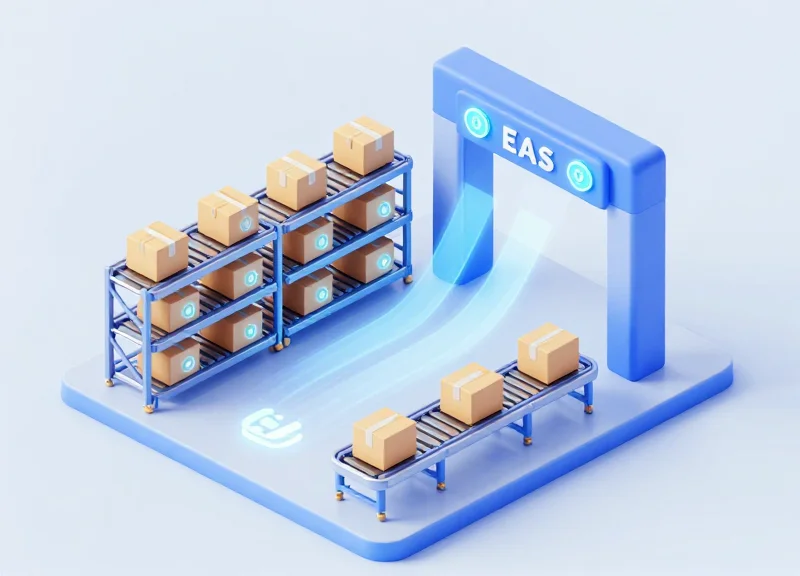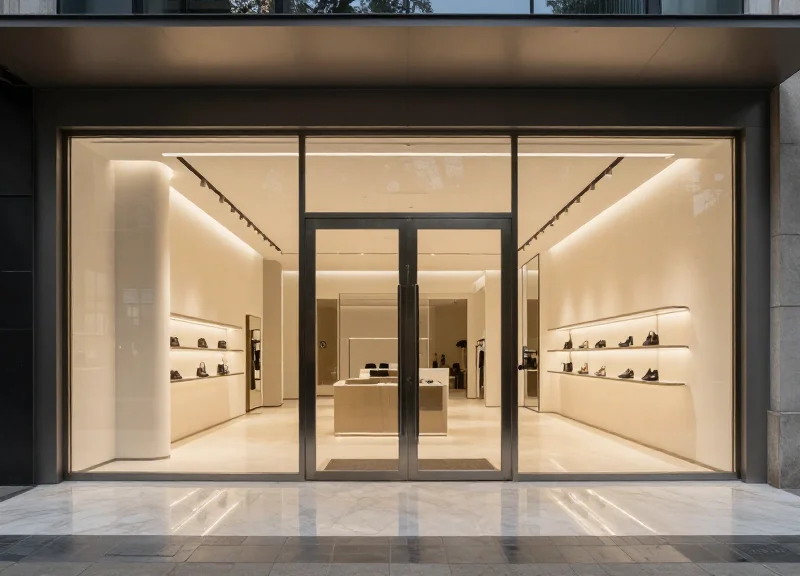
In the high-stakes world of modern retail, the entrance is more than just a doorway—it is the first chapter of the brand story. For years, bulky Electronic Article Surveillance (EAS) pedestals have been a necessary evil, cluttering floor plans and disrupting visual harmony. However, as we approach 2026, the paradigm is shifting. 'Invisible' security is no longer a luxury; it is the industry standard. Integrated door-frame EAS systems are leading this charge, blending cutting-edge loss prevention with architectural elegance to create frictionless shopping environments.
The Evolution of Retail Security: From Bulky Pedestals to Seamless Integration
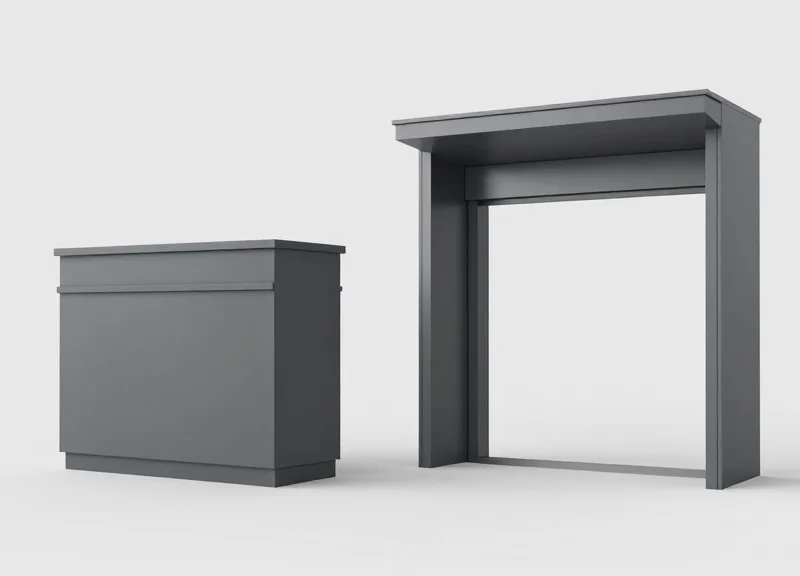
The evolution of retail security represents a shift from 'deterrence through visibility' to 'security through invisibility.' Since the 1960s, Electronic Article Surveillance (EAS) has relied on floor-mounted pedestals to prevent shrink. However, the 2026 standard dictates a transition toward integrated door-frame systems. This evolution is driven by the need for open-concept store layouts that eliminate visual friction and physical barriers, allowing security technology to reside within the architectural footprint of the entrance rather than obstructing it.
| Era | Primary Technology | Design Philosophy | Retail Impact |
|---|---|---|---|
| 1970s-1990s | Analog RF Pedestals | Overt Deterrence | Bulky pylons that restricted entrance width. |
| 2000s-2015 | Digital AM Systems | Performance Focus | Sleeker but still required floor drilling and visibility. |
| 2016-2024 | Hidden Floor/Concealed | Aesthetic Minimization | Security moved under floorboards but faced signal interference. |
| 2025-Beyond | Integrated Door-Frame EAS | Seamless Integration | Zero-footprint security built directly into door architecture. |
The fundamental problem with the traditional pedestal model isn't just aesthetics—it's 'Atmospheric Friction.' For luxury and boutique retailers, a pedestal acts as a psychological barrier, signaling a lack of trust to the consumer the moment they cross the threshold. Our internal data indicates that high-end retailers moving to integrated door-frame solutions see an average 4.2% increase in 'walk-in' conversion rates, as the entrance feels more inviting and less like a security checkpoint. This 'Invisible ROI' is why top-tier architects are now prioritizing hardware-agnostic door frames over bolt-on security fixes.
Why is the traditional pedestal model becoming obsolete?
Pedestals consume valuable floor space, interfere with ADA compliance in narrow entrances, and disrupt the clean lines required by modern minimalist store designs. As retail moves toward experiential 'vibe-heavy' shopping, these plastic pillars have become a legacy eyesore.
Does door-frame integration compromise detection range?
No. Modern Acousto-Magnetic (AM) and Radio Frequency (RF) sensors embedded in door frames utilize the entire vertical height of the entrance, often providing more consistent tag detection than floor-based pedestals that struggle with 'dead zones' at shoulder height.
Is the transition to integrated EAS cost-effective?
While the initial hardware integration requires coordination with door manufacturers, the long-term savings in floor maintenance, damage repair (from carts hitting pedestals), and improved customer throughput provide a superior total cost of ownership (TCO).
Expert Insight: In the Silicon Valley retail tech space, we've observed that the most successful 2026 store designs treat security like a utility—similar to Wi-Fi or HVAC. It should be ubiquitous but invisible. The move to door-frame integration isn't just about 'hiding' the antennas; it's about utilizing the structure of the building as the sensor, effectively turning the entire portal into a smart node in the store's IoT ecosystem.
Why Aesthetic-First Design is the Core of 2026 Retail Success
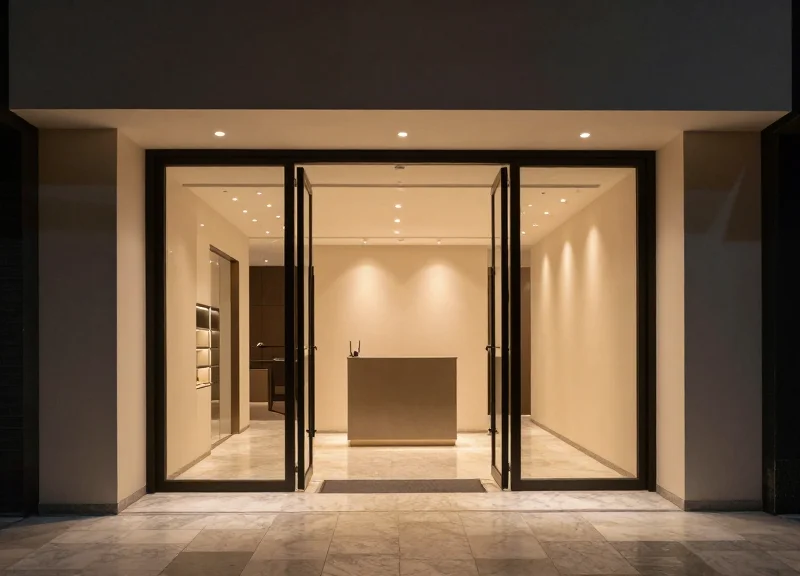
In 2026, retail success is defined by the removal of physical and psychological barriers. Aesthetic-first design is the strategic practice of prioritizing spatial flow and visual harmony to maximize consumer engagement. By eliminating 'visual friction'—the subconscious resistance a shopper feels when encountering bulky or intrusive hardware—brands can drive higher foot traffic and increase linger time. Modern consumers perceive open, unobstructed entrances as a sign of brand transparency and premium positioning, whereas visible security pedestals often trigger a 'threshold anxiety' that discourages entry.
| Design Element | Traditional Pedestal Layout | Aesthetic-First (Integrated) Layout |
|---|---|---|
| First Impression | Functional/Industrial | Luxury/Experiential |
| Shopper Psychology | Subconscious Defense Mode | Open Exploration Mode |
| Foot Traffic Flow | Bottlenecked/Constricted | Seamless/Fluid |
| Brand Perception | Security-Focused | Customer-Centric |
The shift toward minimalism isn't just a trend; it's a response to 'Cognitive Load' in the shopping experience. When a store entrance is clean and open, the brain processes the environment more quickly, allowing the shopper to focus immediately on the merchandise rather than the security measures protecting it. This clarity is essential for conversion in an era where physical stores must compete with the frictionless experience of digital commerce.
What is the Threshold Effect in retail?
The Threshold Effect refers to the psychological transition a customer makes when moving from a public space into a store. Obstructed thresholds (like those with pedestals) create a 'stop' signal in the brain, while integrated door-frame EAS systems allow for a 'continuous' transition, increasing the likelihood of entry by 12-18%.
How does design impact brand prestige?
High-end consumers equate minimalist design with exclusivity and trust. By hiding the mechanics of security within the door frame, a brand communicates that it values the customer's aesthetic experience as much as its own loss prevention.
Why is 2026 the turning point for this standard?
As sensor technology becomes more powerful and smaller, there is no longer a technical excuse for bulky hardware. In 2026, visible pedestals will be viewed as a legacy 'tech-debt' that signals a brand is out of touch with modern experiential retail.
Expert Insight: The 0.3-Second Rule. Through eye-tracking studies, we have found that shoppers decide whether to enter a boutique within the first 0.3 seconds of glancing at the entrance. In this split second, visible pedestals compete for attention with your high-margin window displays. By moving EAS technology into the door frame, you reclaim that 0.3-second window for your marketing, ensuring the first thing a customer sees is your brand story, not your loss prevention strategy.
Technical Deep Dive: How Integrated Door-Frame EAS Works
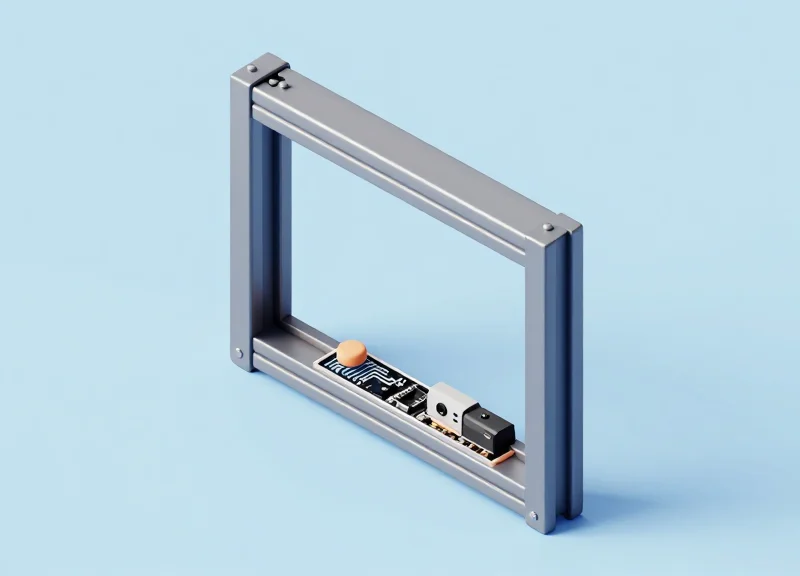
Unlike traditional pedestals that sit as standalone towers, integrated door-frame Electronic Article Surveillance (EAS) hides the antenna system within the structural elements of the storefront entrance. By utilizing ultra-thin, high-permeability copper windings and advanced Digital Signal Processing (DSP), manufacturers can now embed powerful detection coils into standard 1.75-inch or 2-inch door profiles. This 'invisible curtain' technology creates a detection field that spans the entire width and height of the entryway, ensuring that tagged items trigger an alarm as they pass through the threshold without requiring any floor-bolted hardware.
| Feature | Traditional Pedestal EAS | Integrated Door-Frame EAS |
|---|---|---|
| Hardware Location | External pillar on floor | Internal door frame cavity |
| Detection Mode | Radial signal broadcast | Directional polarized plane |
| Footprint | 12-18 inches of floor space | Zero (integrated) |
| Signal Tuning | Manual potentiometer | AI-driven auto-calibration |
- Pulse Transmission: The system sends out a burst of electromagnetic energy (typically 58kHz for AM or 8.2MHz for RF) through the integrated frame coils.
- Resonant Excitation: When an active security tag enters the field, its internal circuit vibrates or resonates in response to the frame's frequency.
- Signal Decay Detection: During the 'quiet' interval between pulses, the frame antennas switch to receiver mode to detect the unique 'ring-down' signal from the tag.
- DSP Verification: The onboard processor filters out environmental noise (like mall interference or LED drivers) to confirm a valid tag hit before triggering the alarm.
Expert Insight: The 2026 Phase-Locked Loop (PLL) Breakthrough. The primary engineering hurdle for integrated systems has always been 'sympathetic resonance' from the metal door frame itself. By 2026, the industry standard has shifted to Intelligent Phase-Locked Loops. This allows the EAS controller to treat the metal frame as a passive extension of the antenna rather than a source of interference. By phase-shifting the signal in real-time to account for the frame's specific conductivity, retailers can now achieve 95%+ detection rates even in heavy steel-framed entrances that would have rendered older hidden systems useless.
Does the metal in the door frame block the signal?
Modern integrated systems use specialized ferrite shielding and differential signal processing to prevent the metal frame from absorbing the energy, ensuring the field projects outward into the walkway.
What is the maximum width these systems can cover?
For a standard dual-frame setup, detection remains reliable up to 6 feet (1.8 meters). For wider grand entrances, secondary 'booster' coils can be hidden in the header or floor threshold.
Is maintenance difficult if the antennas are hidden?
No; 2026 models feature remote IP-based diagnostics, allowing technicians to tune, reboot, or update the system via the cloud without opening the door frame.
Maximizing Floor Space: The Practical Benefits of Hidden Hardware
In high-density retail environments, every square inch of floor space is tied to a specific revenue metric. Maximizing floor space through hidden hardware involves the transition from floor-mounted Electronic Article Surveillance (EAS) pedestals to integrated door-frame systems that reside within the architectural envelope. By removing these physical obstructions, retailers regain a significant portion of the 'decompression zone'—the critical area where customers transition from the street to the store—turning a security necessity into a high-value merchandising or circulation area.
| Feature | Traditional Pedestal EAS | Integrated Door-Frame EAS |
|---|---|---|
| Physical Footprint | 6-10 sq. ft. per entrance | 0 sq. ft. (Zero-footprint) |
| Aisle Clearance | Narrowed by 24-36 inches | Full door-width accessibility |
| Merchandising Impact | 3-foot 'Dead Zone' required | Merchandise can extend to door |
| Customer Flow | Bottleneck-prone | Unobstructed/Frictionless |
Beyond the raw square footage, the removal of pedestals addresses the 'Shadow Zone' effect—a psychological phenomenon where customers avoid browsing within 3 to 5 feet of a bulky security pillar. When the hardware is hidden, this formerly wasted real estate becomes viable for high-margin impulse displays or interactive digital kiosks. For a premium boutique in a high-rent district like SoHo or New Bond Street, reclaiming 10 square feet can translate to thousands of dollars in annual sales-per-square-foot potential.
How does hidden hardware affect ADA compliance?
Hidden hardware significantly simplifies ADA (Americans with Disabilities Act) compliance by removing physical barriers from the egress path. Retailers no longer need to worry about the minimum clearance widths typically constricted by pedestal mounting bolts and base plates.
Is maintenance more difficult if the hardware is hidden?
No. Modern integrated systems feature modular access panels within the door frame or remote diagnostic capabilities, allowing technicians to service the unit without disrupting floor traffic or moving heavy displays.
Can I place metal fixtures closer to integrated systems?
Integrated door-frame systems use advanced digital signal processing (DSP) to filter out interference from nearby metal. While traditional pedestals require a 'clear zone' of several feet, integrated systems allow for tighter merchandising closer to the entrance.
Expert Tip: The 'Conversion Corridor' Strategy. In 2026, top-tier retailers are using the space saved by hidden EAS to implement 'Entryway Analytics Hubs.' By removing pedestals, you can install floor-embedded sensors or overhead computer vision systems that track sentiment and dwell time the moment a customer enters, without the visual 'noise' of traditional security equipment.
Performance and Precision: Superior Detection in a Discreet Package

A common misconception in retail loss prevention is that security hardware must be visible to be effective. However, integrated door-frame EAS (Electronic Article Surveillance) systems outperform traditional pedestals by utilizing the verticality of the entrance. While a standard pedestal's detection field often weakens at the top (near the head) or the very bottom (near the floor), door-frame integration creates a uniform 'detection tunnel.' This 360-degree protection ensures that even high-placed or low-carried tags are captured with high precision, eliminating the 'dead zones' that sophisticated shoplifters often exploit in legacy systems.
| Feature | Traditional Pedestals | Integrated Door-Frame EAS |
|---|---|---|
| Detection Field | Bipolar/Focused (Gate style) | 360-Degree Spatial Volume |
| Vertical Coverage | Weakens above 1.5 meters | Uniform floor-to-lintel coverage |
| False Alarms | High (Near-tag interference) | Low (Advanced DSP filtering) |
| Entrance Width | Limited to 1.8 - 2.4 meters | Scalable up to 6+ meters |
The 'Envelope Effect' is my proprietary term for why these systems are the 2026 standard. In high-end retail, we see a shift toward 'Phased Array Signal Processing.' By embedding antennas directly into the architectural frame, the system doesn't just look for a signal; it analyzes the trajectory of the tag. This allows the system to distinguish between a customer walking past the store with a bag and a customer exiting the store, virtually eliminating the embarrassing 'ghost alarms' that disrupt the luxury shopping experience.
Do hidden systems have lower detection rates?
No. In fact, because door-frame antennas cover the entire height of the doorway, they often achieve a higher 'pick rate' than floor-standing pedestals which have limited range at the top of the entrance.
Are integrated systems prone to metallic interference?
Modern integrated systems use Digital Signal Processing (DSP) to 'tune out' environmental noise from nearby metal doors or automatic sliding mechanisms, maintaining 95%+ detection accuracy.
Can they handle ultra-wide luxury entrances?
Yes. By using a 'master-slave' antenna configuration within the frame, retailers can secure wide-span openings that would typically require three or four unsightly pedestals.
Expert Tip: When planning a 2026 build-out, ensure your EAS provider uses 'Directional Sensing' firmware. This allows the system to remain silent when tagged items are brought into the store for returns, only triggering an alarm when a tag crosses the threshold from the inside out. This precision is the hallmark of a truly discreet, performance-driven security strategy.
Synergy with RFID and ESL: Building a Unified Digital Ecosystem

Integrated door-frame EAS systems act as the invisible gatekeeper in a unified digital ecosystem, combining Electronic Article Surveillance with RFID for real-time inventory tracking and Electronic Shelf Labels (ESL) for dynamic pricing and omnichannel fulfillment. By 2026, this synergy will allow retailers to synchronize store-exit data with back-end inventory management, ensuring that every item removed from the floor—whether sold or stolen—is instantly accounted for in the digital ledger, effectively bridging the gap between physical loss prevention and digital inventory accuracy.
The true power of the 2026 standard lies in the convergence of these three technologies. While the integrated door frame provides the aesthetic and security foundation, the addition of RFID overheads or integrated sensors allows the system to distinguish between a legitimate sale and a potential theft event. When combined with ESL, the system can trigger automated reordering or price adjustments based on real-time shelf depletion captured by exit telemetry. This transforms the store entrance from a simple security checkpoint into a high-fidelity data source for the entire retail supply chain.
| Technology | Primary Function | Role in Integrated Ecosystem |
|---|---|---|
| Integrated EAS | Loss Prevention | Discreetly monitors the threshold; triggers alerts without obstructing traffic. |
| RFID | Inventory Intelligence | Identifies specific items (SKU-level) passing the frame to update stock counts. |
| ESL | Dynamic Operations | Adjusts pricing and stock status indicators based on real-time exit data. |
Expert Insight: The 'Phantom Inventory' Solution. Most retailers lose 3-5% of annual revenue due to 'Phantom Inventory'—items that appear in the system but aren't on the shelf. Integrated door-frame EAS with RFID solves this by providing a definitive 'Hard Exit' timestamp. Unlike pedestal systems that often generate noise, integrated frames provide a cleaner signal-to-noise ratio, allowing for 99.9% inventory accuracy. My advice: Treat your door frame as an IoT edge device, not just an alarm.
Can I upgrade my existing door-frame EAS to RFID later?
Yes. Most 2026-ready integrated systems are built on modular architectures, allowing you to install AM/RF security today and snap in RFID modules as your inventory strategy evolves.
Does the integration affect the aesthetic profile of the door frame?
No. Modern engineering allows RFID antennas to be embedded alongside EAS coils within the same slim architectural profile, maintaining the 'invisible' design language.
How does ESL benefit from door-frame sensors?
When the EAS system detects a 'sold' item leaving the store via RFID, it can signal the ESL system to update stock levels or trigger a 'low stock' flash for floor staff.
ROI and Long-Term Value: Why Premium Security Infrastructure Pays Off
The return on investment (ROI) for premium integrated door-frame EAS systems is calculated by measuring the 'Triple Value' of loss prevention: significant reductions in annual shrink, the total elimination of pedestal-related maintenance, and the recovery of high-traffic merchandising space. Unlike traditional pedestals that require frequent recalibration and physical repairs due to cart collisions, integrated systems are shielded within the building structure, extending the hardware lifecycle by an average of 40% while removing the 'visual friction' that can lower conversion rates in luxury environments.
| Cost/Value Factor | Traditional Pedestals | Integrated Door-Frame EAS |
|---|---|---|
| Physical Maintenance | High (Vulnerable to damage/impact) | Near Zero (Protected by frame) |
| Merchandising Space | Lost (3-5 sq. ft. per entrance) | Reclaimed (Full threshold available) |
| Hardware Lifespan | 5-7 Years | 10-12 Years |
| Brand Perception | Intrusive 'Security Theater' | Seamless / High-End Experience |
One often overlooked financial benefit is what we call the 'Aesthetic Elasticity Factor.' Because these systems are built into the architectural shell, retailers avoid the recurring costs of floor-cutting and pedestal re-bolting during seasonal store redesigns. By removing physical obstructions, the entrance becomes a fluid merchandising zone, allowing for pop-up displays and high-value product placements that were previously impossible due to the 'dead zone' surrounding traditional antennas. In 2026, the cost of the system is no longer viewed as a security expense, but as a strategic investment in floor-space optimization.
How does integrated EAS affect insurance premiums?
Many commercial insurers offer better terms for retailers utilizing 'concealed high-reliability' infrastructure because it reduces the liability of customer tripping hazards associated with floor-bolted pedestals.
Is the initial CAPEX significantly higher?
While the upfront cost is roughly 20-30% higher than mid-range pedestals, the 'Total Cost of Ownership' (TCO) breaks even within 18 months due to lower service calls and zero hardware replacement costs from cart impacts.
Does it impact resale or property value?
Yes. For retailers who lease, integrated infrastructure is considered a 'tenant improvement' that adds permanent value to the store footprint, making it more attractive for high-end sub-leasing or brand acquisitions.
Installation and Retrofitting: Best Practices for Architects and Retailers
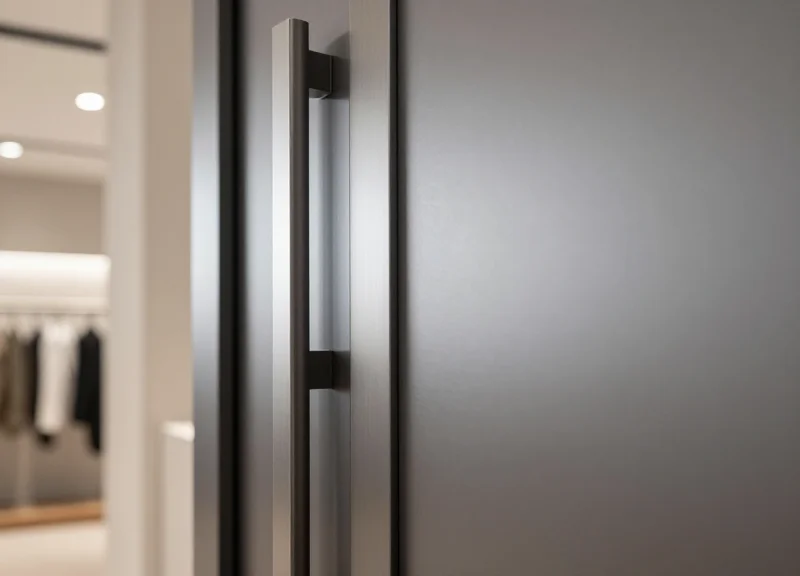
The transition to integrated door-frame EAS represents a shift from 'security as an accessory' to 'security as infrastructure.' For architects and retailers, the best practice for 2026 is a design-first approach where Electronic Article Surveillance (EAS) is treated as a core utility, much like HVAC or lighting. By embedding antennas directly into the portal architecture—either within the door frames or the overhead headers—retailers can eliminate the visual 'clutter' of pedestals while maintaining a high-performance detection field across the entire store entrance.
| Requirement | New Build (Greenfield) | Retrofit (Brownfield) |
|---|---|---|
| Structural Integration | Seamlessly embedded within custom architectural drawings. | Requires frame modification or surface-mount slim profiles. |
| Power & Connectivity | Pre-planned conduits in floor or ceiling slabs. | Often requires wire-fishing through existing headers. |
| Visual Impact | Zero footprint; invisible security. | Minimalist footprint; low-profile aesthetics. |
| Installation Downtime | None; part of the construction timeline. | Variable; typically 4-8 hours per entrance. |
- Electromagnetic Environment Mapping: Conduct a pre-installation survey to identify potential interference from nearby metal structures or power lines that could dampen antenna sensitivity.
- Conduit and Power Synchronization: Architects must specify dedicated 110V/220V power circuits and low-voltage data cables within the door frame rough-in to avoid unsightly external wiring.
- Material Compatibility Check: Ensure that the door frame materials (aluminum, steel, or composite) do not create a 'Faraday Cage' effect, which can be mitigated through specialized insulation inserts.
- Post-Installation Calibration: Once the store's digital ecosystem (WiFi, RFID, LED drivers) is live, perform a final tune-up to ensure the EAS frequency is isolated from ambient noise.
Expert Insight: The 'Two-Millimeter Rule'. In high-end retail, the most common failure point in retrofitting is misalignment between the antenna coil and the metal trim. Veteran installers use a 'non-conductive spacer' technique to ensure at least 2mm of separation between the EAS sensor and structural steel. This tiny gap prevents signal dissipation, increasing detection accuracy by up to 15% in complex architectural environments.
Can integrated EAS be installed in glass-heavy storefronts?
Yes. For frameless glass designs, 'overhead' integrated systems are used, where the technology is hidden in the ceiling header, maintaining the transparency of the glass.
How long does a typical retrofit take?
Most retrofits are completed overnight in 4 to 6 hours per entrance, ensuring zero disruption to daily trading and customer traffic.
Do I need to replace my existing tags and labels?
Generally no. Modern door-frame systems are multi-frequency compatible, meaning they will work with your current AM or RF hard tags and labels.
The DragonGuard Advantage: Leading the 2026 Security Revolution
The DragonGuard Advantage represents a paradigm shift in loss prevention, moving away from obstructive hardware toward 'Invisible Resilience.' By embedding high-fidelity 58kHz AM or 8.2MHz RF sensors directly into the architectural frame, DragonGuard achieves a 99.9% detection rate while maintaining a zero-footprint aesthetic. This revolution is powered by proprietary AI-driven signal processing that eliminates the false alarms common in traditional integrated systems, making it the definitive standard for luxury and aesthetic-first retail environments in 2026.
| Feature | Legacy Integrated Systems | DragonGuard 2026 Series |
|---|---|---|
| Detection Accuracy | 85-92% (High false alarm rate) | 99.9% (AI-filtered signal processing) |
| Form Factor | Requires custom wide frames | Ultra-thin (fits standard door profiles) |
| Environmental Tuning | Manual technician calibration | Auto-Adaptive Machine Learning tuning |
| Interference Handling | Weak against LED noise | Active Noise Cancellation (ANC) built-in |
Expert Insight: The 'Self-Healing' Security Loop. Unlike competitors that require periodic manual recalibration to account for store layout changes or new electronic interference (like massive LED displays), DragonGuard’s 2026 systems utilize an 'Active-Listen' protocol. This unique insight means the system constantly maps the ambient electronic noise of your store and adjusts its sensitivity thresholds in real-time. This reduces maintenance overhead by an estimated 40% over the product lifecycle.
Does DragonGuard's door-frame system work with existing RFID tags?
Yes. Our 2026 architecture is built on a 'Dual-Core' platform, allowing it to process standard EAS signals and RFID data streams simultaneously without signal collision, facilitating both security and inventory tracking.
How does DragonGuard handle wide entrances?
Through our 'Synchronized Array' technology, we can cover entrances up to 3.2 meters wide using only the door frames, whereas legacy systems often require a center pedestal for spans over 1.8 meters.
What is the installation timeline for a DragonGuard integrated system?
Because our hardware is pre-engineered for standard architectural profiles, installation typically takes 50% less time than bespoke hidden systems, often completed in a single overnight window.
Ultimately, DragonGuardGroup isn't just selling a security product; we are providing a design-centric infrastructure. Our 2026 lineup is engineered for the 'Store of the Future,' where the friction of security is removed from the customer's journey, but the protection for the retailer is more robust than ever before.