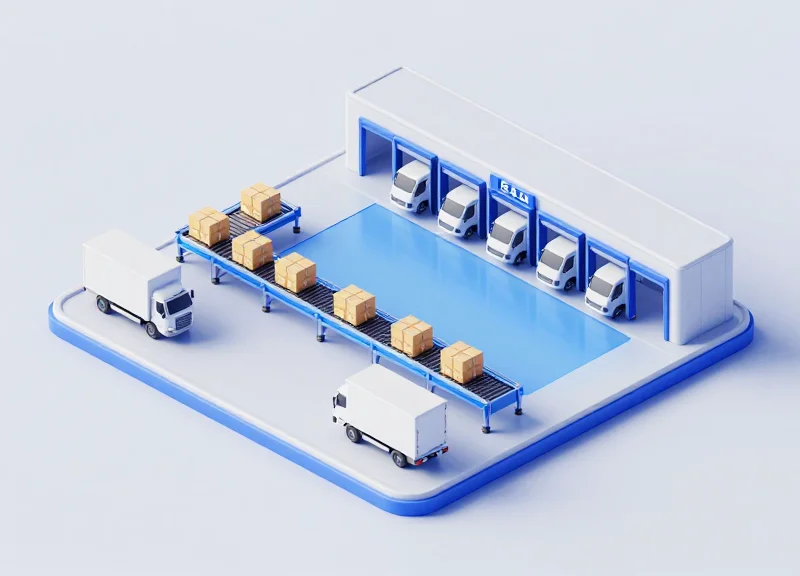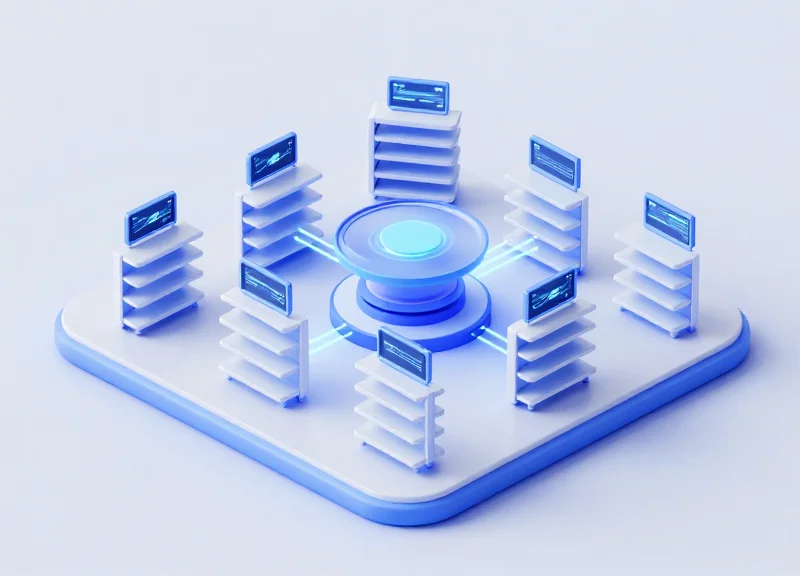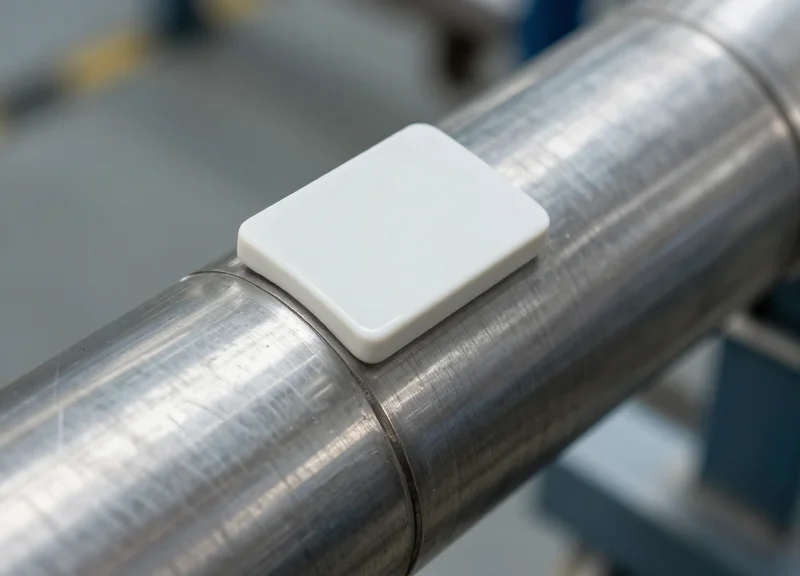
In the fast-evolving manufacturing landscape of 2026, Work-in-Process (WIP) tracking has transitioned from a backend log to a real-time strategic asset. As production lines accelerate to meet global demand, traditional tracking methods often fail, leading to data gaps and operational bottlenecks. Selecting the right RFID tags and readers is critical for capturing high-velocity data without sacrificing accuracy. This guide provides an authoritative roadmap for operations managers and engineers to navigate the complexities of high-speed RFID implementation, ensuring seamless visibility across the entire manufacturing lifecycle.
The Strategic Importance of High-Speed WIP Tracking in 2026

In 2026, high-speed Work-in-Process (WIP) tracking is the backbone of the 'Autonomous Factory,' where RFID systems must capture data from items moving at speeds exceeding 10 meters per second with 99.99% accuracy. As manufacturing shifts toward hyper-personalization and ultra-lean cycles, the ability to identify, locate, and assess the state of every component in real-time is the primary differentiator between market leaders and those hindered by legacy bottlenecks. Strategic implementation of high-performance RFID is no longer just about inventory visibility; it is about providing the granular data feeds required for AI-driven orchestration and digital twin synchronization.
- Elimination of 'Dark' Production Windows: Modern high-speed lines often move faster than traditional barcode scanners or low-end RFID readers can process. High-speed tracking ensures that no part of the assembly process remains invisible to the ERP or MES.
- AI-Driven Predictive Maintenance: By tracking the precise dwell time and transit speed of individual units through high-friction zones, systems can predict machine wear and tear before failures occur.
- Hyper-Personalization at Scale: As Batch Size One becomes the industry standard, high-speed RFID allows the production line to automatically reconfigure itself for each unique item based on its digital identity tag.
- Compliance and Provenance: Regulatory requirements in 2026 demand a 'Digital Product Passport.' High-speed WIP tracking captures every touchpoint, ensuring a full immutable history of the product's creation.
| Feature | Legacy WIP Tracking | 2026 High-Speed WIP (RFID) |
|---|---|---|
| Conveyor Speed | Max 1-2 m/s | Up to 15 m/s |
| Read Success Rate | ~95% (Intermittent) | 99.99% (Deterministic) |
| Data Latency | Minutes/Seconds | Milliseconds |
| Process Integration | Manual/Batch | Autonomous/Edge-Integrated |
Expert Insight: The 'Atomic WIP' Concept. As a veteran of Silicon Valley’s hardware evolution, I’ve observed that the most successful firms in 2026 have moved beyond tracking 'units' to tracking 'state changes' at the atomic level. This means the RFID tag is not just an ID; it is a live ledger of the unit's metabolic rate within the factory. If your RFID infrastructure cannot handle the burst-rate of a 400-item-per-minute throughput with sub-2ms latency, your Digital Twin will always be hallucinating based on stale data. The goal is 'Zero-Latency Logistics,' where the physical world and the digital model are perfectly synchronous.
Technical Challenges of High-Velocity Data Capture

In high-speed Work-in-Process (WIP) tracking, the primary technical barrier is the 'Dwell Time Window'—the total duration a tag remains within a reader's effective interrogation zone. As manufacturing speeds in 2026 push toward 10 meters per second, this window shrinks to under 50 milliseconds. To successfully capture data, an RFID system must complete the 'Power-up, Inventory, and Acknowledge' cycle within this fleeting moment, all while overcoming the physical phenomena of RF signal attenuation and environmental noise.
| Conveyor Speed (m/s) | Approx. Dwell Time (1m Zone) | Primary Risk Factor | 2026 Requirement |
|---|---|---|---|
| 2.0 m/s | 500 ms | Multipath Interference | Standard Circular Antenna |
| 5.0 m/s | 200 ms | Tag Energization Latency | High-Sensitivity ICs |
| 10.0 m/s | 100 ms | Signal 'Null' Pass-through | Phase-Array Beamforming |
The physics of motion introduces a 'Doppler Shift' and 'Dynamic Null Zones.' When a tagged item moves rapidly past a fixed antenna, the frequency of the backscattered signal shifts, potentially falling outside the reader's narrow reception filter. Furthermore, in environments dense with metal machinery, the 'null zones' (points of destructive interference) are not static. A fast-moving tag may enter and exit a null zone multiple times during its dwell window, causing fragmented data packets and the dreaded 'missed read'—a failure that can stop a multi-million dollar production line.
How does tag sensitivity impact high-speed accuracy?
Higher sensitivity tags (measured in dBm) require less energy to 'wake up.' In high-velocity scenarios, a tag with -22dBm sensitivity will energize much faster than a standard -18dBm tag, buying the system precious milliseconds to complete the data handshake.
What is the 'Rule of 3' in high-speed RFID?
The 2026 industry standard for 99.99% reliability is to architect for three full successful EPC read cycles per tag pass. This redundancy accounts for momentary signal blockage or RF collisions that occur at high velocity.
Can AI readers mitigate motion-induced errors?
Yes, 2026-gen readers utilize 'Predictive Edge Filtering' to reconstruct partial backscatter signals. If a tag passes through a null zone mid-transmission, the reader's AI can often interpolate the missing data bits based on previous signal strength patterns.
Expert Insight: In 2026, the real differentiator is 'Dynamic Adaptive Sensitivity' (DAS). Unlike older fixed-power readers, DAS systems utilize sensors to detect the incoming velocity of a WIP item and adjust the reader's gain and phase-angle in real-time. This effectively 'tracks' the tag electronically as it moves, extending the virtual dwell time without slowing down the physical conveyor.
Selecting High-Performance RFID Tags: Durability and Sensitivity
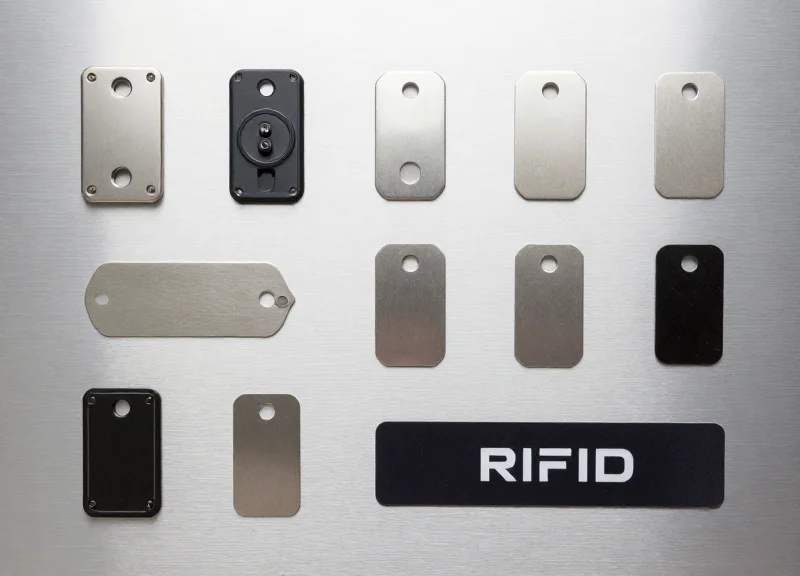
In 2026, selecting high-performance RFID tags for high-speed Work-In-Progress (WIP) tracking is no longer just about 'on-metal' capability; it is about the balance between 'Read Sensitivity' (measured in dBm) and 'Environmental Survivability.' A high-performance tag must possess a sensitivity threshold of -20 dBm or better to be successfully interrogated by a reader while moving at velocities exceeding 10 meters per second. This sensitivity ensures the tag can be energized and transmit its backscatter data within the micro-window provided by high-speed conveyors or robotic sorters.
| Tag Housing Material | Temperature Tolerance | RF Sensitivity | Ideal Application |
|---|---|---|---|
| Ceramic Hard Tags | -40°C to +250°C | Very High | Automotive paint shops & engine block casting |
| Encapsulated Polycarbonate | -20°C to +100°C | Ultra-High | High-speed electronic assembly & cleanrooms |
| Ruggedized PET Inlays | -10°C to +70°C | High | FMCG packaging & high-volume logistics |
| Silicone Flex-Tags | -40°C to +200°C | Moderate | Curved surfaces & medical device sterilization |
How does 'Dwell Time' affect tag sensitivity selection?
As WIP speeds increase, the dwell time—the duration a tag stays within the reader's RF field—decreases. Tags with higher sensitivity (-21 dBm vs -15 dBm) require less energy to wake up, making them essential for high-velocity lines where the interrogation window is less than 10 milliseconds.
What durability ratings are mandatory for 2026 industrial environments?
For high-speed WIP, an IP68 or IP69K rating is standard. This protects the internal chip and antenna from high-pressure washdowns, oil ingress, and caustic chemicals that can cause micro-cracks in the antenna, leading to intermittent read failures.
Should I use 'Global' or 'Region-Specific' frequency tags?
While global tags offer flexibility, region-specific tags (tuned exactly to 865-868 MHz or 902-928 MHz) generally offer 15-20% better sensitivity, which can be the difference between a 99% and 100% read rate at high speeds.
Expert Tip: For 2026, we are seeing the rise of 'Antenna-Agnostic' tag designs. Traditional tags detune when placed on high-dielectric materials or composites. Modern high-speed tags now utilize 3D-loop antenna structures that maintain a consistent resonant frequency regardless of the substrate. If your WIP involves carbon fiber or specialized alloys, always specify a tag with 'Automatic Dielectric Compensation' to avoid the 90% drop in read range that occurs with standard on-metal tags.
- Determine the Thermal Profile: Map the highest temperature the tag will face (e.g., curing ovens) and ensure the housing and adhesive can withstand it without deforming.
- Evaluate RF Interference Environment: Identify nearby metals or liquids that could require specialized 'Spacer' tags to maintain the necessary air gap for signal integrity.
- Benchmark at Velocity: Test the tag sensitivity using the exact reader power and line speed intended for production to verify the 'First-Pass Read Rate' (FPRR).
Choosing the Right RFID Readers for Rapid Production Lines
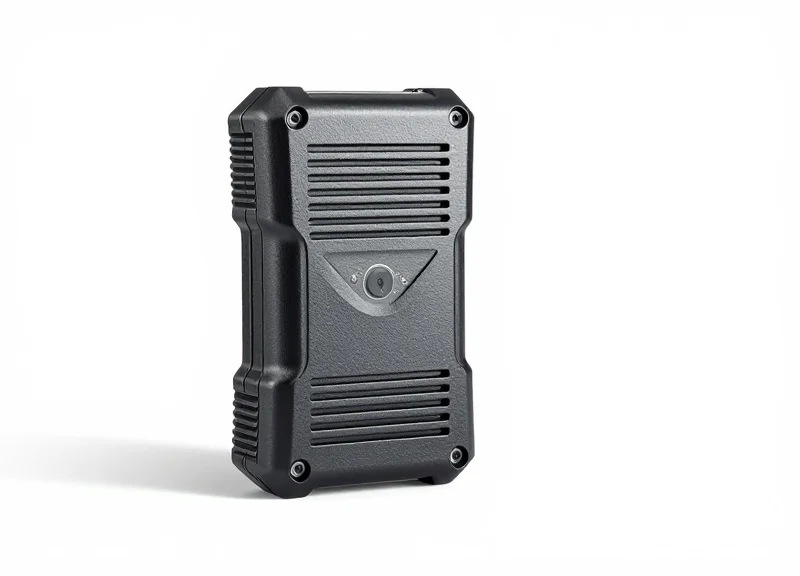
For 2026-era high-speed WIP (Work-in-Progress) tracking, an RFID reader is no longer just a radio; it is a specialized edge-computing node designed to process thousands of tag IDs per second with sub-millisecond latency. To maintain 99.9% accuracy on lines moving faster than 10 meters per second, a reader must possess advanced Digital Signal Processing (DSP) and high-gain sensitivity to capture data during the extremely brief 'dwell time' when a tag passes through the interrogation zone.
| Feature | Standard Industrial Reader | High-Speed WIP Reader (2026) |
|---|---|---|
| Processor Type | Single-core 1GHz ARM | Quad-core 1.8GHz+ with FPGA/NPU Acceleration |
| Read Rate | 200 - 600 tags/sec | 1,200 - 2,500+ tags/sec |
| Connectivity | 10/100 Ethernet | Gigabit Ethernet (PoE+), 5G, or Wi-Fi 6E/7 |
| On-device Memory | 256MB - 512MB | 2GB - 8GB LPDDR4 |
- Prioritize PoE+ (802.3at) Support: High-speed readers require significantly more power to drive maximum sensitivity and processor speeds. PoE+ provides up to 30W, ensuring the reader doesn't 'throttle' its RF output or CPU cycles during peak load.
- Evaluate Multi-Antenna Port Density: Look for 4-port or 8-port readers that allow for 'Dense Reader Mode' (DRM). This allows multiple antennas to create a wider, more redundant interrogation zone to catch tags at high velocity without interference.
- Verify Edge Processing APIs: The reader should support modern containerization (like Docker) to run filtering and deduplication logic locally, reducing the bandwidth load on your central ERP system.
Expert Insight: The 'Interrupt Latency' Factor. In 2026, the true performance bottleneck is not the radio frequency, but the operating system's interrupt latency. Standard Linux-based readers often suffer from 'jitter' when processing dense tag populations. When selecting a reader for lines exceeding 8m/s, demand benchmarks for 'Trigger-to-Action' latency—the time it takes for a reader to detect a tag and fire a GPIO signal to a PLC. Any lag over 5ms can result in missed diverts or sorting errors.
How does PoE+ affect reader performance?
Standard PoE often limits a reader's RF output to 27dBm or less. PoE+ allows the reader to operate at a full 30dBm to 31.5dBm while simultaneously powering high-speed internal cooling and edge-computing modules.
Is Wi-Fi 6E necessary for RFID readers?
For mobile WIP tracking (like AGVs or overhead cranes), Wi-Fi 6E is critical. It utilizes the 6GHz band, which is free from the interference of older 2.4GHz/5GHz industrial equipment, ensuring no data packets are lost during high-speed transit.
What is the benefit of FPGA-accelerated readers?
FPGA (Field-Programmable Gate Array) chips handle the raw radio signals at hardware speeds. This offloads the heavy lifting from the main CPU, allowing the reader to decode multiple tag protocols simultaneously without dropping packets.
Antenna Selection and Placement Strategies
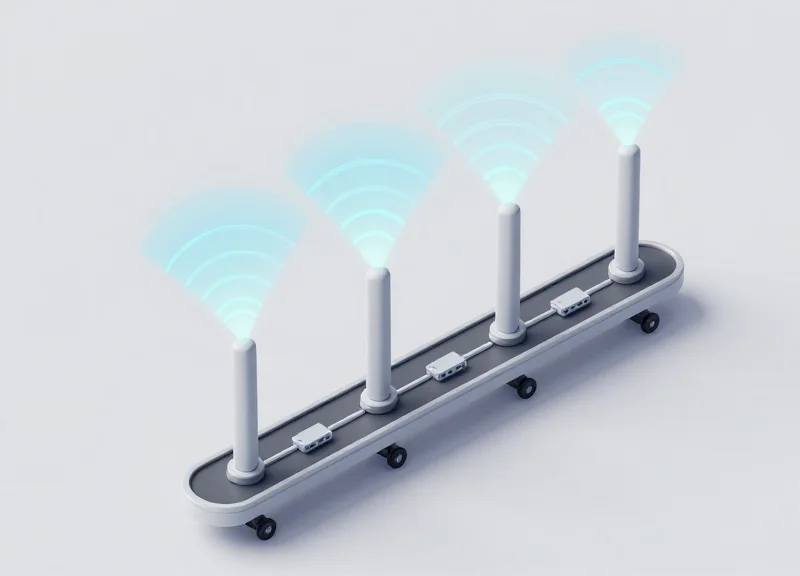
For high-speed Work-in-Progress (WIP) tracking, antenna selection is the pivot point between a system that delivers actionable data and one that creates digital noise. To achieve maximum throughput, engineers must synchronize the antenna's polarization—either linear or circular—with the movement vector of the asset. Linear polarization provides superior range and penetration for tags at a fixed orientation, while circular polarization is the industry standard for high-speed lines where tag orientation is unpredictable. Success in 2026 environments depends on 'Spatial Zoning,' a strategy that uses physical shielding and narrow-beam antennas to create isolated interrogation zones, preventing the 'ghost reads' common in dense manufacturing floors.
| Feature | Linear Polarization | Circular Polarization |
|---|---|---|
| Orientation Sensitivity | High: Tag must align with antenna. | Low: Reads tags at any angle. |
| Effective Range | Longer (up to 30% more distance). | Shorter, more concentrated field. |
| Ideal Speed Profile | Fast moving, fixed orientation (e.g., conveyor rail). | Tumbled parts or varying container heights. |
| Multipath Interference | Higher risk in metal-heavy zones. | Naturally more resistant to reflections. |
Expert Insight: The 'RF Tunneling' Effect. In 2026, the most advanced high-speed lines are moving away from broad-flood illumination. Instead, we are seeing a shift toward 'RF Tunneling'—using phased-array antennas to create a tight, software-defined beam that 'follows' a tag as it passes. This dynamic beamforming increases the dwell time (the duration the tag is powered) without requiring a wider physical footprint, effectively doubling the data transfer window for assets moving faster than 5 meters per second.
- Map the Near-Field Interference: Before mounting, use a spectrum analyzer to identify ambient RF noise from motors or wireless routers that could desensitize the antenna.
- Implement Physical RF Shielding: Utilize carbon-filled foam or metallic baffles between adjacent conveyor lines to prevent an antenna on Line A from reading a tag on Line B.
- Optimize the 'Look-Angle': Angle antennas at 30-45 degrees relative to the path of travel. This 'leading edge' interrogation increases the number of pulses a tag receives before exiting the zone.
- Configure RSSI Filtering: Use the reader's software to set a Received Signal Strength Indicator (RSSI) threshold, automatically discarding weak signals that originate outside the primary tracking zone.
How many antennas are needed for a high-speed portal?
Typically, four antennas are recommended—two on each side at varying heights—to ensure total coverage and mitigate 'blind spots' caused by liquid or metal within the WIP.
Does cable length affect high-speed read rates?
Significantly. Long coaxial cables cause signal attenuation. For high-speed lines, use LMR-400 grade cables and keep runs under 10 meters to maintain maximum power at the antenna head.
Can I use 'near-field' antennas for WIP?
Only if the tag passes within 5-10cm of the antenna. Near-field is excellent for precision tracking on high-speed small-parts assembly where cross-talk must be zero.
Overcoming Environmental Interference: Metal and Liquid Obstacles
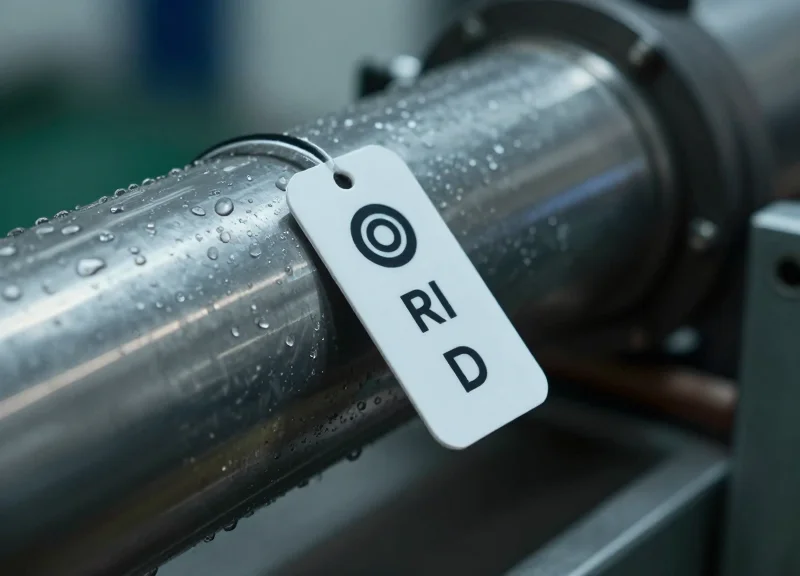
In the context of high-speed WIP tracking, metal and liquid are the primary enemies of RF reliability. Metal surfaces reflect UHF energy, causing multi-path interference and 'detuning' standard tags by shifting their resonant frequency, while liquids act as sponges that absorb RF energy entirely. Overcoming these obstacles in a 2026 manufacturing environment necessitates the use of specialized tag architectures—such as Ceramic, PCB, or Flag tags—designed to create a physical or electromagnetic buffer between the antenna and the interfering substrate.
| Tag Type | Best Use Case | Interference Strategy | High-Speed Suitability |
|---|---|---|---|
| Hard On-Metal (PCB) | Heavy Machinery/Auto Parts | Rigid physical standoff to prevent detuning | Excellent (High Durability) |
| Flexible On-Metal | Curved Metal Containers | Integrated ferrite layer to redirect flux | Good (Low Profile) |
| Flag Tags | Liquid-filled Vials/Bottles | Physical distance from the liquid surface | Moderate (Requires Orientation) |
| Encapsulated Washable | Food/Chemical WIP | High-density polymer shielding | High (Chemical Resistant) |
Expert Tip: The 'Inverse Polarization' Insight. By 2026, the most advanced WIP lines are moving away from brute-forcing signal power. Instead, use 'Adaptive Impedance Matching' tags. These next-generation chips can sense the dielectric constant of the material they are attached to and dynamically shift their internal capacitance to maintain a 100% read rate, even if the liquid levels inside a tracked container fluctuate during the process.
- Conduct an RF Site Survey with 'Noise Floor' Mapping: Before deploying readers, use a spectrum analyzer to identify ambient interference from VFDs and heavy motors common in metal-rich environments.
- Implement Circularly Polarized Antennas: Unlike linear antennas, circular polarization is less susceptible to the signal 'dead zones' created when RF waves reflect off metal surfaces.
- Optimize Tag Standoff Distances: For liquid tracking, ensure the tag's IC is at least 3-5mm away from the fluid surface to prevent signal attenuation.
- Configure 'Read Masking' and RSSI Filtering: Program the reader to ignore low-strength reflections (multipath) and only process high-intensity signals directly from the WIP tag.
Can I use standard inlays on metal if I use a foam spacer?
While possible for low-speed testing, foam spacers are generally unreliable for high-speed WIP due to inconsistent thickness and poor durability compared to dedicated on-metal PCB tags.
How does liquid temperature affect RFID reads?
Extreme temperatures can alter the dielectric properties of liquids, increasing absorption. 2026-grade sensors often include temperature-compensated ICs to maintain read consistency.
What is the role of RF shielding in these environments?
Shielding (using RF-absorbent foam or Faraday curtains) is used to 'gate' the read zone, ensuring the reader doesn't pick up tags reflected off distant metal walls.
Integration: Bridging the Gap Between Hardware and MES/ERP

In 2026, the success of a high-speed WIP tracking system is measured not by how many tags a reader can see, but by how efficiently that data is ingested by the 'Digital Brain' of the factory—the MES or ERP. Integration is the process of translating raw Low Level Reader Protocol (LLRP) signals into actionable business events. Without an intelligent middleware layer, the sheer volume of data from a high-speed production line—often exceeding 1,000 reads per second—can act as a Distributed Denial of Service (DDoS) attack on your ERP database, causing system latency and critical data silos.
| Integration Method | Latency Level | Best Use Case | Complexity |
|---|---|---|---|
| Direct API/REST | Moderate | Low-volume, high-value asset tracking | Low |
| MQTT / Pub-Sub | Ultra-Low | High-speed, massive scale WIP tracking | Moderate |
| Edge Middleware | Low | Complex filtering and data deduplication | High |
| Native ERP Plugins | High | Non-real-time inventory management | Very Low |
The Veteran's Insight: The 'Semantic Edge' Strategy. Most integrators fail by trying to send every tag 'ping' to the cloud. In 2026, the gold standard is performing 'Semantic Filtering' at the edge reader level. This means the hardware is programmed to only trigger a message to the MES when a 'State Change' occurs—such as a component entering a specific zone or a completed assembly passing a quality gate. This reduces data traffic by up to 95% while maintaining 100% accuracy of the digital twin.
- Edge Data Deduplication: Implement algorithms at the reader level to discard redundant reads of the same tag within a millisecond window, ensuring the MES only receives a single, clean event notification.
- Protocol Translation: Utilize gateways to convert proprietary hardware protocols or LLRP into web-friendly formats like JSON via MQTT or Webhooks for seamless ingestion by modern ERPs like SAP S/4HANA or Oracle Cloud.
- Buffer Management: Configure local storage on RFID controllers to buffer data in the event of a network outage, preventing data loss in high-speed environments where a 10-second gap could mean 500 untracked units.
Does RFID integration require a specialized middleware software?
While many modern readers have built-in 'Edge' capabilities, a dedicated middleware layer is highly recommended for multi-site deployments to standardize data before it reaches the MES/ERP.
What is the best protocol for real-time manufacturing updates?
MQTT (Message Queuing Telemetry Transport) is the industry preferred protocol due to its lightweight footprint and 'publish-subscribe' model, which is ideal for high-speed production data.
How do we ensure data security during integration?
Ensure all hardware-to-software communication utilizes TLS 1.3 encryption and OAuth 2.0 authentication to prevent unauthorized access to sensitive production telemetry.
ROI Analysis: Balancing Performance and Hardware Costs
Return on Investment (ROI) in high-speed RFID Work-in-Process (WIP) tracking is the net gain achieved by subtracting the Total Cost of Ownership (TCO)—including hardware, software, and deployment—from the cumulative savings in labor, scrap reduction, and increased throughput. In a 2026 manufacturing environment, ROI is no longer just about 'tag price'; it is about the 'cost-per-successful-read' at velocity. High-performance hardware often pays for itself within 12 to 18 months by eliminating the 'invisible tax' of missed reads that lead to expensive line stoppages and downstream quality failures.
| Investment Tier | Typical Hardware Spend | Error Rate Profile | Primary ROI Driver |
|---|---|---|---|
| Entry-Level (General Purpose) | Low ($) | 2-5% Missed Reads | Initial CAPEX Savings |
| Performance-Grade (WIP Optimized) | Moderate ($$) | <0.5% Missed Reads | Labor & Scrap Reduction |
| Enterprise High-Speed (2026 Spec) | High ($$$) | <0.01% Missed Reads | Maximum Throughput & OEE |
Expert Insight: The 'Ghost Inventory' Penalty. In my 20 years in the Valley, the biggest ROI killer I’ve seen isn't the price of a $0.50 ruggedized tag; it is the cost of 'Ghost Inventory.' When cheap hardware misses a read at 300 feet per minute, the system assumes the part doesn't exist or is in the wrong stage. The manual audit required to fix that one 'ghost' item often costs 100x the price difference between a budget reader and a high-performance one.
- Identify Baseline Labor Costs: Quantify the man-hours currently spent on manual scanning, data entry, and physical inventory counts.
- Calculate the Scrap and Rework Delta: Measure the cost of products ruined because they skipped a critical heat-treat or testing phase due to tracking gaps.
- Factor in Machine Utilization (OEE): Calculate the revenue gain from increasing line speed by 15-20% once you have real-time confidence in your WIP location.
- Amortize TCO Over 5 Years: Include firmware updates and technical support in your hardware budget to ensure the system scales with production volume.
Should I choose high-end readers or high-end tags?
Always prioritize reader sensitivity first. A high-gain, high-speed reader can often compensate for a standard tag, but even the best tag cannot overcome a reader with a slow processor and poor collision arbitration.
How does 'latency' impact the financial model?
In high-speed WIP, latency is money. A 100ms delay in tag processing can mean a part has moved 2 feet past a diverter. High-speed hardware reduces this latency, preventing mechanical sorting errors that cause physical damage.
What is the typical payback period for a 2026 RFID upgrade?
Most enterprise-grade systems see a full break-even point within 14 months, driven primarily by a 30% reduction in manual WIP auditing labor.
Future-Proofing Your WIP Infrastructure for 2027 and Beyond
To future-proof your Work-in-Progress (WIP) infrastructure for 2027 and beyond, you must move beyond simple identification and embrace Ambient IoT—a paradigm where RFID tags act as distributed sensors providing continuous, real-time telemetry. While 2026 is about high-speed read rates, the 2027 horizon is defined by the fusion of UHF RFID with energy-harvesting sensors and Edge AI, ensuring that your hardware doesn't just record movement but predicts production bottlenecks before they occur.
| Feature | Standard 2026 Capability | 2027+ Future-Ready Requirement |
|---|---|---|
| Data Type | Simple EPC (Electronic Product Code) | EPC + Sensor Telemetry (Temp, Humidity, Vibration) |
| Processing | Cloud-based batch processing | AI-driven Edge Processing (Real-time Latency) |
| Connectivity | Fixed Ethernet/Wi-Fi 6 | Private 5G/6G & Mesh-networked Readers |
| Tag Intelligence | Passive memory storage | Dynamic data updating with Blockchain/DLT integrity |
The most significant shift we are seeing in Silicon Valley's industrial labs is the move toward AI-Driven Edge Processing. By 2027, the volume of data generated by high-speed WIP lines will exceed the bandwidth capacity of traditional cloud architectures. Future-ready readers will come equipped with NPUs (Neural Processing Units) that filter 'noise' at the source, only sending relevant anomalies to your MES. This 'intelligence at the antenna' allows for sub-millisecond decision-making, such as automatically rerouting a defective part on a high-speed conveyor without human or cloud intervention.
What is 'Sensor-Integrated RFID' and why do I need it?
Sensor-integrated RFID tags are passive or semi-passive chips that harvest energy from the reader to power environmental sensors. By 2027, tracking a part's ID won't be enough; you'll need to know if that part was exposed to excessive heat or moisture during the WIP cycle to ensure quality compliance.
Will I need to replace my 2026 readers for 2027 standards?
If you invest in Software-Defined Radio (SDR) platforms today, you can likely upgrade via firmware. Ensure your 2026 hardware supports 'Containerized Apps' (like Docker), allowing you to deploy AI models directly onto the reader as tracking requirements evolve.
How does 'Ambient IoT' impact WIP tracking?
Ambient IoT refers to tags that can be read by existing Bluetooth or Wi-Fi infrastructure in addition to RFID readers. Future-proofing means choosing tags that support multi-protocol communication, allowing for seamless tracking between high-speed zones and general warehouse storage.
Expert Insight: One often-overlooked factor for 2027 is the 'Green RFID' movement. As global regulations on electronic waste tighten, future-proofing your WIP involves transitioning to 'Paper-based' or 'Antenna-on-Paper' tags that eliminate PET plastics. Investing in readers with higher sensitivity now ensures you can read these eco-friendly tags, which often have slightly lower gain than traditional plastic-etched counterparts.