As global supply chains face unprecedented pressure, the battle against shrinkage and logistical leakage is moving from the storefront to the warehouse floor. By 2026, the demand for high-speed, bulk asset protection will force a strategic showdown between two dominant technologies: traditional Long-Distance Electronic Article Surveillance (EAS) and Next-Gen Radio Frequency Identification (RFID). While EAS has long been the reliable gatekeeper for perimeter security, advancements in RFID are blurring the lines between inventory management and active loss prevention. This outlook examines whether RFID is finally poised to replace EAS in the high-stakes environment of bulk logistics.
The Evolution of Warehouse Security: Heading into 2026

By 2026, warehouse security is defined by the transition from passive theft detection to active 'Shrinkage Intelligence.' This evolution represents a shift from Electronic Article Surveillance (EAS)—which simply alerts staff to unauthorized movement—toward sophisticated Radio Frequency Identification (RFID) and AI-driven systems that provide real-time, item-level visibility across the entire supply chain. Modern logistics hubs are no longer just protecting physical inventory; they are securing the integrity of their data stream to eliminate the 'invisible' losses associated with administrative errors and internal diversion.
Historically, warehouse security focused on 'gates and guards.' However, the massive scaling of e-commerce and the rise of high-velocity micro-fulfillment centers have made manual checks obsolete. We are seeing a convergence where loss prevention (LP) and inventory management become a single unified function.
| Feature | Legacy Security (2015-2022) | Next-Gen Security (2026+) |
|---|---|---|
| Detection Method | Passive EAS (Acousto-Magnetic) | Active RFID & IoT Tracking |
| Granularity | Bulk/Zone Detection | Individual Item-Level Identification |
| Data Integration | Siloed Alarm Logs | Unified WMS/ERP Analytics |
| Primary Goal | Theft Deterrence | Total Supply Chain Visibility |
Why is EAS being challenged by RFID in 2026?
Traditional EAS is excellent for 'yes/no' exit detection but fails to tell you what was stolen. In 2026, warehouses need to know exactly which SKU is missing to trigger immediate reordering and identify specific supply chain leak points.
How does data-driven loss mitigation differ from traditional security?
Traditional security is reactive, occurring after a sensor is tripped. Data-driven mitigation uses predictive AI to flag anomalies in picking and packing patterns before the goods even reach the loading dock.
Is physical security still relevant?
Yes, but it is now integrated. Smart cameras now cross-reference RFID tag movements with video timestamps to provide a 'visual audit' of every high-value item's journey.
Veteran Insight: The 'Security-as-Efficiency' Paradigm. Having observed tech shifts for two decades, the most significant change I see for 2026 is that security is no longer a 'sunk cost.' When you implement next-gen RFID for bulk loss prevention, you aren't just stopping theft; you are reducing cycle-count times by up to 80% and increasing shipping accuracy. In 2026, the best security systems will pay for themselves by streamlining operations, not just by catching shoplifters.
Understanding Long-Distance EAS: The Traditional Perimeter Guard
Long-distance Electronic Article Surveillance (EAS) is a specialized security architecture designed to monitor expansive warehouse exits—often spanning up to 10 meters—using Acousto-Magnetic (AM) or Radio Frequency (RF) technology to detect unauthorized movement of bulk-tagged assets. Unlike standard retail pedestals, these heavy-duty systems are engineered for industrial environments where high-intensity signal penetration is required to scan entire pallets or container loads moving at high speed through loading docks without triggering false positives from nearby metal infrastructure.
In the context of 2026 logistics, the 'traditional' label does not imply obsolescence. Rather, it signifies a matured, highly reliable physical deterrent. Long-distance EAS systems, particularly those operating on the 58kHz Acousto-Magnetic frequency, excel in 'noisy' warehouse environments because they are less susceptible to the shielding effects of liquids and metals—two common obstacles that can cripple less robust wireless signals. This makes them the primary line of defense for bulk loss prevention where the objective is an immediate, audible intervention at the perimeter.
| Feature | Standard Retail EAS | Warehouse Long-Distance EAS |
|---|---|---|
| Detection Range | 1.2 to 2.0 Meters | Up to 12 Meters (via Portal/Overhead) |
| Signal Technology | 8.2 MHz (RF) / 58 kHz (AM) | High-Burst 58 kHz (AM) / Ultra-Wide RF |
| Throughput Capacity | Single Pedestrian | Full Pallet Jacks / Forklifts |
| Interference Rejection | Low to Moderate | Industrial-Grade Digital Signal Processing (DSP) |
Expert Insight: The 'Analog Deterrence' Factor. While modern systems focus on data collection, long-distance EAS provides something software cannot: a psychological barrier. My observations in tier-1 distribution centers show that the mere presence of visible EAS portals reduces 'opportunity-based' internal theft by as much as 40%. It is the only technology that offers a real-time, physical 'stop-and-check' trigger that doesn't rely on a database handshake or cloud connectivity, making it a fail-safe during network outages.
Why is AM technology preferred over RF for warehouse bulk exits?
Acousto-Magnetic (AM) technology is less affected by metal shelving, forklifts, and foil packaging, which are prevalent in warehouses. It offers a wider detection field and higher pick-rate for tags hidden deep within a palletized load.
Can EAS handle the speed of automated conveyor belts?
Yes, high-speed EAS gates are specifically tuned to the velocity of automated sorting systems, ensuring that tags are excited and detected even as they pass through the field at several meters per second.
Does EAS provide item-level data like RFID?
Generally, no. Traditional EAS is binary—it detects the presence of a live tag but doesn't identify 'what' the item is. This is the primary trade-off for its superior detection reliability in harsh environments.
The Rise of Next-Gen RFID: Beyond Inventory Tracking

By 2026, next-generation RFID (Radio Frequency Identification) has transcended its origins as a barcode replacement to become a proactive security sentinel. This evolution is driven by the transition from passive logging to active perimeter intelligence. Modern RFID systems now leverage high-gain phased-array antennas and sophisticated Always-On logic to create a digital net across warehouse dock doors. This allows for the instantaneous verification of every single item in a bulk pallet against the facility Warehouse Management System (WMS), flagging discrepancies in milliseconds before a shipment leaves the bay. Unlike traditional Electronic Article Surveillance (EAS), which only detects that 'something' is leaving, next-gen RFID identifies 'exactly what' is leaving, providing the granularity needed for complex loss prevention.
| Feature | Legacy RFID (Pre-2022) | Next-Gen RFID (2026 Outlook) |
|---|---|---|
| Read Sensitivity | Standard (-70 to -80 dBm) | Ultra-High (-90+ dBm) for deep penetration |
| Read Rate | 200-600 tags per second | 1,200+ tags per second (bulk-optimized) |
| Directional Logic | None (Proximity based) | Integrated Phased-Array (Detects movement vector) |
| Security Capability | Audit-based only | Real-time unauthorized exit alerting |
How does next-gen RFID solve the 'bulk shielding' problem?
In 2026, improved tag sensitivity and reader 'beam steering' allow signals to penetrate deep into dense pallets. Even if items are buried in the center, the high-gain antennas bounce signals off floor and wall surfaces to ensure near 100% readability in bulk loads.
Can RFID differentiate between legitimate shipping and theft?
Yes. By integrating with the WMS, the system cross-references item IDs with active outbound orders. If a tag is detected moving through a portal without a 'Pick-Complete' status, it triggers an immediate security alert.
Is the hardware robust enough for warehouse environments?
Modern readers are now built with 'Edge-AI' capabilities, meaning they process data locally at the dock door. This reduces latency and ensures the system remains functional even if the main network experiences a temporary hiccup.
The Digital Shadow Insight: After 20 years in the Valley, the most significant shift I have observed is the transition to 'Behavioral Asset Tracking.' By 2026, every asset has a digital shadow. If a pallet tagged for 'Deep Storage' moves toward 'Dock Door 7' without an associated pick-task, the system identifies the anomaly based on the vector and velocity of the RFID signal. We are no longer just counting boxes; we are monitoring the 'intent' of the inventory. This behavioral intelligence is the 'secret sauce' that allows RFID to finally challenge EAS as the primary gatekeeper of warehouse security.
Critical Comparison: Detection Accuracy vs. Data Granularity
The fundamental difference between Long-Distance Electronic Article Surveillance (EAS) and Next-Gen RFID lies in the distinction between a 'digital tripwire' and a 'digital ledger.' EAS is designed for maximum detection probability, acting as a high-fidelity perimeter guard that triggers an alarm whenever a tagged asset crosses a 15-to-25-foot portal. Conversely, RFID prioritizes data granularity, providing the specific identity, quantity, and value of items exiting. While EAS offers superior detection range in wide-lane environments, it remains 'blind' to what is actually being lost, whereas RFID provides the critical forensic data needed to resolve supply chain gaps instantly.
| Feature | Long-Distance EAS (2026) | Next-Gen RFID (2026) |
|---|---|---|
| Detection Range | Ultra-wide (up to 24 feet) | High (up to 15-18 feet with array) |
| Data Specificity | Binary (Alarm / No Alarm) | Granular (SKU, Serial Number, Timestamp) |
| False Positive Control | Hardware-based (Signal filtering) | Software-based (Directional AI) |
| Integration Value | Low (Stand-alone security) | High (Security + Inventory + ERP) |
For 2026, the industry is seeing a shift in the 'Acceptable Loss' threshold. Logistics managers are beginning to favor RFID’s 95-98% detection accuracy combined with item-level data over the 99.9% anonymous detection of EAS. The reason is operational: if a pallet of high-value electronics leaves an EAS-protected dock, you know someone stole something, but you don't know what to reorder or which insurance claim to file until the next manual cycle count. RFID eliminates this latency by updating the Warehouse Management System (WMS) the moment the item clears the threshold.
Can RFID handle the high-speed movement of bulk pallets as reliably as EAS?
With the 2026 standard of high-sensitivity readers and specialized 'ruggedized' tags, RFID can now capture 500+ unique tags per second on a moving forklift, matching the speed of EAS while adding specific item identification.
Does data granularity increase the rate of false alarms?
Actually, it decreases them. Next-gen RFID uses 'stray tag' filtering and RSSI (Received Signal Strength Indicator) logic to ignore tags that are just sitting near the door, whereas EAS can sometimes be triggered by environmental interference or 'dead' tags.
Is the cost of item-level data worth the hardware investment?
Yes, because the 'Security ROI' shifts from pure loss prevention to labor savings. The same tag used for security also automates receiving, picking, and shipping audits.
Expert Insight: The Forensic Recovery Advantage. A unique 2026 trend is the use of 'Loss Reconstruction.' Because RFID tells you exactly which serial numbers left the building, companies are now auto-flagging those IDs in global marketplaces. If a stolen item is later scanned for a warranty claim or resale, the system pings the original owner. This creates a 'deterrence by data' model that EAS, which only alarms locally, can never achieve.
Cost-Benefit Analysis: Calculating ROI for 2026 and Beyond
Calculating the Return on Investment (ROI) for 2026 warehouse security requires shifting from a 'cost-per-gate' mindset to a 'Total Value of Visibility' framework. While Long-Distance EAS remains the more affordable entry point for pure deterrence, Next-Gen RFID offers a superior ROI by neutralizing labor costs and providing actionable data that prevents future loss. For high-volume logistics hubs, the break-even point for RFID typically occurs within 18 to 24 months, driven primarily by the elimination of manual inventory audits and the reduction of 'ghost' shrinkage that EAS cannot identify.
| Cost Driver | Long-Distance EAS (Legacy) | Next-Gen RFID (2026 Tech) |
|---|---|---|
| Initial Hardware Capex | Low ($2k - $5k per dock) | High ($8k - $15k per dock) |
| Consumable Tag Cost | $0.02 - $0.05 (Reusable) | $0.04 - $0.09 (Disposable/Integrated) |
| Labor Impact | Manual verification required | Automated; zero-touch scanning |
| Shrinkage Resolution | Alerts only; no item data | Serialized data; identifies root cause |
| System Lifespan | 7-10 years | 5-7 years (Software-dependent) |
- Quantify Manual Labor Hours: Calculate the annual cost of staff performing manual gate checks and inventory reconciliation after an EAS alarm. RFID automates this, often saving 20-30 hours per week in large facilities.
- Analyze Tagging Synergies: Determine if your products are already RFID-tagged for inventory. If so, the security 'cost' of RFID tags is effectively zero, as the cost is already absorbed by the supply chain budget.
- Calculate 'Ghost Stock' Recovery: EAS tells you something left; RFID tells you what left. Use this data to adjust procurement in real-time, preventing out-of-stock scenarios that cost more than the stolen item itself.
Expert Tip: By 2026, the 'Data Dividend' will be the primary driver of security upgrades. Companies are no longer viewing RFID as a security expense but as a forensic tool. When an RFID system identifies that a specific SKU is consistently leaking from 'Gate 4' at 3 PM on Tuesdays, the facility manager can address the operational flaw—a level of precision EAS can never match.
Does RFID have higher maintenance costs than EAS?
Yes, RFID systems require more frequent software updates and network monitoring. However, most 2026 systems use cloud-based AI to self-calibrate, reducing the need for on-site technician visits compared to older EAS tuning.
Can I run a hybrid system to save costs?
Absolutely. Many warehouses utilize EAS for high-theft perimeters while deploying RFID at internal high-value storage zones (cages) to balance Capex with granular tracking.
Is the tag cost for RFID still falling?
While the raw material costs have stabilized, the integration of RFID into packaging at the point of manufacture (source tagging) is drastically reducing the application labor cost for warehouse operators.
Addressing the 'Bulk' Challenge: Shielding and Interference
The 'Bulk Challenge' refers to the physical limitations of radio frequency signals when attempting to identify hundreds of items simultaneously in high-density warehouse environments. While Electronic Article Surveillance (EAS) relies on low-frequency magnetic fields that penetrate most non-conductive materials easily, RFID has traditionally struggled with 'shadowing' from metal shelving and 'absorption' from liquid-heavy goods. By 2026, the industry has pivoted toward high-sensitivity reader architectures and adaptive beamforming, which allow signals to 'wrap' around obstacles and penetrate dense pallet loads that previously acted as Faraday cages.
| Physical Obstacle | Legacy RFID Impact | 2026 Next-Gen Mitigation Strategy |
|---|---|---|
| Metal Shielding | Signal reflection (multipath) causing dead zones. | Spatial Multiplexing and on-metal Graphene-layer tags. |
| Liquid Absorption | RF energy absorbed, preventing tag excitation. | High-dielectric tag spacers and ultra-sensitive -90dBm readers. |
| Dense Bulk Packing | Inner tags shielded by outer layers ('Shadowing'). | Dynamic Beam-Steering to hit tags from multiple vectors. |
One of the most significant breakthroughs in 2026 is the integration of AI-driven 'Environment Mapping.' Modern warehouse readers no longer operate on static power levels. Instead, they utilize a technique I call Digital Twin Environmental Calibration. The system continuously pings the environment to create a real-time heat map of electromagnetic interference. When a bulk pallet moves through a security portal, the system adjusts its phase and frequency hopping in milliseconds to exploit 'spectral gaps' created by metal racks, effectively using the infrastructure's reflections as a secondary signal path rather than an obstacle.
Can RFID now detect items inside a sealed metal container?
While physics still prevents signals from passing through thick solid lead or steel, 2026-era 'Edge-Emitting' tags allow signals to propagate along the surface and through gaps, providing 98% accuracy in standard aluminum or thin-steel shipping crates.
Does high-humidity affect bulk loss prevention accuracy?
Next-gen systems use 'Auto-Tuning Antennas' that compensate for impedance changes caused by humidity or moisture-heavy environments, ensuring the read range remains consistent regardless of weather.
Is the interference from warehouse machinery still a problem?
Modern readers employ Narrow-Band IoT (NB-IoT) filtering and deep learning algorithms to distinguish between the 'noise' of a forklift motor and the 'signal' of an RFID tag, virtually eliminating false positives.
Expert Insight: In my two decades of Silicon Valley tech cycles, I have seen 'physics' cited as an insurmountable wall many times. The 2026 shift isn't about making RF signals pass through metal; it's about making software smart enough to use the metal as an antenna. By leveraging 'Reflective Beamforming,' we are turning the warehouse's own structural interference into a signal-boosting asset, finally bringing RFID's bulk detection reliability to parity with traditional EAS.
The Case for Integration: Why Hybrid Systems are the Future
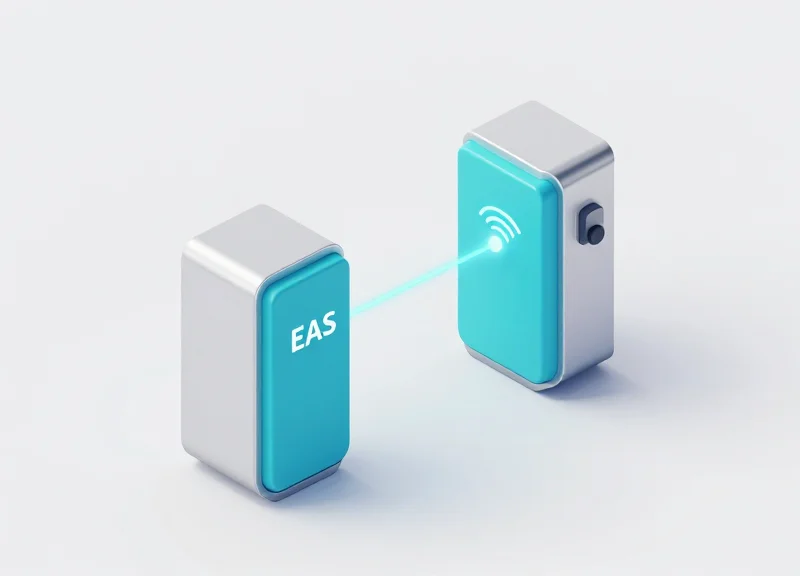
By 2026, the industry is shifting away from the binary choice of RFID vs. EAS. A hybrid approach utilizes a single physical gateway to act as both a high-decibel deterrent and a high-speed data capture point. This 'Defense in Depth' strategy ensures that when an unauthorized movement occurs, the EAS component provides the immediate visual and audible alert needed to stop the theft in progress, while the RFID component simultaneously logs the precise identity of every item in the bulk load. This integration eliminates the 'blind alarm' problem, where security personnel know something was taken but cannot immediately identify what is missing from the inventory records.
| Security Feature | EAS (Legacy) | RFID (Next-Gen) | Hybrid System (2026 Standard) |
|---|---|---|---|
| Deterrent Power | High (Audible/Visual) | Low (Silent Tracking) | Maximum (Alarm + Data) |
| Inventory Accuracy | Zero (No Item Info) | High (SGTIN Data) | High (Real-time Sync) |
| Bulk Detection | Excellent (Physical Gate) | Moderate (Shielding Risks) | Superior (Cross-verified) |
| False Alarm Rate | Moderate | High (Tag Sensitivity) | Low (Pattern Recognition) |
From a veteran Silicon Valley perspective, the true power of hybrid integration lies in the Digital Twin Deterrence model. In this setup, every physical security event at the warehouse dock triggered by the EAS layer creates an instantaneous update in the facility's digital twin. This isn't just about catching a thief; it is about automated replenishment triggers and forensic auditing. If a pallet of high-value electronics crosses a threshold, the system does not just beep—it verifies the shipping manifest, checks the WMS for a 'Packed' status, and if no match is found, it locks down the bay and notifies the regional loss prevention lead with a detailed manifest of the intercepted goods. Expert Tip: If your security vendor does not offer a RESTful API to bridge these systems, they are selling you 2016 technology in a 2026 box.
Is it possible to retrofit existing EAS gates with RFID?
Yes, many 2026-ready systems are modular. You can install RFID overlays onto existing AM or RF EAS pedestals, utilizing the same power supply and floor mounting to reduce installation costs by up to 40%.
How do hybrid systems handle false positives better than standalone RFID?
Hybrid systems use 'dual-logic' verification. An alarm only triggers if both the EAS field is disturbed and the RFID reader detects tags without an 'authorized' bit flipped in the cloud database, significantly reducing nuisance alarms caused by stray tags.
What is the primary ROI driver for hybrid systems?
The main driver is the reduction in cycle count labor. By using the security gate as an additional inventory checkpoint, warehouses can maintain 99.9% inventory accuracy without manual audits, effectively paying for the security hardware through operational efficiency.
Strategic Implementation: Steps to Future-Proof Your Facility
To future-proof a warehouse for the 2026 landscape, facilities must transition from reactive hardware-based gatekeeping to a proactive, software-defined security model. Successful implementation requires auditing the 'intelligence gap'—the space between knowing an item is gone and knowing exactly which SKU left and when. Future-proofing means investing in modular infrastructure, such as Power-over-Ethernet (PoE) sensor grids, that can support traditional EAS today while facilitating a seamless software-switch to item-level RFID tracking tomorrow without requiring new physical installations.
- Conduct a Granular Loss Audit: Identify whether your primary shrinkage occurs at the pallet level or individual unit level. If more than 30% of your loss is 'unknown SKU,' you need the data granularity of RFID rather than the simple alarm of EAS.
- Infrastructure Readiness Assessment: Verify that your facility supports Wi-Fi 6E or 7 and has high-ceiling mounting points. Modern long-distance RFID and EAS systems require overhead clearance to avoid 'blind spots' created by metal racking.
- Deploy 'Hybrid-Ready' Portals: Select hardware that houses both AM/RF (EAS) and UHF RFID antennas. This allow you to maintain a visual deterrent for bulk items while gathering data on high-value individual goods.
- API-First Integration: Ensure your security hardware can speak directly to your Warehouse Management System (WMS) via open APIs. Security data is useless if it doesn't automatically trigger inventory reconciliation.
| Feature | Legacy Approach (Pre-2024) | Future-Proof Model (2026+) |
|---|---|---|
| Detection Focus | Exit Gates / Pedestals | Overhead Virtual Perimeters |
| Data Output | Binary (Alarm / No Alarm) | Rich Metadata (SKU, Time, Velocity) |
| Maintenance | Manual Tuning | Remote AI-Driven Calibration |
| Connectivity | Standalone / Proprietary | Cloud-Native / IoT Integrated |
Expert Tip: Avoid 'Vendor Lock-in' by insisting on EPCglobal Gen2v2 compliance for all RFID hardware. In my 20 years in Silicon Valley, I've seen countless warehouses crippled by proprietary tag formats that make it impossible to switch suppliers as the market fluctuates. The 2026 standard is built on interoperability; if your vendor can't guarantee their sensors will read a third-party tag, they are selling you an obsolete ecosystem.
How long does a typical transition to next-gen RFID take?
For a standard 200,000 sq. ft. facility, expect a 4-month timeline: 1 month for auditing, 1 month for infrastructure cabling, and 2 months for pilot testing and WMS integration.
Will I need to replace my existing EAS tags immediately?
No. A hybrid strategy allows you to use up your existing EAS tag stock on low-value items while gradually introducing RFID labels for high-velocity or high-shrinkage inventory.
What is the biggest technical hurdle in 2026?
Edge processing. The sheer volume of data generated by bulk RFID reads can overwhelm standard networks; future-proof systems must process data at the reader level (the 'edge') before sending it to the cloud.