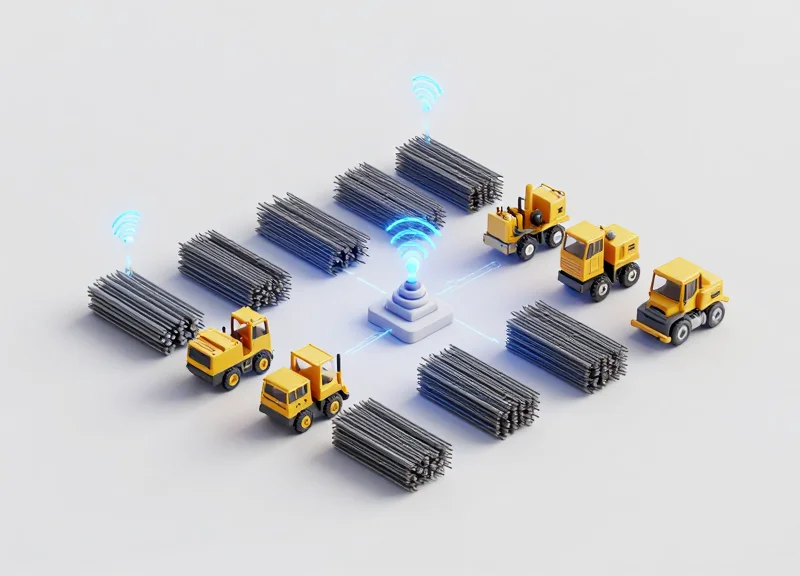
In the high-stakes world of construction, material shrinkage is often accepted as a 'cost of doing business.' However, losing 30% of raw materials like steel rebar or misplacing expensive equipment can decimate project margins. This article explores how RFID-enabled real-time tracking moves construction sites from manual guesswork to digital precision. By implementing robust RFID solutions, firms are not just tracking assets; they are reclaiming lost profits and ensuring every ton of steel is accounted for from the fabricator to the final pour.
The Hidden Drain: Why Construction Sites Lose 30% of Materials
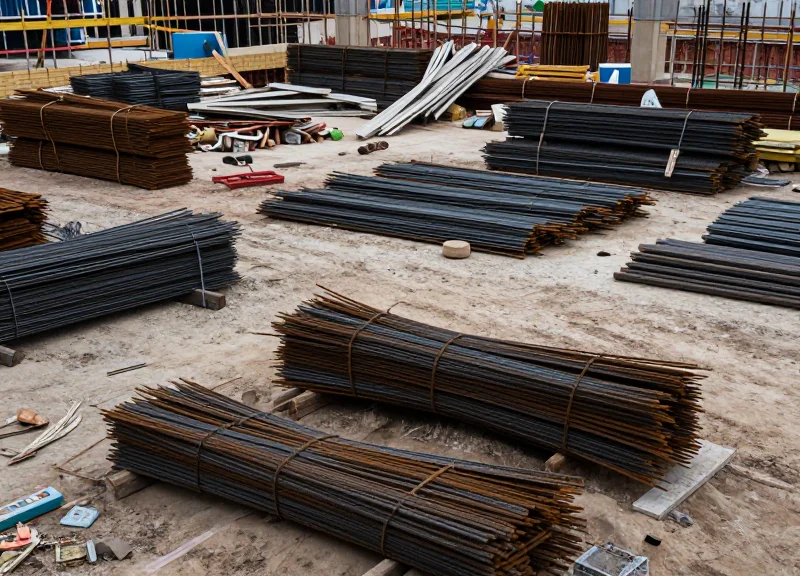
Construction sites lose an average of 30% of materials due to 'material shrinkage'—a combination of theft, damage, and logistical misplacement—compounded by 'process waste,' where redundant ordering occurs because existing inventory cannot be located in real-time. This 30% loss is not a single catastrophic event but a cumulative result of manual tracking failures, where the speed of material consumption consistently outpaces the accuracy of paper-based or spreadsheet-driven inventory logs.
In the context of high-value assets like steel rebar and heavy equipment, these losses are particularly corrosive to profit margins. Steel rebar, often stored in massive, undifferentiated piles across sprawling sites, is highly susceptible to 'phantom inventory'—material that is physically present but practically invisible to project managers due to poor location data. When a foreman cannot find the specific grade of rebar needed for a pour, the standard response is to place an emergency order, leading to over-procurement and increased storage costs.
| Loss Category | Estimated Impact | Primary Drivers |
|---|---|---|
| Theft and Shrinkage | 10-12% | Unsecured perimeters, high scrap value of steel, and unauthorized 'borrowing' between sub-contractors. |
| Logistical Errors | 8-10% | Mislabeling at the fabricator, delivery to incorrect site zones, and double-handling damage. |
| Inventory Mismanagement | 10-15% | Manual entry lag, spreadsheet errors, and inability to track material lifecycle from delivery to installation. |
Why is steel rebar particularly vulnerable to loss?
Rebar is often treated as a bulk commodity rather than a tracked asset. Its weight and volume make frequent manual counting impossible, and without unique digital IDs, different batches of specific structural grades are easily mixed or used in the wrong sections, leading to engineering non-compliance and waste.
Does equipment loss only refer to stolen machinery?
No. Significant loss comes from 'under-utilization' and 'search time.' When small tools or attachments are misplaced on-site, the labor cost spent searching for them often exceeds the value of the tool itself, contributing to the 30% efficiency drain.
How do logistical errors compound material loss?
When materials arrive without real-time verification, they are often offloaded in 'temporary' zones. Without a digital breadcrumb, these materials are frequently forgotten or buried under newer deliveries, effectively removing them from the available project inventory.
Expert Insight: The 'Inventory Velocity Gap.' After 20 years of observing Silicon Valley-style supply chains applied to construction, I have identified the primary culprit as the 'Velocity Gap.' This is the 48-to-72-hour window between a physical event (like a rebar delivery) and its digital recording in the project management software. In this window, approximately 15% of all site losses occur because the 'truth' of the site's inventory is entirely reliant on human memory, which fails under the pressure of tight construction schedules.
RFID Technology: The Digital Backbone of Modern Construction

RFID (Radio Frequency Identification) technology functions as the digital nervous system of a modern construction site, utilizing radio waves to capture and transmit data from tags attached to physical assets without requiring a direct line of sight. Unlike traditional barcodes that demand individual manual scanning, RFID enables the autonomous, high-speed identification of thousands of items simultaneously, effectively bridging the gap between the chaotic physical reality of a job site and the structured data environments of BIM (Building Information Modeling) and ERP systems.
| Feature | Passive RFID Tags | Active RFID Tags |
|---|---|---|
| Power Source | Powered by reader signal | Internal battery |
| Read Range | Up to 15 meters | Up to 100+ meters |
| Cost | Low ($0.10 - $2.00) | High ($15.00 - $50.00) |
| Best Use Case | Steel rebar, pallets, small tools | Heavy machinery, fleet vehicles |
| Lifespan | Virtually indefinite | 3-5 years (battery limited) |
The true challenge in construction is the environment. Standard RFID tags fail when applied directly to metal or submerged in mud. To combat this, industry-grade 'Metal-Mount' tags utilize a specialized dielectric spacer that prevents the metal's conductivity from reflecting the RF energy and detuning the tag. For steel rebar, these tags are often encapsulated in high-impact polymers or ceramic housings rated for IP68 or IP69K, ensuring they remain functional even when buried under piles of material or exposed to extreme pressure and moisture.
Can RFID scan through a pile of steel rebar?
Yes, but it requires specific high-memory UHF tags and circular-polarized antennas. While metal blocks signals, the radio waves 'bounce' through the gaps in the bundle, allowing the reader to identify tags inside the pile through a process called multi-path propagation.
Is the technology affected by weather conditions?
Modern ruggedized RFID tags are designed to operate from -40°C to +85°C. Performance is largely unaffected by rain, snow, or dust, which often cause optical tracking systems like QR codes to fail.
How does RFID integrate with existing software?
Most RFID readers use standard APIs to push data directly into Project Management software or BIM platforms, providing an automated 'as-built' status update every time a material moves.
Expert Insight: The Dielectric Advantage. A common mistake is using generic tags for steel tracking. My 20 years in the field have shown that for rebar tracking, you must specify tags with a high 'dielectric constant' material. This creates a buffer that actually uses the metal surface as an extended antenna, increasing the read range rather than dampening it. This counterintuitive physics is what allows for 99.9% read accuracy in high-density metal environments.
Precision Tracking for Steel Rebar: From Fabrication to Site
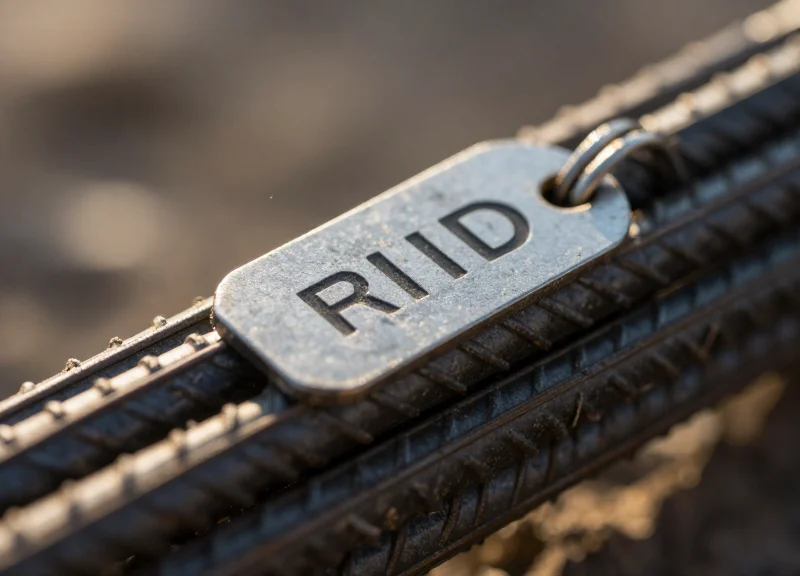
Precision tracking for steel rebar transforms the construction supply chain from a manual, error-prone 'black box' into a transparent, data-driven ecosystem. By applying specialized, ruggedized RFID tags to rebar bundles during the fabrication process, contractors can automate the verification of steel grades, quantities, and delivery schedules. This digital chain of custody ensures that the exact structural materials required for specific architectural zones are delivered, verified, and installed without the 15-20% margin of error typical of manual gate-logging.
- Source-Level Tagging: RFID tags are applied at the fabrication shop, linked to the mill test report (MTR) and specific BIM coordinates, creating a digital 'birth certificate' for every bundle.
- Automated Transit Manifests: As trucks leave the fabricator, long-range RFID readers capture the manifest automatically, notifying the site manager of the exact ETA and load composition.
- Instant Gate-In Verification: Upon arrival, the 'Gate-In' reader verifies the load against the purchase order in seconds, eliminating the need for manual offloading and counting before the driver departs.
- Zone-Specific Staging: Handheld readers guide crane operators and ground crews to the precise staging area, ensuring Grade 60 rebar intended for the foundation doesn't end up in the Level 4 slab.
| Feature | Manual Tracking | RFID-Enabled Tracking |
|---|---|---|
| Data Entry | Handwritten logs/Excel | Automated real-time cloud sync |
| Verification Speed | 20-40 minutes per truck | Less than 3 seconds |
| Grade Mix-up Risk | High (Visual identification only) | Zero (Digital ID verification) |
| Inventory Accuracy | Approximately 75-80% | 99.9% real-time accuracy |
Expert Insight: Eliminating the 'Shadow Inventory' — One of the most significant yet overlooked benefits of RFID is the elimination of 'shadow inventory.' In large-scale projects, subcontractors often 'hoard' bundles of rebar in their specific zones to ensure they don't run out, leading to perceived shortages and unnecessary re-orders. RFID provides a single source of truth that reveals exactly where every bundle is located across the entire site, effectively unlocking 5-10% of 'lost' capital tied up in misplaced materials.
Can RFID tags survive the harsh conditions of a rebar yard?
Yes. Modern construction-grade RFID tags are encapsulated in high-impact polymers or metal-mount housings, designed to withstand UV exposure, heavy rain, and the abrasive friction of steel-on-steel contact.
Do we need to tag every individual piece of rebar?
No. Efficiency is found in 'bundle-level' tracking. By tagging the wire ties of a bundle, you track the weight, grade, and count of that unit, which is the standard unit of movement in construction logistics.
Does RFID replace the need for Mill Test Reports (MTRs)?
It doesn't replace them; it digitizes them. The RFID tag acts as a digital pointer to the MTR, allowing an inspector to scan a bundle and instantly pull up the metallurgical certification on a tablet.
Securing High-Value Equipment and Tools with Real-Time Alerts
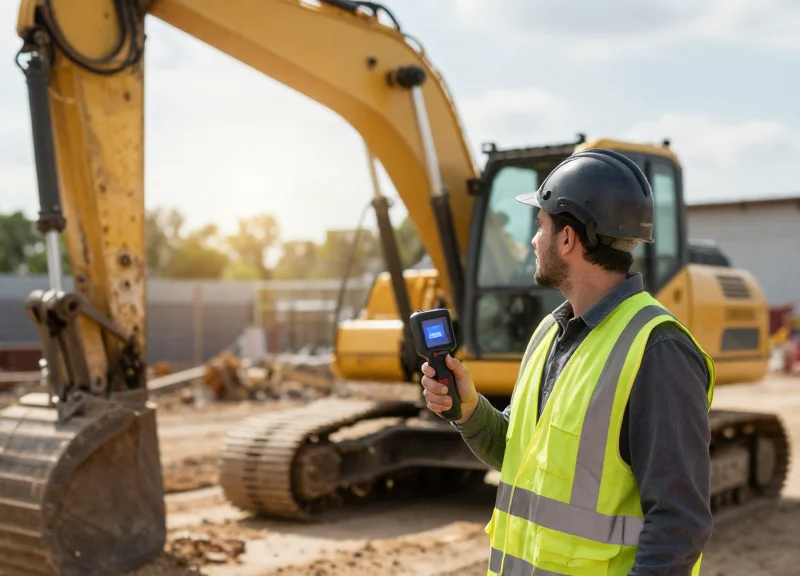
Securing high-value construction equipment involves using Active RFID or GPS-hybrid tags to create a 'digital geofence' around a job site. When an asset like a generator or excavator crosses this virtual boundary without authorization, the system triggers an instant alert via SMS or email to site security and management. This real-time visibility transforms equipment management from a reactive 'recovery' model to a proactive 'prevention' model, significantly reducing the financial impact of theft and the operational friction of misplaced tools.
| Asset Category | RFID Tag Type | Tracking Goal | ROI Driver |
|---|---|---|---|
| Heavy Machinery (Excavators) | Active RFID / GPS Hybrid | Geofencing & Engine Hours | Theft Prevention & Maintenance |
| Site Utilities (Generators) | Active RFID | Location & Fuel Monitoring | Operational Uptime |
| Small Power Tools | Rugged Passive RFID | Check-in/Check-out | Loss Prevention (30% reduction) |
| Specialized Testing Gear | Active RFID | Real-time Inventory | Zero 'Search-Induced' Downtime |
Beyond theft, the most pervasive 'hidden tax' on a construction site is search-induced downtime. Expert Tip: On a typical 10-acre site, a foreman spends an average of 45 minutes daily simply locating specific high-value tools or attachments. By implementing a Real-Time Location System (RTLS), firms can digitize their equipment map, allowing any worker with a tablet to see the exact 'last seen' location of an asset within a 3-meter radius, effectively reclaiming lost labor hours for actual production.
- Establish Digital Perimeters: Define geofences within the software platform that correspond to site exits, storage containers, and high-activity zones.
- Configure Multi-Channel Alerts: Set up automated notifications that escalate based on severity—starting with an app notification for internal movement and moving to SMS/Voice alerts for after-hours breaches.
- Integrate with Daily Logs: Sync RFID data with project management software to automatically log equipment utilization rates and operator accountability.
How long do the batteries in equipment tags last?
Active RFID tags used for heavy equipment typically feature a battery life of 3 to 5 years, depending on the ping frequency (e.g., once every 30 seconds vs. once per hour).
Can these tags withstand extreme weather and vibration?
Industrial-grade tags are rated IP68 or higher, meaning they are fully waterproof and encased in shock-resistant polymers designed to handle the high-vibration environment of diesel engines and jackhammers.
Is it possible to track tools inside steel containers?
Yes, while steel blocks signals, strategic placement of an external antenna or 'gateway' on the container allows the system to register every tool as it enters or exits the storage unit.
Quantifying the ROI: Calculating Your Savings and Break-Even Point

Return on Investment (ROI) for RFID-enabled tracking in construction is calculated by dividing the net profit—primarily derived from reduced material shrinkage, recovered labor hours, and lower replacement costs—by the total cost of ownership (TCO). For most mid-to-large scale steel rebar projects, firms experience a break-even point between 6 to 14 months, with an average ROI ranging from 200% to 400% over a three-year lifecycle. This financial shift transforms inventory management from a cost center into a strategic profit driver.
| Expense/Saving Category | Initial Investment (TCO) | Projected Annual Savings | Economic Impact |
|---|---|---|---|
| Hardware & Infrastructure | Tags, Handhelds, Fixed Portals | N/A | Capital Expenditure (CAPEX) |
| Material Loss Reduction | N/A | 25% - 35% of Rebar Waste | Direct Bottom-Line Gain |
| Labor Productivity | Software & Integration | 15% Reduction in Search Time | Operational Efficiency |
| Equipment Recovery | Deployment & Training | 80% Lower Tool Theft/Loss | Reduced Replacement Costs |
- Establish the Baseline Shrinkage Rate: Audit the last 12 months of material procurement versus actual consumption. In steel-heavy projects, the 'missing' 3-5% of inventory due to misplacement or theft is your primary recovery target.
- Quantify 'Walking Time' and Searching: Track the man-hours lost by foremen and laborers looking for specific rebar grades or generators. Multiply these hours by the average fully-burdened labor rate.
- Calculate Total Cost of Ownership (TCO): Include the cost of passive UHF tags, ruggedized readers, and the cloud-based middleware. Do not forget the 'soft costs' of training your site crew.
- Determine the Payback Period: Divide your TCO by the monthly anticipated savings. If your monthly loss is $50,000 and the system costs $300,000, your break-even point is exactly 6 months.
Expert Insight: The Insurance Arbitrage. One often overlooked financial lever is the reduction in insurance premiums. Many 'Builder’s Risk' and inland marine insurance providers offer premium discounts or lower deductibles when contractors demonstrate a digital chain of custody and real-time asset tracking. This 'insurance dividend' can effectively subsidize 10-15% of your hardware costs annually.
How does the ROI for passive RFID compare to active GPS tracking?
Passive RFID has a lower per-unit cost ($0.15 - $2.00 per tag), making it ideal for high-volume items like rebar bundles, whereas GPS is reserved for high-value machinery. Passive RFID typically achieves ROI faster due to lower upfront capital.
Can RFID software integrate with existing ERP systems for financial reporting?
Yes, modern RFID platforms use APIs to feed data directly into ERPs like SAP, Procore, or Oracle, automating the reconciliation of physical inventory with financial ledgers.
What is the typical lifespan of the hardware investment?
Industrial RFID readers generally have a 5-7 year utility lifespan, while tags are typically one-time use for consumables (rebar) or multi-year for assets (equipment).
Solving the 'Metal Interference' Problem in RFID Deployment

Solving the 'metal interference' problem in RFID deployment requires a transition from standard passive tags to specialized On-Metal RFID tags, which utilize high-dielectric spacers or Planar Inverted-F Antenna (PIFA) designs to prevent signal absorption. While metal surfaces naturally reflect radio frequency (RF) energy and 'detune' standard antennas, modern industrial solutions leverage the metal itself as an extension of the antenna or create a physical buffer to ensure reliable data transmission even when mounted directly onto steel rebar or heavy machinery.
| Feature | Standard RFID Tag | On-Metal RFID Tag (IP68) |
|---|---|---|
| Substrate Interaction | Signal absorbed/shorted by metal | Utilizes spacer to maintain impedance |
| Read Range on Steel | Near Zero (< 10cm) | Up to 10-12 Meters |
| Form Factor | Thin paper or plastic inlay | Ruggedized ABS, FR4, or Ceramic |
| Primary Use Case | Cardboard, Wood, Plastic | Rebar Bundles, Excavators, I-Beams |
The fundamental challenge with steel is its conductivity. When a standard UHF RFID tag is placed on a steel beam, the metal surface acts as a ground plane, creating 'eddy currents' that oppose the tag's own magnetic field. This effectively 'mutes' the tag. To solve this, we deploy tags with a 'spacer'—usually a few millimeters of specialized foam or FR-4 material—that creates an air gap. This gap allows the RF waves to form a complete circuit without being canceled out by the metal's surface conductivity.
How does antenna polarization affect steel tracking?
In environments with high metal density, circular polarization is preferred for readers. Unlike linear polarization, which requires the tag and reader to be aligned, circular waves rotate, significantly increasing the probability of a 'hit' as the signal bounces off various metal surfaces in the yard.
Can RFID tags survive the movement of heavy rebar bundles?
Yes, but it requires 'Encapsulated Tags.' These are housed in high-impact polymer shells. For rebar, tags are often attached with stainless steel cable ties to the core of the bundle rather than the outer edge to protect them from shear forces during crane lifts.
Does the environment's moisture affect metal-mount tags?
While metal reflects signals, water absorbs them. On-metal tags designed for construction are usually IP68 or IP69K rated, meaning they are vacuum-sealed to ensure that rain or slurry on the steel surface doesn't interfere with the internal dielectric properties.
Expert Insight: The 'Multipath Benefit' Strategy. While most engineers view metal as a hindrance, a sophisticated deployment uses 'Multipath' signals to its advantage. In a steel yard, RF signals bounce off beams to reach tags in 'non-line-of-sight' (NLOS) locations. By using high-sensitivity readers like the Impinj R700 with specialized algorithms, we can capture these reflected signals, essentially using the steel inventory as a giant mirror to extend the reach of the RFID gates, rather than a barrier to be feared.
Data Integration: Connecting RFID to BIM and ERP Systems

Data integration is the bridge that converts raw RFID pings into actionable business intelligence. By connecting RFID-enabled hardware to Building Information Modeling (BIM) and Enterprise Resource Planning (ERP) systems, construction firms create a 'Live Digital Twin.' This ecosystem allows the physical movement of steel rebar or equipment on-site to automatically update project schedules in BIM (4D/5D) and trigger financial or procurement workflows in the ERP, eliminating the lag time and human error associated with manual data entry.
| System Type | RFID Data Function | Primary Business Value |
|---|---|---|
| BIM (4D/5D) | Updates 'As-Built' status and installation progress. | Real-time visibility into project delays vs. schedule. |
| ERP (Finance/Ops) | Automated inventory depletion and receipt verification. | Instant financial reconciliation and cash flow accuracy. |
| Inventory/WMS | Real-time stock levels of rebar bundles/tools. | Automated re-order triggers to prevent work stoppages. |
| Maintenance CMMS | Usage tracking and location history of equipment. | Predictive maintenance scheduling based on actual runtime. |
- Middleware Filtering: Raw RFID data is often 'noisy.' Use a middleware layer to filter out redundant reads and transmit only relevant 'event changes' (e.g., 'Rebar Bundle X entered Zone B') to the ERP.
- API Handshaking: Utilize RESTful APIs to push data from the RFID cloud to your ERP (like SAP or Oracle) and BIM environment (like Autodesk Revit or Navisworks).
- Attribute Mapping: Link the Unique Identifier (UID) of the RFID tag to specific BIM objects. When the tag is scanned, the corresponding element in the 3D model changes color to indicate 'on-site' or 'installed.'
- Automated Trigger Execution: Set logic gates: If rebar inventory drops below 15% for Grade 60 steel, the ERP automatically generates a Purchase Order (PO) to the pre-approved vendor.
Expert Insight: The Power of 'Edge-Filtered Events' A common mistake in RFID deployment is flooding the ERP with every single tag read, which can lead to system bloat and high API costs. Silicon Valley best practices suggest using 'Edge Computing' at the reader level. By only reporting state changes—such as when a piece of equipment moves from 'Storage' to 'Active Work Zone'—you reduce data traffic by 90% while maintaining 100% accuracy in your BIM and ERP records.
Can RFID work with older ERP systems that lack modern APIs?
Yes. Most RFID middleware can export CSV or XML files via Secure FTP (SFTP) that legacy ERP systems can batch-process at set intervals, though this sacrifices 'real-time' benefits.
How does RFID integration improve 5D BIM (Cost Management)?
By tracking exactly when materials arrive and are consumed, the 5D BIM model can provide an 'Earned Value Analysis' (EVA) based on actual physical progress rather than estimated percentages.
What is the typical latency between a tag scan and a BIM update?
In a well-optimized cloud-based integration, the latency is typically between 5 to 30 seconds, providing virtually instantaneous site visibility to off-site project managers.
Operational Efficiency Beyond Loss Prevention
While preventing theft and material loss provides the most immediate ROI, the true strategic power of RFID-enabled tracking lies in its ability to eliminate 'administrative friction' through passive data capture. By transforming physical movements into digital events, construction firms can shift from reactive management to proactive workflow orchestration. This transition typically yields a 15% improvement in overall labor productivity by removing the manual burden of data entry, site check-ins, and inventory reconciliation.
| Operational Metric | Manual/Legacy Process | RFID-Enabled Process |
|---|---|---|
| Site Access/Check-in | Paper logs or manual badge swipes | Passive vehicle & personnel sensing |
| Safety Compliance | Visual spot-checks & weekly audits | Real-time geofencing & exclusion alerts |
| Schedule Variance | Discovered after weekly reporting | Identified instantly via 'as-built' tracking |
| Asset Handover | Manual search and verification | Digital chain-of-custody signatures |
A significant but often overlooked efficiency gain is the 'Digital Handover.' In steel-heavy projects, verifying that the correct rebar grade has been moved from the laydown yard to the installation site traditionally requires a manual sign-off. RFID automates this verification. As the material passes through a portal, the ERP is updated, the BIM model is flagged as 'in-progress,' and the procurement team is alerted if stock levels fall below a safety threshold—all without a single human intervention.
How does RFID improve site safety compliance?
By utilizing active or semi-passive tags, site managers can create digital geofences around hazardous areas (e.g., crane swing zones). If an unauthorized worker or a specific piece of equipment enters the zone, the system triggers an immediate alert, drastically reducing the risk of accidents.
Can RFID data assist in project timeline forecasting?
Yes. By analyzing the 'dwell time' of materials in various stages—from arrival to installation—project managers can identify bottlenecks. This high-fidelity historical data allows for more accurate 'predictive scheduling' on future project bids.
What is the impact on subcontractor management?
RFID provides an immutable record of when equipment was utilized and by whom. This transparency resolves billing disputes and ensures that subcontractors are held accountable for the tools and materials assigned to their specific work zones.
Expert Tip: Leverage your RFID data to negotiate lower insurance premiums. Many modern insurers are now offering 'data-driven' General Liability discounts for firms that can prove a lower risk profile through digital safety logs and automated asset recovery protocols. This 'Insurance Edge' can often offset 5-10% of the annual cost of the RFID infrastructure itself.
Selecting the Right RFID Partner: Why DragonGuard's Expertise Matters
Selecting the right RFID partner is the single most critical factor in moving from a pilot program to a successful, enterprise-wide deployment. In the construction and steel industries, an RFID partner must offer more than just hardware; they must provide industrial-grade durability, specialized on-metal engineering expertise, and end-to-end integration support. DragonGuard stands out by bridging the gap between delicate electronics and the rugged reality of job sites, ensuring that tracking systems remain operational under extreme weather, high-impact handling, and the complex electromagnetic interference inherent to steel-heavy environments.
| Feature/Capability | Generic RFID Reseller | DragonGuard Industrial Solutions |
|---|---|---|
| Tag Durability | Standard adhesive or plastic | IP68/IP69K, high-impact polymers |
| Metal Interference | Generic spacers used | Custom-tuned on-metal antennas |
| Temperature Range | 0°C to 50°C | -40°C to +200°C (for curing/forging) |
| Technical Support | Sales-focused helpdesk | Engineering-led implementation |
- Proven On-Metal Performance: Steel rebar and heavy equipment act as natural shields for RF signals. DragonGuard specializes in UHF on-metal tags that utilize the metal surface itself as a parasitic element to enhance read range rather than inhibit it.
- End-to-End Manufacturing Control: Unlike resellers, DragonGuard maintains control over the manufacturing process, allowing for custom tag form factors that can be embedded directly into concrete or welded onto steel frames.
- Vertical Industry Expertise: With over two decades of experience in EAS and RFID, DragonGuard understands the specific workflow of construction logistics, from the fabrication shop to the final install site.
Expert Insight: The Shear Force Factor. A unique insight often overlooked by generic providers is 'Mechanical Shear Resistance.' In the steel industry, tags aren't just exposed to rain; they are subjected to thousands of pounds of pressure and lateral shear forces during crane lifts and stacking. DragonGuard's heavy-duty tags are engineered with proprietary resin-filling techniques that prevent the internal chip from fracturing under physical compression, a common failure point in lower-tier hardware.
Why is manufacturing transparency important for RFID?
Direct manufacturers like DragonGuard can provide rigorous batch testing and quality assurance reports, ensuring every tag meets the sensitivity requirements needed for long-range gate readers.
Can DragonGuard tags withstand the concrete curing process?
Yes, our specialized tags are designed to withstand the high pH levels and exothermic heat generated during concrete hydration, making them ideal for precast tracking.
What level of customization is available?
We offer custom frequency tuning, laser-etched barcodes for redundancy, and specialized attachment methods including high-bond adhesives, welding brackets, or mechanical fasteners.