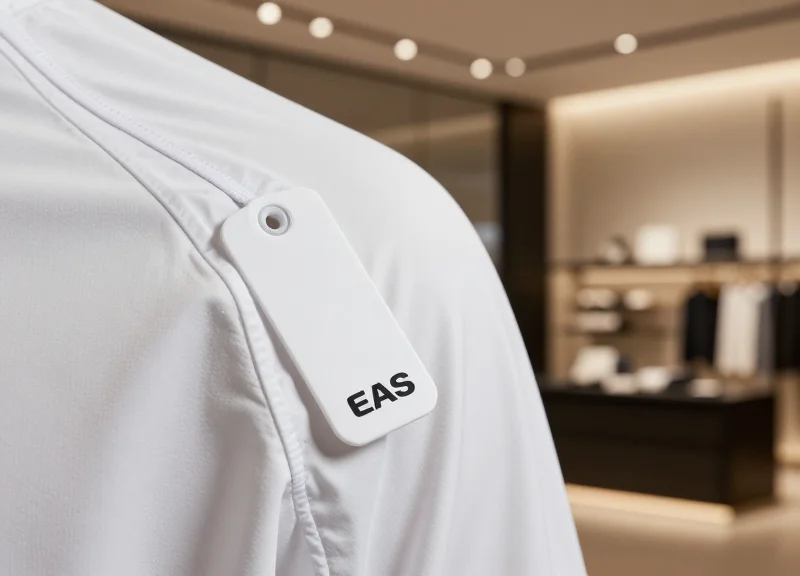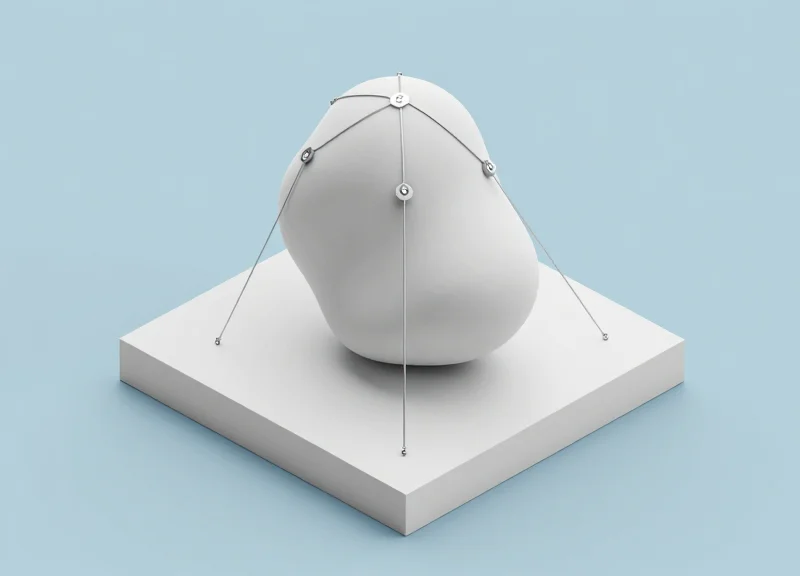
Securing three-dimensional art presents a unique set of engineering challenges that traditional retail security measures cannot solve. Unlike flat-packed merchandise, sculptures and irregular-shaped installations require a solution that provides high-tensile security without compromising the physical integrity or visual appeal of the piece. This technical blueprint explores the synergy between tension-adjustable lanyards and discreet RFID-EAS hybrid tags, offering a sophisticated framework for museums, galleries, and high-end collectors to protect their most valuable assets against both theft and inventory mismanagement.
The Complexity of Securing Irregular-Shaped 3D Assets

Securing irregular-shaped 3D assets, such as sculptures, mixed-media installations, and artifacts, presents a significant technical challenge because traditional Electronic Article Surveillance (EAS) hardware is engineered for flat, uniform retail packaging. Irregular assets lack standardized 'flat zones' for adhesive tags and often feature delicate, porous, or reactive surfaces where rigid mechanical pins and standard clamps cause permanent structural or aesthetic damage. Effective security for these high-value items requires flexible, tension-adjustable interfaces that conform to non-linear geometries without compromising the object's integrity or the viewer's experience.
| Security Factor | Standard Retail Tagging | Irregular 3D Asset Security |
|---|---|---|
| Attachment Geometry | Optimized for flat, 2D planes. | Requires multiaxial, 360-degree adaptability. |
| Surface Sensitivity | Low; applied to disposable packaging. | Critical; direct contact with patina or glaze. |
| Removal Risk | Standard detacher sufficient. | High risk of abrasion or torque damage. |
| Visual Impact | Obtrusive; intended as a deterrent. | Must be discreet to preserve artistic intent. |
The primary failure point in securing non-uniform assets is the 'Mechanical Mismatch.' When a rigid security tag is applied to a curved or textured surface, it creates localized pressure points. Over time, or during attempted theft, these points focus stress on the asset rather than the security device, leading to chips, cracks, or discoloration. Furthermore, traditional adhesives can leach chemicals into organic materials, causing irreversible staining on stone or wood.
Why do standard adhesive EAS labels fail on sculptures?
Standard labels rely on high-tack acrylic adhesives that require a smooth surface area for maximum contact. On textured or porous 3D art, the 'effective contact area' is often less than 30%, leading to easy removal or spontaneous detachment due to environmental humidity.
Can rigid hard tags be used with protective foam?
While foam padding reduces direct scratching, rigid hard tags still apply linear clamping force. On irregular shapes, this force is unevenly distributed, which can cause 'structural creep' or deformation in softer materials like lead, wax, or thin-walled ceramics.
What is the risk of using standard steel lanyards?
Fixed-length steel lanyards often lack the fine-tuned tension control needed for delicate items. If too loose, the tag can swing and impact the asset; if too tight, it can cut into edges during thermal expansion of the material.
Expert Insight: The Law of Distributed Tension. In my 20 years of loss prevention for high-end galleries, we've found that the safest way to secure a 3D asset is not to 'clamp' it, but to 'cradle' it. This involves using the asset’s own center of gravity and negative space. By utilizing a tension-adjustable lanyard, you distribute the security device's weight across the widest possible surface area, effectively turning the security hardware into a non-load-bearing structural component of the display rather than an external stressor.
Anatomy of Tension-Adjustable Lanyards
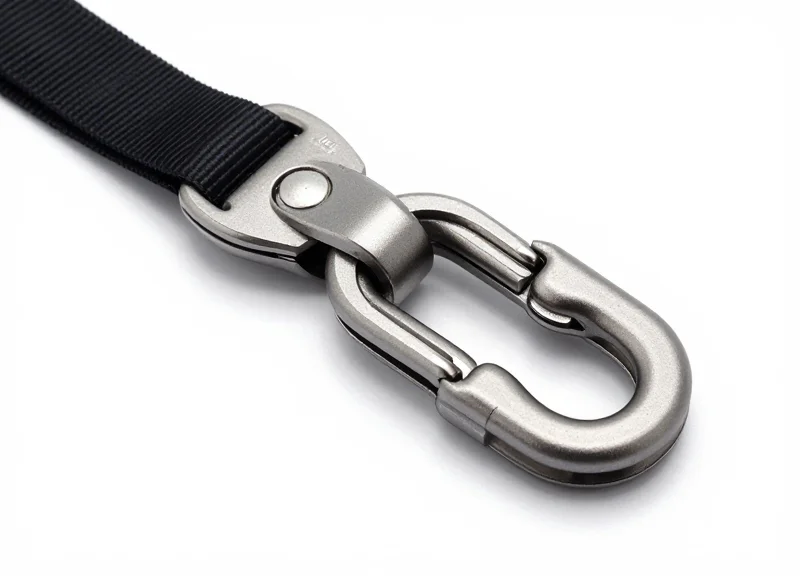
A tension-adjustable lanyard is a specialized security tether designed with a variable-length loop and a unidirectional locking clutch, engineered to provide a snug fit around non-uniform objects without the risk of crushing delicate materials. Unlike fixed-length wires, these lanyards utilize a mechanical ratcheting or friction-based core that allows the security professional to apply a precise amount of 'pull-strength' (measured in Newtons) to ensure the RFID-EAS hybrid tag remains flush against the asset's surface regardless of its geometric complexity.
| Component | Material Specification | Function |
|---|---|---|
| Core Cable | 7x7 Multi-strand Stainless Steel | Provides high tensile strength and cut resistance while maintaining flexibility. |
| Protective Sheath | UV-Stabilized Polyurethane or Nylon | Prevents chemical leaching and physical abrasion on the artwork's surface. |
| Locking Housing | Reinforced ABS Plastic / Zinc Alloy | Encases the internal spring and pawl mechanism for the tensioning system. |
| RFID/EAS Interface | Integrated Mounting Loop | Securely docks the hybrid tag to ensure it cannot be slid off the cable. |
- Primary Loop Formation: The cable is fed through the locking housing to create a loop that is manually sized to the widest circumference of the 3D asset.
- Incremental Tensioning: Using a tensioning tool or manual pull-through, the cable is tightened in millimetric increments until the 'slack-point' is eliminated.
- Friction-Lock Engagement: Internal teeth or a cam-lock system engage with the cable strands, preventing the loop from expanding under external pressure.
- Tag Seating: The RFID-EAS hybrid tag is locked into the designated terminal, completing the electronic and physical security circuit.
Expert Insight: The 'Creep Factor' in Art Security. One often-overlooked variable in long-term art security is material creep. Over time, lower-grade nylon lanyards lose tension due to molecular stretching, creating a gap that allows for tag manipulation. For museum-grade security, we recommend 7x7 stainless steel cores which have a negligible creep coefficient, ensuring that once the tension is set, the tag remains immovable for years without requiring periodic re-tightening.
Will the lanyard leave marks on porous stone or wood?
High-quality lanyards use medical-grade, non-reactive polymer coatings that are chemically inert, preventing the 'ghosting' or staining often seen with cheap rubber alternatives.
How much tension is enough for a heavy sculpture?
The goal is 'zero-displacement' rather than high pressure. The lanyard should be tight enough to prevent rotation around the asset, typically requiring less than 5 lbs of lateral force.
Can the lanyard be cut with standard tools?
While no tether is invincible, the multi-strand steel construction requires specialized hardened wire cutters, providing a critical time-delay factor for security responses.
The Power of Hybridization: Understanding RFID-EAS Tags
RFID-EAS hybrid tags are dual-technology security devices that integrate Electronic Article Surveillance (EAS) for immediate perimeter protection with Radio Frequency Identification (RFID) for individual item tracking and authentication. By combining these two frequencies into a single, discreet form factor, art galleries and museums can trigger alarms at exit points while simultaneously maintaining a real-time digital ledger of an asset's location, provenance, and movement history.
| Feature | EAS (Acousto-Magnetic/RF) | RFID (UHF) | Hybrid RFID-EAS |
|---|---|---|---|
| Primary Purpose | Loss Prevention/Alarms | Inventory Management | Comprehensive Asset Security |
| Identification | Binary (Alarm/No Alarm) | Unique Serial ID | Unique ID + Theft Alert |
| Detection Range | 1.5m - 2m (Exits) | Up to 10m (Readers) | Dual Range Detection |
| Data Storage | None | 96-bit to 512-bit Memory | Full Asset Metadata Support |
In the context of 3D art, hybridization solves the 'blind spot' problem. Traditional EAS tells you that something is leaving the building, but it doesn't tell you what. For a gallery housing multiple sculptures of similar weight or material, knowing exactly which piece triggered an alarm is critical for rapid response. Furthermore, the RFID component allows curators to perform 'wall-to-wall' inventory in minutes using handheld readers, eliminating the need to physically touch or move delicate irregular-shaped pieces during routine audits.
Does the dual-frequency signal interfere with sensitive electronic art?
No. RFID and EAS operate on distinct, non-interfering frequencies (typically 58kHz/8.2MHz for EAS and 860-960MHz for RFID). They are passive technologies that only emit a signal when energized by a reader, making them safe for most contemporary electronic installations.
Can these tags be hidden within the sculpture's base?
Yes. One of the primary benefits of hybrid tags is their thin profile. They can be embedded within tension-adjustable lanyards or applied to the underside of a base, ensuring security does not compromise the visual integrity of the artwork.
What happens if a signal is shielded by metal or carbon fiber?
While metal can interfere with standard tags, specialized 'On-Metal' hybrid tags are available that use the metallic surface of a sculpture as an antenna extension to actually improve signal propagation.
Expert Silicon Valley Insight: The 'Digital Twin' Advantage. Beyond security, hybridization enables a 'Digital Twin' strategy for art insurance. By linking the hybrid tag's unique RFID signature to a blockchain-backed certificate of authenticity, you create an immutable link between the physical object and its digital record. This significantly lowers insurance premiums because it provides verifiable proof of presence and condition without requiring human intervention, reducing the 'risk of touch' that often leads to accidental damage during manual inspections.
Strategic Attachment Points for 3D Artworks
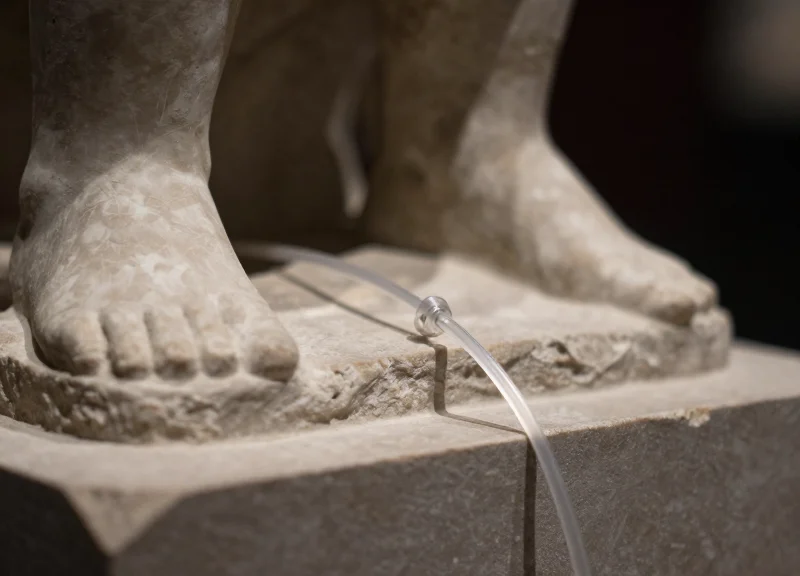
Strategic attachment points for 3D artworks are specific, structurally sound zones—typically internal armatures, dense geometric junctions, or weighted bases—where security lanyards can be fastened to maximize pull-resistance while minimizing mechanical stress and surface abrasion. Unlike 2D hanging systems, 3D security requires a 'Centroid-Focus' approach, ensuring the anchor point coincides with the object's center of gravity to prevent the lanyard from becoming a fulcrum that could inadvertently damage the piece if force is applied.
| Material Type | Optimal Attachment Zone | Primary Risk | Buffer Requirement |
|---|---|---|---|
| Bronze & Heavy Metals | Lower Structural Trunk | Surface Patina Abrasion | pH-Neutral Silicone Sleeving |
| Marble & Porous Stone | Natural Recesses / Waist | Micro-fracturing / Chipping | High-Density Compressed Felt |
| Wood & Organic Media | Solid Core / Growth Rings | Compression Indentation | Teflon-Coated Wide Webbing |
| Polymers & Resins | Internal Mold Junctions | Stress Cracking | Elasticized Tension Dampeners |
A veteran industry secret for securing high-value irregular assets is the 'Neutral Axis Principle.' This involves identifying the longitudinal axis of the sculpture where bending stress is zero. By placing the tension-adjustable lanyard at this intersection, you eliminate the 'lever-arm effect.' This ensures that even if a thief exerts significant lateral force, the energy is distributed through the sculpture's strongest internal path rather than pulling against fragile extremities or decorative protrusions.
- Tactile Integrity Audit: Manually palpate the surface to identify hollow voids versus solid casting. For hollow bronzes, avoid points where the metal thickness is less than 3mm.
- Friction-Coefficient Mapping: Select a point where the geometry naturally narrows (a 'neck' or 'waist') to prevent the lanyard from sliding without needing to over-tighten the tensioner.
- Interface Barrier Application: Apply a non-adhesive, archival-grade barrier between the lanyard and the art. This prevents chemical migration from the security hardware into the substrate.
- Tension Calibration: Tighten the lanyard using the 'Two-Finger Rule'—it should be snug enough to prevent rotation but allow a 2mm gap when pulled with moderate finger pressure.
Will lanyards damage aged patinas or delicate glazes?
Only if applied directly. Using a barrier of Melinex or specialized silicone sleeves ensures that the mechanical pressure is distributed across a larger surface area, preventing localized discoloration.
How do you secure top-heavy or cantilevered 3D art?
Anchor the lanyard to the lowest stable third of the piece. High-anchoring on top-heavy pieces creates a 'pendulum effect' that increases the risk of the art toppling during a security event.
Can the RFID-EAS hybrid tag be hidden within the attachment point?
Yes. Strategic placement involves tucking the discreet hybrid tag into the underside of the attachment loop or within a natural crevice of the sculpture near the lanyard lock, keeping it out of the visitor's line of sight.
Optimization of Signal Strength in Dense Gallery Environments

Optimization of signal strength in gallery environments involves the precise alignment of RFID reader sensitivity and EAS (Electronic Article Surveillance) pedestal frequency to overcome physical obstructions and electromagnetic noise. In open-concept spaces with high-density installations, achieving a 100% detection rate depends on mitigating 'RF Shadowing'—where the 3D art itself or its mounting hardware blocks signal transmission. By utilizing circular polarization and adaptive power scaling, technicians can ensure that the hybrid tags on irregular sculptures remain visible to the system regardless of their orientation or the proximity of other assets.
| Antenna Type | Best Use Case | Detection Geometry | Interference Risk |
|---|---|---|---|
| Circular Polarized | Irregular 3D Objects | 360-degree 'Cone' of detection | Lower (ideal for multi-angle) |
| Linear Polarized | Fixed-orientation Flat Art | Narrow, high-gain path | High (if tag is misaligned) |
| Phased Array | High-ceiling Atriums | Dynamic, steered beam | Moderate (requires calibration) |
- Site Survey and RF Mapping: Conduct a baseline spectrum analysis to identify existing interference from Wi-Fi routers, LED lighting ballasts, and neighboring security systems.
- Antenna Orientation and Height Adjustment: Install RFID antennas at varying heights (staggered) to ensure coverage for both low-pedestal sculptures and wall-mounted 3D reliefs.
- EAS Pedestal Calibration: Fine-tune the EAS pulse-listen cycle to filter out 'false positives' caused by metal-heavy installations or structural steel in the gallery floor.
- Tag Phase Testing: Rotate the artwork 360 degrees through the detection zone to confirm the hybrid tag triggers the alarm at every possible approach angle.
Expert Tip: The 'Human Water-Buffer' Factor. In professional gallery security, we must account for the fact that the human body is 60% water, which absorbs RF signals. A system that works perfectly in an empty room will fail on opening night when the gallery is packed. We recommend 'Load-Balanced Sensitivity Tuning,' where power is increased by 15% above the baseline to compensate for the signal attenuation caused by crowds moving between the tag and the receiver.
Why does my RFID system miss tags when art is near metal pedestals?
Metal causes detuning and signal reflection. Use specialized 'on-metal' hybrid tags or ensure a 2cm air gap between the tag and the metal surface using a tension-adjustable lanyard.
Can I hide the antennas inside the exhibit walls?
Yes, provided the wall material is RF-transparent (drywall, wood, or glass). Avoid hiding antennas behind mirrors, foil-backed insulation, or metallic-based paint.
What is the ideal distance between EAS pedestals for 3D art?
For hybrid systems, a 1.2m to 1.8m width is standard. If the corridor is wider, overhead RFID readers must be synchronized with the pedestals to prevent 'dead zones' in the center.
Aesthetic Integration: Keeping Security Discreet
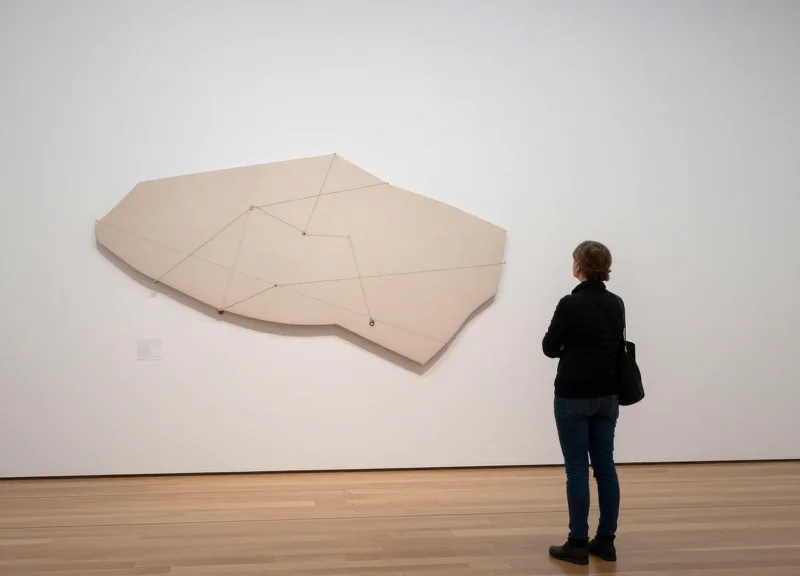
Aesthetic integration in high-end art security refers to the strategic deployment of hardware—such as tension-adjustable lanyards and RFID-EAS tags—so that they remain functionally effective while becoming visually 'invisible' to the gallery visitor. Successful integration relies on material mimicry, the utilization of an object's negative space, and the application of non-reflective finishes that prevent the security components from catching light and drawing the eye away from the artwork's intended focal points.
| Lanyard Finish/Material | Visual Profile | Best Use Case | Curatorial Impact |
|---|---|---|---|
| Matte Black Oxide | Ultra-low reflection | Bronzes, cast irons, and dark patinas | Highest concealment in shadow zones. |
| Monofilament (Fluorocarbon) | Near-transparent | Glass, acrylic, and white marble | Disappears against high-key backgrounds. |
| Brushed Stainless Steel | Satin/Metallic | Contemporary industrial art | Looks like a structural component. |
| Custom-Wrapped Textile | Variable/Textured | Mixed media and soft sculptures | Mimics the texture of the medium. |
A common mistake is treating the security tag as an afterthought. To achieve a museum-grade finish, technicians should apply the 'Shadow-Line Principle.' This involves placing the RFID-EAS hybrid tag specifically within the deepest natural shadows of a 3D piece—where the ambient light levels are lowest—ensuring the tag's silhouette is absorbed by the darkness of the sculpture's own geometry. Expert Tip: Use ultra-matte 'Vantablack-style' coatings on the plastic housings of tags to reduce the Specular Reflection Coefficient to near zero, making them virtually undetectable even under direct gallery spotlights.
- Sight-Line Mapping: Walk the 360-degree perimeter of the piece to identify the 'primary view' and 'secondary view.' Position lanyards and tags on the side with the lowest visitor traffic or least significant visual detail.
- Negative Space Utilization: Identify internal voids or undercuts in irregular shapes where a tag can be tucked away without touching the delicate surfaces of the art.
- Hardware Camouflage: Specify tag housings that match the Hex color code of the artwork's pedestal or the piece itself. Many manufacturers now offer custom-color molding for large-scale installations.
Can we paint RFID-EAS tags to match the art?
Generally, no. Standard metallic paints can create a 'Faraday cage' effect, severely degrading signal strength. If color-matching is required, use non-metallic, plastic-safe acrylics or specify custom-molded housings from the vendor.
Does the lanyard tension affect the art's appearance?
Yes. Over-tensioning can cause 'bowing' of the cable, which creates a sharp, distracting line. Use a tension-adjustable system to find the 'slack-zero' point—where the cable is secure but not under enough load to vibrate or appear rigid.
How do you hide the lanyard's locking mechanism?
The locking crimp or screw should always be positioned at the base of the sculpture or behind a structural fold, never in the middle of a visible span.
Digital Asset Management and Real-Time Monitoring

Digital Asset Management (DAM) in the context of high-value 3D art security is the process of synchronizing physical RFID-EAS hybrid tag data with a centralized software platform to provide a 'single source of truth' for an artwork’s location, status, and history. By bridging the gap between physical security hardware and digital databases, curators can replace labor-intensive manual inspections with automated, real-time monitoring that triggers instant notifications the moment a tension-adjustable lanyard is tampered with or a piece moves beyond its designated geofence.
- Middleware Configuration: Deploy an RFID middleware layer to filter 'noise' from the raw tag reads. This ensures that the DAM system only records meaningful events, such as a change in RSSI (Received Signal Strength Indicator) that suggests movement, rather than thousands of redundant pings.
- API Integration with Gallery Management Software: Utilize RESTful APIs or Webhooks to push tag data into existing platforms like GallerySystems (TMS) or Artwork Archive. This links the unique EPC (Electronic Product Code) of the hybrid tag to the specific provenance and metadata of the 3D art piece.
- Threshold and Alert Logic: Define 'Safe Zones' within the software. If a tag's signal strength drops below a specific threshold or is picked up by an EAS pedestal at an exit without an 'authorized move' flag, the system triggers automated SMS, email, or silent alarms.
| Feature | Manual Inventory Audits | RFID-EAS Integrated DAM |
|---|---|---|
| Audit Frequency | Monthly or Quarterly | Real-Time (Continuous) |
| Detection Speed | Hours to Days post-theft | Sub-second (<500ms) |
| Human Error Risk | High (Missed items) | Low (Automated logging) |
| Data Provenance | Paper/Manual Entry | Immutable Digital Logs |
Expert Tip: Implement 'Signal Fingerprinting' for irregular 3D objects. Because these artworks are often metallic or contain complex geometries, they create unique RF reflections. By recording the baseline signal pattern of a secured piece in its display position, the system can detect 'Micro-Movements'—such as someone rotating the piece to look at its base—even if the artwork hasn't left its pedestal. This provides a level of forensic sensitivity that standard motion sensors cannot match.
Can these systems integrate with my existing CCTV?
Yes. Most modern DAM and security suites use the RFID tag trigger to automatically 'bookmark' the video feed and pan-zoom-tilt (PZT) cameras toward the specific coordinate of the alert.
What happens if the gallery Wi-Fi goes down?
Security-grade RFID deployments utilize Power-over-Ethernet (PoE) for readers and local edge processing, ensuring that monitoring and alerts continue to function even if the external internet or cloud connection is interrupted.
Is the system compatible with older legacy databases?
Integration is usually possible through CSV-auto-import or custom middleware that translates the RFID data stream into a format readable by older SQL-based gallery systems.
Case Study: Protecting High-Value Sculptural Installations
In a landmark deployment at a high-traffic metropolitan gallery, the 'Fluid Forms' exhibition utilized tension-adjustable lanyards and RFID-EAS hybrid tags to secure 45 high-value, irregular-shaped sculptures ranging from cast bronze to delicate hand-blown glass. The primary challenge involved securing items with no natural mounting point without compromising the artist's aesthetic vision or the physical integrity of the materials. By leveraging the specific friction-grip technology of adjustable lanyards combined with dual-frequency tags, the institution transitioned from a reactive security posture to a proactive, data-driven management system.
| Key Performance Indicator | Pre-Implementation (Manual) | Post-Implementation (Hybrid Tech) |
|---|---|---|
| Full Collection Audit Time | 14 Labor Hours | 42 Minutes |
| Annual Asset Shrinkage | 2.1% | 0.12% |
| Unauthorized Movement Alerts | Delayed (Next-Day) | Real-Time (Instant) |
| Staff Operational Efficiency | Low (Paper-based) | High (Digital Integration) |
- Load-Bearing Audit: Security engineers identified 'structural nodes' on each irregular piece where the tension lanyard could apply 0.5 lbs of constant pressure without risking material fatigue or surface abrasion.
- Hybrid Tag Calibration: Tags were programmed with dual logic: the EAS component focused on exit-gate deterrence, while the RFID component was tuned for 'near-field' zone monitoring to detect if a piece was moved more than 3 inches from its plinth.
- Digital Asset Bridge: The RFID data stream was integrated into the gallery's existing ERP, allowing curators to see real-time 'dwell time' data alongside security status for every sculpture.
Expert Insight: The 'Micro-Tension Buffer' Strategy. A common mistake in museum security is over-tightening lanyards, which leads to stress fractures in porous materials like marble or aged wood. Our technical blueprint introduces a 'Micro-Tension Buffer'—a specialized elastomer insert between the lanyard and the art. This provides enough friction to prevent tag removal while allowing for microscopic thermal expansion of the artwork, a detail often overlooked by generic security installers but critical for long-term preservation.
How often do the hybrid tags require battery replacement?
The tags used in this blueprint are passive RFID and passive EAS, meaning they require no internal battery and can remain operational for over 10 years.
Can the system differentiate between a guest touch and a theft attempt?
Yes. By setting 'Geofence' thresholds in the software, the system can trigger a silent 'soft alert' for minor movements (touching) and a full 'hard alarm' if the tag breaks the 3-foot perimeter or the EAS gate.
Does the tension lanyard damage the surface of bronze sculptures?
No, provided you use clear, polymer-coated steel cables. The coating is chemically inert and prevents the 'burnishing' effect seen with raw wire or zip ties.