
As we approach 2026, the retail landscape is facing unprecedented challenges from sophisticated organized retail crime (ORC) and evolving consumer expectations. Traditional passive EAS systems, once the gold standard, are increasingly falling short in high-stakes premium environments. This article explores the paradigm shift toward active self-alarming technology—a proactive solution that does not just react to theft but actively deters it, ensuring brand integrity and bottom-line protection for luxury and high-end retailers.
The Evolution of Retail Loss Prevention: From Passive to Proactive
The evolution of retail loss prevention (LP) marks a fundamental shift from a 'passive' model—where security systems merely detect stolen merchandise at the exit—to a 'proactive' model that utilizes active self-alarming technology to stop theft the moment it is attempted. While traditional Electronic Article Surveillance (EAS) serves as a digital receipt check at the door, modern proactive systems provide real-time intervention by triggering localized alarms on the high-value item itself if a security element is tampered with or if the product is moved outside a designated zone. This transition is driven by the rise of Organized Retail Crime (ORC) and the need for premium retailers to protect open-display merchandise without compromising the customer experience.
For decades, the standard for retail security was the 58kHz or 8.2MHz EAS pedestal. These systems were designed for an era where theft was largely opportunistic. However, as we approach 2026, the retail environment has become more volatile. Professional shoplifters now use booster bags and magnetic detachers to neutralize passive tags. Consequently, the industry is moving toward 'Active Self-Alarming' technology—devices that monitor their own integrity and environment, creating a multi-layered defense that begins at the shelf, not the sidewalk.
| Feature | Passive EAS (Traditional) | Active Self-Alarming (2026 Standard) |
|---|---|---|
| Primary Function | Detection at exit gates | Real-time deterrence at point-of-sale/display |
| Alert Trigger | Passing through a magnetic field | Tampering, cutting, or unauthorized movement |
| Theft Method Resistance | Low (Vulnerable to booster bags/magnets) | High (Alarms even if pedestals are bypassed) |
| Customer Experience | Reactive and intrusive at the door | Seamless; allows for 'open-sell' interaction |
| Asset Protection Type | Broad/General | Targeted for Premium/High-Value goods |
Why is Passive EAS no longer sufficient for premium retail?
Passive EAS relies on the 'Exit Alarm' logic, which often triggers too late for security to respond effectively. In premium retail, where high-value items are targeted by organized groups, the 'grab-and-run' happens faster than a guard can react to a door alarm. Active technology identifies the threat the second a lanyard is cut or a tag is tampered with.
How does proactive technology improve the ROI of loss prevention?
By reducing 'shrink' (inventory loss) and allowing products to remain accessible on open displays, proactive technology increases sales velocity. It replaces the need for locked glass cabinets, which are known to reduce impulse purchases by up to 25%.
What is the role of 'Active' alerts in modern security protocols?
Active alerts provide immediate situational awareness. Unlike a generic door beep, a self-alarming tag tells staff exactly which item is being compromised, allowing for a localized and less confrontational intervention.
Expert Insight: The 2026 security pivot is defined by 'The Time-to-Response Gap.' In modern retail environments, the window to stop a professional theft is less than 15 seconds. Passive EAS systems provide zero lead time. Active self-alarming technology, however, creates a 'pre-exit' alert phase. By shifting the alarm event from the exit gate to the display fixture, retailers regain the tactical advantage of time—allowing staff or automated security systems to engage the suspect before they ever reach the door. This 'Lead-Time Advantage' is the single most important metric for reducing high-value shrink in premium environments.
Defining Passive EAS: Why Traditional Systems are Reaching Their Limit
Passive Electronic Article Surveillance (EAS) refers to a security framework where a tag or label attached to merchandise triggers an alarm only when passing through a set of detection pedestals (gates) at a store's exit. Unlike active systems, these tags do not possess internal power or intelligence; they rely entirely on the electromagnetic or acousto-magnetic field generated by the gate to resonate and signal a breach. While effective for decades against impulsive shoplifting, these systems are fundamentally limited by their inability to identify a theft before the perpetrator leaves the premises and their vulnerability to physical and electronic interference.
| Failure Mechanism | Technical Limitation | Impact on Premium Retail |
|---|---|---|
| Signal Shielding | Faraday cages (foil-lined bags) block tag resonance. | Professional ORC teams bypass detection entirely. |
| Tag Detaching | Simple mechanical removal tools are easily available. | Merchandise is compromised in dressing rooms. |
| High False Positives | Non-deactivated tags or interference from electronics. | Customer friction and 'alarm fatigue' for staff. |
| Proximity Requirement | Requires gates to be placed at narrow exit points. | Restricts open-store layouts and luxury aesthetics. |
Why do foil-lined bags work against passive EAS?
Passive EAS tags require a clear radio frequency (RF) or acousto-magnetic (AM) signal from the exit pedestal to respond. Conductive materials like aluminum foil create a Faraday cage, blocking the electromagnetic field and rendering the tag invisible to the sensors.
What is 'Alarm Fatigue' and how does it hurt retailers?
When passive systems trigger false alarms—due to 'tag-around' (tags from other stores) or environmental noise—staff eventually stop investigating them seriously. This creates a security gap where actual thefts go unchallenged.
Can passive EAS track items inside the store?
No. Passive tags are essentially binary 'yes/no' sensors that only communicate at the exit gate, offering zero data on where or how an item was removed from its display.
Expert Insight: The 'Decoupling Effect' of Security Theater. In the high-stakes environment of premium retail, passive EAS has largely transitioned from a deterrent to a form of security theater. Professional shoplifters have mastered 'the decoupling effect'—the realization that by the time a passive alarm sounds at the exit, they have already reached the 'strike zone' (the immediate transition to public space). Because passive tags cannot alarm until they reach the gate, the perpetrator has a head start that makes recovery operations dangerous for staff and often legally complex for the brand. In 2026, the goal is to shift from reactive exit-gating to proactive, shelf-level awareness.
The Mechanics of Active Self-Alarming Technology: How It Works

Active self-alarming technology, often referred to as 'autonomous security,' represents a paradigm shift from traditional Electronic Article Surveillance (EAS). Unlike passive tags that rely entirely on an external electromagnetic field generated by exit pedestals to trigger an alarm, active tags possess an internal power source and an integrated microprocessor. This allows the tag to act as its own 'miniature security system,' capable of detecting tampering, signal interference, or unauthorized movement in real-time, regardless of where the item is located within the store.
| Component | Technical Role | Impact on Security |
|---|---|---|
| Lithium-Ion Battery | Continuous power supply | Allows the tag to sound its internal 95dB+ siren even if detached from the pedestal system. |
| On-board Microprocessor | Logic and signal processing | Differentiates between normal handling and illicit tampering or 'booster bag' shielding. |
| Dual/Triple Logic Sensors | Multi-state detection | Detects when the lanyard is cut, the pin is forced, or the tag enters a restricted zone. |
| Piezoelectric Speaker | Localized audible alert | Provides immediate acoustic tracking of the shoplifter, making concealment nearly impossible. |
- The Integrity Check: The microprocessor continuously monitors the electrical continuity of the tag's locking mechanism or lanyard. If the circuit is broken via cutting or prying, the internal alarm triggers instantly.
- The Proximity Handshake: As the tag approaches the store perimeter, it detects the low-frequency (LF) or radio-frequency (RF) field of the pedestals. Unlike passive tags, the active tag 'recognizes' the gate and triggers its own siren before it even passes through.
- Synchronized Deterrence: In a 3-way logic system, the tag alarms, the pedestal alarms, and a signal is sent to the store's CCTV system to bookmark the event, creating a multi-layered defensive response.
A unique insight into 2026-grade active tags is the 'Dynamic Heartbeat' feature. In premium retail environments, these tags don't just wait for a breach; they emit a low-energy wireless 'heartbeat' to a localized mesh network. If a high-value item—such as a designer handbag—suddenly stops checking in (indicating it has been placed in a shielded lead-lined bag), the system alerts floor staff before the thief even moves toward the exit. This effectively eliminates the 'booster bag' loophole that has plagued passive EAS for decades.
What happens if the battery dies?
Modern active tags feature a 3-to-5-year battery life with low-battery LED indicators. Even if the battery fails, most tags maintain a passive backup coil to function like a traditional EAS tag.
Can these tags be deactivated by standard magnets?
No. Active self-alarming tags require high-strength, proprietary 'S3' or encrypted magnetic detachers. Attempts to use a generic high-street magnet will typically trigger the internal 'tamper alarm'.
Does the internal alarm cause 'noise pollution' in stores?
Because the alarms are localized to the specific item being stolen, they are far less disruptive than the 'false positives' of pedestal-only systems. The alarm clearly identifies the source of the threat.
Critical Advantages: Why 2-Way and 3-Way Alarms Outperform Standard Tags

Active self-alarming technology, specifically 2-way and 3-way configurations, outperforms standard passive EAS tags by initiating an immediate audio response at the source of the threat. Unlike passive tags that only trigger a pedestal alarm upon exit, active alarms monitor the integrity of the security device itself. A 2-way alarm triggers both the tag and the pedestal if a boundary is crossed, while a 3-way alarm adds a 'tamper' trigger that activates the tag's internal siren if the lanyard is cut or the housing is compromised, ensuring high-value merchandise is never unprotected.
In high-shrink environments, the fundamental weakness of passive technology is its reliance on the exit gate. Professional shoplifters use 'booster bags' or 'shielding' to bypass these gates entirely. Active alarms negate this advantage by moving the intelligence into the tag. When a thief attempts to remove a tag in a blind spot or a fitting room, the tag itself becomes the whistleblower, providing the most critical asset in retail security: time for staff intervention.
| Feature | Passive Tag (1-Way) | Active Tag (2-Way) | Active Tag (3-Way) |
|---|---|---|---|
| Trigger Mechanism | Antenna Proximity | Antenna + Logic | Antenna + Logic + Tamper |
| Tamper/Cut Alert | None | None | Immediate 95dB+ Siren |
| Pedestal Interaction | Pedestal Alarms | Tag & Pedestal Alarm | Tag & Pedestal Alarm |
| Best Use Case | Low-value apparel | Mid-range accessories | Premium luxury & electronics |
- The 'Cut-Line' Defense: The most significant advantage of 3-way technology is the internal circuitry that monitors the lanyard or pin. If the cable is severed with wire cutters, the tag emits a high-frequency alarm instantly. This prevents the common 'cut and run' tactic where thieves disable security before reaching the exit.
- Zone-Based Deterrence: Modern active tags can be programmed with proximity sensors. If a product is moved from a high-security zone (like jewelry) toward a low-security zone (like the restrooms), the tag can emit a 'pre-alert' chirp, signaling to the thief that the system is tracking their movement.
- Reduced False Alarms: Because active tags use sophisticated digital signal processing (DSP), they are significantly less prone to 'tag pollution' or interference from other electronic devices, ensuring that when an alarm sounds, it is a legitimate security event.
Expert Insight: The Psychological 'Follow-Me' Effect. From a loss prevention standpoint, the greatest advantage of 3-way alarms is the 'Follow-Me' sound. When a tag is tampered with, the siren remains active even as the thief moves. In our experience, this creates a psychological panic that often leads the perpetrator to drop the merchandise and flee. Unlike a pedestal alarm which signifies a 'race to the door,' a screaming tag on the person makes them a walking target for both staff and law enforcement, effectively ruining their exit strategy.
Combatting Organized Retail Crime (ORC) with Smart Alarming
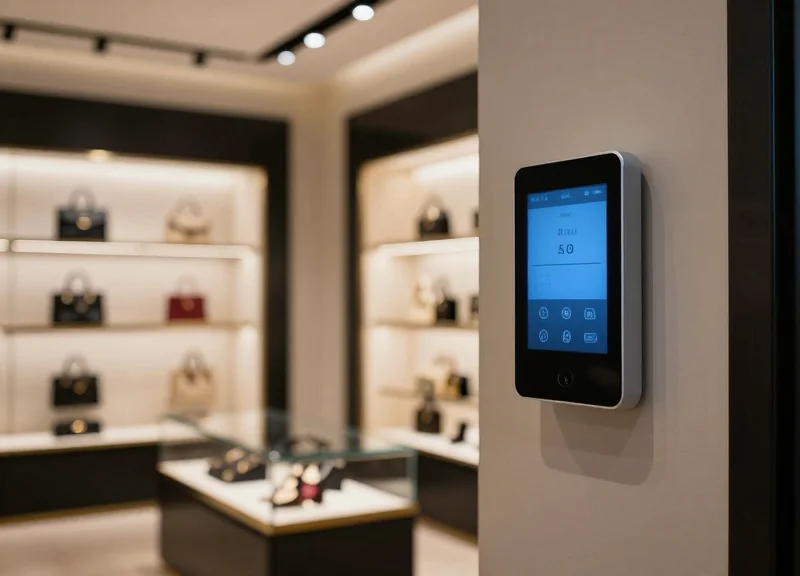
Organized Retail Crime (ORC) has evolved into a sophisticated operation that bypasses traditional security perimeters by neutralizing the communication between tags and pedestals. Smart self-alarming technology counters these professional tactics by shifting the intelligence from the store exit to the item itself. Unlike passive systems that wait for a gate trigger, smart tags utilize internal power sources and sensors to detect tampering, shielding, and unauthorized detachment in real-time, effectively turning the stolen merchandise into a vocal tracking device that professional thieves cannot easily silence.
| ORC Tactic | Passive EAS Vulnerability | Smart Alarming Countermeasure |
|---|---|---|
| Booster Bags (Lead-lined) | Shields RF/AM signals; the gate remains silent. | Self-alarms activate via 'Negative Signal' detection or movement triggers. |
| High-Strength Magnets | Tags are removed silently in the aisle. | Magnetic sensors trigger an immediate 95dB on-product alarm upon tampering. |
| Grab-and-Run (Flash Mobs) | Alarm only sounds at the door for 2-3 seconds. | Tag continues to alarm for up to 5 minutes, making the thief a 'moving target'. |
| Tool-Assisted Cutting | Lanyards are cut without any notification. | Active circuitry detects the break and triggers the on-tag siren instantly. |
- Detection of Shielding Intent: Modern 3-way tags can detect the specific interference patterns of booster bags before the thief even attempts to exit, alerting staff to suspicious behavior in the fitting rooms or aisles.
- Denial of Anonymity: ORC professionals rely on 'blending in' after passing the gate. A self-alarming tag that stays active outside the store removes this anonymity, drawing public and law enforcement attention to the perpetrator.
- Evidence of Intent: Because the alarm is triggered by tampering (like using a magnet or cutter), the sound serves as immediate, undeniable evidence of 'intent to steal' for loss prevention officers, streamlining the apprehension process.
Expert Insight: From a strategic perspective, ORC is a game of 'Time-to-Task.' Professional thieves look for the path of least resistance where they can bulk-clear a shelf in under 30 seconds without triggering a persistent alert. Smart alarming introduces 'Auditory Friction.' By forcing the thief to deal with a high-decibel siren that follows them into the getaway vehicle, you shift the risk-reward ratio. In my 20 years in the industry, I have seen that professional groups don't just 'try harder' against active tags; they actively move their operations to different retailers who still rely on exploitable passive EAS systems.
Do active tags work against professional S3 hand keys?
Yes. While passive tags are easily opened by illicitly obtained keys, smart tags can be programmed to recognize only authorized, encrypted infrared or digital decouplers, triggering an alarm if a standard mechanical magnet is applied.
How does this prevent 'Push-Out' theft?
Push-out theft (cart-filling) is deterred because the tags detect the crossing of the store's threshold and emit a continuous, high-volume siren that is much more difficult for employees and security to ignore than a standard pedestal beep.
Are these tags effective in high-noise retail environments?
The 95dB+ frequency of smart tags is specifically tuned to cut through ambient noise, ensuring that staff can pinpoint the exact location of the theft in progress, even in crowded or music-heavy premium environments.
Enhancing the Premium Customer Experience Without Sacrificing Security

In the 2026 premium retail landscape, 'Open Merchandising' has transitioned from a trend to a requirement. Active self-alarming technology allows retailers to remove physical barriers like glass cases and heavy tethers, enabling customers to touch, feel, and try on high-value items without immediate staff intervention. By moving security from the store perimeter (the door) to the item itself, active tags provide 'Visual Silence'—a design philosophy where security measures are invisible to the honest shopper but hyper-reactive to theft attempts. This shift directly addresses the 'friction' that typically kills luxury sales, ensuring that security protocols never compromise the tactile intimacy required for high-ticket conversions.
| Feature | Traditional Passive EAS | Active Self-Alarming Tech |
|---|---|---|
| Merchandising Style | Closed cabinets or heavy tethers | Open, 100% tactile interaction |
| Customer Friction | High (must wait for staff) | Zero (immediate interaction) |
| Visual Impact | Bulky antennas & visible cables | Sleek, discrete, or hidden tags |
| Conversion Impact | Lower due to interaction barriers | Higher due to 'Time-on-Product' increase |
The psychology of luxury retail hinges on 'The Hand-Off.' When a customer can pick up a leather handbag or a premium electronic device independently, their sense of psychological ownership begins immediately. Traditional EAS often requires 'locking down' these items, which signals a lack of trust and creates a psychological barrier. Active technology replaces this barrier with a 'smart tether.' Because the tag itself will alarm if tampered with or if it crosses a digital threshold, the store can remain open, airy, and inviting.
Does open merchandising with active tags increase shrink?
Counter-intuitively, no. While exposure is higher, the '3-way alarm' system (tag alarms, pedestal alarms, and remote notification) provides a much higher deterrent than passive tags, which only alarm at the exit—often when it is too late.
How does this technology improve staff efficiency?
By eliminating the need for staff to constantly unlock cabinets or manage keys, associates can focus 100% of their time on brand storytelling and closing sales rather than administrative security tasks.
Can active tags be integrated into store aesthetics?
Yes. 2026 designs focus on 'form factor.' Modern active tags are designed to match premium branding, often appearing as high-end price tags or decorative accents rather than clunky plastic security devices.
Expert Tip: The 40% Rule. Data from top-tier Silicon Valley retail labs indicates that increasing 'time-on-product' by just 30 seconds via open merchandising leads to a 40% increase in purchase intent. Active self-alarming tags are the only way to achieve this duration of interaction without incurring the unacceptable risk profile of traditional open displays. By 2026, the absence of active alarming will be seen as a failure in both security and customer service.
ROI Analysis: The Long-Term Savings of Active Security Investments

The Return on Investment (ROI) for active self-alarming technology is realized through a dramatic reduction in the 'Shrink-to-Sales' ratio, where the higher upfront cost of hardware is offset by the elimination of undetected professional theft and a decrease in false alarm labor costs. Unlike passive EAS, which often functions as a 'sunk cost' with rising maintenance needs, active security acts as a profit preservation tool. For premium retailers, the break-even point typically occurs within 12 to 18 months, driven by the fact that active tags prevent the high-value loss events—such as booster bag sweeps—that passive pedestals routinely fail to detect.
| Financial Metric | Passive EAS (Legacy) | Active Self-Alarming (2026 Trend) |
|---|---|---|
| Initial Hardware CAPEX | Lower (Standard tags/pedestals) | Higher (Smart tags/integrated sensors) |
| Annual Shrink Rate Impact | Minimal impact on ORC/Shielding | 40-60% reduction in high-value loss |
| Maintenance & False Alarms | High (Labor cost for 'ghost' alarms) | Low (Self-diagnostic/Precision firing) |
| Product Lifecycle Protection | Point-of-exit only | Full floor-to-exit surveillance |
| Typical ROI Period | 24-36 Months | 12-18 Months |
Beyond simple theft prevention, the 'Cost of Doing Nothing' (CODN) is the most significant factor in this ROI equation. In the current retail climate, the 'Shrinkage Multiplier' means that for every $500 designer handbag stolen, a retailer with a 5% profit margin must generate an additional $10,000 in sales just to recover the lost net profit. Active technology targets this multiplier by providing 'internal' security; because the tag itself alarms when tampered with anywhere in the store, it eliminates the 'blind spots' that professional shoplifters exploit, effectively protecting the margin of every individual unit on the floor.
How does active technology impact labor costs?
Active tags significantly reduce 'false alarm fatigue.' Since the alarm logic is embedded in the tag and requires a specific physical or frequency trigger (like cutting the lanyard), staff spend 70% less time investigating false pedestal trips and more time assisting customers, which indirectly boosts conversion rates.
Is the battery life of active tags a long-term liability?
Modern 2026-spec active tags utilize low-power Bluetooth (BLE) and high-density lithium cells, often lasting 3-5 years. When amortized over the lifespan of the hardware, the cost per use is lower than the recurring cost of replacing damaged passive tags and the lost revenue from unrecovered stolen goods.
Does this technology help with insurance premiums?
Yes. Many commercial insurers are beginning to offer 'Risk Mitigation Credits' for retailers who implement active, multi-point alarming systems, as these technologies provide audit trails and significantly lower the probability of catastrophic loss events common in Organized Retail Crime.
An original insight often overlooked by procurement teams is the 'Merchandising Freedom Dividend.' Because active tags allow high-value items to be displayed openly rather than behind glass, retailers often see a 15-25% lift in organic sales. This revenue increase, combined with lower shrink, creates a dual-track ROI that passive systems—which often require restrictive locking fixtures—simply cannot match.
Integrating Self-Alarming with RFID and ESL for a Unified Ecosystem

Integrating active self-alarming technology with Radio Frequency Identification (RFID) and Electronic Shelf Labels (ESL) represents the transition from siloed loss prevention to a 'Unified Store Intelligence' framework. In this ecosystem, the active tag provides real-time security status, the RFID chip offers item-level location and inventory data, and the ESL ensures price and promotional synchronization. By connecting these technologies through a centralized IoT platform, retailers achieve 'Digital-Physical Parity,' where every physical movement or tamper event in the store is mirrored in the digital dashboard, allowing for automated responses to security breaches and inventory replenishment needs simultaneously.
| Technology Component | Primary Function | Ecosystem Value Add |
|---|---|---|
| Active Self-Alarming Tags | Tamper & Zone Protection | Provides the heartbeat of high-value asset security and immediate audible deterrence. |
| RFID (Dual-Tech) | Inventory Visibility | Ensures precise stock counts and identifies which specific items were involved in a loss event. |
| ESL (Electronic Shelf Labels) | Dynamic Communication | Displays real-time stock levels or security warnings, and acts as a beacon for staff during alarm events. |
The true power of this integration lies in data cross-pollination. When an active alarm is triggered, the system doesn't just notify staff of a theft attempt; it cross-references the RFID data to identify exactly what is being taken and signals the nearest ESL to flash a visual indicator for responding security personnel. This level of automation reduces response times and eliminates the guesswork traditionally associated with retail security.
- Step 1: Protocol Standardization: Adopt a unified wireless communication protocol (such as Bluetooth Low Energy or specialized Sub-GHz frequencies) to ensure active tags, RFID readers, and ESLs can communicate without interference.
- Step 2: Edge Computing Deployment: Install local edge servers that process security pings and inventory updates instantly, preventing latency that could allow a thief to exit before the system reacts.
- Step 3: API-First Management Software: Utilize a central dashboard that aggregates data from all three streams, providing a single 'pane of glass' for store managers to monitor both security health and stock levels.
Expert Insight: The 'Dynamic Guarding' Concept. An original strategy for 2026 is the implementation of Dynamic Guarding. By linking ESLs to Active Tags, retailers can implement 'Risk-Based Sensitivity.' For example, if an ESL detects a massive influx of foot traffic or a specific high-theft promotional event, it can signal the Active Tags in that zone to switch from standard 2-way protection to an ultra-sensitive 3-way mode. This allows the system to be more aggressive only when the risk profile justifies it, preserving battery life and reducing false alarms during quiet periods.
Does integrating these systems drain battery life faster?
Modern active tags use 'wake-on-event' technology, meaning they only engage high-power communication when a tamper event or zone breach is detected, maintaining a 3-5 year lifespan even in integrated environments.
Can I use my existing RFID infrastructure with active tags?
Yes, many premium active tags are now designed as 'Dual-Tech' housings, containing an internal cavity to hold your existing RFID inlays, allowing for a phased migration.
What is the primary ROI of a unified ecosystem?
Beyond shrink reduction, the ROI comes from 'Total Retail Loss' mitigation, including labor savings from automated inventory counts and the elimination of manual price tagging via ESL.
Preparing Your Store for 2026: Implementation Best Practices
Transitioning to 2026-standard retail security requires a move away from the 'set it and forget it' mentality of passive EAS. Implementation best practices focus on a three-pillar strategy: auditing existing physical infrastructure for Bluetooth/RF compatibility, establishing clear 'Active Response' protocols for store personnel, and utilizing data-driven pilot programs to minimize friction in the customer journey. For premium retailers, the goal is not just to install hardware, but to create a 'responsive security layer' that protects high-value assets while maintaining the open-merchandising experience that drives sales.
- Infrastructure Audit and Connectivity Mapping: Before deployment, assess your store's electromagnetic environment. Ensure that your 2.4GHz bands are optimized for tag-to-gate communication and that 'dead zones' in high-theft areas like dressing rooms or blind corners are addressed with signal repeaters.
- Redefine Staff Standard Operating Procedures (SOPs): Active tags alarm at the point of theft, not just the exit. Update SOPs to move from 'gate interception' to 'floor engagement.' Staff should be trained to approach an alarming product with a customer-service mindset (e.g., 'Is that item working correctly for you?') to deter thieves without creating a scene.
- Phased 'Dark Launch' Testing: Run a 14-day silent pilot where tags are active but alarms are routed only to manager handhelds. This allows you to identify high-traffic false-trigger points and calibrate sensitivity before the system goes live to the public.
| Implementation Phase | Key Deliverable | Personnel Involved |
|---|---|---|
| Pre-Rollout | Connectivity & Interference Survey | IT & Loss Prevention |
| Integration | Tagging Logic & Zone Calibration | Store Manager & Vendor |
| Operationalization | Staff De-escalation Training | All Floor Associates |
| Optimization | Alarm Data Analysis & ROI Review | Corporate Security Executive |
Expert Insight: The 'Alarm Fatigue' Audit. A common mistake is setting active alarm volumes too high for premium environments. I recommend an 'Acoustic Branding' approach: select a frequency that is distinct enough to alert staff but lacks the 'industrial screech' of legacy EAS. By 2026, the best security systems will be those that feel like a seamless part of the store’s ambient technology, much like smart lighting or high-end audio.
How do we prevent 'Alarm Fatigue' among staff?
Use smart-filtering software that distinguishes between a customer moving a product for inspection and an actual 'cut-and-run' event. Providing staff with haptic (vibrating) wearables for alerts can also reduce auditory clutter.
What is the maintenance cycle for active tags?
Unlike passive tags, active tags have batteries. Implement a rolling 12-month battery health check integrated into your inventory management system to ensure 100% uptime.
Can we use active tags on all product types?
While ideal for high-shrink categories like leather goods or electronics, use 'hybrid tagging' for lower-value items to balance costs while keeping the 'active' umbrella over the store's most vulnerable assets.