Retail spaces located near mall elevators and escalators face a unique set of electronic challenges. The constant electromagnetic noise generated by heavy machinery and power cables can trigger frequent false alarms in standard Electronic Article Surveillance (EAS) systems, disrupting the customer experience and eroding security trust. This guide explores how boutique owners can navigate these technical hurdles by selecting high-performance, interference-resistant technology designed to protect assets in high-traffic, electrically noisy environments.
The Challenge: Why Mall Elevators Trigger EAS False Alarms
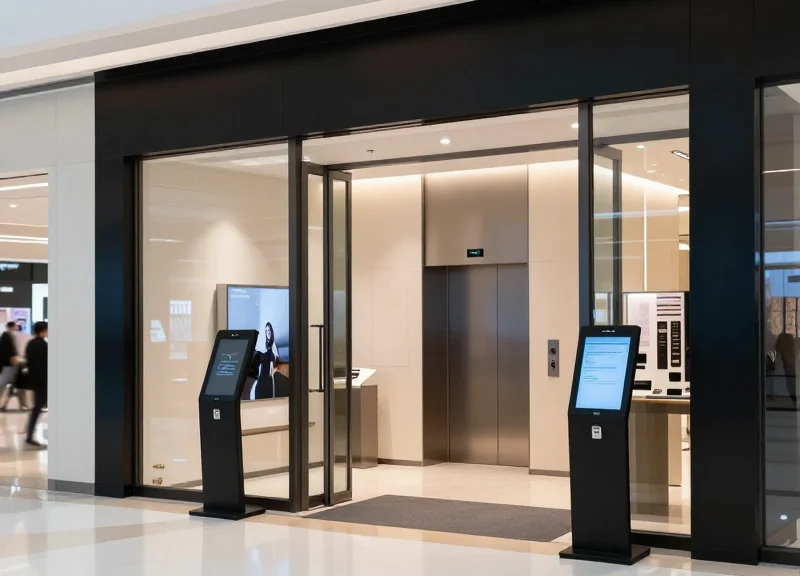
Boutique security systems located near mall elevators often suffer from 'phantom alarms' because the elevator’s electrical architecture acts as a massive radio frequency transmitter. When high-power motors or Variable Frequency Drives (VFDs) cycle on and off to move the elevator car, they create bursts of electromagnetic interference (EMI) and harmonic noise. Because many Electronic Article Surveillance (EAS) systems operate on standard frequencies (like 58kHz or 8.2MHz), they struggle to distinguish the chaotic electrical noise of an elevator from the intentional signal of a security tag, resulting in frequent, unprompted alarms that frustrate staff and customers alike.
| Interference Source | Technical Mechanism | Impact on EAS Performance |
|---|---|---|
| Variable Frequency Drives (VFDs) | High-speed switching of power transistors creates wide-band harmonic noise. | High: Triggers intermittent false alarms during acceleration/deceleration phases. |
| High-Voltage Cabling | Unshielded power lines create electromagnetic fields that bleed into signal cables. | Medium: Lowers the Signal-to-Noise Ratio (SNR), making real tags harder to detect. |
| Brake Solenoids | Inductive spikes occur when the mechanical brakes engage or disengage. | Medium: Causes sharp 'clicks' or single-pulse alarms when the elevator stops. |
| Metallic Mass Displacement | The movement of the large steel elevator car shifts local magnetic fields. | Low: Causes 'drifting' in Acousto-Magnetic (AM) systems that require constant re-tuning. |
In a retail environment, the 'Signal-to-Noise Ratio' (SNR) is the most critical metric. Near an elevator bank, the 'noise' floor is significantly higher than in a standalone street-front store. Standard EAS controllers are often pre-set with sensitivity thresholds that are too low for these environments. When the elevator motor draws peak current, the noise floor spikes above the threshold, and the system interprets this as a tag entering the detection zone. Expert Tip: In mall environments, the interference isn't just 'in the air'—it often travels through the building's common electrical ground, a phenomenon known as conducted EMI.
Why is the 58kHz (Acousto-Magnetic) frequency particularly sensitive to elevators?
Acousto-Magnetic (AM) systems are highly sensitive because their operating frequency is very close to the harmonics generated by the heavy-duty pulse-width modulation used in modern elevator motors. Without digital signal processing (DSP), the system cannot differentiate the mechanical 'hum' from the tag resonance.
Does the distance from the elevator matter?
Yes, but it is not just linear distance. Interference can travel through shared electrical conduits up to 50 feet away. If your boutique shares a wall with the elevator shaft or the machine room, you are in the 'High-Interference Zone' and require specialized shielded equipment.
Can shielding the EAS pedestals fix the problem?
Physical shielding (like lead or copper mesh) can help block airborne RFI, but it does nothing for conducted interference coming through the power lines. A comprehensive solution requires both physical shielding and advanced software filtering.
AM vs. RF Technology: Comparing Stability Near Moving Machinery
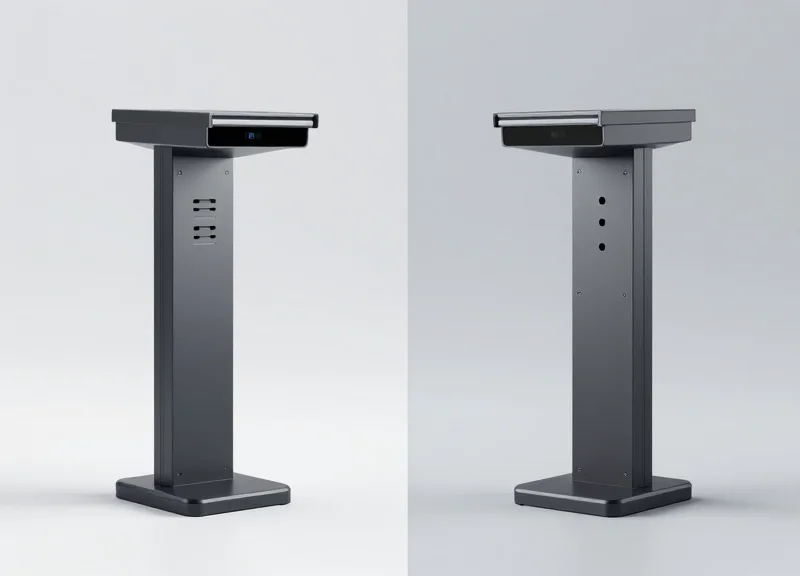
When selecting an Electronic Article Surveillance (EAS) system for a boutique near mall elevators, the primary technical differentiator is the operating frequency: Acousto-Magnetic (AM) systems operate at 58kHz, while Radio Frequency (RF) systems typically operate at 8.2MHz. AM technology is vastly superior for these environments because it utilizes a 'pulse-listen' signal method that can distinguish between a security tag and the ambient electromagnetic noise generated by heavy elevator motors and high-voltage cabling.
| Feature | AM (Acousto-Magnetic) 58kHz | RF (Radio Frequency) 8.2MHz |
|---|---|---|
| Signal Processing | Pulsed (Digital Signal Processing) | Continuous Swept Frequency |
| EMI Resistance | High (Filters out machinery noise) | Low (Prone to phantom alarms) |
| Detection Width | Up to 2.4m (Wider entrances) | Up to 1.8m (Narrower coverage) |
| Tag Deactivation | Non-contact (Higher distance) | Proximity/Contact required |
| Best Use Case | High-interference mall locations | Stand-alone street-front shops |
The 'Pulse-Listen' mechanism in AM systems works like a sonar. The pedestal sends out a burst of energy that 'rings' the amorphous metal strip inside the tag. The system then pauses to listen for the specific 58kHz resonance. This silent interval allows the system to ignore the constant 'buzz' of elevator drive harmonics. Conversely, RF systems use a continuous wave that is easily distorted when a large metal mass (like an elevator car) moves nearby or when motors spin up, leading to the dreaded 'phantom alarm' that erodes staff trust in the system.
Why do elevator motors specifically trigger RF systems?
Elevator Variable Frequency Drives (VFDs) generate 'noise' across a broad spectrum. RF systems operate at a much higher frequency (8.2MHz) where these harmonics are more likely to mimic the signature of a security tag, causing the receiver to misinterpret interference as a theft event.
Is AM technology more expensive than RF?
Historically, AM was a premium option. However, the total cost of ownership (TCO) in a mall setting is lower for AM because it requires fewer service calls for recalibration and avoids the lost sales associated with false alarms driving customers away.
Can shielding fix RF interference issues near elevators?
While physical shielding (like lead or specialized foils) can help, it is often aesthetically unpleasing for boutiques and rarely 100% effective against the low-frequency magnetic fields generated by large elevators.
Expert Insight: The 5% Harmonic Rule. In my 20 years of retail engineering, I've observed that elevators don't just create noise; they create 'jitter' in the power grid. A boutique within 15 feet of an elevator shaft will experience a 5-10% increase in total harmonic distortion (THD). AM systems use sophisticated Digital Signal Processing (DSP) to 'tune out' this specific THD, whereas traditional RF systems see this jitter as a signal, making AM the only logical choice for high-traffic mall corridors.
Key Features of Interference-Resistant EAS Systems
An interference-resistant Electronic Article Surveillance (EAS) system is defined by its ability to distinguish between the specific frequency of a security tag and the 'dirty' electromagnetic noise generated by heavy machinery like mall elevators. Unlike standard systems that rely on basic signal thresholds, professional-grade interference-resistant hardware employs high-speed Digital Signal Processing (DSP) and multi-phase filtering to maintain a high Signal-to-Noise Ratio (SNR), ensuring alarms only trigger when a legitimate threat is detected.
| Core Feature | Technical Function | Benefit for Elevator-Adjacent Stores |
|---|---|---|
| Digital Signal Processing (DSP) | Converts analog signals to digital for real-time analysis. | Filters out elevator motor 'spikes' that mimic tag signals. |
| Automatic Noise Filtering | Continuously scans ambient EMI levels. | Automatically adjusts sensitivity based on elevator activity. |
| Phase-Locked Loop (PLL) | Synchronizes system frequency to the power source. | Prevents drift caused by high-voltage mall power grids. |
| Remote Tuning Capability | Cloud-based sensitivity calibration. | Allows technicians to optimize performance without site visits. |
One unique insight often overlooked by generic retailers is the 'Environmental Learning Algorithm.' Premium systems do not just filter noise; they map it. By 'learning' the specific electromagnetic signature of a nearby elevator's startup and braking cycle, the system can create a dynamic digital mask. This allows the system to remain at maximum sensitivity for tags even while the elevator is in motion, whereas inferior systems simply shut down or desensitize themselves to avoid the alarm, creating a temporary security blind spot.
What is 'Smart Sensitivity' in EAS systems?
Smart sensitivity refers to adaptive software that identifies rhythmic interference patterns from elevators and ignores them while staying alert for the non-rhythmic signal of a moving security tag.
Why is multi-pedestal synchronization important?
In mall environments, multiple stores often have systems. Synchronization ensures that your system's 'pulse' doesn't clash with your neighbor's or the elevator's electrical harmonics.
Can shielding physically stop elevator interference?
Yes, high-end antennas often include internal Faraday-style shielding on the 'back' side to block signals coming from the elevator bank while remaining open to the storefront entrance.
The Role of Software Tuning and Remote Calibration

Modern Electronic Article Surveillance (EAS) systems have evolved beyond simple hardware loops; they are now sophisticated software-defined sensors. In boutiques located near mall elevators, software tuning acts as the 'brain' that filters out the chaotic electromagnetic noise generated by elevator motors. By adjusting Digital Signal Processing (DSP) algorithms, technicians can define the exact signal profile of a security tag while instructing the system to ignore the specific low-frequency pulses or surges characteristic of high-voltage machinery. This ensures that the system remains sensitive to theft without being triggered by the surrounding mall infrastructure.
| Feature | Legacy Manual Tuning | Modern Software-Driven Calibration |
|---|---|---|
| Accuracy | Low (Requires physical 'guesswork' with knobs) | High (Granular digital threshold control) |
| Interference Handling | Static (Filters all signals equally) | Dynamic (Isolates specific noise frequencies) |
| Maintenance Cost | High (On-site technician visit required) | Low (Instant remote adjustments via cloud) |
| Detection Sensitivity | Degrades when noise is high | Maintains sensitivity through adaptive filtering |
One of the most significant advancements in boutique security is the shift toward Remote Calibration. Previously, if an elevator repair or a change in the mall's electrical grid caused false alarms, a store would have to wait days for a technician. Today, cloud-connected EAS systems allow experts to log in remotely, analyze a live 'signal-to-noise' map of your storefront, and recalibrate the sensors in minutes. This minimizes downtime and prevents the 'alarm fatigue' that leads staff to ignore real security breaches.
- Baseline Noise Mapping: The system records the ambient EMI levels when elevators are in motion to establish a 'background' noise profile.
- Threshold Optimization: Technicians set the detection trigger just above the peak elevator interference level to ensure maximum tag sensitivity.
- Frequency Filtering: Specific software filters are applied to 'notch out' the rhythmic electrical interference typical of large industrial motors.
- Validation & Testing: Remote testing of tag detection is performed to ensure the new settings do not create 'blind spots' in the entrance.
Expert Insight: Temporal Sensitivity Scheduling. A unique advantage of software-driven systems is the ability to implement 'Time-of-Day' tuning. Because mall traffic and elevator usage peak at specific times, high-end systems can be programmed to increase filtering during busy hours and maximize sensitivity during low-traffic periods (like night stocking). This 'Dynamic Guarding' ensures your boutique is always protected by the most efficient profile possible, a capability that fixed hardware systems simply cannot match.
Can software tuning eliminate 100% of false alarms?
While it can reduce them by over 95%, total elimination depends on the physical distance between the pedestals and the interference source. Software tuning makes the system 'smarter,' but physics still applies.
Is remote calibration secure for my boutique?
Yes, professional-grade systems use encrypted VPN connections and bank-level security protocols to ensure that only authorized technicians can access your security settings.
Do I need to buy new hardware for these features?
Generally, yes. Older 'analog' systems do not support remote calibration. Look for systems labeled 'IoT Ready' or 'Smart EAS' to ensure software-driven capabilities.
Optimal Placement Strategies for Boutique Entrances
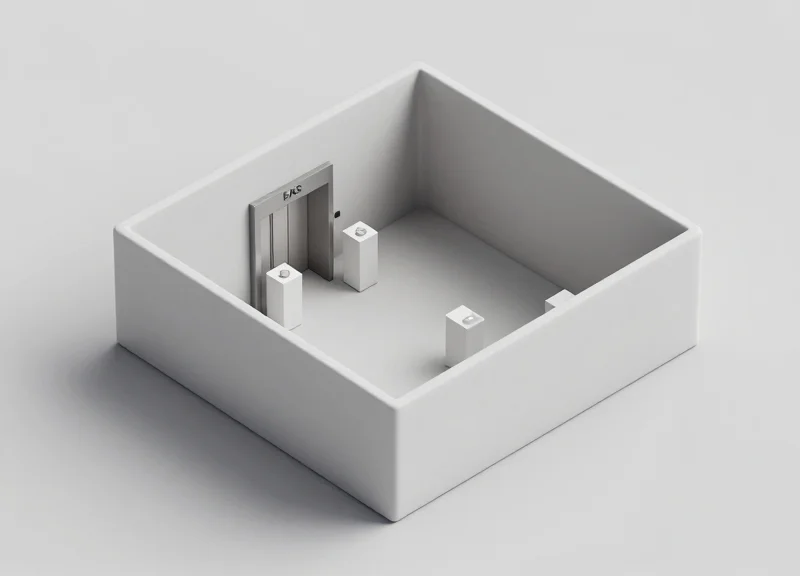
Optimal placement for boutique EAS systems near mall elevators requires maintaining a minimum 3-meter buffer from elevator machinery and a 15-30cm clearance from structural metal frames to prevent signal reflection and the 'antenna effect.' By positioning pedestals away from high-conductive paths and ensuring they are perpendicular to the elevator’s path of travel, boutiques can achieve high-security detection without the nuisance of electromagnetic interference (EMI) false alarms.
| Interference Source | Minimum Safe Distance | Risk Factor |
|---|---|---|
| Elevator Shaft / Motor Room | 3.0 - 5.0 Meters | High: Magnetic pulse interference |
| Metal Door Frames / Mullions | 15 - 25 Centimeters | Medium: Loop signal reflection |
| Automatic Sliding Doors | 50 Centimeters | Medium: Motor brush noise |
| Adjacent Store EAS Systems | 2.5 - 4.0 Meters | High: Signal 'crosstalk' |
A common mistake in mall boutique design is the 'Flush-Mount Trap,' where retailers attempt to hide EAS pedestals directly against decorative metal cladding or structural steel beams. This creates a secondary loop that amplifies ambient noise from the elevator's power lines. Instead, utilize specialized spacers or offset floor mounts to create a 'neutral zone' between the antenna and the building's metal skeleton.
- Electromagnetic Mapping: Before drilling, use an AM/RF field strength meter to identify 'hot spots' where elevator motor activity peaks. Map these peaks to determine the quietest 2-meter span for pedestal installation.
- Parallel vs. Perpendicular Alignment: Install pedestals so the antenna loop is perpendicular to the elevator cables. This orientation minimizes the surface area exposed to fluctuating magnetic fields generated by moving lift cars.
- Sub-Floor Isolation: Ensure EAS power cables are not run in the same conduit as high-voltage lighting or escalator power lines. Use shielded CAT6 or specific EAS twin-core cabling to prevent induction.
Expert Insight: The Phasing Cancellation Technique. For boutiques situated directly opposite an elevator bank, simply moving the pedestal is often not enough. Modern digital EAS controllers allow for 'Phase-Sync' tuning. By intentionally shifting the phase of your system to match the frequency cycle of the building's main power grid, you can effectively 'blind' the system to the specific 50/60Hz noise spikes produced by elevator starts and stops, focusing only on the unique resonance of your security tags.
Can I install EAS pedestals under a metal lintel?
Yes, but you must ensure a 'break' in the metal loop. If the lintel is continuous, it can act as a giant antenna for elevator noise. Consult your installer about adding non-conductive gaskets at mounting points.
Does the floor material affect elevator interference?
Significantly. If your boutique has a raised computer floor or a metal deck under the screed, it can carry EMI directly to the pedestal base. Specialized grounding mats may be required.
Combining Aesthetics with Functionality in High-End Retail

In high-end retail, the entrance is more than a doorway; it is the first touchpoint of a brand's luxury narrative. Combining aesthetics with functionality means selecting Electronic Article Surveillance (EAS) systems that offer invisible or architectural-grade physical designs without compromising the Digital Signal Processing (DSP) power required to negate electromagnetic interference (EMI) from mall elevators. For boutiques, the goal is 'Zero-Visual Friction' security—where the technology protects the inventory while remaining a silent partner to the interior design.
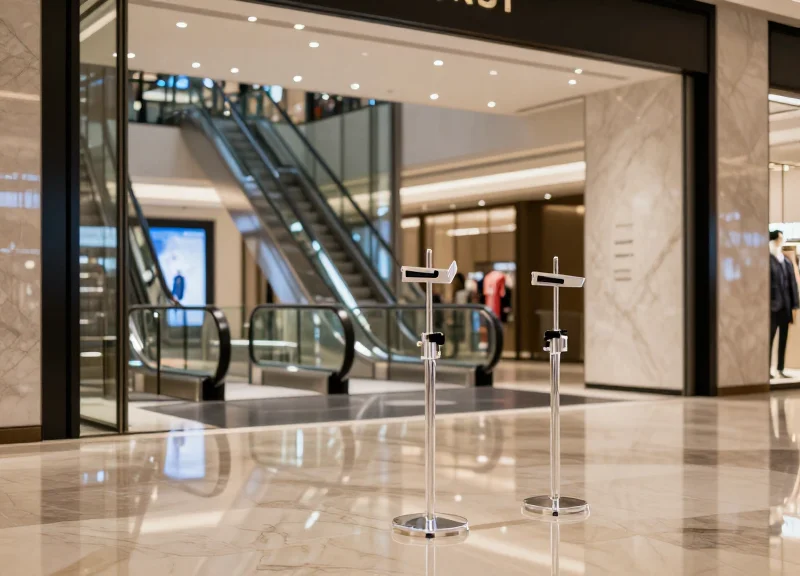
The most effective solutions for boutiques near elevators often utilize high-grade, ultra-clear acrylic pedestals or concealed 'Invisible' systems. While traditional retail might favor bulky, plastic-housed antennas, luxury environments require materials that allow sightlines to remain open. However, aesthetics must not lead to a 'signal sacrifice.' Professional-grade acrylic antennas are not just about looks; they often house multi-directional loop configurations that provide a wider detection field, which is critical when trying to maintain sensitivity in a 'noisy' elevator-adjacent environment.
| System Type | Aesthetic Impact | Interference Resilience | Best Use Case |
|---|---|---|---|
| Ultra-Clear Acrylic | Low (Transparent) | High (Built-in DSP) | Open-concept boutique entrances |
| Concealed Floor Loops | Zero (Invisible) | Medium (Requires Shielding) | Historical or minimalist storefronts |
| Overhead IR/EAS | Minimal (Ceiling Mount) | Low (Distance issues) | Low-theft, high-luxury showrooms |
| Slim-Line Metallic | Moderate (Sleek Profile) | Extreme (Superior Shielding) | High-traffic mall corridors |
Expert Insight: Beware of 'Acrylic Ghosting.' Lower-end acrylic pedestals use inferior resins that can yellow over time or develop micro-fractures that reflect store lighting poorly. More importantly, cheaper units often lack the internal EMI shielding found in premium models. A Silicon Valley-level retail strategy involves specifying 'Signal-Isolated Acrylics'—pedestals where the internal electronics are encased in a Faraday-style mesh that allows the antenna to pick up tags while ignoring the low-frequency hum of nearby elevator motors.
Can concealed floor systems handle elevator interference?
Yes, but they require professional calibration. Since floor systems are closer to the building's structural steel and elevator rails, they must use advanced 'Noise Mapping' software to create a digital profile of the elevator's interference and subtract it from the detection signal.
Do acrylic pedestals scratch easily in high-traffic mall areas?
Premium EAS pedestals use 'Optical Grade' acrylic with a high Shore hardness rating, making them resistant to handbags and shopping carts. Always look for systems with a scratch-resistant coating to maintain the boutique's premium look.
How do I hide the 'alarm sound' in a luxury setting?
Modern systems allow for 'Discrete Alerting.' Instead of a loud siren, the system can trigger a silent alert to staff pagers or mobile devices, or play a specific, soft chime that alerts staff without panicking customers.
Future-Proofing with Integrated RFID and ESL Solutions
Future-proofing a boutique involves transitioning from standalone security pedestals to an integrated ecosystem where RFID (Radio Frequency Identification) and ESL (Electronic Shelf Labels) communicate on distinct, non-overlapping frequencies. This digital shift not only provides 99% inventory accuracy but also leverages Frequency-Hopping Spread Spectrum (FHSS) technology to bypass the low-frequency electromagnetic noise typically generated by mall elevator motors and power cables.
| Feature | Standalone AM/RF EAS | Integrated RFID/ESL System |
|---|---|---|
| Detection Accuracy | 75-85% (Subject to false alarms) | 98%+ (Item-level identification) |
| Interference Resistance | Low (Sensitive to Metal/Elevators) | High (Uses Digital Signal Processing) |
| Inventory Management | Security Only | Real-Time Automated Tracking |
| ROI Driver | Loss Prevention Only | Omnichannel Readiness & Labor Savings |
One unique insight often overlooked by boutique owners is that RFID and ESL operate on the UHF (860-960 MHz) and 2.4 GHz bands respectively, which are light-years away from the 58 kHz or 8.2 MHz frequencies used by traditional EAS. By moving your critical retail data to these higher frequencies, you effectively 'step out' of the interference zone created by heavy mall machinery, ensuring that your security system and your inventory data remain crystal clear and reliable.
- Baseline Signal Mapping: Begin by conducting a spectrum analysis to identify the specific harmonic frequencies being emitted by the nearby elevator shafts.
- Digital Component Selection: Choose RFID-enabled security tags that support 'Soft-Alarming,' allowing the system to distinguish between a shoplifted item and a signal bounce from a metal elevator door.
- ESL Ecosystem Deployment: Install Electronic Shelf Labels to automate pricing; these systems act as a secondary mesh network that can actually help stabilize the digital environment of the store.
- Unified Cloud Monitoring: Connect all components to a DragonGuardGroup centralized dashboard to monitor system health and interference levels in real-time.
Will adding RFID and ESL create more signal clutter?
Actually, the opposite is true. Integrated digital systems use synchronized time-slots to transmit data, which organizes the airwaves more efficiently than old analog EAS systems.
Can RFID tags be read through elevator doors?
Advanced RFID readers utilize circular polarization to filter out signal reflections from large metal surfaces like elevators, ensuring only the tags inside your boutique are read.
Is the integration compatible with existing boutique aesthetics?
Yes, DragonGuardGroup's integrated sensors are often hidden within door frames or under flooring, providing invisible security that doesn't disrupt high-end branding.
Case Study: Successful EAS Implementation in Multi-Story Malls
Successful EAS implementation in multi-story malls requires neutralizing the 'Bellows Effect'—the electromagnetic surge and metal movement interference caused by elevator cabins—through the use of 58kHz Acousto-Magnetic (AM) systems equipped with advanced Digital Signal Processing (DSP). By isolating the frequency of the EAS gates from the mechanical noise of the elevator motors, boutiques can achieve a near-zero false alarm rate even in high-traffic, metal-heavy environments.
A flagship luxury apparel retailer located in a premium Shanghai mall faced a significant challenge: their entrance was situated less than 4 meters from a bank of four high-speed elevators. The existing Radio Frequency (RF) system suffered from 'phantom' alarms every time the elevator doors cycled, leading to 'alarm fatigue' among staff who eventually began ignoring the pedestals. This security gap resulted in an 18% increase in unexplained inventory shrinkage over six months.
| Metric | Legacy RF System | Optimized AM Solution |
|---|---|---|
| False Alarms per Day | 45+ (Elevator Triggered) | < 2 (Environmental Only) |
| Detection Width | 1.4 Meters | 2.2 Meters (Aisle-Wide) |
| Interference Shielding | None (Passive) | Active Software Filtering |
| Inventory Shrinkage | High (Alarm Fatigue) | Reduced by 65% |
The solution involved a transition to the DragonGuard Ultra-Slim AM Pedestal series, chosen specifically for its high-performance noise-cancellation algorithms. Our team implemented a 'Triple-Shielding' approach that serves as a blueprint for boutiques in similar high-interference zones.
- Electromagnetic Mapping: We used an oscilloscope to map the peak interference cycles of the elevators, identifying the specific millisecond delays where signal noise was highest.
- Shielded Cable Routing: All power and sync cables were replaced with double-shielded twisted pair (STP) wiring to prevent the elevator motors from inducing current into the EAS loop.
- Dynamic Threshold Tuning: Using remote calibration software, the system’s sensitivity was tuned to ignore the specific 50-60Hz frequency harmonics generated by the elevator's variable voltage variable frequency (VVVF) drives.
Expert Tip: In multi-story environments, remember that interference isn't just lateral. Elevators moving above or below the boutique can create vertical magnetic flux. Always specify EAS systems that offer 'Phase Synchronization,' allowing multiple pedestals across different floors to pulse in harmony, effectively cancelling out cross-floor crosstalk.
Does the elevator's metal mass affect detection?
Yes, large moving metal masses can cause signal reflection. This is why we use AM technology, which is significantly less sensitive to metal interference than standard RF systems.
Can I hide the EAS system to keep my boutique's aesthetic?
Absolutely. For this case study, we utilized acrylic pedestals that blend into the glass storefront, but under-floor or overhead AM sensors are also viable for high-interference zones.