As we approach 2026, the activewear retail landscape is undergoing a radical transformation. No longer is loss prevention just about stopping theft; it is about enabling a fluid, omnichannel customer journey. Traditional hard tags, while effective at deterrence, often hinder the tactile experience and lack the data capabilities required for modern inventory management. Enter RFID-EAS hybrid systems—a dual-purpose solution that combines the robust security of Electronic Article Surveillance with the granular tracking of Radio Frequency Identification. This article explores why top-tier activewear brands are making the switch to ensure survival and growth in the next era of commerce.
The 2026 Outlook: Activewear Retail at a Crossroads

By 2026, the activewear retail sector is defined by a critical pivot: the transition from 'defensive' loss prevention to 'intelligent' inventory visibility. As consumers demand frictionless omnichannel fulfillment and self-checkout, traditional hard tags have become a bottleneck. The industry is currently at a crossroads where brands must decide between maintaining legacy security hardware that creates friction or adopting RFID-EAS hybrid systems that unify loss prevention with real-time data analytics. This shift isn't just about security; it is about the survival of the physical storefront in a high-velocity, inventory-sensitive market.
| Feature | Legacy Hard Tag Model (Pre-2024) | Hybrid RFID-EAS Model (2026) |
|---|---|---|
| Primary Goal | Shrinkage Prevention Only | Inventory Intelligence + Loss Prevention |
| Customer Experience | Friction-heavy (Manual removal) | Seamless (Automatic or hybrid sensing) |
| Inventory Accuracy | 65% - 75% Average | 98% - 99.8% Real-time |
| Operational Efficiency | High labor costs per item | Low labor; automated tracking |
Activewear brands are leading this technological charge because their SKU complexity—ranging from high-performance textiles to varied sizing and limited-edition colorways—makes traditional inventory management impossible at scale. In the 'Silicon Valley of Retail,' we are seeing that the most successful 2026 brands are treating security tags not as a necessary evil, but as data-generating nodes in a larger ecosystem. Expert Insight: The '98% Threshold' has become the new industry benchmark. In 2026, if your inventory accuracy is below 98%, your autonomous checkout and buy-online-pick-up-in-store (BOPIS) systems will fail, leading to significant customer churn.
Why is activewear at the forefront of this trend?
Activewear has the highest 'turnover velocity' in retail. Hybrid systems allow brands to track item-level movement from the fitting room to the exit, providing data on what is tried on versus what is sold—a metric legacy tags cannot provide.
What is the primary driver behind the 2026 retail crossroads?
The consumer's expectation for 'Invisible Commerce.' Shoppers now view manual tag removal at a checkout counter as an outdated friction point. Hybrid systems allow for overhead EAS sensing that validates purchases automatically.
Is the transition to RFID-EAS hybrid systems purely for large enterprises?
No. By 2026, the cost of RFID-EAS hardware has reached a parity point where mid-market activewear brands are finding that the reduction in labor and increase in sales conversion (due to better stock availability) pays for the infrastructure within 14-18 months.
The Problem with Legacy Systems: Why Traditional Hard Tags are Fading
Traditional Electronic Article Surveillance (EAS) hard tags are fading because they create a physical and digital mismatch with modern performance apparel, causing irreversible damage to high-gauge synthetic fibers and introducing significant bottlenecks in the labor-intensive checkout and return processes. As retailers shift toward self-service and high-velocity fulfillment, the mechanical requirement of a manual detacher has become a primary source of friction that inhibits the seamless 'phygital' experience consumers now expect.
| Feature | Legacy EAS Hard Tags | Modern Activewear Requirement |
|---|---|---|
| Material Impact | Thick pin gauges cause 'runs' in compression gear. | Non-invasive, zero-contact protection. |
| Checkout Speed | Manual removal takes 5-10 seconds per item. | Instant, bulk-scanned RFID checkout. |
| Data Visibility | Binary (On/Off) - no SKU-level data. | Real-time inventory and location tracking. |
| User Experience | Bulky, heavy, and interferes with try-ons. | Discreet, lightweight, or embedded form factors. |
- The 'Fiber Memory' Conflict: Modern activewear utilizes high-elastane content and recycled polyester yarns that have a 'memory.' Unlike traditional cotton, the 1.5mm to 2mm pins used in legacy hard tags can permanently displace these fibers, creating micro-tears and visible holes that render premium $120+ leggings unsellable after a single tagging cycle.
- Labor Drain and Operational Drag: In an era of rising labor costs, the 'Tagging-Untagging' workflow is a massive sink for employee hours. Research suggests that activewear staff spend up to 25% of their floor time managing hardware rather than assisting customers or optimizing merchandising.
- The Omnichannel Blind Spot: Legacy EAS tags are 'dumb'—they alert you to theft at the door but provide no insight into whether a specific SKU is in the dressing room, the backstock, or misfiled. This leads to high 'out-of-stock' occurrences even when the item is physically present in the store.
Expert Insight: From a sustainability perspective, traditional hard tags are becoming a liability. As activewear brands move toward circularity and resale programs, the physical damage caused by heavy EAS hardware significantly lowers the 'Grade A' resale value of pre-owned items. By 2026, brands that continue to use invasive pinning will find themselves at a disadvantage in the secondary market, which is projected to grow twice as fast as primary retail.
Do traditional tags actually prevent theft in 2026?
While they provide a visual deterrent, Organized Retail Crime (ORC) groups now easily bypass standard magnetic locks. Legacy systems lack the 'point of exit' SKU-level intelligence needed to prosecute or track loss patterns effectively.
Why is the weight of the tag a problem for activewear?
Technical fabrics like ultra-lightweight ripstop or seamless knits are designed for movement. A heavy hard tag causes the garment to hang incorrectly on the mannequin or hanger, negatively impacting the garment's perceived quality and 'drape' during the customer's initial inspection.
Can legacy EAS be integrated with digital checkout?
No. Legacy EAS requires a physical mechanical action (detaching) that is incompatible with mobile POS or grab-and-go technology, creating a permanent barrier to a truly frictionless store.
Fabric Integrity and Aesthetic Concerns
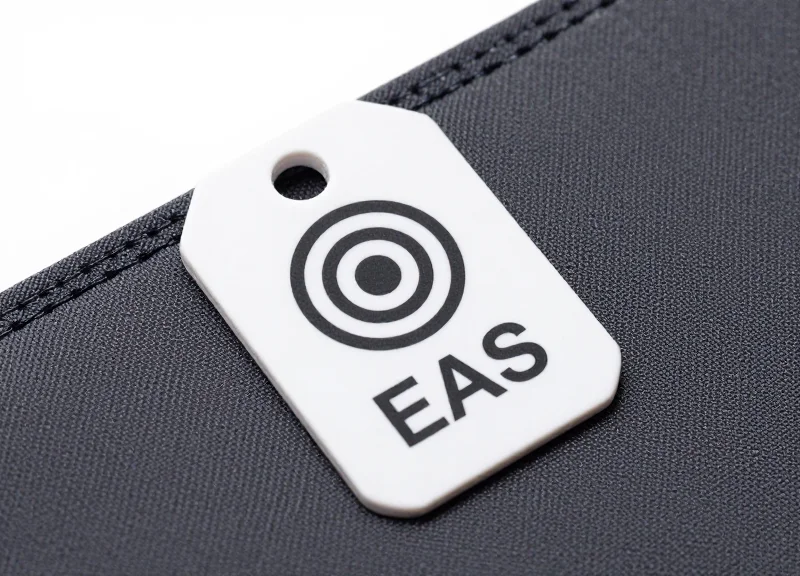
In the context of 2026 retail standards, fabric integrity refers to the preservation of a garment's structural and functional properties—such as compression, moisture-wicking, and elasticity—which are frequently compromised by the mechanical puncture of legacy hard tags. Traditional pin-based EAS systems cause 'fiber displacement' and 'micro-tears' in high-gauge performance knits. These defects are often permanent, resulting in visible snags or weakened zones that fail under the high-stress conditions typical of athletic use, ultimately damaging brand perceived value and increasing return rates.
| Feature | Legacy Hard Tags (Pin-Based) | RFID-EAS Hybrid Labels (Adhesive/Soft) |
|---|---|---|
| Structural Impact | High: Pierces weave, creates permanent holes | Zero: Surface-level application via medical-grade adhesive |
| Material Compatibility | Poor: Damages silk-weight nylons and mesh | Excellent: Safe for all synthetics and ultra-thin membranes |
| Visual Silhouette | Bulky: Distorts garment hang on the mannequin | Streamlined: Remains flat, preserving design lines |
| Consumer Perception | Negative: Signals 'low-trust' or 'low-tech' retail | Positive: Signals premium, tech-forward experience |
As we move toward 2026, activewear brands are increasingly utilizing recycled polymers and 'smart yarns' that feature complex, hollow-core structures for thermoregulation. These advanced materials are significantly more brittle than virgin polyester. An expert insight often overlooked is the 'Micro-Tear Cascade': when a heavy hard tag creates a puncture in a recycled synthetic blend, the mechanical stress of the garment hanging on a rack causes the hole to elongate over time, a process known as 'creep.' By the time a customer tries on the item, the structural failure is already underway, leading to 'blowouts' during the first workout. Hybrid RFID-EAS labels eliminate this mechanical stress entirely.
Does the adhesive from hybrid tags leave residue on premium fabrics?
Modern 2026-spec hybrid tags use pH-neutral, pressure-sensitive adhesives (PSA) designed specifically for high-energy synthetic surfaces. They leave zero residue and do not react with moisture-wicking chemicals or silver-ion antimicrobial treatments.
How do bulky tags affect the customer's 'Try-On' experience?
Hard tags create localized weight imbalances that prevent compression leggings from sitting correctly on the waist during fitting. This leads to a false sense of poor fit, causing lost sales that have nothing to do with the garment design itself.
Are hybrid tags visible enough to deter theft if they don't look like hard tags?
Yes. Hybrid systems utilize 'Visible Intelligence' branding. While they are thinner, they often feature clear EAS/RFID iconography that signals to shoplifters that the item is digitally tracked and protected by sophisticated gate alarms.
Defining the RFID-EAS Hybrid Revolution

An RFID-EAS Hybrid system is a converged hardware solution that embeds both Radio Frequency Identification (RFID) and Electronic Article Surveillance (EAS) technology into a single, discreet form factor. By combining item-level data tracking with loss prevention triggers, these systems eliminate the need for redundant, bulky hard tags. This allows activewear retailers to maintain high-security standards while simultaneously achieving near-perfect inventory accuracy and providing a frictionless checkout experience.
| Feature | Legacy Hard Tag (EAS) | Standard RFID Label | RFID-EAS Hybrid System |
|---|---|---|---|
| Primary Function | Theft Deterrence Only | Inventory Accuracy | Theft Protection + Data |
| Item-Level Visibility | None | High (98%+) | High (99%+) |
| Customer Friction | High (Manual Removal) | Low (Scannable) | Zero (Seamless/Self-Checkout) |
| Data Insights | Binary (Alarm/No Alarm) | Location & SKU Data | Real-time Shrinkage Analytics |
The technical synergy of a hybrid system lies in its dual-frequency architecture. Typically, these systems utilize Ultra-High Frequency (UHF) RFID for long-range inventory counting and supply chain visibility, paired with Acousto-Magnetic (AM) or Radio Frequency (RF) components for traditional electronic gate protection. In 2026, the revolution is moving toward 'integrated soft tags'—thin, flexible labels sewn directly into the garment's care label, making the security system virtually invisible to the consumer while remaining fully functional for the retailer.
How does the 'Hybrid' aspect work in a retail environment?
The system uses the RFID chip to identify exactly which SKU is passing through the door. If the item hasn't been marked as 'sold' in the POS system, the EAS component triggers the alarm. This prevents 'false positives' and provides specific data on what is being stolen.
Can hybrid tags be deactivated without being removed?
Yes. Unlike traditional hard tags that require mechanical detachers, hybrid soft tags are 'deactivated' digitally at the point of sale. The RFID status changes to 'paid,' allowing the customer to walk through the gates without triggering an alarm, even though the tag remains on the garment.
Why is this critical for the activewear sector specifically?
Activewear relies on high-performance, compressive, and lightweight fabrics. Traditional tags cause 'pinhole' damage and distort the drape of the garment. Hybrid systems use lightweight adhesive or sewn-in labels that do not compromise the technical integrity of the fabric.
Expert Insight: The Shift to 'Silent Recovery' Protocols. A unique advantage of the 2026 hybrid model is the move away from loud, embarrassing door alarms. Leading activewear brands are now implementing 'Silent Recovery'—where the hybrid gate identifies the stolen item and instantly sends a photo and SKU description to a floor manager's mobile device. This allows for a polite, data-backed intervention rather than a chaotic scene, preserving the premium brand atmosphere even during a security event.
Bridging the Gap: Security Meets Intelligence
Bridging the gap between security and intelligence means transitioning from legacy Electronic Article Surveillance (EAS) that merely triggers an alarm to a hybrid RFID-EAS model that provides granular, item-level data during every security event. This synergy allows activewear retailers to maintain robust loss prevention standards while simultaneously capturing real-time inventory visibility. By integrating these two technologies, a 'beeping' pedestal no longer just signals a generic loss; it identifies exactly which SKU, color, and size is exiting the store, enabling immediate and accurate inventory reconciliation.
| Feature | Traditional EAS (Acousto-Magnetic) | Standalone RFID | Hybrid RFID-EAS |
|---|---|---|---|
| Loss Prevention | High (Deterrence only) | Low (Audit only) | Superior (Deterrence + Data) |
| Inventory Visibility | None | High (Item-level) | Real-time (Item-level) |
| Data at Exit | Binary Alarm (On/Off) | ID Capture (No Alarm) | ID Capture + Triggered Alarm |
| Customer Friction | High (Manual Detaching) | Low (Digital Deactivation) | Minimal (Invisible/Integrated) |
The Veteran Perspective: From Reactive to Proactive Loss Prevention. In my two decades observing retail tech shifts, the biggest pain point has always been 'shrinkage blindness.' You know you've lost 5% of your inventory, but you don't know when or how. Hybrid systems provide what I call 'Forensic Inventory Insight.' For an activewear brand, this means realizing that high-compression leggings are disappearing specifically on Tuesday afternoons between 4:00 PM and 5:00 PM. This intelligence allows for data-driven staffing and merchandising decisions that traditional 'dumb' tags simply cannot support.
Does the hybrid system reduce the need for security personnel?
No, but it makes them more efficient. Instead of chasing every alarm, staff receive mobile alerts identifying the specific stolen item, allowing for more informed and professional floor management.
Can hybrid systems prevent 'sweethearting' at checkout?
Yes. Because the system tracks both the EAS deactivation and the RFID sale record, it can flag instances where a security element was disabled without a corresponding SKU being scanned in the POS system.
Is the intelligence gathered compliant with privacy laws?
Absolutely. RFID-EAS systems track product IDs (EPC codes), not customer identities. The focus is strictly on the movement of the garment, not the person carrying it.
- Inventory Accuracy Optimization: Hybrid tags allow for weekly or even daily cycle counts with 99% accuracy, ensuring that 'out of stock' never happens for your best-selling activewear lines.
- Automated Restocking Triggers: When an item passes through the security gate (either as a sale or as shrink), the system can automatically trigger a restock request from the backroom or DC.
- Omnichannel Fulfillment Shield: Real-time security intelligence ensures that items reserved for Buy Online Pick Up In Store (BOPIS) are actually on the shelf and haven't been lost to unrecorded shrink.
Maximizing ROI through Improved Inventory Accuracy

RFID-EAS hybrid systems maximize ROI by bridging the gap between asset protection and data intelligence, elevating inventory accuracy from the retail industry average of 65% to a staggering 99%. For activewear retailers in 2026, this precision is the linchpin of profitability, ensuring that every SKU—across complex size, color, and performance-fabric variations—is visible in real-time. By eliminating 'phantom inventory' and reducing out-of-stock events by up to 80%, brands can capture every possible sale while significantly lowering the capital tied up in safety stock.
| Metric | Traditional Hard Tags | RFID-EAS Hybrid Systems |
|---|---|---|
| Inventory Accuracy | 60% - 70% | 98% - 99.5% |
| Stockout Rates | 8% - 15% | < 2% |
| Cycle Count Speed | 200 units/hour | 12,000+ units/hour |
| Omnichannel Fulfillment | High Error Margin | Near-Perfect Reliability |
Beyond simple stock levels, the 2026 ROI model incorporates 'The Velocity Capture Metric.' This is an expert-level KPI that measures the time it takes for a returned or mis-shelved item to be identified by the hybrid system and reintroduced into the digital 'available for sale' pool. In the high-churn activewear market, where seasonal drops have short lifespans, capturing this lost time can improve gross margins by 2-4% annually.
- Automated Receiving and Reconciliation: Hybrid systems allow for bulk scanning of shipments upon arrival, instantly verifying contents against purchase orders without opening boxes, reducing labor costs by 90% in the backroom.
- Precision Replenishment: Real-time alerts notify staff exactly which leggings or sports bras are missing from the floor, ensuring high-margin sizes are always available for trial.
- Dynamic Omnichannel Routing: With 99% accuracy, retailers can confidently use store stock to fulfill online orders, turning physical locations into high-efficiency micro-fulfillment centers.
How does RFID-EAS improve the bottom line compared to legacy systems?
Legacy systems only provide security; RFID-EAS provides security plus actionable data. This reduces shrink while simultaneously increasing sales floor availability, leading to a typical ROI payback period of less than 18 months.
Can these systems help with 'Buy Online, Pick Up In-Store' (BOPIS)?
Yes. Inventory accuracy is the biggest failure point for BOPIS. Hybrid systems ensure that when a customer sees an item as 'available' in-store, it is actually there, preventing negative brand experiences and canceled orders.
What is the impact on labor allocation?
By automating the inventory count and reconciliation process, staff spend 75% less time on manual administration and more time on high-value customer engagement and styling.
Elevating the 'Phygital' Shopping Experience
In 2026, the 'Phygital' shopping experience represents the seamless integration of digital convenience with the tactile benefits of physical retail, facilitated primarily by RFID-EAS hybrid tags. By combining item-level data with security protocols, these systems allow activewear retailers to remove the 'friction point' of manual tag removal at checkout. This transition enables consumers to enjoy 'scan-and-go' or walk-through checkout zones where the system automatically identifies the item via RFID and deactivates its security signal digitally, providing a digital-first speed within a physical environment.
For the modern activewear consumer, time is the ultimate currency. The traditional process of waiting in line for a cashier to physically pry a hard tag off a high-performance compression legging is increasingly viewed as an archaic interruption. Hybrid tags solve this by remaining on the garment but transitioning their state from 'protected' to 'sold' in the cloud instantly upon payment.
- Automated Detection: As a customer enters the checkout zone, overhead RFID sensors instantly identify every item in the basket without line-of-sight scanning.
- Invisible Deactivation: Upon successful mobile or kiosk payment, the system sends a command to the cloud to 'whitelist' the unique EPC (Electronic Product Code), effectively neutralizing the EAS alarm for that specific exit event.
- Staff Redirection: Freed from the manual labor of tag removal, store associates pivot to high-value tasks like personalized styling advice and performance consultations.
| Feature | Traditional Hard Tags | RFID-EAS Hybrid Systems |
|---|---|---|
| Checkout Speed | Slow (Manual removal required) | Instant (Digital deactivation) |
| Customer Autonomy | Low (Requires staff assistance) | High (Supports full self-checkout) |
| Security Accuracy | Binary (On/Off) | Intelligence-based (Identifies exact item) |
| Service Focus | Transactional/Administrative | Consultative/Experiential |
Expert Insight: The true ROI of phygital elevation isn't just in labor savings; it's in 'Labor Realignment.' In elite activewear boutiques, we are seeing a 40% increase in upsell conversions because staff are no longer anchored to a cash wrap. They are on the floor, using the RFID data to tell customers which colors are available in the back or suggesting a matching moisture-wicking top to complete the outfit.
Does self-checkout increase theft in activewear?
Actually, hybrid systems often reduce 'sweethearting' and shrink because every item is tracked individually. If a non-paid RFID tag passes the exit sensors, the system logs exactly what item left the store, providing better data for loss prevention than traditional alarms.
How does this improve the 'Click-and-Collect' experience?
Hybrid systems ensure that store inventory is 99% accurate, meaning when a customer orders online for in-store pickup, the item is guaranteed to be there, eliminating the 'out-of-stock' frustration.
The Role of Smart Fitting Rooms

A smart fitting room is an interactive retail environment that uses RFID-EAS hybrid tags to instantly recognize garments, enabling touch-screen mirrors to provide customers with size availability, styling suggestions, and direct communication with store associates. By 2026, these rooms will be the standard for activewear brands, where the complexity of fit and performance requires more information than a simple price tag can provide. The integration of RFID into the security tag ensures that the garment is tracked from the moment it enters the stall without compromising store security or requiring staff to manually scan items.
| Feature | Traditional Fitting Room | RFID-EAS Smart Room |
|---|---|---|
| Item Detection | Manual counting by staff | Automatic via hybrid tag sensors |
| Customer Engagement | Passive and staff-dependent | Interactive mirrors with digital styling |
| Inventory Feedback | None until item is re-shelved | Real-time visibility into trial-to-purchase ratios |
- Automated Product Recognition: Hybrid tags allow the mirror to identify every item in the room without the customer scanning a single barcode, maintaining the flow of the shopping experience.
- Personalized Recommendations: Based on the specific activewear items detected, the mirror suggests matching leggings, tops, or high-performance accessories to increase average order value.
- On-Demand Service: Customers can request a different size or color directly from the mirror interface, sending an instant alert to a staff member's handheld device.
The Fit-Fail Diagnostic: From a marketing perspective, the smart fitting room illuminates the 'dark funnel' of retail. While e-commerce tracks every click and cart abandonment, physical stores traditionally lose visibility once a customer enters the fitting room. Hybrid tags change this by providing data on which items are 'high trial' but 'low conversion.' For activewear, this often highlights fit issues—such as a waistband that rolls down during a squat test—allowing brands to iterate on designs based on real-world trial data rather than just sales figures. In my 20 years in the Valley, I have seen that this specific trial-phase data is the most overlooked lever for increasing long-term LTV.
Do hybrid tags interfere with interactive mirrors?
No, hybrid tags are engineered to allow high-frequency RFID waves to communicate with mirror sensors while the EAS component remains active for loss prevention.
Can the system handle multiple garments at once?
Yes, the RFID component of hybrid tags supports bulk reading, allowing the mirror to recognize an entire outfit instantly as the customer enters the stall.
Sustainability and the Shift Toward Recyclable Smart Tags

In 2026, sustainability is no longer a marketing buzzword but a core operational requirement, driving a massive shift from traditional plastic-heavy hard tags to recyclable RFID-EAS hybrid smart tags. This transition addresses the 'hidden' environmental cost of retail security—specifically the millions of tons of non-recyclable polymers and metal components discarded annually—by replacing them with multi-functional, slim-profile tags that utilize paper-based substrates and eco-friendly conductive inks. These hybrid systems minimize the physical footprint of tagging while providing the data necessary to power a truly circular economy in the activewear sector.
| Feature | Traditional EAS Hard Tags | Next-Gen Recyclable Hybrid Tags |
|---|---|---|
| Primary Material | Acrylonitrile Butadiene Styrene (ABS) Plastic | FSC-Certified Paper or Bio-Plastics |
| Lifecycle Impact | Linear (Manufacture -> Use -> Landfill) | Circular (Multi-use or Component Recovery) |
| Waste Generation | High; requires manual detachment and collection | Low; integrated into garment or fully recyclable |
| Carbon Footprint | Significant due to heavy shipping and molding | Reduced by 40-60% through lightweighting |
The true innovation lies in the 'Digital Product Passport' (DPP). Unlike traditional hard tags that are removed at the point of sale, soft-washable hybrid tags can remain with the garment. This allows for an 'Embedded Circularity' model: when a customer is finished with their activewear, the RFID component enables automated sorting at recycling facilities. Recyclers can instantly identify the fiber blend (e.g., 80% recycled polyester, 20% elastane) without manual inspection, solving the single biggest bottleneck in textile-to-textile recycling. By 2026, the tag is no longer just a security device; it is the garment's permanent digital identity for the resale and recovery markets.
Can hybrid RFID-EAS tags be recycled with the garment?
Yes, many 2026-standard hybrid tags utilize aluminum etched antennas on paper substrates or washable conductive threads, allowing them to be processed alongside synthetic textiles without contaminating the recycling stream.
How do these tags reduce the overall carbon footprint of a retail store?
By combining security (EAS) and inventory (RFID) into one tag, retailers reduce the energy and resources required for manufacturing, shipping, and applying two separate devices, often resulting in a 30% reduction in supply chain carbon intensity.
Are sustainable tags as durable as traditional hard tags?
Modern eco-tags are engineered for 'fit-for-purpose' durability. While they may appear slimmer, they are designed to withstand the high-intensity shipping environments of activewear and can even be reinforced for high-theft items using bio-based polymers.
Expert Tip: To maximize your ESG score, look for 'Zero-Waste' inlay manufacturing. Leading hybrid tag producers in 2026 are using additive printing processes for antennas rather than subtractive chemical etching. This eliminates the acidic waste byproducts traditionally associated with RFID production, ensuring your security tech is as clean as the sustainable fabrics you sell.
Implementation Strategy: Transitioning from Legacy EAS to Hybrid RFID
Transitioning from legacy Electronic Article Surveillance (EAS) to a hybrid RFID system is a strategic migration that allows retailers to gain item-level visibility without abandoning established security protocols. The most effective implementation strategy involves a 'Dual-Frequency Overlay' approach, where new hybrid pedestals supporting both legacy frequencies (AM/RF) and Ultra-High Frequency (UHF) RFID are installed. This ensures that existing inventory protected by traditional hard tags remains secure while new, source-tagged merchandise is automatically ingested into the digital inventory system upon arrival.
- Infrastructure Audit & Zone Mapping: Analyze store entrance dimensions and point-of-sale (POS) layouts. Unlike legacy EAS, RFID requires precise 'read-zone' calibration to prevent 'stray reads' of items near the door or checkout counter.
- Source Tagging Integration: Collaborate with activewear manufacturers to embed hybrid RFID-EAS inlays into garment care labels or hangtags during production, reducing in-store labor costs by up to 80%.
- The Hardware Overlay Phase: Install hybrid pedestals that can detect both legacy hard tags and new soft hybrid labels. This allows for a 'soft cutover' where old stock is sold through while new stock is tracked digitally.
- Backend API Synchronization: Connect the hybrid reader output to your ERP and Warehouse Management System (WMS) to bridge the gap between physical security events and inventory data.
| Feature | Legacy EAS Only | Hybrid RFID-EAS | Transition Benefit |
|---|---|---|---|
| Security Mechanism | Simple Alarm | Alarm + Item ID | Identify exactly what is being stolen |
| Inventory Counting | Manual / Barcode | Automated / Instant | 99%+ stock accuracy during migration |
| Tagging Labor | In-Store Manual | Source Integrated | Reallocate staff to customer service |
Expert Insight: The 'Shadow Inventory Mitigation' Technique. A common pitfall in transition is 'ghost inventory' caused by inconsistent tagging during the swap. To solve this, I recommend the '60-Day Silent Run' strategy: deploy RFID readers in a passive mode first to collect data alongside active EAS alarms. This allows you to calibrate the system’s sensitivity to the store's unique RF environment—such as metal shelving or high-performance activewear fabrics with metallic threads—before relying on it for primary security or inventory replenishment.
Can we use our existing EAS pedestals?
Typically no. Most legacy pedestals lack the antennas required for UHF RFID. However, many modern frames are 'RFID-Ready,' meaning a simple internal kit upgrade is possible without replacing the entire aesthetic housing.
How do we handle returns of legacy-tagged items?
Retailers should maintain a small stock of legacy deactivators at the POS during the transition period (usually 6-12 months) to handle returns and older inventory clearing.
What is the biggest risk during implementation?
Environmental interference. Activewear stores often have large mirrors and metal fixtures that bounce RFID signals. Professional site surveys and 'shielding' are essential to prevent false alarms.