
In the high-stakes environment of modern finance, the ability to track physical assets with 100% accuracy is a core operational requirement. Traditional manual ledger systems for cash boxes and collateral management are prone to human error, security gaps, and inefficient auditing processes. RFID technology has emerged as the gold standard for financial institutions, providing real-time visibility and automated security protocols. This guide provides a strategic framework for selecting the best RFID systems tailored specifically for the rigorous demands of the banking sector.
The Evolution of Asset Tracking in the Banking Sector
The evolution of asset tracking in banking represents a fundamental shift from reactive, labor-intensive manual logging to proactive, real-time automated systems. Historically, tracking high-value assets like cash-in-transit (CIT) boxes or physical collateral required human-led processes, such as paper ledgers or line-of-sight barcode scanning, which were inherently prone to error and security delays. Today, the industry has embraced Radio Frequency Identification (RFID) to create a 'glass pipeline' effect, where assets are monitored continuously without human intervention, significantly reducing the risk of internal fraud and operational bottlenecks.
| Era | Primary Technology | Operational Impact | Level of Risk |
|---|---|---|---|
| Legacy Era | Manual Ledgers / Paper | Extremely slow; high dependency on staff integrity. | High (Human Error) |
| Scanning Era | Barcodes & QR Codes | Improved accuracy but requires individual, line-of-sight scans. | Medium (Visibility Gaps) |
| Automation Era | Passive & Active RFID | Bulk scanning; no line-of-sight required; real-time alerts. | Low (Automated Audit) |
| Smart Banking | RFID + IoT + AI | Predictive analytics for cash flow and automated collateral valuation. | Minimal (Total Transparency) |
Expert Insight: The 'Custodian Gap' Phenomenon. In my twenty years observing banking logistics, the greatest vulnerability has always been the 'Custodian Gap'—the period between two manual scan points where an asset is effectively invisible to the system. Traditional barcode systems only confirm where an asset was, not where it is. Modern RFID systems solve this by providing persistent visibility, ensuring that if a cash box moves outside of a designated 'safe zone' without a scheduled transport order, an alert is triggered instantly. This transition from 'point-in-time' tracking to 'continuous' monitoring is what defines the modern banking standard.
Why did banks move away from barcode systems for cash box tracking?
Barcodes require manual interaction and a direct line of sight for every single unit. In a high-volume vault or during rapid CIT transfers, scanning boxes individually is too slow and allows for 'missed' scans that compromise the chain of custody.
How does RFID improve collateral management?
For physical collateral like vehicles or equipment, RFID allows for automated inventory audits. Instead of sending staff to manually verify VINs or serial numbers, an RFID reader can scan an entire lot in minutes, ensuring the bank's security interest is physically present.
What is the primary ROI driver for RFID in banking?
The primary driver is the reduction in 'Shrinkage' and 'Audit Velocity.' Banks can complete a full vault audit in 90% less time than manual methods while ensuring 99.9% data accuracy for regulatory compliance.
Why RFID is Essential for Cash Box Security and Transit
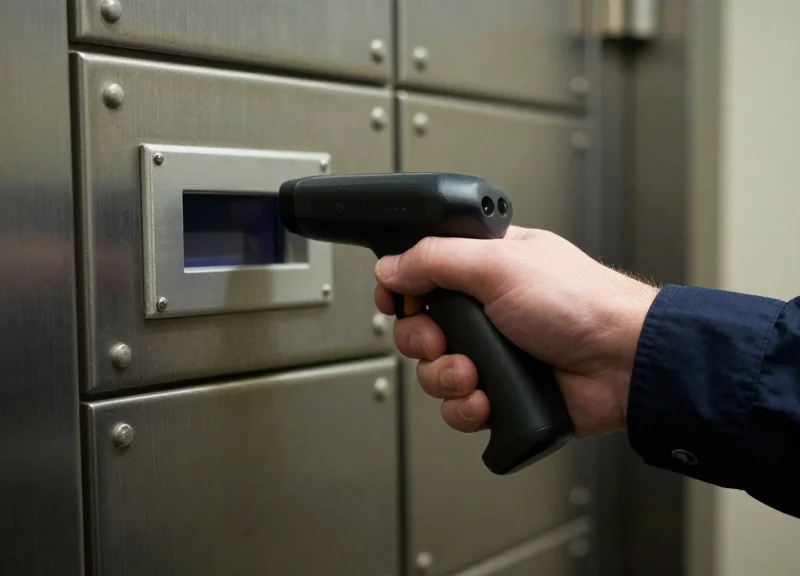
RFID is essential for cash box security because it enables automated, non-line-of-sight tracking of assets, creating a continuous and tamper-evident chain of custody from the bank vault to the armored vehicle and the final destination. Unlike traditional methods, RFID systems allow for the simultaneous identification of multiple cash containers in seconds, ensuring that every asset is accounted for during critical transition points without human intervention.
In my 20 years of observing security tech evolution in Silicon Valley, the most significant shift provided by RFID isn't just speed—it's the 'Invisible Audit.' By embedding RFID tags into cash boxes and integrating them with IoT sensors, banks move from reactive security (finding out something is missing later) to proactive security (getting an alert the moment a box deviates from its planned path). This granular visibility directly translates to lower insurance premiums and higher operational trust.
| Feature | Legacy Manual/Barcode Tracking | Modern RFID Systems |
|---|---|---|
| Processing Speed | Slow; one-by-one scanning | Near-instant; bulk scanning |
| Line of Sight | Mandatory (physical access required) | Not required (scan through bags/crates) |
| Audit Integrity | Subject to human error/falsification | Automated and immutable digital logs |
| Security Level | Reactive; logs checked after the fact | Proactive; real-time alerts for unauthorized movement |
Does RFID work inside armored vehicles with heavy metal shielding?
Yes, by utilizing specialized UHF (Ultra-High Frequency) tags designed for metallic environments and strategically placing antennas within the vehicle cargo area, banks can maintain a 100% read rate even in signal-challenging environments.
How does RFID prevent 'Ghost Shipments'?
RFID ensures that every box recorded in the system is physically present during loading. If a box is logged but not detected by the vehicle's gateway reader, the system triggers an immediate alert, preventing the departure of incomplete shipments.
Can RFID tags be easily cloned or tampered with?
Modern banking RFID tags use advanced encryption and 'locking' mechanisms. If a tag is physically tampered with, the antenna loop breaks, rendering the tag unreadable and immediately flagging the asset as compromised during the next automated checkpoint scan.
Ultimately, the transition to RFID for cash-in-transit is about institutionalizing transparency. By removing the 'human element' from the verification process, financial institutions effectively close the gap between physical reality and digital records, ensuring that every dollar is tracked with surgical precision.
Streamlining Collateral Management with Precision Tracking
Streamlining collateral management with RFID involves embedding high-frequency (HF) or ultra-high-frequency (UHF) tags onto physical assets—such as property deeds, vehicle titles, and high-value jewelry—to enable instantaneous, non-line-of-sight tracking. Unlike traditional barcodes, RFID allows bank personnel to perform full vault audits in minutes rather than days, maintaining a digital chain of custody that reduces operational risk and ensures regulatory compliance with zero manual entry errors.
In the high-stakes environment of commercial banking, the misplacement of a single original property deed can lead to months of legal delays and significant financial exposure. Modern RFID systems move beyond simple identification; they create a 'Smart Vault' environment where every movement of a collateral folder or asset is logged automatically. This level of precision is particularly critical for high-churn collateral, such as jewelry in pawn-backing or vehicle titles in floor-plan financing, where items move in and out of secure storage frequently.
| Collateral Type | RFID Tag Recommendation | Key Benefit |
|---|---|---|
| Legal Documents/Deeds | UHF Paper-Thin Inlays | Bulk reading of hundreds of stacked files in seconds. |
| High-Value Jewelry | Tamper-Evident HF Tags | Secure authentication and close-range precision. |
| Vehicle Titles | Encrypted NFC Tags | Tap-to-verify security using mobile devices. |
| Bullion/Hard Assets | On-Metal Rugged Tags | Consistent signal performance near conductive materials. |
Expert Insight: The 'Flag-Tag' Strategy. When tracking thousands of paper documents stored in dense rows, standard flat RFID stickers can suffer from signal interference due to tight stacking. We recommend using 'Flag Tags'—RFID labels that fold to create a small physical gap between the antenna and the document. This simple hardware adjustment can increase your audit read-rates from 85% to 99.9%, effectively eliminating 'ghost assets' in your digital ledger.
- Asset Tagging & Enrollment: Apply specialized RFID tags to collateral at the point of intake and link the unique EPC (Electronic Product Code) to the bank's Loan Management System (LMS).
- Zonal Monitoring: Install fixed RFID overhead readers at vault entrances to automatically detect when collateral enters or exits a restricted area.
- Rapid Inventory Audits: Use handheld RFID sleds to scan entire shelving units; the system compares the scanned data against the expected ledger in real-time.
- Exception Alerting: Trigger automated alerts if a high-value document is moved without an authorized work order or if it remains outside the vault past a set threshold.
Can RFID tags be read through thick vault doors?
No, RFID signals cannot penetrate heavy steel vault doors. However, readers are typically placed inside the vault or at the entryway to capture data as items pass through the threshold.
Will RFID tags damage sensitive historical documents?
Modern archival-grade RFID adhesives are acid-free and non-reactive, designed specifically to ensure that the integrity of legal documents is maintained over decades of storage.
How does RFID handle jewelry and metal assets?
For metal-heavy assets, we use 'on-metal' tags that feature a spacer or specialized antenna design to prevent the metal from detuning the radio signal, ensuring reliable tracking.
Technical Requirements: Selecting the Right Tags and Readers
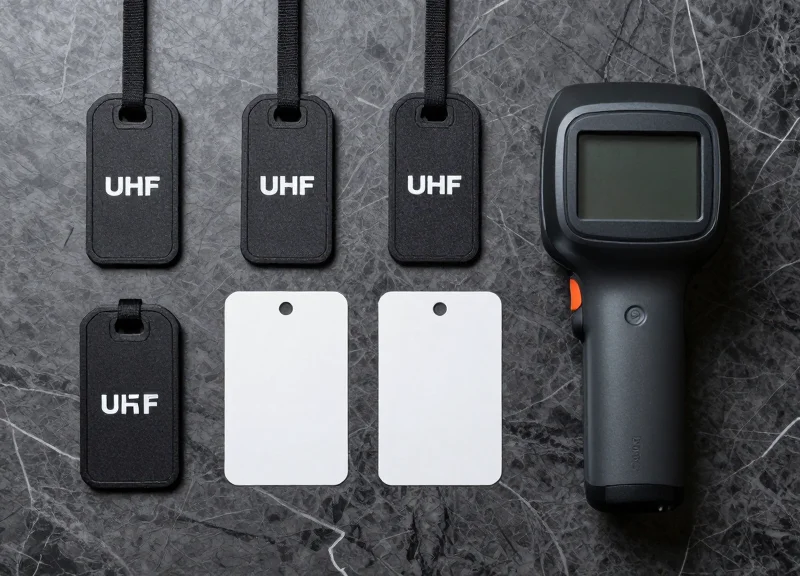
Selecting the optimal RFID hardware for banking operations is a strategic decision that hinges on two physical variables: the material composition of the asset and the required read distance. For cash box tracking, where assets are often made of steel or aluminum, Ultra-High Frequency (UHF) Passive RFID is the industry standard due to its ability to be read from several meters away during transit. Conversely, for collateral management involving sensitive paper documents, High-Frequency (HF) tags are often preferred for their short-range precision and lower susceptibility to signal interference in high-density storage environments.
| Feature | HF RFID (13.56 MHz) | UHF RFID (860-960 MHz) |
|---|---|---|
| Read Range | Up to 1 meter | Up to 12+ meters |
| Data Transfer Speed | Moderate | High |
| Metal Interference | Low (with shielding) | High (requires specialized tags) |
| Best Use Case | Individual Folder/Deed Tracking | Cash-in-Transit (CIT) & Pallets |
| Standard | ISO 14443 / ISO 15693 | EPC Gen2 / ISO 18000-6C |
The 'Metal Challenge' is the most significant technical hurdle in banking logistics. Standard RFID tags fail when applied directly to metal cash boxes because the metal reflects the RF energy, creating an electromagnetic 'dead zone.' To solve this, banks must utilize 'On-Metal' tags, which incorporate a physical spacer or a specialized antenna design to utilize the metal surface as a reflector rather than a shield, ensuring consistent readability even when boxes are stacked inside an armored vehicle.
- Assess the Environment: Identify if the tags will be used in vault environments with thick concrete walls or high-frequency interference from other electronic security systems.
- Select Tag Form Factor: For collateral files, use thin adhesive inlays; for cash boxes, use ruggedized hard tags with IP68 ratings to withstand transit wear and tear.
- Define Reader Infrastructure: Deploy fixed portal readers at vault entrances for automated 'in/out' logging and handheld mobile readers for periodic inventory audits.
- Test for Polarized Antennas: In document vaults, use Circularly Polarized Antennas to ensure tags are read regardless of their orientation in a folder.
Expert Tip: For high-security banking environments, always specify readers that support 'Dense Reader Mode.' This technical setting prevents multiple RFID readers in a small area from interfering with each other's signals, which is a common point of failure during massive end-of-quarter audits in collateral warehouses.
Do I need active or passive RFID for cash boxes?
Passive UHF is generally sufficient and more cost-effective. Active RFID (battery-powered) is only necessary if you require real-time location tracking across miles of open space without gateway infrastructure.
Can RFID tags be hidden inside collateral documents?
Yes, ultra-thin dry inlays can be embedded within the lining of folders or envelopes, making them virtually invisible and tamper-resistant.
How do I prevent 'leakage' where tags outside the room are read?
This is managed by adjusting the reader's power output (RSSI filtering) and using shielded antennas that focus the RF energy strictly within the doorway or portal.
Security Protocols and Data Encryption in Banking RFID
Security in banking RFID applications is defined by the 'Defense in Depth' model, where data protection occurs at the tag level, the air interface, and the network layer. For cash box tracking and collateral management, the primary security objective is to prevent 'skimming' (unauthorized reading) and 'cloning' (creating a replica tag). Modern banking systems achieve this by implementing AES-128 or AES-256 cryptographic standards, ensuring that even if a signal is intercepted, the payload remains computationally infeasible to decrypt without the master keys held in a Secure Access Module (SAM).
| Security Layer | Protocol/Standard | Banking Application |
|---|---|---|
| Air Interface | ISO/IEC 18000-63 (Gen2v2) | Mutual authentication between tag and reader to prevent rogue devices. |
| Data Encryption | AES-128 Cryptography | Protects sensitive asset metadata stored on the tag chip memory. |
| Identity Integrity | Dynamic Authentication | Uses non-repeating 'rolling' codes to prevent replay attacks during transit. |
| Physical Security | Digital Tamper Evidence | Automatically flags a 'void' status in the database if the tag antenna is cut. |
Expert Insight: Moving Beyond Static UIDs. A common mistake in banking deployments is relying solely on the tag's factory-set Unique Identifier (UID). Professional-grade banking RFID utilizes 'Physical Unclonable Functions' (PUF) or UCODE DNA technology. These systems generate a unique cryptographic 'fingerprint' for every individual read cycle. Even if a bad actor records a successful scan of a cash box, that captured data becomes instantly invalid for any subsequent authentication attempt, rendering replay attacks impossible.
Can RFID tags used in banking be cloned by hackers?
While low-frequency legacy tags were susceptible, modern banking tags using UHF Gen2v2 with cryptographic handshakes are virtually impossible to clone because the secret keys never leave the secure memory of the chip.
What is the role of a SAM (Secure Access Module) in banking RFID?
A SAM is a hardware-based security chip placed inside the RFID reader that stores the master encryption keys. This ensures that even if a reader is physically stolen, the keys cannot be extracted easily.
Does RFID pose a privacy risk for sensitive collateral?
No, because banking RFID systems typically store a 'pointer' or an encrypted token on the tag rather than PII (Personally Identifiable Information). The actual collateral details reside behind the bank's primary firewall.
Integrating RFID with Core Banking Systems (CBS)

Integrating RFID with Core Banking Systems (CBS) involves bridging the physical world of cash boxes and collateral documents with the digital world of financial ledgers. This connection is typically achieved through an intermediate middleware layer that translates raw RFID tag 'reads' into actionable financial events, ensuring that the bank's central records accurately reflect the location, status, and chain of custody for every tracked asset without manual entry.
- Data Mapping and Schema Alignment: Identify which RFID data points (e.g., Tag ID, timestamp, reader location) correspond to specific CBS fields such as GL accounts, asset IDs, or teller IDs.
- Middleware Deployment: Implement a dedicated RFID middleware to filter out redundant 'noise' (multiple reads of the same tag) before sending a single clean transaction to the CBS.
- Secure API Handshaking: Utilize RESTful APIs or SOAP web services with mutual TLS encryption to facilitate secure communication between the RFID controller and the bank's internal network.
- Event-Driven Synchronization: Configure the system to trigger CBS updates based on physical milestones, such as a cash box exiting a vault or a collateral document entering a secure archive.
| Integration Method | Best For | Complexity | Key Benefit |
|---|---|---|---|
| Middleware Orchestration | Enterprise-scale banks with high volume | High | Prevents CBS overload by filtering data |
| Direct API Integration | Smaller institutions or specific silos | Moderate | Lower initial cost and faster deployment |
| Batch File Processing | Non-critical collateral reporting | Low | Easy to implement with legacy systems |
Expert Insight: The 'State-Change' Buffer Strategy. In my 20 years of silicon valley integration experience, the biggest mistake banks make is trying to push every single RFID 'ping' into their Core Banking System. This creates massive data bloat and latency. The gold standard is a 'State-Change' architecture: your middleware should maintain a shadow record of the asset and only push a message to the CBS when a definitive status change occurs (e.g., from 'In Transit' to 'Received'). This protects the performance of your core financial engine while maintaining 100% audit integrity.
Will RFID integration require changes to our core banking source code?
Generally, no. Modern integrations use standard APIs or database connectors that allow the CBS to receive data without modifying its underlying logic.
How does the system handle network outages?
Robust RFID systems employ 'Store-and-Forward' logic, where the hardware caches data locally and synchronizes it with the CBS once the connection is restored.
Is real-time integration necessary for all assets?
No. While cash-in-transit (CIT) requires real-time updates for security, collateral document tracking can often be handled via periodic batch updates to save on processing resources.
Regulatory Compliance and the Audit Trail Advantage
RFID systems in banking transform regulatory compliance from a manual, error-prone burden into a seamless, automated process by generating a real-time, immutable audit trail for every asset interaction. By capturing the movement of cash boxes and collateral without human intervention, financial institutions ensure 'Chain of Custody' integrity that satisfies the rigorous transparency requirements of global frameworks like Basel III and the Sarbanes-Oxley Act (SOX). This automation eliminates the 'human variable,' providing auditors with timestamped, verified data that proves exactly who accessed an asset, where it moved, and when it happened.
| Regulatory Framework | Compliance Requirement | RFID Strategic Solution |
|---|---|---|
| Basel III | Operational risk management and capital adequacy reporting. | Automated asset tracking reduces 'lost' assets and operational loss events. |
| SOX (Section 404) | Internal controls over financial reporting and physical asset security. | Real-time digital logs provide verifiable proof of asset existence and location. |
| AML / KYC | Stringent oversight of cash movements and physical wealth storage. | Automated 'Gatekeeper' logs for every cash-in-transit (CIT) handoff. |
| Local Central Bank Mandates | Mandatory daily reconciliation of physical cash and bullion. | Instantaneous bulk-inventory scanning replaces manual serial number counting. |
Expert Insight: The 'Zero-Touch Audit' Advantage. Traditionally, audits are a snapshot in time—a sample of records. With RFID, banks move toward 'Continuous Compliance.' Because the system logs data 24/7 without manual input, the bank is technically 'audit-ready' at any moment. This shifts the auditor's role from forensic data collection to simple data verification, often reducing audit cycles from weeks to hours and significantly lowering the risk of regulatory fines.
- Automated Event Logging: Every time a collateral document or cash box passes an RFID gate, an entry is automatically created in the database, removing manual logbook discrepancies.
- Cryptographic Timestamping: Entries are secured using bank-grade encryption and synchronized with network time servers to prevent backdating or tampering of logs.
- Exception Reporting: The system alerts compliance officers instantly if an asset moves outside of approved operational hours or unauthorized zones, creating a record of the breach.
- One-Click Regulatory Export: Generate standardized compliance reports for regulators directly from the RFID management software, ensuring format consistency and data accuracy.
Does RFID data hold up in a legal court or regulatory inquiry?
Yes. When implemented with secure, non-rewritable databases (WORM storage) and integrated with the Core Banking System (CBS), RFID logs are considered high-integrity evidence for chain of custody.
How does RFID reduce the 'Three Lines of Defense' risk?
It strengthens the 'First Line' (operational control) and 'Third Line' (internal audit) by providing objective, machine-generated data that minimizes subjective reporting errors.
Can RFID help with ESG (Environmental, Social, and Governance) compliance?
Absolutely. By optimizing the transit routes of cash and assets through better visibility, banks can report more accurately on operational efficiency and reduced carbon footprints.
Evaluating ROI: Calculating the Long-term Savings

Return on Investment (ROI) for RFID systems in banking is measured by the total cost of ownership (TCO) relative to the direct reduction in labor costs, the elimination of inventory shrinkage, and the mitigation of regulatory non-compliance risks. While the initial capital expenditure for readers and tags may be significant, most financial institutions achieve a break-even point within 12 to 18 months by automating the tracking of cash boxes and high-value collateral. This transition replaces labor-intensive manual logging with instantaneous, error-free digital capture, creating a scalable infrastructure that grows more cost-effective as asset volume increases.
| Cost Driver | Manual/Barcode Process | RFID-Enabled Process | Estimated Savings |
|---|---|---|---|
| Audit Time | 4-6 hours per vault branch | 15-30 minutes per vault branch | 90-95% Reduction |
| Data Entry Errors | 3-5% industry average | Near 0% (Automated) | 100% Error Mitigation |
| Asset Shrinkage | High risk of misplaced collateral | Real-time location/status alerts | 60-80% Loss Reduction |
| Regulatory Fines | High risk during manual audits | Automated, verifiable audit trails | Varies (Significant) |
### The Silicon Valley Perspective: The Hidden Audit Premium. Beyond simple labor hours, the most overlooked ROI factor is the 'Hidden Audit Premium.' In traditional banking, a single missed collateral document or miscounted cash box can trigger a full-scale internal audit or regulatory scrutiny, costing tens of thousands in consultant fees and executive time. RFID doesn't just save time; it provides a 'continuous audit' state. This high-fidelity data allows banks to negotiate lower professional liability insurance premiums and significantly reduces the probability of regulatory fines, which are often 10x the cost of the RFID hardware itself.
- Establish the Baseline: Quantify the current man-hours spent on manual inventory, reconciliation, and searching for misplaced assets across all branches.
- Account for Hardware & Integration: Include the cost of fixed readers, handhelds, RFID tags (passive or active), and the software integration middleware.
- Factor in Risk Mitigation: Assign a dollar value to the reduction in lost collateral and the avoidance of regulatory non-compliance penalties.
- Analyze Long-term Operational Scaling: Calculate the marginal cost of adding new assets to the system, which is typically just the cost of a single tag once infrastructure is in place.
How long does it take to see a return on investment?
Most mid-sized to large banks see a positive ROI within 12 to 24 months, depending on the volume of collateral and the frequency of audits.
What is the biggest cost-saver in RFID implementation?
The reduction in 'Search Time.' Banking staff often spend hundreds of hours annually locating specific collateral folders or cash boxes; RFID reduces this search time to seconds.
Does RFID reduce the need for security personnel?
No, it empowers security personnel. Instead of manual counting, security teams can focus on higher-level threat detection and rapid response to unauthorized asset movements.
Common Implementation Pitfalls and How to Avoid Them
Successful RFID implementation in banking hinges on recognizing that the technology is an enhancement to—not a replacement for—sound operational logic. Most failures occur when institutions treat RFID as a 'plug-and-play' solution without accounting for the specific physical and digital constraints of a financial environment. To ensure a seamless rollout for cash box tracking and collateral management, banks must prioritize environmental mapping, staff buy-in, and incremental scaling over aggressive, site-wide deployments.
| Common Pitfall | Operational Impact | Strategic Mitigation |
|---|---|---|
| The 'Metal Shielding' Oversight | Signal blockage in vaults and reinforced transport vehicles. | Perform a comprehensive RF site survey and utilize specialized on-metal tags. |
| Data Flooding | Legacy systems overwhelmed by thousands of tag pings. | Implement 'Edge Computing' to filter redundant data before it hits the CBS. |
| Inadequate Training | Staff circumventing the system for 'faster' manual entries. | Incorporate RFID workflows into standard operating procedures (SOPs). |
| Poor Tag Attachment | Tags detaching from high-use collateral files or rugged cash boxes. | Select adhesives and form factors based on the surface material and lifecycle of the asset. |
- Environmental Interference: Many banks overlook that vault doors and high-density metal shelving create multipath interference. Solution: Use specialized antennas with circular polarization to capture signals bouncing off metallic surfaces.
- Ignoring the 'Human-in-the-Loop': RFID is highly accurate but not infallible. Pitfall: Eliminating manual audits entirely too soon. Solution: Maintain a 'trust but verify' period where RFID and manual checks run in parallel.
- Scaling Too Fast: Attempting a bank-wide rollout without a localized pilot leads to systemic errors. Solution: Conduct a 90-day pilot at a single high-volume branch to identify friction points.
Expert Insight: Beware of 'Signal Shadowing' in High-Value Collateral Storage. One unique challenge I have seen in large-scale banking deployments is the 'Signal Shadow.' This occurs when items are stacked so tightly that the inner tags are completely shielded by outer ones. To mitigate this, banks should adopt a 'Z-pattern' tag placement strategy, ensuring that no two tags are perfectly aligned in a stack, which allows the RF energy to penetrate deeper into the storage units.
Why does my RFID system miss tags in the vault?
This is likely due to the Faraday cage effect created by vault construction. You may need to install localized reader nodes or use high-gain antennas positioned at varying angles to eliminate dead zones.
How do we prevent tag damage on frequently handled cash boxes?
Standard labels will fail. You must use encapsulated 'hard tags' or RFID-integrated handles that are physically bolted or fused to the box to withstand heavy mechanical impact.
What is the most common software mistake during integration?
The most common mistake is failing to handle 'stale data.' Software must be programmed to recognize when a tag hasn't been seen for a specific duration and trigger an alert rather than simply assuming the last known location is still valid.
The DragonGuard Advantage in Banking Security

The DragonGuard advantage in banking security lies in our specialized 'Industrial-Grade Signal Integrity,' which overcomes the physical interference common in vaults and transit vehicles. Unlike generic RFID vendors, DragonGuard designs hardware specifically for high-density metal environments, ensuring that every cash box, gold bullion crate, and collateral asset is accounted for with 99.99% read accuracy, even when stacked deep within a reinforced steel vault.
Banking environments present a unique 'Faraday Cage' challenge where standard RFID signals are absorbed or reflected by metal surfaces. DragonGuard’s proprietary anti-metal tag technology doesn't just resist this interference; it utilizes the metal surface of the asset to actually extend the antenna’s reach, a technique known as 'Conductive Coupling.' This ensures that tracking remains seamless from the teller's desk to the armored transport vehicle.
| Feature | Generic RFID Systems | DragonGuard Banking Solutions |
|---|---|---|
| Metal Interference | High signal drop-off | Optimized via Conductive Coupling |
| Durability | Plastic housing (prone to cracking) | IP68-rated, impact-resistant enclosures |
| Data Security | Standard UID broadcasting | AES-128 bit cryptographic handshaking |
| Read Range | Inconsistent in vaults | Adjustable high-gain for deep-vault penetration |
Expert Insight: Most banking failures in RFID implementation occur not at the software level, but at the physical tag level due to 'mechanical fatigue' from frequent handling of heavy cash boxes. DragonGuard tags are tested for over 100,000 impact cycles, ensuring the internal chip remains bonded to the antenna even under extreme physical stress—a critical requirement for long-term ROI in high-velocity cash logistics.
Can DragonGuard tags be used for tracking individual collateral documents?
Yes, our ultra-thin 'Paper-Safe' tags are designed for sensitive document tracking, providing long-range readability without adding bulk to legal files or collateral folders.
Does the system support multi-custodian authentication?
Absolutely. Our hardware integrates with your existing access control to require dual-factor RFID scans (e.g., Tag + Staff Badge) before an asset is flagged as 'Authorized for Move' in the CBS.
How does DragonGuard handle data privacy during transit?
We utilize 'Shielded Tracking' where tags remain silent until they receive a proprietary encrypted wake-up signal from an authorized DragonGuard reader, preventing unauthorized 'skimming' in public spaces.