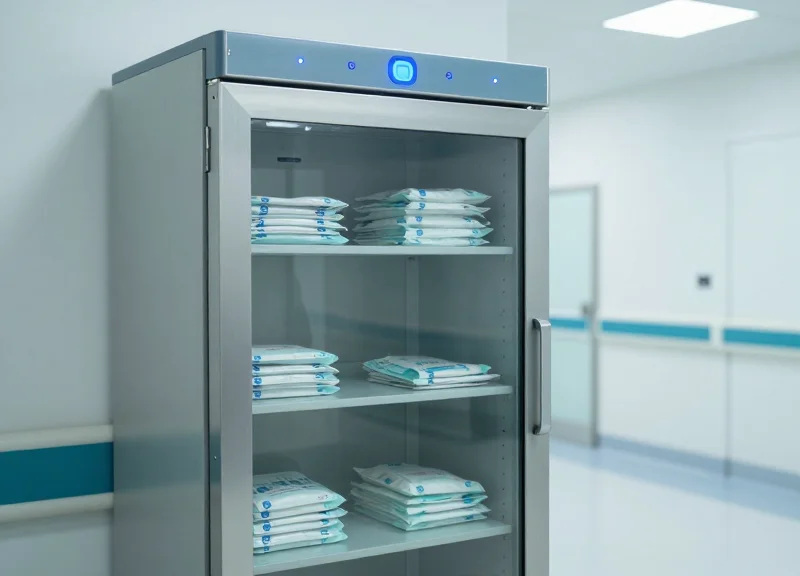
In the high-stakes world of clinical operations, managing high-value consumables like stents, implants, and specialty surgical kits is a logistical nightmare. Traditional manual tracking often leads to a staggering 35% shrinkage due to loss, expiration, and administrative errors. As healthcare budgets tighten, optimizing clinical ROI is no longer optional—it is a necessity. Smart RFID cabinets represent a paradigm shift, offering a secure, automated shield for your most expensive assets while streamlining the supply chain from delivery to patient use.
The Financial Impact of Shrinkage in Modern Healthcare

In a modern clinical setting, 'shrinkage' refers to the discrepancy between the medical supplies a hospital purchases and the quantity actually utilized in patient care and billed accordingly. This includes loss due to theft, administrative errors, and critically, the expiration of high-value consumables. For high-acuity departments like Interventional Radiology or Cardiology, shrinkage often accounts for 5% to 15% of total inventory value, directly eroding the razor-thin operating margins that define 21st-century healthcare systems.
| Cost Category | Economic Impact | Clinical Consequence |
|---|---|---|
| Direct Procurement Loss | Replacement cost of missing high-value stents, grafts, and implants. | Delayed procedures due to unexpected stockouts. |
| Expired Inventory | 100% loss of capital invested in un-used, time-sensitive consumables. | Risk of accidental use of sub-standard materials. |
| Charge Capture Gap | Unbilled revenue for items used but not documented in the EMR. | Inaccurate patient records and skewed analytics. |
| Labor Overhead | Nurses spending 20% of their shift on manual inventory counts. | Increased clinician burnout and reduced bedside time. |
The 'Invisible Tax' Insight: Most administrators view shrinkage as a line-item loss, but the true impact is exponential. In a facility with a 4% operating margin, every $10,000 lost to expired or missing catheters requires $250,000 in new patient revenue just to break even on that loss. This is the '7% Margin Trap'—where a seemingly small inventory leak effectively consumes half of a department's net profit potential.
Why is shrinkage higher in healthcare than in retail?
Unlike retail, healthcare inventory management is often secondary to urgent patient needs. In high-pressure environments, clinicians prioritize immediate care over manual barcode scanning, leading to 'documentation drift' where high-value items are used but never logged.
What are high-value consumables?
These are items costing between $500 and $10,000+ per unit, such as orthopedic implants, pacemakers, and specialty balloons, which represent the largest opportunity for ROI improvement through RFID tracking.
How does shrinkage affect clinical outcomes?
Beyond finances, shrinkage creates 'phantom inventory.' If a system shows an item in stock that isn't physically there, it can lead to dangerous mid-procedure shortages or the use of less-optimal substitutes.
Why Traditional Inventory Methods Fail High-Value Consumables

Traditional inventory methods fail high-value consumables because they rely on manual intervention in high-pressure clinical environments where patient care rightfully takes precedence over data entry. Systems like paper logbooks and barcode scanning create a 'documentation lag'—a period where items are removed but not recorded—resulting in inaccurate stock levels, expired products remaining on shelves, and a lack of real-time visibility into the actual cost per procedure. For items like stents, pacemakers, and orthopedic implants, these visibility gaps are the primary driver of the 35% shrinkage rate seen in modern healthcare facilities.
| Feature | Manual Logbooks | Barcode Scanning | The Resulting Failure |
|---|---|---|---|
| Data Integrity | Highly Subjective/Incomplete | Prone to 'Batch Scanning' errors | Inaccurate ROI reporting |
| Time Requirement | High (Manual Entry) | Moderate (One-by-one scans) | Clinical burnout and workflow delays |
| Visibility | Static/Historical | Point-in-time only | Stockouts of life-saving items |
| Expiry Tracking | Visual Inspection Required | Database dependent | High waste from overlooked dates |
The fundamental flaw in traditional methods is the requirement for 'Line of Sight' and 'Active Participation.' In a surgical or cath-lab setting, a nurse may use five high-value items in minutes. Expecting them to stop and find a scanner or a pen creates a friction point that leads to the 'I'll do it later' syndrome, which is where 80% of data loss occurs.
Why is barcode scanning insufficient for high-value items?
Barcode scanning requires a one-to-one interaction. In emergency scenarios, staff cannot scan every individual item. Furthermore, barcodes don't 'broadcast' their location, meaning if an item is moved to the wrong cabinet, it is effectively lost until a manual audit is performed.
How do manual systems contribute to 'Shadow Inventory'?
When staff don't trust the inventory system to reflect reality, they begin 'hoarding'—hiding high-value items in unmonitored drawers to ensure they have what they need for surgery. This creates a hidden layer of inventory that inflates costs and leads to unnecessary over-ordering.
What is the 'Documentation Gap' in clinical settings?
It is the time delay between an item being pulled from a shelf and it being charged to a patient. Traditional methods often have a gap of 24-48 hours, making it impossible for supply chain managers to respond to rapid stock depletion.
Expert Insight: The Velocity of Care vs. The Velocity of Compliance. After 20 years in the industry, I have observed that traditional systems fail not because of staff negligence, but because of a structural mismatch. Clinical staff prioritize 'The Velocity of Care'—getting the patient stable. Traditional inventory systems require 'The Velocity of Compliance'—stopping to record data. When these two collide, compliance always loses. Smart RFID cabinets solve this by making compliance passive; the act of taking the item is the act of recording it, eliminating the friction that causes shrinkage.
The Science Behind Smart RFID Cabinets: Real-Time Visibility
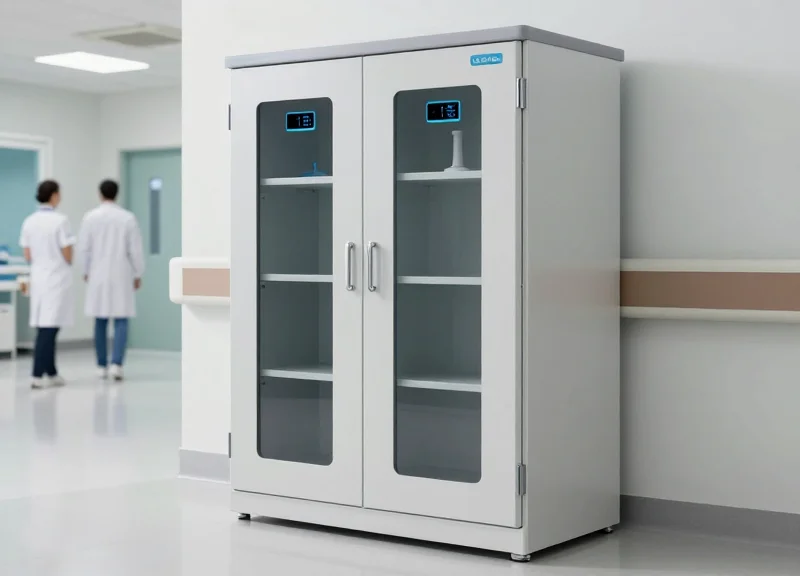
Smart RFID cabinets are automated IoT (Internet of Things) storage solutions that use Ultra-High Frequency (UHF) radio waves to identify, track, and manage medical consumables in real-time. Unlike manual systems, these cabinets create a 'closed-loop' environment where sensors continuously poll for the presence of RFID-tagged items, transmitting data to a cloud-based management platform. This architecture provides clinical teams with 24/7 visibility, ensuring that every suture, stent, or implant is accounted for from the moment it is stocked until the moment it is used in a procedure.
The technical foundation of these systems rests on three critical layers: the physical tag (containing a microchip and antenna), the cabinet-integrated reader/antenna array, and the cloud-native middleware. When the cabinet door closes, the system initiates a 'cycle count.' The reader sends out a radio signal that powers the passive RFID tags on the items. Each tag responds with its unique Electronic Product Code (EPC), allowing the software to reconcile the physical stock against the digital inventory record in seconds.
| Feature | Legacy Barcode Systems | Smart RFID Cabinets |
|---|---|---|
| Scanning Method | Manual, Line-of-sight required | Automated, No line-of-sight needed |
| Data Capture Speed | 1 item per 3-5 seconds | Up to 500 items per second |
| Human Error Risk | High (Missed scans, double entries) | Negligible (System-automated tracking) |
| Visibility Frequency | Periodic/Batch updates | Continuous/Real-time updates |
A unique insight often overlooked by procurement teams is the role of 'Spatial Multiplexing' in high-end RFID cabinets. In a standard clinical environment, RF interference from metal surfaces or liquids can create 'dead zones.' Professional-grade cabinets utilize strategically positioned multi-antenna arrays and signal-hopping algorithms to ensure 99.9% read accuracy, effectively eliminating the 'Shadow Inventory'—those high-value items that are physically present but invisible to the digital system.
Does RFID interfere with sensitive medical equipment?
No. Modern smart cabinets operate within the FCC-approved UHF bands (typically 860-960 MHz) and are designed with shielded enclosures to ensure zero electromagnetic interference with nearby life-support or diagnostic machinery.
How does the system handle expiration dates?
Each RFID tag is linked to the item's Lot Number and Expiration Date in the cloud database. The science of 'Real-Time Visibility' allows the system to trigger alerts for items nearing expiration, enabling 'First-Expired, First-Out' (FEFO) logistics.
What happens if the hospital Wi-Fi goes down?
Top-tier RFID cabinets utilize edge computing. They store transaction data locally on a secure internal buffer and synchronize with the cloud immediately once connectivity is restored, preventing any loss of usage data.
How Automation Reduces Clinical Shrinkage by Up to 35%

Automation reduces clinical shrinkage by creating an immutable digital audit trail for every high-value consumable, effectively eliminating the three primary causes of loss: administrative manual-entry errors, expiration of 'hidden' stock, and unauthorized item removal. By shifting the responsibility of tracking from busy clinical staff to autonomous RFID sensors, hospitals can achieve a 35% reduction in shrinkage through 100% accurate real-time inventory reconciliation and proactive expiration management.
- Authenticated Access Control: Smart cabinets require badge or biometric authentication before unlocking. This creates an immediate 'Chain of Custody' where every interaction is timestamped and tied to a specific user, virtually eliminating casual theft or 'borrowing' without documentation.
- Automated Charge Capture: As items are removed, the RFID system automatically records the transaction and links it to the patient electronic health record (EHR). This closes the gap between usage and billing, preventing items from 'vanishing' into unrecorded procedures.
- Dynamic Expiration Monitoring: The system monitors the shelf-life of every individual item. Automated alerts notify staff of items nearing expiration, allowing them to be used before they become waste—a significant and often overlooked component of the 35% shrinkage figure.
- Elimination of 'Stockpiling' Behavior: When staff trust the inventory visibility, they stop 'squirrel-holing' high-value items in unauthorized locations to ensure they have them for emergencies. This behavior is a leading cause of phantom shrinkage and expiration waste.
| Feature | Manual/Barcode Process | Automated RFID Cabinet |
|---|---|---|
| Inventory Visibility | Periodic (Weekly/Monthly) | Real-Time (Second-by-Second) |
| Data Accuracy | 60-70% (Human Error Dependent) | 99.9% (Sensor Driven) |
| Accountability | Anonymized/General Access | User-Specific Audit Trails |
| Reorder Logic | Reactive/Guesswork | Proactive/Data-Driven |
Expert Insight: The Psychology of Invisible Accountability. In my 20 years of analyzing supply chain efficiencies, the most profound shift I've observed with RFID automation isn't just the tech—it's the behavioral change. Shrinkage often occurs not due to malice, but due to 'convenience-driven non-compliance.' When a cabinet 'watches' its own inventory, the psychological barrier to bypassing protocols is raised. We call this the 'Invisible Auditor' effect, which typically accounts for a 15-20% immediate drop in loss upon implementation, even before data-driven optimizations begin.
Can RFID cabinets prevent the removal of the wrong item?
Yes. Smart systems can be programmed with 'pick-to-light' technology or immediate audio/visual alerts if a clinician removes an item that doesn't match the scheduled procedure or is nearing expiration.
Does automation increase the time clinicians spend on logistics?
On the contrary. Because the cabinet handles the logging, clinicians spend zero time on manual documentation, allowing them to focus entirely on patient care while the system handles the 'shrinkage-proof' data entry in the background.
Integrating RFID Cabinets with Hospital Management Systems

Successful integration of RFID cabinets with Hospital Information Systems (HIS) and Enterprise Resource Planning (ERP) platforms creates a 'digital nervous system' for medical supplies. By synchronizing real-time cabinet data with patient records and procurement databases, hospitals can achieve 100% charge capture accuracy and automated replenishment. This connectivity ensures that the moment a high-value consumable—such as a cardiac stent or orthopedic implant—is removed from a shelf, it is instantly linked to the specific procedure and patient billing account, eliminating the multi-billion dollar 'lost revenue' problem caused by manual data entry errors.
- System Discovery and API Mapping: Technical teams identify the data exchange protocols (RESTful APIs, HL7, or FHIR) required to bridge the RFID cabinet software with the hospital's existing EMR or ERP suite.
- Bi-Directional Data Synchronization: Establishing a two-way flow where the cabinet receives patient schedules from the HIS, and the HIS receives consumption data from the cabinet in real-time.
- Automated Reordering Triggers: Configuring 'Par Level' thresholds within the ERP that automatically generate purchase orders when stock drops below a predefined limit, preventing clinical stockouts.
- Financial Audit Reconciliation: Matching physical inventory consumption against billed accounts to ensure every high-value item removed from the cabinet has a corresponding entry in the revenue cycle.
| Feature | HIS/EMR Integration | ERP/Supply Chain Integration |
|---|---|---|
| Primary Objective | Patient Safety & Billing | Operational Efficiency & Cost |
| Data Exchanged | Patient ID, Procedure Codes | SKU, Batch, Expiry, Par Levels |
| Clinical Value | Accurate Charge Capture | Elimination of Stockouts |
| ROI Driver | Reduced Denied Claims | Lower Inventory Holding Costs |
Expert Insight: To truly maximize ROI, hospitals should move beyond 'Batch Processing' and adopt 'Event-Driven Architecture.' In this model, the RFID cabinet doesn't wait until the end of the shift to sync; it emits a real-time signal the moment a door closes. This enables 'Closed-Loop Supply Management,' where the vendor-managed inventory (VMI) systems can see real-time consumption, allowing for leaner inventory levels without compromising clinical readiness.
Does integration require a complete IT overhaul?
No. Modern RFID cabinets utilize 'Middleware' layers that translate RFID tag data into standard HL7 or FHIR messages, making them compatible with legacy systems like Epic, Cerner, or SAP without custom coding.
How does integration handle emergency override scenarios?
Systems are designed with 'Offline-First' capabilities; if the hospital network goes down, the cabinet continues to track access locally and synchronizes the data once the connection is restored.
What is the impact on clinical staff workflow?
Integration actually simplifies the workflow. Nurses no longer need to scan barcodes or fill out paper logs; the system automatically pairs the consumed item with the active patient case in the OR.
Enhancing Patient Safety Through Expiration and Recall Management
Patient safety is significantly compromised when manual inventory processes fail to identify expired or recalled high-value consumables, such as stents, implants, or specialized catheters. Smart RFID cabinets act as an automated safety firewall, providing real-time 'algorithmic surveillance' over every individual item's shelf life. By leveraging item-level serialization, these systems ensure that no compromised product ever reaches the sterile field, effectively reducing clinical liability and improving procedural outcomes.
| Feature | Manual Inventory Management | Smart RFID Cabinet System |
|---|---|---|
| Expiry Tracking | Periodic manual audits (prone to error) | Real-time, 24/7 automated monitoring |
| Recall Response | Hours to days to locate specific lots | Instantaneous 'Digital Quarantine' (seconds) |
| Stock Rotation | LIFO/Random (increases waste) | Strict FIFO (First-In-First-Out) enforcement |
| Alert System | Visual stickers or memory-based | Automated email/SMS and on-cabinet visual cues |
Unique Expert Insight: The 'Active Interdiction' Advantage. Unlike standard inventory software that merely reports an expired item, advanced Smart RFID cabinets utilize 'Active Interdiction.' This means the system can be configured to physically prevent the checkout of a flagged or expired item by disabling the electronic lock or requiring a supervisor override. This moves the hospital from a reactive 'discovery' posture to a proactive 'prevention' posture, creating a zero-tolerance environment for expired medical device usage.
- Automated Expiry Alerts: The system monitors dates and triggers multi-level notifications (30, 60, and 90 days out) to ensure older stock is utilized before newer arrivals.
- Rapid Recall Identification: Upon receiving a manufacturer recall, staff can search the UDI (Unique Device Identification) in the system to locate the exact cabinet and shelf where the affected units are stored.
- Instant Digital Quarantine: Affected items are marked as 'Non-Issue' in the software, preventing them from being billed or associated with a patient record until they are removed.
How does RFID improve compliance with Joint Commission standards?
RFID cabinets provide a comprehensive, timestamped audit trail of every item's lifecycle, from receipt to expiration or consumption, making compliance reporting for regulatory bodies instantaneous and accurate.
Can the system handle items with varying shelf lives from the same lot?
Yes. Because RFID tracks individual tags rather than just lot numbers, it can manage unique expiration dates assigned to specific units, even if they arrived in the same shipment.
Does this reduce the workload for nursing staff?
Significantly. Nurses no longer need to spend time manually checking dates before procedures; the cabinet does the work, allowing them to focus entirely on patient care.
Calculating Your ROI: The Direct Cost Savings of Smart Storage

Calculating the Return on Investment (ROI) for smart RFID cabinets involves measuring the net financial gain achieved by reducing high-value consumable shrinkage, automating inventory labor, and eliminating expired waste. For most clinical environments, the transition from manual tracking to automated RFID systems results in a 35% reduction in shrinkage and a 90% decrease in manual counting time, often leading to a full system payback within 12 to 18 months. By treating inventory as liquid capital rather than a sunk cost, healthcare facilities can significantly improve their bottom-line performance.
| Financial Metric | Manual/Barcode System | Smart RFID Cabinet | Annual Savings Potential |
|---|---|---|---|
| Shrinkage & Loss | 5% - 15% of inventory value | < 1% through real-time tracking | $50,000 - $150,000 |
| Clinical Labor (Inventory) | 15-20 hours/week per dept | < 2 hours/week (automated) | $35,000 - $45,000 |
| Expired/Wasted Stock | 4% - 8% annual write-offs | < 0.5% with proactive alerts | $25,000 - $60,000 |
| Charge Capture Accuracy | 85% - 92% (human error) | 99.9% (automatic billing) | $40,000 - $100,000 |
- Determine Baseline Shrinkage: Audit the last 12 months of high-value consumable purchases against patient billing records to identify the 'unaccounted' gap.
- Quantify Reclaimed Labor Hours: Calculate the hourly rate of nursing and supply chain staff currently spent on cycle counts, manual logging, and searching for missing items.
- Assess Charge Capture Leakage: Identify the percentage of consumables used in procedures that fail to appear on the final patient invoice due to lost paperwork or missed scans.
- Project Waste Reduction: Evaluate the cost of items discarded annually due to expiration and apply a 90% reduction factor based on automated first-in, first-out (FIFO) management.
A unique perspective often overlooked by hospital administrators is the 'Cost of Phantom Inventory.' In manual systems, departments over-order by 10-20% as a safety buffer because they don't trust their stock counts. RFID cabinets eliminate this 'just-in-case' hoarding, allowing facilities to reduce their standing inventory levels. This release of tied-up capital provides an immediate one-time cash flow injection that often covers a significant portion of the initial RFID hardware investment.
What is the typical payback period for an RFID cabinet?
Most hospitals see a full return on investment within 12 to 18 months, depending on the volume and unit cost of the consumables being tracked.
Does this calculation include software integration costs?
A comprehensive ROI model should include initial integration fees; however, the ongoing labor savings usually far outweigh these one-time technical costs.
How does automated tracking affect insurance reimbursements?
By ensuring 99.9% charge capture accuracy, facilities can maximize their reimbursement claims and reduce the likelihood of audit-related penalties.
Compliance and Accountability: Audit Trails in the Clinical Setting
Audit trails in a clinical setting are automated, timestamped digital records that provide a comprehensive 'chain of custody' for every high-value consumable, from the moment it enters the cabinet to its final point of care. By replacing unreliable manual logs with encrypted RFID tracking, hospitals can satisfy stringent regulatory requirements such as the FDA's Unique Device Identification (UDI) mandates and Joint Commission standards, while simultaneously building a transparent environment where every asset interaction is attributed to a specific authorized user.
| Feature | Manual Paper Logs | RFID-Enabled Audit Trails |
|---|---|---|
| Data Accuracy | Subject to human error/omission | 99.9% automated precision |
| Time Attribution | Estimated or back-filled | Real-time server synchronization |
| User Verification | Illegible signatures | Biometric or HID badge integration |
| Regulatory Readiness | Labor-intensive audit prep | Instant, one-click report generation |
A unique advantage of smart RFID audit trails is the mitigation of 'Charge Capture Leakage.' In many clinical environments, items are removed but never billed to the patient because the manual entry was forgotten during a high-stress procedure. The RFID cabinet acts as an invisible gatekeeper, automatically flagging any discrepancy between items removed and items scanned into the Electronic Health Record (EHR). This forensic level of detail doesn't just stop shrinkage; it identifies specific training gaps where staff may need assistance with inventory protocols.
- Identify the Actor: Secure access via hospital ID badges or biometrics ensures that every cabinet opening is linked to a specific staff member.
- Capture the Action: Internal sensors detect exactly which item (identified by its unique RFID tag) was removed or returned in real-time.
- Verify Against Schedule: Advanced systems cross-reference the removal with the surgical schedule to ensure the item is appropriate for the scheduled procedure.
- Archive for Compliance: Data is stored in a cloud-based, tamper-proof database that allows for historical analysis during annual audits or internal investigations.
How do audit trails help during a Joint Commission inspection?
They provide immediate proof of proper storage, expiration management, and authorized access control, moving the audit from a multi-day file search to a five-minute digital demonstration.
Do audit trails violate staff privacy?
No. They are designed for operational integrity and patient safety, focusing on the professional handling of hospital assets rather than personal monitoring.
Can these logs be used for recall management?
Absolutely. If a manufacturer issues a recall, the audit trail can pinpoint exactly which patient received a specific lot number and which staff member handled it.
Future-Proofing Your Facility: Scaling RFID Solutions with DragonGuardGroup
Future-proofing a clinical facility requires transitioning from isolated 'point solutions' to a unified, scalable RFID ecosystem that grows alongside your institution. Scaling with DragonGuardGroup involves deploying modular, cloud-native hardware that integrates seamlessly into existing hospital IT infrastructures, ensuring that as you expand from the OR to the Cath Lab or Pharmacy, your data remains centralized and your ROI compounds. The key is selecting a partner that offers interoperable standards (EPC Gen2) and a flexible API-first approach to avoid the 'vendor lock-in' that plagues legacy healthcare systems.
- Phase 1: The High-Impact Pilot: Identify the department with the highest shrinkage or highest-value consumables, typically the Operating Room or Interventional Radiology, to establish a baseline ROI within the first 90 days.
- Phase 2: Architectural Integration: Connect the DragonGuardGroup cloud platform with your HIS/ERP via standardized APIs to ensure real-time inventory synchronization across the entire facility.
- Phase 3: Multi-Departmental Rollout: Deploy specialized cabinets (e.g., chilled cabinets for biologics, high-density units for sutures) across different wards while managing them from a single administrative dashboard.
- Phase 4: Predictive Optimization: Utilize cross-departmental data to move from reactive reordering to predictive procurement, leveraging aggregate consumption patterns to negotiate better bulk pricing with vendors.
| Feature | Legacy RFID Systems | DragonGuardGroup Solutions |
|---|---|---|
| Scalability | Hard-wired, difficult to relocate | Modular, plug-and-play cloud architecture |
| Interoperability | Proprietary tags only | Open-standard EPC Gen2 global compatibility |
| Maintenance | Manual on-site software updates | Automatic OTA (Over-the-Air) firmware updates |
| Data Access | Siloed departmental reporting | Unified enterprise-wide analytics |
A unique insight gained from decades of Silicon Valley tech integration: the true value of scaling RFID lies in 'Data Gravity.' As more departments adopt DragonGuardGroup cabinets, the resulting dataset becomes your most valuable asset. You aren't just preventing 35% shrinkage; you are creating a digital twin of your supply chain that allows for 'just-in-time' inventory levels, potentially freeing up millions in tied-up capital that can be redirected to patient care.
Will our current network handle the increased traffic of a facility-wide rollout?
Yes. DragonGuardGroup uses edge computing to process tag reads locally within the cabinet, only sending compressed, encrypted data packets to the cloud, minimizing bandwidth impact.
How do we handle different cabinet sizes for different departments?
Our solution is modular. We offer everything from compact countertop units for specialized clinics to high-capacity double-door cabinets for trauma centers, all running on the same software core.
Is the system compliant with international medical standards?
Absolutely. Our hardware and data protocols comply with HIPAA, GDPR, and ISO standards for medical device safety and data privacy.