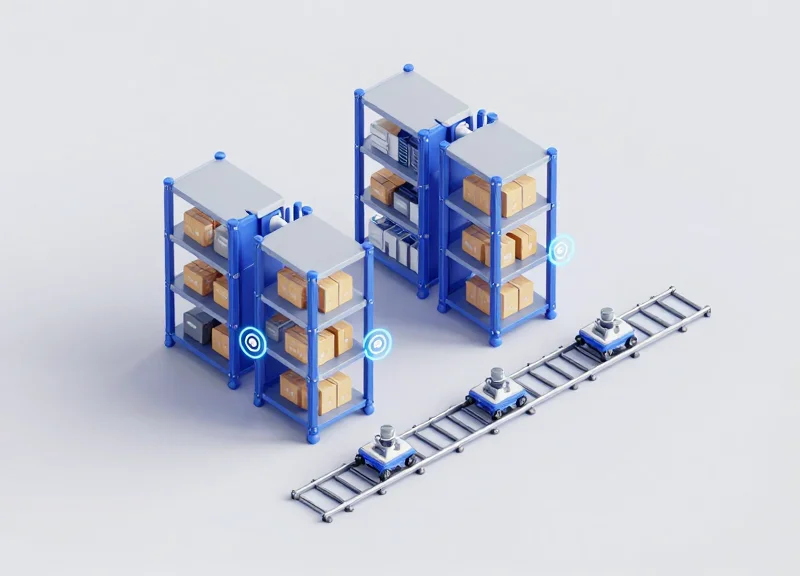
As global supply chains brace for the complexities of 2026, the reliance on traditional line-of-sight barcode systems is reaching a breaking point. Next-generation Automated Storage and Retrieval Systems (AS/RS) require more than just a scan; they demand instantaneous, high-density data capture. High-Frequency (HF) RFID technology is emerging as the superior alternative, offering the precision and speed necessary for hyper-automated environments. This article explores the seismic shift in logistics technology and why your facility's ROI depends on moving beyond the barcode in an era defined by speed and intelligence.
The Evolution of AS/RS: Transitioning to Hyper-Automation
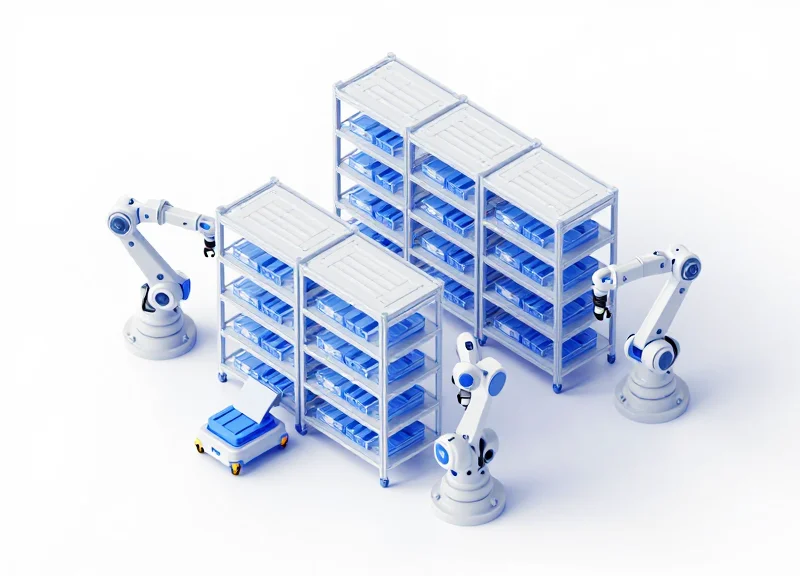
The evolution of Automated Storage and Retrieval Systems (AS/RS) represents a structural shift from basic mechanical retrieval to 'Hyper-Automation'—an integrated state where AI, high-frequency RFID, and autonomous robotics converge to enable sub-second inventory processing and zero-touch fulfillment. While legacy systems focused on saving floor space, 2026-era hyper-automation prioritizes 'cognitive throughput,' the ability of a system to make autonomous decisions at the edge without waiting for centralized server instructions.
| Feature | Legacy AS/RS (2010s) | Hyper-Automated AS/RS (2026) |
|---|---|---|
| Tracking Method | Line-of-sight Barcodes | High-Frequency RFID (HF-RFID) |
| Decision Logic | Fixed WMS Algorithms | Edge-AI & Machine Learning |
| Human Intervention | Required for Error Recovery | Autonomous Self-Correction |
| Throughput Metric | Pallets per Hour | Events per Millisecond |
- Phase 1: Mechanized Storage: Early systems focused on vertical carousels and basic stacker cranes to maximize cube utilization, relying entirely on manual data entry.
- Phase 2: Digital Integration: The introduction of Warehouse Management Systems (WMS) allowed for barcode-driven tracking, providing the first real-time glimpse into inventory levels.
- Phase 3: Hyper-Automation (2026+): The current transition involves 'swarm' robotics and HF-RFID sensors that allow the AS/RS to function as a giant, living computer, identifying thousands of items simultaneously.
Expert Insight: The 'Decision Latency' Paradox. In my 20 years in Silicon Valley, the biggest bottleneck I've observed isn't the speed of the robot, but the 'Decision Latency'—the time it takes to scan a barcode, send data to the cloud, and receive a command. Hyper-automation in 2026 solves this by moving the identity layer from the label (barcode) to the air (RFID waves). When the system knows where every item is at all times without a physical scan, decision latency drops to near zero, increasing effective throughput by up to 40% without increasing robotic hardware speed.
Why is 'Hyper-Automation' different from 'Automation'?
Automation refers to a single task being done by a machine. Hyper-automation is the orchestrated use of multiple technologies (AI, RFID, Robotics) to automate the entire decision-making process within the warehouse.
What role does 2026 play in this timeline?
2026 is the projected tipping point where the cost of high-frequency RFID tags falls below the threshold of traditional labeling labor costs, making the transition financially inevitable for Tier-1 logistics providers.
The 'Line-of-Sight' Bottleneck: Why Barcodes are Faltering
In the context of 2026 logistics, the 'Line-of-Sight' bottleneck refers to the inherent physical limitation of optical scanning technology, where a sensor must have an unobstructed, direct view of a printed code to register data. As Automated Storage and Retrieval Systems (AS/RS) move toward hyper-speed cycles, this requirement forces mechanical deceleration. Unlike RFID, which uses radio waves to penetrate materials, barcodes require precise orientation, clean surfaces, and singular focus—constraints that are increasingly incompatible with the fluid, high-velocity demands of autonomous warehouses.
| Feature | Traditional Barcode (1D/2D) | High-Frequency RFID |
|---|---|---|
| Reading Physics | Optical (Requires light/vision) | Electromagnetic (No vision required) |
| Orientation | Must face the scanner directly | Omnidirectional; 360-degree sensing |
| Bulk Reading | Sequential (One at a time) | Simultaneous (Hundreds per second) |
| Durability | Fails if smudged, torn, or dusty | Functions through dirt, paint, or plastic |
| Human Interaction | High (Manual re-scans common) | Zero (Full autonomous tracking) |
The hidden killer in modern AS/RS isn't total system failure; it is the 'Nano-Stall.' This is a phenomenon where a high-speed gantry robot or shuttle must pause for 200–500 milliseconds to allow an optical scanner to find, focus, and verify a barcode. While seemingly negligible, in a system performing 10,000 picks per hour, these micro-delays aggregate into hours of lost productivity. Furthermore, the 2026 logistics landscape emphasizes 'Dark Warehousing'—environments with minimal lighting to save energy. Barcodes struggle in these low-contrast settings, whereas RFID operates with 100% accuracy in total darkness.
Why do barcodes cause higher error rates in high-density storage?
In high-density AS/RS, items are packed tightly. Barcode labels are frequently obscured by neighboring totes or structural racking, leading to 'No-Reads.' This forces the system to eject the item for manual inspection, breaking the automation loop.
How does label degradation impact 2026 logistics trends?
Modern supply chains involve more touchpoints and faster transit. Barcodes are susceptible to friction, moisture, and ink fading. If a label is damaged by just 10%, most optical scanners fail, whereas RFID chips remain readable even if the outer packaging is compromised.
Can barcode scanners handle the 'Mass-Batching' requirements of future AS/RS?
No. Barcode technology is fundamentally serial. To scan a pallet of 50 items, a scanner must hit 50 individual targets. High-frequency RFID can 'bulk-read' all 50 items in a single pass as they move through a portal, eliminating the scanning queue entirely.
From a Strategic SEO perspective, it is vital to recognize that 'Efficiency' is no longer the metric for 2026—'Flow' is. Barcodes act as physical speed bumps. As we transition to AI-driven logistics, the inability of barcodes to provide real-time, non-line-of-sight data telemetry makes them the primary point of failure in the move toward autonomous, lights-out operations.
The Rise of High-Frequency (HF) RFID in Logistics
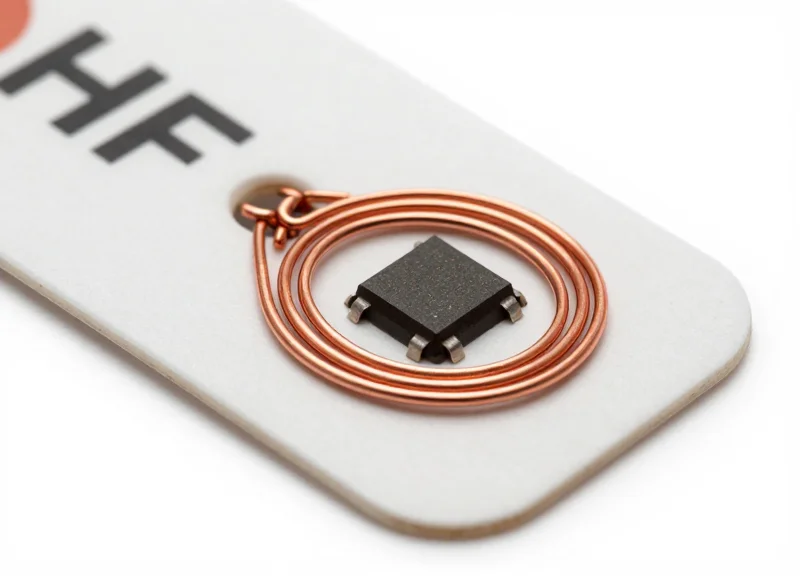
High-Frequency (HF) RFID in logistics refers to the use of radio-frequency identification operating at the 13.56 MHz band to automate item tracking. Unlike legacy barcodes that require a direct line-of-sight or Ultra-High Frequency (UHF) tags that can suffer from 'read-leakage' in dense bins, HF RFID provides a controlled, short-range read field (typically up to 1 meter). This technology enables Automated Storage and Retrieval Systems (AS/RS) to process high-density inventory with nearly 100% accuracy by ensuring that only the specific item being handled by a robotic picker is recorded, effectively eliminating the noise of surrounding inventory.
| Feature | HF RFID (13.56 MHz) | UHF RFID (860-960 MHz) | Traditional Barcode |
|---|---|---|---|
| Read Range | Short (up to 1m) | Long (up to 12m) | Direct Line-of-Sight |
| Data Transfer Speed | High/Secure | Moderate | Manual/Slow |
| Liquid/Metal Tolerance | High | Low (Interference Issues) | N/A |
| Multi-Tag Reading | Excellent (Anti-collision) | Excellent | None (Single Scan) |
| Security | Encrypted/Highly Secure | Varies | None |
- Precise 'Near-Field' Localization: The 13.56 MHz frequency creates a well-defined electromagnetic field. This allows AS/RS robots to identify a single SKU in a multi-unit tote without accidentally reading the tag of an adjacent tote, a critical requirement for micro-fulfillment centers.
- Interference Immunity: Unlike UHF, HF waves are less susceptible to interference from water, liquids, and metallic shelving. This makes it the only viable choice for cold-storage logistics or chemical-heavy fulfillment.
- Integrated Sensing Capabilities: Modern HF chips often include integrated sensors for temperature or moisture, allowing the logistics system to track not just where an item is, but its environmental health during the storage lifecycle.
The Veteran Perspective: Solving the 'Read-Bleed' Crisis. In my 20 years of observing warehouse automation, the biggest failure point for RFID adoption wasn't the cost—it was 'read-bleed.' In high-density AS/RS where items are packed millimeters apart, UHF tags would often trigger false positives from three aisles away. The industry's shift toward HF in 2026 is a strategic 'retreat' to shorter ranges for the sake of absolute precision. By limiting the read zone to the robot's gripper or the immediate conveyor deck, engineers are finally achieving the 'Five-Nines' (99.999%) reliability required for fully autonomous dark warehouses.
Is HF RFID more expensive than barcodes?
While the initial cost per tag is higher than a printed barcode, the total cost of ownership (TCO) is lower because it eliminates manual scanning labor, reduces mis-picks by 85%, and allows for tag reuse in closed-loop pallet systems.
Can HF RFID tags store more data than barcodes?
Yes. While a barcode is a simple pointer to a database, HF RFID tags can store up to several kilobytes of data, including expiration dates, batch numbers, and origin details, directly on the item.
Why not just use UHF for everything?
UHF is great for bulk scanning an entire truckload at once, but it is too imprecise for individual item picking in a dense AS/RS. HF provides the 'surgical' precision needed for high-frequency robotic handling.
HF vs. UHF: Choosing the Right Frequency for AS/RS
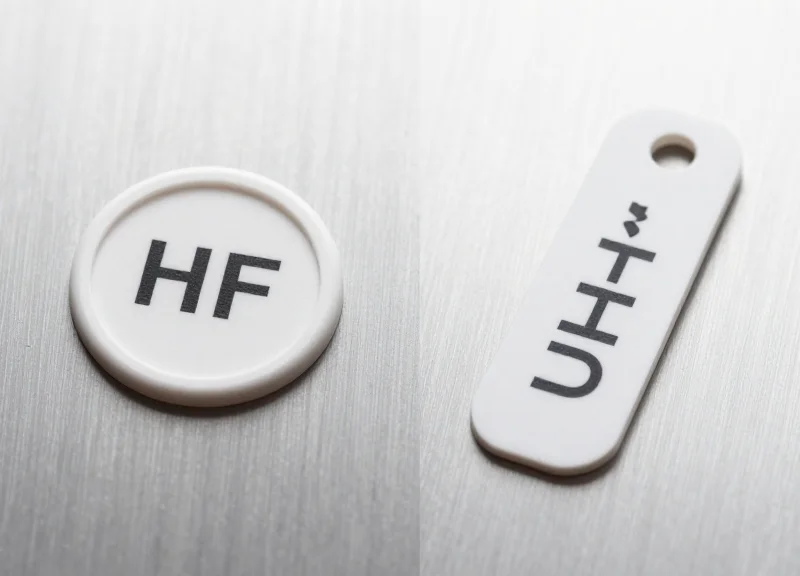
In the context of modern AS/RS, the choice between High-Frequency (HF) and Ultra-High-Frequency (UHF) RFID is determined by the 'Physics of Proximity.' While UHF (860-960 MHz) is designed for long-range logistics, HF (13.56 MHz) utilizes inductive coupling to create a localized magnetic field that is significantly more resistant to interference from metal and liquids. For high-density automated warehouses where items are packed tightly on steel racking, HF RFID provides the surgical precision required to avoid 'stray reads'—a common failure point where UHF scanners accidentally trigger data from adjacent bins.
| Feature | High-Frequency (HF) | Ultra-High-Frequency (UHF) |
|---|---|---|
| Primary Frequency | 13.56 MHz | 860 - 960 MHz |
| Typical Read Range | Up to 30 cm (Near-Field) | Up to 12 meters (Far-Field) |
| Metal/Liquid Tolerance | Excellent (Low interference) | Poor (Signal reflection/absorption) |
| Read Accuracy in AS/RS | High (Localized precision) | Moderate (Risk of 'Stray Reads') |
| Standard Compliance | ISO 15693 / ISO 14443 | EPCglobal Gen2 (ISO 18000-6C) |
The 'Silicon Valley Insight' on 2026 trends: We are seeing a strategic shift toward HF for internal 'Closed-Loop' AS/RS operations. While UHF remains the king of the open supply chain (trucking and receiving), it often fails inside the guts of a robotic shuttle system. The original perspective here is that in 2026, 'Data Integrity over Distance' is the new mantra. Engineers are intentionally limiting read ranges to 10cm using HF to ensure that a robotic picker knows with 100% certainty it is grabbing the correct SKU, eliminating the 'ghost inventory' errors that plague UHF-enabled high-density steel environments.
- Why HF is winning in Shuttle Systems: The localized magnetic field of HF does not bounce off steel pillars. This allows for precise item-level tracking in micro-fulfillment centers where totes are separated by only millimeters of metal.
- Where UHF still dominates: UHF is ideal for dock-door portals where you need to scan an entire pallet of 200 items in seconds as it moves through a 4-meter wide opening.
Can HF and UHF coexist in the same warehouse?
Yes, this is known as a 'Dual-Frequency' strategy. UHF is used for external logistics and yard management, while HF is used for internal high-precision automated storage and retrieval.
Does metal completely block RFID signals?
UHF signals are reflected by metal, creating 'blind spots' or false reads. HF signals are less affected by metal, especially when using 'on-metal' tags designed with a ferrite spacer to prevent detuning.
Is HF more expensive than UHF?
Historically, HF tags were more expensive. However, in 2026, the cost gap has narrowed, and the ROI is often higher in AS/RS due to the reduction in manual error-correction cycles.
Speed and Throughput: Quantifying the RFID Advantage

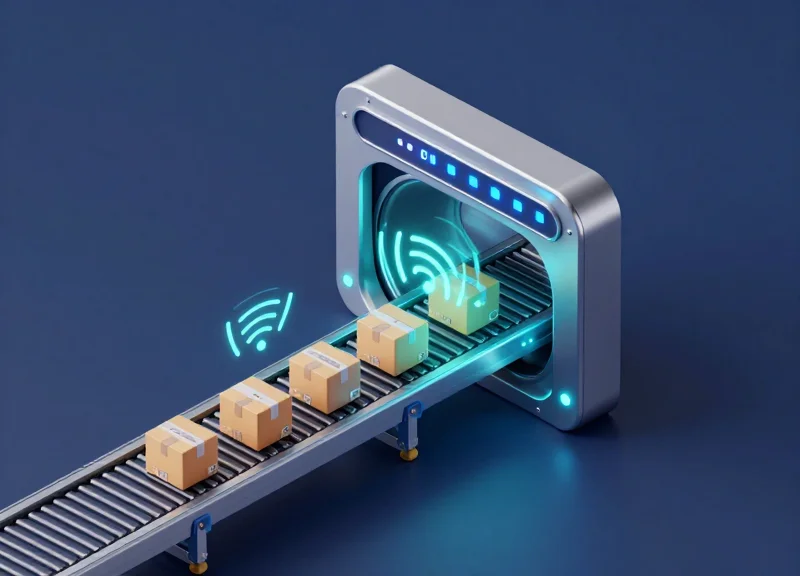
In high-density Automated Storage and Retrieval Systems (AS/RS), throughput is often throttled not by the speed of the motors, but by the latency of the data capture. RFID eliminates the 'stop-and-scan' requirement of barcodes, allowing for instantaneous data acquisition as items pass through a read zone. By removing the need for precise line-of-sight alignment, RFID enables 'scanning at full velocity,' where a robot or shuttle can identify a payload in less than 50 milliseconds without decelerating. This shift from sequential, visual scanning to concurrent, radio-frequency identification translates into a 25% to 40% increase in total system cycle capacity.
| Metric | Traditional Barcode (1D/2D) | High-Frequency RFID (HF) |
|---|---|---|
| Alignment Time | 1.5 - 3.0 Seconds | 0.0 Seconds (Omnidirectional) |
| Read Latency | 300ms - 800ms | 10ms - 50ms |
| Batch Processing | Sequential (One by One) | Simultaneous (Multiple Items) |
| Robotic Speed Impact | Requires Deceleration/Stop | Continuous Movement (Pass-through) |
| System Throughput Gain | Baseline | 20% - 45% Improvement |
The 'Zero-Alignment Dividend': A 2026 Perspective. The most significant throughput gain isn't found in the millisecond read speed, but in what I call 'Movement Decoupling.' In legacy systems, the robot's kinetic path is slave to the optical scanner's field of view. By 2026, the trend in logistics engineering is to decouple identification from movement. Because HF RFID is proximity-based rather than vision-based, the AS/RS control logic no longer needs to calculate 'slow-down zones' for scanning. This allows for more aggressive acceleration profiles and tighter interleaving of tasks, effectively shrinking the 'dead time' between a pick and a place to near zero.
How does RFID improve 'First-Pass Read Rates' (FPRR)?
Unlike barcodes, which drop to 85-90% accuracy if labels are crinkled or poorly oriented, HF RFID maintains a >99.9% FPRR. This eliminates the 're-scan loop'—a major throughput killer where a robot must pull back and re-attempt a read or divert an item to a manual inspection station.
Can RFID handle the throughput of 'Dark Warehouses'?
Absolutely. In fully autonomous (dark) facilities, RFID is the preferred backbone because it does not require ambient lighting or clean lenses. It provides a consistent data flow regardless of dust, low light, or high-speed vibration that would normally blur an optical barcode capture.
Does the simultaneous read capability apply to HF RFID?
While UHF is known for bulk reads, modern HF RFID protocols (like ISO 15693) allow for anticollision, enabling the AS/RS to identify several items on a single tray or tote simultaneously as they pass through the gate, further compounding the speed advantage over barcodes.
Enhanced Data Capacity for 2026 Compliance
By 2026, global supply chain regulations will transition from simple identification to complex lifecycle documentation, driven by the shift toward Digital Product Passports (DPP) and ESG reporting. High-Frequency (HF) RFID tags provide a massive leap in data capacity—storing up to 2,000 bytes (2KB) of rewritable memory compared to the mere 20-100 characters found in traditional linear barcodes. This 'on-tag' intelligence allows automated storage and retrieval systems (AS/RS) to process items based on their individual history, maintenance status, or environmental footprint without needing a constant, high-latency connection to a central database.
| Feature | Linear Barcode | QR Code (2D) | HF RFID (ISO 15693) |
|---|---|---|---|
| Data Capacity | ~20-25 Characters | Up to 3KB (Read-only) | Up to 2KB (Read/Write) |
| Updateability | Static (Print once) | Static (Print once) | Dynamic (Rewritable) |
| Compliance Utility | Simple ID Only | Linked URL/Reference | Complete On-Tag History |
| Read Environment | Line of Sight | Line of Sight | Proximity (Non-Line-of-Sight) |
One of the most significant advantages for 2026 logistics is the transition from 'Centralized Lookup' to 'Distributed Intelligence.' In high-speed AS/RS environments, every millisecond spent querying a remote server for item status (such as 'Is this item quarantined?' or 'What is the remaining shelf life?') creates a latency bottleneck. HF RFID allows the tag itself to function as a mobile database. As an item moves through the warehouse, the AS/RS can write timestamps, inspection logs, or temperature alerts directly to the tag. This ensures that the physical item and its digital record are never out of sync, providing an immutable audit trail for regulatory compliance.
How does HF RFID support 2026 'Right to Repair' and Sustainability mandates?
The 2026 regulations often require products to carry a detailed history of materials and repairability. HF RFID tags can store service logs and components lists locally on the product, ensuring that even if the manufacturer's cloud database is offline, the item can be properly processed for recycling or repair.
Can the data stored on HF RFID tags be secured for sensitive industries?
Yes, unlike barcodes which are easily copied, HF RFID chips support password protection and data encryption. This is vital for 2026 compliance in pharmaceuticals and aerospace, where data integrity is a legal requirement.
Does the increased data capacity slow down scanning speeds?
No. Modern HF RFID readers can read and write data at high speeds. Because the reader doesn't need to 'wait' for a database handshake to verify simple status flags, the overall system throughput often increases.
Expert Insight: Edge-Based Decision Making. Most logistics managers view RFID as a better barcode, but the real 2026 'killer app' is edge-based logic. With 2KB of memory, an AS/RS robot can execute 'if-then' logic based solely on the data stored on the tag. For example, if a tag's 'Maintenance_Required' bit is set to 1, the sorter diverts it immediately without a server call. This reduces network traffic by up to 40% and virtually eliminates downtime caused by Wi-Fi or server outages.
The 'Dark Warehouse' Concept: RFID as the Enabler
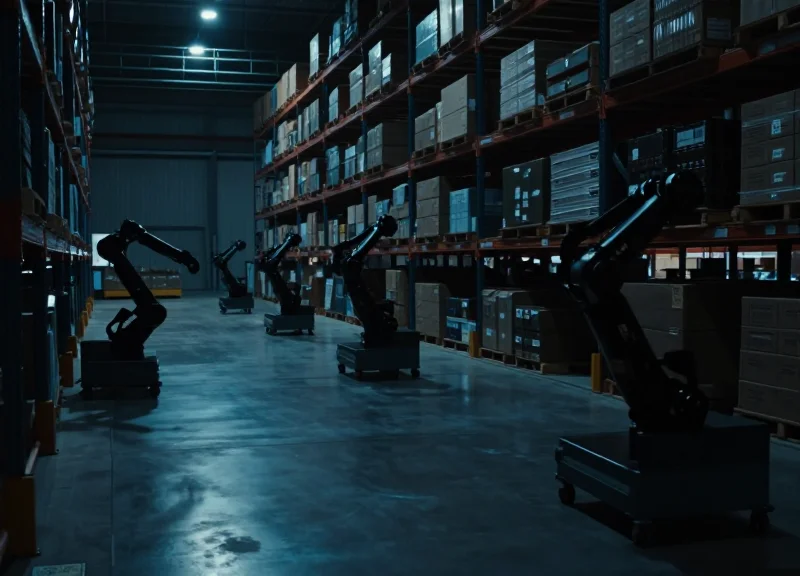
A 'Dark Warehouse' is a fully automated distribution center designed to operate without human presence, effectively removing the need for lighting, heating, or air conditioning in the storage areas. While traditional automation relies on line-of-sight barcode scanning—which often requires precise illumination and expensive vision systems—HF RFID acts as the digital nervous system that enables this transition. By utilizing radio waves rather than optical signals, HF RFID allows AS/RS robots to identify, track, and move inventory with 100% accuracy in total darkness, significantly reducing energy overhead and human safety risks.
| Feature | Traditional Automated Warehouse | RFID-Enabled Dark Warehouse |
|---|---|---|
| Visibility Requirement | High-intensity LED/Natural light for scanners | Zero light required (Radio Frequency propagation) |
| Navigation & Tracking | Optical markers and barcodes | Embedded HF RFID tags and beacons |
| Energy Profile | Significant HVAC and lighting costs | Low power; energy focused purely on motion |
| Maintenance | Frequent cleaning of lenses/labels | Low maintenance; tags are impervious to dust |
The strategic shift toward dark warehousing in 2026 is driven by the 'Three Es': Efficiency, Energy, and Extensibility. Without the need for aisles wide enough for human pickers or the structural costs of ventilation for personnel, warehouses can increase storage density by up to 40%. HF RFID is the critical enabler here because it mitigates the 'noise' issues found in dense metallic environments. Unlike UHF, which can suffer from signal bounce in tight steel racking, HF RFID’s localized magnetic field ensures that a robot picking a pallet in the dark doesn't accidentally trigger sensors from a neighboring rack.
Can dark warehouses function with standard barcodes?
Technically yes, but it requires expensive, high-maintenance infrared lighting and advanced computer vision. RFID is more cost-effective because it works through dust, film, and darkness without any external visual aid.
What is the primary ROI of a Dark Warehouse?
Beyond labor savings, the reduction in energy consumption for lighting and climate control can reduce operational utility costs by 30-50% annually.
How does HF RFID handle the 'Metal interference' problem?
HF RFID operates via inductive coupling at 13.56 MHz, which is less prone to reflection and interference from the steel structures of AS/RS than higher frequency waves.
Expert Tip: The most overlooked benefit of the RFID-enabled Dark Warehouse is 'Thermal Inertia.' By eliminating the need for constant air exchange required for human breathability, the facility maintains a much more stable internal temperature. For cold-chain logistics or sensitive electronics, this stability prevents the micro-fluctuations that cause condensation—a leading cause of barcode label degradation. RFID tags, however, remain readable regardless of humidity or surface frost, ensuring the data chain never breaks.
Calculating the Long-Term ROI: RFID Migration Costs vs. Gains
In the context of 2026 logistics, the Return on Investment (ROI) for High-Frequency (HF) RFID in AS/RS is typically realized within 18 to 24 months. While the initial capital expenditure (CAPEX) for RFID tags and readers can be 2.5x to 4x higher than barcode systems, the long-term gains are driven by a 30-40% increase in throughput and the near-total elimination of 'exception handling' costs. By removing the need for line-of-sight and physical scanner alignment, RFID allows AS/RS units to operate at peak velocity, effectively lowering the cost-per-pick by up to 25% over a five-year lifecycle.
| Cost Factor | Barcode System (Legacy) | HF RFID System (Next-Gen) |
|---|---|---|
| Initial Hardware CAPEX | Low (Standard scanners/printers) | High (Readers, antennas, smart tags) |
| Maintenance & Cleaning | High (Lens cleaning, label repair) | Low (Passive tags, ruggedized readers) |
| Error Rate / Exceptions | 1% - 3% (Misreads/No-reads) | < 0.01% (Reliable proximity reads) |
| Labor Requirement | Moderate (Manual intervention needed) | Minimal (Fully autonomous 'Dark' ops) |
| Data Capacity | Static (SKU only) | Dynamic (Batch, Expiry, History) |
- Reduction in Labor 'Interventions': Every time a barcode fails to scan in an automated system, a human operator must intervene. RFID removes this friction, potentially saving hundreds of man-hours per month in large-scale facilities.
- Increased Asset Utilization: Faster read cycles mean AS/RS cranes and shuttles spend less time idling for scan confirmation, allowing for higher density and more moves per hour without adding hardware.
- Shrinkage and Accuracy Gains: Real-time, high-frequency tracking provides a continuous audit trail, reducing inventory shrinkage and costly shipping errors that damage brand reputation.
Expert Tip: The 'Hidden' ROI Multiplier for 2026 lies in the lifespan of the tag. Unlike thermal barcode labels that degrade, fade, or peel in high-velocity AS/RS environments, HF RFID tags are often embedded into the pallet or tote itself. This 'permanent tagging' strategy transforms a recurring consumable expense into a one-time asset investment that can last over 100,000 read/write cycles, effectively paying for itself through the elimination of label printing and application labor.
Is the high cost of RFID tags still a barrier in 2026?
While unit costs are higher than labels, the shift toward reusable plastic totes and pallets in AS/RS makes the 'cost-per-trip' of an RFID tag significantly lower than single-use barcodes.
How does RFID affect energy costs in a Dark Warehouse?
RFID enables total darkness because it does not require ambient light or camera-based lighting for scanning, contributing to a 5-10% reduction in facility energy consumption.
What is the primary driver of RFID ROI in metal-heavy environments?
HF RFID's ability to operate near metal without the interference issues of UHF means fewer read failures and hardware adjustments, ensuring the 'calculated' ROI matches 'actual' performance.
Overcoming Implementation Hurdles in Modern Logistics
Overcoming implementation hurdles in the shift to HF RFID involves moving beyond simple hardware installation to focus on software interoperability and 'signal hygiene' within the AS/RS environment. To ensure a seamless 2026-ready deployment, organizations must bridge the gap between legacy Warehouse Management Systems (WMS) and the massive data throughput generated by RFID readers through a robust middleware layer that filters, aggregates, and validates tag data before it reaches the core database.
- Establish an Edge Computing Middleware: Deploy localized processing units at the AS/RS nodes to filter 'noise' and duplicate reads, ensuring only actionable inventory data is transmitted to the cloud or ERP.
- Audit the 'Metal-Environment' Profile: Conduct a comprehensive RF site survey to identify reflective surfaces and deploy on-metal tags or specialized spacers that maintain the required air gap for HF signals.
- Implement a Hybrid 'Shadow' Phase: Run RFID in parallel with existing barcodes for 60-90 days, using the 'Shadow Inventory' method to calibrate reader accuracy without risking operational downtime.
- Standardize Data Protocols: Adopt EPCIS (Electronic Product Code Information Services) standards to ensure that data captured by the RFID system is readable across the entire global supply chain.
| Hurdle Type | Common Challenge | 2026 Strategic Solution |
|---|---|---|
| Technical | Signal interference from metal racking | HF (13.56 MHz) Near-Field coupling and Ferrite-backed tags |
| Software | WMS data bloat from high-frequency pings | Logic-based event filtering at the reader level |
| Financial | High upfront tag and reader costs | Unit-cost amortization through 30% faster cycle times |
| Operational | Staff retraining and workflow shifts | Gamified UI for handheld scanners and automated portal alerts |
Expert Insight: The 'Micro-Zoning' Approach. One unique strategy used by Silicon Valley logistics leaders is 'Micro-Zoning.' Instead of blanketing the entire warehouse with readers, engineers are installing low-power HF readers only at 'Critical Decision Points' within the AS/RS—such as shuttle hand-offs or elevator shafts. This minimizes signal collision and significantly reduces the initial infrastructure cost while capturing 99.9% of movement data.
Will RFID interfere with existing Wi-Fi or IoT networks?
No. HF RFID operates at 13.56 MHz, which is far removed from the 2.4 GHz or 5 GHz bands used by industrial Wi-Fi, preventing any signal crosstalk.
How do we handle legacy products still using barcodes?
Most modern AS/RS scanners are 'Dual-Mode' capable, featuring both a laser aperture for 1D/2D barcodes and an integrated RFID antenna for phased migration.
Can HF RFID tags survive extreme cold-chain environments?
Yes, high-quality passive HF tags are rated for temperatures as low as -40C, making them superior to barcode labels that often peel or frost over in deep-freeze AS/RS units.