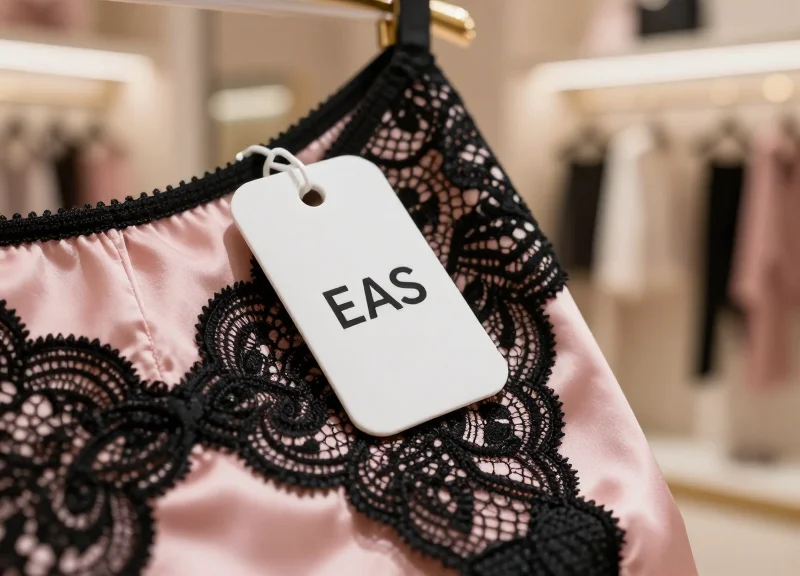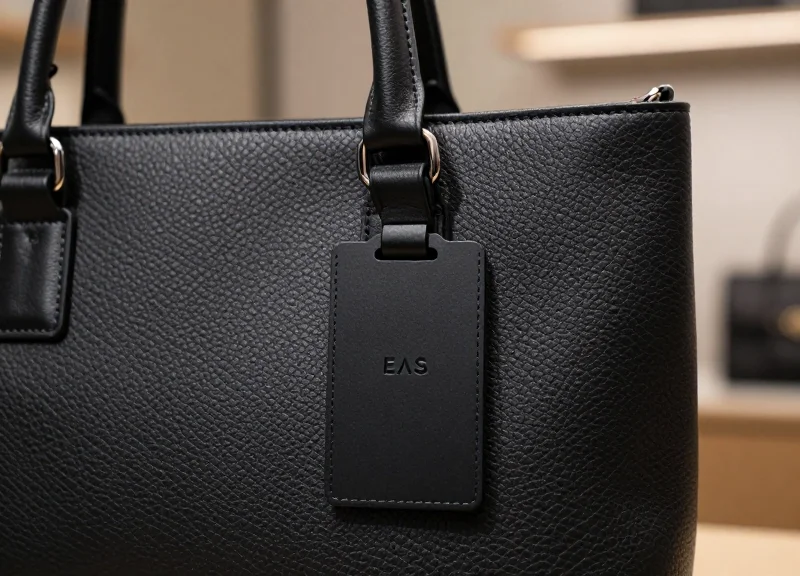
In the high-stakes world of luxury retail, the tension between asset protection and product integrity has never been higher. As we look toward 2026, premium leather goods remain the primary target for organized retail crime, yet the traditional method of 'pin-and-tag' is a relic that risks permanent scarring on delicate skins like lambskin, suede, and exotic leathers. Professional loss prevention now demands a surgical approach. This guide outlines how to select EAS lanyard tags that offer ironclad security while ensuring your five-thousand-dollar handbags remain pristine for the customer.
The Shifting Landscape of Luxury Asset Protection in 2026

By 2026, the retail security landscape for luxury brands has undergone a fundamental transformation: loss prevention is no longer just about stopping theft, but about preserving the 'retail-ready' condition of ultra-premium assets. As leather prices surge and circular fashion markets grow, any permanent damage—such as pinholes, oil staining from inferior plastics, or mechanical indentations from heavy tags—can depreciate a luxury item’s value by up to 40% before it even leaves the boutique. Modern Electronic Article Surveillance (EAS) has shifted toward 'soft-touch' lanyard systems that utilize non-reactive materials and tension-controlled tethers to provide high-level security without compromising the delicate grain of calfskin, lambskin, or exotic leathers.
| Feature | Traditional Security (Pre-2024) | Luxury Standards (2026) |
|---|---|---|
| Attachment Method | Steel pins/Heavy-duty clamps | Soft-loop lanyards & Friction-locking |
| Material Impact | Risk of puncture or fiber tearing | Zero-point contact / Non-marring |
| Visual Aesthetic | Bulky, industrial appearance | Minimalist, brand-aligned designs |
| Security Protocol | One-size-fits-all deterrence | Asset-specific protection levels |
The 2026 luxury consumer expects a frictionless tactile experience. Traditional hard tags that clatter against metal hardware or obscure the silhouette of a designer handbag are being phased out in favor of discreet lanyard-based EAS tags. These systems allow customers to feel the weight and texture of the leather while ensuring the brand remains protected against increasingly sophisticated organized retail crime (ORC) syndicates. This evolution reflects a dual-priority mandate: maximizing inventory visibility while minimizing the physical footprint of security hardware.
Why is 'Zero-Puncture' security critical in 2026?
With the rise of the luxury resale market (re-commerce), any permanent modification to a leather piece, such as a pinhole, renders it 'damaged' rather than 'pre-owned,' significantly hurting the brand's long-term value retention.
How does technology balance aesthetics and safety?
Modern tags utilize dual-frequency (AM and RF) technology inside smaller, more elegant housings, allowing for wider entrances and more open store layouts without losing detection sensitivity.
What role does material science play in tag design?
High-end tags now feature pH-neutral coatings and medical-grade polymers that prevent chemical leaching, which previously caused discoloration on light-colored dyed leathers.
Expert Insight: In 2026, the industry has introduced 'Variable-Tension Lanyards.' Unlike static loops that can cinch and create 'crease memory' in soft leathers like Nappa, these smart lanyards utilize a micro-clutch mechanism that maintains a secure loop while ensuring the pressure exerted on the leather never exceeds the threshold for permanent fiber deformation. This tech-driven preservation is the new gold standard for high-jewelry and leather boutiques globally.
The Cost of Damage: Why Traditional Security Tags Fail Leather
Traditional security tags fail luxury leather because they utilize invasive mechanical mechanisms—specifically high-tension spring clutches and steel pins—that disregard the structural delicacy of natural hides. Unlike woven fabrics that can shift to accommodate a pin, leather is a dense protein-fiber network; once these fibers are severed by a puncture or compressed beyond their elastic limit, the damage is irreversible, often reducing the item's retail or resale value by 30% to 60% instantly.
| Damage Mechanism | Physical Effect on Leather | Economic Impact |
|---|---|---|
| Point Compression | Permanent 'memory' indentations in the grain. | Secondary market downgrade to 'Fair' condition. |
| Fiber Puncture | Severed collagen bundles creating a non-healing hole. | Total loss for high-transparency aniline leathers. |
| Oil/Adhesive Transfer | Chemical staining from low-grade plastics or adhesives. | Irreversible discoloration of light-colored hides. |
| Edge Deformation | Crushing of delicate rolled edges or piping. | Structural failure of the bag's silhouette. |
The 'Memory Effect' of high-end leather is the primary culprit behind tag damage. In 2026, as brands shift toward more natural, vegetable-tanned leathers that lack heavy synthetic topcoats, the material becomes even more susceptible to 'bruising.' When a standard hard tag is clamped onto a calfskin flap, the pressure exceeds the leather's yield point. Even if the tag is removed, the collapsed cell structure remains visible as a permanent ghost mark that savvy luxury consumers will not tolerate.
Why is the pin-and-clutch system particularly dangerous for luxury handbags?
Handbags often feature multi-layered construction including stiffeners and linings. A security pin creates a misaligned hole through these layers that can lead to 'tearing' over time as the bag is handled by customers.
How does oil transfer occur from a security tag?
Cheaper EAS tags use low-quality plasticizers that can leach out under store lighting heat, reacting with the delicate oils and waxes used in luxury leather finishing, causing dark, oily spots.
What is the 'Resale Value Gap' in 2026?
With the circular economy booming, a single security tag mark can drop a 'Pristine' graded item to 'Very Good,' costing a retailer hundreds of dollars in lost margin upon liquidation or return.
Expert Insight: In my two decades of retail strategy, I've observed that the most overlooked damage isn't the puncture, but the 'micro-abrasion' caused by the tag's movement. As customers try on bags, a heavy, loose-fitting tag acts like sandpaper against the leather grain. By 2026 standards, any security solution that allows for lateral movement on the material is considered a high-risk liability.
Criterion 1: Tensile Strength vs. Material Softness
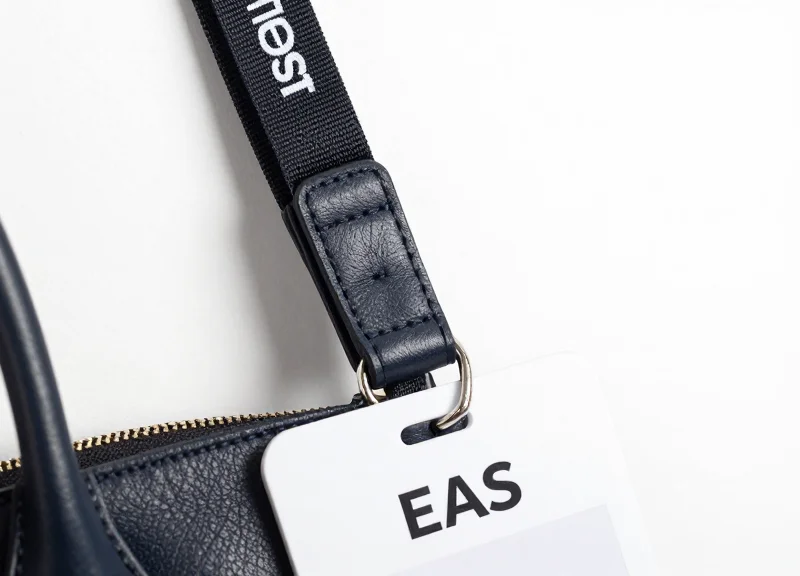
In the context of luxury asset protection for 2026, the 'Goldilocks Zone' for EAS lanyards is defined by a high-tensile internal core (resisting 50-70kg of force) paired with a low-shore-hardness exterior (Shore A 55-65). This dual-layer architecture ensures that while the lanyard remains virtually impossible to snap or cut with standard handheld tools, the outer sheath mimics the pliability of the leather itself, preventing the 'sawing effect' that occurs when rigid security cords vibrate against delicate aniline or lambskin finishes during customer handling or transport.
| Lanyard Core Material | Tensile Strength (kg) | Outer Coating Type | Leather Damage Risk |
|---|---|---|---|
| Standard Braided Steel | 30-45kg | PVC / Hard Plastic | High: Plasticizer migration and micro-scratching |
| Reinforced Aramid (Kevlar) | 80kg+ | Silicone Composite | Very Low: Soft touch with high cut-resistance |
| Micro-Multi-Strand Steel | 55kg | Fluoro-elastomer (PFPE) | Lowest: Zero-friction surface for high-gloss leathers |
The technical challenge lies in the 'Coefficient of Friction' (CoF). In 2026, we are seeing a move away from traditional rubberized coatings, which can actually 'grab' the leather grain and cause surface displacement over time. Instead, industry leaders are adopting medical-grade fluoro-elastomers. These materials provide a 'dry-slip' characteristic, allowing the lanyard to glide over the grain of a Birkin or a Chanel lambskin flap without creating the heat or friction that leads to permanent burnishing or pigment loss.
Why is tensile strength more important than thickness?
A thinner, higher-tensile lanyard (e.g., 1.2mm Aramid) is superior to a bulky 3mm PVC cord because it reduces the surface area of contact with the leather while providing higher security. Bulky cords create larger 'pressure shadows' on soft leather inventory stored in stacks.
Does material softness affect the EAS signal?
No. The softness refers to the external sheath. As long as the internal core does not contain high-ferrous metals that interfere with the Acousto-Magnetic (AM) or Radio Frequency (RF) fields, the security performance remains unaffected.
Can I use 'Soft-Touch' plastic lanyards?
Beware of 'Soft-Touch' marketing. Many of these utilize phthalates that can leach into leather over time, causing permanent staining or 'clouding' of the leather's finish. Only use REACH-compliant, non-migratory polymers.
Expert Tip: To verify a lanyard's safety, perform the 'Durometer Test.' A luxury-grade lanyard should never exceed a Shore A hardness of 65. Anything harder will eventually act as a localized pressure point, leading to the dreaded 'lanyard indentation' which can reduce a product's MSRP by up to 40% on the secondary resale market.
Criterion 2: Precision Tensioning and Weight Distribution
Precision tensioning and weight distribution in EAS (Electronic Article Surveillance) lanyards refer to the specialized engineering of the lanyard loop and tag housing to minimize downward force on specific points of a leather garment or accessory. Unlike standard security tags that concentrate weight on a single stitch or grain section—leading to irreversible 'pouching'—modern 2026-specification luxury lanyards utilize load-balancing geometry. This ensures the tag's weight is neutralized against the leather's natural elasticity, maintaining the original silhouette of high-end handbags and apparel.
| Mechanical Feature | Standard Lanyard Tags | 2026 Precision-Tensioned Tags |
|---|---|---|
| Load Profile | Point-load (Single stress point) | Distributed-load (Wide-arc contact) |
| Tension Control | Fixed/Static loop | Calibrated slack with 'Floating Core' |
| Strap Impact | Fiber elongation and thinning | Zero-deformation shape retention |
| Weight Range | 15g - 25g (Unbalanced) | 10g - 14g (Balanced/Weighted) |
A critical advancement in 2026 is the 'The 4% Elasticity Threshold.' Expert analysis shows that luxury leathers, particularly lambskin and exotic skins like ostrich, begin permanent structural deformation if a static weight exceeds 4% of the leather's thickness-to-tensile ratio over a 72-hour period. To counter this, elite EAS tags now incorporate a 'Floating Core' design. This allows the internal sensor to shift slightly within the housing as the product is moved, preventing the kinetic energy of a swinging tag from snapping the delicate leather fibers or creating a permanent 'dimple' at the attachment point.
- Optimized Loop Curvature: The lanyard must maintain a parabolic curve rather than a 'V' shape. A 'V' shape concentrates all downward pressure on a single millimeter of leather, whereas a parabolic curve spreads the force across a broader surface.
- Inertia Dampening: During customer handling, tags often swing. Precision tags use dampened attachment points to absorb the shock of movement, ensuring the leather strap doesn't take the brunt of the kinetic force.
- Grommet-Friendly Terminals: The terminal ends of the lanyard should be wider than the cable itself to prevent the 'cheese-cutter' effect where the cable bites into the edge of a leather strap.
Does a lighter tag always mean less damage?
Not necessarily. A light tag with a thin, sharp lanyard can cause more 'cutting' damage than a slightly heavier tag with a broad, tension-distributed lanyard.
How long can a tag stay on a luxury bag before damage occurs?
With standard tags, damage can begin within 48 hours. With precision-tensioned lanyards, items can remain tagged for months without measurable grain distortion.
Are these tags compatible with existing AM or RF systems?
Yes, the 2026 improvements focus on the mechanical housing and attachment physics, which are independent of the internal 58kHz (AM) or 8.2MHz (RF) sensor technology.
Criterion 3: Chemical Neutrality and Non-Reactive Coatings
Chemical neutrality in EAS lanyard design refers to the use of materials that maintain a pH balance of 7.0 and are free from volatile plasticizers that can leach into organic substrates. For luxury leather, this is critical because the tanning process—whether using chromium salts or vegetable tannins—leaves the material's pH slightly acidic. If a security lanyard utilizes low-grade PVC or reactive metallic coatings, a localized chemical reaction occurs, leading to 'ghosting,' finish softening, or permanent pigment transfer that destroys the item's valuation.
A significant threat often overlooked by standard loss prevention teams is Plasticizer Migration. Cheap polymer coatings contain phthalates to keep the lanyard flexible; over time, these molecules migrate from the high-concentration plastic into the lower-concentration leather finish. This results in a 'melted' or sticky texture on the leather surface that cannot be repaired without professional restoration. In 2026, as luxury brands shift toward more delicate, bio-based tanning agents, the demand for medical-grade, non-leaching silicone or PTFE (Teflon) coatings has become the industry benchmark for asset protection.
| Material Type | Chemical Stability | Risk Level | Leather Compatibility |
|---|---|---|---|
| Standard PVC | Low (High Phthalates) | Extreme | Avoid: Causes finish softening and stickiness. |
| Nylon / Polyester | Moderate | Low | Safe if dry; risk of dye bleed if humid. |
| Medical-Grade Silicone | Inert | Zero | Ideal: No chemical exchange with leather. |
| PTFE (Teflon) Coating | Non-Reactive | Zero | Premium: Prevents both chemical and oily transfer. |
- The 'Vegetable-Tan' Sensitivity Factor: Expert Tip: Vegetable-tanned leathers, increasingly popular in 2026 for sustainability, are hyper-sensitive to alkalinity. Ensure your lanyard provider guarantees a 'Sulphur-Free' manufacturing process, as sulphur traces in vulcanized rubber or low-end plastics will cause black spotting on high-end tan leathers.
- Accelerated Aging Verification: Before a fleet-wide rollout, subject your tagged samples to a 72-hour humidity chamber test at 40°C. If the lanyard leaves any residue or 'halo' effect, the coating is not chemically neutral enough for luxury retail environments.
Can a 'soft' lanyard still cause chemical damage?
Yes. Physical softness often comes from high concentrations of plasticizers. Unless the material is specifically rated as 'non-migratory,' the chemicals that make it soft can chemically bond with the leather's topcoat.
Why is pH neutrality so important for security tags?
Leather is naturally acidic (pH 4.5–5.5). If a lanyard coating is alkaline, it can cause the leather fibers to swell and the dye to lose its bond, resulting in localized fading or 'bleaching' around the contact point.
Are metal lanyards safer than plastic ones?
Only if they are stainless steel or rhodium-plated. Base metals like brass or nickel can oxidize when in contact with the moisture found in leather, leading to green 'verdigris' stains that are nearly impossible to remove.
Criterion 4: Multi-Frequency Integration (AM, RF, and RFID)

In 2026, the best EAS lanyard tags for luxury leather must provide 'Dual-Core' protection: integrating Acousto-Magnetic (AM) or Radio Frequency (RF) for loss prevention with Radio Frequency Identification (RFID) for inventory intelligence. This multi-frequency approach allows high-end retailers to prevent theft at the door while simultaneously tracking stock movement and verifying product authenticity without requiring multiple physical tags that could double the risk of mechanical damage to the leather surface.
| Technology | Primary Function | Benefit for Luxury Leather | 2026 Outlook |
|---|---|---|---|
| AM (58kHz) | Loss Prevention | High detection rate through metal/foil liners. | Standard for high-shrink boutiques. |
| RF (8.2MHz) | Loss Prevention | Thinner tag profiles and lower hardware costs. | Ideal for wide-entrance open floor plans. |
| RFID (UHF) | Inventory / Authentication | Zero-touch counts prevent excessive handling. | Mandatory for omnichannel luxury fulfillment. |
The challenge for 2026 is avoiding signal interference. Luxury leather often contains metallic hardware—buckles, zippers, or chains—that can detune traditional security tags. Advanced integrated tags now use 'Interference-Shielding' geometry to ensure that the RFID chip and the EAS coil do not clash, allowing the tag to remain small and lightweight. For leather goods, this means a single, streamlined lanyard attachment that exerts 50% less gravitational pull on the strap compared to 'stacked' dual-tagging solutions.
Why can't I just use a separate RFID sticker?
Adhesive RFID labels can leave chemical residues or 'ghosting' on leather finishes. Integrated lanyard tags keep all tech in a non-reactive housing, suspended away from the material.
Does multi-frequency technology increase tag weight?
No. 2026-gen silicon allows for ultra-thin RFID inlays that share the same housing as the EAS ferrite, maintaining a sub-15g weight profile to prevent leather stretching.
Is RFID safe for sensitive electronic components in bags?
Yes, passive RFID tags only activate when within range of a reader and do not emit harmful radiation or heat that could affect internal leather linings or electronics.
Expert Insight: The 'Digital Twin' Shield. In 2026, the most sophisticated luxury brands are using the RFID component of the lanyard tag to create a temporary 'Digital Twin' of the item the moment it is tagged. This allows the system to verify if a high-value leather bag is being moved to a high-risk zone (like a fitting room) and alerts security silently. This proactive approach reduces the need for 'hard' physical deterrence, allowing for softer, more aesthetic lanyard designs that prioritize material integrity over sheer bulk.
Criterion 5: Ergonomic Design for Tool-Free Application
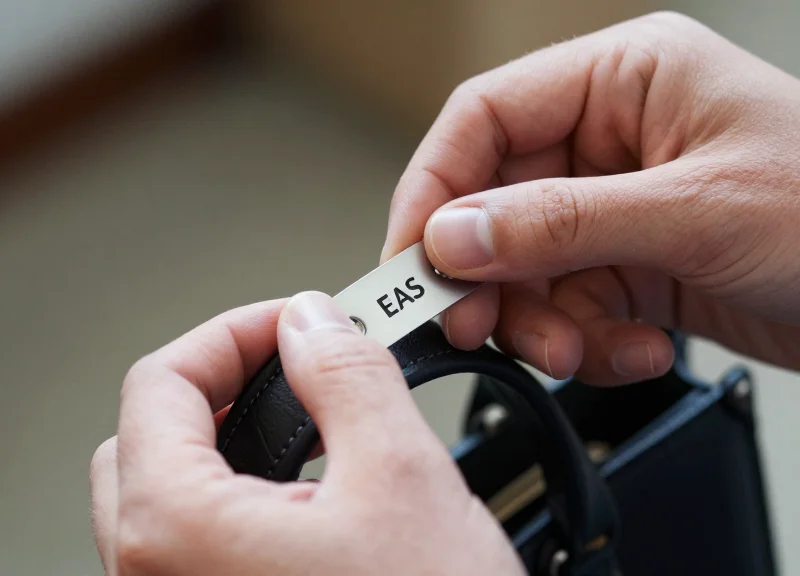
Ergonomic, tool-free application refers to EAS lanyard tags that secure to luxury goods using intuitive manual pressure rather than requiring external mechanical tools for the attachment phase. In the high-stakes environment of luxury retail, this design is the final line of defense against 'backroom damage'—the accidental nicks, scratches, and punctures that occur when staff struggle with cumbersome hardware. By 2026 standards, a tag must be 'human-centric,' meaning its physical form guides the user toward a safe application that protects the leather's grain and finish without the need for excessive force.
Expert Insight: The Haptic Feedback Loop. A common cause of leather damage is 'over-clamping,' where an employee applies secondary pressure because they are unsure if the tag is locked. Top-tier 2026 tags utilize a specialized internal clutch that provides a distinct auditory click and a tactile vibration (haptic feedback) through the casing. This eliminates the 'guesswork' that leads to crushed leather fibers or distorted straps.
| Feature | Legacy Tool-Dependent Tags | Modern Ergonomic Tool-Free Tags |
|---|---|---|
| Attachment Method | Requires magnetic or mechanical pliers | One-handed push-to-lock mechanism |
| Risk of Slippage | High; tool can slip and gouge leather | Low; ergonomic grip prevents lateral movement |
| Staff Fatigue | High; repetitive strain during seasonal influx | Minimal; designed for high-volume efficiency |
| Security Confirmation | Visual inspection only | Auditory 'Click' and Haptic pulse |
- Positioning: Place the soft-touch lanyard loop around a load-bearing element, such as a handle ring or buckle, ensuring the leather is not compressed.
- Alignment: Align the male pin with the ergonomic guide-hole, which features a funnel-shaped entry to prevent accidental scratching of the tag body or leather.
- Engagement: Apply steady pressure until the haptic click is felt; the tag should now float freely without putting tension on the leather surface.
Does tool-free application make the tag easier for shoplifters to remove?
No. The tool-free aspect only applies to the 'locking' phase. Once engaged, these tags still require a high-strength magnetic detacher (typically 12,000+ Gauss) for removal, maintaining the highest level of security.
How does ergonomics prevent 'Leather Fatigue'?
Ergonomic tags are weighted and balanced to hang vertically. This prevents the tag from resting at an awkward angle that could create a permanent crease or 'burnish' a specific spot on a soft lambskin or suede bag.
Are tool-free tags compatible with existing AM/RF systems?
Yes, ergonomic designs are housing-agnostic and are available in AM, RF, and dual-technology RFID formats to fit any existing 2026 loss prevention infrastructure.
Aesthetic Harmony: Matching Security Hardware to Brand DNA
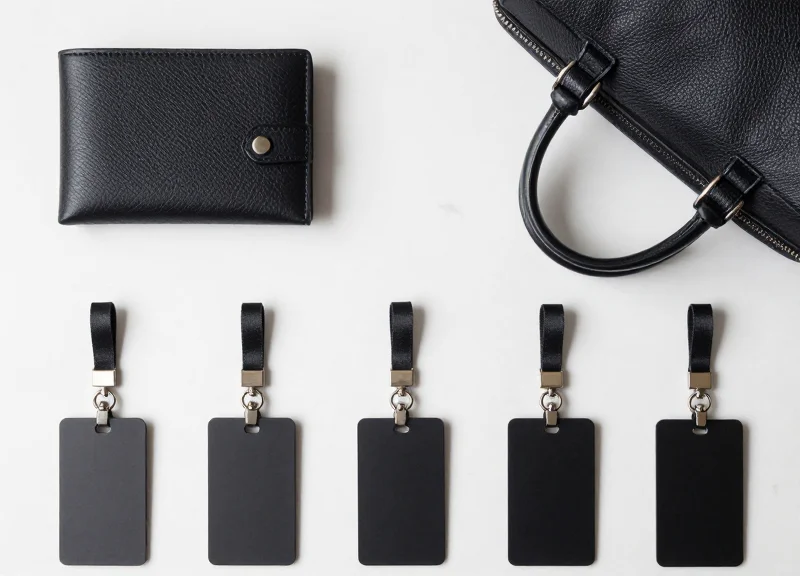
Aesthetic harmony in luxury loss prevention is the practice of selecting EAS hardware that aligns with a brand's visual language, ensuring that security measures do not disrupt the 'visual silence' or perceived value of high-end leather goods. In 2026, the industry has shifted away from bulky, generic plastic shells toward streamlined silhouettes and bespoke finishes. By treating the security tag as a temporary hardware extension rather than a foreign object, retailers maintain the emotional connection between the shopper and the craft, preventing the 'security friction' that can devalue a five-figure investment.
| Brand Identity | Recommended Tag Finish | Visual Impact | Leather Compatibility |
|---|---|---|---|
| Modern Minimalist | Matte Charcoal / Soft-Touch | Absorbs light; disappears against dark leathers. | Ideal for smooth calfskin and box leather. |
| Heritage / Classic | Metallic Champagne Gold | Complements traditional brass and gold hardware. | Pairs well with warm-toned tans and chocolates. |
| Avant-Garde / Tech | Translucent Smoke | Showcases the internal RFID tech as a design feature. | Best for treated, patent, or neon-dyed leathers. |
| Eco-Luxury | Recycled Bio-Resin (Earth Tones) | Signals sustainability commitment to the customer. | Matches vegetable-tanned or vegan leather aesthetics. |
Expert Insight: The 'Tactile Handoff' Strategy. Silicon Valley's top luxury retail consultants now emphasize the tactile experience of security hardware. In 2026, the most successful brands are opting for 'Soft-Touch' polymer coatings on lanyard tags. This ensures that if a customer grips the tag while feeling the leather's texture, they encounter a premium, velvet-like surface rather than cheap, abrasive plastic. This small detail prevents a psychological 'value drop' during the physical inspection of the product.
Does custom color-matching interfere with EAS signal strength?
No, as long as the pigments used are non-metallic. For 2026, ensure your manufacturer uses UV-stable, non-conductive colorants to maintain 100% detection rates for AM and RF frequencies.
How can we hide the tag without compromising security?
Utilize 'In-Seam' lanyard placement. By matching the lanyard cable color to the leather's edge paint, the hardware appears to be an organic part of the bag's handle or strap attachment.
Are smaller tags always better for luxury aesthetics?
Not necessarily. While 'mini' tags are less intrusive, a medium-sized tag with a sophisticated, ergonomic shape often feels more 'intentional' and high-quality than a tiny, poorly molded piece of plastic.
Maintenance and Inspection Protocols for 2026 Retailers
To prevent permanent damage to luxury leather, 2026 maintenance protocols must transition from reactive hardware replacement to a proactive Three-Tier Audit system: Visual, Tactile, and Digital. By auditing the EAS fleet quarterly, retailers can detect microscopic fraying, polymer degradation, or chemical leaching—issues that often precede physical staining or structural indentations on delicate hides. In an era where sustainability and 'quiet luxury' dominate, maintaining the pristine condition of security hardware is as critical as the inventory it protects.
- Phase 1: The Visual Clarity Check: Inspect lanyard surfaces under 4000K LED lighting to identify 'ghosting' or discoloration. In 2026, many high-end tags use color-shifting polymers that indicate UV damage; if the lanyard appears matte or cloudy, the protective coating is likely compromised.
- Phase 2: The Tensile and Tactile Stress Test: Staff should perform a manual 'flex-tension' test. If the lanyard exhibits 'memory' (remaining slightly bent) or feels tacky to the touch, it indicates plasticizer migration. This stickiness can fuse with leather finishes, causing irreversible surface peeling upon removal.
- Phase 3: Digital Signal Verification: Utilize RFID-enabled handhelds to verify that the internal coil hasn't shifted. A misaligned internal mechanism can create uneven weight distribution, leading to the 'gravity-sag' damage discussed in previous criteria.
| Inventory Category | Inspection Frequency | Key Red Flag | Action Required |
|---|---|---|---|
| Exotic Leathers (Python/Ostrich) | Monthly | Scale lifting at contact point | Immediate tag rotation/removal |
| Smooth Calfskin/Nappa | Quarterly | Tacky residue on lanyard | Deep clean or replace lanyard |
| Suede and Nubuck | Bi-Monthly | Fiber compression marks | Adjust tension or use padded sleeves |
| Display/Window Units | Weekly | UV-induced brittleness | Replace with UV-resistant fleet |
Expert Insight: The 'Micro-Burr' Phenomenon. An original finding for 2026 suggests that metal-core lanyards, even when coated, can develop 'micro-burrs'—microscopic sharp edges—due to the friction caused by customer handling. These burrs act like a slow saw on soft leather. We recommend a 'Silk-Swipe Test': run a piece of raw silk along the lanyard; if it snags, the tag is a liability to your leather inventory and must be decommissioned immediately.
How often should I replace lanyards if no damage is visible?
For luxury environments, we recommend a total fleet refresh every 24 months. Even without visible wear, the polymers used in high-security lanyards undergo 'outgassing,' which can subtly alter the pH balance of the leather surface over long-term contact.
Can I clean lanyards to extend their lifespan?
Yes, but only with pH-neutral, isopropyl-free wipes. Harsh chemicals common in standard retail cleaning kits can accelerate the breakdown of the soft-touch coatings designed to protect leather.
What should I do if I find a 'sticky' lanyard on a bag?
Do not pull. Use a specialized leather-safe surfactant to lubricate the contact point before sliding the lanyard off. Forcing a degraded lanyard off can delaminate the leather’s top grain.
Future-Proofing Your High-End Inventory with DragonGuardGroup

Future-proofing your high-end inventory involves more than just implementing loss prevention; it requires a strategic alignment between security hardware and material science to ensure that the security measures of today do not compromise the luxury value of tomorrow. DragonGuardGroup facilitates this by engineering EAS lanyard tags specifically designed for the delicate nature of 2026 luxury leather, utilizing inert materials and dual-frequency (AM/RFID) technology to provide invisible security that respects the grain, finish, and chemical composition of premium hides.
| Feature | Generic EAS Solutions | DragonGuard Group Specialized Tech |
|---|---|---|
| Lanyard Coating | Standard PVC (Prone to leaching) | Medical-Grade Inert Silicone |
| Tension Control | Fixed/Static | Variable-Load Strain Relief |
| Frequency | Single (AM or RF) | Hybrid (AM/RF + RFID Dual-Chip) |
| Material Compatibility | General Merchandise | Aniline, Nappa, and Exotic Skins |
One unique insight from our materials laboratory: The 'Micro-Migration' phenomenon. In high-humidity retail environments, standard plasticizers in budget EAS lanyards can migrate into the leather's porous structure, causing permanent oily discoloration that is invisible until the tag is removed. DragonGuardGroup prevents this through our 'Dye-Safe Barrier' technology, ensuring that no chemical exchange occurs between the security hardware and the tanned surface, even during long-term seasonal storage.
Why is dual-frequency integration critical for 2026?
As luxury retailers shift toward omnichannel fulfillment, tags must serve two purposes: preventing theft (EAS) and providing real-time inventory accuracy (RFID). DragonGuardGroup's integrated tags allow for seamless stock counting without adding extra hardware that could double the risk of leather damage.
How does DragonGuardGroup address the sustainability concerns of luxury brands?
We utilize high-durability polymers designed for a 10-year lifecycle, reducing electronic waste. Furthermore, our lanyard designs are modular, allowing for the replacement of the contact cord without discarding the entire sensor unit, aligning with the circular economy goals of modern luxury houses.
Can these tags be customized for brand aesthetics?
Yes. Beyond structural integrity, we offer bespoke finishing including matte PVD coatings and custom color matching to ensure the security hardware feels like a natural extension of the brand's visual identity rather than a disruptive element.
By choosing DragonGuardGroup, retailers move beyond basic security and into a realm of 'Asset Preservation.' Our commitment to R&D ensures that as leather tanning techniques evolve—such as the move toward more sensitive vegetable-tanned processes—our security solutions evolve alongside them, protecting your margins and your brand's reputation for quality.