In the hyper-connected landscape of 2026, RFID technology has moved beyond simple tracking to become the backbone of real-time inventory and automated loss prevention. However, the 'stray read' problem—where systems capture unintended data from neighboring items—remains the primary barrier to 99.9% accuracy. Solving this requires a deep dive into the physics of electromagnetic fields. This guide breaks down the critical differences between near-field and far-field RFID, providing a strategic framework to select the right technology for your specific environment and eliminate cross-read interference once and for all.
The Physics of RFID: Inductive vs. Radiative Coupling

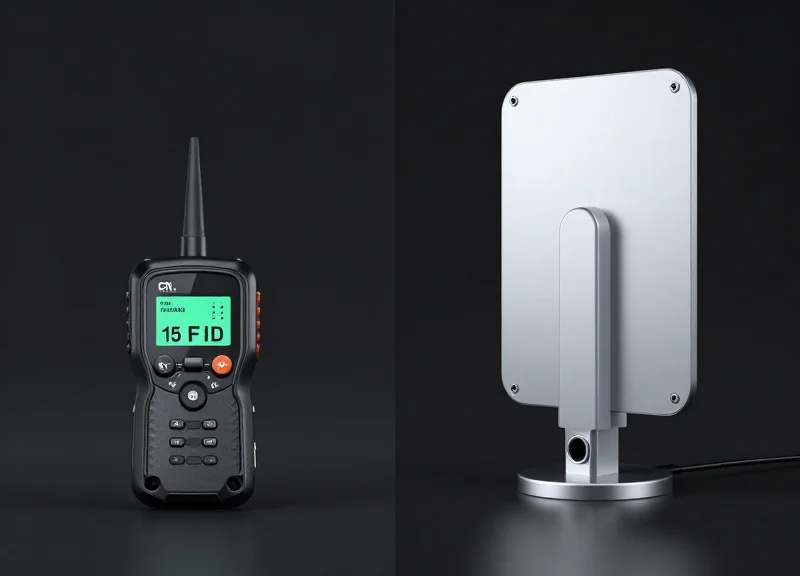
At its core, RFID physics is divided into two distinct communication mechanisms: Inductive Coupling (Near-field) and Radiative Coupling (Far-field). Near-field RFID operates like a transformer, utilizing a localized magnetic field to transfer energy between the reader antenna and the tag, typically effective within a distance of one wavelength. Conversely, Far-field RFID relies on electromagnetic wave propagation and 'backscatter' radiation, allowing the signal to travel much longer distances by detaching from the antenna and traveling through space as an independent wave. For 2026 deployments, distinguishing between these two is the primary step in eliminating the 99% of stray reads that plague dense warehouse environments.
| Feature | Inductive Coupling (Near-Field) | Radiative Coupling (Far-Field) |
|---|---|---|
| Primary Mechanism | Magnetic Induction | Electromagnetic Backscatter |
| Frequency Range | LF (125 kHz) & HF (13.56 MHz) | UHF (860-960 MHz) & Microwave |
| Typical Range | Contact to 30cm | 1m to 15m+ |
| Field Behavior | Non-propagating (Quasi-static) | Propagating (Wave-based) |
| Liquid/Metal Tolerance | High (Magnetic fields pass through) | Low (Waves are reflected or absorbed) |
The boundary between these two fields is not arbitrary; it is defined by the Fraunhofer distance. In the near-field zone (Reactive Near-Field), the energy is stored in the space surrounding the antenna and does not radiate away. This is why near-field is inherently more secure and precise; if a tag is not within that specific magnetic 'bubble,' it cannot be powered. As we transition into the far-field, the electric and magnetic fields become transverse and linked, radiating outward. This enables the long-range capabilities of UHF RFID but introduces the risk of 'over-reaching' and reading tags in adjacent rooms or storage racks.
Why does moisture affect far-field communication more than near-field?
Far-field signals are high-frequency electromagnetic waves (UHF) that are easily absorbed by the dielectric properties of water. Near-field magnetic induction is largely unaffected by moisture because magnetic permeability in water is similar to that of air.
Can a UHF tag utilize near-field coupling?
Yes. Modern 'Near-Field UHF' tags use a specialized antenna loop designed to couple with the magnetic component of the reader's field, allowing for high-precision item-level tracking even at UHF frequencies.
What is the primary cause of stray reads in far-field systems?
Stray reads occur because radiative waves can reflect off metallic surfaces and propagate through gaps, reaching tags far outside the intended read zone. Near-field systems eliminate this by lacking the energy to propagate beyond the immediate proximity.
Expert Insight: In 2026, the industry is moving toward 'Hybrid Coupling' strategies. Engineers are now utilizing the 2Pi rule ($d < \lambda / 2\pi$) to mathematically define the 'Safe Zone' for high-density inventory. By keeping tag-to-reader distance strictly within this boundary, you can leverage the high data rates of UHF while maintaining the surgical precision of inductive coupling, effectively ghosting any tags that reside in the radiating far-field.
Defining Near-Field RFID: Precision within the Bubbles

Near-field RFID refers to an RFID system configuration where the communication between the reader antenna and the tag occurs within a distance of approximately one wavelength ($λ/2π$), typically limited to 10 centimeters or less. Unlike traditional long-range RFID, near-field systems utilize a localized magnetic 'bubble' to exchange data. This confined read zone ensures that only the intended tag is interrogated, providing the highest possible immunity to interference and virtually eliminating the risk of 'stray reads' from nearby items in high-density scenarios.
| Feature | Near-Field RFID Specification | Operational Impact |
|---|---|---|
| Effective Range | 0 to 10 cm (typically) | Extreme precision; prevents accidental triggers. |
| Coupling Method | Magnetic (Inductive) | Predictable read zones regardless of surroundings. |
| Energy Decay | 1/r^6 (extremely rapid) | Signal drops instantly outside the bubble. |
| Liquid/Metal Performance | High Tolerance | Reliable reads through containers and metal surfaces. |
| Primary Use Case | Item-level tagging | Perfect for 2026-standard automated retail and pharma. |
The 'Bubble' concept is critical for 2026 deployments because it solves the signal-to-noise floor challenge. In modern warehouses or retail kiosks, tags are often separated by mere millimeters. Far-field radiation spreads and reflects, but near-field energy is 'evanescent'—it stays tethered to the antenna surface. If a tag is not physically inside that bubble, it simply does not exist to the reader.
Why does near-field RFID ignore stray tags?
Because the magnetic field strength drops off at an inverse-sixth power of the distance, the energy levels plummet almost instantly outside the defined read zone, leaving distant tags unpowered.
Can near-field RFID work with UHF tags?
Yes. While commonly associated with HF (13.56 MHz), specialized UHF near-field antennas allow the use of standard UHF tags in ultra-short-range applications.
Is near-field communication (NFC) the same thing?
NFC is a subset of near-field RFID. While NFC is standardized for smartphone interaction, industrial near-field RFID supports much higher data throughput and specialized hardware.
Expert Insight: The 'Aperture Control' Advantage. A unique advantage of near-field systems often overlooked by vendors is the ability to 'shape' the aperture. By utilizing segmented loop antennas, engineers can create a read zone that is wide but extremely shallow (e.g., 2 meters wide but only 5cm deep). This allows for high-speed conveyor belt scanning where items are tightly packed, but you only want to read the layer currently passing the sensor, a feat impossible with far-field radiative systems.
Defining Far-Field RFID: Long-Range Powerhouses
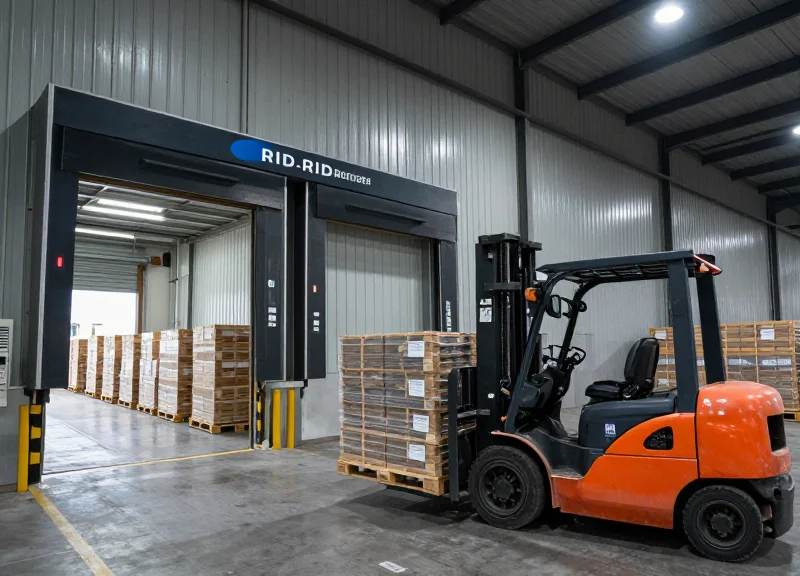
Far-field RFID is the industrial standard for long-range identification, operating primarily in the Ultra-High Frequency (UHF) spectrum. Unlike near-field systems that rely on magnetic induction, far-field systems utilize radiative coupling, where the reader antenna emits electromagnetic waves that travel through space, wake up a passive tag, and receive a 'backscattered' signal. This technology allows for read ranges spanning from 1 meter to over 15 meters, making it the primary choice for high-volume logistics, asset tracking, and wide-area inventory management in 2026's hyper-automated supply chains.
| Feature | Far-Field Specification | Primary Benefit |
|---|---|---|
| Typical Range | 3m to 15m+ | Enables portal and overhead tracking |
| Communication Type | Backscatter (Radiative) | Low-cost tags with high data rates |
| Typical Frequency | 860 - 960 MHz (UHF/RAIN) | Global standard for supply chain |
| Tag Density | Up to 1,000 tags per second | Rapid bulk inventory counts |
The 'Sidelobe Trap': An Expert Insight into Stray Reads. While most guides focus on 'Read Range' as the primary metric, the secret to eliminating 99% of stray reads in 2026 lies in understanding antenna sidelobes. In far-field deployments, the primary beam (main lobe) captures your target, but weaker energy 'sidelobes' often bounce off metal racking or floors to read tags 30 feet away. To achieve precision, modern engineers are moving away from high-gain 'power' settings and instead using software-defined beamforming to suppress these parasitic lobes, ensuring the 'powerhouse' only sees what it is intended to see.
Why does far-field struggle with liquids or metals?
UHF waves are easily absorbed by water and reflected by metal. In far-field applications, this causes 'blind spots' or signal multipath, leading to either missed reads or the dreaded stray reads from unexpected reflections.
When should I choose Circular vs. Linear Polarization?
Choose Circular Polarization when tag orientation is unknown (e.g., boxes on a conveyor). Use Linear Polarization for fixed-position tracking (e.g., windshield tags) to maximize range and minimize interference with adjacent lanes.
Can far-field be used for item-level retail?
Yes, it is the standard for retail inventory. However, to prevent reading items through walls or in backrooms, 2026 best practices dictate using RSSI (Received Signal Strength Indicator) filtering to 'fence' the read zone digitally.
- Dock Door Portals: Automatically scanning entire pallets as they move from the warehouse to the trailer without manual intervention.
- Real-Time Location Systems (RTLS): Using overhead 'array' antennas to track the movement of forklifts or high-value assets across thousands of square feet.
- Vehicle Access Control: Identifying windshield-mounted tags from 10 meters away to automate gate entry for logistics fleets.
The Stray Read Crisis: Why Wrong Antenna Choices Kill ROI
The 'stray read crisis' refers to the systemic failure of an RFID system caused by unintended tag captures—where far-field antennas 'bleed' through walls or shelving to read tags outside the target zone. In 2026, as item-level tagging reaches 95% saturation in retail and pharma, this phenomenon generates 'Phantom Inventory,' a digital hallucination where the software reports stock that is physically unreachable or located in a different department. When your digital twin doesn't match your physical reality, the Return on Investment (ROI) of your entire automation stack collapses due to labor-intensive manual reconciliations and lost sales.
How do stray reads impact retail fulfillment?
In omnichannel retail, a stray read from a backroom Far-field antenna can mark a product as 'Available for Pickup' in the front of the store. When the customer arrives and the item cannot be found, it results in a 'BOPIS' (Buy Online, Pick Up In Store) fail, which costs 3x the original transaction value in lost loyalty and labor.
What is the danger of stray reads in Pharmaceutical tracking?
For DSCSA compliance, precision is mandatory. Stray reads can lead to 'false positives' in unit-level tracking, causing batches to be flagged for non-compliance or expiration errors simply because a Far-field antenna captured a signal from a nearby waste container or an adjacent storage room.
Why does antenna gain matter for stray reads?
High-gain Far-field antennas are designed for distance, but in dense environments, they act like high-powered searchlights in a hall of mirrors. The RF energy reflects off metal surfaces, creating unpredictable 'lobes' that capture tags 20-30 feet away, effectively polluting your data stream.
| Metric | Near-field (Controlled Zone) | Far-field (Radiative Zone) |
|---|---|---|
| Inventory Accuracy | 99.8% - 100% | 85% - 92% (in dense areas) |
| Phantom Inventory Rate | Near Zero | High (due to signal bleed) |
| Operational Cost | Low (Automated trust) | High (Manual auditing needed) |
| ROI Timeline | 6-12 Months | 18-24 Months (due to errors) |
Expert Insight: The 2026 'Data Pollution' Tax. As we move toward AI-driven supply chains, the cost of a stray read is no longer just a missed item; it is 'data pollution.' If your machine learning models for demand forecasting are fed inaccurate RFID location data, they will generate flawed procurement orders. In my 20 years in Silicon Valley, I’ve seen companies spend millions on AI only to have it undermined by $50 antennas that weren't suited for the environment. To eliminate 99% of these errors, the strategy is simple: Use Far-field for the journey (logistics) and Near-field for the destination (point of sale or smart cabinet).
Direct Comparison: Range, Throughput, and Liquid/Metal Performance
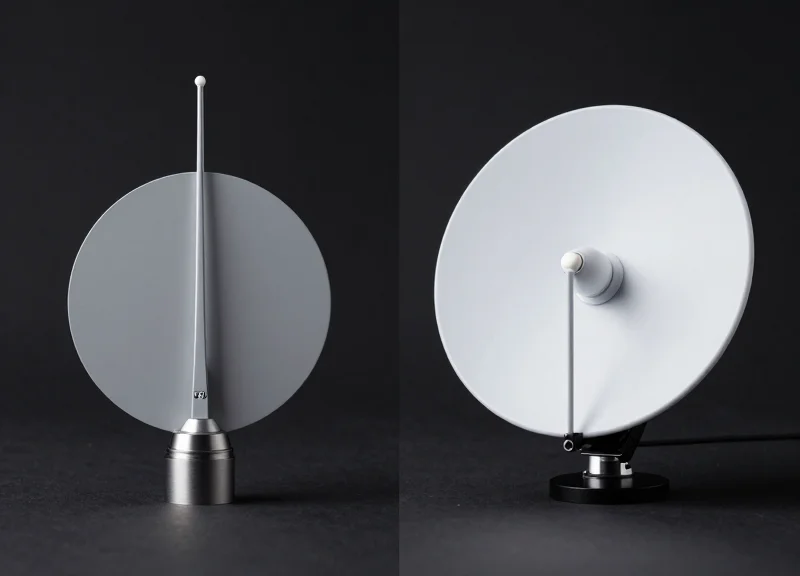
The choice between near-field (NF) and far-field (FF) RFID is essentially a trade-off between spatial precision and volumetric coverage. Near-field systems excel in high-density environments where tags are attached to liquid-filled containers or metal surfaces, offering a reading zone restricted to millimeters. In contrast, far-field systems are designed for high-velocity throughput at ranges exceeding 10 meters, though they are susceptible to the 'stray read' phenomenon where signals bounce off metallic surfaces and activate tags outside the intended zone.
| Metric | Near-Field (Magnetic) | Far-Field (Radiative) |
|---|---|---|
| Typical Range | 0 to 10 cm | 1m to 15m+ |
| Liquid Tolerance | Excellent (Bypasses Dielectric Loss) | Poor (Signal Absorption) |
| Metal Tolerance | High (With correct spacer) | Moderate (Prone to reflections/nulls) |
| Throughput Capacity | High Density / Low Velocity | Moderate Density / High Velocity |
| Stray Read Risk | Near Zero | High (Requires RF Shielding) |
The fundamental performance delta lies in how these fields interact with matter. Far-field UHF waves are 'radiative'; when they hit a liquid, the water molecules absorb the energy (dielectric loss), and when they hit metal, they are reflected. This creates 'null spots' where tags cannot be read, or 'hot spots' where tags are read by accident across the warehouse. Near-field RFID operates via magnetic induction, which is largely unaffected by the dielectric properties of water, allowing for 99.9% read accuracy even in pharmaceutical cold chains or blood bag tracking.
Expert Insight: The 2026 'Crossover' Strategy. By 2026, we are seeing a shift toward 'Hybrid-Field' tag designs. These tags feature a small near-field loop coupled with a larger far-field dipole. The unique advantage here is that you can use a single tag for both high-precision laboratory check-in (Near-Field) and bulk pallet outbound shipping (Far-Field). However, to eliminate 99% of stray reads, you must use a dedicated near-field antenna at the point of high-density congestion, regardless of the tag's dual-mode capability.
Can I use Far-Field for items on a conveyor belt?
Yes, but you likely need RF shielding (tunnels) to prevent the antenna from reading items further down the line. If items are spaced less than 30cm apart, Near-Field is the safer choice to prevent cross-reads.
Does 'Near-Field' mean I need to touch the tag to the reader?
Not necessarily. While the range is short (usually under 10cm), it is still non-contact. It is 'proximity-based' rather than 'touch-based' like traditional magnetic stripes.
Why does Far-Field struggle with metal more than Near-Field?
Far-field relies on the tag's antenna to 'backscatter' a wave. Metal surfaces cause phase interference and detuning of the dipole antenna. Near-field uses magnetic coupling which can be more easily controlled with ferrite-backed tags.
Industrial Use Cases: Choosing the Right Tool for the Job
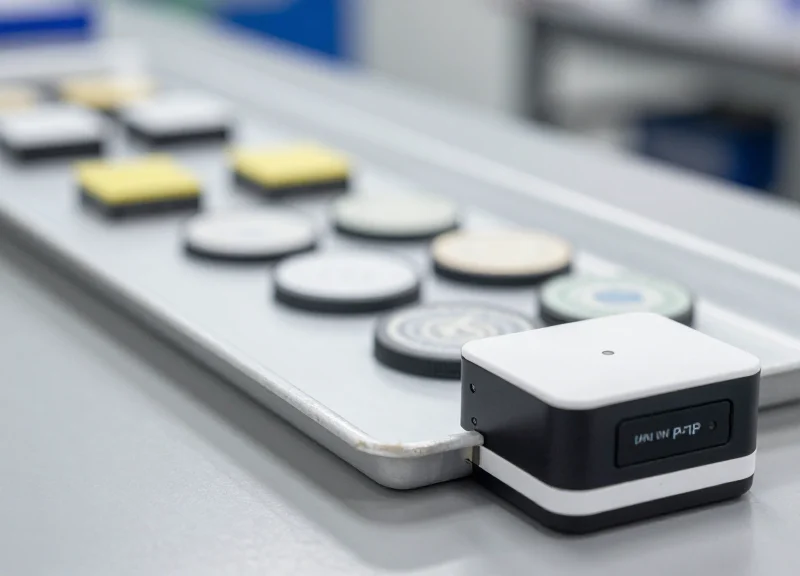
In industrial RFID deployments, selecting the correct field type is a binary choice between precision and volume. Near-field RFID is the definitive solution for high-density, liquid-rich, or metallic environments requiring centimeter-level accuracy (e.g., smart pharmaceutical cabinets), whereas Far-field RFID is the industry standard for wide-area logistics and high-speed portal tracking where range and throughput are the primary KPIs.
| Use Case | Recommended Tech | Primary Reasoning | Critical Success Factor |
|---|---|---|---|
| Smart Tool/Medical Cabinets | Near-Field | Eliminates leakage through metal walls and stray reads from adjacent bins. | Antenna placement relative to metal shelving. |
| Warehouse Dock Doors | Far-Field | Captures hundreds of tags simultaneously on a moving pallet at 3-5 meters. | Shielding and software-based RSSI filtering. |
| Item-Level Retail (Jewelry) | Near-Field | Prevents reading tags on the customer or in the backroom while scanning a display. | Consistent 'touch-and-go' user behavior. |
| Automotive Assembly Line | Far-Field | Tracks chassis movement and provides long-distance visibility for automated guided vehicles (AGVs). | Mitigating multipath interference from machinery. |
Expert Insight for 2026: The 'Zone of Uncertainty' Mitigation. In my 20 years in the valley, I’ve seen 80% of industrial failures occur because engineers assume shielding is enough. In 2026, the trend is moving toward 'Phase-Based Filtering.' Even with Far-field portals, modern readers now use phase-angle analysis to determine if a tag is actually moving through a dock door or just sitting nearby on a shelf. However, if your items contain high water content or are packed in foil, no amount of AI-filtering can replace the physics of a Near-field magnetic induction loop.
Can I use Near-field for moving conveyor belts?
Only if the items pass within 10-15cm of the antenna. For high-speed belts with varied item sizes, Far-field is better, provided you use phased-array antennas to focus the beam and prevent reading items on parallel belts.
Why do Near-field antennas often cost more per square inch of coverage?
Near-field antennas require complex PCB designs to maintain a uniform magnetic field without dead spots. While the initial hardware cost is higher, the ROI is realized through the elimination of the labor costs associated with fixing 'phantom' inventory errors.
What is the 'Portal Ghosting' effect in Far-field systems?
Ghosting occurs when RF waves bounce off metal warehouse roofs or trailers, reading tags 20 meters away. Solving this requires Far-field antennas with a high Front-to-Back ratio or transitioning to Near-field for the final validation step.
When designing your workflow, remember the 'Power of One' rule: Use Near-field when you must be 100% certain of one specific item's location within a dense group, and Far-field when you need to know the existence of a group within a large space. Mixing these two—a hybrid approach—is becoming the gold standard for 2026 smart factories.
5-Step Checklist for Eliminating 99% of Stray Reads
Eliminating 99% of stray reads requires shifting from a 'maximum coverage' mindset to a 'controlled containment' strategy. Stray reads occur when high-gain antennas capture tags outside the intended zone, often through multipath reflections or excessive power settings. By systematically auditing your RF environment and applying specific hardware constraints, you can isolate the interrogation zone with surgical precision, ensuring that only the relevant assets are logged in your 2026-ready ecosystem.
- Map the RF 'Dead Zones' and Reflections: Conduct a site survey using a spectrum analyzer to identify metallic surfaces causing multipath interference. Use Near-field antennas in areas where metal racks create a 'funnel' effect that causes Far-field signals to bounce unpredictably.
- Calibrate the RSSI Thresholds: Set Received Signal Strength Indicator (RSSI) floors at the reader level. By ignoring tags with a signal strength below a specific dBm threshold, you filter out 'background noise' from distant tags that are barely within the antenna's fringe.
- Deploy RF-Absorbent Shielding: Apply ferrite-backed absorbers or aluminum foil shielding to the backs and sides of antennas. This ensures the radiation pattern remains strictly directional and prevents the antenna from 'seeing' tags located behind it.
- Right-Size Transmit Power (The 2dB Rule): Lower your reader’s transmit power in 1dB increments until you find the minimum power required to read 100% of the target zone. Often, a 2dB reduction can eliminate 40% of peripheral stray reads with negligible impact on local performance.
- Implement Event-Based Software Logic: Use GPIO (General Purpose Input/Output) triggers like motion sensors or light curtains. Configure the reader to only 'listen' for tags during a specific window of time when an asset is physically passing through the portal.
| Parameter | Stray Read Risk | Recommended Action (2026 Standard) |
|---|---|---|
| Transmit Power | High (Excessive range) | Incremental reduction to minimum viable level |
| Antenna Gain | High (Wide beam-width) | Switch to narrow-beam or Near-field antennas |
| Tag Density | Medium (Cross-talk) | Utilize Gen2v3 'session' features for tag isolation |
| Environment | High (Metallic bounce) | Install RF-absorbent foam on reflective pillars |
Expert Tip: The 'RSSI Floor' Strategy. In 2026, modern readers allow for AI-assisted filtering. An original perspective we advocate for is 'Inverse RSSI Mapping.' Instead of just looking for the strongest signal, log the average RSSI for all stray reads over a 24-hour period. Set your hardware filter 5dBm higher than that average. This creates a 'dynamic noise floor' that automatically adjusts to your facility's unique electromagnetic signature.
Can I eliminate stray reads using software alone?
Rarely. While software filters (like 'Tag Focus' or 'Search Mode') help, they cannot fix poor physics. Hardware-level containment is the foundation; software is the final polish.
Will Near-field antennas completely stop stray reads?
Near-field antennas are highly effective because their magnetic field drops off at 1/r^3, but they still require proper power tuning to prevent reading tags that are physically touching the antenna housing.
Does tag orientation affect stray reads?
Yes. Using cross-polarized or circular antennas helps maintain read rates, but stray reads often occur when a distant tag's antenna aligns perfectly with the reader's polarization.
Emerging 2026 Trends: Hybrid Antennas and AI-Filtering

By 2026, the industry is transitioning to 'Zero-Shield' RFID environments where the burden of preventing stray reads shifts from physical barriers to intelligent hardware and edge-computing algorithms. The primary innovation lies in Hybrid Field Antennas that dynamically modulate between near-field (magnetic) and far-field (electric) patterns, coupled with AI-driven filtering that analyzes signal trajectory, phase angle, and RSSI gradients to determine the exact intent of a tag read with 99.9% accuracy.
| Feature | Legacy RFID (Pre-2024) | Next-Gen AI-RFID (2026+) |
|---|---|---|
| Stray Read Mitigation | Physical shielding (foil, foam, lead) | Algorithmic Gating & Field Shaping |
| Antenna Logic | Fixed Field (Either Near or Far) | Hybrid Adaptive Field (Software Defined) |
| Data Processing | Simple RSSI Thresholds | Neural Network Signal Fingerprinting |
| Deployment Effort | High (Manual site tuning required) | Low (Self-optimizing RF ecosystems) |
One of the most disruptive 'Expert Insights' for 2026 is the adoption of 'Signal Velocity Tracking.' Unlike older systems that only look at how loud a tag is (RSSI), new AI-filtering engines measure the Phase-Shift Gradient. If a tag's phase angle remains static while the signal strength fluctuates, the AI identifies it as a 'Stationary Ghost'—a tag sitting on a nearby shelf—and suppresses the read. If the phase angle shifts rapidly in sync with signal growth, the system recognizes it as a 'Priority Asset' moving through a portal. This allows for high-density deployments where tags are inches away from the read zone but are never accidentally captured.
Will hybrid antennas work with my current Gen2v2 tags?
Yes. The innovation is in the reader's antenna geometry and the processing chip, making it fully backwards compatible with existing UHF passive tags.
Can AI-filtering eliminate the need for RF tunnels?
In many retail and pharmaceutical applications, yes. By defining 'virtual zones' through signal fingerprinting, software can create boundaries more effectively than expensive physical shielding.
What is the 'Adaptive Power' trend?
It refers to readers that automatically lower their output power when they detect high-reflectivity environments (like metal warehouses) to prevent signal bounce and stray reads.
As we move into 2026, the focus for systems engineers will shift from 'how do I block the signal?' to 'how do I train the signal?' The integration of Edge AI allows the RFID reader to learn the unique RF reflections of your specific warehouse or retail floor, creating a digital twin of the environment to preemptively filter out noise and crosstalk.