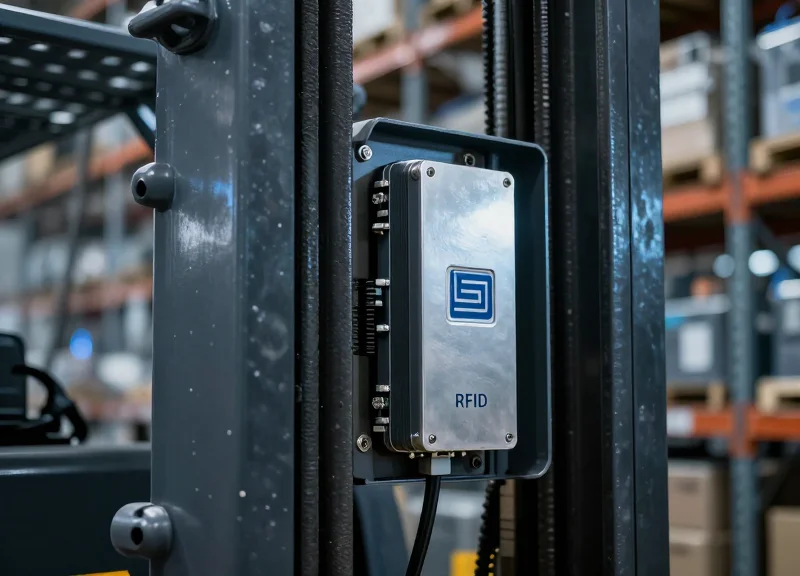
In modern warehouse logistics, RFID technology is essential for real-time tracking, yet metal rack environments present a significant challenge. Metal surfaces reflect radio waves, leading to "ghost reads" or signal dead zones. This guide provides a comprehensive framework for shielding and optimizing forklift-mounted RFID carriage readers, ensuring seamless data capture and zero-interference operations in even the densest metal infrastructures.
The Physics of Interference: Why Metal Racks Disrupt RFID Signals

In warehouse environments, metal racks act as electromagnetic obstacles that disrupt Ultra-High Frequency (UHF) RFID systems through three primary physical phenomena: reflection, absorption, and multipath propagation. Unlike non-conductive materials like wood or plastic, metal surfaces reflect RF energy back into the environment, creating a chaotic 'echo chamber' effect. This leads to destructive interference, where reflected waves arrive at the reader antenna out of phase with the direct signal, effectively canceling the signal out and creating 'null zones' where tags become invisible to the forklift carriage reader.
| Phenomenon | Physical Mechanism | Impact on RFID Reliability |
|---|---|---|
| Reflection | Specular bounce off conductive surfaces | Causes 'ghost reads' of tags in adjacent aisles. |
| Multipath | Phase-shifted waves colliding | Creates 'dead zones' where readers fail to see tags. |
| Detuning | Parasitic capacitance shift | Changes the tag's frequency, making it non-responsive. |
| Faraday Effect | Enclosure of electromagnetic fields | Complete signal blockage within dense metal cages. |
Expert Insight: The 'Near-Field Detuning' Trap. Most logistics managers assume metal simply 'blocks' signals. However, the more insidious culprit is Near-Field Detuning. When a passive RFID tag is placed within 10mm of a metal rack, the metal acts as a parasitic element that shifts the tag’s resonant frequency. Even if your reader is at maximum power, a detuned tag will not 'wake up' because its antenna is no longer tuned to the 902-928 MHz band. This is why specialized 'on-metal' tags with a built-in dielectric spacer are mandatory for carriage-to-rack operations.
Does the type of metal (Steel vs. Aluminum) affect interference?
Yes. Highly conductive metals like aluminum cause more significant eddy currents and reflection than carbon steel. While both are problematic, aluminum racks require more aggressive shielding and narrower beam-width antennas.
Why does signal 'nulling' happen even when the forklift is close to the rack?
This is due to the 'Fresnel Zone' being obstructed. If the metal rack enters the elliptical space between the reader and the tag, it causes phase cancellation, meaning the signal can be at 0% strength even at a 1-meter distance.
Can I simply increase the reader power to punch through the metal?
No. Increasing power (RSSI) often worsens the problem by creating more reflections, leading to more multipath interference and accidental reads of tags located behind the forklift.
Selecting the Right Shielding Materials for Forklift Carriages
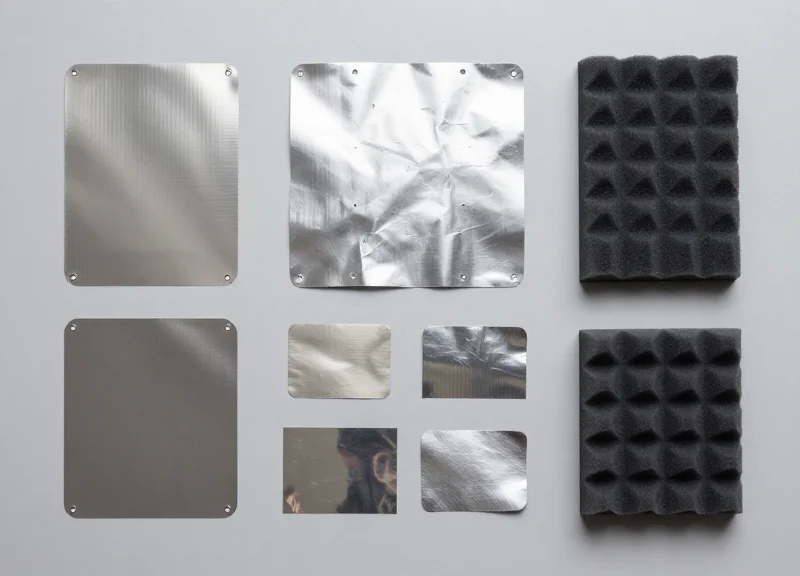
Selecting shielding materials for forklift RFID systems requires a strategic balance between magnetic permeability and microwave absorption. Unlike general electronics, forklift carriages demand materials that can redirect the electromagnetic flux away from the metal frame (using high-permeability ferrite) or dissipate stray RF energy as heat (using carbon-loaded absorbers) to prevent the 'multipath' signal bounce that causes false reads or blind spots in dense metal rack environments.
| Material Type | Primary Mechanism | Optimal Application | Industrial Durability |
|---|---|---|---|
| Flexible Ferrite Sheets | Flux Redirection | Decoupling tags from metal surfaces | High (Vibration Resistant) |
| Carbon-Loaded Foam | Broadband Absorption | Reducing echo in enclosed bays | Moderate (Requires Covering) |
| Metal-Backed Absorbers | Reflection + Absorption | Isolating the reader's backlobe | High (Impact Resistant) |
| Conductive Fabric/Tapes | EMI Gasketing | Sealing gaps in reader housings | Low (Wear-prone) |
Expert Insight: The 'Flex-Ferrite' Mandate. Standard rigid ferrite plates are highly effective but will shatter within weeks due to the mechanical shocks and thermal expansion cycles of a forklift carriage. For industrial deployments, you must specify Polymer-Bonded Flexible Ferrite. This material maintains a high 'Mu' (permeability) while surviving the G-forces of daily warehouse operations. Always check the Curie temperature of your selected material; if the carriage operates near heavy motors or in extreme heat, the shielding could lose its effectiveness if it exceeds its thermal limit.
Why not just use lead or heavy copper foil?
Lead and copper provide electrical shielding (Faraday effect) but do not address the magnetic component of UHF RFID. Without a material with high magnetic permeability (like ferrite), the metal will still reflect waves and create destructive interference.
How thick should the shielding material be?
For 902-928 MHz (Standard US UHF), a thickness of 0.5mm to 1.5mm is usually sufficient for ferrite sheets. For foam absorbers, 3mm to 6mm is required to effectively dampen reflections from the rack uprights.
Can I use adhesive-backed materials?
Yes, but ensure it is an industrial-grade acrylic adhesive. Solvent-based adhesives can degrade the RF-absorbing polymers over time when exposed to hydraulic fluid or warehouse cleaning chemicals.
Strategic Antenna Positioning and Mounting Techniques
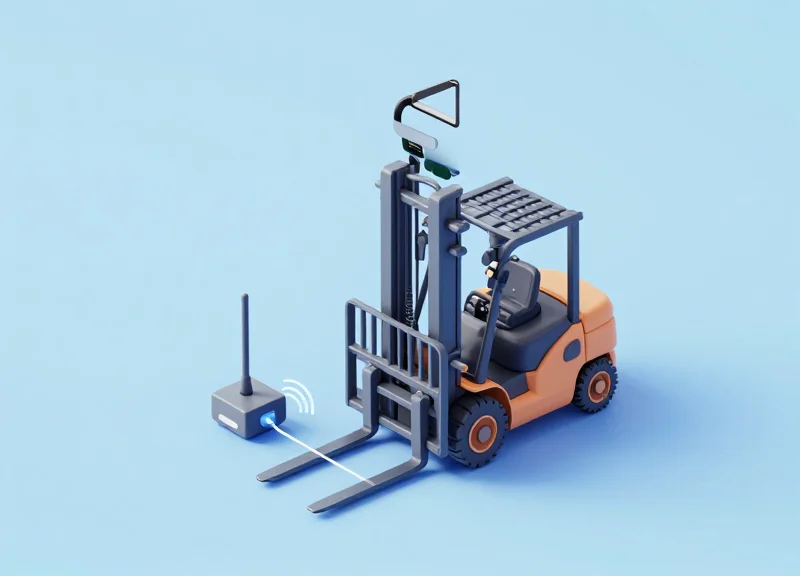
Strategic antenna positioning for forklift RFID readers involves the intentional alignment of the antenna's radiation pattern to maximize Line of Sight (LoS) with tags while minimizing signal reflection (backscatter) from metal racks. By utilizing specific tilt angles—typically between 15 and 30 degrees—and maintaining a calculated standoff distance, engineers can create a 'beam-shaping' effect. This ensures that the primary RF lobe captures the target pallet tag with high gain while the 'null zones' of the antenna are directed toward the most reflective metal surfaces, effectively silencing the environmental noise that causes read failures.
- Determine Polarization Alignment: Match the antenna polarization (linear vs. circular) to the tag orientation. In high-metal environments, circular polarization is often preferred to catch tags at various angles, but linear polarization offers deeper reach if pallet orientation is strictly controlled.
- Implement the 15-Degree Tilt Rule: Avoid mounting antennas perfectly flush with the metal carriage. Angling the antenna downward or upward by 15-30 degrees prevents 'specular reflection,' where the signal bounces directly back into the reader and causes a blind spot.
- Establish Minimum Standoff Distance: Mount the antenna at least 2-4 inches away from the solid metal of the forklift carriage using non-conductive spacers. This prevents the metal from de-tuning the antenna and shifting its resonant frequency.
- Clear the Fresnel Zone: Ensure the first Fresnel zone—the elliptical area around the line of sight—is as free from metal obstructions as possible to prevent phase shifts that weaken the signal.
| Mounting Angle | Backscatter Risk | Read Range Impact | Recommended Use Case |
|---|---|---|---|
| 0° (Flush) | Very High | High (but unstable) | Non-metallic environments only |
| 15° - 20° | Moderate | Optimal | Standard pallet racking; mixed inventory |
| 30° - 45° | Very Low | Reduced | High-density metal racks; deep-lane storage |
Expert Tip: The 'Vibration Isolation' Factor. Most engineers overlook the mechanical impact of forklift operation on RF stability. Beyond just positioning, use rubberized vibration-dampening mounts between the antenna and the carriage bracket. Constant micro-vibrations can cause 'flicker' in the RF beam pattern, leading to intermittent read errors that are often misdiagnosed as signal interference. A stabilized mount ensures the phase center of your antenna remains constant during high-speed transit.
How does Line of Sight (LoS) change in a metal environment?
In metal-rich environments, 'Line of Sight' is not just about visibility; it is about 'RF Clearance.' Metal objects within the signal's path can cause multipath interference, where the same signal reaches the antenna at different times, canceling itself out.
Can I use multiple antennas to solve interference?
Yes, but they must be carefully multiplexed. Using two antennas with different polarizations or heights can cover 'null spots' created by the metal racks, provided the reader software is tuned to manage the rapid switching without creating redundant data.
What is the best mounting height on the forklift carriage?
The antenna should be mounted at the median height of the pallet tags. Mounting too high or too low increases the angle of incidence against the metal shelves, which increases the likelihood of reading the wrong pallet in the next rack over.
Tuning Polarization and Beam-Width for Precision Reading
Tuning polarization and beam-width is the strategic process of shaping the RFID 'read zone' to match the physical footprint of the target pallet while physically excluding interference from surrounding metal structures. In high-interference metal rack environments, precision is achieved by selecting an antenna's electromagnetic orientation—either Linear or Circular—and narrowing the radiation pattern to prevent signal 'bleed' into adjacent rack bays or floors. This configuration acts as a physical filter, ensuring the forklift reader only interacts with the tag directly in front of the carriage, effectively eliminating the 'ghost reads' caused by signal bouncing off metal beams.
| Feature | Linear Polarization | Circular Polarization |
|---|---|---|
| Tag Alignment | Must be perfectly aligned with antenna. | Reads tags at any orientation/angle. |
| Signal Range | Longer, concentrated reach. | Shorter, more localized reach. |
| Metal Reflection | High risk of multipath interference. | Superior at mitigating 'signal bounce'. |
| Best Use Case | Consistent, known tag placement. | Variable pallet loading and dense racking. |
While Linear polarization offers more range, it is often a liability in metal-heavy environments because its narrow wave plane reflects predictably and powerfully off flat metal surfaces, leading to false reads of pallets located three aisles away. Circular polarization is generally the industry standard for carriage-mounted readers because it emits a corkscrew-shaped wave that is much more likely to hit a tag regardless of its orientation and less likely to create a cohesive reflection that confuses the reader.
- Assess the Fresnel Zone: Identify the 'first radius' of your RF signal. In metal racks, you must ensure that the path between the antenna and the pallet tag is clear of structural steel to prevent the beam from diffracting before it reaches the target.
- Select Narrow Beam-Width Antennas: Choose antennas with a beam-width of 60 degrees or less. Standard wide-beam (90-120 degree) antennas will illuminate the rack beams above and below the forklift, causing massive backscatter.
- Execute a Power Step-Down Test: Start at maximum transmission power and gradually reduce it. The goal is to find the 'Minimum Viable Power' (MVP) that reads the target pallet consistently but lacks the energy to penetrate the metal reflections of the surrounding bays.
- Implement Side Lobe Suppression: Use RF-absorbent shrouds to 'choke' the side lobes of the antenna. This focuses 100% of the energy into the primary forward-facing lobe, which is critical for precision in narrow-aisle environments.
Expert Insight: The 'Aperture Effect' in Metal Racks. Many engineers mistakenly try to solve rack interference by increasing reader sensitivity. In reality, a high-density metal rack acts like a series of mirrors. A unique veteran tip is to use 'Asymmetric Beam-Width' antennas—specifically those with a wide horizontal beam but a very narrow vertical beam. This allows the forklift to capture tags across the width of the pallet while preventing the signal from leaping vertically into the next rack level, which is the most common cause of inventory reconciliation errors.
Can I use software to adjust beam-width?
No, beam-width is a physical property of the antenna's hardware design. You can adjust the 'power' via software, but to change the 'angle,' you must switch the antenna or use physical shielding to narrow the aperture.
Why does circular polarization reduce ghost reads?
When a circular wave hits a metal surface, its 'handedness' (rotation) reverses. Most circular antennas are designed to ignore waves with the 'wrong' rotation, effectively filtering out reflected signals that have bounced off the metal racks.
Is linear polarization ever better for forklifts?
Only in 'Tunnel' applications where you have a single, controlled entry point and all tags are guaranteed to be oriented the same way. In general warehouse environments, it is too sensitive to alignment issues.
Configuring RSSI Thresholds and Read Filtering

RSSI (Received Signal Strength Indicator) filtering is a software-level optimization technique that allows an RFID reader to distinguish between a 'valid' tag in the immediate pick zone and 'ghost' tags reflected off distant metal surfaces. By setting a minimum power threshold (typically measured in dBm), the system can programmatically ignore any signals that fall below a specific intensity, ensuring that only the tag directly in front of the forklift carriage is processed.
| Signal Range (dBm) | Classification | Action Recommendation |
|---|---|---|
| -30 to -50 dBm | Primary Target | Accept and process immediately. |
| -55 to -65 dBm | Proximity Noise | Apply temporal filtering or RSSI windowing. |
| -70 dBm and lower | Multipath Reflection | Discard; likely a ghost read from an adjacent rack. |
Expert Tip: In metal-rich environments, signal strength is rarely static. Use a 'Moving Average RSSI Filter' rather than a hard cutoff. A tag should only be considered 'valid' if its average signal strength remains above your threshold for at least 3 consecutive read cycles (approx. 100-200ms). This prevents 'flash reads'—momentary signal spikes caused by RF bouncing off a moving forklift mast—from triggering false positives.
- Establish a Baseline: Place a test tag on a pallet at the standard pick distance. Record the RSSI values while the forklift mast is at various heights to identify the 'Floor' of a legitimate read.
- Map the Reflection Zone: Drive the forklift past adjacent racks with tags present. Identify the 'Peak' RSSI of these unwanted reads; your software threshold must be set at least 3-5 dBm above this peak.
- Implement Temporal Read Filters: Configure 'Read-Count' filters. Require that a tag be seen 'X' times within a 250ms window before the middleware reports it to the WMS, filtering out transient reflections.
- Apply Delta-RSSI Logic: Configure the reader to prioritize the tag with the highest upward trend in RSSI, which mathematically indicates the forklift is moving toward that specific tag.
{
  "AntennaConfiguration": {
    "RSSIThreshold": -58,
    "SearchMode": "DUAL_TARGET",
    "TagPopulationEstimate": 32,
    "ReadFilter": {
      "MinReadCount": 3,
      "TimeWindowMS": 250
    }
  }
}
What is a 'Ghost Read' in metal racks?
A ghost read occurs when RF energy bounces off metal shelving and illuminates a tag on a different aisle or shelf, which then reflects back to the reader, appearing as if it is in the current pick zone.
Why not just lower the antenna power?
Lowering power reduces the 'read bubble,' but in high-ceiling or narrow-aisle environments, it may prevent you from reading the target tag reliably if it is slightly misaligned. RSSI filtering is more surgical than raw power reduction.
How does moisture or humidity affect RSSI settings?
High humidity can attenuate signals. If your warehouse is not climate-controlled, you may need 'Dynamic RSSI Thresholding' that adjusts based on the ambient noise floor measured during the morning boot-up sequence.
Hardware Protection: Ruggedizing Readers for Industrial Use
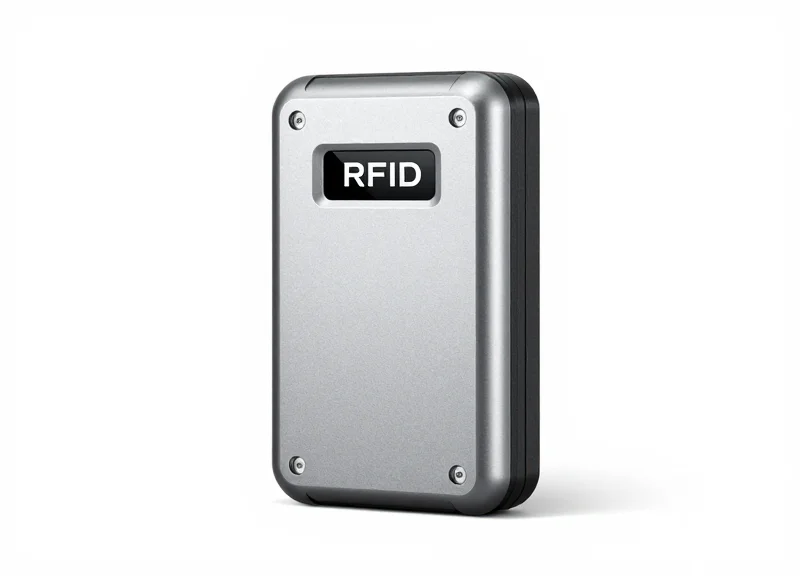
Ruggedizing forklift RFID readers is the engineering practice of reinforcing sensitive electronics and interference-shielding materials against the high-G forces, constant vibration, and physical impacts inherent in warehouse logistics. Beyond simply protecting the device from breaking, professional-grade ruggedization ensures that shielding components—such as ferrite sheets and RF absorbers—remain in their precise, calibrated positions to prevent 'shielding drift' and subsequent signal interference.
| Feature | Standard Office Grade | Industrial Forklift Grade |
|---|---|---|
| Vibration Resistance | Minimal (standard PCB mounting) | Mil-Std-810G (shock/vibration rated) |
| Ingress Protection | IP54 (Basic dust protection) | IP67/IP69K (High-pressure washdown) |
| Impact Rating | IK04 (Light plastic housing) | IK09/IK10 (Cast aluminum/Polycarbonate) |
| Shielding Integrity | Adhesive-only attachment | Mechanical retention + conductive epoxy |
One of the most overlooked aspects of hardware protection is the 'Shielding Drift' Phenomenon. In a warehouse environment, the micro-vibrations of a forklift's engine and the jarring impact of floor joints can cause adhesive-backed shielding materials to shift by even a few millimeters. This movement can change the antenna's resonance and radiation pattern, turning a once-optimized reader into a source of ghost reads or dead zones. To mitigate this, experts recommend using mechanical retention clips or specialized conductive epoxies rather than standard tapes.
How does moisture impact ruggedized RFID readers?
Moisture ingress can create conductive bridges on the PCB or inside the antenna housing, which alters the impedance and severely degrades RF performance. An IP67 rating is mandatory for environments with temperature fluctuations to prevent condensation.
Is metal casing better than plastic for RFID reader protection?
While metal (like cast aluminum) offers superior physical protection and heat dissipation, it can interfere with the RF signal if the antenna is internal. For carriage-mounted readers, a hybrid approach—metal housing for the reader and ruggedized polycarbonate for the antenna radome—is usually the most effective.
What is the role of armored cabling in hardware protection?
RF cables are often the first point of failure. Using stainless steel flexible conduits or high-flex 'C-Track' cables prevents the coaxial core from kinking or fraying during the repetitive lifting motions of the forklift carriage.
- Apply Thread-Locking Fluid: Use medium-strength thread-locker (e.g., Loctite 243) on all mounting bolts to prevent them from loosening due to the constant 24/7 vibration of the forklift mast.
- Install Vibration Isolation Mounts: Utilize rubber or wire-rope isolators between the forklift carriage and the reader enclosure to decouple the hardware from mechanical shocks.
- Seal Cable Entry Points: Use industrial-grade cable glands (nickel-plated brass or nylon) to maintain the IP rating where the RF and power cables enter the protective enclosure.
Expert Tip: Consider the thermal management of your 'shielded' enclosure. While thick shielding and heavy-duty cases protect the hardware, they can also trap heat. Always select a reader rated for extended temperature ranges (-20°C to +55°C) and ensure the enclosure design facilitates passive heat dissipation through the mounting plate, which can act as a secondary heatsink.
Step-by-Step Calibration and Field Testing Protocol
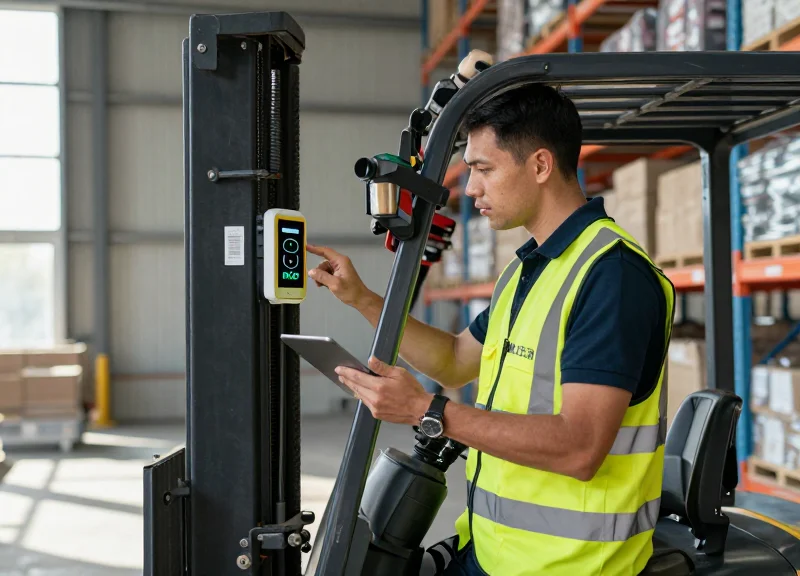
The Calibration and Field Testing Protocol is a systematic validation process used to verify that forklift RFID carriage readers perform accurately within high-density metal environments. Unlike open-air testing, field testing in a warehouse requires measuring the 'Null Zone'—the area where signals are successfully blocked—just as much as the 'Read Zone.' This ensures that while the target pallet is identified, the surrounding metal racks and adjacent inventory do not trigger 'ghost reads' or signal multipath errors.
- Baseline Static Validation: Position the forklift 24 inches from a standard metal rack with a test tag. Gradually increase the reader power until a consistent 100% read rate is achieved, then lock this as your 'Floor Power' setting.
- Cross-Talk Interference Mapping: Place tags on the racks immediately above, below, and to the sides of the target slot. If these tags are detected, increment the RSSI filter threshold or adjust shielding angles until only the target tag is visible.
- Dynamic Velocity Testing: Drive the forklift toward the rack at operational speeds (3–5 mph). Validate that the 'Time-to-Read' is sufficient for the software to register the tag before the carriage reaches its final lift height.
- The 'Sacrificial Tag' Stress Test: Place a tag on the far side of a metal upright. This test ensures that your shielding is effectively dampening the backscatter reflections common in narrow-aisle environments.
| Metric | Target Value | Failure Condition |
|---|---|---|
| Read Accuracy | 99.9%+ | <98% over 50 passes |
| RSSI Margin | 10dBm+ delta | Cross-talk within 5dBm of target |
| Read Latency | <250ms | >500ms (causes operational delay) |
| Ghost Reads | Zero | Any detection of non-target inventory |
Expert Tip: The 'Fresnel Zone' Trap. Many engineers overlook that metal racks can act as unintended wave guides. During your field test, always perform a 'vibration test'—shake the forklift carriage slightly while reading. If the RSSI fluctuates by more than 15%, your shielding is likely causing internal resonance, and you should add a thin layer of RF-absorbing foam between the reader and the metal mounting plate.
Why do I get reads from the rack behind the forklift?
This is likely 'Back-Lobe' interference. Even with front shielding, RF energy can wrap around the carriage. Ensure you have installed a ferrite backing behind the antenna to kill the rear signal propagation.
What should I do if the read rate drops when the forklift is loaded?
The load itself (especially if it contains liquids or metal) changes the RF environment. Calibrate your power settings using the 'Worst-Case Load' scenario to ensure consistency.
How often should field testing be repeated?
Conduct a re-calibration every 6 months or whenever the warehouse racking configuration is altered, as new metal structures change the local multipath environment.
Ongoing Monitoring and Interference Audits
Ongoing monitoring and interference audits are the systematic processes of verifying that RFID signal integrity remains within calibrated parameters as warehouse environments evolve. Unlike static environments, metal rack warehouses are dynamic ecosystems where moving inventory, new machinery, and structural changes can cause 'interference drift'—a slow degradation of read rates that occurs when the RF environment shifts away from its initial calibration state. Regular audits ensure that your shielding, RSSI filters, and mounting angles continue to provide zero-interference performance despite these environmental fluctuations.
- Monthly Signal Mapping: Conduct a sweep of known high-interference zones (e.g., dense metal cross-beams) to ensure the 'null zones' established during initial calibration have not shifted due to floor settlement or rack re-profiling.
- Hardware Integrity Check: Inspect the physical RFID carriage shielding for micro-fractures or loosening mounts. In a metal-heavy environment, even a 2-degree shift in antenna tilt can cause backscatter interference from the racks.
- Log Analysis for Ghost Reads: Review the reader’s internal logs for an uptick in discarded tags. A sudden increase in filtered tags often indicates a new source of multipath interference, such as a recently installed conveyor system or overhead door.
- Firmware and Threshold Optimization: Verify that RSSI thresholds are still appropriate for current pallet densities. If the average inventory weight or material composition has changed (e.g., switching from plastic to foil-lined packaging), thresholds must be re-tuned.
| KPI Metric | Target Range | Intervention Trigger |
|---|---|---|
| First-Pass Read Rate | 99.5% - 100% | < 98.0% over 24 hours |
| Average RSSI Delta | < 5 dBm variance | Sudden >10 dBm spike/drop |
| Ghost Read Frequency | < 0.1% of total reads | Detected reads outside carriage zone |
| Ambient Noise Floor | -70 dBm to -90 dBm | Noise floor rising above -60 dBm |
Expert Tip: The 'Canary' Reference Tag Strategy. To differentiate between a reader hardware failure and environmental interference, mount a 'Reference Tag' at a fixed, shielded location on the forklift frame itself, just at the edge of the reader's range. If the reader's ability to see this 'Canary' tag fluctuates while the forklift is stationary, the issue is environmental interference or EMI. If the tag is lost entirely, the issue is likely hardware or shielding degradation. This allows maintenance teams to diagnose the root cause in seconds rather than hours.
How often should interference audits be performed?
Full audits should occur quarterly, but automated KPI monitoring should be real-time. Any significant change to warehouse layout (e.g., adding a new row of racks) should trigger an immediate ad-hoc audit.
Can software updates impact interference?
Yes. Firmware updates for the RFID reader or the middleware can sometimes reset power levels or sensitivity settings. Always re-verify RSSI filters after any software patch.
What tools are needed for a professional audit?
In addition to the reader's own diagnostic software, a handheld RF spectrum analyzer is recommended to identify 'noise' from non-RFID sources like Wi-Fi access points or industrial motors.