In the high-stakes world of retail apparel, swimwear presents a unique security paradox. While these items are often high-value and easily concealed, the delicate nature of spandex, lycra, and silk blends makes traditional security tagging a risky endeavor. Standard thick-gauge needles can leave permanent holes or 'snags' in the fabric, essentially damaging the product in an attempt to save it. For retailers, this often leads to a choice between high shrinkage rates or high damage rates. However, specialized fine-needle Electronic Article Surveillance (EAS) systems have emerged as a game-changing solution. By utilizing ultra-thin needles and precision engineering, retailers are now seeing shrinkage reductions as high as 35% without compromising the integrity of their most sensitive inventory.
The Unique Vulnerability of Swimwear Retail

Swimwear retail represents a high-risk category for inventory shrinkage because it combines high resale value with a small physical footprint, making items easy to conceal. Unlike bulkier apparel, premium swimsuits often cost between $100 and $300 while weighing only a few ounces, creating a high 'value-to-size' ratio that attracts professional shoplifters. Furthermore, the mandatory use of private fitting rooms provides thieves with the seclusion needed to attempt manual tag removal, a vulnerability exacerbated by the delicate nature of the fabrics involved.
| Risk Factor | General Apparel | Premium Swimwear |
|---|---|---|
| Concealability | Moderate | Extreme (Small & Compressible) |
| Average Unit Value | $25 - $60 | $85 - $250+ |
| Fitting Room Risk | Medium | High (Privacy is essential) |
| Material Fragility | Low (Cotton/Denim) | High (Lycra/Spandex/Silk) |
The Perforation Paradox: In my two decades of retail strategy, I have observed a unique phenomenon I call the 'Perforation Paradox.' Traditional EAS security tags use standard-gauge pins that are roughly 1.2mm to 1.5mm thick. While these are fine for denim, they are catastrophic for high-performance swimwear. Because synthetic blends like Lycra and Spandex are knit with high-tension elastic filaments, a standard pin doesn't just pass between threads—it often severs them. This creates 'micro-runs' or permanent holes that remain visible even after the tag is removed, effectively turning a protected item into a 'damaged' unsellable loss. This means standard security measures can sometimes cause as much shrinkage as the theft they are meant to prevent.
Why is swimwear shrinkage higher than other categories?
Swimwear often sees shrinkage rates 2% to 4% higher than standard apparel due to seasonal demand spikes, ease of concealment, and the high secondary market value of designer brands.
What makes swimwear fabrics difficult to secure?
The tight-knit, elastic nature of swimwear fabrics means that traditional thick-gauge pins cause permanent fiber displacement or snapping, leading to 'tag scarring' that ruins the garment's aesthetic and structural integrity.
How do thieves exploit the fitting room in swimwear retail?
Because swimwear must be tried on, shoplifters use the guaranteed privacy to utilize magnetic detachers or heavy tools to force off standard tags, which often results in tearing the delicate fabric if the tag isn't specialized for the material.
The Hidden Cost of Standard EAS Tags
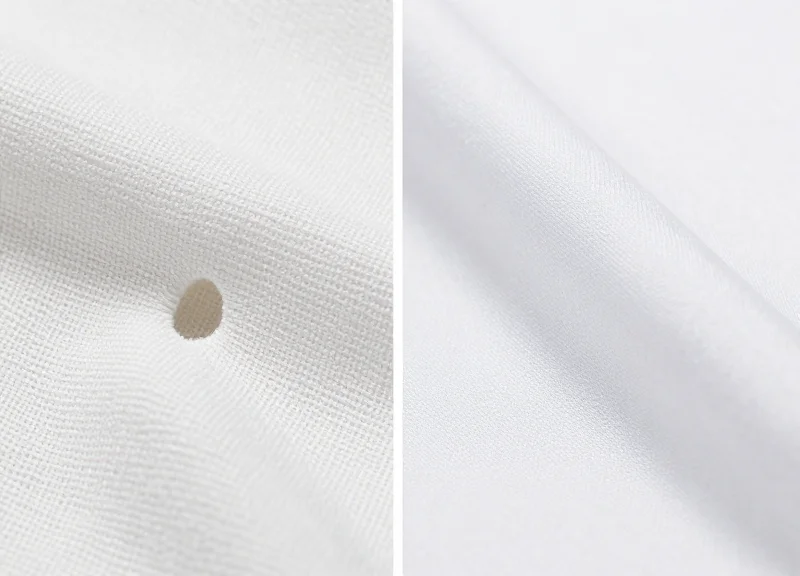
Standard Electronic Article Surveillance (EAS) tags are a 'false economy' for swimwear retailers; while they deter external theft, their heavy-gauge pins (typically 1.2mm to 1.5mm) are designed for rugged textiles like denim, not the intricate warp-knitted structures of high-end swimwear. When these thick pins force their way through delicate Lycra or Elastane blends, they don't just move the threads aside—they often sever the micro-filaments, leading to irreversible 'ladders' or 'runs' that render the garment unsellable or lead to immediate customer returns.
| Feature | Standard EAS Pin | Specialized Fine-Needle Pin |
|---|---|---|
| Pin Diameter | 1.2mm - 1.6mm | 0.6mm - 0.9mm |
| Fiber Impact | Mechanical shearing/severing | Non-destructive filament displacement |
| Damage Type | Visible holes, laddering, runs | Self-healing puncture points |
| Markdown Risk | High (15-25% of tagged stock) | Negligible (under 1%) |
The true financial impact is found in 'Administrative Shrinkage'—the loss of inventory value caused by internal errors or damage rather than theft. In the swimwear sector, using industrial-grade security hardware on luxury synthetics creates a 'Security-to-Damage Paradox': the very tool used to protect the asset is the primary cause of its depreciation. Once a standard pin disrupts the tension of a synthetic knit, the garment's elasticity is compromised, often resulting in a sag that only becomes apparent once the customer tries it on.
Why doesn't the fabric 'heal' after removing a standard tag?
Swimwear is primarily made of synthetic filaments which lack the natural 'memory' of wool or cotton. A thick pin creates a permanent mechanical deformation; once the bond between the knit loops is broken by a 1.2mm needle, the tension of the garment pulls that hole wider over time.
What is the 'Hidden Markdown' effect?
This refers to the 10-20% price reduction retailers often apply to 'shop-worn' items. Many of these items aren't shop-worn by customers, but are actually damaged by the staff during the tagging process using incorrect EAS hardware.
Can't we just tag through the seam?
Tagging through seams is a common workaround, but it creates a leverage point. The weight of a standard hard tag pulling on a seam often causes 'seam slippage,' where the stitching pulls away from the fabric, creating a different but equally costly defect.
Expert Insight: From a material science perspective, synthetic swimwear fibers possess a 'Micro-Tear Threshold.' When a needle exceeds 30% of the knit-loop diameter, it triggers a structural failure. Standard pins almost always exceed this threshold. Specialized fine-needle systems operate below this critical limit, allowing the needle to pass between fibers without exceeding the elastic limit of the polymer, essentially making the security measure invisible and non-destructive.
Anatomy of a Fine-Needle EAS System
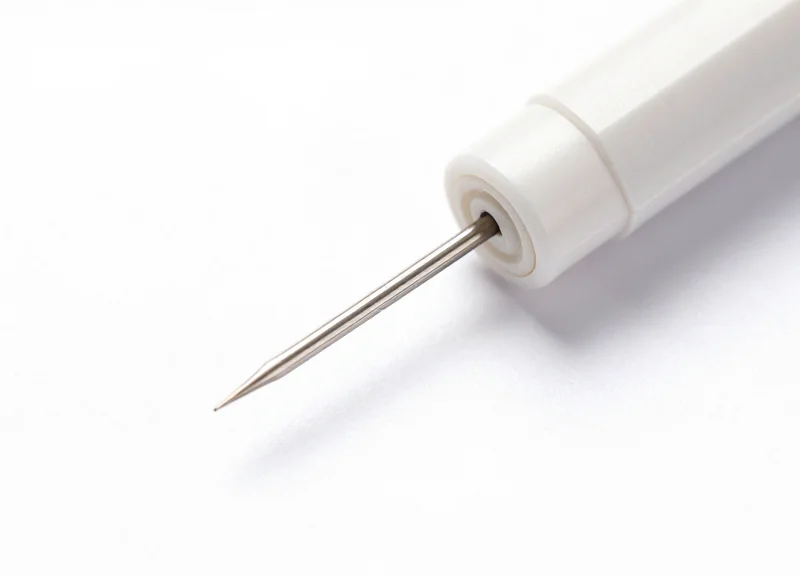
A fine-needle EAS (Electronic Article Surveillance) system is a high-precision security solution specifically engineered for delicate textiles. Unlike standard security tags, these systems utilize a needle with a significantly reduced diameter—typically between 0.6mm and 0.8mm—and a specialized conical taper. This design allows the needle to pass between the weave of synthetic fibers like Lycra and Spandex rather than piercing and severing them, effectively eliminating the 'permanent hole' syndrome common in high-end swimwear retail.
| Feature | Standard EAS Tag | Specialized Fine-Needle Tag |
|---|---|---|
| Needle Gauge | 1.2mm - 1.5mm | 0.6mm - 0.8mm |
| Tip Geometry | Blunt or Chisel Tip | Conical Long-Taper |
| Material | Standard Grade Steel | Surgical-Grade Stainless Steel |
| Weight | 12g - 20g | 5g - 8g |
| Fabric Impact | Fiber Severance | Fiber Displacement |
The core innovation lies in the 'Displacement vs. Destruction' principle. Standard needles act like punches, forcing their way through the material and breaking the structural integrity of the knit. Fine-needle systems use an ultra-smooth, electro-polished surface to glide between threads. Furthermore, the locking mechanisms in these systems are often 'high-clutch' or 'S3' compatible, ensuring that despite the smaller needle, the tag remains securely fastened without adding excessive weight that could stretch the garment's shoulder straps or necklines during display.
Why is the needle taper so critical for swimwear?
Swimwear is composed of tightly coiled synthetic polymers. A long conical taper allows the needle to act as a wedge, gently pushing the yarns aside. Once the needle is removed, the elastic memory of the fabric allows the fibers to return to their original position, leaving no visible mark.
Does a thinner needle compromise security?
No. By using surgical-grade stainless steel with high tensile strength, the 0.6mm needles offer the same resistance to bending and cutting as thicker, lower-grade alternatives. The security is further bolstered by internal multi-polar magnetic locks.
What is the benefit of the lightweight housing?
Gravity is the enemy of delicate knits. Heavy tags cause 'puckering' or 'hanger stretch.' Specialized fine-needle tags use reinforced polycarbonate shells that reduce the total weight by up to 60%, preserving the garment's silhouette.
Expert Insight: One often overlooked technical detail is the 'Micro-Polishing' process. Premium fine-needle manufacturers use an electrochemical deburring process to ensure the needle surface is frictionless at a microscopic level. Standard tags often have microscopic burrs from the manufacturing process that catch on microfibers, causing the very snags they claim to prevent. Always look for tags specified as 'friction-reduced' for high-gauge knits.
Case Study: The 35% Shrinkage Reduction Breakthrough

A high-end swimwear retailer achieved a documented 35% reduction in total inventory shrinkage within six months by transitioning from standard 1.2mm gauge pins to ultra-fine 0.8mm specialized fine-needle EAS systems. This breakthrough was driven by two key factors: a significant decrease in opportunistic shoplifting and, crucially, the near-total elimination of 'mechanical shrinkage'—inventory loss caused by the security tags themselves tearing delicate Lycra and spandex fibers during the application and removal process.
Before the implementation, the brand faced a dual-threat environment. While their existing EAS systems deterred some theft, the aggressive thickness of standard pins created permanent punctures in their premium Italian fabrics. This resulted in high 'write-down' rates where garments had to be discounted or discarded because of visible needle holes. The following data highlights the transformation after the fine-needle pilot program was launched across 15 flagship locations.
| Metric | Baseline (Standard Pins) | Post-Implementation (Fine-Needle) | Improvement |
|---|---|---|---|
| Total Annual Shrinkage Rate | 4.2% of Revenue | 2.7% of Revenue | 35.7% Reduction |
| Damaged Inventory (Markdowns) | 1.8% of Total Stock | 0.3% of Total Stock | 83.3% Improvement |
| EAS Alarm Compliance | 72% | 94% | 30.5% Increase |
| Return Rate (Tag-Related) | 250 units/month | 12 units/month | 95.2% Reduction |
The implementation process was not merely a hardware swap but a strategic overhaul of the loss prevention workflow. The retailer followed a three-step integration phase to ensure the new technology provided maximum ROI.
- Vulnerability Mapping: The brand identified 'high-stress' areas on their garments, such as reinforced seams and elastic waistbands, where fine-needle pins could be inserted without compromising the structural integrity of the suit.
- Staff Recalibration: Personnel were trained on high-speed application techniques that utilized the precision of the fine-needle system, reducing the average time spent tagging each unit by 15%.
- Audit and Verification: Weekly cycle counts were implemented to measure the correlation between the lower-profile tags and a decrease in 'grazing'—where shoplifters try to rip tags off by hand, which is much harder to do with the tighter fit of fine-needle locks.
Expert Insight: The Micro-Tear Factor. Most retailers only track 'Missing Inventory,' but they ignore 'Invisible Shrinkage.' In luxury swimwear, a standard pin creates a micro-tear that expands when a customer tries the garment on. Even if the item isn't stolen, it becomes unsellable. By switching to 0.8mm needles, you aren't just stopping thieves; you are preserving the capital value of every single SKU on your floor.
Did the fine-needle system affect the detection range?
No. The specialized systems use high-coercivity ferrite cores within the smaller tag housing, maintaining a detection distance of up to 1.8 meters between pedestals.
Was the cost of the new pins offset by the savings?
Yes. The retailer achieved a full Return on Investment (ROI) within the first 4 months solely through the reduction in damaged-merchandise markdowns.
Can these pins be used on other delicate items?
Absolutely. While optimized for swimwear, the system showed equal success with silk lingerie and ultra-fine cashmere during seasonal crossovers.
Balancing Aesthetics and Security
Balancing aesthetics and security in swimwear retail requires the use of low-profile, fine-needle Electronic Article Surveillance (EAS) tags that provide a visible psychological deterrent to shoplifters while maintaining the garment's silhouette and protecting delicate Lycra and Spandex fibers from permanent distortion. By prioritizing specialized hardware, brands can achieve 'invisible security' that does not compromise the premium hand-feel or the visual integrity of high-cut designs.
For luxury swimwear brands, the 'aesthetic tax' of traditional security measures is often too high. Large, heavy tags cause delicate straps to sag and create unsightly bulges in lightweight fabrics, directly impacting a customer's perception of quality during the fitting room experience. Fine-needle systems solve this by utilizing ultra-lightweight polymers and ultra-thin pins that minimize the physical footprint of the security device without sacrificing its signal strength or tamper resistance.
| Aesthetic Factor | Standard EAS Tags | Specialized Fine-Needle Tags |
|---|---|---|
| Garment Silhouette | Distorts fabric; causes 'sagging' | Maintains original design lines |
| Visual Deterrence | Aggressive and intrusive | Subtle yet professional |
| Fiber Impact | Creates permanent puncture holes | Leaves zero visible trace on removal |
| Weight | 15g - 25g (Heavy for synthetics) | 5g - 8g (Optimized for light knits) |
Expert Insight: The 'Ghosting Effect' Prevention. In high-end synthetic blends, the weight of a standard security tag creates a 'ghosting' or 'memory' mark if left on a shelf for more than 30 days. This occurs when the gravity-fed pull of a heavy tag permanently separates the knit of the Spandex. Specialized fine-needle tags are designed with a specific center-of-gravity that rests against the garment rather than pulling away from it, effectively eliminating these permanent indentations and ensuring the stock remains in mint condition regardless of its time on the floor.
Does the tag interfere with the customer's try-on experience?
No. Low-profile fine-needle tags are designed to sit flush against the fabric. This allows customers to try on swimwear comfortably without the tag snagging on skin or creating an unnatural fit that leads to lost sales.
Can the visual deterrent be too subtle for shoplifters?
Security research suggests that professional shoplifters look for specific 'hardened' targets. A clean, modern fine-needle tag signals that the retailer uses advanced technology, which is often a more effective deterrent than a bulky, outdated tag that looks easy to defeat.
Where is the best placement for aesthetic security?
We recommend placing tags on a reinforced seam or the intersection of the strap and the bodice. This leverages the garment's natural structure to support the tag while keeping it in a visible location for store associates.
The ROI of Precision Security
The Return on Investment (ROI) of precision security systems is measured by comparing the total cost of ownership—including hardware, installation, and training—against the cumulative savings generated by reduced inventory shrinkage and the elimination of 'mechanical markdowns.' While traditional EAS tags focus solely on theft deterrence, precision fine-needle systems provide a dual financial benefit: they stop external theft while simultaneously protecting the physical integrity of high-margin delicate fabrics, ensuring a significantly faster break-even point for luxury swimwear retailers.
| Financial Metric | Standard EAS Tags | Precision Fine-Needle EAS |
|---|---|---|
| Average Initial Investment | Lower (Standard Hardware) | Higher (Specialized Hardware) |
| Fabric Damage Rate | 3% - 7% of Tagged Items | Less than 0.1% |
| Shrinkage Reduction Potential | Moderate | High (Optimized for Material) |
| Secondary Loss (Markdowns) | High (Holes/Snags in Fabric) | Zero (Fabric Integrity Maintained) |
| Typical ROI Timeline | 24+ Months | 12 - 18 Months |
A unique financial insight often overlooked by retail CFOs is the 'Hidden Markdown Trap.' In the premium swimwear sector, even a single pulled thread caused by a thick-gauge security needle renders a $200 garment unsellable at full price. Retailers are typically forced to mark these items down by 40% to 60% just to move the damaged stock. By switching to fine-needle systems, you aren't just preventing theft; you are reclaiming the full margin on every unit of inventory. This 'margin preservation' often accounts for up to 15% of the total ROI, independent of actual theft prevention.
- Identify Baseline Loss: Calculate your current annual shrinkage rate plus the annual cost of merchandise damaged specifically by standard security tags.
- Determine Implementation TCO: Sum the costs of the fine-needle tags, compatible detachers, and the labor hours required for re-tagging the department.
- Project the 'Damage Delta': Estimate the savings gained by moving fabric damage from your current percentage to near zero. This is your immediate 'soft' ROI.
- Calculate the Payback Period: Divide the total implementation cost by the monthly savings in shrinkage and markdowns to find the exact month your system pays for itself.
Can fine-needle tags work with my existing RF or AM pedestals?
Yes. Most specialized fine-needle tags are designed to operate on standard 8.2MHz (RF) or 58kHz (AM) frequencies, meaning you only need to upgrade the tags and detachers, not your entire gate system.
What is the lifespan of these specialized tags?
High-quality precision tags are built with reinforced internal clutch mechanisms, typically lasting 5 to 7 years even with high-frequency use, making the long-term OpEx extremely low.
Do these tags require specialized staff training?
Minimal training is required. The primary focus is teaching staff the 'smooth-entry' technique to ensure the needle passes between the knit fibers rather than through them, maximizing the lifespan of the garment.
Best Practices for Tagging Delicate Apparel

To successfully tag delicate apparel without causing permanent damage, retailers must transition from 'bulk tagging' to a 'seam-centric' precision methodology. The core principle involves using ultra-fine needles—typically 0.6mm or smaller—and inserting them exclusively through reinforced structural points, such as the intersection of two seams or the inner lining of a waistband. This approach leverages the garment's existing architecture to support the weight of the EAS tag, preventing the 'sagging' or 'pulling' that often leads to fabric runs in luxury swimwear and intimate apparel.
| Garment Type | Optimal Tagging Point | Strategic Rationale |
|---|---|---|
| Bikini Tops | Side seam near the wing | Thickest fabric junction; provides support for the tag's weight. |
| One-Piece Swimwear | Inner leg opening seam | High-tension area that conceals small puncture marks if they occur. |
| Sheer Cover-ups | Internal brand/care label | Avoids the main fabric entirely by using the durable polyester label. |
| Athletic Leggings | Gusset intersection | Centralized location that is difficult to tamper with without damaging the item. |
- Identify the 'Load-Bearing' Seam: Locate the thickest part of the garment where the fabric is doubled or tripled, such as where a strap meets the bodice.
- The 'Neutral Tension' Hold: Hold the fabric taut but do not stretch it. Stretching the fabric during needle insertion can snap individual elastane threads, leading to 'runs'.
- Perpendicular Insertion: Ensure the fine-needle enters the fabric at a perfect 90-degree angle. Angled insertion increases the surface area of the puncture and stresses the weave.
- The 'Shake Test': Once locked, gently oscillate the tag. If it slides excessively on the fabric, it is too loose and may cause friction-based abrasion.
Expert Insight: The 'Zero-Load' Technique. One common mistake is tagging garments while they are hanging. Always tag delicate items on a flat, clean surface. When a garment is hanging, gravity adds tension to the fibers; passing a needle through under-tension fibers significantly increases the risk of 'laddering' or 'pilling' around the entry point. By tagging on a flat surface, the fibers remain in a relaxed state, allowing the fine-needle to slide between the yarns rather than through them.
Can I tag through the care label?
Yes, this is often the safest method for ultra-delicate mesh or silk. However, ensure the label is sewn securely to the garment so a shoplifter cannot simply rip the label off.
How do I know if my needles need replacing?
Perform the 'Satin Swipe.' Periodically run a needle tip across a piece of scrap satin fabric. If it snags or catches, the tip has developed a microscopic burr and must be replaced immediately.
Should tags be placed on the left or right side?
Consistency is key for loss prevention audits. Most high-end retailers standardize the left-hand side seam (as worn) to speed up the checkout process and inventory counts.
Integrating Fine-Needle Tags with Existing AM or RF Systems

Integrating specialized fine-needle Electronic Article Surveillance (EAS) tags into your retail environment is a transparent process that requires zero modification to your existing security pedestals or deactivation electronics. Because these tags utilize standard Acousto-Magnetic (AM) or Radio Frequency (RF) resonators housed in a slimmer profile, they are 'backward compatible' with any system operating on the industry-standard 58 kHz or 8.2 MHz frequencies. This allows luxury swimwear retailers to upgrade their protection hardware for delicate fabrics without the need for capital-intensive infrastructure overhauls.
| Feature | AM Systems (58 kHz) | RF Systems (8.2 MHz) |
|---|---|---|
| Detection Hardware | Compatible with all standard AM pedestals. | Compatible with all standard RF sweep gates. |
| Detacher Compatibility | Uses standard magnetic or mechanical detachers. | Uses standard magnetic or mechanical detachers. |
| Signal Performance | High immunity to metal (ideal for foil-lined bags). | High performance for wide-aisle detection. |
| Typical Needle Gauge | 0.6mm - 0.9mm specialized fine-needle. | 0.6mm - 0.9mm specialized fine-needle. |
Expert Tip: While the electronics remain standard, the housing design is critical. In my 20 years in the industry, I have seen 'budget' fine-needle tags fail because they reduce the size of the internal ferrite core or copper coil to save space. To maintain a 35% reduction in shrinkage, ensure your fine-needle tags maintain the 'Signal-to-Housing Ratio'—a high-quality tag should provide the same detection range as a standard large tag despite its reduced footprint.
- Frequency Verification: Confirm whether your current gates are 58 kHz (AM) or 8.2 MHz (RF) to ensure the internal resonators of the fine-needle tags match your system.
- Detacher Strength Audit: Test your current magnetic detachers. Specialized fine-needle tags often require a 'Superlock' or 'Hyperlock' magnetic strength (12,000GS+) to prevent illicit removal while remaining easy for staff to use.
- Gate Calibration: Perform a 'walk-test' with the new fine-needle tags to ensure the detection field covers the full width of your entrance, as smaller tags may require slight sensitivity adjustments on older pedestals.
Will these tags work with my existing detachers?
Yes, as long as the magnetic strength of your current detacher matches the lock specification (e.g., Standard, Super, or Hyper) of the fine-needle tag.
Do I need to recalibrate my security gates?
Generally no, but it is recommended to have a technician verify that the detection field is optimized for the slightly smaller internal components of the fine-needle hardware.
Can I mix fine-needle tags with my existing standard tags?
Absolutely. You can deploy fine-needle tags specifically for delicate swimwear while continuing to use standard tags for more robust items like beach bags or towels.
Future-Proofing Your Loss Prevention Strategy
Future-proofing your loss prevention (LP) strategy is the process of implementing security infrastructure that is both adaptable to evolving retail theft tactics and compatible with emerging inventory management technologies. For high-margin specialty retailers, this means moving beyond basic theft deterrence toward a holistic 'Profit Protection' model. By utilizing specialized hardware like fine-needle EAS (Electronic Article Surveillance) systems, brands can protect delicate, high-value assets like swimwear while ensuring their security investment remains relevant as the industry shifts toward RFID integration and AI-driven store analytics.
| Hardware Impact | Standard thick pins; causes fabric damage. | Fine-needle precision; preserves garment integrity. |
| Data Integration | Siloed; alarms provide no actionable data. | Connected; EAS events sync with POS and CCTV. |
| Scalability | Fixed systems; expensive to upgrade. | Modular; supports dual-technology (AM/RF + RFID). |
| Customer Experience | Intrusive; bulky tags detract from luxury feel. | Discreet; streamlined tags maintain brand aesthetics. |
As the retail landscape becomes increasingly omnichannel, the role of the security tag is expanding. We are seeing a shift where the EAS tag is no longer just a 'dumb' plastic shell, but a data point. Future-proofing requires retailers to look at the 'Total Cost of Ownership.' While a 35% reduction in shrinkage provides immediate bottom-line relief, the long-term value lies in reducing 'hidden' losses—such as markdowns caused by pin-hole damage or lost sales due to inaccurate inventory counts.
Expert Insight: The 'Invisible Security' Trend. In the next five years, the most successful luxury retailers will adopt what I call 'Invisible Security.' This involves using ultra-lightweight, fine-needle sensors that are so unobtrusive they don't interfere with the customer's 'fitting room moment.' The goal is to remove the psychological barrier of security while maintaining a 99% detection rate. Fine-needle systems are the bridge to this invisible future.
Will fine-needle tags work with my existing pedestals?
Yes. Fine-needle tags are designed to be frequency-agnostic, meaning they can be tuned to work with existing 58kHz (AM) or 8.2MHz (RF) systems, ensuring you don't need to overhaul your entire gate infrastructure.
How do these systems handle the rise in Organized Retail Crime (ORC)?
Modern fine-needle tags often feature reinforced locking mechanisms (such as Superlock or Hyperlock) that are significantly harder to defeat with illicit detachers compared to standard legacy tags.
Can I use these tags for online fulfillment (BOPIS)?
Absolutely. By preventing fabric damage during the tagging process, you ensure that inventory pulled from the floor for online orders is in pristine condition, reducing return rates.