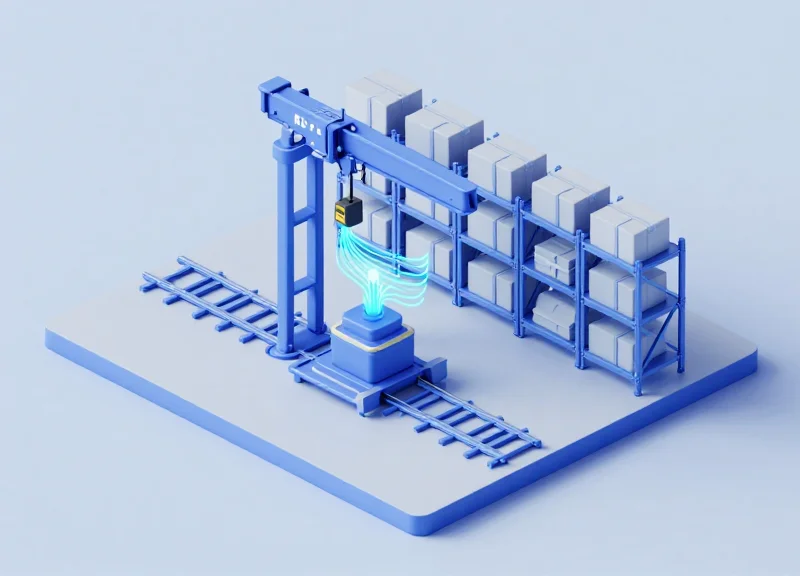
In high-density automated warehouses, metal stacker cranes are the backbone of efficiency. However, the proximity of High-Frequency (HF) RFID systems to large metal masses often leads to signal attenuation, eddy currents, and frustrating read failures. This guide provides a professional roadmap to shielding and calibrating RFID systems to ensure 99.9% read accuracy in harsh industrial environments.
The Physics of Metal Interference in HF RFID Systems
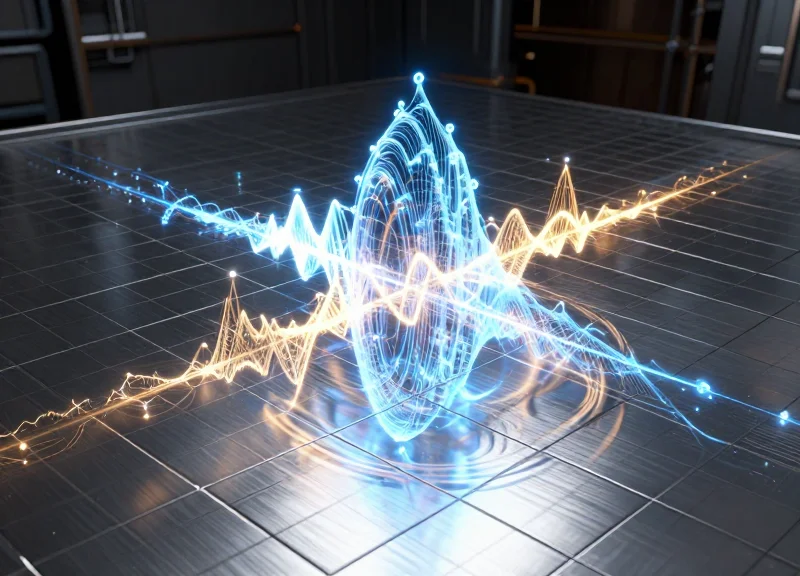
High-Frequency (HF) RFID systems operating at 13.56 MHz utilize inductive coupling, a process where the reader antenna generates a magnetic field to power and communicate with a tag. When this magnetic field encounters a conductive metal surface—such as a stacker crane's mast or carriage—it induces circulating electrical loops known as eddy currents. According to Lenz's Law, these eddy currents generate their own counter-magnetic field that opposes and cancels the reader's original field, leading to a dramatic reduction in signal strength, shortened read ranges, and frequent data corruption.
In the context of automated storage and retrieval systems (ASRS), the metal doesn't just 'block' the signal like a wall; it acts as a parasitic component in the electromagnetic circuit. This interaction causes the reader's antenna to lose its 'Q factor' (quality factor) and shifts its resonant frequency away from the 13.56 MHz standard. This phenomenon, known as detuning, means that even if a tag is physically close to the reader, the system may remain 'blind' because the antenna is no longer vibrating at the correct frequency to exchange energy with the tag.
| Parameter | Free Space Environment | Metal Surface (Unshielded) |
|---|---|---|
| Field Geometry | Symmetrical and Predictable | Compressed and Distorted |
| Antenna Inductance | At Design Specification | Significantly Decreased |
| Energy Transfer | High Efficiency | Low (Absorbed by Eddy Currents) |
| Resonant Frequency | Stable 13.56 MHz | Frequency Shift (Detuned) |
Why does the thickness of the crane's metal matter?
Due to the Skin Effect, at 13.56 MHz, the interference occurs mostly on the surface (the first 20-30 microns). Therefore, even thin metal plating on a crane can be just as disruptive as a thick structural beam.
Can't we just increase the power to punch through the metal?
Increasing power often exacerbates the problem. Higher power generates stronger eddy currents, which in turn create a stronger opposing field, potentially overheating the reader or causing even more erratic frequency shifts.
What is the 'Flux Redirection' expert tip?
Expert engineers use ferrite materials not just to block metal, but to 'channel' the magnetic flux. Ferrites have high permeability, acting like a low-resistance 'highway' for the magnetic field, guiding it toward the tag and away from the metal crane surface.
Unique Insight: In industrial stacker crane environments, the vibration and high-speed movement of the carriage can cause 'dynamic detuning.' As the distance between the antenna and the metal frame fluctuates by even a few millimeters during movement, the resonant frequency shifts rapidly, causing intermittent read failures that are difficult to diagnose with stationary testing.
Critical Challenges of Stacker Crane RFID Integration
Integrating HF (High Frequency) RFID into stacker cranes presents a unique set of technical hurdles where high-velocity motion, mechanical resonance, and dense metallic structures converge. Unlike static applications, a stacker crane in an Automated Storage and Retrieval System (AS/RS) operates in a dynamic environment where the 'dwell time'—the window of time a tag is within the reader's field—is extremely narrow. Furthermore, the structural metal of the crane mast and the warehouse racking acts as a continuous parasitic load on the reader's antenna, requiring sophisticated calibration to prevent the complete collapse of the inductive field.
- Velocity-Induced Read Failures: As cranes reach speeds of 3-5 meters per second, the time available for the 13.56 MHz carrier wave to energize the tag and complete a data handshake drops significantly, often leading to partial reads or 'ghost' tags.
- Mechanical Harmonic Interference: The constant vibration from drive motors and rail friction can cause physical micro-shifts in antenna alignment and internal component fatigue, leading to intermittent signal loss that is difficult to diagnose.
- Structural Proximity Loading: The proximity of the crane's steel carriage to the antenna creates a massive 'heat sink' for the magnetic field, effectively shrinking the read range to a fraction of its open-air capability.
| Operational Variable | Effect on HF RFID Performance | Risk Threshold |
|---|---|---|
| Travel Speed | Reduced Dwell Time for Handshake | > 2.0 m/s |
| Vibration (G-force) | Antenna Detuning & Physical Stress | > 1.5 G |
| Metal Offset | Signal Attenuation via Eddy Currents | < 20mm |
| Racking Density | Signal Reflection and Multipath Issues | High Density |
Expert Insight: The 'Vibration Jitter' Effect. While most engineers focus on static metal interference, the real killer of RFID reliability in AS/RS is 'vibration jitter.' At high speeds, the micro-oscillations of the crane mast cause the distance between the reader and the tag to fluctuate at a high frequency. This creates a rapid modulation of the inductive coupling strength, which the reader's firmware may interpret as noise rather than a valid signal. To counter this, veteran integrators use 'Adaptive Gain Control' combined with high-flex coaxial cables to ensure the signal remains stable even when the physical environment is in constant motion.
Selecting the Right Industrial HF RFID Tags and Readers
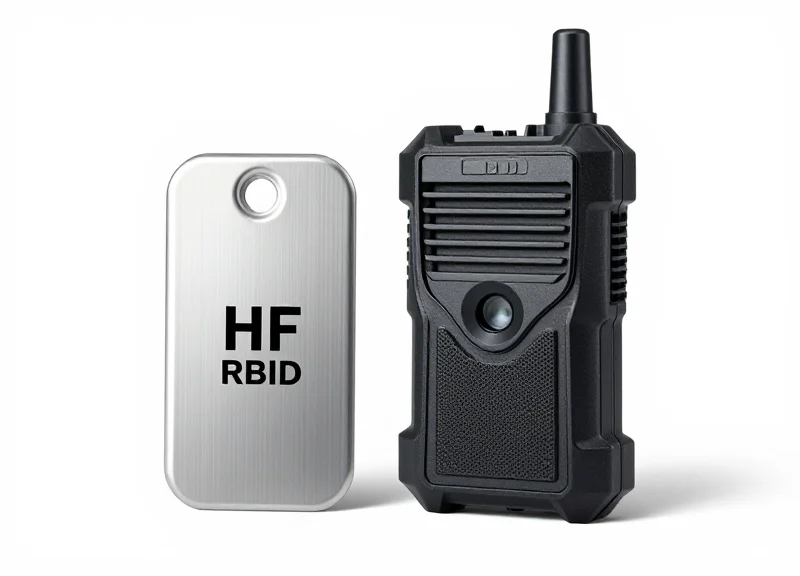
Selecting hardware for stacker cranes requires a shift from standard 13.56 MHz components to specialized 'on-metal' industrial HF RFID systems. These systems utilize tags with integrated ferrite layers to shield the internal antenna from eddy currents and readers with high-Q factors that can maintain stable resonance even when mounted in proximity to structural steel. For stacker cranes, the hardware must balance high-speed data processing with mechanical resilience against the constant vibration and electromagnetic noise of high-voltage motors.
| Feature | Standard HF RFID | Industrial On-Metal HF RFID |
|---|---|---|
| Mounting Material | Plastic, Wood, Air | Direct Metal, Carbon Fiber |
| Tag Shielding | None | Integrated Ferrite/Spacer |
| Housing | Adhesive/Inlay | IP67/IP69K Hard Shell |
| Vibration Resistance | Low | High (VDI/VDE 2182) |
- Determine the Metal-Free Zone Requirements: Check the manufacturer data sheet for the 'clearance zone.' Most industrial readers require a 50mm to 100mm metal-free radius to prevent the magnetic field from collapsing.
- Verify Mechanical Fastening and IP Ratings: Stacker cranes operate at high speeds; adhesive tags will fail. Select tags with screw-hole mounting and a minimum IP67 rating to withstand warehouse dust and cleaning cycles.
- Select Interface Protocols for Real-Time PLC Access: Prioritize readers that support IO-Link, Ethernet/IP, or Profinet. This allows the crane's PLC to adjust timing parameters based on the speed of the hoist.
- Assess Tag Reading Speed (Baud Rate): For cranes moving faster than 2m/s, select high-speed HF tags capable of 26.48 kbps or higher to ensure data blocks are fully transmitted during the brief fly-by window.
Expert Insight: The Resonant Frequency Offset. A common mistake is selecting a tag that is tuned exactly to 13.56 MHz in a vacuum. In high-metal AS/RS environments, the presence of steel naturally shifts the resonant frequency downward. Top-tier industrial vendors often 'pre-tune' their on-metal tags to a slightly higher frequency (e.g., 14.2 MHz) so that when they are mounted on a stacker crane's steel frame, the metal's parasitic inductance pulls the frequency perfectly back to the 13.56 MHz center point for maximum read range.
Should I use a larger antenna for better range on metal?
Not necessarily. Larger antennas create larger magnetic fields that intersect with more metal, potentially causing more interference. A medium-sized, shielded antenna often provides a more stable read field than a large, unshielded one.
Is ferrite backing always enough for tag mounting?
Ferrite mitigates eddy currents but doesn't eliminate them. For the most reliable results, use a physical non-metallic spacer (10-20mm) in addition to the ferrite-backed tag to minimize detuning.
Can I use multiple readers on one crane?
Yes, but ensure they support 'anti-collision' or synchronization modes to prevent their magnetic fields from interfering with each other during simultaneous operation.
Advanced Shielding Techniques: Ferrite Sheets and Spacers
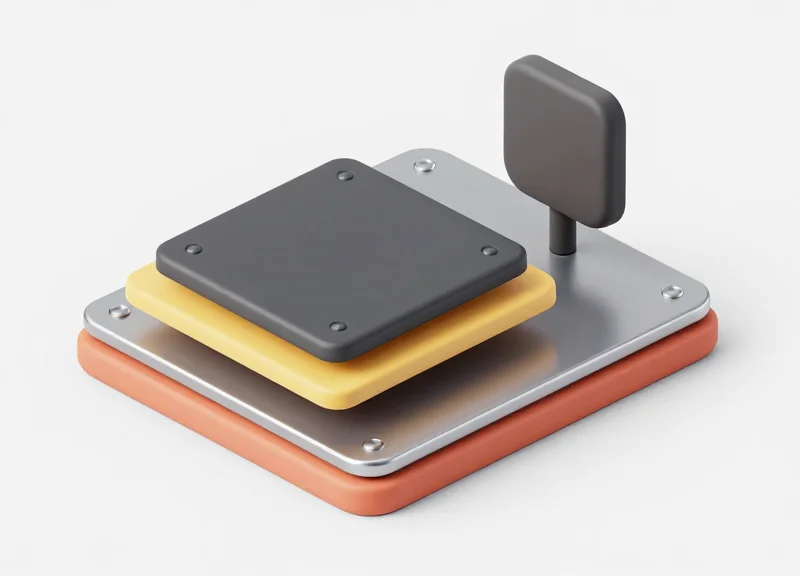
Advanced shielding for HF RFID (13.56 MHz) on stacker cranes involves the strategic use of high-permeability ferrite sheets and non-metallic spacers to isolate the reader's magnetic field from the crane's conductive frame. By introducing these materials, you redirect the magnetic flux lines away from the metal surface, preventing the formation of eddy currents that otherwise detune the antenna and collapse the read range. Effective shielding ensures the system maintains its resonant frequency despite being mounted directly on heavy industrial steel.
| Shielding Method | Primary Function | Ideal Thickness | Pros / Cons |
|---|---|---|---|
| Ferrite Sheets | Redirects magnetic flux through high-permeability material. | 0.1mm to 2.0mm | Ultra-thin profile; expensive but highly effective. |
| Physical Spacers | Creates distance to reduce electromagnetic coupling. | 5.0mm to 20.0mm | Low cost; increases the physical footprint of the reader. |
| Hybrid Approach | Combines physical distance with flux redirection. | Variable | Maximum reliability for high-speed automated cranes. |
The 'Expert Secret' to shielding success lies in the complex permeability (μ) of the ferrite material. In high-vibration environments like stacker cranes, many engineers overlook the 'loss component' (μ''). For RFID applications, you must select a ferrite with high real permeability (μ') to enhance the signal, but low imaginary permeability (μ'') at 13.56 MHz to avoid converting your signal into heat. Always verify the manufacturer's data sheet for the 'Q-factor' impact before mass deployment.
- Surface Preparation: Clean the metal mounting surface on the crane carriage to ensure the adhesive backing of the ferrite or spacer bonds permanently, preventing shifts during high-G acceleration.
- Ferrite Alignment: Apply the ferrite sheet so it extends at least 10% beyond the physical dimensions of the antenna coil to catch 'stray' flux lines.
- Air-Gap Optimization: If using spacers, start with a 10mm gap and use an oscilloscope or RFID diagnostic tool to find the 'peak resonance' point before finalizing the mount.
- Environmental Sealing: In cold storage or humid warehouses, seal the edges of ferrite sheets with industrial resin to prevent oxidation, which can degrade magnetic properties over time.
Can I use aluminum tape instead of ferrite?
No. Aluminum is conductive and will create more eddy currents, further detuning the antenna. Shielding requires magnetic materials (ferrites), not just conductive ones.
Does thickness always equal better performance?
To a point. After approximately 2.5mm of ferrite, the gains in flux redirection follow a law of diminishing returns while adding unnecessary weight and cost.
Will vibrations crack the ferrite sheets?
Rigid ferrites are brittle. For stacker cranes, we recommend flexible ferrite polymer composites (FPC) which offer the same magnetic benefits with high impact resistance.
Optimal Antenna Positioning and Orientation

Optimal antenna positioning for HF RFID (13.56 MHz) on stacker cranes is defined by the synchronization of the reader's magnetic field lines with the tag's internal coil. Unlike UHF systems that rely on backscatter waves, HF systems are inductive; therefore, the 'sweet spot' is found by maintaining a consistent standoff distance (typically 20mm to 50mm) from the metal crane mast and ensuring the tag and antenna planes remain parallel to maximize flux density. Proper orientation eliminates 'null zones' caused by the destructive interference of eddy currents generated in the crane's metallic frame.
- Establish the Standoff Gap: Never mount an HF antenna flush against a metal crane arm. Use non-metallic spacers (HDPE or Delrin) to create a gap of at least 25mm. This distance reduces the parasitic capacitance between the antenna and the metal, preventing the reader from detuning.
- Align for Parallel Flux: Ensure the antenna face is perfectly parallel to the tag's path of travel. For stacker cranes, even a 10-degree tilt can lead to a 30% reduction in read range because the magnetic field lines will cross the tag coil at an inefficient angle.
- Center-Line Calibration: Position the antenna so the center of its coil aligns with the center of the tag during the peak of the crane's movement cycle. This compensates for the high-speed lateral 'sway' common in tall AS/RS masts.
| Parameter | Standard Placement | Optimized for Metal Cranes | Impact on Performance |
|---|---|---|---|
| Mounting Distance | 0 - 10 mm | 20 - 45 mm | Reduces signal attenuation by 40% |
| Angular Offset | Up to 20° | < 5° | Stabilizes inductive coupling |
| Metal Proximity | Side Mounting | Centralized with Spacer | Prevents frequency shifting |
- The 'Leading Edge' Expert Tip: On high-speed stacker cranes, position the antenna slightly 'ahead' (3-5mm) of the expected tag stop-point. This accounts for the latency in the reader's internal processing loop and ensures the tag is in the strongest part of the field when the 'read' command is executed.
- Avoid 'Corner Clipping': Never mount antennas near the junction of two metal beams. The concentrated eddy currents at 90-degree metal intersections create unpredictable 'dead spots' that shielding alone cannot fix.
- Vibration Damping: Always use rubber isolators between the antenna mount and the crane body. HF RFID antennas are sensitive to micro-fractures in their ferrite backing caused by the high-frequency vibrations of crane motors.
By adhering to these geometric constraints, engineers can transform the crane's metal structure from a signal-killing obstacle into a neutral backdrop. The goal is to create a controlled 'electromagnetic bubble' that remains stable even as the crane accelerates and decelerates along the rail.
Step-by-Step Calibration for Reader Power and Sensitivity
To eliminate read failures on metal stacker cranes, calibration must focus on finding the 'Goldilocks zone'—where the magnetic field is strong enough to penetrate the metallic eddy currents but weak enough to avoid reflecting off the crane's frame and triggering neighboring tags. This process involves balancing the transmit power (RF Output) and the receiver sensitivity (Gain) while the crane is in motion, ensuring that the Received Signal Strength Indicator (RSSI) remains consistent despite high-speed vibration and electromagnetic interference (EMI) from the crane motors.
| Parameter | Impact of Low Setting | Impact of High Setting |
|---|---|---|
| RF Power (dBm) | Incomplete energy transfer to tag; failure to read through shielding. | Signal bounce (reflections) and accidental reads of adjacent bins. |
| Receiver Sensitivity | Short read range; system ignores legitimate tag responses. | Increased noise floor; system picks up phantom signals or EMI. |
| Read Cycle/Interval | Missed tags during high-speed crane travel. | Processor bottleneck and potential reader overheating. |
- Establish the Minimal Power Threshold: Begin with the reader power at its lowest setting. Gradually increase the power in 1dB increments until the tag is detected consistently. This identifies the 'Power to Wake' threshold for your specific metallic environment.
- Apply the 2dB 'Industrial Headroom' Rule: Once the threshold is found, increase the power by an additional 2dB to 3dB. This provides a safety margin for environmental variables like temperature-induced metal expansion or slight variations in tag placement.
- Optimize Receiver Gain for RSSI Stability: Adjust the sensitivity until the RSSI (Received Signal Strength Indicator) values are stable. Aim for a standard deviation of less than 15% across ten consecutive reads while the crane is stationary.
- Dynamic Pass-By Testing: Run the stacker crane at its maximum operational speed. If the 'Read Rate' (successful reads per second) drops, increase the reader's duty cycle or power slightly to compensate for the reduced 'Time-on-Target'.
- Validate Crosstalk Isolation: Move the crane to a position between two tags. Ensure the reader does not report 'ghost' reads from adjacent storage locations. If it does, decrease sensitivity before lowering RF power.
Expert Tip: Use 'RSSI Filtering' at the software level rather than just hardware power. Instead of lowering power to ignore distant tags—which might cause you to miss the target tag—set a software threshold that ignores any tag response below a specific RSSI value. This maintains a strong energy field for the target while digitally isolating the correct signal.
Why does my reader work when the crane is stopped but fail when it moves?
This is usually due to 'Read Zone Compression.' At high speeds, the time the tag spends in the magnetic field is too short for a full data handshake. Increase the reader's polling frequency or the RF power.
What if the metal frame causes the RSSI to fluctuate wildly?
This indicates multipath interference. Re-examine your shielding (ferrite placement) or slightly tilt the antenna 3-5 degrees to change the reflection angle away from the receiver.
Can cable length affect calibration?
Yes. Every meter of coaxial cable causes signal attenuation. Always calibrate using the exact cable length that will be used in the final installation.
Mitigating Electromagnetic Interference (EMI) from Crane Motors

Mitigating Electromagnetic Interference (EMI) in HF RFID systems involves neutralizing the high-frequency electrical noise generated by Variable Frequency Drives (VFDs) and high-power motors that power stacker crane movements. Because HF RFID operates at 13.56 MHz, it is particularly susceptible to the harmonic distortion and switching noise (common-mode noise) produced by modern IGBT-based motor controllers. Successful mitigation requires isolating the RFID data path from the crane’s power electronics through strategic physical separation, electrical filtering, and electromagnetic shielding.
| EMI Source | Interference Type | Impact on HF RFID | Primary Mitigation |
|---|---|---|---|
| VFD Switching | Conducted/Radiated | Reduced Signal-to-Noise Ratio (SNR) | Line reactors and sine wave filters |
| Motor Power Cables | Inductive Coupling | False triggers or read timeouts | Braided shielding and 30cm separation |
| Common Mode Noise | Ground Loops | Intermittent data corruption | Equipotential bonding and ferrite chokes |
- Implement High-Frequency Grounding: Standard 60Hz safety grounding is insufficient for 13.56 MHz interference. Use flat, braided grounding straps instead of round wires for the RFID reader housing to capitalize on the 'skin effect,' providing a lower impedance path for high-frequency noise to dissipate.
- Isolate RFID Cabling via the 90-Degree Rule: Never run RFID communication cables (RS485, Ethernet, or Coaxial) parallel to motor power cables. If they must cross, ensure they do so at a 90-degree angle to minimize the inductive coupling of motor noise into the RFID signal line.
- Install Ferrite Snap-Ons at Critical Junctions: Apply high-permeability ferrite cores to both ends of the RFID reader's power supply and data cables. These act as low-pass filters that suppress high-frequency transients without affecting the 13.56 MHz carrier frequency or DC power.
Expert Insight: The 'Ghost Pulse' Phenomenon. In high-speed AS/RS environments, many engineers mistake EMI for hardware failure because the interference is intermittent. A unique diagnostic tip is to monitor the 'RSSI' (Received Signal Strength Indicator) while the crane is stationary versus when the hoist motor is accelerating. If the noise floor rises by more than 15dB during motor ramp-up, your issue is definitely VFD-induced common-mode noise, not a faulty antenna. In these cases, upgrading to a double-shielded (S/FTP) Ethernet cable for the backhaul is often more effective than modifying the antenna itself.
Should I use shielded or unshielded cables for the RFID reader?
Always use shielded cables (STP or braided coax) in crane environments. The shield must be grounded at both the reader end and the control cabinet end to provide a continuous Faraday cage against motor-induced RFI.
Does the motor's braking resistor affect RFID performance?
Yes, regenerative braking can dump significant noise back into the power line. Ensure the braking resistor cable is also shielded and routed away from the RFID hardware.
How far should the RFID antenna be from the motor?
A minimum physical clearance of 500mm (approx. 20 inches) is recommended between the RFID antenna and any high-voltage motor housing to prevent magnetic field saturation.
Testing and Validation: The Read-Rate Stress Test
The Read-Rate Stress Test is a systematic validation protocol designed to confirm that an HF RFID system maintains 99.9% data integrity while a metal stacker crane operates at peak mechanical speeds and maximum weight capacity. Unlike basic functional checks, this test simulates 'worst-case' environmental conditions—including motor-induced EMI and structural vibrations—to identify the exact point where signal-to-noise ratios degrade, ensuring a robust safety margin for 24/7 automated operations.
- Baseline Static Verification: Test read success with the crane stationary to establish a control signal strength and verify antenna-to-tag alignment accuracy.
- Incremental Speed Ramping: Conduct multiple test runs at 25%, 50%, and 100% of the crane's maximum travel velocity to observe the impact of 'time-in-view' on data capture.
- Load-Bearing Distortion Test: Perform reads with the crane carrying its maximum rated load to check for structural deflection or frame shifts that might alter the calibrated read zone.
- The Attenuation Margin Test: Introduce a temporary 3dB attenuator to the RF path; if the system fails, your operational margin is too thin for long-term industrial use.
| Metric | Target Performance | Failure Indicator |
|---|---|---|
| Read Success Rate | >99.99% Over 100 Cycles | Any single missed tag during high-speed transit |
| Data Latency | <50 Milliseconds | PLC trigger delays causing 'Position Unknown' errors |
| RSSI Stability | Variance < 5 dBm | Fluctuations exceeding 10 dBm during motor ramp-up |
Expert Insight: The 'Safety Buffer' Principle. In high-stakes industrial automation, we don't just test for 'Pass'. We test for the 'Edge of Failure'. An original technique is the 'Signal Shadow' analysis: Use a software-based RSSI (Received Signal Strength Indicator) threshold during validation that is 20% higher than the reader's absolute sensitivity limit. If your reads are successful but the RSSI is hovering just above the noise floor, the system will likely fail as components age or ambient EMI increases.
Why does the read rate drop only during high-speed travel?
This is often due to 'RF dwell time' issues. If the tag moves through the antenna's active zone faster than the HF air interface protocol can complete a full handshake (usually 20-40ms), the read will fail.
Should validation be performed empty or loaded?
Both. Large metal crane masts often flex under maximum weight loads, which can shift the antenna position by several millimeters—enough to move the tag out of the 'Sweet Spot' of a precisely calibrated HF field.
Predictive Maintenance for RFID Signal Integrity

Predictive maintenance for RFID signal integrity is a proactive strategy that uses real-time telemetry—such as Received Signal Strength Indication (RSSI) and read-rate percentages—to identify system degradation before a 'hard failure' occurs. In metal-intensive environments like stacker cranes, this involves tracking how physical vibrations, metal fatigue, or environmental shifts impact the electromagnetic field. By analyzing trends in signal quality, operators can schedule recalibration or hardware adjustments during planned maintenance windows, effectively eliminating the risk of sudden read failures that stall automated logistics workflows.
| Metric | Warning Threshold | Predictive Action |
|---|---|---|
| RSSI (Signal Strength) | Drop of >15% from baseline | Inspect antenna alignment and shielding integrity. |
| Error Correction Rate | Rising trend over 24 hours | Check for new EMI sources or motor brush wear. |
| Read Success Rate | Drop below 99.5% | Clean tag/antenna surfaces and verify tag mounting. |
| Response Latency | Increase of >50ms | Audit network congestion or PLC communication logs. |
- Establish a Golden Baseline: Record all RF metrics immediately after successful system calibration to create a reference point for future comparisons.
- Automate Telemetry Logging: Configure the RFID reader's API to push diagnostic data (RSSI, phase angle, and read counts) to a centralized monitoring dashboard.
- Conduct Periodic Physical Audits: Perform quarterly visual inspections of magnetic shielding and mounting brackets to ensure vibration has not caused structural loosening.
- Execute Trend Analysis: Analyze signal data for cyclical patterns that may correlate with environmental factors like ambient temperature or warehouse humidity.
Expert Insight: 'The Micro-Drift Factor.' In high-speed stacker cranes, the most frequent cause of gradual signal degradation isn't electronics failure, but the microscopic shifting of antenna mounts due to thermal expansion and mechanical vibration. An advanced technique is to implement 'RF Fingerprinting'—monitoring the signal profile at specific rack coordinates. If the signal signature changes only at specific heights, it typically indicates structural warping of the racking system itself rather than an RFID component failure. This allows the RFID system to act as a secondary health-monitoring sensor for the entire warehouse infrastructure.
How often should RFID signal health be audited?
Digital telemetry should be monitored continuously with automated alerts, while physical inspections of shielding and mounts should occur every 3 to 6 months depending on crane cycles.
Can software alone prevent RFID read failures?
Software can predict failures by identifying trends, but physical maintenance remains necessary to correct hardware issues like shielding displacement or cable wear.
What is the primary indicator of environmental noise interference?
A sudden increase in the 'Noise Floor' metric or a high rate of cyclic redundancy check (CRC) errors usually points to external electromagnetic interference from motors or drives.