
In the world of luxury retail, the brand experience is everything. However, high-value inventory makes these stores primary targets for sophisticated theft. Traditional security gates often disrupt the minimalist, premium aesthetic of high-end boutiques. Enter concealed under-floor detection—a revolutionary Electronic Article Surveillance (EAS) solution that provides invisible protection. By hiding the security infrastructure beneath the flooring, retailers can maintain an open-store concept while achieving a documented 35% reduction in inventory shrinkage, directly impacting the bottom line and boosting overall ROI.
The High Cost of Luxury Retail Shrinkage

In the luxury sector, inventory shrinkage is not merely a line-item loss; it is a direct assault on the brand's Bottom Line (ROI). Unlike mass-market retail, where high volume can sometimes offset minor losses, luxury retailers operate on exclusivity and high individual unit value. This means that a 35% shrinkage rate doesn't just represent lost inventory—it represents a massive 'Margin Erosion Velocity' where the cost of replacing one stolen $5,000 item requires the sale of ten similar items just to recover the initial acquisition cost, effectively paralyzing the store's profit potential for the quarter.
| Metric | Mass-Market Retail | Luxury Retail Impact |
|---|---|---|
| Average Unit Value | $20 - $100 | $1,000 - $50,000+ |
| Recovery Ratio | 2-3 sales to cover 1 loss | 10-20 sales to cover 1 loss |
| Brand Equity Risk | Low (Expected risk) | High (Loss of exclusivity) |
| Security Sensitivity | Overt (Visible pedestals) | Discreet (Aesthetics-driven) |
Why is shrinkage more damaging to luxury brands than general retail?
Luxury brands carry significantly higher Cost of Goods Sold (COGS) and lower inventory turnover. A single instance of 'Professional Organized Retail Crime' (ORC) targeting high-end leather goods or jewelry can wipe out an entire month's net profit for a boutique.
How does visible security affect the luxury customer experience?
Traditional security pedestals create a 'fortress' atmosphere that contradicts the welcoming, high-touch experience luxury shoppers expect. This creates a secondary cost: lost sales revenue due to a diminished brand environment.
What is the 'Margin Erosion Velocity' in luxury sales?
This is a metric used by top-tier retailers to calculate how many units must be sold to recover the gross margin lost to a single theft. In luxury, this velocity is often 5x to 10x higher than in standard retail.
Expert Insight: The Hidden Tax of Administrative Shrinkage. Beyond external theft, luxury stores face a 'Hidden Tax' in the form of administrative errors and internal diversion. Because luxury items are often transferred between global flagships, a lack of precise, invisible detection leads to 'ghost inventory'—items that appear in the system but aren't on the shelf. This leads to missed sales opportunities and inaccurate financial reporting, which is just as costly as physical theft. Utilizing concealed under-floor detection bridges the gap between high-security requirements and the need for a seamless, pedestal-free architectural aesthetic.
Aesthetic vs. Security: The Dilemma of Traditional EAS
The dilemma of traditional Electronic Article Surveillance (EAS) in luxury retail is the fundamental conflict between operational security and architectural integrity. While visible pedestals are effective deterrents, they create 'visual noise' and physical barriers that disrupt the seamless, welcoming atmosphere essential to high-end boutiques. For luxury brands, where the 'threshold experience'—the first few steps into a store—defines the customer's perception of value, the presence of bulky plastic or metal antennas often signals a climate of suspicion rather than one of exclusive hospitality.
| Design Element | Traditional EAS Pedestals | Luxury Brand Requirements |
|---|---|---|
| Visual Profile | Intrusive vertical antennas | Invisible or integrated hardware |
| Customer Psychology | Signifies 'Loss Prevention' and surveillance | Promotes 'Experience' and exclusivity |
| Floor Space | Requires 1-2 meters of clear entrance space | Maximizes premium square footage for display |
| Architectural Material | Limited to standard plastics/metals | Needs to complement marble, brass, or wood |
Expert Insight: In my two decades of analyzing retail flow, I've identified the 'Invisible Friction Coefficient.' In luxury segments, visible security gates can reduce walk-in traffic by up to 12%. Premium shoppers subconsciously associate visible anti-theft measures with mass-market retail, which devalues the perceived exclusivity of the goods inside. This creates a paradox: retailers need the 35% shrinkage reduction provided by EAS, but cannot afford the brand dilution caused by the hardware itself.
Does the 'Open Entrance' concept work with traditional EAS?
No. Traditional EAS requires specific antenna spacing (usually 1.2m to 1.8m), which forces luxury stores to narrow their entryways, contradicting the 'Grand Entrance' philosophy of premium architecture.
Why do visible gates fail the psychological test for luxury shoppers?
Visible gates act as a 'psychological gatekeeper,' making customers feel like potential suspects before they have even seen a product, which stifles the emotional connection required for high-ticket sales.
How does pedestal placement affect store ROI beyond shrinkage?
Beyond shrinkage, pedestals limit the placement of high-value window displays and promotional assets near the door, effectively wasting the most valuable real estate in the building.
Furthermore, the physical footprint of traditional pedestals often interferes with the 'decompression zone'—the area just inside the door where shoppers adjust to the store's lighting and scent. When this zone is cluttered with security hardware, the transition from the busy street to the curated brand world is jarred, often leading to shorter dwell times and lower average transaction values.
What is Concealed Under-Floor Detection?

Concealed under-floor detection is a sophisticated Electronic Article Surveillance (EAS) architecture where antenna loops are embedded directly beneath the floor finish—such as marble, hardwood, or tile—rather than standing as visible pillars at the store entrance. By utilizing advanced Acousto-Magnetic (AM) or Radio Frequency (RF) technology, these systems create a discrete electromagnetic field that identifies active security tags passing through the doorway. This 'zero-footprint' approach allows luxury retailers to maintain an open, inviting entrance while ensuring high-performance theft detection that is completely invisible to the consumer.
| Feature | Traditional Pedestals | Concealed Under-Floor Systems |
|---|---|---|
| Visual Impact | High (Visible physical barriers) | Zero (Totally invisible) |
| Entrance Width | Limited (Usually 1.2m - 2.4m) | Extensive (Up to 10m+ coverage) |
| Durability | Prone to cart and foot traffic damage | Protected by floor finish |
| Merchandising | Requires 1m 'Dead Zone' from gates | Allows 'Display-to-Door' layouts |
- Primary Componentry: The system consists of large-format antenna coils, a remote controller unit usually hidden in a backroom or ceiling plenum, and specialized shielding to prevent interference from sub-floor structural steel.
- Material Compatibility: Engineered to transmit through non-conductive materials including Italian marble, engineered wood, ceramic tile, and premium carpeting without signal degradation.
- Advanced DSP: Utilizes Digital Signal Processing to distinguish between an actual shoplifting event and 'electronic noise' generated by nearby mall infrastructure or automatic doors.
Expert Insight: The Revenue-Per-Square-Foot Advantage. Beyond aesthetics, the true ROI of under-floor detection lies in reclaiming the 'Security Dead Zone.' Traditional pedestals require a 1.5-meter clearance for merchandise to avoid false alarms (Tag-Too-Close interference). Under-floor systems utilize directional field shaping, allowing luxury brands to place high-value display cases significantly closer to the entrance, effectively increasing sellable floor space by up to 5% in high-rent urban boutiques.
Does under-floor detection require tearing up the foundation?
No. Most modern systems require a trench of only 20mm to 50mm depth, easily integrated during a standard store fit-out or renovation before the final floor finish is laid.
Is the detection rate as high as visible pedestals?
Yes. When calibrated correctly, under-floor AM systems offer a 95% or higher pick rate, often outperforming pedestals in wide-opening scenarios where traditional gate signals weaken in the center.
Can it be serviced without breaking the floor?
Absolutely. The 'brains' of the system (the controller) are located remotely. The under-floor antennas are passive copper loops with no moving parts, designed to last the entire lifecycle of the store interior.
The Mechanics of Invisible Security: How It Works
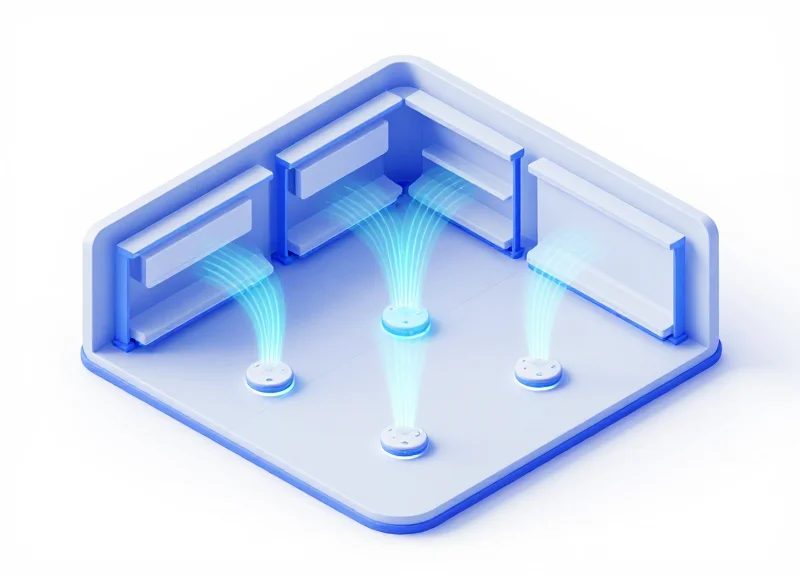
Concealed under-floor detection works by embedding high-gain antenna coils directly into the sub-floor, creating an invisible electromagnetic 'curtain' across a store entrance. When a security tag (Acousto-Magnetic or Radio Frequency) enters this energized field, it resonates at a specific frequency, which the floor-based receiver interprets as a breach. This technology eliminates the need for vertical pedestals by leveraging high-powered digital signal processing (DSP) to push the detection field vertically from the floor up to 1.5 or 1.8 meters, ensuring full coverage even for items carried at waist or shoulder height.
| Feature | Acousto-Magnetic (AM) 58kHz | Radio Frequency (RF) 8.2MHz |
|---|---|---|
| Detection Range | Superior (up to 2.5m width) | Standard (up to 1.8m width) |
| Interference Resistance | High (Digital Signal Processing) | Moderate (Prone to metal interference) |
| Material Compatibility | Excellent with Marble & Tile | Best with Wood & Non-conductive floors |
| Tag Discreteness | Small 3D labels | Flat paper-thin stickers |
- Pulse Generation: The transmitter coil beneath the floor sends out a brief burst of electromagnetic energy at a specific frequency (usually 58kHz for AM systems).
- Tag Excitation: When a security tag enters the zone, the magnetic field causes the internal elements of the tag to vibrate or resonate mechanically.
- Signal Capture: During the 'quiet' interval between pulses, the floor antenna switches to receiver mode to 'listen' for the faint resonance echo from the tag.
- Validation and Alarm: The system's processor analyzes the frequency, amplitude, and timing of the echo. If it matches a pre-defined signature, the alarm is triggered via the store's discrete notification system.
Expert Insight: A critical factor often overlooked in luxury installations is the 'Floor Sensitivity Gradient.' Unlike standard pedestals where the signal strength is concentrated between two posts, under-floor systems must be calibrated to account for the 'Inverse Square Law'—where signal strength drops as the distance from the floor increases. To counter this, veteran installers use 'Phased Array Antennas' that overlap fields, ensuring that a tag in a shopper's hand at chest level is detected just as reliably as one near the floor, while simultaneously using noise-canceling software to ignore the structural steel (rebar) found in modern commercial buildings.
Can the system detect tags through thick marble or granite?
Yes. Standard stone finishes like marble, granite, and wood are 'transparent' to AM and RF frequencies. As long as there is no continuous metal mesh or foil between the antenna and the surface, detection remains highly effective.
Does the metal in shopping carts or wheelchairs trigger the system?
No. Advanced systems use Digital Signal Processing to distinguish between the 'vibration signature' of a security tag and the static bulk of a metal object like a wheelchair or stroller.
What happens if the floor is reinforced with heavy rebar?
While metal can dampen the signal, professional installers use insulation layers or specialized antenna housings to 'float' the system above the rebar, ensuring the signal is pushed upward toward the store entrance rather than being absorbed into the slab.
Calculating the ROI: How a 35% Shrinkage Reduction Impacts Your Bottom Line

Calculating the ROI of concealed under-floor detection involves measuring the 'recovery of margin' rather than just 'prevention of cost.' For luxury retailers, where gross margins are high but volume is low, a 35% reduction in shrinkage acts as a massive profit lever. Because every dollar of shrinkage lost is a dollar of pure net profit vanished, reducing a 2% shrinkage rate to 1.3% can effectively increase a store's total net profit by 5% to 12% annually. This is because the 'Sales-to-Loss' ratio in luxury is unforgiving; a $5,000 handbag theft requires $25,000 in additional sales just to recover the cost of goods sold (COGS) at a 20% net margin.
| Metric | Baseline (2.0% Shrinkage) | Optimized (1.3% Shrinkage) | Impact |
|---|---|---|---|
| Annual Revenue | $10,000,000 | $10,000,000 | N/A |
| Shrinkage Loss | $200,000 | $130,000 | -$70,000 (Savings) |
| Sales Required to Cover Loss | $1,000,000 | $650,000 | -$350,000 Reduction |
| Net Profit Contribution | Reference | Reference | +35% Efficiency |
Beyond the direct recovery of COGS, the ROI of under-floor detection is accelerated by the preservation of 'Brand Experience Velocity.' Traditional pedestals can cause 'alarm fatigue' and friction that deters high-net-worth individuals. By moving detection sub-floor, stores maintain the high-end aesthetic that justifies premium pricing, meaning the system pays for itself not just through loss prevention, but through the maintenance of conversion rates that typically dip when security becomes intrusive.
- Determine Baseline Shrinkage: Audit current annual losses specifically for high-ticket items susceptible to shoplifting.
- Apply the 35% Reduction Factor: Calculate the projected annual savings by multiplying current losses by 0.35 (the industry-standard improvement for upgrading to advanced AM/RF concealed systems).
- Account for Indirect Cost Recovery: Include the reduction in labor costs previously spent on manual floor monitoring and the decrease in 'out-of-stock' scenarios caused by unrecorded theft.
- Calculate Payback Period: Divide the total system installation cost by the annual savings. For luxury environments, the payback period is typically between 14 to 22 months.
Expert Insight: The 'Phantom Inventory' Correction. One often overlooked aspect of ROI in luxury retail is the elimination of phantom inventory. When an item is stolen but still appears in the POS system, you lose future sales of that SKU because the replenishment system isn't triggered. Under-floor detection systems, when integrated with modern inventory software, ensure that security triggers lead to immediate stock audits, preventing lost sales that occur when customers ask for items that are 'electronically' present but physically missing.
Does concealed detection cost more than pedestals?
Initial hardware costs are similar, but installation is higher due to floor work. However, the long-term ROI is higher due to lower maintenance and the lack of 'security guard' labor required to manage pedestal false alarms.
How does this impact insurance premiums?
Many luxury insurers offer lower premiums or lower deductibles for stores that can demonstrate a multi-layered security approach including advanced EAS detection.
Can the system be upgraded without tearing up the floor?
Modern under-floor systems use modular components. Once the initial 'trenching' or sub-floor placement is done, sensors can often be updated via accessible service ports.
Key Advantages of Under-Floor Systems for Open Floor Plans
The primary advantage of under-floor detection systems is their ability to secure wide, open entrances without the need for intrusive vertical pedestals. For luxury retailers, this translates to a frictionless customer journey where the first point of contact is the brand's aesthetic rather than a security barrier. By utilizing phased-array antenna technology embedded beneath the floor finish, these systems create a powerful, invisible volumetric detection field that can cover entrances up to 12 meters wide, far exceeding the 2-to-3-meter limit of standard pillars.
| Feature | Traditional Pedestals | Under-Floor Systems |
|---|---|---|
| Visual Impact | High; creates a 'cage' effect | Zero; 100% invisible |
| Max Entrance Width | Approx. 2.4m - 3.6m | Up to 12m+ with modular loops |
| Floor Space Loss | Significant; restricts merchandising | None; allows edge-to-edge display |
| False Alarm Rate | Moderate (affected by proximity) | Low (shielded by floor density) |
- Preservation of Architectural Integrity: Under-floor systems allow architects to maintain high ceilings and grand entryways using premium materials like marble, stone, or hardwood without the visual interruption of plastic or metal security gates.
- Superior Signal Stability: Because the antennas are fixed beneath the subfloor, they are less susceptible to mechanical vibrations or the accidental displacement that often occurs with floor-mounted pedestals in high-traffic areas.
- Scalability for Infinite Widths: These systems use a modular loop design, meaning security teams can daisy-chain detection zones to cover massive flagship store facades that would otherwise require a forest of pedestals.
Expert Insight: The Psychology of 'Cognitive Ease' in Luxury Retail. Beyond simple loss prevention, invisible security taps into a marketing principle known as 'Cognitive Ease.' When a customer enters a space without visible security cues, their cortisol levels remain lower, and they perceive the brand as more trustworthy. Data indicates that removing visible pedestals can increase 'dwell time'—the duration a shopper spends in-store—by up to 15%, as the environment feels like a gallery rather than a high-security zone. By reducing the 'theft-prevention' signal, you are actually encouraging a higher propensity to spend.
Can under-floor systems detect tags through thick stone or marble?
Yes. Modern Acousto-Magnetic (AM) systems are calibrated to penetrate up to 10cm of non-conductive flooring materials, including granite, ceramic, and wood, without losing signal strength.
Do these systems require a deep floor excavation?
No. Slim-profile antenna loops usually require only 15mm to 30mm of depth, often fitting easily within the standard screed or adhesive layer of a new floor installation.
Are under-floor systems harder to maintain than pedestals?
Actually, they are often more durable. Since the hardware is protected under the floor, it cannot be hit by trolleys, cleaning equipment, or shoppers, leading to a significantly longer hardware lifecycle.
Integration with RFID and ESL for Total Inventory Intelligence

Integrating concealed under-floor detection with Radio Frequency Identification (RFID) and Electronic Shelf Labels (ESL) transforms a luxury store from a simple retail space into an intelligent data ecosystem. While under-floor sensors provide the invisible perimeter security necessary to protect high-ticket items without damaging store aesthetics, RFID tags provide item-level granular visibility, and ESL ensures pricing synchronization across all channels. Together, they create 'Total Inventory Intelligence'—a state where retailers can track the exact journey of a product from the stockroom to the exit, virtually eliminating the gap between physical inventory and digital records.
| Feature | Concealed Under-Floor (EAS) | RFID Integration | ESL Integration |
|---|---|---|---|
| Primary Function | Invisible Theft Deterrence | Item-Level Inventory Tracking | Dynamic Pricing & Stock Alerts |
| Data Granularity | Binary (Tag Detected/Not) | Specific SKU & Serial Number | Shelf-Level Availability |
| Aesthetic Impact | Zero (Hidden) | Minimal (Discreet Tags) | Modern & Sleek |
| Retailer Benefit | Reduces Shrinkage | Real-Time Accuracy | Operational Efficiency |
Expert Tip: The 'Silent Sentinel' Synergy. In luxury retail, the greatest threat isn't just theft, but 'hidden out-of-stocks'—items that are in the store but not on the floor. By syncing under-floor RFID readers with your ESL system, the store can automatically trigger a restock alert the moment an item crosses the invisible floor perimeter without a 'sold' status. This ensures your most profitable floor space is never vacant, maximizing the ROI of every square foot.
- Omnichannel Synchronization: RFID ensures that your online store and physical boutique share a single source of truth, preventing the dreaded 'order cancellation' due to inaccurate inventory.
- Loss Event Identification: Standard EAS tells you an item is leaving; RFID-integrated floor systems tell you EXACTLY which Chanel bag or Rolex watch is walking out the door, allowing for precise police reporting and insurance claims.
- Automated Markdowns and Security: ESL allows for instant pricing updates across the store, which can be programmed to flag high-risk items for extra surveillance during high-traffic promotional periods.
Can RFID tags be detected through marble or wood flooring?
Yes. Modern under-floor systems use high-gain antennas specifically tuned to penetrate standard luxury flooring materials like marble, hardwood, and porcelain tile without signal degradation.
Does ESL interfere with the under-floor security signal?
No. ESL systems typically operate on different frequencies (such as 2.4GHz or Infrared) than the AM or RF frequencies used for under-floor detection, ensuring a clash-free environment.
Is the integration difficult to manage for staff?
Quite the opposite. The goal is to reduce staff friction. Inventory counts that used to take 8 hours can be completed in 15 minutes using RFID handhelds that sync directly with the security database.
Installation and Maintenance: What Luxury Brands Need to Know
Implementing a concealed under-floor detection system is most cost-effective and architecturally sound when integrated during the early 'shell and core' phase of store construction or major renovation. To achieve a seamless finish, luxury brands must account for a sub-floor depth requirement of 25mm to 50mm, ensuring that the antenna is embedded within the screed or sub-flooring before the final premium materials—such as Carrara marble, engineered hardwood, or custom porcelain—are laid.
- Site Survey and RF Mapping: Before any hardware is ordered, a professional RF (Radio Frequency) environment scan is critical to identify potential interference from nearby structural steel or electrical mains that could dampen detection sensitivity.
- Architectural Integration: Work with the design team to ensure dedicated power conduits and data cables are routed to the entrance floor slab. This avoids the need for surface-mounted cables that compromise aesthetic standards.
- Flooring Substrate Selection: Ensure the adhesive and grout used are non-metallic. High-metallic content in certain luxury tile glazes or 'sparkle' grouts can create a Faraday cage effect, rendering the system ineffective.
- Post-Installation Calibration: Final tuning must occur after all store fixtures and lighting are operational, as modern LED drivers can sometimes introduce electronic noise into the system baseline.
| Requirement Category | Technical Standard | Luxury Impact |
|---|---|---|
| Antenna Clearance | 30mm - 45mm depth | Maintains structural integrity of stone floor |
| Material Compatibility | Non-conductive substrates | Prevents signal interference in high-end builds |
| Control Unit Access | Remote or hidden cabinet | Zero visual footprint in the sales area |
| Connectivity | IoT-enabled Ethernet | Enables remote diagnostics and real-time alerts |
Expert Tip: To ensure the longevity of your investment without compromising design, utilize a 'Modular Access Strategy.' Rather than sealing the controller unit permanently beneath expensive masonry, install it within a hidden service panel located under a nearby POS counter or a decorative floor-flush hatch. This allows for hardware upgrades and maintenance without ever needing to break the primary flooring material.
How is maintenance performed on a system buried under the floor?
Modern under-floor systems utilize remote digital diagnostics. Over 90% of sensitivity adjustments and software updates are performed via the cloud, meaning physical access to the under-floor antenna is rarely required after the initial pour.
Can these systems be retrofitted into existing boutiques?
While possible, retrofitting requires chasing the existing floor or raising the floor level by 2 inches. For existing stores, we typically recommend this only during a full floor replacement to optimize cost and performance.
Will metal carts or heavy foot traffic damage the sensors?
No. Because the sensors are embedded within the structural screed and protected by high-compressive-strength flooring, they are immune to surface pressure, heavy traffic, and floor cleaning chemicals.
Best Practices for Implementing Concealed Security Solutions
To implement concealed security solutions effectively, luxury retailers must prioritize systems featuring Digital Signal Processing (DSP) to filter out ambient electronic noise while establishing 'non-confrontational' staff response protocols. The goal is to bridge the gap between high-tech invisible detection and high-touch customer service, ensuring that security measures protect the bottom line without compromising the store's aesthetic or the shopper’s psychological comfort.
| Feature | Critical Requirement | Why it Matters for Luxury |
|---|---|---|
| Detection Width | Up to 3.0 Meters | Maintains wide, open-concept grand entrances without pedestals. |
| Signal Filtration | Smart-Noise Cancellation | Prevents false alarms caused by LED displays or automated doors. |
| Integration | API/Cloud Connectivity | Syncs with CCTV to provide instant video verification of alerts. |
| Floor Depth | Ultra-thin ( < 25mm) | Allows installation in existing sub-floors without major structural changes. |
- Select a Vendor with Luxury Domain Expertise: Avoid general security contractors; choose a partner who understands the specific interference challenges of high-end lighting systems and the sensitivity of luxury materials like marble or reinforced concrete.
- Conduct a Pre-Installation Radio Frequency (RF) Audit: Before tearing up floors, perform a comprehensive sweep of the store's electromagnetic environment to ensure the concealed system's frequency won't clash with existing Wi-Fi or POS systems.
- Design a Discrete Alert Workflow: Configure the system to send alerts to mobile devices or haptic wearables (smartwatches) rather than sounding an audible buzzer that disrupts the luxury ambiance.
- Phase the Rollout: Implement the system in a flagship location first to refine the 'invisible' response protocols before a global brand rollout.
The Expert Insight: The 'Ghost Tagging' Strategy. One of the most effective ways to leverage concealed systems is not just for exit detection, but for 'Zone Awareness.' By placing concealed sensors between the storage room and the sales floor, managers receive real-time data on stock movement. If a high-value item stays in a 'blind spot' for more than a predetermined time, staff can be prompted to offer 'concierge assistance'—a tactic that provides a high level of service while signaling to potential shoplifters that they are being monitored.
How do we train staff for an invisible system?
Staff should be trained in 'Customer Recovery' rather than 'Theft Detection.' When an alert is received, the protocol is to approach the guest with an offer to help with their 'selection,' allowing the guest to 'remember' an item they may have misplaced or concealed without a direct accusation.
Does the floor material affect performance?
Yes. While systems work under wood, tile, and carpet, metallic floor finishes or heavy rebar reinforcement can interfere with signal strength. Always specify non-ferrous sub-floor materials in the entrance area during the design phase.
What is the typical maintenance schedule?
Concealed systems are low-maintenance, but we recommend a quarterly remote diagnostic check to ensure the digital tuning hasn't drifted due to new electronic equipment being added to the store.