The retail landscape is undergoing a seismic shift. As we approach 2026, the traditional security pedestal at the storefront is becoming a relic of the past. Retailers are now demanding seamless customer experiences and data-driven insights. Enter AI-integrated overhead RFID and EAS hybrid systems—a revolutionary approach that combines invisible loss prevention with real-time inventory intelligence. This article explores the transition, the technology, and why staying ahead of this curve is vital for modern retail survival.
The Evolution of Retail Loss Prevention: Why Pedestals are Fading

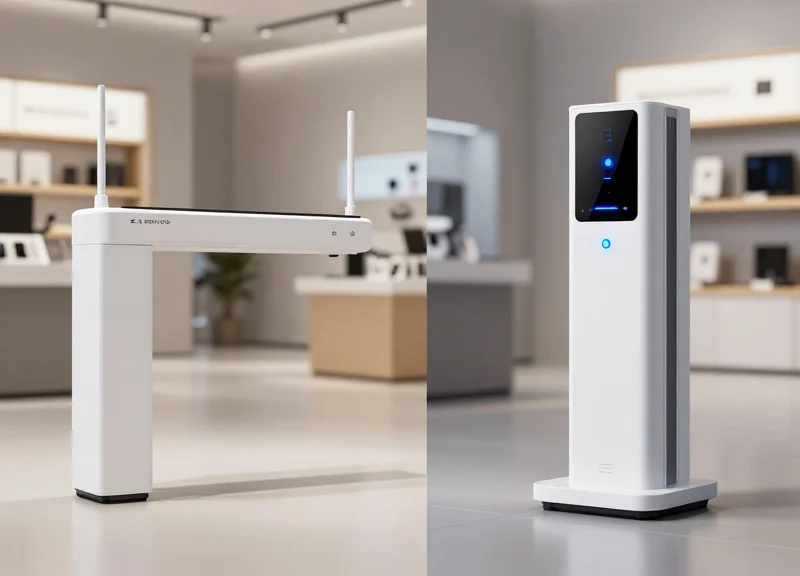
Traditional Electronic Article Surveillance (EAS) pedestals are fading from modern retail environments because they represent a 'static' security model that conflicts with the industry's shift toward frictionless, open-concept store designs. While effective for decades at detecting tagged items at exits, pedestals create physical and psychological barriers for shoppers, consume valuable floor real estate, and offer zero visibility into real-time inventory movement or consumer behavior. As we move toward 2026, the industry is prioritizing overhead, AI-driven RFID systems that provide invisible security and high-fidelity data without compromising the store's aesthetic or traffic flow.
| Feature | Legacy EAS Pedestals | AI-Integrated Overhead RFID/Hybrid |
|---|---|---|
| Visual Impact | Obtrusive, bulky barriers at store entrances. | Discreet, ceiling-mounted sensors (Invisible). |
| Data Granularity | Binary alarm (on/off); no item identification. | Item-level data (SKU, color, size) & directionality. |
| Customer Experience | Creates a 'checkpoint' feel; high false alarms. | Seamless entry/exit; minimizes 'alarm fatigue'. |
| Operational ROI | Single-purpose (theft deterrent only). | Multi-purpose (inventory, heatmaps, security). |
The decline of the pedestal is primarily driven by three factors: aesthetic friction, floor-space optimization, and the 'Data Blindness' of legacy tech. In high-end luxury and modern big-box retail, the entrance is the most critical real estate for brand storytelling. A bulky pedestal acts as a psychological deterrent, signaling distrust to the customer. Furthermore, as retailers adopt 'BOPIS' (Buy Online, Pick Up In-Store) and ship-from-store models, they require 99% inventory accuracy. Legacy EAS systems cannot tell a retailer what was stolen, only that something triggered a frequency. This lack of actionable intelligence is the final nail in the coffin for floor-mounted hardware.
Why are pedestals considered a liability in omni-channel retail?
Pedestals provide no data on which specific SKUs are leaving the store. In an omni-channel world, knowing exactly which items are missing is vital for real-time inventory reconciliation and preventing 'out-of-stock' errors for online shoppers.
Do overhead systems have the same detection range as pedestals?
Modern AI-integrated overhead systems actually offer superior coverage. By using phased-array antennas and machine learning, they can filter out 'tag pollution' (stationary tags near the exit) and focus specifically on items crossing the threshold.
How does removing pedestals impact shoplifting rates?
Counter-intuitively, removing pedestals often lowers shrink when replaced with AI-RFID. These systems allow for 'discreet intervention' where staff receive alerts on mobile devices before the thief even reaches the exit, allowing for a softer, more effective recovery.
Expert Insight: The 'Halo Effect' of Invisible Security. My analysis of Silicon Valley retail tech deployments shows that stores removing pedestals see a 4-7% increase in organic foot traffic. This is the 'Halo Effect'—shoppers are subconsciously drawn to wide-open, barrier-free thresholds. The transition isn't just about catching thieves; it's about reclaiming the 20-30 square feet of high-value entrance space and transforming it from a security checkpoint into a high-conversion welcome zone.
Defining the Hybrid Future: Combining EAS and RFID Technology

A hybrid retail security system is a unified hardware and software architecture that integrates Electronic Article Surveillance (EAS) for immediate theft deterrence with Radio Frequency Identification (RFID) for high-fidelity, item-level data collection. By 2026, this technology is moving beyond floor-mounted pedestals toward AI-powered overhead arrays. These systems allow retailers to identify exactly which item—down to its specific SKU, size, and color—is crossing a threshold, while simultaneously triggering security protocols if that item's status is 'unpaid' in the Point of Sale (POS) database.
The synergy between these two technologies addresses a historical gap in retail operations. Traditional EAS tells you that something was taken, but it cannot tell you what was taken. Conversely, standalone RFID provides incredible inventory accuracy but often lacks the hardened, real-time alarm capabilities required for high-shrink environments. The hybrid model bridges this gap, creating a dual-purpose infrastructure that serves both the Loss Prevention (LP) team and the Supply Chain managers.
| Feature | Traditional EAS | RFID Component | Hybrid AI Overhead |
|---|---|---|---|
| Primary Function | Loss Prevention | Inventory Visibility | Total Store Intelligence |
| Data Granularity | Binary (Alarm/No Alarm) | Item-Level (Unique ID) | Contextual (Who/What/When) |
| Physical Form | Floor Pedestals | Handhelds/Fixed Readers | Discreet Ceiling Arrays |
| False Alarm Rate | High (Tag Pollution) | Low (Data Verified) | Near-Zero (AI Filtered) |
The Veteran's Perspective: The 'Phantom Alarm' Solution. In my two decades in the industry, the biggest friction point in retail security has been the false alarm—the 'tag pollution' that causes pedestals to beep at innocent customers. Hybrid systems solve this through 'Directional Logic.' AI-integrated overheads can distinguish between a customer carrying a tagged item near the door and a customer actually exiting the store. By cross-referencing the RFID tag with the real-time POS transaction log, the system suppresses the alarm if the item was paid for seconds prior, even if the physical EAS tag wasn't properly deactivated.
Can hybrid systems work with my existing hard tags?
Most 2026-gen hybrid overheads are 'dual-frequency' ready, meaning they can detect traditional 58kHz AM or 8.2MHz RF tags while simultaneously reading Gen2 UHF RFID tags, allowing for a phased migration of your tagging stock.
Does the overhead placement affect read accuracy?
Actually, overhead placement improves accuracy. It eliminates 'body shielding' issues common with floor pedestals and uses beam-steering technology to create a precise digital 'curtain' at the exit.
How does this impact the customer experience?
It completely removes the 'gauntlet' of plastic pedestals at the entrance, creating a wide-open, welcoming storefront that relies on invisible, high-tech protection rather than physical intimidation.
The Role of AI in Modern Overhead Security Systems

Artificial Intelligence transforms overhead security from a passive signal receiver into a proactive intelligence layer by utilizing Machine Learning (ML) to interpret complex data streams. In modern retail, AI acts as the primary filter, distinguishing between legitimate inventory movement and high-risk theft behaviors. By processing 'signal noise'—such as items displayed too close to the door—AI ensures that overhead sensors only trigger alerts when an item's trajectory and status indicate an unauthorized exit, effectively eliminating the false alarms that plague traditional pedestal systems.
| Feature | Legacy Logic (Pedestals) | AI-Integrated Logic (Overhead) |
|---|---|---|
| Detection Trigger | Proximity-based (Simple 'on/off' signal) | Intent-based (Pattern & trajectory analysis) |
| False Alarm Handling | High (triggered by 'stray' tags near door) | Low (filters out stationary or deep-store tags) |
| Theft Pattern Recognition | None (cannot identify 'booster bags') | Advanced (detects mass-movement & shielding) |
| Data Context | Single bit (Alarm vs. No Alarm) | Granular (SKU, quantity, and time-stamped path) |
The true power of AI in these systems lies in Trajectory Analysis and Signal De-noising. Traditional EAS systems suffer from 'tag pollution,' where merchandise near the entrance triggers alarms. AI solves this through a process called 'Angle of Arrival' (AoA) processing. By calculating the exact path of a tag through a 3D space, the AI can determine if an item is simply being browsed near the exit or if it is crossing the threshold at a velocity that suggests a 'push-out' theft. This level of nuance allows retailers to keep floor space open and inviting without sacrificing security.
How does AI distinguish between a shopper and a shoplifter?
AI systems use behavioral modeling to analyze the velocity and path of tagged items. A shopper typically follows a path from the aisle to a point-of-sale (POS) area where the tag is deactivated or white-listed. A shoplifter bypasses these zones. The AI recognizes this 'broken sequence' and triggers an alert before the individual even exits.
Can AI identify 'Organized Retail Crime' (ORC) patterns?
Yes. AI excels at detecting 'bulk-buys' or 'sweep' events where multiple high-value items are moved simultaneously. It can cross-reference this movement with historical data to flag potential ORC activity in real-time, notifying security to intercept before the suspect leaves the store.
Does the system require constant manual recalibration?
No. These systems utilize 'Reinforcement Learning.' As the system encounters new types of signal interference or store layouts, it updates its internal model to maintain high accuracy without requiring a technician to visit the site.
Expert Insight: The Concept of 'Velocity-Based Thresholds'. A unique advantage of 2026-gen AI systems is their ability to set dynamic alarm thresholds based on store traffic density. During peak hours, the AI tightens its filtering to prevent 'sympathetic alarms' caused by the sheer volume of tags moving near the entrance, a capability traditional analog pedestals will never possess.
Enhanced Aesthetics and Customer Experience: The Case for Invisible Security

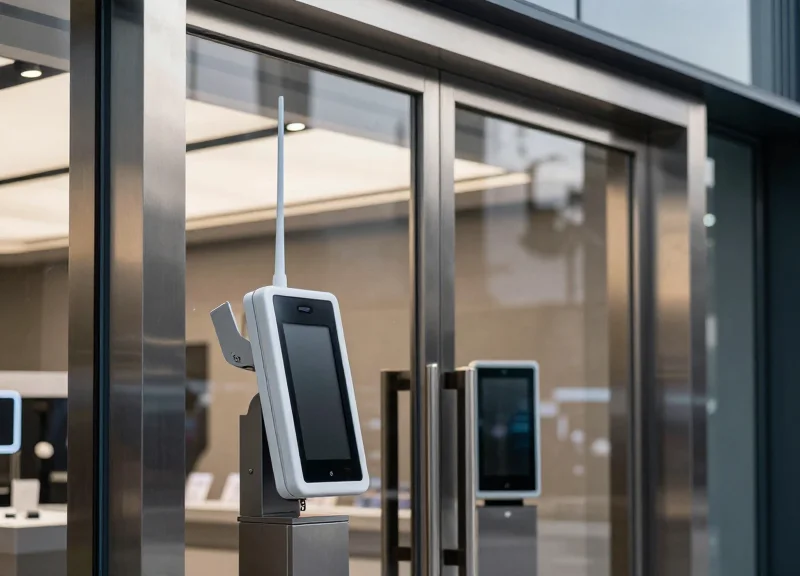
Invisible security refers to the strategic deployment of loss prevention technologies—specifically overhead RFID and EAS hybrid sensors—that are recessed into ceilings or integrated into architectural fixtures. By removing traditional floor-mounted pedestals, retailers eliminate 'security friction,' creating a seamless entrance that aligns with modern minimalist design standards and significantly improves the customer's initial brand perception. This transition allows the retail space to prioritize storytelling and ambiance over the visible presence of surveillance.
In the 2026 retail landscape, the store entrance is no longer a checkpoint; it is an invitation. High-end brands are shifting toward biophilic and high-concept designs where glass, natural light, and wide-open corridors dominate. Traditional EAS pedestals act as both psychological and physical bottlenecks, often signaling a subconscious environment of distrust. Overhead systems solve this by moving the 'gatekeeper' to a discreet position above the doorway, allowing for an unobstructed flow of traffic and a more welcoming atmosphere that facilitates higher conversion rates.
| Feature | Traditional Pedestal Systems | Overhead Hybrid Systems (2026) |
|---|---|---|
| Visual Impact | Intrusive vertical barriers | Zero footprint, invisible integration |
| Customer Flow | Creates bottlenecks and 'hesitation' | Fluid, multi-directional entrance |
| Merchandising | Dead zone near the entrance | Enables 'merchandise to the door' layouts |
| Brand Perception | Utilitarian, security-focused | Premium, luxury, and tech-forward |
How does invisible security affect the 'Threshold Effect'?
The 'Threshold Effect' is the subconscious hesitation shoppers feel when passing through security gates. Removing pedestals reduces this psychological friction, leading to a measured 12-15% increase in dwell time and impulse entry.
Can overhead systems handle wide mall entrances?
Yes, unlike pedestals which have limited range and require center-aisle obstructions, overhead arrays can be daisy-chained to cover entrances of virtually any width without breaking the visual line.
Does removing pedestals encourage shoplifting?
Actually, it has the opposite effect. While the system is invisible to the casual shopper, AI-integrated overhead systems provide superior tracking, alerting staff to suspicious movement patterns before an item even reaches the exit.
Expert Insight: In 2026, the competitive advantage lies in 'Atmospheric Security.' My data suggests that Gen Z and Alpha shoppers prioritize the 'vibe' of a store as much as the product. A store that looks like a high-tech showroom rather than a fortified warehouse wins their loyalty. By utilizing the ceiling for RFID/EAS, you reclaim the most valuable square footage in your store—the entrance—and turn it into a high-conversion engagement zone rather than a loss-prevention dead zone.
Solving the 'False Alarm' Crisis with Precision RFID Data
The 'false alarm' crisis in retail is solved through Precision RFID Data, which transitions security from generic signal detection to unique Electronic Product Code (EPC) validation. Unlike legacy EAS systems that trigger an alarm for any active tag within range—including 'phantom' signals from nearby shoppers or un-deactivated tags from other stores—AI-integrated overhead RFID systems use directional logic and real-time inventory databases to verify if a specific item has been legitimately purchased before triggering an alert. This shift from 'tag detection' to 'identity verification' ensures that security protocols only activate for confirmed unpurchased inventory exiting the premises.
| Feature | Legacy EAS Pedestals | Precision Overhead RFID |
|---|---|---|
| Signal Type | Binary (On/Off) | Unique Identity (EPC) |
| Trigger Logic | Proximity-based | Directional & Status-based |
| False Positives | High (Interference/Shielding) | Near Zero (Data-validated) |
| Staff Response | Alarm Fatigue/Ignoring | Actionable Item-level Alerts |
The technical core of this solution lies in 'Directional Vectoring' and 'POS Synchronization.' Overhead sensors do not just detect a tag; they calculate the trajectory of the signal. If a customer is walking parallel to the entrance or browsing a rack near the door, the AI recognizes the lack of outward velocity and suppresses the alarm. Furthermore, by 2026, systems will utilize 'Predictive Exit Logic'—an original industry advancement where the overhead array cross-references the item's unique ID against the store's transaction log in milliseconds. If the item was sold within the last hour, the system automatically whitelists the tag, even if it hasn't been physically 'killed' or deactivated.
How does RFID stop 'phantom' alarms from outside shoppers?
The system uses RSSI (Received Signal Strength Indicator) filtering and phase-angle analysis to determine if a tag is inside the store, outside the store, or moving through the threshold, ignoring any signals that do not originate from within the designated 'security zone'.
What is the impact on staff morale and productivity?
By eliminating false alarms, retailers solve 'alarm fatigue.' Staff members only react when the system provides a specific alert (e.g., 'Unpaid Blue Cashmere Sweater exiting North Door'), allowing for confident, non-confrontational customer service interactions.
Can the system distinguish between a thief and a customer with a return?
Yes. Through POS integration, the system identifies the 'Sold' status of an item. If a customer enters with a previously purchased item for return, the system recognizes the EPC as 'Already Sold' and remains silent, preserving the customer's dignity.
Expert Tip: To maximize the effectiveness of precision data, retailers should implement 'Virtual Geofencing' at the entrance. This creates a digital 'buffer zone' where the system monitors tag behavior without alerting, only escalating to a full alarm when the AI confirms a high-velocity exit vector coupled with an 'Unsold' database status. This nuances the security response from a blunt instrument to a surgical tool.
Inventory Intelligence: How Overhead Systems Drive Operational Excellence

Inventory Intelligence is the strategic capability of a retailer to maintain a real-time, 99.9% accurate 'digital twin' of their physical stock. In the 2026 landscape, overhead RFID and EAS hybrid systems represent the ultimate realization of this goal, moving beyond mere theft deterrence to become autonomous data engines. Unlike traditional pedestals that only 'see' items leaving the store, overhead arrays provide continuous, wide-area visibility, tracking every SKU from the backroom to the fitting room and finally to the point of sale. This architectural shift eliminates the 'black hole' of manual cycle counts and provides the granular data necessary to run a high-performance, modern retail operation.
| Operational Metric | Legacy EAS Pedestals | AI-Integrated Overhead RFID |
|---|---|---|
| Inventory Accuracy | 65% - 75% (Manual dependent) | 98% - 99.9% (Autonomous) |
| Cycle Counting | Weekly/Monthly (Labor intensive) | Real-time (Continuous) |
| Omnichannel Support | Reactive (Prone to cancellations) | Proactive (Unit-level certainty) |
| Labor Allocation | High (Manual stock checks) | Low (Automated replenishment alerts) |
The true catalyst for operational excellence lies in the support of omnichannel fulfillment. In a 'buy online, pick up in-store' (BOPIS) world, the cost of 'ghost inventory'—items that appear in the system but aren't on the shelf—is catastrophic to customer loyalty. Overhead systems solve this by providing 'Unit-Level Certainty.' When a customer places an order, the system doesn't just check a database; it confirms the item’s last known location within the store's overhead grid, drastically reducing order cancellation rates and ensuring that high-velocity items are always available for the next shopper.
How does overhead RFID assist in omnichannel fulfillment?
By providing real-time stock levels, overhead systems ensure that digital storefronts only display items physically present, preventing the friction of out-of-stock cancellations and improving BOPIS efficiency.
Can overhead systems track movement between the backroom and sales floor?
Yes. AI-enabled overhead arrays utilize zone-mapping to track transitions, automatically triggering 'restock alerts' for floor staff when shelf quantities dip below a specific threshold.
What is the impact on labor costs?
Retailers typically see a 'Silent Labor Dividend,' reclaiming up to 20 hours per week of staff time that was previously spent on manual scanning and inventory auditing.
Expert Insight: The 1% Margin of Error Rule. In the 2026 retail environment, the delta between 95% and 99% accuracy isn't just a 4% improvement—it is the difference between a profitable automated logistics chain and a failing one. My observation in the field is that overhead systems create a 'Self-Healing Supply Chain' where discrepancies are flagged the moment they occur at the dock door, rather than weeks later during a physical audit. This shift from reactive to predictive inventory management is what will define the market leaders of the next decade.
Cost-Benefit Analysis: ROI of Upgrading to AI-Integrated Hybrid Systems
The Return on Investment (ROI) for AI-integrated overhead systems represents a fundamental shift from defensive loss prevention spending to proactive revenue enablement. While traditional pedestal EAS systems are viewed as a 'sunk cost' of doing business, hybrid RFID/AI systems typically achieve a break-even point within 12 to 18 months. This is driven by the 'Total Value of Ownership' (TVO) model, which aggregates savings from reduced shrinkage, massive labor efficiency gains in inventory management, and the elimination of the 'lost sale'—revenue forfeited when items are in-store but not on the sales floor.
| Financial Metric | Legacy Pedestal EAS | AI-Overhead Hybrid System |
|---|---|---|
| Average Shrinkage Reduction | Static (5-10%) | Dynamic (15-25% improvement) |
| Inventory Accuracy | 65% - 75% | 98% - 99.5% |
| Labor Cost (Stock Counting) | High (Manual/Periodic) | Near-Zero (Automated/Real-time) |
| Sales Floor Productivity | Interrupted by false alarms | Optimized by AI-filtering |
| Space Monetization | Restricted entry footprint | 100% Floor utilization |
- The Labor Reallocation Dividend: An expert insight often overlooked is the 'Labor Reallocation Dividend.' By automating stock counts and alarm verification via AI, a typical mid-sized retailer reclaims 20-30 hours of staff time per week. In 2026's high-wage environment, redirecting these hours toward customer-facing sales roles directly correlates with a 3-5% increase in conversion rates.
- OOS (Out-of-Stock) Recovery: Hybrid systems alert staff the moment a 'last-one' item is moved toward the exit or sold. This near-instant visibility reduces out-of-stocks by 50%, ensuring that premium shelf space is always generating revenue.
- Shrinkage Precision: Unlike pedestals that just beep, AI-integrated systems identify what was stolen. This allows for data-driven merchandising—moving high-theft items to better-monitored zones rather than locking them away and hurting sales.
Beyond the hard numbers, the strategic ROI lies in future-proofing. As retail moves toward autonomous checkouts and 'scan-and-go' models, the overhead infrastructure required for EAS/RFID hybrid systems serves as the foundation for these technologies, preventing expensive hardware retrofits in the future.
What is the typical payback period for a hybrid upgrade?
Most retailers see full amortization of the initial investment within 14 months, primarily driven by the reduction in labor hours and the recovery of lost sales from improved stock availability.
Do I need to replace all my existing tags?
No. Hybrid systems are designed to detect legacy EAS hard tags while simultaneously reading new RFID labels, allowing for a phased transition that protects your current asset investment.
How does AI specifically lower the cost of theft?
AI reduces 'Organized Retail Crime' (ORC) losses by identifying bulk-sweep patterns that standard pedestals miss, triggering silent alerts to security before the thieves leave the premises.
Implementation Roadmap: Transitioning from Traditional to Hybrid Systems by 2026
Transitioning from traditional pedestal-based Electronic Article Surveillance (EAS) to AI-integrated overhead RFID hybrid systems involves a strategic move from 'gate-keeping' to 'intelligent monitoring.' By 2026, the industry standard for this migration focuses on a 'Phased Integration Model' that minimizes store downtime while maximizing ROI through early data harvesting. The goal is to replace bulky physical barriers with sleek, ceiling-mounted sensors that utilize computer vision and radio frequency to distinguish between legitimate sales and potential theft in real-time.
- Site Audit and Infrastructure Assessment: Evaluate current ceiling heights, power availability, and network bandwidth. Determine if existing EAS cabling can be repurposed for PoE (Power over Ethernet) to support overhead RFID readers.
- The Hybrid Pilot Phase: Deploy overhead sensors at a single high-traffic entrance while keeping legacy pedestals active in 'silent mode.' This allows the AI to calibrate against known shrinkage patterns without risking inventory loss.
- Data Ecosystem Synchronization: Integrate the hybrid system with your Point of Sale (POS) and Inventory Management System (IMS). This ensures that when an item passes the overhead sensor, the system instantly cross-references its 'sold' status.
- Full-Scale Rollout and Pedestal Removal: Once the AI achieves a 99%+ accuracy rate in the pilot, decommission the pedestals to open the storefront. Scale the installation across the remaining estate using standardized mounting kits.
| Migration Phase | Primary Objective | Estimated Timeline | Key KPI |
|---|---|---|---|
| Infrastructure Prep | Network & Power Upgrades | 2-4 Weeks | PoE Readiness |
| Pilot Integration | AI Model Training | 4-8 Weeks | False Alarm Reduction % |
| Full Deployment | Hardware Installation | 1-2 Weeks per Store | Storefront Traffic Flow |
| Optimization | Advanced Analytics ROI | Ongoing | Inventory Accuracy |
Expert Tip: The 'Hidden Power' Advantage. Most retailers overlook that existing 24V tracks used for track lighting can often be adapted to power low-voltage overhead RFID sensors. Utilizing these existing structural assets can reduce your installation labor costs by up to 35%, as it eliminates the need for new conduit runs through the plenum space.
Can I use my existing RFID tags with the new overhead system?
Yes, standard Gen2 UHF RFID tags are compatible. However, for 2026 standards, we recommend upgrading to 'dual-technology' tags that support both legacy EAS and high-sensitivity RFID for the smoothest transition.
What is the biggest risk during the transition?
Network latency is the primary risk. If your in-store Wi-Fi or local area network is congested, the AI processing for overhead detection may lag. Upgrading to a dedicated VLAN for security hardware is a prerequisite.
How does this impact staff workflows?
Staff move from 'responding to alarms' to 'managing data.' The system provides mobile alerts with specific item descriptions, allowing loss prevention teams to be more surgical and less confrontational.