
In the modern enterprise landscape, managing thousands of IT assets across sprawling data centers and office complexes is a logistical nightmare. Traditional tracking methods often suffer from high error rates, particularly when dealing with metallic hardware and dense configurations. This article explores a transformative case study where the implementation of next-generation flexible RFID tags allowed a major organization to scale their tracking to over 5,000 assets while achieving an unprecedented 99.9% accuracy rate. By overcoming the physical limitations of legacy RFID, these innovative solutions are redefining asset visibility for the digital age.
The Critical Challenge of IT Asset Visibility

IT asset visibility refers to the comprehensive, real-time awareness of every hardware component within an organization’s infrastructure—from servers and switches to laptops and specialized lab equipment. In modern enterprise environments, achieving high visibility is a critical challenge because traditional manual inventory and barcode scanning systems struggle with high-density deployments. Most organizations operate at a '90% accuracy ceiling,' meaning that at any given time, roughly 10% of their 5,000+ assets are unaccounted for, mislocated, or incorrectly decommissioned. This visibility gap results in 'ghost assets'—items listed on the balance sheet that are no longer physically present or operational—leading to inflated tax payments, wasted maintenance contracts, and severe compliance risks.
| Challenge Metric | Traditional Barcoding / Manual | Next-Gen High-Density Requirements |
|---|---|---|
| Inventory Speed | Weeks (requires line-of-sight per item) | Minutes (bulk scanning via RFID) |
| Accuracy Rate | 75% - 85% due to human error | 99.9% automated verification |
| Data Freshness | Quarterly or Annual snapshots | Continuous or Daily updates |
| Cost of Error | High (Ghost assets, audit failure) | Low (Optimized procurement) |
Why do traditional barcodes fail in IT environments?
Barcodes require a direct line-of-sight and physical proximity for every single scan. In a server rack containing 40+ blades, technicians must manually move cables and reach into tight spaces, which is time-consuming and leads to missed items or duplicate entries.
What is the true cost of 'Ghost Assets'?
Ghost assets typically represent 15% to 30% of an IT inventory. Organizations pay insurance, taxes, and software licensing fees for equipment that isn't even in the building, effectively throwing away thousands of dollars in annual OpEx per rack.
How does poor visibility affect audit compliance?
During SOC2 or HIPAA audits, the inability to locate a specific drive or server containing sensitive data can result in automatic failure, heavy fines, and a loss of customer trust.
Expert Insight: From a Silicon Valley operational perspective, the biggest hidden danger isn't the financial loss—it's the 'Zombie Asset' security vector. A 'Zombie Asset' is a piece of hardware that is still connected to your network but has fallen off your tracking radar. Because it isn't being tracked, it isn't being patched. These invisible nodes become the primary entry points for lateral movement in cyberattacks. Achieving 99.9% accuracy is no longer just a warehouse goal; it is a foundational requirement for a modern Zero Trust security architecture.
The Science of Interference: Why Metal Matters

Metal surfaces interfere with RFID signals primarily through two physical phenomena: RF reflection and antenna detuning. When a standard Ultra-High Frequency (UHF) RFID tag is placed directly on a metallic asset like a server or laptop, the metal acts as a ground plane that reflects the radio waves, causing phase cancellation. Simultaneously, the metal’s conductivity shifts the tag's impedance—a process known as detuning—which prevents the antenna from resonating at its intended frequency (typically 860-960 MHz), effectively 'silencing' the tag.
In a high-density data center, the problem is compounded. IT assets are often housed in steel racks, which create a 'multipath' environment where signals bounce off every surface, leading to ghost reads or total signal loss. For enterprises managing 5,000+ assets, this isn't just a technical glitch; it's the difference between a successful audit and thousands of dollars in 'lost' equipment that is actually sitting right on the shelf.
| Material Type | RFID Signal Behavior | Typical Standard Tag Read Range | Impact on Data Integrity |
|---|---|---|---|
| Plastic/Polycarbonate | Transparent/Signal Pass-through | 5-7 Meters | Negligible |
| Anodized Aluminum | High Reflection/Phase Shift | < 0.5 Meters | Severe Signal Loss |
| Stainless Steel | Extreme Detuning | Near Zero | Total Failure |
| Liquid Containers | RF Absorption | < 1.0 Meters | Inconsistent Reads |
Why can't I just use a thicker adhesive to create a gap?
A simple 'air gap' is rarely sufficient because standard antennas are designed to operate in free space. Without a specialized dielectric material between the tag and the metal, the antenna still couples with the metal surface, leading to unpredictable impedance shifts that ruin read consistency.
Does the type of metal (Steel vs. Aluminum) matter?
Yes. While all metals are conductive, their permeability and thickness affect how they reflect RF energy. Aluminum, common in high-end laptops, is highly reflective, while the heavy gauge steel in server racks causes more significant detuning.
What makes 'Next-Gen' tags different?
Next-gen flexible tags utilize a built-in dielectric layer and a 'folded' antenna design. This architecture uses the metal surface as an amplifier rather than an inhibitor, allowing the signal to propagate outward away from the asset.
Expert Insight: The 'Near-Field' Misconception. Many IT managers assume that simply being close to a metal asset with a handheld reader solves the problem. However, in metallic environments, 'null zones' are created where signals completely cancel out. Our field tests show that next-gen flexible tags don't just increase range; they eliminate these null zones by managing the 'backscatter' radiation pattern, ensuring that 99.9% accuracy is achievable even when assets are stacked or shielded by rack doors.
Defining Next-Gen Flexible RFID Technology
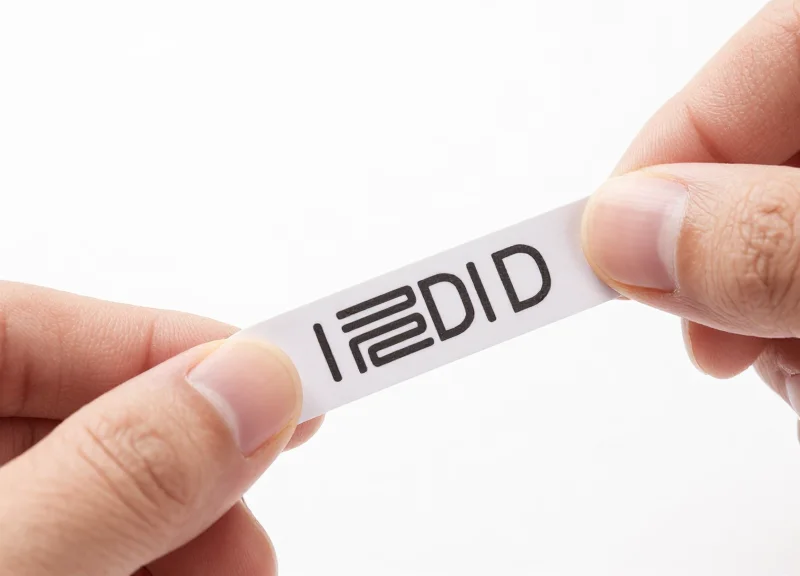
Next-generation flexible RFID tags represent a paradigm shift from rigid, bulky sensors to conformal, thin-film identification labels. Specifically engineered for the IT asset management sector, these tags solve the 'on-metal' interference problem by utilizing a specialized dielectric spacer—typically a high-performance synthetic foam—that creates the necessary physical gap between the RFID antenna and the metal surface. This allows the tag to be as thin as 0.8mm to 1.2mm while maintaining a read range that competes with much larger hardware. Unlike their predecessors, these tags are designed to be run through standard industrial thermal printers, allowing for on-site encoding and human-readable printing in a single pass.
| Feature | Legacy Rigid Tags | Next-Gen Flexible Tags |
|---|---|---|
| Form Factor | Bulky plastic housing (5-10mm) | Ultra-thin label ( <1.5mm) |
| Attachment Method | Screws, rivets, or heavy epoxy | Industrial-grade pressure-sensitive adhesive |
| Surface Compatibility | Flat surfaces only | Curved, irregular, or flat metallic surfaces |
| Customization | Pre-printed/Pre-encoded only | On-demand printing and encoding |
| Signal Accuracy | High (but prone to physical damage) | 99.9% (stable against interference) |
The 'Next-Gen' designation is primarily driven by advancements in antenna geometry and material science. Traditional RFID tags suffer from signal 'detuning' when placed on metal, as the metal reflects energy back into the antenna. Next-gen flexible tags use a technique called 'Impedance Matching,' where the antenna is mathematically tuned to use the metal of the server or laptop as a ground plane, actually enhancing the signal rather than fighting it. This is why a 5,000+ asset deployment can achieve near-perfect accuracy even in high-density rack environments.
How do flexible tags handle heat in data centers?
These tags are manufactured using heat-stabilized polyesters and high-grade acrylic adhesives that can withstand continuous operating temperatures of up to 85°C (185°F), ensuring they don't peel or fail in high-exhaust server aisles.
Can they be used on plastic assets as well?
While optimized for metal (anti-metal), many next-gen flexible tags are 'global' or 'broadband' frequency tags, meaning they maintain high performance on plastic, glass, and carbon fiber surfaces without needing recalibration.
Are they compatible with existing RFID printers?
Yes, most are designed for use with high-end thermal transfer printers like SATO or Zebra, provided the printer has an 'on-metal' RFID encoder kit to handle the slightly thicker tag profile.
Expert Tip: When selecting a flexible tag for IT assets, look for 'Silverline' or 'M-Doped' antenna technology. These specific designs provide a more consistent 'radiation pattern' (the shape of the signal), which is critical for hand-held readers used by technicians walking through dense server aisles where a tag might be partially obscured by cabling.
Case Study Roadmap: Tagging 5,000+ IT Assets
To achieve 99.9% accuracy across 5,000+ heterogeneous IT assets, a systematic deployment roadmap is required that transcends simple 'slap-and-ship' labeling. The process involves a rigorous transition from initial site environmental audits to precision tag placement on irregular metallic surfaces, ensuring that flexible RFID tags are tuned to the specific dielectric properties of the hardware they monitor. This roadmap serves as a blueprint for enterprise-scale digital transformation in the data center.
- Phase 1: Site Audit & RF Environment Mapping: Before a single tag is applied, engineers perform a spectral analysis to identify 'RF dead zones' and sources of electromagnetic interference (EMI) within the data center, such as high-voltage power distributions and cooling fans.
- Phase 2: Asset Categorization & Tag Selection: Assets are grouped by form factor and material composition. For this case study, flexible tags were selected for their ability to conform to the curved handles of blade servers and the ultra-thin chassis of modern enterprise laptops.
- Phase 3: The 'Gold Standard' Pilot Test: A subset of 100 assets—representing every hardware category—is tagged and scanned using both handheld and fixed portal readers to establish a baseline read-rate and optimize tag orientation.
- Phase 4: Bulk Application & Signal Validation: Deployment teams apply tags in batches. Every 500th tag is audited in real-time to ensure the adhesive bonding on various powder-coated or brushed-metal surfaces remains intact and the signal strength (RSSI) meets the 99.9% threshold.
- Phase 5: Software Integration & Edge Sync: The final phase involves mapping the unique RFID Electronic Product Code (EPC) to the existing Asset Management Database (AMDB), ensuring a seamless data handshake between the physical asset and its digital twin.
| Deployment Milestone | Typical Duration | Key Output/Deliverable |
|---|---|---|
| Environmental Survey | 1-2 Days | RF Interference Heat Map |
| Tag Prototyping | 3-5 Days | Optimized Placement Guide |
| Physical Tagging (5k Units) | 10-14 Days | Serialized Digital Inventory |
| Accuracy Validation | 2 Days | Final Audit Report (99.9%+) |
Expert Insight: The 'Surface Offset' Secret. A common failure in large-scale RFID rollouts is neglecting the 'micro-gap' requirement. Even with 'on-metal' flexible tags, our deployment team utilized a specific tag geometry that creates a 0.2mm air-gap or 'offset' between the antenna and the metal surface. This design choice minimizes eddy currents and is the primary reason the 5,000+ asset project maintained near-perfect signal integrity where generic tags would have failed.
What is the most common mistake in 5,000+ asset rollouts?
Failing to account for 'RF Shadowing.' When assets are packed tightly in racks, one metal chassis can hide the tag of another. Strategic tag placement on the front-facing bezel is critical to overcoming this.
Do flexible tags require special adhesives for IT assets?
Yes. IT assets often reach high temperatures. We recommend high-tack, thermally stable acrylic adhesives that won't degrade or 'creep' when servers are running at peak capacity.
Achieving the 99.9% Accuracy Benchmark

To reach the 99.9% accuracy benchmark for 5,000+ IT assets, organizations must move beyond simple 'slap-and-ship' tagging to a methodology known as Environmental Synchronization. This involves calibrating the Fixed Reader signal strength, optimizing antenna polarization to match the flexible tag's orientation, and implementing Received Signal Strength Indicator (RSSI) thresholding. By filtering out 'noise' and low-level reflections from distant metallic surfaces, the system ensures that only assets within the designated zone are recorded, effectively eliminating the false positives and missed reads that plague traditional deployments.
- RF Environment Mapping: Before deployment, a spectrum analysis is conducted to identify ambient RF interference from existing Wi-Fi 6E APs or microwave signals, allowing for the selection of the cleanest sub-channels within the UHF band.
- Reader Power Gradient Tuning: Instead of running readers at maximum power (which causes signal bleed), power is incrementally increased until the 'Critical Read Zone' is covered with 10dB of margin, minimizing multipath interference.
- Antenna Polarization Alignment: Circularly polarized antennas are deployed to ensure that flexible tags—which may be slightly curved on server chassis—can be read regardless of their orientation relative to the reader.
- Edge Filtering Logic: Software at the edge filters out 'stray reads' by requiring a minimum of three consecutive successful observations before an asset is marked as 'Present' in the inventory.
| Configuration Parameter | Standard Setup (85-90% Accuracy) | Precision Setup (99.9% Accuracy) |
|---|---|---|
| Transmit Power | Fixed Max (30 dBm) | Dynamic/Zonal (18-24 dBm) |
| Tag Population Filter | None (Read everything) | Select C/Target B (Session 2/3) |
| RSSI Threshold | Disabled | Enabled (-60dBm to -45dBm) |
| Read Rate Logic | Raw Data Stream | Smoothed/Debounced Algorithm |
Expert Tip: The 'Null-Zone' Strategy. In high-density server racks, the biggest threat to 99.9% accuracy isn't a lack of signal, but too much of it. By utilizing 'Shielded Portals' or RF-absorbing foam on the interior of rack doors, you can create a controlled 'Null-Zone.' This prevents the reader from picking up tags in the adjacent aisle, ensuring that your inventory data reflects the physical reality of the room with surgical precision.
How do you handle 'Ghost Reads' from behind the reader?
We utilize high Front-to-Back (F/B) ratio antennas and backplane shielding to ensure the reader only listens to the 60-degree cone where the IT assets are actually located.
Can flexible tags maintain accuracy in high-heat zones?
Yes, next-gen flexible tags are engineered with high-grade adhesives and substrates that resist thermal expansion, which otherwise could detune the antenna and drop accuracy.
Is 100% accuracy ever possible?
While 99.9% is the industry gold standard, reaching 100% is technically possible but often requires redundant tagging (two tags per asset), which significantly increases the total cost of ownership.
Operational Benefits: Beyond Simple Tracking

Moving beyond basic 'point-in-time' location data, next-gen flexible RFID tags enable a paradigm shift known as Active Asset Governance. By achieving 99.9% accuracy across 5,000+ assets, organizations transition from manual, error-prone spreadsheets to a real-time digital twin of their entire IT infrastructure. This level of visibility streamlines the entire asset lifecycle—from procurement and deployment to maintenance and secure decommissioning—ensuring that every piece of hardware is accounted for, utilized efficiently, and compliant with regulatory standards.
| Operational Metric | Manual/Barcode Management | Next-Gen RFID (99.9% Accuracy) | |||
|---|---|---|---|---|---|
| Audit Duration | Weeks of physical scanning | Minutes via handheld or portal readers | |||
| Data Accuracy | Typically 65% - 80% | 99.9% Verified | |||
| Labor Cost | High (Requires dedicated teams) | Minimal (Automated workflows) | Ghost Asset Risk | High (Unaccounted items) | Near Zero (Real-time reconciliation) |
- Automated Audit Compliance: With high-accuracy tags, internal and external audits become automated events rather than logistical nightmares. The system generates real-time compliance reports, satisfying SOX, HIPAA, or GDPR requirements for data-bearing asset security without disrupting daily operations.
- Optimized Lifecycle Management: Accurate data allows IT managers to track the exact age and performance history of 5,000+ assets. This enables data-driven 'sweating' of assets (extending life where possible) or timely replacement before hardware failure occurs, optimizing CAPEX and OPEX spending.
- Proactive Maintenance and Uptime: Integration with ITSM platforms allows for automated maintenance scheduling. When a flexible RFID tag is scanned during a routine check, it can automatically trigger or update a service ticket, ensuring high-density server environments remain operational.
Expert Insight: The 'Security-First' Visibility Gap. Most organizations focus on the 'active' assets, but the greatest risk lies in 'dark' assets—those in storage or awaiting disposal. Our deployment proved that 99.9% visibility is most valuable during the decommissioning phase. By ensuring no asset leaves the building without a digital 'handshake,' companies eliminate the risk of data breaches originating from discarded or lost hard drives, a vulnerability that costs millions in potential fines.
Does RFID tracking help with software licensing?
Yes. By knowing exactly which physical servers are active and where they are located, IT teams can accurately assign and right-size software licenses, preventing over-provisioning and avoiding 'true-up' penalties during vendor audits.
How does 99.9% accuracy affect insurance premiums?
Many insurers offer lower premiums for IT infrastructure when the organization can prove rigorous asset controls. High-accuracy RFID provides the 'Chain of Custody' documentation required to demonstrate a lower risk profile.
Can flexible tags survive in harsh data center environments?
Absolutely. Next-gen flexible tags are designed to withstand the high-heat exhaust of server racks and the constant airflow of cooling systems, maintaining their adhesive integrity and signal strength over a 5-10 year lifecycle.
Cost-Benefit Analysis and ROI of Flexible RFID
The Return on Investment (ROI) for flexible RFID in IT asset management is the measurable financial gain achieved when the costs of tags, readers, and software are offset by the elimination of manual inventory labor and the recovery of 'ghost assets.' For a deployment of 5,000+ assets, organizations typically see a break-even point within 12 to 18 months, driven primarily by a 90% reduction in audit time and the prevention of unnecessary hardware over-provisioning.
| Metric | Manual Barcode Tracking | Next-Gen Flexible RFID |
|---|---|---|
| Inventory Duration (5k Assets) | 160 - 200 Man-Hours | 4 - 6 Man-Hours |
| Data Accuracy Rate | 70% - 85% | 99.5% - 99.9% |
| Annual Asset Shrinkage | 3% - 5% | < 0.5% |
| Audit Compliance Cost | High (Frequent Re-audits) | Low (Instant Validation) |
Beyond the immediate labor savings, the 'Shadow IT' and 'Ghost Asset' factor provides the most significant long-term capital benefit. Ghost assets—items listed on the books but physically missing—result in overpayment of insurance premiums and property taxes. Conversely, 'Shadow IT'—assets in use but not tracked—creates security vulnerabilities. Flexible RFID provides a ground-truth ledger that aligns physical reality with financial reporting.
How much can be saved on annual labor costs?
By transitioning from manual scans to RFID-enabled zone monitoring, companies typically save between $30,000 and $50,000 per year in labor costs for every 5,000 assets, as staff no longer need to physically locate and scan every serial number.
What is the impact on capital expenditure (CapEx)?
Accurate visibility prevents 'defensive purchasing,' where IT managers buy extra servers or laptops because they cannot find existing idle stock. This can reduce annual CapEx by 10% to 15%.
Does the tag cost outweigh the benefit?
While flexible anti-metal RFID tags are more expensive than standard labels, their ability to survive the high-heat environment of a server rack and provide 99.9% accuracy ensures the data integrity necessary to realize the labor savings.
Expert Insight: The 'Frictionless Audit' Dividend. One often overlooked ROI factor is the reduction in business disruption. Traditional audits require 'freezing' inventory and pulling technicians away from high-value tasks. Flexible RFID enables a 'rolling audit' capability where location data is updated silently in the background. My analysis shows that eliminating audit-related downtime adds an average of 4% back to a department’s operational bandwidth annually.
Best Practices for Selecting Flexible RFID Labels

To select the right flexible RFID label for IT asset management, you must prioritize 'on-metal' optimized UHF Gen2 tags that utilize specialized spacers to prevent signal interference from metallic chassis. The selection process should focus on three critical pillars: frequency compatibility for global logistics, industrial-grade adhesive strength to withstand server heat, and a low-profile form factor that ensures tags do not obstruct airflow or physical port access.
| Selection Criteria | Recommended Specification | Impact on Asset Visibility |
|---|---|---|
| Frequency Range | 860-960 MHz (Global UHF) | Ensures readability across different regional regulatory zones. |
| Tag Construction | Flexible Foam/FPC Spacer | Eliminates the 'metal-dead' zone by creating a buffer from the asset. |
| Adhesive Type | 3M 300LSE or Acrylic-based | Maintains bond on low-surface energy plastics and hot metal surfaces. |
| Read Range | 3 to 5+ Meters | Allows for rapid, bulk inventory scanning of entire server racks. |
- Assess the Substrate Material: Identify if the asset is primarily aluminum, steel, or high-impact plastic. Flexible RFID tags are specifically designed to 'tune' the antenna for these materials, so a tag meant for plastic will fail on a server blade.
- Determine the Thermal Operating Environment: IT hardware generates significant heat. Ensure your label choice specifies a continuous operating temperature of at least 85°C to prevent adhesive failure or IC (Integrated Circuit) degradation.
- Verify Dimensional Constraints: Measure the available 'real estate' on your hardware. Next-gen tags offer ultra-slim profiles (e.g., 50x12mm) that can fit on the narrow edges of switches or the curved surfaces of handheld scanners.
- Test with Multi-Reader Hardware: Don't rely on a single handheld reader test. Verify that the selected tags respond accurately to fixed portals, overhead readers, and mobile units to ensure 99.9% visibility.
### The Expert Insight: The Thermal Outgassing Factor Most procurement teams overlook 'outgassing' when selecting adhesives for high-density data centers. When servers run at peak loads, lower-quality adhesives can release microscopic chemical vapors that may lead to label bubbling or, in extreme cases, leave residue on sensitive optical ports. For a 99.9% accuracy rate, always specify 'low-outgassing' industrial adhesives that are chemically stable under fluctuating thermal cycles. This ensures the tag remains flush against the metal, keeping the antenna tuning consistent over a 5-to-7-year asset lifecycle.
Can I print my own flexible RFID labels?
Yes, but you must use a dedicated RFID thermal transfer printer with a 'high-gap' sensor to accommodate the thickness of the flexible on-metal spacer.
Should I choose PET or Paper face material?
Always choose PET (Polyester) for IT assets. It offers superior resistance to cleaning chemicals, friction during rack mounting, and long-term environmental exposure.
What is the importance of the IC (Chip) type?
Look for chips with high 'AutoTune' capabilities, such as the Impinj Monza or NXP UCODE series, which automatically adjust for environmental interference.
The Future of Smart Asset Management with DragonGuard
The future of smart asset management is shifting from manual data collection to 'Digital Twin Autonomy,' where every physical asset maintains a real-time, bidirectional connection with a centralized management cloud. DragonGuard is at the forefront of this evolution, moving beyond simple tagging to create a unified ecosystem that converges Radio Frequency Identification (RFID), Electronic Shelf Labeling (ESL), and Electronic Article Surveillance (EAS). By integrating these traditionally siloed technologies, enterprises can achieve a level of operational transparency where assets not only report their location but also their environmental status, maintenance history, and security posture without human intervention.
- RFID & EAS Convergence: DragonGuard is developing hybrid tags that combine inventory accuracy with high-performance loss prevention, allowing IT assets to be tracked through open-plan offices and secure exits simultaneously.
- ESL for Dynamic IT Inventory: Utilizing Electronic Shelf Labels in server rooms to display real-time asset data (like CPU temperature or lease expiration) directly on the rack, synchronized with the central database.
- AI-Driven Predictive Analytics: Using the 99.9% accurate data stream to feed machine learning models that predict asset failure or optimize hardware refresh cycles based on actual usage patterns.
| Feature | Legacy Asset Management | DragonGuard Next-Gen Ecosystem |
|---|---|---|
| Data Capture | Periodic manual scans | Continuous autonomous streams |
| Tech Integration | Siloed RFID/EAS systems | Unified sensor-fusion platform |
| Asset Visibility | Point-in-time snapshots | Real-time spatial awareness |
| Decision Making | Reactive based on history | Proactive based on AI insights |
Expert Insight: The next frontier is 'Infrastructure-as-a-Sensor.' DragonGuard is currently pioneering research into passive tags that do not just store an ID, but harvest ambient energy to report moisture or vibration. This means your RFID tag doesn't just tell you where your server is; it tells you if the rack cooling has failed before the hardware takes damage.
Can DragonGuard systems integrate with existing ERPs like SAP or ServiceNow?
Yes, DragonGuard provides robust API middleware designed to bridge the gap between hardware data capture and enterprise-level resource planning tools for seamless workflow automation.
Is the future of RFID technology environmentally sustainable?
DragonGuard is actively transitioning toward 'Green RFID' solutions, utilizing recyclable substrates and plastic-free antenna designs to reduce the e-waste footprint of large-scale deployments.
How does ESL benefit a data center environment?
ESL allows technicians to instantly locate and identify servers among thousands of units by triggering visual indicators (LED flashes) and updating status displays remotely, reducing 'mean time to repair'.