In the high-stakes environment of modern retail, RFID technology is the backbone of inventory accuracy. However, high-density stores often face a frustrating technical hurdle: signal bleed. This phenomenon occurs when an RFID reader captures tags outside its intended zone, leading to ghost inventory and checkout errors. To achieve 99% accuracy, selecting the right antenna is not just a hardware choice; it is a strategic necessity. This guide provides an authoritative look at five critical selection criteria designed to eliminate signal interference and ensure your RFID deployment delivers peak performance.
The Impact of Signal Bleed in Retail Operations

Signal bleed, or 'stray reads,' occurs when an RFID antenna captures data from tags outside its intended coverage zone, such as items on the other side of a wall or in an adjacent display rack. In high-density retail environments, this phenomenon creates 'ghost inventory'—items that appear to be in stock or in a specific location but are physically elsewhere. This lack of spatial precision sabotages the primary goal of RFID: achieving 99% inventory visibility. When signal bleed goes unchecked, the digital twin of the store becomes decoupled from physical reality, leading to systemic failures in replenishment and order fulfillment.
| Operational Metric | Impact of Signal Bleed | Business Consequence |
|---|---|---|
| Inventory Accuracy | Inflation of stock levels via 'phantom' tags from back-of-house. | Missed replenishment triggers and lost sales. |
| Omnichannel (BOPIS) | Systems show items available that are actually in transit or mislocated. | High order cancellation rates and poor customer NPS. |
| Labor Efficiency | Staff spend hours searching for items 'detected' by the system but not present. | Increased operational overhead and employee frustration. |
| Shrinkage Control | False alarms at exit portals due to nearby merchandise bleed. | Desensitization of staff to actual theft events. |
How does signal bleed affect the 'Last Mile' of in-store fulfillment?
When a customer buys online for in-store pickup, the system relies on localized RFID data. If signal bleed from the stockroom makes an item appear to be on the sales floor, the picker fails to find it, leading to a 'pick-denial' and a lost customer relationship.
Can signal bleed interfere with automated checkout?
Yes. If an antenna at a point-of-sale (POS) station is not properly shielded or phased, it may accidentally scan items being carried by nearby shoppers or merchandise on nearby 'impulse buy' racks, resulting in overcharging and checkout friction.
Why is 'High Density' a specific risk factor?
In high-density stores, merchandise is packed closer together (e.g., apparel racks). Traditional wide-beam antennas cannot distinguish between a shirt 2 feet away and one 10 feet away behind a thin partition, making signal bleed almost inevitable without specialized hardware.
Unique Expert Insight: The 'Trust Erosion' Factor. Beyond the data errors, the most insidious impact of signal bleed is the erosion of employee trust in the technology. In my 20 years of retail tech deployment, I have observed that when staff see 'teleporting' inventory—items appearing in the wrong zone due to bleed—they revert to manual counting. Once the human element stops trusting the RFID data, the entire multi-million dollar investment loses its ROI because the 'actionable' insights are ignored by the people on the floor.
Criterion 1: Precision Beamwidth Control

Precision beamwidth control is the technical ability of an RFID antenna to focus its electromagnetic energy within a specific, narrow angular range—ideally between 30° and 60°—to ensure that only tags within a designated zone are energized. In high-density retail environments, such as apparel racks or jewelry displays, using antennas with tight beamwidth is the primary defense against 'signal bleed,' where a reader inadvertently captures data from items on the opposite side of a wall or an adjacent shelf.
In a typical retail layout, shelves are often separated by less than five feet. Standard wide-beam antennas (90° or higher) create a 'floodlight' effect, casting energy across multiple aisles simultaneously. This leads to ghost inventory and 'false positives' at the point of sale or exit portals. By selecting antennas with a narrow Half Power Beamwidth (HPBW), retailers can achieve 'spotlight' precision, creating discrete read zones that align perfectly with physical merchandising boundaries.
| Antenna Type | Horizontal Beamwidth | Read Zone Width at 3m (10ft) | Best Use Case |
|---|---|---|---|
| Ultra-Narrow Beam | 30° - 40° | ~1.6 meters | High-value jewelry cases, narrow jewelry aisles |
| Standard Narrow Beam | 60° - 65° | ~3.5 meters | Standard apparel racking, fitting rooms |
| Wide Beam (Avoid) | 90° - 120° | ~6.0+ meters | Open warehouses, ceiling-mount bulk tracking |
Expert Tip: Don't just look at the primary beamwidth; investigate the 'Front-to-Back Ratio' and 'Side Lobe Suppression.' Even a 60° antenna can cause signal bleed if it has significant side lobes—secondary energy peaks that leak out of the sides or back of the housing. In high-density Silicon Valley retail pilots, we have found that antennas with a Side Lobe Suppression of -15dB or better are 40% more effective at eliminating stray reads than standard commercial-grade antennas.
How does beamwidth affect read depth?
Narrower beams generally provide a longer read range (depth) for the same amount of power because the energy is more concentrated, but they require more precise physical alignment.
Can software settings compensate for wide beamwidth?
While reducing power (RSSI) can shrink the read zone, it does not change the shape of the beam. A wide-beam antenna at low power still risks hitting tags in the 'bleed zone' before it hits tags directly in front of it if the latter are further away.
Is circular or linear polarization better for narrow beams?
In retail, circular polarization is preferred to capture tags at various orientations, but it must be paired with high-quality shielding to maintain narrow-beam integrity.
Criterion 2: Polarization Strategy—Linear vs. Circular
Polarization refers to the geometric orientation of the radio waves emitted by an RFID antenna. In high-density retail, selecting the correct polarization—linear for high-power directional focus or circular for orientation-independent reading—is a fundamental step in preventing 'cross-talk,' a phenomenon where a reader accidentally scans inventory from the next aisle or backstock area. While circular polarization is the industry standard for general retail, linear polarization is the secret weapon for stores with high-density shelving and minimal spacing between zones.
| Feature | Linear Polarization | Circular Polarization |
|---|---|---|
| Signal Shape | Concentrated, single plane | Rotating, 360-degree coverage |
| Orientation Sensitivity | High (Tag must match antenna angle) | Low (Reads tags at any angle) |
| Signal Bleed Risk | Low (Very directional) | High (Spills into adjacent aisles) |
| Ideal Use Case | Narrow aisles, point-of-sale, portals | Apparel racks, general floor tracking |
In a retail environment with high tag density, circular polarization often causes issues because the signal 'bounces' off metal fixtures and reaches behind the antenna. If your goal is to eliminate signal bleed, linear polarization provides a more predictable 'read zone.' However, it requires you to ensure that your product tags are oriented in the same direction as the antenna. If your stock is messy or tags are placed haphazardly, circular polarization remains the safer choice for read reliability, provided you use it in conjunction with the beamwidth controls discussed in Criterion 1.
- Expert Tip: The 45-Degree Slant Strategy: A common mistake in retail is using purely vertical or horizontal linear polarization. I recommend using a 'Dual-Linear' or a '45-degree slanted' orientation. This provides a 'middle ground' that offers much of the bleed-prevention of linear polarization while increasing the likelihood of reading tags that aren't perfectly aligned. It is a high-performance configuration used by elite system integrators to solve cross-talk in tight apparel showrooms.
Does circular polarization always cause more signal bleed?
Technically, yes. Because it emits energy in multiple planes, it is more likely to reflect off surfaces like metal shelves or mirrors, causing the signal to travel further and hit unintended tags.
Can I mix linear and circular antennas in the same store?
Absolutely. Use linear antennas at the Point of Sale (POS) and inventory portals where control is paramount, and use circular antennas for general ceiling-mount coverage where you need to catch tags at various heights and angles.
What happens if a tag is 90 degrees off from a linear antenna?
The read range will drop significantly, often to zero. This 'null' orientation is why linear polarization is difficult for self-service retail but excellent for controlled environments like jewelry counters.
Criterion 3: Adjustable Gain and Read Range Management
Adjustable gain and read range management is the process of fine-tuning an RFID antenna's power output (Gain) and the reader's reception threshold (Sensitivity) to define a strict 'electronic fence.' In high-density retail, this criterion is critical because it allows operators to constrain the signal to a specific shelf or portal, ensuring that items even six inches away in an adjacent aisle are not accidentally recorded as 'in-stock' or 'sold.' Selecting an antenna that maintains high sensitivity at lower gain levels is the secret to eliminating signal bleed without sacrificing data accuracy.
In the world of RF engineering, there is a common misconception that 'more gain is always better.' In a warehouse, high-gain antennas (typically 9 dBi or higher) are useful for long-distance reads. However, in a retail environment where garments are packed tightly on racks, high-gain antennas often create excessive signal reflections off metal fixtures and floors. This leads to 'over-reading,' where a reader at the point-of-sale captures tags from a nearby display. To prevent this, the best antennas for retail must provide a predictable, uniform gain profile that can be attenuated via software without losing the ability to detect weak signals from high-quality tags.
| Gain Level (dBi) | Read Range Type | Typical Retail Application | Bleed Risk |
|---|---|---|---|
| 1 - 4 dBi | Short Range | Desktop POS, Jewelry Trays | Low |
| 5 - 7 dBi | Mid-Range | Apparel Racks, Smart Shelves | Moderate |
| 8 - 10+ dBi | Long Range | Loading Docks, Ceiling Mounts | High |
Expert Insight: The 'Sensitivity-First' Paradox. Most engineers try to stop signal bleed by simply lowering the reader's transmit power. However, the truly effective way to manage high-density retail environments is to select an antenna with a high Signal-to-Noise Ratio (SNR) and then leverage 'Receive Sensitivity' thresholds. By telling the system to ignore any signal weaker than -65 dBm, you create a hard boundary that software alone cannot achieve. This ensures that only the 'loudest' tags (those directly in front of the antenna) are processed, effectively silencing the noise from the rest of the store.
How does Gain affect the shape of the read zone?
Higher gain antennas generally produce a narrower, longer beam (like a spotlight), while lower gain antennas produce a wider, shorter beam (like a floodlight). In retail, matching the gain to the shelf depth is essential for zone isolation.
Can software settings replace the need for specific antenna gain?
Software can attenuate power, but it cannot fix a poorly designed radiation pattern. A high-quality antenna provides a 'clean' edge to the signal, whereas a low-quality high-gain antenna will have side lobes that cause bleed regardless of software settings.
What is the best way to test for signal bleed during installation?
Use a 'reference tag' placed in the prohibited zone (e.g., the next aisle) and gradually lower the gain or adjust the sensitivity until that tag is no longer detected, while the target tags remain 100% readable.
Criterion 4: Near-Field Antenna Specialization for Checkouts

Near-field RFID antennas are specialized devices designed to operate within the 'reactive' zone of the electromagnetic field, typically restricted to a range of 0 to 20 centimeters. Unlike standard far-field antennas that broadcast radio waves (E-field) over long distances, near-field antennas rely on magnetic induction (H-field) to transmit energy. In high-density retail environments, this technology is the gold standard for Point-of-Sale (POS) systems because it creates a 'bubble' of readability that is physically incapable of reaching tags in a customer's shopping cart three feet away or items on an adjacent promotional display.
| Feature | Near-Field Antenna (H-Field) | Far-Field Antenna (E-Field) |
|---|---|---|
| Primary Read Range | 0 - 25 cm (Highly localized) | 1m - 12m+ (Long distance) |
| Signal Bleed Risk | Negligible; strictly proximity-based | High; penetrates through gaps and reflects |
| Coupling Method | Magnetic Induction | Radiated Electromagnetic Waves |
| Ideal Application | POS Checkouts, Jewelry Trays | Warehouse Portals, Aisle Tracking |
The technical differentiation lies in the suppression of the electric field. By focusing on the magnetic component, these antennas ensure that energy levels drop off at a rate of 1/r^6 (inverse sixth power of distance), compared to the 1/r^2 drop-off of far-field antennas. This rapid decay is the physical mechanism that eliminates signal bleed. For a retail manager, this means that even if a checkout lane is packed with merchandise, the antenna only 'sees' what is placed directly on the counter mat. This eliminates the 'ghost ring-up' errors that destroy customer trust and inventory accuracy.
Can I simply lower the power on a far-field antenna instead of buying near-field?
While lowering power (attenuation) reduces range, far-field antennas still emit radiated waves that can bounce off metal surfaces or pass through gaps, causing unpredictable 'stray reads' at lower sensitivities. Near-field antennas provide a hardware-level physical boundary that power settings alone cannot replicate.
Do near-field antennas require special RFID tags?
Most modern UHF Gen2 tags are 'dual-resonant,' meaning they have both a dipole for far-field and a loop for near-field. However, for the best performance at checkouts, using tags optimized for near-field (loop-based designs) will result in 100% read rates within the zone.
Are these antennas affected by liquids or metals on the counter?
Near-field (H-field) signals are significantly more resistant to interference from liquids (like bottled water or perfumes) and human tissue than far-field signals, making them much more reliable for diverse retail product mixes.
Expert Insight: The 'Dielectric Sandwich' Technique. To further sharpen the read boundary in high-density checkouts, veteran engineers often employ a dielectric spacer between the near-field antenna and the counter surface. By placing the antenna beneath a 10mm high-density polyethylene (HDPE) layer, you can 'tune' the magnetic field to peak exactly at the surface of the counter while ensuring that any tag held just two inches above the counter remains invisible. This creates a literal 'scanning plane' that prevents the accidental reading of items still inside a customer's handbag or items being scanned at an adjacent, back-to-back checkout lane.
Criterion 5: Physical Shielding and Environmental Compatibility
Physical shielding is the mechanical containment of radio frequency energy through the use of RF-opaque or RF-absorbent materials built into the antenna's chassis. While beamwidth and gain manage the signal's electronic logic, physical shielding provides the 'hard' boundary required in high-density retail stores where stock rooms and sales floors are often separated by only a single thin wall or metal shelf. Without robust physical shielding, an antenna can 'leak' energy through its rear or sides, leading to erroneous data from items located behind the mount.
| Shielding Type | Material Used | Effect on Signal Bleed | Best Use Case |
|---|---|---|---|
| Integrated Backplane | Aluminum or Steel | Reflects rear energy forward | Wall-mounted perimeter zones |
| Absorptive Lining | Carbon-loaded foam | Converts stray energy to heat | High-density shelving isolation |
| Faraday Enclosure | Grounded mesh or solid metal | Zero leakage to rear and sides | Point-of-Sale (POS) counters |
| Radome Housing | UV-stabilized polymer | No shielding (protection only) | Low-density open floor plans |
Environmental compatibility extends beyond just RF blocking; it involves how the antenna interacts with its immediate surroundings. In a retail setting, metal gondolas and shelving units act as giant reflectors. High-quality antennas designed for dense environments often include specialized mounting brackets that create a physical 'air gap' or include ferrite chokes to prevent the mounting structure from resonating and causing 'ghost reads' from unintended areas.
How does antenna housing affect signal bleed?
High-density antennas use metal-backed housings to ensure that nearly 100% of energy is directed out of the front face, preventing the antenna from reading tags located directly behind it through walls or partitions.
Can I use external shielding materials to fix an existing bleed issue?
Yes, applying RF-absorbent foam or copper foil to the back of a standard antenna can retrofit it for high-density use, though integrated shielding is generally more durable and consistent.
Does physical shielding impact the antenna's aesthetic or IP rating?
Modern shielding is often integrated internally, allowing the antenna to maintain a slim, retail-friendly profile and an IP67 rating for durability while still providing maximum bleed protection.
Expert Tip: The 'Isolation Gasket' Strategy. To truly eliminate bleed in metal-heavy environments, do not mount your antenna flush against a metal rack. Use a non-conductive spacer or an RF-absorbent gasket between the antenna backplane and the rack. This prevents the metal structure itself from becoming an unintended secondary radiator, which is a common but overlooked cause of signal spillover in apparel and electronics aisles.
The Role of DragonGuardGroup in High-Density RFID Solutions

DragonGuardGroup acts as a strategic hardware partner by providing specialized RFID antennas that utilize advanced beam-forming technology and integrated electromagnetic shielding to solve the retail industry’s most persistent signal bleed challenges. While standard antennas often suffer from 'over-reading' in crowded aisles, DragonGuardGroup’s solutions are engineered to create surgically precise read zones. By focusing on the intersection of hardware physics and retail workflow, they enable stores to achieve near-100% inventory accuracy without the interference common in high-density deployments.
| Feature | Generic RFID Antennas | DragonGuardGroup Specialized Solutions |
|---|---|---|
| Beam Precision | Wide, uncontrolled patterns | Ultra-narrow 30-60 degree focused beams |
| Back-Lobe Suppression | Minimal (reads behind antenna) | Integrated shielding to block rear signal bleed |
| Deployment Support | Hardware only | Site-specific RF environment mapping |
| Durability | Standard plastic housings | Industrial-grade, interference-resistant builds |
Expert Insight: The 'Acoustic Barrier' Analogy. To understand DragonGuardGroup's unique approach, think of a standard antenna as a megaphone in a library—everyone hears you. DragonGuardGroup designs their antennas like high-end directional speakers; only the person directly in front of the beam receives the message. Their proprietary 'Spatial Filtering' technology ensures that even if a tag is only 10cm outside the designated zone, the antenna effectively ignores it, a feat rarely achieved by commodity hardware.
Does DragonGuardGroup provide custom frequency tuning?
Yes. Unlike one-size-fits-all providers, DragonGuardGroup offers hardware that can be fine-tuned to specific regional frequencies and local environmental factors to minimize signal bounce off metallic shelving.
How does their hardware handle 'Multi-Path' interference?
Their antennas utilize advanced circular polarization filters that specifically reject reflected signals, ensuring the reader only processes direct 'Line of Sight' communications from the intended tags.
Is engineering support included for large-scale retail rollouts?
DragonGuardGroup emphasizes a 'Solution-First' approach, providing technical documentation and engineering consultation to ensure antennas are mounted at the optimal angles to prevent cross-aisle signal bleed.
In conclusion, the role of DragonGuardGroup extends beyond being a mere supplier; they are an essential engineering resource for retailers who cannot afford the operational delays caused by inaccurate data. By implementing their high-precision hardware, retailers can finally realize the full ROI of their RFID investment through cleaner data and reduced manual inventory reconciliation.
Best Practices for Antenna Installation and Configuration
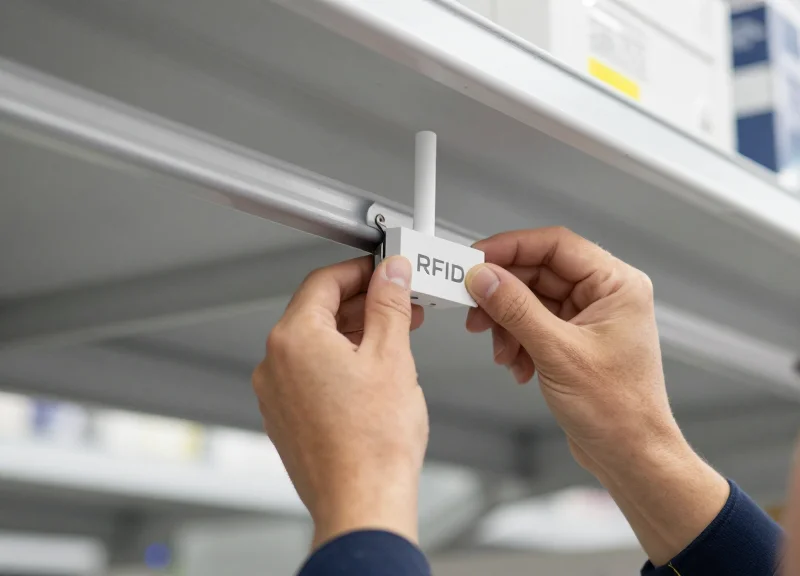
To eliminate signal bleed in high-density retail stores, antenna installation must move beyond simple mounting to 'Spatial Gating.' This involves the strategic coordination of physical tilt, height, and power attenuation to create a hard boundary for RF energy. By treating the read zone as a three-dimensional volume rather than a simple radius, engineers can ensure that an antenna at a point-of-sale or transition door ignores tags located just inches away on the sales floor.
- Geometric Alignment (The 15-Degree Rule): Mount antennas at a downward angle of 10 to 15 degrees. This 'downtilt' directs the main lobe toward the floor, utilizing the ground as a natural backstop for RF energy and preventing the signal from traveling horizontally into adjacent aisles.
- Cable Loss Compensation: Ensure all coaxial cables are of uniform length and high-quality shielding (like LMR-400). Uneven cable lengths introduce phase shifts and unpredictable power drops, which can cause one antenna to 'over-read' to compensate for another's weakness.
- Dynamic Power Scaling: Avoid the 'max power' trap. Start at the lowest possible dBm setting and incrementally increase power until the required read rate is achieved. This minimizes the 'Fresnel Zone' spillover that typically causes signal bleed.
| Installation Factor | Target Configuration | Impact on Signal Bleed |
|---|---|---|
| Mounting Height | 2.1m - 2.5m (Overhead) | Reduces horizontal propagation into next aisles. |
| Polarization Match | Cross-Linear Alignment | Minimizes reflection-based ghost reads in metal-heavy areas. |
| Reader Sensitivity | -70dBm to -80dBm | Filters out weak, reflected signals from distant tags. |
Expert Tip: The 'Null Zone' Strategy. In Silicon Valley's most advanced deployments, we utilize 'Back-to-Back Nulling.' By placing two antennas back-to-back with a thin layer of carbon-based RF absorber between them, you can create a literal dead-zone behind the antennas. This is far more effective than software filtering alone and is the gold standard for separating high-density apparel racks from checkout counters.
Can I use metallic tape to block signal bleed?
While foil or metallic tape can reflect signals, it often causes 'multipath interference,' which can actually push signals into areas you don't want. Professional RF shielding foam or specialized DragonGuard directional antennas are much safer choices.
How often should I recalibrate my antennas?
Recalibration should occur whenever the store layout changes by more than 20% or when moving high-dielectric items (like liquids or heavy metals) closer to the read zones.
Future-Proofing Your RFID Infrastructure
In the fast-evolving retail landscape, future-proofing means moving beyond simple tag reading to building a 'unified edge' architecture. This approach ensures that the antennas you install today for inventory management can seamlessly pivot or expand to support omnichannel fulfillment, loss prevention, and customer experience enhancements without requiring a complete hardware 'rip-and-replace' every three to five years.
| Feature | Legacy RFID Setup | Future-Proofed Infrastructure |
|---|---|---|
| Integration | Siloed RFID systems | Converged RFID, ESL, and BLE |
| Scalability | Fixed hardware limits | Modular, software-defined expansion |
| Maintenance | On-site manual tuning | Remote diagnostics and OTA updates |
| Loss Prevention | Separate EAS pedestals | Integrated overhead RFID/EAS sensors |
The most significant shift in modern retail is the convergence of Electronic Shelf Labels (ESL) and Electronic Article Surveillance (EAS) with RFID. By selecting wide-band antennas that operate across a broader spectrum, retailers can leverage the same physical infrastructure to manage real-time pricing and security. Expert Tip: Look for 'Software-Defined Radio' (SDR) capabilities in your RFID readers; this allows the system to be retuned via firmware to accommodate emerging protocols or new frequency allocations without changing the physical antenna.
How does RFID integrate with Electronic Shelf Labels (ESL)?
Modern infrastructure uses the RFID backbone to facilitate data exchange. High-density antennas can be used to locate ESLs within centimeters, ensuring that digital price updates and inventory counts are perfectly synchronized across the floor map.
Can RFID antennas replace traditional EAS gates?
Yes. Next-generation overhead RFID antennas provide 'invisible' EAS. By using sophisticated beam-forming, they can detect tagged items crossing the exit threshold with higher accuracy than traditional pedestals, reducing false alarms and improving store aesthetics.
What is the benefit of a multi-protocol gateway?
A multi-protocol gateway allows your RFID infrastructure to communicate with BLE (Bluetooth Low Energy) and Wi-Fi sensors. This enables secondary use cases like heat-mapping customer foot traffic or tracking high-value assets that require active battery-powered tags.
Ultimately, a future-proofed system is one that views the antenna not just as a peripheral, but as a multi-functional sensor hub. By prioritizing antennas with high gain-control flexibility and broad-frequency compatibility, you ensure that your investment scales alongside consumer expectations and technological breakthroughs.