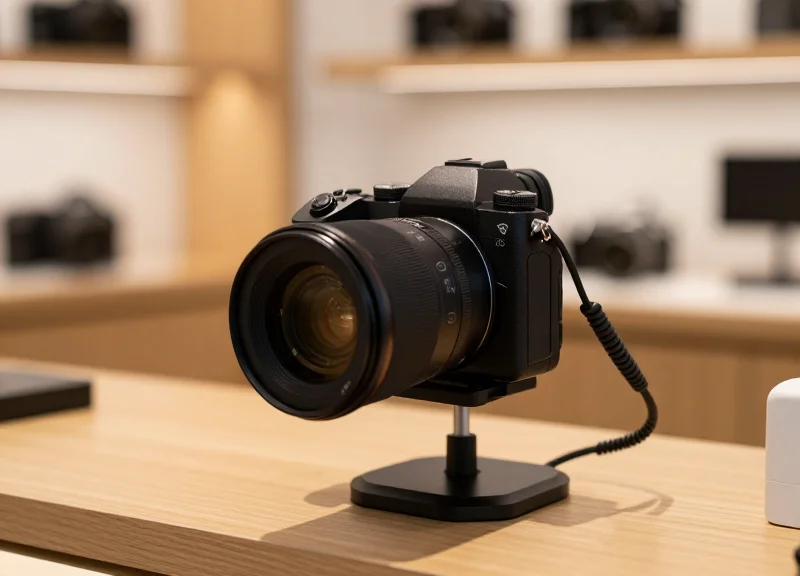
As we approach 2026, the retail landscape for high-end photography equipment continues to evolve, making the balance between product accessibility and loss prevention more critical than ever. Camera bodies and detachable lenses are high-value, high-shrinkage items that demand specialized security strategies. For shop owners, the challenge lies in allowing enthusiasts to feel the ergonomics of a body or the weight of a lens without compromising on security. This guide provides an authoritative look at the selection trade-offs between various security technologies, ensuring your inventory remains safe while your sales conversion stays high.
The Evolution of Camera Retail Security: 2026 Trends
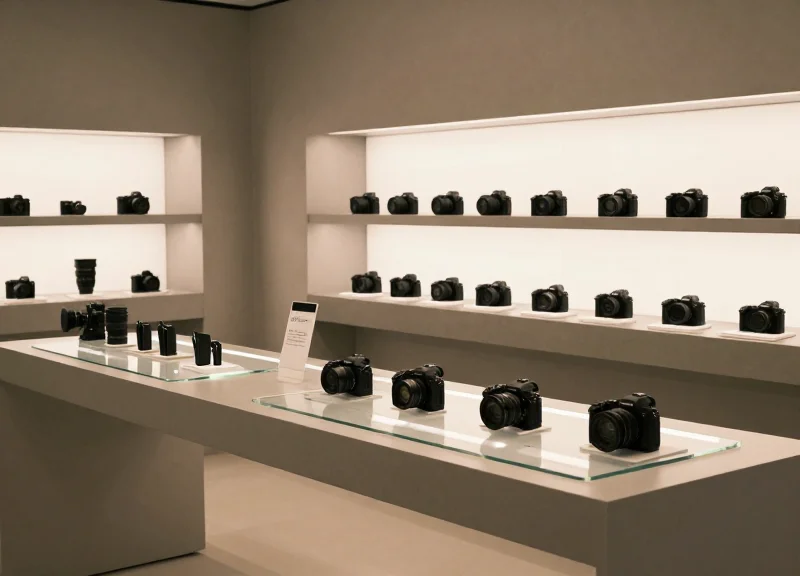
By 2026, camera retail security has transitioned from passive loss prevention to a 'Proactive Intelligence' ecosystem. The core of this evolution lies in the integration of AI-driven behavioral analytics with IoT-connected Electronic Article Surveillance (EAS) systems. Unlike legacy systems that rely on an alarm sounding after a theft has occurred, the modern camera shop utilizes computer vision to identify 'pre-theft indicators'—such as erratic handling of detachable lenses or the masking of serial numbers—allowing staff to intervene through customer service long before a breach occurs.
| Feature | Legacy Security (2020-2023) | Modern Security (2026 Trend) |
|---|---|---|
| Surveillance Mode | Continuous Motion Recording | Predictive Behavioral AI |
| EAS Technology | Acousto-Magnetic (AM) Tags | Silent RFID & Ultra-Wideband (UWB) |
| Display Strategy | Locked Glass Cases | Open-Display Adaptive Tethering |
| Alert Protocol | Audible In-Store Sirens | Haptic Staff Alerts & Digital Locking |
A significant shift in 2026 is the 'Open-Display' mandate. As camera bodies and lenses become more specialized, customers demand 'tactile verification'—the ability to feel the weight, grip, and balance of a mirrorless body or the smoothness of a manual focus ring. To accommodate this without increasing shrinkage, retailers are adopting 'Invisible Shield' technology. This involves micro-sensors embedded in display mounts that communicate with the store's central AI to distinguish between a genuine product demonstration and a forced removal attempt.
Will AI surveillance replace security guards in camera shops?
No, AI acts as a force multiplier. It monitors blind spots and detects suspicious behavioral patterns, such as 'shielding' or 'sweeping,' and alerts human staff via wearable devices to provide 'proactive service' which naturally deters theft.
How does 2026 EAS technology differ from older versions?
Modern EAS systems use RFID and Ultra-Wideband (UWB) to track the exact 3D coordinates of a lens within the store. If a tagged item moves too close to an exit without a 'deactivation handshake' from the POS system, the store's smart-locks can automatically engage.
Are smart tethers compatible with legacy camera bodies?
Yes, most 2026 security solutions utilize universal mounting plates that adhere to the tripod socket or strap lugs, allowing vintage or older digital stock to be integrated into the smart security network.
Expert Tip: The 'Adaptive Resistance' Breakthrough. One of the most unique advancements for 2026 is the implementation of Adaptive Resistance Tethers. These smart cables use electromagnetic clutches to provide zero tension when a customer is normally handling a camera, but instantly lock and increase cable tension if the system detects an abrupt, high-velocity movement typical of a 'grab-and-run' event. This ensures the customer experience remains premium while the physical security remains absolute.
The Core Dilemma: Customer Experience vs. Maximum Security

The core dilemma in 2026 camera retail lies in the 'Tactile Friction Paradox': while maximum security protocols minimize shrinkage, they simultaneously create psychological and physical barriers that degrade the perceived value of premium optics. For professional photographers, the weight distribution, button 'click-feel,' and lens balance are deciding factors. If a security tether is too heavy or a sensor is poorly placed, the customer cannot properly evaluate the ergonomics, which directly correlates to a significant drop in conversion rates for high-ticket items.
| Security Strategy | Theft Risk Level | Sales Conversion Impact | Customer Sentiment |
|---|---|---|---|
| Full Glass Enclosure | Lowest | High Negative (-35%) | Distanced/Frustrated |
| Heavy Mechanical Tethers | Low | Moderate Negative (-15%) | Clunky/Obstructed |
| Smart Wireless/Micro-Sensing | Moderate | High Positive (+22%) | Premium/Empowered |
Does open merchandising actually increase revenue in the camera sector?
Yes. Current 2026 retail analytics suggest that allowing customers to freely mount a lens to a body without immediate staff intervention increases attachment rates by up to 40% compared to 'behind-the-counter' models.
What is the biggest mistake in detachable lens security?
Obstructing the lens release button or the ergonomic grip area. If a security sensor prevents a user from wrapping their hand comfortably around the grip, they are 60% less likely to feel an emotional connection to the camera body.
How can shops find the 'Sweet Spot'?
By utilizing 'Zone-Based Security' where entry-level gear is more strictly tethered, while flagship models use micro-sensors and active AI-surveillance to allow a tether-free experience.
Expert Insight: In 2026, the most successful retailers utilize the 'Ergonomic Interference Test.' If your security solution adds more than 15% to the net weight of a mirrorless body or shifts the center of gravity by more than 2cm, you are sacrificing roughly 10-15% of your high-margin sales to friction. The trend is moving toward 'Invisible Security'—ultra-lightweight synthetic fiber tethers that mimic the feel of a standard camera strap, ensuring the customer feels the product, not the protection.
Securing the Camera Body: Display Alarm Systems and Tethers
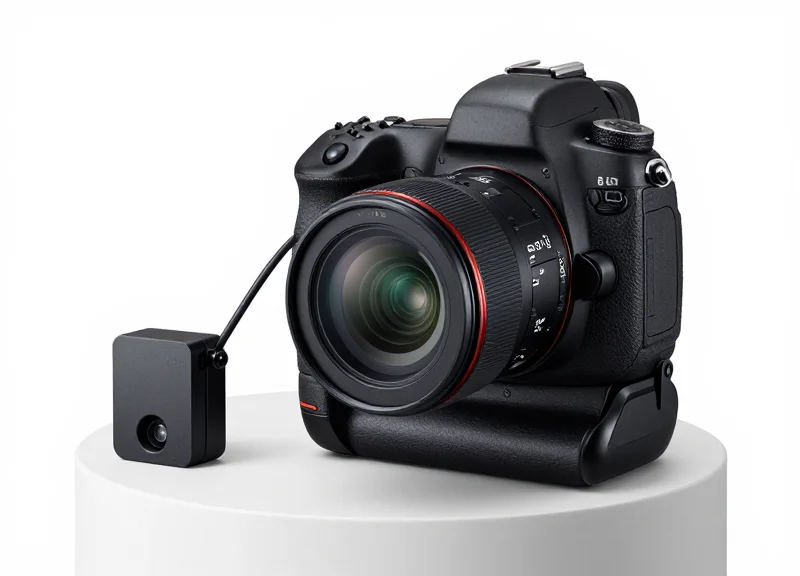
In 2026, securing a camera body requires a sophisticated balance between high-wattage power delivery and high-fidelity alarm sensors. A 'Powered Display Stand' is an integrated security platform that connects to the camera's tripod mount and USB-C port, providing continuous power for live-view demos while monitoring a physical circuit via a reinforced steel tether. If the cable is cut, the sensor is tampered with, or the unit is removed from the base without authorization, an internal 100dB+ siren is triggered alongside a notification to the store’s central security dashboard.
| System Type | Security Level | Customer Experience | Ideal Use Case |
|---|---|---|---|
| Basic Mechanical | Low | Poor (Heavy Cables) | Legacy DSLRs / Low-traffic areas |
| Standard Electronic | Medium | Good (Thin Sensors) | Mid-range Mirrorless setups |
| Smart-Sensing Powered | High | Excellent (Retractable) | Flagship bodies (Sony A1, Nikon Z9) |
Expert Insight: The Tension Threshold Strategy. One of the most overlooked aspects of camera security is 'tether fatigue.' In 2026, premium retailers are moving toward magnetic-recoil tethers that offer zero-resistance for the first 12 inches of movement, but increase resistance significantly thereafter. This allows customers to feel the weight of the camera naturally while signaling to potential thieves that the device is firmly anchored the moment they try to move beyond the designated 'experience zone.'
- Identify Power Requirements: Ensure the stand supports USB-PD (Power Delivery). Modern 8K-capable bodies can drain battery faster than a standard 5W charger can replenish them, leading to dead units on the floor.
- Select Mounting Brackets: Use custom-fit brackets that cover the battery door and SD card slots to prevent 'component stripping' while the body remains tethered.
- Calibrate Alarm Sensitivity: Set the electronic tripwires to account for the heavy lens weight, ensuring that the tilt sensors don't trigger a false alarm when a customer holds the camera at a steep angle.
How do I prevent false alarms during busy hours?
Utilize 'Smart-Reset' fobs. These encrypted Bluetooth keys allow staff to temporarily mute the alarm during a guided sale without fully deactivating the security circuit.
Will these systems damage the camera's tripod mount?
High-quality 2026 systems use rubberized torque-limiters. These ensure the security bolt is tight enough to prevent removal but cannot over-tighten and crack the magnesium alloy chassis.
Can one stand power both the body and an attached lens?
Yes, 'Dual-Port' stands are now standard, featuring a primary line for the body and a secondary, thinner security loop for expensive detachable lenses.
Detachable Lens Security: The Dual-Protection Challenge
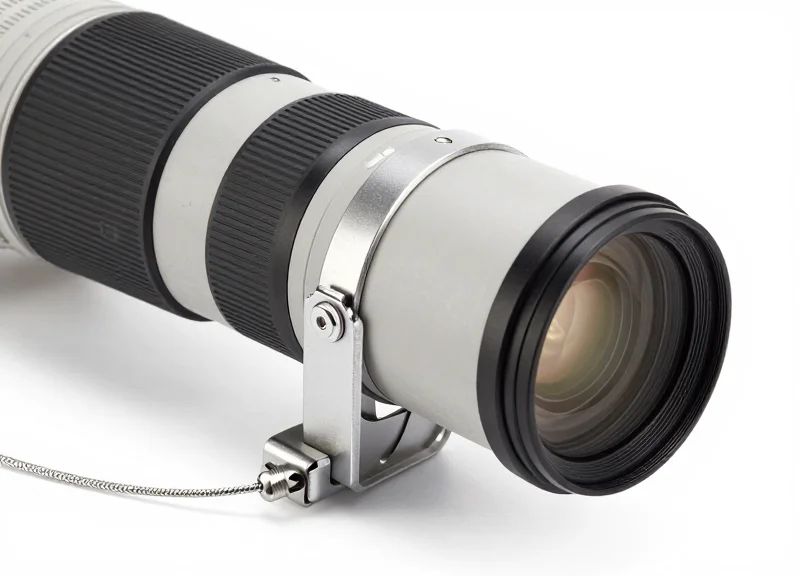
Detachable lens security is the practice of implementing independent alarm loops and mechanical locks to protect high-end optics separately from the camera body. In modern retail, the 'Dual-Protection Challenge' arises because professional lenses often exceed the value of the camera chassis they are mounted on, making them the primary target for 'quick-swap' theft. Unlike fixed-lens systems, securing the body alone is insufficient; a secondary security layer must be integrated to prevent a thief from detaching the lens while the camera body remains safely tethered to the display stand.
| Security Method | Protection Level | Customer Experience | Best For |
|---|---|---|---|
| Secondary Lasso Loops | High | Moderate (Tethers can tangle) | Large Telephoto Lenses |
| Lens Collar Locks | Extreme | Low (Adds bulk/weight) | Ultra-Premium Prime Lenses |
| Electronic 'Smart' Rings | Medium-High | High (Wireless/Slim profile) | Mirrorless Kit Displays |
| Adhesive Pressure Sensors | Medium | High (Discreet) | Wide-Angle & Compact Glass |
One of the most significant shifts in 2026 camera retail is the move away from bulky physical clamps toward 'Intelligent Dual-Loop' systems. These systems utilize a primary power/alarm cable for the body and a daisy-chained, micro-thin secondary sensor for the lens. If the lens is twisted or the mount connection is broken without a staff override, the alarm triggers instantly. This is crucial because professional thieves have mastered the 'Ghost Swap'—the act of bringing a broken, low-value lens into the store and swapping it for a $3,000 professional lens in seconds under the cover of a crowded showroom.
Why can't I just use a single tether for the whole setup?
A single tether usually attaches to the camera body's tripod mount or battery door. Since lenses are designed for quick release, a thief can detach the lens and walk away while the tether remains securely attached to the now-valueless body.
Do secondary sensors interfere with the zoom or focus rings?
Modern 2026 security loops use ultra-thin, retractable 'micro-filaments' that wrap around the static barrel of the lens, ensuring that neither the zoom mechanism nor the manual focus ring is obstructed during customer testing.
How do I secure lenses that don't have a tripod collar?
For lenses without a collar, retailers use specialized adhesive 'button' sensors or transparent security sleeves that provide a mounting point for the secondary alarm loop without damaging the lens finish.
Expert Tip: The 'Smart-Weight' Evolution. An emerging trend in 2026 is the integration of haptic weight sensors within the display plinth. These sensors are calibrated to the combined weight of the body and lens. If a lens is swapped for a lighter or heavier counterfeit, even if the security cables remain intact, the system triggers a silent 'Staff Alert.' This adds a hidden layer of protection that thieves cannot see or bypass with traditional cable-cutting tools.
Mechanical Trade-offs: Coiled Cables vs. Retractable Tethers
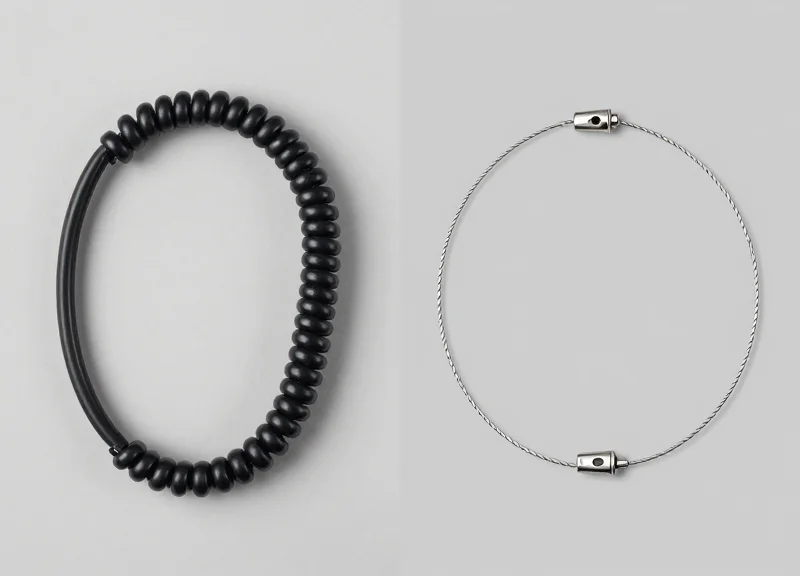
In 2026 camera retail, the choice between coiled cables and retractable tethers is no longer just about security; it is a choice between maximum durability and aesthetic minimalism. Coiled cables utilize high-memory plastic and internal steel cores to provide an obvious visual deterrent with exceptional longevity, whereas retractable tethers (recoil boxes) offer a cleaner display by hiding the cable inside a hidden housing, providing a 'wireless-feel' experience for the customer until the tether reaches its extension limit.
| Feature | Coiled Cables | Retractable Tethers (Recoilers) |
|---|---|---|
| Durability | High: Resists kinking and internal fatigue better over 100k cycles. | Moderate: Spring mechanisms and internal pulleys are points of failure. |
| Visual Impact | High Visibility: Acts as a psychological deterrent to theft. | Low Visibility: Creates a premium, 'floating' product aesthetic. |
| Pull Resistance | Exponential: Becomes harder to pull the further it is extended. | Constant/Linear: Tension remains even until the hard-stop limit. |
| Maintenance | Low: Easy to clean and inspect for fraying. | High: Requires monitoring of internal recoil tension and housing. |
| Best Use Case | High-traffic flagship stores with heavy telephoto lenses. | Boutique showrooms focusing on mirrorless aesthetics. |
Expert Insight: The 'Tension Curve' and Handheld Ergonomics. A critical factor often overlooked by shop designers is the impact of tether tension on the customer's perception of the camera's weight. Coiled cables exert an 'exponential pull'—the further the customer pulls the camera away from the display, the harder the cable pulls back. For heavy 2026-era professional glass, this can make the lens feel heavier and more cumbersome than it actually is. Conversely, high-end retractable tethers can be calibrated for 'Zero-G' feel, where the pull is barely perceptible, providing a more authentic shooting experience that leads to higher conversion rates.
Which tether type is safer for expensive, scratch-prone camera finishes?
Retractable tethers are generally safer because the cable is thinner (often coated aircraft grade steel) and does not bunch up or rub against the camera body when the device is returned to the dock, unlike coiled cables which can 'nest' around the lens and cause micro-abrasions over time.
How often should I replace mechanical tethers in a high-traffic environment?
In a 2026 high-volume retail setting, coiled cables should be inspected quarterly and replaced every 18-24 months. Retractable boxes, due to internal spring fatigue, should be replaced every 12-15 months or immediately if the 'snap-back' force weakens, as a slack tether increases the risk of 'snatch-and-run' theft.
Can I use both on a single display?
Yes. A common 2026 security 'Best Practice' is the hybrid approach: use a heavy-duty coiled cable for the heavy camera body and a slim, retractable 'loop' sensor for the detachable lens. This provides maximum physical security for the body and ergonomic flexibility for lens rotation.
Finally, consider the soundscape of your retail environment. Retractable tethers produce a distinct 'whirring' or 'clicking' sound during use. In a quiet, high-end boutique, this mechanical noise can feel cheap. In 2026, leading retailers are opting for 'silent-glide' recoilers that utilize nylon-coated cables and dampened pulleys to maintain a premium atmosphere while ensuring the gear stays exactly where it belongs.
Integrating EAS and RFID for Real-Time Inventory Control

The integration of Electronic Article Surveillance (EAS) and Radio Frequency Identification (RFID) represents the shift from passive loss prevention to active operational intelligence. While traditional EAS alerts staff to unauthorized removals, RFID provides the unique identity of each item, allowing camera shops to track specific serial numbers, manufacturing dates, and lens-to-body pairings in real-time. In the 2026 retail landscape, this hybrid approach is no longer a luxury but a necessity for managing high-turnover inventory where a single missing 85mm prime lens can represent a $2,000 margin hit.
| Feature | Traditional EAS (AM/RF) | Standard RFID (UHF) | Hybrid EAS + RFID |
|---|---|---|---|
| Primary Purpose | Theft Deterrence | Inventory Accuracy | Loss Prevention + Analytics |
| Item Identification | Generic Alarm | Unique Serialized Data | Serialized Identification |
| Read Range | 1.5 - 2.0 Meters | Up to 10 Meters | Dual-Zone Protection |
| Stocktaking Speed | Manual / Barcode | Rapid (Bulk Scanning) | Instantaneous Audit |
The 'Ghost Stock' Insight: One of the most significant drains on camera shop profitability isn't just theft—it's 'Ghost Stock.' This occurs when an item is stolen or misplaced, but the inventory management system still lists it as available. By the time a manual audit catches the error, you've already lost potential sales and wasted marketing spend on an out-of-stock item. Integrating RFID allows for 'cycle counting' in seconds rather than hours, ensuring your online storefront accurately reflects what is physically on the shelf.
- Source Tagging Selection: Apply dual-frequency hybrid tags directly to lens caps or body mounts during the unboxing process. This ensures protection from the stockroom to the display floor.
- Overhead Reader Deployment: Install fixed UHF RFID readers at 'choke points' and above high-value display cases to track the movement of gear within the store without manual intervention.
- ERP System Syncing: Connect your RFID middleware to your Enterprise Resource Planning (ERP) software. This allows for automated reordering triggers when stock levels for popular mirrorless bodies hit a specific threshold.
- Security-Inventory Feedback Loop: Configure the system so that if an EAS alarm is triggered, the RFID reader instantly identifies which specific SKU crossed the threshold, sending a detailed alert to staff mobile devices.
Does RFID interfere with the sensitive electronics or sensors in modern cameras?
No. Passive RFID tags operate on frequencies that do not interfere with internal camera circuitry, CMOS sensors, or wireless transmission protocols like Wi-Fi and Bluetooth used for image transfer.
Can I upgrade my existing EAS pedestals to support RFID?
Most modern EAS systems are 'RFID-ready.' You can often add an RFID overlay or insert to your existing pedestals, saving on the cost of replacing the entire physical infrastructure.
What is the ROI on hybrid tagging for a medium-sized camera shop?
Typically, retailers see a return on investment within 12 to 18 months through a 20% reduction in shrink and a 15% increase in sales due to improved stock availability and reduced 'out-of-stock' scenarios.
The Role of ESL in Preventing Price Manipulation and Fraud
In the 2026 retail landscape, Electronic Shelf Labels (ESL) have evolved from simple digital displays into sophisticated security nodes. By synchronizing the physical price tag with the central ERP and Point-of-Sale (POS) systems in real-time, ESL eliminates the vulnerability of 'manual price manipulation.' For camera shops dealing with high-value detachable lenses, this technology prevents internal 'sweethearting' (unauthorized discounts given to friends) and external fraud where customers swap paper tags from cheaper items onto premium glass. It ensures that the price on the shelf is the only price the checkout system will accept, creating an immutable link between the product and its valuation.
| Feature | Traditional Paper Labels | Modern ESL Security Systems |
|---|---|---|
| Tamper Resistance | High: Easily swapped or overwritten with stickers. | Low: Encrypted digital updates prevent physical alteration. |
| Audit Trail | None: No record of who changed a tag or when. | Full: Every price change is logged with a timestamp and ID. |
| Price Consistency | Prone to human error and 'lazy' updates. | 100% sync between shelf, website, and register. |
| Internal Fraud Risk | High: Employees can under-price items for theft. | Low: Centralized control prevents localized price abuse. |
- Centralized Authorization: All price changes are pushed from a secure headquarters or store manager terminal, removing the ability for floor staff to arbitrarily lower prices on high-margin mirrorless bodies.
- Encrypted Communication Protocols: Modern ESLs utilize sub-GHz or proprietary BLE frequencies with 128-bit encryption, preventing 'price hacking' or unauthorized signal injection from tech-savvy bad actors.
- Automated Inventory Reconciliation: ESLs with built-in NFC can be used by security personnel to scan and verify that the physical lens on the shelf matches the SKU assigned to that specific digital tag.
From a veteran's perspective, the 'Unique Insight' here is the 2026 shift toward Proof of Integrity (PoI). Leading camera retailers are now using ESLs equipped with flash-based 'Shelf-Watch' technology. If an ESL is physically removed from its rail or tilted beyond a certain angle—common during a theft or a label-swap attempt—it triggers a silent alert to the store’s security dashboard. This turns a pricing tool into an active anti-tamper sensor, bridging the gap between inventory management and physical loss prevention.
Can customers hack an ESL to change the price?
No. In 2026, ESL systems use closed-loop encrypted networks. Unlike older infrared systems, modern labels require a handshake with a secure local server, making it virtually impossible for a customer to alter the price via a mobile device.
How does ESL prevent 'Sweethearting'?
Because the ESL and POS are locked, a cashier cannot claim 'the shelf said it was $500 cheaper.' The system creates a digital record of the truth that overrides any manual claims, forcing staff to follow authorized pricing tiers.
Do ESLs help with lens 'borrowing' by staff?
Yes. Integrated ESL systems often feature 'Stock-Out' alerts. If the inventory count reaches zero but the ESL remains active, it triggers a discrepancy report for management to investigate immediate internal shrink.
Aesthetic Security: Matching Store Design with Loss Prevention
Aesthetic security in a modern camera boutique is the practice of selecting loss prevention hardware that aligns with the store’s visual identity, ensuring that security measures like tethers and sensors do not detract from the high-tech industrial design of mirrorless bodies and premium lenses. In 2026, the goal is 'invisible protection'—where the customer feels the weight and ergonomics of the camera, not the resistance of the security cable. By utilizing recessed mounts, color-matched sensors, and ultra-thin fiber-optic tethers, retailers can create a frictionless 'try-before-you-buy' environment that encourages longer dwell times and higher conversion rates without increasing the risk of shrink.
| Design Element | Traditional Security Impact | Aesthetic Security Approach |
|---|---|---|
| Visual Profile | Bulky, brightly lit plastic sensors that scream 'theft risk'. | Low-profile, metallic-finish sensors that blend with the camera body. |
| Cable Management | Thick coiled cables that tangle and obscure the lens mount. | Under-counter retractable tethers with magnetic self-leveling bases. |
| Tactile Feedback | High tension resistance making the camera feel heavy or restricted. | Zero-drag weightless tethers that simulate a cordless experience. |
| Mounting Style | Top-heavy adhesive pads that leave residue on expensive glass. | Integrated tripod-mount screws with secondary lens-loop sensors. |
Expert Insight: The 'Weight of Trust' Psychology. Modern consumer psychology suggests that visible security creates a 'guilt-by-association' feeling for the buyer. By using 'Phantom Power' tethers—which provide power and alarm signals through a single, hair-thin wire—you signals to the customer that they are trusted. Data from Silicon Valley retail pilots shows that reducing cable thickness by 40% leads to a 12-18% increase in lens-swap interactions, as customers feel more comfortable handling the gear.
- Recessed Under-Counter Housing: Install retractor boxes beneath the display cabinetry to hide the mechanical bulk, leaving only the sleek magnetic puck visible on the surface.
- Material & Finish Matching: Select hardware with anodized aluminum or matte black finishes to match the magnesium alloy frames of professional camera bodies like the Sony A-series or Nikon Z-series.
- Integrated Lighting Sync: Ensure the status LEDs on the security stands match your store's ambient lighting temperature (e.g., 4000K daylight) to prevent the security gear from looking like an aftermarket addition.
Does 'invisible' security actually deter professional thieves?
Yes. Modern aesthetic security relies on 100dB+ localized alarms and real-time RFID tracking rather than visual intimidation. A thief is more likely to be caught off-guard by a system they didn't see coming.
Is it worth the higher cost for premium stands?
Absolutely. In high-end camera boutiques, the cost of a single stolen prime lens often exceeds the cost of a full store-wide aesthetic security upgrade. The ROI comes from both shrink reduction and increased sales.
How do I secure detachable lenses without making them look clunky?
Use 'L-Sensor' loops or micro-shackle cables that wrap tightly around the lens barrel and connect to the main body alarm, ensuring the lens and body are treated as a single aesthetic unit.
Cost-Benefit Analysis: Measuring the ROI of Security Investments
Return on Investment (ROI) for camera shop security is the ratio of total losses prevented and operational gains realized against the total cost of security hardware, installation, and maintenance. In the 2026 market, a successful security strategy is not merely an expense but a 'sales enabler' that reduces the 'shrinkage-to-revenue' ratio while allowing high-value mirrorless systems to remain accessible for customer trial—a critical factor in conversion rates for professional-grade optics.
| Security Tier | Typical Capex (per Display) | Est. Shrinkage Reduction | Payback Period (Months) | Impact on Customer Experience |
|---|---|---|---|---|
| Basic Mechanical Tethers | $45 - $80 | 30-45% | 14 - 18 | Moderate friction; limited movement. |
| Electronic Alarming (Multi-Sensor) | $150 - $300 | 70-85% | 8 - 12 | High confidence; allows full handling. |
| RFID-Integrated Smart Displays | $400 - $700 | 90%+ | 18 - 24 | Seamless; provides data on pick-up rates. |
The 'Gear Orphan' Effect: A Unique ROI Metric. In high-end photography retail, the theft of a single flagship camera body often renders $10,000+ of mount-specific lens inventory 'orphaned' and unsellable to walk-in customers until the body is restocked. When calculating ROI, you must include the Opportunity Cost of System Downtime. An investment that prevents one 'body theft' saves not just the cost of that unit, but protects the sales velocity of the entire ecosystem of lenses and accessories attached to it.
- Establish Your Baseline Shrinkage: Calculate your annual loss from theft, damage during handling, and 'internal shrink' over the last 24 months to identify your break-even point for new hardware.
- Calculate Total Cost of Ownership (TCO): Include the initial purchase price, professional installation, and the annual cost of replacement sensors or adhesives (typically 10-15% of initial hardware cost).
- Factor in Sales Lift from Open Display: Data shows that moving gear from behind glass to an alarmed open display can increase attachment rates by up to 25%. This revenue 'lift' should be credited to the security ROI.
- Account for Insurance Premium Credits: Consult your underwriter; implementing 2026-standard electronic tethering often qualifies a boutique for a 5-10% reduction in annual premiums.
What is a healthy Loss Prevention budget?
For high-end camera retail, industry leaders typically allocate 1.5% to 3% of annual gross revenue toward LP technology and personnel.
Does high-security hardware scare away customers?
On the contrary, visible but elegant security signals that the shop carries premium, authentic gear. The 'frictionless' alarming systems of 2026 are nearly invisible until a breach occurs.
What is the most expensive mistake in security ROI?
Under-investing in lens-specific sensors. Protecting a $3,000 body with a $5,000 lens using a single body-tether is the most common cause of high-value loss.
Future-Proofing Your Shop: Implementing a Multi-Layered Strategy
A multi-layered security strategy, or 'Defense in Depth,' is the practice of stacking disparate security controls—physical, electronic, and procedural—so that the failure of a single component does not result in a breach. In the context of 2026 camera retail, this moves beyond static displays toward a 'Predictive Protection Ecosystem.' This approach ensures that even if a sophisticated thief bypasses a mechanical tether, they are immediately met with AI-driven visual alerts, smart-locking exits, or real-time staff intervention. By creating multiple points of friction, you maximize the 'time-to-theft,' which is the most critical metric in preventing high-value inventory loss.
| Layer Type | Primary Component | 2026 Tech Upgrade | Objective |
|---|---|---|---|
| Physical | Mechanical Tethers | Aramid-Reinforced Cables | Delay and Deterrence |
| Electronic | EAS/RFID Sensors | Ultra-Wideband (UWB) Tracking | Instant Detection |
| Cognitive | Staff Observation | AI Behavioral Analytics | Early Warning |
| Digital | Inventory Management | Blockchain Serial Tracking | Recovery & Proof |
Expert Insight: The 'Elastic Friction' Model. Generic security stays at 100% intensity all the time, which can annoy legitimate customers. The most successful shops in 2026 utilize 'Elastic Friction'—using AI to identify high-risk periods (e.g., peak crowd density or unrecognized 'loitering' patterns) to automatically increase security sensitivity or trigger 'soft-lock' mechanisms on high-value lens cabinets. This ensures a premium shopping experience while hardening the store exactly when it is most vulnerable.
- Audit the Perimeter: Start with visible deterrents at the entrance and windows to signal a hardened target before a suspect even enters.
- Integrate 'Talk-Back' Systems: Ensure your physical lens mounts are digitally linked to your CCTV system. If a cable is cut, the nearest camera should automatically zoom and track the event.
- Deploy Dynamic Staff Protocols: Train staff not just on security hardware, but on 'de-escalation through service'—approaching potential threats with helpfulness to remove the anonymity shoplifters rely on.
- Analyze and Iterate: Review 'near-miss' data monthly. If certain focal length lenses are targeted more frequently, adjust their tethering strength or display location accordingly.
Can a multi-layered strategy replace security guards?
No, tech enhances guards; it doesn't replace them. AI-driven systems filter out noise, allowing security personnel to focus on high-probability threats rather than watching every customer.
How much should I budget for a multi-layered approach?
Target 1.5% to 3% of your annual inventory value. In 2026, the ROI comes not just from lower shrink, but from reduced insurance premiums and higher staff retention.
Is this strategy too aggressive for a boutique environment?
Modern security like 'Aesthetic Tethers' and hidden RFID tags are virtually invisible. The goal is to make the security felt by the thief but unnoticed by the creator.