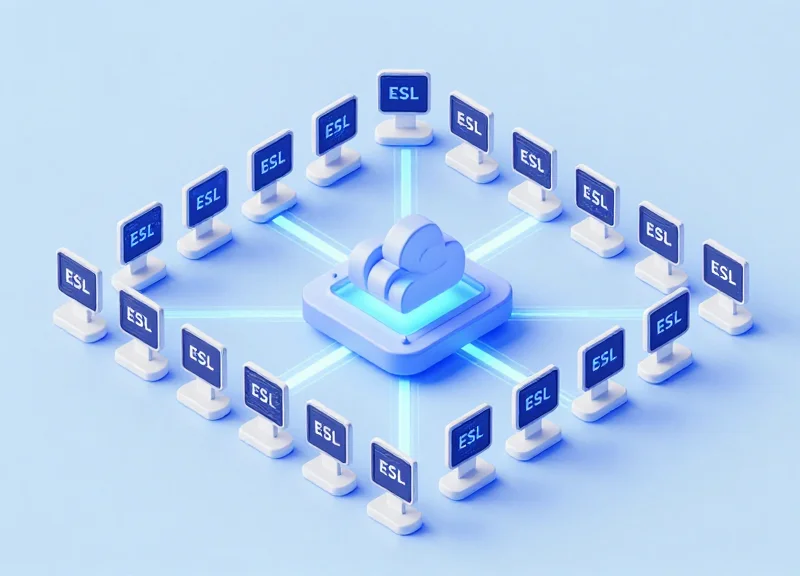
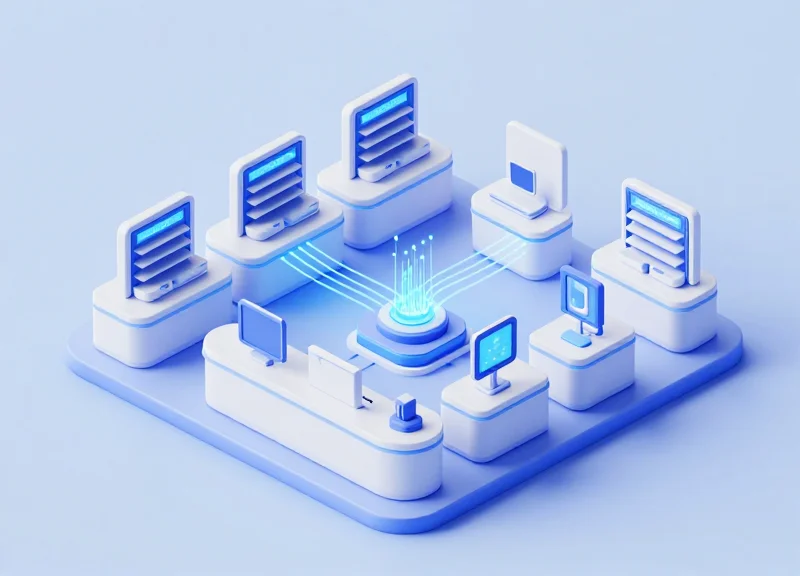
As we approach 2026, the retail technology landscape is undergoing a silent but significant revolution. For years, the public cloud was the default for Electronic Shelf Label (ESL) deployments, offering scalability but introducing concerns over data sovereignty and latency. Today, a new paradigm is emerging: Data Localization. High-security retailers are increasingly moving their ESL ecosystems toward localized, edge-based infrastructures to mitigate cyber threats, comply with tightening global privacy regulations, and ensure 100% operational uptime. This article explores the drivers behind this shift and how localized ESL architecture is becoming the gold standard for secure modern retail.
The Evolution of ESL Architecture: Why the Public Cloud is No Longer Enough

The evolution of Electronic Shelf Label (ESL) architecture has reached a critical tipping point where the 'Cloud-First' mantra is being replaced by 'Security-First' localized ecosystems. While the public cloud initially enabled rapid scaling and reduced upfront infrastructure costs, the 2026 landscape demands a level of data sovereignty and operational resilience that centralized servers simply cannot provide. Modern retail environments now treat ESLs not just as digital price tags, but as mission-critical IoT endpoints where even a few seconds of latency or a single data breach can disrupt thousands of physical locations simultaneously.
| Feature | Legacy Local (Gen 1) | Public Cloud (Gen 2) | Localized Edge (Gen 3) |
|---|---|---|---|
| Data Residency | On-site (Isolated) | Centralized (Multi-tenant) | Localized (Sovereign) |
| Latency | Low but manual | Variable (Internet dep.) | Ultra-Low (Real-time) |
| Security | Physical access only | Broad attack surface | Hardened Edge / Zero Trust |
| Scalability | Difficult/Manual | High | Automated Orchestration |
As retailers integrate dynamic AI-driven pricing and real-time inventory tracking, the limitations of the public cloud become glaringly apparent. The primary drivers for this shift include the 'Latency Tax'—the hidden cost of delayed updates during peak shopping hours—and the 'Compliance Wall,' where regional data protection laws increasingly view price and consumer behavioral data as sensitive assets that must remain within domestic or even store-level borders.
Why is the public cloud considered a 'single point of failure' for 2026 retailers?
A regional internet outage or cloud provider downtime can render an entire retail chain unable to update prices or manage stock, leading to massive revenue loss and potential legal non-compliance if prices at the shelf don't match the POS.
Does data localization mean returning to expensive on-premise servers?
No. The 2026 trend focuses on 'Localized Edge Ecosystems' which use lightweight, containerized microservices running on-site but managed via a secure, private control plane, offering cloud-like agility with local-site reliability.
What is the unique 'security friction' in public cloud ESL?
Public cloud ESL systems often rely on shared API gateways. A breach in one tenant's infrastructure can potentially expose the pricing strategies and operational data of hundreds of other retailers using the same provider.
Expert Insight: The '99.9% Uptime Fallacy' is the biggest risk in current ESL strategies. A 0.1% downtime for a cloud provider might seem acceptable on paper, but if that downtime coincides with a Black Friday event or a major price shift, the operational 'dark period' results in localized chaos. The 2026 trend toward data localization isn't just about security; it's about 'Operational Autonomy'—ensuring that a store remains fully functional even if it is completely severed from the global internet.
Defining Data Localization in the 2026 Retail Context

In the 2026 retail landscape, data localization is defined as the architectural requirement to store and process mission-critical operational data—such as dynamic pricing logic, inventory levels, and consumer interaction metadata—within the physical boundaries of the store or a private localized micro-datacenter. For Next-Gen High-Security ESL ecosystems, this means moving away from a 'Cloud-First' model to an 'Edge-Primary' configuration. By localizing data, retailers ensure that their digital price tags and IoT sensors remain fully functional and secure even during backbone internet failures, while simultaneously meeting stringent new global data sovereignty regulations that treat retail pricing as sensitive commercial infrastructure.
This transition is driven by the realization that the public cloud, while scalable, introduces a 'dependency tax' in the form of latency and external vulnerability. In 2026, the retail sector identifies data localization not merely as a storage preference, but as a critical component of 'Operational Autonomy'—the ability for a physical store to maintain 100% of its digital functions without an external heartbeat.
| Feature | Legacy Public Cloud ESL | 2026 Localized ESL Ecosystem |
|---|---|---|
| Data Processing Location | Centralized Remote Servers | On-site Edge Gateway / Private Server |
| Latency (Price Updates) | 500ms - 5s (Network Dependent) | < 50ms (Deterministic) |
| Security Perimeter | Shared Public Infrastructure | Hardened Local Intranet |
| Offline Functionality | Read-only / Cached | Full Dynamic Updates & Analytics |
| Compliance | Third-party Data Handlers | Absolute Data Sovereignty |
Does data localization mean we lose the benefits of remote management?
No. Modern localized systems use a 'Fed-Cloud' approach where management is centralized via a dashboard, but the execution and sensitive data residency remain strictly at the edge.
Is private server deployment more expensive for 2026 retailers?
While initial hardware investment is higher, the total cost of ownership (TCO) is lower due to the elimination of high-bandwidth cloud egress fees and the mitigation of expensive downtime.
How does localization impact ESL security?
It significantly reduces the attack surface. By keeping pricing data local, hackers cannot perform massive, multi-store price manipulations via a single cloud vulnerability.
Expert Insight: The 'Sovereign Shelf' concept is the true differentiator in 2026. Leading retailers are now implementing what I call 'Latent-Zero' architectures. This involves an ESL system that treats the public cloud as an optional secondary backup rather than the primary source of truth. By utilizing on-premise Kubernetes clusters tailored for retail (K3s), stores can now run complex AI-driven pricing algorithms locally on the same hardware that manages their ESL labels. This is a massive leap from the 2020s, where an ESL gateway was a simple 'dumb' pass-through device; it is now a robust local brain.
Security Imperatives: Mitigating Cyber Threats at the Edge

In the context of 2026 retail architecture, mitigating cyber threats at the edge means shifting security from a reactive cloud-perimeter model to a proactive, localized defense-in-depth strategy. By processing Electronic Shelf Label (ESL) data on-site, retailers eliminate the 'Centralized Honeypot' effect—where a single breach of a cloud provider exposes the pricing and inventory data of thousands of stores simultaneously. Localization ensures that the most critical data assets never leave the physical premises, effectively air-gapping the primary control plane from the global internet and reducing the lateral movement capabilities of sophisticated threat actors.
| Security Vector | Public Cloud Dependency | Localized Edge Ecosystem |
|---|---|---|
| Attack Surface | Global (Exposed via Public APIs) | Local (Limited to Store Network) |
| Data-in-Transit | Multiple Hops (ISP/Backbone Risks) | Intra-network (Internal Only) |
| DDoS Vulnerability | High (Can paralyze entire chains) | Near-Zero (Localized isolation) |
| Blast Radius | Enterprise-wide systemic risk | Single-site containment |
### The Silicon Valley Insight: Reducing the 'Blast Radius' through Physical Proximity Validation. In my two decades observing retail tech, the most overlooked vulnerability is the 'Global Price Override' attack. In a cloud-centric model, a compromised administrative credential can change the price of high-end electronics to $0.01 across 500 stores in seconds. Data localization introduces a 'Physical Proximity Validation' (PPV) requirement. In 2026, high-security ESL ecosystems will require localized cryptographic handshakes that can only be initiated by on-site hardware. This means even if an attacker gains control of your global management software, they cannot push updates to the labels without a localized gateway token—essentially making remote, massive-scale price manipulation physically impossible.
- Local Key Management: Store unique encryption keys within on-site Hardware Security Modules (HSMs) rather than shared cloud key vaults.
- Traffic Segmentation: Isolate ESL traffic onto a dedicated VLAN that does not communicate with public-facing Wi-Fi or point-of-sale systems.
- Edge-Based Anomaly Detection: Deploy AI models at the edge to detect unusual price update patterns locally, triggering an immediate lockdown if a deviation occurs.
Does data localization prevent all hacking attempts?
No, but it fundamentally changes the risk profile. While a local breach is still possible, it requires physical presence or access to that specific store's network, preventing a single digital exploit from cascading across your entire global infrastructure.
How does localization protect customer privacy?
Next-gen ESLs often interact with customer smartphones via BLE or NFC. By localizing this data, any interaction logs or temporary device IDs are processed and purged locally, ensuring sensitive customer behavior data isn't stored in a vulnerable cloud database.
What is the impact on regulatory compliance like GDPR or CCPA?
Localization simplifies compliance by keeping data within specific geographic or physical boundaries, reducing the legal complexities associated with cross-border data transfers and third-party cloud processing.
Regulatory Compliance and Data Sovereignty
In the 2026 retail landscape, regulatory compliance and data sovereignty refer to the strategic practice of maintaining data within a specific jurisdiction to satisfy legal mandates and protect the autonomy of information. For Next-Gen ESL (Electronic Shelf Label) systems, this means moving beyond simple encryption to a localized architecture where sensitive pricing strategies, inventory metrics, and consumer behavioral data are physically stored and processed within the region of operation. By eliminating the cross-border data transfers inherent in traditional public cloud models, retailers can automatically align with strict data residency requirements and avoid the astronomical fines associated with jurisdictional overreach.
The shift toward localization is a proactive response to the fragmentation of global privacy laws. As nations increasingly view data as a sovereign resource, the legal 'Safe Harbors' of the past have evaporated. Retailers using legacy cloud-only ESL systems often find themselves in a 'compliance trap' where a software update or a change in a cloud provider's server routing can instantly trigger a violation of local laws. Localized ESL ecosystems resolve this by keeping the data 'legal by design,' ensuring that local auditors can access physical hardware if necessary without navigating international legal treaties.
| Regulation | Key Data Residency Requirement | Impact on ESL Cloud Models | Localization Benefit |
|---|---|---|---|
| GDPR (EU) | Strict limits on data transfers outside the EEA. | High risk during US-based cloud synchronization. | Data never leaves EU soil; zero transfer risk. |
| CCPA/CPRA (USA) | Consumer right to know where data is stored/sold. | Complex mapping of third-party cloud nodes. | Simplified reporting via on-premise/edge storage. |
| PIPL (China) | Mandatory local storage for critical infrastructure. | Cloud models often require separate, isolated stacks. | Native compliance through localized server deployment. |
Expert Tip: The 'Infrastructure-as-Legality' Pivot. In 2026, the most successful retailers are moving from 'Agreement-based Compliance' (relying on legal contracts with cloud vendors) to 'Infrastructure-based Compliance.' By owning the physical or private-cloud location of the data, you remove the 'third-party risk' entirely. This is particularly critical for ESLs that integrate with AI-driven dynamic pricing, as those algorithms often contain proprietary business intelligence that is legally classified as protected intellectual property in many jurisdictions.
Does localization help with GDPR Right to Erasure requests?
Yes. When data is localized within an ESL ecosystem, the 'Search and Destroy' process for specific customer data points is significantly faster and more verifiable than searching through massive, distributed cloud databases.
How does data sovereignty affect multi-national retailers?
Multi-national retailers are adopting a 'Federated Local' model, where each country has its own localized ESL server hub. This allows for global management of brand assets while keeping sensitive operational data within national borders.
Will localized ESL systems simplify regulatory audits?
Unquestionably. Having a physical server or a dedicated private edge node allows IT teams to provide auditors with a clear, localized audit trail, proving exactly where data sits and who has accessed it at any given moment.
Zero Latency and Real-Time Synchronization

Zero latency in Next-Gen ESL ecosystems refers to the elimination of network bottlenecks by processing data at the store level (the Edge) rather than routing every update through a remote public cloud server. By keeping data local, retailers achieve real-time synchronization across thousands of labels in under 50 milliseconds, ensuring that the price at the shelf always matches the Point of Sale (POS) system without the risk of lag-induced pricing discrepancies or consumer mistrust.
As we approach 2026, the demand for dynamic pricing strategies—triggered by real-time inventory levels, competitor tracking, or perishable expiration windows—requires a response time that public clouds cannot consistently guarantee. Factors like 'internet jitter' and regional data center outages create a 'synchronization gap' where shelf prices and checkout prices differ, a liability that localized data structures effectively solve by removing the external dependency on the wide-area network (WAN).
| Performance Metric | Public Cloud Architecture | Localized/Edge Architecture (2026) |
|---|---|---|
| Average Response Latency | 250ms - 1500ms | < 50ms |
| Sync Reliability | Dependent on WAN Uptime | 100% (Intranet-Based) |
| Bulk Update Throughput | Serial / Throttled by API | Parallel / Broadcast-Native |
| Offline Capability | Read-Only / Stale Data | Full Operational Autonomy |
Expert Insight: The 'Packet-Storm' Bottleneck. A major overlooked risk in cloud-based ESL is the synchronization failure during store-wide flash sales. When a retailer attempts to update 50,000 labels simultaneously via the cloud, the sheer volume of outbound API calls often triggers 'rate-limiting' from cloud providers or saturates the store's upload bandwidth. Next-gen localized systems utilize 'Broadcast-at-the-Edge' logic, where a single localized command propagates to every label simultaneously without the data ever needing to traverse the internet, ensuring 100% price integrity during peak traffic.
Does localization require significant on-site hardware?
No. Modern localized ESL ecosystems typically run on a single ultra-small form factor (USFF) gateway or as a containerized service on existing store-side servers, requiring minimal physical footprint while providing massive performance gains.
How does real-time sync impact customer experience?
It enables 'Just-in-Time' promotions where prices can change as a customer approaches the shelf, and it guarantees that mobile-app pricing matches the physical tag, a major friction point in omnichannel retail.
Is the data still backed up if it is localized?
Yes. The localization trend focuses on 'Operational Data' being processed locally for speed, while 'Historical Data' is asynchronously synced to the cloud or a central data warehouse for long-term analytics without affecting store performance.
Hybrid Cloud vs. Full Localization: Choosing the Right Path

In the 2026 retail landscape, choosing between Hybrid Cloud and Full Localization for ESL ecosystems is a choice between 'distributed agility' and 'sovereign control.' A Hybrid Cloud model combines the scalability of public cloud providers with local edge nodes for mission-critical tasks, while Full Localization (On-Premise Edge) keeps all data processing, encryption keys, and pricing logic within the physical confines of the store or private data center. For most high-security retailers, the decision hinges on the 'Data Gravity'—the principle that as data sets grow larger and more sensitive, they become harder to move safely and cheaply across public networks.
| Feature | Hybrid Cloud Model | Full Localization (Private Edge) |
|---|---|---|
| Primary Use Case | Multi-region chains needing centralized analytics and rapid scaling. | High-security luxury retail or sensitive government-contracted stores. |
| Data Sovereignty | Shared responsibility model; data may transit public backbones. | Absolute ownership; data never leaves the local firewall. |
| Maintenance | Managed by vendor; lower internal IT overhead. | Requires local hardware management and dedicated IT resources. |
| Latency | Low (Edge processing) to Medium (Cloud syncing). | Near-Zero (All processing is local). |
| Cost Structure | OpEx-heavy (Subscription-based). | CapEx-heavy (Upfront hardware investment). |
For 2026, the 'Hybrid' approach has evolved. It no longer means sending every price change to the cloud. Instead, it uses the cloud exclusively for 'Global Intelligence' (like training pricing algorithms) while the 'Local Edge' executes those decisions in real-time. Conversely, 'Full Localization' is becoming the standard for retailers operating in regions with aggressive data residency laws or in environments where a 10-minute internet outage equates to millions in lost revenue.
When should I choose Full Localization over Hybrid?
Choose full localization if your risk assessment identifies 'Cloud Vendor Lock-in' or 'Regional Backbone Failure' as high-probability threats, or if you are handling biometric data for personalized in-aisle experiences that must comply with strict localized privacy laws.
Is Hybrid Cloud inherently less secure than Localized solutions?
Not necessarily. Hybrid models often benefit from the billion-dollar security budgets of cloud providers. However, they possess a larger 'attack surface' due to the transit points between the store and the cloud.
How does the 'Store-as-a-Data-Center' trend impact this choice?
By 2026, modern ESL systems treat each store as a micro-data center. This makes full localization more feasible than in the past, as the hardware required is now smaller, more energy-efficient, and capable of running complex AI locally.
Expert Insight (The 2026 Silicon Valley Perspective): The true differentiator in 2026 is 'AI Model Sovereignty.' When you use a full-cloud ESL provider, they often own the 'learnings' derived from your store's traffic and pricing data to improve their general algorithms. By choosing Full Localization, you ensure that the specific AI models trained on your proprietary customer behavior remain your intellectual property, locked within your private infrastructure.
Integration with EAS and RFID: A Unified Localized Security Ecosystem
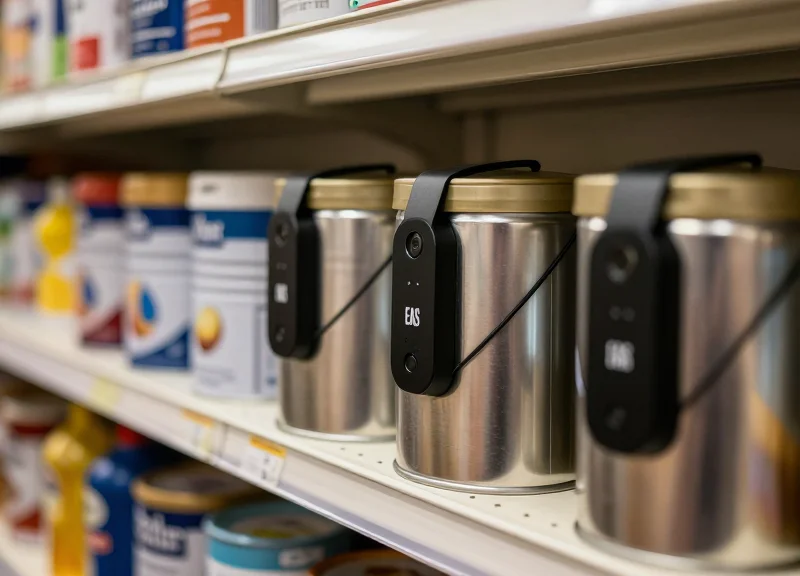
In the 2026 retail landscape, the integration of Electronic Article Surveillance (EAS) and Radio Frequency Identification (RFID) with localized Electronic Shelf Labels (ESL) represents the pinnacle of loss prevention. Unlike traditional setups that rely on fragmented cloud APIs, a unified localized ecosystem processes security and inventory data on-site. This ensures that the moment an RFID tag identifies a product movement or an EAS pedestal detects a potential theft, the localized ESL system can instantly cross-reference this with real-time stock levels and pricing data. By removing the public cloud from the critical security loop, retailers eliminate the 'latency gap' where theft often occurs, creating a seamless, high-security perimeter that functions even during internet outages.
| Feature | Siloed Cloud-Based Security | Unified Localized Ecosystem (2026 Trend) |
|---|---|---|
| Average Latency | 2 - 5 Seconds | < 100 Milliseconds |
| Offline Functionality | None (System goes blind) | Fully Operational (Edge-processed) |
| Data Residency | Public Cloud / Third-party Servers | Private Localized Infrastructure |
| Inter-device Synergy | Asynchronous (API-dependent) | Synchronous (Hard-wired/Local Mesh) |
- Deploy Localized Edge Gateways: Establish hardware gateways that support ESL, RFID, and EAS protocols simultaneously to act as the single source of truth for the store floor.
- Synchronize ESL IDs with RFID Data: Map unique RFID Electronic Product Codes (EPC) to specific ESL hardware IDs locally to ensure real-time item-level tracking.
- Integrate EAS Alarm Triggers: Link EAS pedestal output to the localized ESL management server to trigger visual alerts or price-lock mechanisms during security events.
- Apply Localized Heuristic Analytics: Use edge computing to analyze movement patterns (e.g., a sudden removal of five identical items) and flag anomalies without sending data to the cloud.
Expert Insight: The future of retail security lies in 'Active Deterrence.' DragonGuardGroup is pioneering a method where localized ESLs serve as the visual UI for the security system. For example, if an RFID-tagged high-value item is moved without a corresponding POS transaction, the nearby ESL can automatically change its display to a 'Restricted Access' warning or flash a specific LED color to alert floor staff. This localized response happens in milliseconds, making it impossible for sophisticated shoplifters to exploit the 'sync lag' found in standard cloud environments.
Does this integration increase hardware costs?
While the initial setup for edge-capable gateways is higher, the long-term ROI is achieved through a 30-40% reduction in retail shrinkage and the elimination of monthly cloud security subscription fees.
Can existing RFID tags work with this localized system?
Yes, modern localized ecosystems are designed to be hardware-agnostic, allowing standard UHF RFID tags to be integrated into the localized ESL security loop via the edge gateway.
What happens to security data after it is processed locally?
Data can be batched and uploaded to a central ERP for long-term auditing, but the critical 'actionable intelligence' remains local to ensure immediate response and data sovereignty.
Future-Proofing Your Retail Infrastructure for 2026 and Beyond

To future-proof retail infrastructure for 2026, organizations must pivot from 'cloud-first' to 'edge-native' localization strategies. This transition involves deploying decentralized Electronic Shelf Label (ESL) systems where critical pricing logic and security protocols reside on local edge servers rather than being tethered to public cloud availability. By establishing a localized data core, retailers can eliminate external latency, meet emerging data residency mandates, and ensure that store operations remain fully functional even during global ISP outages or cloud service disruptions.
- Audit Data Dependencies: Identify which ESL functions currently rely on round-trip cloud communication and categorize them by mission-critical priority to determine the scope of localized migration.
- Deploy Edge-Native Gateways: Replace legacy hubs with high-performance edge gateways capable of local data processing and hosting localized encryption databases for ESL and RFID tags.
- Implement Hybrid-Mesh Synchronization: Set up a synchronization layer that pushes non-sensitive analytics to the cloud while keeping sensitive PII and pricing algorithms strictly within the local store perimeter.
- Execute Zero-Trust Hardware Verification: Transition to ESL hardware that supports physical unclonable functions (PUF) to ensure every label is cryptographically verified at the local gateway level.
| Infrastructure Feature | Legacy Cloud-Centric (Pre-2024) | Edge-Native Localized (2026+) |
|---|---|---|
| Data Sovereignty | Third-party hosted; vulnerable to cross-border law | Full local control; compliant with regional residency |
| Operational Continuity | Offline during ISP or Cloud outages | 100% store uptime with local server failover |
| Security Model | Perimeter-based (Firewalls) | Micro-segmented Zero-Trust (Local Encryption) |
| Latency | 200ms - 2s (Variable) | <10ms (Deterministic) |
Expert Insight: The 'Air-Gap Fallacy' is the biggest risk in 2026 planning. Many retailers believe that simply moving 'on-premise' is enough. However, true future-proofing requires 'Intelligent Autonomy.' This means your system should not be a static offline island; it should be an autonomous node capable of self-healing and local decision-making that only checks in with the cloud for global policy updates. This 'Local-First, Cloud-Optional' approach is the only way to scale high-security ESL ecosystems without creating a management nightmare.
Will localized ESL systems increase hardware costs?
Initial CAPEX for edge gateways is slightly higher, but this is offset by the elimination of recurring high-bandwidth cloud egress fees and the mitigation of costly downtime risks.
How does localization impact multi-store management?
Centralized management is still possible through a 'Single Pane of Glass' dashboard that manages local nodes remotely without requiring the data to reside in the cloud.
Is localized data actually more secure than the cloud?
Yes, because it shrinks the attack surface. A breach in a centralized cloud database exposes millions of records; a breach at a localized store node is isolated and significantly harder for remote hackers to exploit.