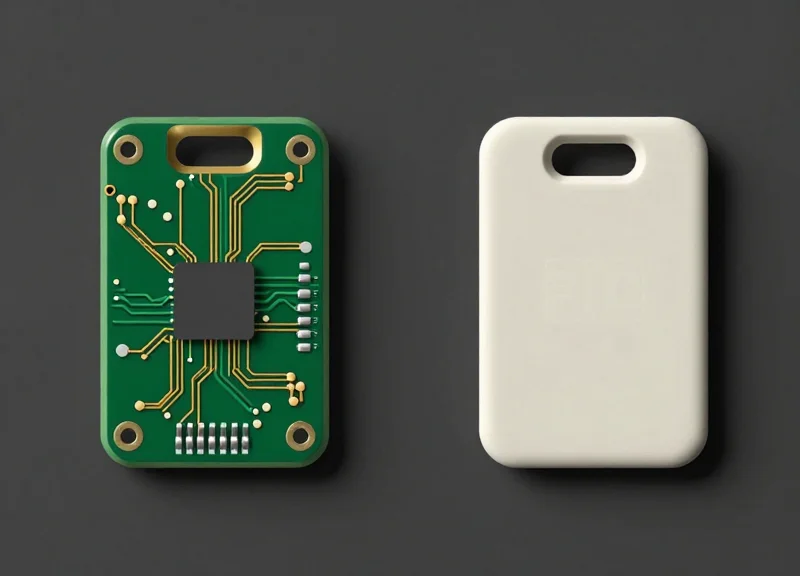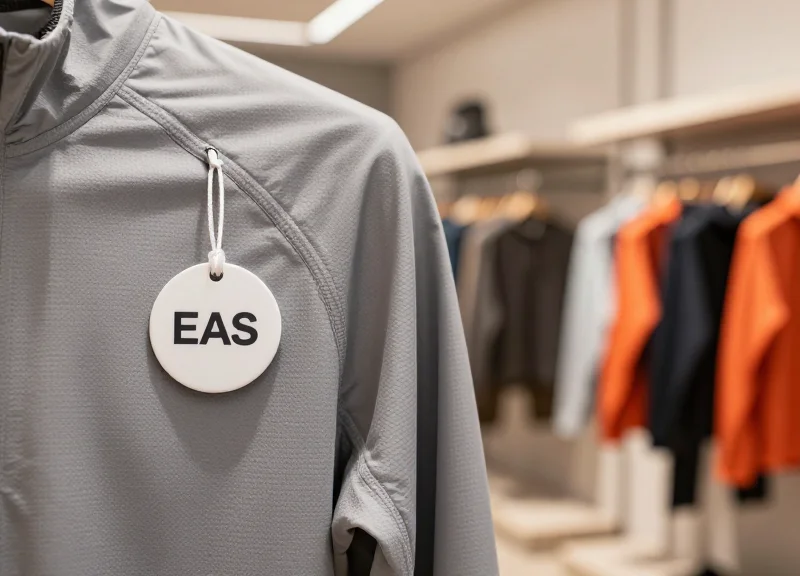
The rapid growth of the athleisure market has presented a unique challenge for retailers: securing high-value, high-performance fabrics without causing structural damage. Modern activewear, crafted from specialized blends like spandex, Lycra, and moisture-wicking synthetics, is highly susceptible to snags and permanent holes caused by traditional security pins. As a retailer, your goal is to minimize shrinkage while maintaining the pristine condition of your inventory. This guide explores the critical considerations for selecting EAS (Electronic Article Surveillance) solutions that shield your high-performance apparel from both theft and physical harm.
The High Cost of Incompatible Security Tags
Incompatible security tags are anti-theft devices whose physical design—specifically large-gauge pins or high-pressure clamps—is mismatched with the structural delicacy of technical fabrics like elastane, compression knits, and moisture-wicking synthetics. When these tags are applied, the heavy pins sever the fine filaments of high-performance yarns rather than sliding between them, leading to permanent snags, 'runs', and structural failure of the garment. For premium retailers, this results in 'self-inflicted shrinkage,' where the inventory is rendered unsellable or requires heavy discounting despite never being stolen.
| Fabric Category | Damage Mechanism | Retail Impact |
|---|---|---|
| Compression/Spandex | Micro-tears and fiber memory loss at the puncture site | Garment loses elasticity; visible bagging at pin site |
| Moisture-Wicking Knit | Standard 1.2mm pins sever capillary-action microfibers | Reduced technical performance and visible 'runs' |
| Seamless Athleisure | Stress points created in continuous-loop knitting | Total structural unravelling during customer try-ons |
| Waterproof Laminates | Membrane puncture creates permanent leak points | Loss of functional integrity; unsellable as performance gear |
- What is the financial impact of 'Self-Inflicted Shrinkage'?: Self-inflicted shrinkage refers to the profit margin lost when security hardware damages a product, necessitating a markdown. In high-end activewear, a $5 markdown on a $100 item due to a snag represents a 5% loss in gross margin—often exceeding the actual shoplifting rate of that SKU.
- Why do standard pins fail on performance fabrics?: Performance fabrics are often knit under high tension. Unlike loose-weave cotton, where a pin can move between yarns, tight-knit technical synthetics force the pin to pierce the yarn itself, causing immediate and irreparable fiber breakage.
- Expert Tip: The 'Shadow Loss' Metric: Retailers should calculate their 'Shadow Loss'—the cost of damaged inventory found during audits that was tagged but ruined. If this number exceeds 1% of your inventory value, your security hardware is likely the wrong gauge for your fabric mix.
Factor 1: Pin Diameter and Tip Precision
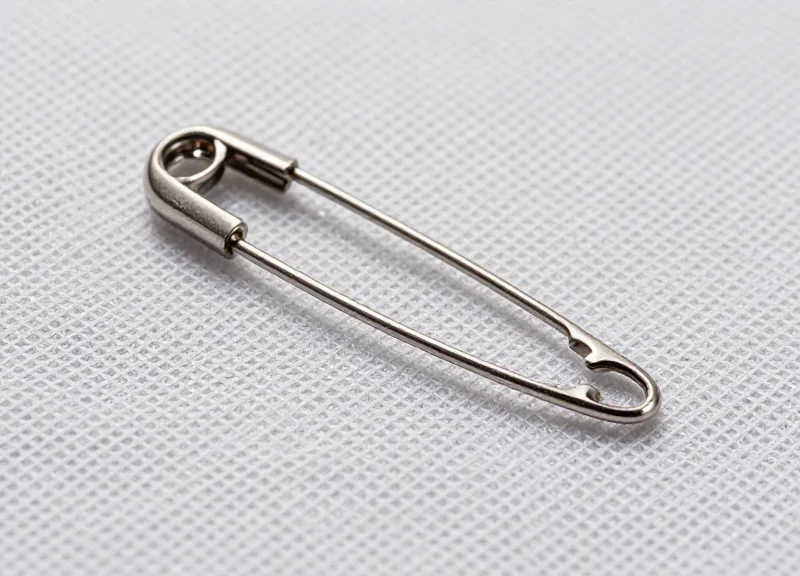
Selecting the right pin diameter is the most critical technical decision when tagging high-stretch garments. Standard security pins are often too thick for the tight weave of compression leggings or moisture-wicking shirts, leading to 'pin-hole scarring.' To protect these fabrics, retailers must utilize ultra-fine pins with a diameter of 1.2mm or less, featuring a polished, conical tip designed to navigate between fibers rather than severing them. This 'zero-force' insertion is what separates professional-grade loss prevention from generic solutions that inadvertently create 'self-inflicted' markdowns.
| Metric | Standard EAS Pin | Performance Fabric Pin |
|---|---|---|
| Diameter | 1.5mm - 1.8mm | 0.8mm - 1.2mm |
| Tip Geometry | Blunt or Chisel | Precision Conical |
| Fiber Impact | High Risk of Shearing | Zero-Force Insertion |
| Best Use | Denim / Heavy Outerwear | Yoga Pants / Cycling Jerseys |
Expert Insight: The Latent Damage Risk. While a thick pin might not leave a visible hole immediately, it creates 'micro-fissures' in the elastane or spandex core. Under the tension of wear and the heat of a dryer, these fissures expand, leading to 'runs' or small holes after the customer has already purchased the item. This leads to high return rates and brand erosion. Always specify stainless steel pins with a 1.2mm gauge to maintain the structural integrity of 4-way stretch materials.
Does a thinner pin make the tag easier to remove by force?
Actually, no. Security depends on the internal locking mechanism and the tensile strength of the pin material. Using high-grade stainless steel allows for a thinner diameter without sacrificing the 50kg+ pull-force resistance required for high-security environments.
How can I tell if a pin tip is damaged before use?
Implement the 'Silk-Pull Test.' Periodically drag a pin tip across a piece of scrap silk or fine nylon. If it catches or creates a snag, the batch has microscopic burrs and should be rejected to avoid damaging high-performance inventory.
Factor 2: Tag Weight and Fabric Tension
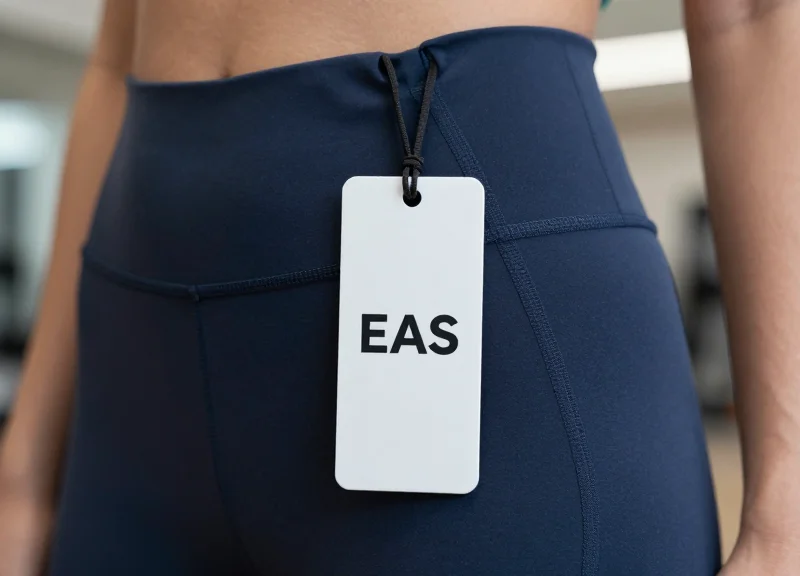
Tag weight is the primary driver of 'merchandise deformation' in the activewear sector, where the gravitational pull on a standard EAS tag can cause permanent stretching—often referred to as 'neckline creep' or 'waistband sag'—in high-elastane fabrics. Unlike denim or cotton twill, high-performance textiles like nylon-spandex blends have a high 'elastic memory' but low structural rigidity; when a heavy security tag (typically 15-20 grams) is applied, the constant tension on the localized area can fatigue the fibers beyond their recovery point, leading to 'self-inflicted' markdowns before the item even reaches the checkout counter.
| Tag Category | Typical Weight (Grams) | Impact on High-Stretch Fabrics | Recommended Use |
|---|---|---|---|
| Standard Hard Tag | 16g - 22g | High: Causes visible sagging and fiber distortion. | Outerwear, Heavy Hoodies |
| Mid-Range Composite | 10g - 14g | Moderate: Risk of 'puckering' on thin compression wear. | Standard T-shirts, Shorts |
| Ultra-Lightweight Mini | 5g - 8g | Negligible: Maintains garment silhouette and integrity. | Leggings, Sports Bras, Tech-Tees |
When evaluating tag weight, retailers must consider the 'Leverage Effect.' An EAS tag placed at the edge of a neckline or a thin strap exerts significantly more torque on the fabric than one placed near a reinforced seam. For lightweight activewear, the goal should be a 'total system weight' (tag plus pin) of under 9 grams. Using lightweight polycarbonate or advanced ABS plastic composites allows for high security without the mechanical burden that leads to permanent garment misshaping.
How does tag weight affect 'hanger appeal'?
Heavy tags pull the garment asymmetrical on the hanger, making the merchandise look worn or low-quality to customers, which can decrease the perceived value of premium athleisure.
Is a smaller tag always lighter?
Not necessarily. Some 'mini' tags use older, heavier ferrite cores. Always verify the actual weight in grams rather than relying on the physical dimensions of the tag.
Can I use heavy tags if I tag on the seam?
While seams provide more support, the weight can still cause the entire garment to 'bias' or twist over time. Lightweight tags are always the safer bet for technical fabrics.
Expert Tip: The 48-Hour Creep Rule. High-performance polymers in activewear are susceptible to 'creep'—a slow, permanent deformation under a constant load. In a retail environment, if a garment hangs for more than 48 hours with a heavy tag, the fibers may lose their ability to return to their original shape. To differentiate your brand and protect your margins, prioritize tags engineered for 'neutral buoyancy' relative to the fabric's tensile strength.
Factor 3: AM vs. RF Frequency Performance

Choosing the right Electronic Article Surveillance (EAS) frequency for activewear depends on the garment's composition: while Radio Frequency (RF) at 8.2 MHz is the industry standard for general retail, Acousto-Magnetic (AM) technology at 58 kHz is significantly more effective for high-performance apparel containing metallic fibers or conductive threads. AM systems offer superior detection through 'shielding' materials and are less susceptible to interference from the silver or copper-infused yarns common in premium sportswear.
| Feature | RF (Radio Frequency) | AM (Acousto-Magnetic) |
|---|---|---|
| Standard Frequency | 8.2 MHz | 58 kHz |
| Metallic Resistance | Low (Susceptible to shielding) | High (Resists interference) |
| Detection Range | Moderate (Best for narrow doors) | High (Supports wider entrances) |
| Tag Size | Can be very small/flat | Typically slightly thicker |
| Deactivation Height | Low (Requires close contact) | High (Can deactivate at a distance) |
The technical challenge with modern activewear lies in the 'Faraday Cage' effect. High-end brands often weave silver-coated nylon or copper threads into fabrics to provide permanent anti-microbial and anti-odor properties. These metallic elements can absorb or deflect RF signals, leading to 'tag shielding' where a sensor fails to trigger even if the tag is active. Because AM technology operates at a lower frequency and utilizes magnetic resonance rather than a simple radio sweep, it penetrates these conductive layers more reliably, ensuring that 'tech-heavy' garments don't become invisible to your security pedestals.
Can I use RF tags if my activewear is 100% synthetic without metal?
Yes. If your inventory consists strictly of polyester, spandex, and nylon without metallic additives, RF systems are a cost-effective solution with high-speed deactivation.
Why does AM usually cost more than RF?
AM systems require more complex electronics and internal components (like magnetostrictive material) in the tags, but they offer wider aisle coverage and better performance near metal fixtures.
What is the 'Golden Rule' for testing frequency performance?
Always test your 'smart fabrics' by placing an active tag inside a folded stack of the garment and walking through the pedestal; if the alarm doesn't trigger, the fabric is shielding your frequency.
Expert Tip: For retailers using 'source tagging' (where tags are applied at the factory), AM is the safer strategic bet. As activewear technology evolves toward more integrated electronics and conductive heat-mapping threads, AM systems provide the 'future-proofing' necessary to ensure that new fabric innovations don't compromise your loss prevention ROI.
Factor 4: Visual Deterrence vs. Fitting Room Comfort
Visual deterrence in activewear security is the psychological strategy of using visible EAS tags to discourage opportunistic shoplifting, but it must be balanced against fitting room comfort to prevent 'sales friction.' While a large, conspicuous tag signalizes high security, if that same tag pinches the skin or restricts a customer's range of motion during a squat or stretch test, it can lead to an abandoned purchase. The ideal solution utilizes high-visibility deterrents with an ergonomic, low-profile form factor that follows the body's natural contours.
| Feature | Legacy Hard Tags | Ergonomic Activewear Tags |
|---|---|---|
| Visual Impact | High (Bulky) | Moderate (Sleek/Modern) |
| Weight | 15g - 25g | 5g - 10g |
| Form Factor | Round/Clamshell (Obtrusive) | Contoured/Teardrop (Streamlined) |
| Fitting Room Impact | Restricts movement; causes 'bulge' | Low profile; allows for fabric drape |
| Deterrence Level | High physical resistance | High psychological resistance |
In the activewear sector, the 'fitting room experience' is a high-stakes performance test. Customers don't just look in the mirror; they perform lunges, yoga poses, and stretches. A traditional, heavy hard tag placed on the hip of a pair of high-compression leggings will create an unnatural protrusion, potentially distorting the customer's perception of the fit and their own physique. This 'aesthetic interference' is one of the leading causes of cart abandonment in premium athleisure boutiques.
How does tag placement affect the sale?
Placing tags on seams or waistbands can prevent skin irritation, but for activewear, it is critical to avoid 'hinge points' like the inner thigh or underarm. Optimal placement is often the lower hem or high on the hip where the fabric has the most stability.
Can visual deterrence be achieved without bulk?
Yes. Modern EAS tags use high-contrast colors (like bright yellow or stark white against dark fabrics) or ink-refill indicators to signal risk to shoplifters without needing a large physical footprint.
What is 'Tag Fatigue' in customers?
This occurs when a customer tries on multiple items and finds the process of navigating around heavy tags frustrating, leading them to try on fewer items and reducing the average transaction value.
Expert Tip: Implement the 'Dynamic Movement Audit' when selecting your tags. Instead of simply pinning a tag to a static mannequin, have a staff member perform a standard 'Sun Salutation' yoga flow while wearing a tagged garment. If the tag creates a pressure point against the floor or the body, it is a liability to your conversion rate. The best tags for high-performance fabrics are those that 'disappear' during movement but 'stand out' on the display rack.
Factor 5: Ease of Detachment at Point-of-Sale
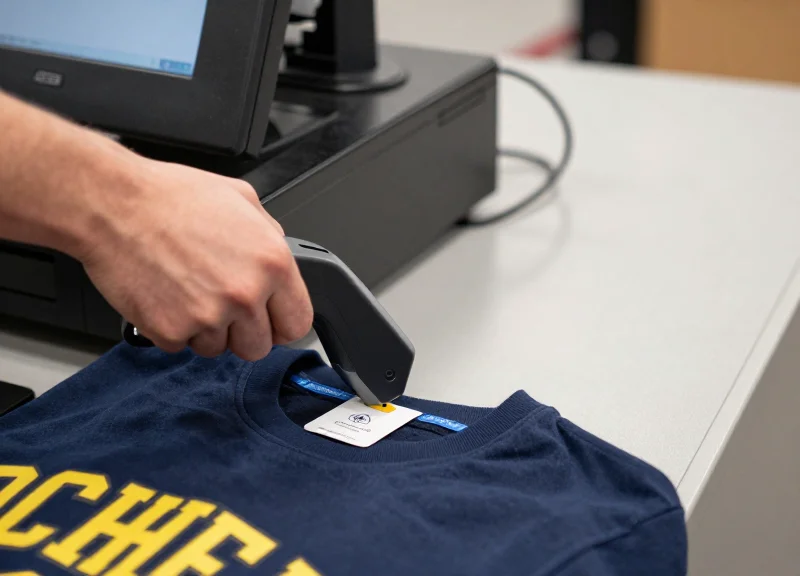
Ease of detachment at the point-of-sale (POS) is the operational capability to remove security tags quickly and safely without applying excessive lateral force to the garment. In the context of activewear, where technical fabrics like Lycra and high-gauge knits are prone to snagging, a seamless detachment process is the final safeguard against 'clumsy damage'—inventory loss occurring right at the cash wrap due to hardware resistance or cashier fatigue.
When a cashier struggles with a stubborn magnetic lock or an improperly aligned pin, they often resort to 'yanking' or 'twisting' the tag. For a standard cotton t-shirt, this might be negligible. However, for a $120 pair of compression leggings, that split-second of mechanical stress can snap elastane fibers, creating a permanent run or hole. Retailers must prioritize detachers that offer high-strength magnetic pull (often 12,000GS or higher) and ergonomic designs that guide the tag into the 'sweet spot' effortlessly.
| Detacher Type | Activewear Suitability | Key Advantage | Risk Level |
|---|---|---|---|
| Manual Magnetic | Moderate | Cost-effective and durable | High: Requires manual alignment and force |
| Power Detachers | High | Consistent release pressure | Low: Motorized pin ejection minimizes fabric tugging |
| Counter-Sunk Detachers | Very High | Natural ergonomic flow | Minimal: Keeps fabric flat during the release |
Expert Insight: The Vertical-Release Advantage. To truly protect high-performance gear, look for detachment systems designed for vertical release. Many traditional tags require a lateral sliding motion to clear the pin. For activewear, systems that allow the pin to be ejected vertically (straight up) while the garment remains flat on the counter are superior. This eliminates the 'shear force' that typically catches the micro-loops of warp-knit fabrics during the checkout rush.
Why do tags sometimes get stuck even on the detacher?
This is often due to magnetic fatigue in older detacher units or low-quality tags with internal spring friction. Ensure your detachers are rated for Superlock or Hyperlock strengths to ensure immediate release.
Can automated detachers damage delicate fabrics?
Actually, automated or power-assisted detachers are safer for delicate knits because they use a controlled, consistent mechanical pulse to release the pin, removing the variable of human yanking from the equation.
How often should detacher hardware be inspected?
We recommend a monthly audit. Over time, detacher wells can accumulate lint and debris from synthetic fabrics, which can interfere with the tag's seating and cause the cashier to apply unnecessary pressure.
The Rise of RFID Integration in Sportswear

RFID (Radio Frequency Identification) integration in sportswear is the strategic transition from simple anti-theft measures to a comprehensive data-ecosystem. By embedding RFID chips within traditional EAS (Electronic Article Surveillance) tags, retailers can achieve a 'dual-layered' defense: the EAS component triggers alarms at the door, while the RFID component identifies exactly which SKU—including size, color, and style—is moving. For activewear brands, this technology is the foundation of modern omnichannel retail, enabling 99% inventory accuracy and providing the granular data needed to identify and prosecute Organized Retail Crime (ORC) syndicates.
In the high-stakes world of premium activewear, where a single rack of compression gear can exceed $5,000 in value, 'blind' loss is no longer acceptable. RFID integration allows for 'item-level intelligence.' When a theft occurs, the system doesn't just beep; it logs precisely what was taken. This data allows loss prevention teams to identify patterns, such as specific 'hot' items frequently targeted by professional shoplifters, and adjust floor layouts or staffing accordingly.
| Feature | Traditional EAS Only | RFID-EAS Hybrid |
|---|---|---|
| Theft Detection | Triggers alarm at exit gates | Triggers alarm and identifies specific SKU |
| Inventory Counting | Manual, labor-intensive (80% accuracy) | Instant, automated (99%+ accuracy) |
| ORC Mitigation | Limited to physical deterrence | Identifies bulk theft patterns and 'hot' SKUs |
| Omnichannel Support | None; requires manual stock checks | Enables real-time 'Find in Store' accuracy |
The synergy between EAS and RFID also optimizes the checkout experience. Since RFID can read multiple items simultaneously without line-of-sight, the detachment process for high-performance fabrics becomes safer. Staff no longer need to hunt for hidden labels or struggle with multiple scans, reducing the risk of accidental fabric snags during the rush of high-volume sales periods.
Can RFID tags be embedded directly into the garment?
Yes, many sportswear brands now use 'source tagging' where RFID inlays are sewn into the care label or brand heat-transfer at the point of manufacture, providing protection throughout the entire supply chain.
How does RFID help with 'BOPIS' (Buy Online, Pick Up In Store)?
RFID ensures that the inventory reflected online is physically present on the floor, preventing the 'out-of-stock' cancellations that often plague activewear retailers during major product drops.
Does RFID interfere with the performance of metallic-infused fabrics?
While high-metal content can occasionally shield signals, modern UHF (Ultra-High Frequency) RFID tags are specifically tuned to work effectively alongside the silver or copper ions often found in anti-odor sportswear.
Expert Tip: Use 'Predictive Fitting Room Analytics.' By placing RFID readers at the entrance of fitting rooms, retailers can detect 'bulk-loading' behavior—an ORC hallmark where a person takes ten identical high-value leggings into a stall. This provides a discrete, early warning system for staff to provide 'enhanced customer service,' which often deters theft before it occurs without the need for a confrontation.
DragonGuard Solutions: Engineered for Performance
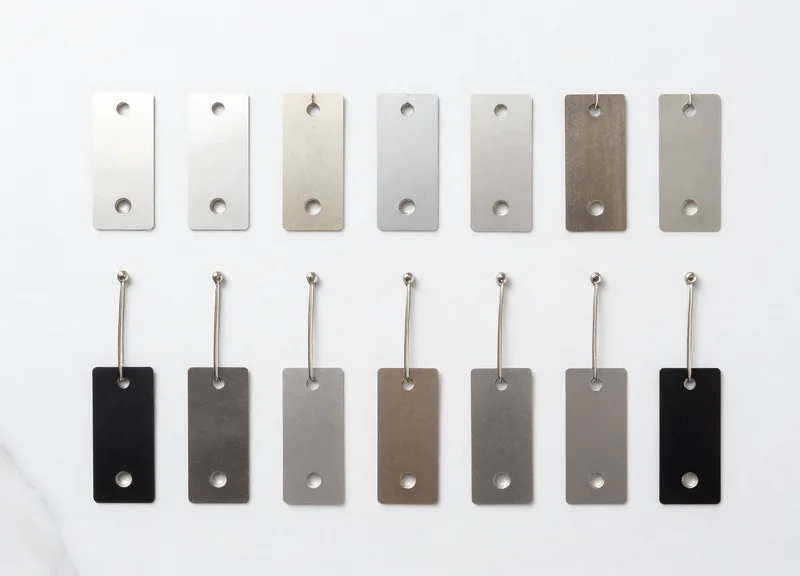
DragonGuard Solutions sets the industry standard for activewear loss prevention by engineering EAS tags that prioritize fabric integrity and customer comfort without compromising security. Unlike generic retail tags, DragonGuard's ActiveSeries line utilizes proprietary Micro-Pin technology and ultra-lightweight housings specifically calibrated for the high elasticity and delicate knit structures of modern compression gear and performance textiles. By focusing on the 'Zero-Pinch' design philosophy, these solutions ensure that even the most expensive elastane blends return to their original shape after the security device is removed, effectively shielding your highest-margin inventory from both theft and structural damage.
| Product Model | Best Application | Key Advantage | Weight (Approx.) |
|---|---|---|---|
| DragonGuard Ultra-Fine Pencil | Yoga Leggings & Thin Spandex | 0.6mm Micro-Pin prevents permanent weave separation | 5.2g |
| Active-Ink Dual-Deterrent | Premium Windbreakers & Outerwear | Combines EAS detection with mechanical ink staining | 8.5g |
| Mini-Square RFID/EAS Hybrid | High-Volume Training Apparel | Dual-inventory and security tracking in one sleek shell | 6.0g |
| Soft-Grip Lanyard Tag | Sports Bras & Mesh Inserts | Rubberized grip prevents sliding on silky surfaces | 4.8g |
- Micro-Pin Technology: DragonGuard's signature 0.55mm-0.6mm pins are significantly thinner than the industry-standard 1.2mm pins, ensuring they slide between threads rather than piercing them.
- Impact-Resistant ABS Shells: Engineered to withstand high-velocity impacts in changing rooms while remaining smooth to the touch to prevent snagging on neighboring garments.
- Low-Profile Ergonimics: The rounded, low-profile design minimizes 'tag bulge,' allowing customers to try on tight-fitting activewear without the tag distorting the garment's fit or silhouette.
Expert Insight: In the world of high-performance synthetics, 'needle memory' is a common cause of post-sale returns. Generic thick-pin tags can leave permanent holes in nylon and polyester knits. DragonGuard’s unique use of surgical-grade steel pins with a tapered tip ensures that once the tag is removed at the POS, the fabric fibers can immediately snap back into place, leaving no visible trace of the security device.
Can DragonGuard tags be used with both AM and RF systems?
Yes, DragonGuard offers specific ActiveSeries versions for both 58kHz Acoustic Magnetic (AM) and 8.2MHz Radio Frequency (RF) systems to suit any existing store infrastructure.
Are these tags compatible with standard detachers?
While they work with high-strength magnetic detachers, we recommend DragonGuard’s ergonomic detacher line to ensure the smooth, snag-free release of the micro-pin from delicate performance fabrics.
How do these tags perform in a high-moisture environment?
DragonGuard tags are constructed with internal components that resist corrosion, making them ideal for performance gear that might be exposed to humidity or transit-related moisture.