As we approach 2026, the retail landscape is undergoing a radical transformation driven by AI, IoT, and high-density store layouts. In this new era of 'Smart Retailing,' traditional loss prevention methods are being put to the test. For decades, Radio Frequency (RF) and Acousto-Magnetic (AM) technologies have been the pillars of Electronic Article Surveillance (EAS). However, as retailers demand higher precision, wider entrances, and better performance near metal, the limitations of RF are becoming more apparent. This article explores why AM technology is emerging as the definitive winner for future-proof retail security.
The Evolution of Loss Prevention in Smart Retailing

The evolution of loss prevention (LP) in smart retailing represents a fundamental shift from reactive physical deterrence to proactive, data-integrated intelligence. In the modern retail ecosystem, loss prevention is no longer just about 'stopping the thief' at the exit; it is about harmonizing high-level security with a frictionless customer journey. As we move toward 2026, the industry is transitioning from standalone Radio Frequency (RF) systems to sophisticated Acousto-Magnetic (AM) and IoT-enabled technologies that support open floor plans, self-checkouts, and high-aesthetic brand environments without compromising inventory integrity.
Historically, retail security relied on visible barriers. However, the rise of 'Smart Retailing'—characterized by omnichannel fulfillment, AI-driven inventory management, and automated checkout—has rendered traditional security methods obsolete. Modern retailers now view Loss Prevention as a component of the 'Store Intelligence' stack, where security hardware must double as a source of actionable data.
| Era | Primary Technology | Focus Area | Retail Environment |
|---|---|---|---|
| 1.0: Traditional | Mechanical/Early RF | Visual Deterrence | Malls & Big Box |
| 2.0: Digital | Standard RF/AM | Shrink Reduction | E-commerce Integration |
| 3.0: Smart Retailing | Intelligent AM & IoT | Customer Experience/Data | Frictionless/Flagship |
Expert Insight: The 'Aesthetic Tax' of Legacy Systems. A common mistake retailers make is neglecting the psychological impact of security hardware. In high-end smart retail, bulky, interference-prone RF gates act as a 'visual tax' that degrades brand perception. The evolution toward AM technology is driven largely by its ability to protect wider exits with more discreet, elegant hardware, effectively eliminating this aesthetic friction while maintaining a detection rate that outperforms legacy RF in complex electronic environments.
Why is the retail environment changing so rapidly?
Consumer demand for 'just-walk-out' or self-service technology is forcing retailers to remove physical barriers, meaning security must become more 'invisible' and technologically robust.
What role does data play in modern loss prevention?
Modern systems don't just alarm; they provide heat mapping, traffic counts, and alarm-event data that help managers optimize staffing and store layouts.
How does store aesthetics impact security choices?
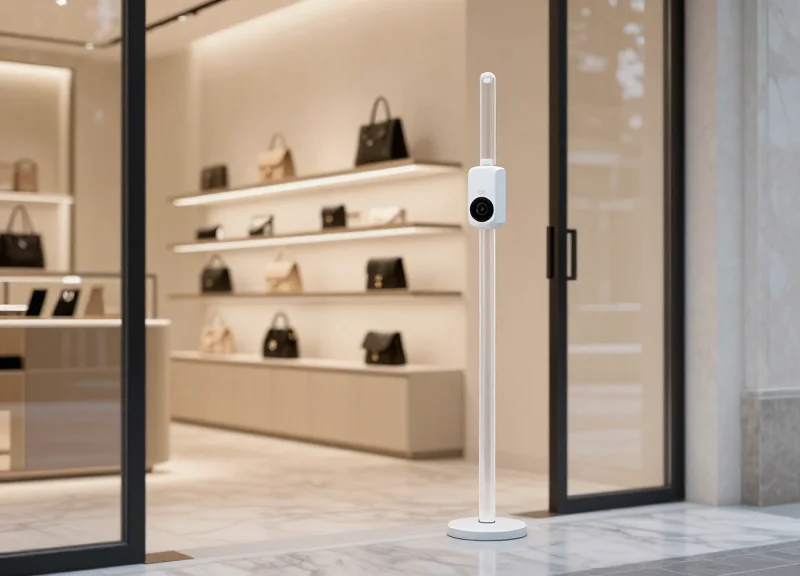
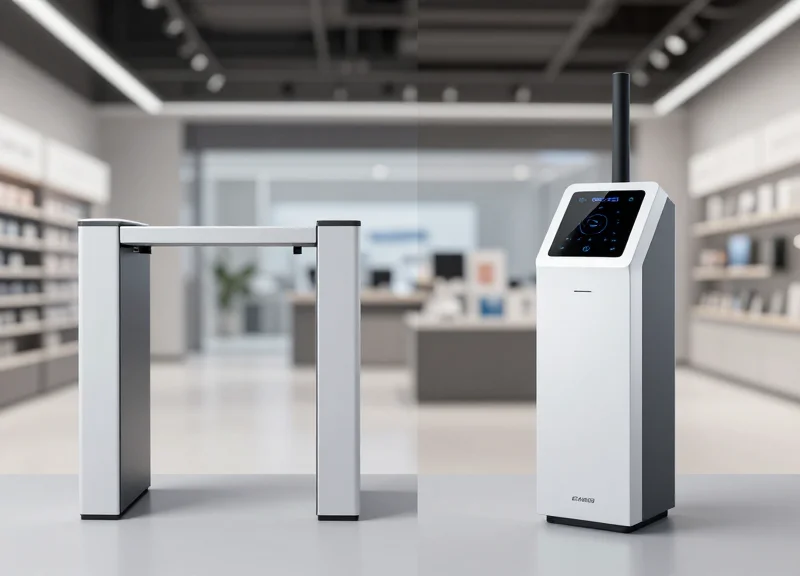
As flagship stores become 'experience centers,' retailers are choosing AM technology over RF because it allows for wider, cleaner entrances without the need for multiple intrusive pedestals.
Technical Deep Dive: The Physics of AM vs. RF
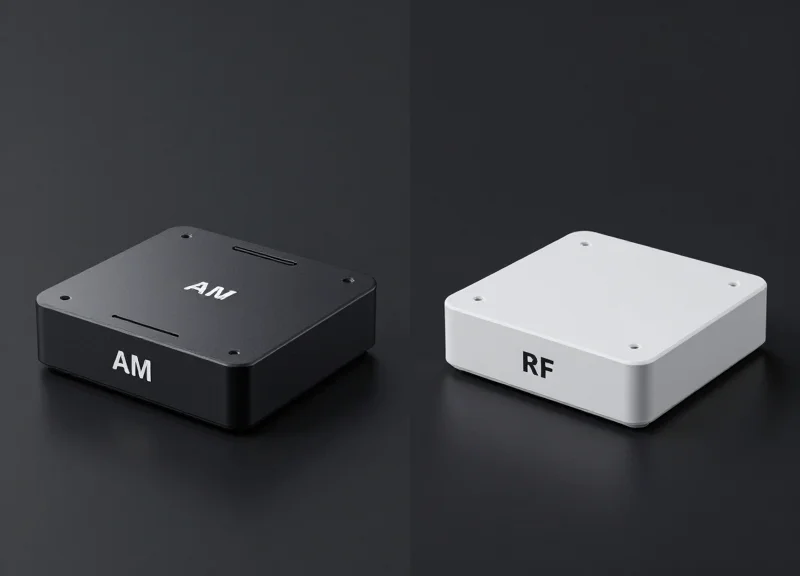
The primary difference between Acousto-Magnetic (AM) and Radio Frequency (RF) technology lies in their operational frequency and resonance method: AM operates at a low frequency of 58 kHz using mechanical resonance, whereas RF operates at a high frequency of 8.2 MHz using electrical oscillation. This physics-based distinction allows AM systems to offer superior 'material immunity,' effectively detecting tags through liquids, foil-lined bags, and near metallic objects where RF signals often fail due to interference, detuning, or shielding effects.
| Feature | AM (Acousto-Magnetic) | RF (Radio Frequency) |
|---|---|---|
| Operating Frequency | 58 kHz (Low Frequency) | 8.2 MHz (High Frequency) |
| Detection Mechanism | Mechanical Magnetostrictive Resonance | Electrical LC Circuit Oscillation |
| Metal/Foil Immunity | High - Signal penetrates conductive materials | Low - Signal is easily shielded or detuned |
| Liquid Resistance | Excellent - No signal absorption | Poor - Signal is absorbed by water/liquids |
| Typical Exit Width | Up to 2.4m+ (Dual Pedestal) | Typically 0.9m to 1.8m |
| Signal Type | Pulsed (Higher Signal-to-Noise Ratio) | Continuous or Swept (Prone to Interference) |
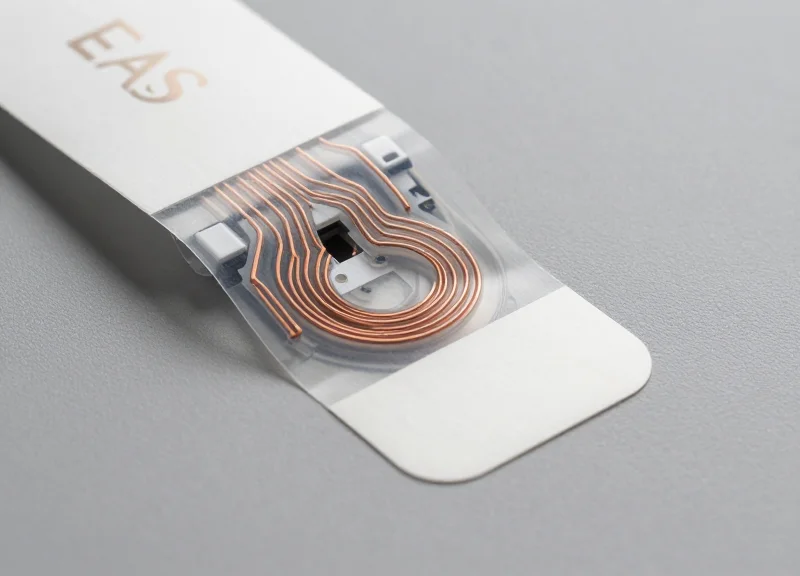
At the heart of AM technology is the magnetostrictive effect. When the system's transmitter sends a burst of energy at 58 kHz, the metallic strips inside the AM tag physically expand and contract. When the transmitter pulse stops, the tag continues to 'ring' or vibrate mechanically, creating a unique magnetic echo. Because this echo occurs during the 'quiet' interval between pulses, the receiver can identify it with extreme precision. Conversely, RF systems generally use a continuous wave or swept frequency; if a metallic object (like a soda can or foil-lined bag) is nearby, it shifts the tag's resonance frequency away from 8.2 MHz, rendering the tag invisible to the system.
Why is AM better for cosmetics and high-end apparel?
Cosmetics often contain liquids or foil packaging, and high-end apparel may include metallic buttons or zippers. RF signals are absorbed by liquids and blocked by metals, whereas the 58 kHz AM signal passes through these materials virtually unimpeded.
Does environmental noise affect detection?
Modern retail stores are filled with 'electronic smog' from LED lighting, Wi-Fi, and HVAC systems. Because AM operates at a very low frequency and uses a pulsed signal-and-echo technique, it is significantly more resilient to this background noise than RF systems.
What determines the width of the entrance coverage?
The physics of low-frequency magnetic fields allows AM to maintain a more consistent 'bubble' of detection. RF signals are more directional and lose power quickly when spread over wide distances, which is why AM is the standard for wide, open-concept mall entrances.
Expert Insight: for 2026: As smart retailing integrates more IoT sensors and 5G small cells within the store footprint, the 8.2 MHz spectrum is becoming increasingly crowded. The 'Q-factor' (quality factor) of AM tags allows for a much narrower and cleaner signal identification. By operating at the 58 kHz range, AM exists in an electromagnetic 'quiet zone,' ensuring that as your store becomes smarter and more connected, your loss prevention system doesn't suffer from increased false alarms or diminished sensitivity.
Wide Exit Capabilities: Meeting Modern Architectural Needs

In modern retail architecture, the storefront is no longer just a door but a brand statement, often featuring floor-to-ceiling glass and expansive entryways designed to reduce customer friction. Acousto-Magnetic (AM) technology excels in these environments because its 58 kHz operating frequency allows for significantly wider detection ranges—up to 2.4 meters between pedestals—compared to the 1.5 to 1.8-meter limitations typical of Radio Frequency (RF) systems. This increased range ensures that security does not compromise the 'open-concept' aesthetic, allowing for seamless traffic flow and a more inviting shopping experience.
| Feature | AM Technology (58 kHz) | RF Technology (8.2 MHz) |
|---|---|---|
| Max Pedestal Spacing | 2.0m - 2.4m (Standard) | 1.2m - 1.8m (Standard) |
| Detection Consistency | High (even with wide exits) | Decreases rapidly with distance |
| Architectural Integration | Visible, Concealed, or Underfloor | Primarily Visible Pedestals |
| Interference Resilience | High (Low frequency ignores metal) | Moderate (High frequency bounces) |
The technical advantage of AM lies in its long-wavelength signal, which is less susceptible to 'dead zones' created by metallic frames or structural steel common in high-end mall construction. While RF signals often bounce off these surfaces—creating false alarms or requiring unsightly shielding—AM signals wrap around obstacles, providing consistent 3D detection. This allows architects to specify 'invisible' security solutions, such as floor loops or overhead sensors, that maintain total protection without the need for intrusive physical barriers.
Can AM systems be completely hidden from view?
Yes. Unlike RF, AM technology can be installed as underfloor loops or integrated into door frames, providing 'invisible' security that is ideal for luxury boutiques where aesthetics are paramount.
How does exit width impact the 'Frictionless Security Paradox'?
Wider exits reduce the 'bottleneck effect.' By eliminating crowds at the door, security personnel can more easily identify suspicious behavior, while honest customers enjoy a faster, more pleasant exit experience.
Does wider spacing lead to more missed tags?
Not with AM. Because AM tags use a mechanical resonance that is highly distinct from environmental noise, the system maintains high pick rates even at maximum distance, where RF would typically suffer from signal drop-off.
Expert Tip: To future-proof your retail space, consider the 'Frictionless Security Paradox.' While it may seem counterintuitive, wider exits can actually lower shrink rates. Narrow exits create artificial congestion, providing cover for professional shoplifters to 'blend in' with a crowd during an alarm. AM’s wide-exit capability allows for clear lines of sight and distinct alarm events, ensuring that your Loss Prevention team can react with precision rather than confusion.
The Metal Interference Factor: Why AM Technology Wins
The fundamental reason Acousto-Magnetic (AM) technology wins the battle against metal interference lies in its low-frequency operational physics. Unlike Radio Frequency (RF) systems, which operate at a high 8.2 MHz and are easily 'detuned' or shielded by conductive materials like aluminum foil and metal-lined packaging, AM systems operate at 58 kHz. This lower frequency creates a robust magnetic field that is not easily absorbed by metal or liquid, allowing AM tags to maintain high detection rates even when placed inside shopping carts or attached to foil-wrapped electronics and luxury cosmetics.
In the context of modern 'Smart Retailing,' the environment is increasingly hostile to RF signals. High-end store aesthetics frequently incorporate stainless steel fixtures, and premium product packaging often utilizes metallic finishes to attract consumers. This creates a 'Faraday Cage' effect for RF systems, where the signal is trapped or reflected, leading to 'blind spots' at the store exit. AM technology bypasses this limitation, ensuring that the security signal penetrates through metallic layers to provide consistent protection.
| Environmental Challenge | RF (Radio Frequency) Impact | AM (Acousto-Magnetic) Impact |
|---|---|---|
| Foil-Lined Packaging | High: Signal is often completely blocked (shielded). | Low: Signal penetrates packaging with minimal loss. |
| Liquid Containers | Moderate: Signal is absorbed, reducing detection range. | Negligible: Unaffected by water or alcohol content. |
| Metal Shopping Carts | High: Causes frequent 'detuning' and false alarms. | Stable: Magnetic resonance remains consistent. |
| Structural Steel Proximity | High: Requires significant distance from door frames. | Minimal: Can be installed closer to metal structures. |
Expert Insight: The 'Skin Effect' Threshold. A critical technical differentiator often overlooked by procurement teams is the 'skin depth' of the electromagnetic wave. At 8.2 MHz (RF), the depth at which the signal can penetrate a conductor is incredibly shallow, meaning even a thin layer of metallic foil can render an RF tag invisible. At 58 kHz (AM), the skin depth is significantly deeper, allowing the signal to 'ignore' surface-level metallic interference that would otherwise cripple a standard RF-based loss prevention strategy.
Why does RF fail near foil-lined bags?
RF relies on electromagnetic waves that are easily reflected or absorbed by conductive materials. Foil-lined bags create a shield that prevents the RF antenna from 'seeing' the tag inside, a common exploit used in organized retail crime.
Does AM technology work better for grocery and liquor stores?
Yes. Because liquids absorb RF energy but do not significantly affect magnetic fields, AM is the industry standard for protecting high-value spirits, liquid perfumes, and infant formula.
Can metal shelving interfere with AM pedestals?
While all electronic systems have limits, AM pedestals are significantly more resilient. They utilize sophisticated digital signal processing (DSP) to filter out static environmental noise caused by metal fixtures, whereas RF systems often require 'clear zones' that disrupt store layouts.
Smart Integration: Synergizing AM with RFID and ESL

In the era of smart retailing, technology synergy is the key to operational excellence. Smart integration refers to the unified deployment of Acousto-Magnetic (AM) security systems alongside Radio Frequency Identification (RFID) and Electronic Shelf Labels (ESL). While AM technology serves as the unshakeable foundation for loss prevention at the exit, RFID provides item-level visibility throughout the supply chain, and ESL automates price management on the floor. At DragonGuardGroup, we advocate for a 'defense-in-depth' strategy where these three technologies communicate to reduce labor costs, eliminate 'phantom inventory' caused by theft, and ensure a frictionless customer journey.
| Feature | AM Technology | RFID (UHF) | ESL (IoT) |
|---|---|---|---|
| Primary Purpose | Loss Prevention & Deterrence | Inventory Tracking & Logistics | Dynamic Pricing & UX |
| Operational Frequency | 58 kHz (Low Frequency) | 860-960 MHz (High Frequency) | 2.4 GHz or Sub-GHz |
| Signal Interference | Immune to most metals/liquids | Highly sensitive to metals/liquids | Minimal interference issues |
| Interaction | Detects unauthorized removal | Identifies exactly WHAT is stolen | Displays stock status/QR codes |
The true breakthrough lies in 'Hybrid Tagging.' By embedding both an AM resonator and an RFID inlay into a single hard tag or label, retailers gain the physics-based reliability of AM (which outperforms RF/RFID in detecting theft through metal-lined bags) while simultaneously capturing the rich data stream of RFID. This dual-technology approach ensures that when an alarm sounds, the system doesn't just notify staff that 'something' is leaving—it identifies exactly which SKU is exiting, allowing the inventory management system to update in real-time.
Does AM technology interfere with RFID or ESL signals?
No. Because AM operates at a very low frequency (58 kHz) compared to the ultra-high frequencies of RFID (900 MHz range) and ESL (2.4 GHz), there is zero spectral overlap. This allows all three systems to operate in close proximity without signal degradation or false alarms.
How does ESL integration enhance security?
ESL displays can be programmed to show real-time stock levels or 'out of stock' alerts to employees based on RFID data. If an AM system detects a high-shrink event, the ESL can trigger a visual cue for staff to check specific high-value shelf areas immediately.
Can I upgrade my existing AM system to support RFID later?
Yes. Most modern AM pedestals, such as those from DragonGuardGroup, are designed with modularity in mind. You can install the AM frames today and add RFID readers or ESL infrastructure as your digital transformation budget scales.
Expert Insight: The Data-Interlock Principle. A unique advantage of AM-RFID synergy is the elimination of 'false shrinkage' data. In standalone RFID environments, an item that is misplaced or shielded by metal might be flagged as 'missing' in the database. However, when interlocked with an AM system, the store manager can verify that no security alarm was triggered at the exit, confirming the item is likely still in the building but simply misplaced. This cross-verification saves hours of unnecessary inventory auditing.
Tagging Diversity: Protecting Everything from Cosmetics to Electronics

Acousto-Magnetic (AM) technology delivers the industry's most versatile tagging portfolio, providing reliable protection for a vast range of inventory including cosmetics, power tools, and high-end electronics. Unlike Radio Frequency (RF) systems, which are easily disrupted by the physical properties of products, AM 58kHz labels and tags maintain high detection rates even when applied to items with significant liquid content or those encased in metallic packaging, making it the gold standard for diverse retail environments.
| Product Category | Common Challenge | AM Technology Performance | RF Technology Performance |
|---|---|---|---|
| Cosmetics & Beauty | Liquid/Foil Packaging | Excellent; signal penetrates liquids | Poor; 'detuning' caused by liquids |
| Consumer Electronics | Metallic components | Stable; minimal signal shielding | High failure rate near circuits/metal |
| Hardware & Tools | Large metal surface area | Superior; high-intensity magnetic pulse | Frequent false alarms or non-detection |
| Bottled Beverages | Liquid volume interference | Optimal; bottle tags bypass liquid | Inconsistent; heavily attenuated |
Expert Insight: The 'Micro-Tagging' Revolution. As we move beyond 2026, the trend is toward 'invisible protection.' My experience in the field indicates that retailers are increasingly opting for AM because the technology allows for smaller, more discrete labels that can be hidden inside product packaging without losing effectiveness. This is particularly crucial for luxury cosmetics where aesthetic integrity is as important as security. While RF labels must be relatively large to maintain their resonant circuit, AM's mechanical resonance allows for ultra-slim strips that fit into the smallest crevices of a fragrance box or a smartphone case.
Why is AM better for small cosmetic items?
Small cosmetic items often contain liquids or foils. AM signals at 58kHz are not absorbed by water-based products, ensuring that even a tiny label on a mascara tube remains detectable at the store exit.
Can AM tags protect metal-cased electronics?
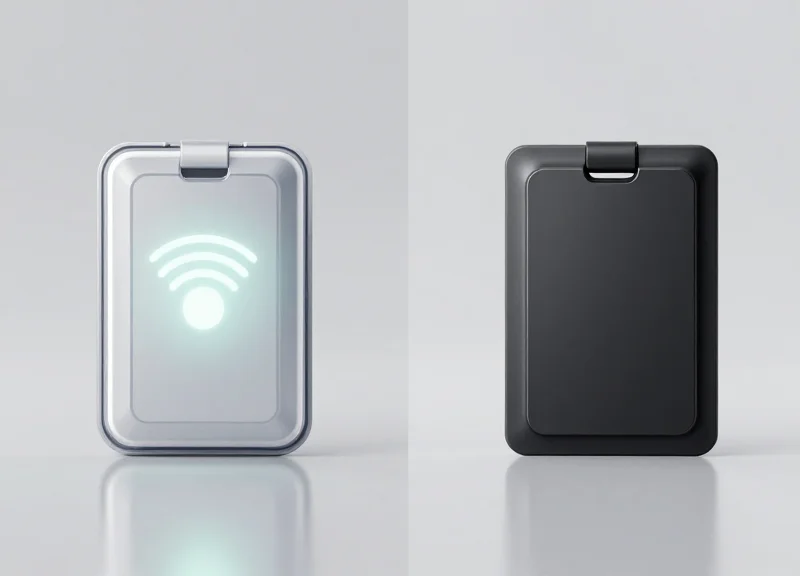
Yes. While metal can shield any signal, AM technology is far more resistant to the 'Faraday cage' effect than RF. Specialized AM hard tags and ferrite-core labels are designed specifically to work on or near metallic surfaces found in power tools and laptops.
Are AM labels more expensive than RF labels?
Historically, AM labels had a higher price point. However, looking toward 2026, manufacturing efficiencies and the lower 'Total Cost of Ownership'—driven by fewer false alarms and higher recovery rates—make AM the more cost-effective choice for diverse inventories.
Operational Efficiency and False Alarm Reduction
Operational efficiency in the smart retail era is measured by the absence of friction, specifically the elimination of 'phantom alarms'—security triggers that occur without a theft event. Acousto-Magnetic (AM) technology achieves a significantly higher Signal-to-Noise Ratio (SNR) than Radio Frequency (RF) systems by operating at a distinct 58kHz frequency. This low-frequency pulsed signal allows the system to distinguish between a genuine security tag and background electronic noise with surgical precision, ensuring that the store atmosphere remains professional and that security personnel focus only on legitimate threats.
Beyond the technical specifications, the true cost of false alarms is found in 'Alarm Fatigue.' When EAS systems trigger incorrectly, staff become desensitized, leading to slower response times or, in many cases, ignoring the alarm entirely. Furthermore, false alarms create a 'guilty-until-proven-innocent' environment that can permanently damage brand loyalty. AM technology’s stability ensures that every alarm is a high-confidence event, allowing staff to approach customers with certainty rather than hesitation.
| Feature | RF Technology (8.2 MHz) | AM Technology (58 kHz) |
|---|---|---|
| Susceptibility to Interference | High (Fluorescent lights, WiFi, IoT) | Very Low (Low-frequency stability) |
| Detection Accuracy | Variable based on environmental noise | Superior (High Signal-to-Noise Ratio) |
| False Alarm Frequency | Common (Phantom Alarms) | Rare (Specific resonance detection) |
| Impact on Staff | Higher risk of Alarm Fatigue | Enables high-confidence responses |
Expert Insight: In the post-2026 retail landscape, the 'Ambient Noise Floor' is rising due to the proliferation of 5G beacons, smart lighting, and robotics. While RF systems are increasingly struggling to filter this noise, the 58kHz band used by AM remains a 'quiet zone.' This makes AM not just a choice for today, but a strategic necessity for the interference-heavy smart stores of tomorrow.
How does AM technology reduce 'Phantom Alarms'?
AM systems use pulsed energy to excite a tag and then listen for a specific resonance frequency during the 'off' cycle. This 'listen-after-pulse' method allows the system to ignore ambient electronic noise that typically triggers continuous-wave RF systems.
What is the ROI of reducing false alarms?
Reducing false alarms saves hundreds of labor hours annually by preventing staff from performing unnecessary bag checks. It also preserves the customer lifetime value (CLV) by avoiding embarrassing or negative checkout experiences.
Can environmental factors like power cables affect AM systems?
While all electronic systems face some interference, AM's digital signal processing (DSP) and low frequency make it much more resilient than RF to nearby power lines and heavy machinery.
Total Cost of Ownership (TCO): Long-term ROI Beyond 2026

Total Cost of Ownership (TCO) in retail security is the comprehensive assessment of all costs associated with an Electronic Article Surveillance (EAS) system over its entire lifecycle, typically five to seven years. Beyond 2026, the TCO for Acousto-Magnetic (AM) technology outperforms Radio Frequency (RF) because AM systems significantly reduce 'hidden' operational expenses—such as labor costs lost to false alarms and the inability of RF to protect liquid or foil-wrapped high-value items—resulting in an estimated 20-30% higher ROI despite a slightly higher initial capital expenditure.
| Cost Factor | RF Systems (Standard) | AM Systems (Next-Gen) |
|---|---|---|
| Initial Hardware Cost | Lower (Entry-level price point) | Moderate to High |
| Detection Accuracy | Variable (Subject to interference) | High (Stable across diverse materials) |
| False Alarm Frequency | High (Increases labor/stress) | Low (Superior signal-to-noise ratio) |
| Maintenance & Calibration | Frequent (Environment sensitive) | Infrequent (Auto-tuning capabilities) |
| Annual Shrink Mitigation | Limited by material constraints | Comprehensive (Liquids/Metals/Foil) |
One critical factor often overlooked in TCO calculations is 'Alarm Fatigue.' In a Silicon Valley-style data-driven retail model, every false alarm represents a measurable loss in staff productivity and customer satisfaction. While RF systems are cheaper upfront, their tendency to trigger on non-security items (like coiled cables or certain credit card chips) creates an operational drag. AM technology, with its 58kHz stability, ensures that when an alarm sounds, it is statistically significant. Expert Tip: Beyond 2026, retailers should calculate TCO using the 'Effective Protection Rate' (EPR) rather than just installation costs—EPR measures how many actual theft attempts are stopped versus how many items can be tagged. Because AM can protect perfumes, cosmetics, and canned goods that RF cannot, its EPR is nearly double that of RF in high-shrink categories.
How long does it typically take to see a positive ROI on an AM system?
Most retailers recover the price differential between RF and AM systems within 12 to 18 months through reduced shrink and decreased maintenance call-outs.
Does AM technology require more expensive tags?
While AM labels historically cost more, the mass adoption of AM in global supply chains has normalized pricing. Furthermore, the durability of AM hard tags leads to a longer reuse cycle, lowering the cost per use.
Why is AM considered more future-proof for 2026?
As retail stores transition to 'dark stores' or hybrid fulfillment centers, the density of metal shelving and electronic equipment increases. AM's immunity to this electronic 'noise' ensures it remains functional while older RF systems fail.
Global Trends: Why Top Retailers are Switching to AM
The global retail landscape is currently undergoing a systemic shift, with the majority of Tier-1 retailers transitioning from legacy Radio Frequency (RF) systems to Acousto-Magnetic (AM) technology. This trend is driven by AM’s ability to provide a consistent 95-98% detection rate even in high-density shopping environments, compared to the diminishing performance of RF in the presence of modern 'liquid and metal' heavy inventories. As retailers expand globally, the 58 kHz frequency used by AM has emerged as the de facto international standard for high-performance Electronic Article Surveillance (EAS).
| Retail Vertical | Adoption Trend | Primary Driver for AM Switch |
|---|---|---|
| Luxury & High-Fashion | Accelerating | Aesthetic-friendly, ultra-small labels and high-end pedestal designs. |
| Health & Beauty | Dominant | Resistance to signal shielding caused by liquids and foil packaging. |
| Consumer Electronics | Increasing | Superior performance near metallic products and active electronic interference. |
| Global Department Stores | Strategic Standard | Simplified supply chain through universal 58 kHz source tagging. |
- The Rise of Universal Source Tagging: Retailers are forcing vendors to apply AM labels at the point of manufacture. Because AM labels are active across the 58 kHz spectrum globally, it eliminates the need for region-specific tagging, streamlining international logistics.
- Wide-Exit Architecture: Modern store designs favor open, wide entrances. AM technology supports wider aisle widths (up to 2.4 meters or more) without the performance drop-off typically seen in RF systems.
- Sustainability in Deactivation: Top retailers are prioritizing AM because its deactivation process is non-contact and highly reliable, reducing the number of 'failed deactivations' that lead to embarrassing customer interactions and lost brand loyalty.
Expert Insight: The 'Signal-to-Noise' Era. As a Silicon Valley veteran, I've observed that the move to AM isn't just about theft—it's about data integrity. In the 'Smart Retail' era, noise from ubiquitous Wi-Fi, Bluetooth, and 5G signals can cripple 8.2 MHz RF systems. AM’s lower frequency (58 kHz) operates in a much 'quieter' band of the electromagnetic spectrum, making it the only viable choice for the hyper-connected flagship stores of 2026 and beyond.
Is RF technology becoming obsolete?
While RF remains cost-effective for small local retailers with simple inventory (like books or apparel), it is being phased out by enterprise-level global retailers who require reliability across diverse product categories.
Why is AM preferred for 'BOPIS' (Buy Online, Pick Up In-Store)?
AM systems have significantly fewer false alarms. This ensures that customers picking up online orders are not mistakenly flagged, preserving the high-speed convenience that the BOPIS model promises.
Does the shift to AM impact RFID strategies?
Not negatively. In fact, most top retailers use AM for security (EAS) and RFID for inventory management. The two technologies are increasingly bundled into 'Dual-Technology' pedestals to maximize operational efficiency.