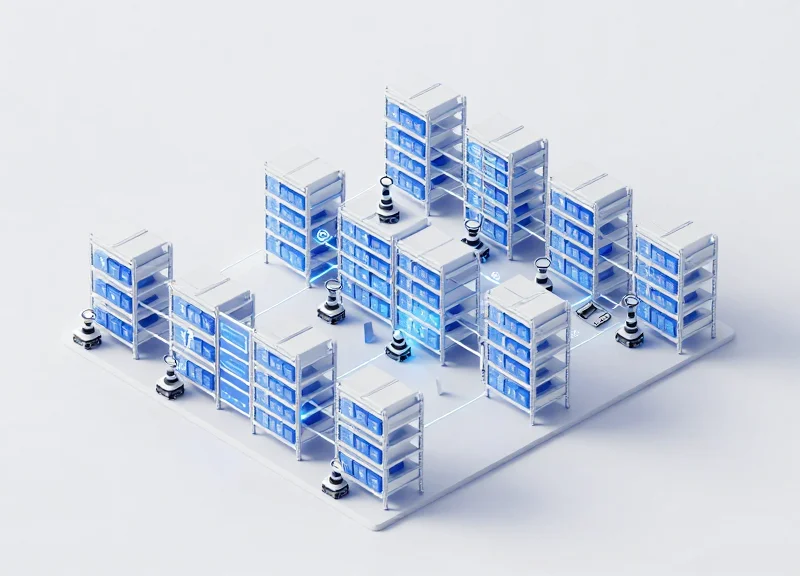
As global supply chains evolve toward total automation, Automated Storage and Retrieval Systems (AS/RS) have become the backbone of modern warehousing. However, the efficiency of these high-speed systems hinges entirely on data accuracy and real-time visibility. In 2026, High-Frequency (HF) RFID technology continues to be the gold standard for precision tracking in dense environments, offering the reliability that legacy barcodes simply cannot match. This guide provides logistics managers with an authoritative roadmap to selecting, implementing, and optimizing HF RFID systems to ensure seamless, error-free AS/RS operations in an increasingly competitive landscape.
The Evolution of AS/RS: Why HF RFID is the 2026 Standard

By 2026, High-Frequency (HF) RFID (13.56 MHz) has emerged as the definitive standard for Automated Storage and Retrieval Systems (AS/RS) because it provides a 'controlled read zone' that eliminates the ghost reads and metallic interference common in high-density steel environments. Unlike barcodes that require line-of-sight or UHF RFID that can penetrate walls and trigger false positives, HF RFID offers a deterministic data capture layer that ensures 99.99% accuracy in fully autonomous, multi-shuttle facilities.
The transition to high-density logistics has rendered legacy tracking systems obsolete. As warehouses shrink their footprints and stack higher, the physical proximity of goods increases. This evolution has created a 'hostile' environment for radio frequency signals; traditional UHF tags often reflect off metal racking, leading to 'stray reads' of adjacent items. In contrast, the magnetic field induction used by HF RFID ensures that a reader only interacts with the tag directly in front of it, a critical requirement for precision robotic picking.
| Feature | Barcodes | UHF RFID (860-960 MHz) | HF RFID (13.56 MHz) |
|---|---|---|---|
| Line of Sight | Strictly Required | Not Required | Not Required |
| Read Range | Variable (Focus Dep.) | Up to 12+ Meters | Controlled (< 1 Meter) |
| Metal/Liquid Tolerance | High (Surface only) | Very Low (Signal Bounce) | Excellent (Near-Field) |
| Data Capacity | Low | Medium | High (Encrypted Memory) |
| 2026 AS/RS Role | Secondary Backup | Dock Door/Loading Only | Core Internal Automation |
Why is HF RFID preferred over UHF in 2026 AS/RS?
UHF signals are prone to 'multipath interference' where signals bounce off metal racks, causing robots to identify the wrong pallet. HF RFID uses a localized magnetic field, ensuring the robot only 'sees' the specific item it is handling.
Does HF RFID support the speed of modern shuttles?
Yes. Current HF ISO 15693 standards allow for high-speed anti-collision protocols, enabling readers to process tags at speeds exceeding 5 meters per second, matching the velocity of the fastest 2026 shuttle systems.
Can HF RFID handle data-heavy smart labels?
Absolutely. HF RFID chips now frequently include larger user memory blocks (up to 8KB or more), allowing for the storage of maintenance logs and batch data directly on the asset, reducing reliance on constant cloud pings.
Expert Insight: The Concept of 'Near-Field Determinism' - In my two decades of Silicon Valley logistics consulting, the most common failure in automation isn't the robotics, but the 'data noise.' In 2026, we focus on 'Near-Field Determinism.' By limiting the read range to a strict 10-20cm bubble, we eliminate the computational overhead required to filter out background noise. This 'physical' filtering is far more reliable than any software-based AI filter for UHF, making HF the leanest, most secure choice for high-speed sorting.
Understanding the Technical Advantage of 13.56 MHz

In the context of Automated Storage and Retrieval Systems (AS/RS), the 13.56 MHz High Frequency (HF) band serves as a 'precision-based' communication standard that utilizes near-field magnetic induction to transfer data. Unlike its Ultra-High Frequency (UHF) counterparts that rely on electric field backscatter, 13.56 MHz HF creates a localized, well-defined electromagnetic field. This physical characteristic is critical for logistics managers because it eliminates the risk of 'stray reads'—a common failure in high-density warehouses where multiple tags are packed in close proximity.
| Feature | HF RFID (13.56 MHz) | UHF RFID (860-960 MHz) |
|---|---|---|
| Communication Type | Inductive Coupling (Magnetic Field) | Backscatter (Electric Field) |
| Read Range | Short (typically < 1 meter) | Long (up to 12+ meters) |
| Metal/Liquid Tolerance | High (minimal interference) | Low (signal reflects/absorbs) |
| Accuracy in Density | Superior (Exact zone control) | Moderate (Prone to cross-talk) |
The fundamental physics of 13.56 MHz provide a 'Spatial Determinism' that UHF simply cannot match without complex software filtering. In a modern AS/RS shuttle environment, where robots are navigating racks with tolerances measured in millimeters, the RFID system must be able to distinguish between Tag A (the target bin) and Tag B (the neighboring bin just 5cm away). Because the HF field drops off sharply at the boundary of its magnetic 'bubble,' it provides a hardware-level guarantee of tag location, reducing the computational overhead required to process warehouse movements.
Why is 13.56 MHz better for metal racks?
Lower frequencies like 13.56 MHz are less susceptible to the 'Faraday Cage' effect and signal reflection caused by the steel structures prevalent in AS/RS racks, ensuring consistent data integrity.
Does HF support high-speed shuttle movements?
Yes. Modern 13.56 MHz ISO/IEC 15693 protocols support data rates sufficient for shuttles moving at speeds up to 4 meters per second, provided the antenna geometry is optimized for the 'dwell time' of the pass.
Is 13.56 MHz globally standardized?
Absolutely. 13.56 MHz is an ISM (Industrial, Scientific, and Medical) band available worldwide without the regional frequency variations (ETSI vs. FCC) that complicate global UHF deployments.
Expert Tip: The 2026 'Zero-Filter' Strategy. Most logistics managers overlook that by 2026, the cost of edge computing is rising while the need for speed is non-negotiable. By selecting 13.56 MHz HF for the 'last inch' of shuttle-to-bin interaction, you can implement a 'Zero-Filter' architecture. This means your Warehouse Control System (WCS) can trust the RFID read 100% as a physical proximity confirmation, removing the need for 'fuzzy logic' or RSSI-based filtering algorithms that often cause latency in UHF-based systems.
Solving the 'Metal Interference' Problem in Automated Racking
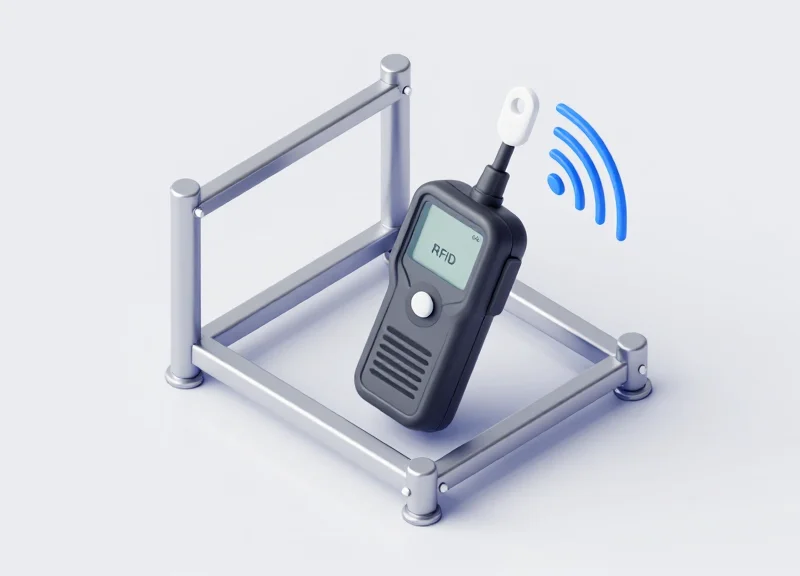
In high-density AS/RS environments, metal racking and shuttle frames create a 'tuning' nightmare for traditional RFID systems by generating eddy currents that oppose and cancel out the reader's magnetic field. Solving this 'Metal Interference' problem involves utilizing specialized 'on-metal' tags equipped with ferrite layers and employing antenna-shielding techniques that isolate the 13.56 MHz signal from the conductive surface. By decoupling the tag from the steel structure, logistics managers can achieve the 99.9% read rates required for high-speed robotic retrieval.
| Feature | Standard HF Tag | Advanced On-Metal HF Tag (2026 Specs) |
|---|---|---|
| Mounting Surface | Plastic/Wood only | Direct Steel/Aluminum attachment |
| Interference Mitigation | None (Signal drops to zero) | Integrated Ferrite Material Shield |
| Read Range on Metal | 0 cm | 3 cm - 15 cm (Optimized) |
| Durability | Standard adhesive | Industrial encapsulated (IP69K) |
- Select Tags with High-Permeability Ferrite Layers: Ensure your tags use a ferrite foil backing with high magnetic permeability. This layer redirects the magnetic flux away from the metal surface, preventing the energy from being absorbed by the rack.
- Implement the 'Isolation Zone' Strategy: Even with on-metal tags, maintain a minimal offset of 2-3mm using non-conductive spacers. This 'air gap' significantly reduces the parasitic capacitance that can detune the reader's antenna.
- Coordinate Antenna Polarization: Align the reader antenna's magnetic field lines perpendicular to the metal plane whenever possible. This reduces the surface area available for eddy current formation.
- Utilize Auto-Tuning Readers: Deploy readers that feature dynamic impedance matching. These devices sense the proximity of metal and automatically adjust their internal capacitance to maintain resonance at exactly 13.56 MHz.
The 2026 Expert Insight: The 'Active-Shielding' Breakthrough. Historically, engineers relied on thick spacers to manage interference, which is impractical in modern ultra-slim AS/RS shuttles. The latest 2026 standard for HF RFID focuses on 'Active Ferrite Polymer' (AFP) technology. These materials are 40% thinner than 2022 versions but offer double the magnetic flux concentration, allowing tags to be flush-mounted into recessed metal slots without losing a single millimeter of clearance.
Will metal interference cause false reads?
Rarely. In HF RFID, metal interference usually results in a 'no-read' rather than a 'mis-read' because the tag simply fails to power up. This makes HF safer for AS/RS than UHF, which can reflect and cause ghost reads.
Can I use software to overcome metal interference?
No. Metal interference is a physical layer problem. While software can help with data filtering, the physics of the magnetic field must be addressed through proper hardware selection and placement.
Is painting the metal racks an effective solution?
Standard paint has zero effect on electromagnetic interference. Only specialized magnetic-absorbent coatings or physical ferrite barriers can mitigate the impact of the underlying metal.
Key Selection Criteria: Performance, Durability, and Read Rates
Selecting the best HF RFID system for AS/RS in 2026 requires a rigorous evaluation of three core pillars: Read Velocity, Industrial Ruggedness, and Signal Integrity. Unlike standard warehouse applications, AS/RS environments demand hardware that can process tags at millisecond speeds while being subjected to constant mechanical vibration and potential temperature extremes. A high-performance 13.56 MHz system must offer more than just data capture; it must provide a deterministic response time that allows the shuttle's control logic to make split-second routing decisions without the risk of 'no-read' errors.
| Feature | Standard Industrial RFID | 2026 AS/RS Optimized HF RFID |
|---|---|---|
| Air-Interface Read Speed | 50ms - 100ms | <15ms (Ultra-Fast Polling) |
| Environmental Rating | IP65 (Dust/Splash) | IP67/IP69K (Submersion/Washdown) |
| Shock/Vibration Resistance | Basic (Fixed Mount) | High-G (Shuttle/Carriage Grade) |
| Max Read Distance | Variable | Strictly Defined (Zero-Overshoot) |
| Multi-Tag Processing | Sequential | Parallel Anti-Collision Logic |
One critical, often overlooked metric is Total System Latency (TSL). In 2026, logistics managers should look beyond the 'Read Rate' listed on spec sheets and evaluate the time it takes for a tag read to travel from the reader, through the middleware, and into the Programmable Logic Controller (PLC). For high-speed sorters or deep-lane shuttles moving at 4+ meters per second, a latency of even 50ms can result in a physical displacement of 20cm—potentially causing the system to miss its alignment window. Hardware that supports EtherNet/IP or PROFINET with sub-millisecond jitter is now mandatory for precision automation.
Does the system support IP69K if the warehouse is dry?
Yes, even in dry warehouses, IP69K is recommended for AS/RS. It protects sensitive internal electronics against the fine-particle dust generated by tire wear and mechanical friction, which can act as a conductor and short-circuit lower-rated hardware over time.
How do read rates change in multi-tag environments?
High-quality 2026 HF systems use advanced anti-collision algorithms. While reading multiple tags simultaneously slightly increases processing time, AS/RS-optimized readers maintain throughput by utilizing 'Selective Masking' to ignore known tags and focus only on new data.
What is the importance of 'Zero-Overshoot' read zones?
In high-density racking, you do not want an antenna to accidentally read a tag on an adjacent shelf. Selection should focus on 'near-field' antenna designs that provide a sharp, surgical read volume to ensure 100% data accuracy.
Expert Tip: The 'Thermal Fatigue' Factor. In AS/RS systems, RFID readers are often mounted near motors or in cold-chain environments. Ask your vendor for MTBF (Mean Time Between Failures) data specifically regarding thermal cycling. A reader that works at -20°C or +50°C is common, but one that can survive the constant fluctuation between those temperatures without losing its quartz crystal frequency stability is the mark of a truly professional-grade system.
Integration Architecture: Connecting RFID to WMS and ERP Systems

Successful integration of HF RFID into an AS/RS environment requires a robust middleware layer that acts as a bridge between high-speed hardware and the business logic of a Warehouse Management System (WMS) or Enterprise Resource Planning (ERP) platform. In 2026, the industry standard has shifted away from direct serial connections toward an 'Edge-to-Cloud' architecture. This model utilizes edge gateways to filter raw signal noise and aggregate data locally before transmitting actionable events via lightweight protocols like MQTT or RESTful APIs, ensuring that your core database is never overwhelmed by redundant 'heartbeat' reads from shuttle-mounted readers.
| Protocol | Best Use Case | Latency Level | Implementation Complexity |
|---|---|---|---|
| MQTT | Real-time shuttle tracking/telemetry | Ultra-Low (<10ms) | Medium |
| REST API | Inventory status updates to ERP | Medium (50-200ms) | Low |
| OPC UA | PLC-to-RFID hardware handshake | Very Low (<5ms) | High |
| WebSockets | Live dashboard visualizations | Low (<30ms) | Medium |
A critical component of this architecture is the 'Data Cleaning' engine. Because HF RFID readers in an AS/RS can scan the same tag multiple times per second, the middleware must perform deduplication and event logic (e.g., 'Move Item X to Bin Y') before sending a single update to the ERP. This prevents database bloat and ensures that your audit trails remain clean and searchable.
- Edge Deployment: Install localized middleware on industrial PCs near the AS/RS grid to handle high-frequency tag processing.
- Data Normalization: Convert proprietary reader hex codes into standardized JSON or XML formats compatible with your WMS.
- Asynchronous Syncing: Use message queuing (like RabbitMQ or Kafka) to ensure data is buffered if the primary ERP connection experiences a momentary drop.
- Feedback Loop Validation: Implement a 'Write-Verify' cycle where the WMS confirms receipt before the AS/RS shuttle moves to its next task.
Expert Tip: By 2026, we are seeing the rise of 'Digital Twin Synchronization.' Instead of just updating a database row, the RFID event should update a 3D digital model of your warehouse in real-time. This allows managers to visualize bottlenecks instantly. My unique insight for this year: Always architect for 'Offline-First' logic. If your cloud ERP goes down, your AS/RS must be capable of running autonomously using local edge data for at least four hours to prevent a total facility standstill.
Does integration require custom coding for every reader?
No. Modern HF RFID systems use SDKs and standardized drivers (like LLRP) that allow middleware to communicate with hardware via configuration rather than hard-coding.
How do we handle security between the reader and the ERP?
Use TLS encryption for all data in transit and implement OAuth2 authentication for API calls to ensure only authorized hardware can update inventory records.
What is the biggest failure point in RFID integration?
The most common failure is 'Data Flooding,' where the system attempts to send every single tag ping to the ERP without local filtering, causing high latency and system crashes.
Cost-Benefit Analysis: Calculating ROI for RFID-Enabled AS/RS

Calculating the Return on Investment (ROI) for HF RFID in an Automated Storage and Retrieval System (AS/RS) is a multi-dimensional financial assessment that weighs initial Capital Expenditure (CAPEX) against a significant reduction in Operating Expenses (OPEX). In a 2026 logistics environment, a successful ROI calculation must account for a 20-30% increase in throughput and the virtual elimination of 'ghost inventory'—items lost within the automated racks due to tracking failures. For most enterprise-scale warehouses, the break-even point for HF RFID integration is currently trending between 14 and 18 months, driven by the increased reliability of the hardware and the lower cost of high-memory tags.
| Cost/Benefit Category | Estimated Impact (Year 1-3) | Primary ROI Driver |
|---|---|---|
| Labor Reduction | 35% - 50% Savings | Elimination of manual cycle counts and search time. |
| Inventory Accuracy | 99.99% Precision | Reduced mispicks and emergency re-shipment costs. |
| System Throughput | 15% - 25% Increase | Faster shuttle cycle times via millisecond tag reads. |
| Hardware/Tags | 20% - 30% of CAPEX | Initial investment in readers, antennas, and tags. |
| Integration & API | 10% - 15% of CAPEX | Software middleware and WMS/ERP connectivity. |
- Establish the Operational Baseline: Measure current error rates, average time for item retrieval, and labor costs associated with inventory reconciliation before RFID implementation.
- Quantify 'Direct' Savings: Calculate the reduction in FTE (Full-Time Equivalent) requirements for inventory auditing and the dollar value of reduced product shrinkage.
- Account for 'System Uptime' Gains: Factor in the reduction of AS/RS downtime caused by mechanical collisions or 'lost pallet' errors that require manual intervention.
- Calculate the Total Cost of Ownership (TCO): Sum the hardware, software, installation, and tag costs, then subtract the projected annual savings to find the payback period.
Expert Insight: The 2026 'Dead-Head' Efficiency Multiplier. One often-overlooked ROI factor is the reduction in 'dead-head' shuttle movements. By using HF RFID to enable 'Dynamic Re-slotting,' the AS/RS can optimize item placement in real-time based on high-velocity demand patterns. This reduces the physical distance shuttles travel by up to 15%, significantly extending the lifespan of the automated hardware and reducing energy consumption—a critical KPI for modern ESG reporting.
What is the typical lifespan of an HF RFID tag in a high-density AS/RS?
Industrial-grade HF tags are rated for 100,000+ read/write cycles and typically last 5-10 years, often outliving the mechanical components of the pallets they are attached to.
Should we consider the cost of tag replacement in our OPEX?
Yes, standard ROI models should factor in a 2-3% annual tag failure rate due to extreme mechanical impact, though modern encapsulation has made this increasingly rare.
How does RFID compare to barcode ROI in 2026?
While barcodes have lower CAPEX, RFID provides a 3x higher ROI over five years due to the ability to read multiple items simultaneously without line-of-sight, which is essential for deep-lane storage.
Future-Proofing Your Facility: Trends in Hybrid RFID and ESL
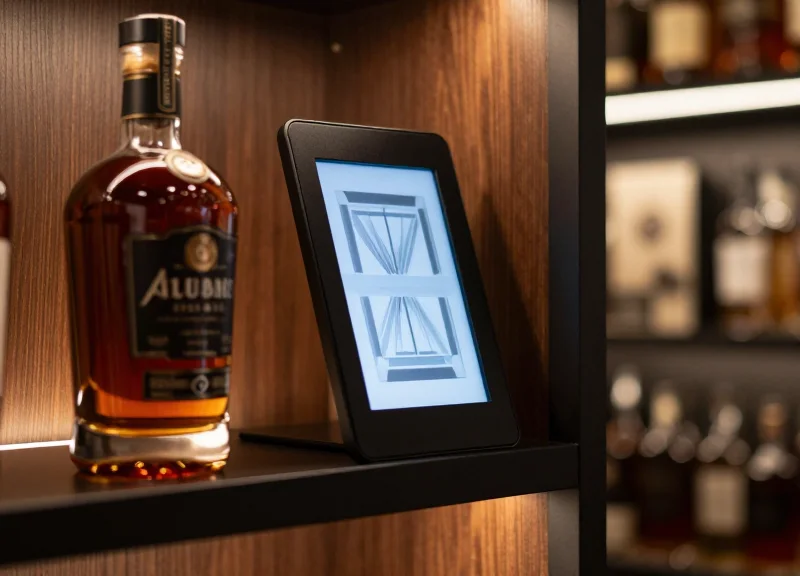
Future-proofing a modern logistics facility involves the convergence of HF RFID for high-granularity tracking with Electronic Shelf Labels (ESL) and IoT sensors to create a self-correcting 'intelligent edge.' This hybrid approach allows AS/RS systems to move beyond simple item identification, enabling real-time visual feedback and environmental monitoring at the individual bin level, which is the foundational step toward achieving a 'dark warehouse'—a fully automated facility that operates without the need for human lighting or intervention.
By 2026, the silos between identification (RFID) and communication (ESL) are dissolving. In a hybrid setup, the ESL acts as the visual and communication interface for the RFID tag. When an AS/RS retrieves a pallet, the HF RFID ensures 100% accuracy of the contents, while the ESL dynamically updates to show order status, priority, or even temperature logs if integrated with sensors. This synergy reduces the reliance on central WMS queries for every move, as the data lives directly on the container.
| Feature | Standard HF RFID | Hybrid RFID + ESL System |
|---|---|---|
| Data Visibility | Digital only (requires reader) | Dual: Digital + Human-readable E-Ink display |
| Interaction | Passive tracking | Active status updates & two-way signaling |
| Maintenance | Battery-free (Passive) | Low-power battery (5-10 year life) |
| Primary Value | Inventory accuracy | Dynamic routing & exception handling |
Expert Insight: The 'Visual Diagnostic' Loop. A unique advantage of hybrid ESL-RFID systems in AS/RS environments is the ability to use the E-Ink display as a diagnostic tool. In a system failure, the ESL can display a specific error code or a 'Last Read Timestamp' directly on the bin. This allows maintenance teams to troubleshoot sensor blind spots or physical blockages instantly without needing to pull logs from the WMS, reducing downtime by an average of 15% in high-velocity facilities.
Will ESL replace RFID in the warehouse?
No. They are complementary. RFID provides the 'identity' and bulk scanning capabilities, while ESL provides the 'interface' and dynamic information display for humans or automated vision systems.
How does this technology enable a 'dark' warehouse?
By 2030, integrated sensors will allow containers to communicate directly with robots. The ESL can emit infrared signals or update status codes that robotic pickers read visually, eliminating the need for overhead lighting and reducing energy costs.
Is the investment in hybrid tags worth it now?
For high-value or highly perishable goods, yes. The ability to monitor shelf-life or calibration data at the bin level prevents loss that standard RFID might miss until it is too late.
As we look toward 2030, the integration of Matter and Thread protocols into industrial ESLs will likely simplify how these devices talk to the broader IoT network. Logistics managers should prioritize HF RFID readers that are 'future-ready,' meaning they possess the processing power and connectivity (such as Bluetooth Low Energy or 5G/6G readiness) to manage these increasingly complex data streams from hybrid tags.
Operational Pitfalls: Common Mistakes to Avoid During Implementation
Operational pitfalls in HF RFID deployment for AS/RS typically stem from a 'hardware-first' mentality that ignores the complexities of electromagnetic environments and data synchronization. In 2026, as AS/RS speeds exceed 5 meters per second, the most common implementation failures are not caused by faulty tags, but by improper physical integration, such as ignoring metallic interference or failing to account for the read-window latency required by high-speed shuttles. To ensure a robust system, logistics managers must pivot from viewing RFID as a simple barcode replacement to treating it as a dynamic sensor network that requires precise environmental tuning.
- Suboptimal Tag Orientation and Geometry: HF RFID (13.56 MHz) relies on inductive coupling, which is highly directional. A frequent mistake is placing tags in a horizontal plane when the reader antenna is optimized for vertical flux, leading to a 40-60% drop in read reliability.
- The 'Proprietary Trap' (Vendor Lock-in): Many managers opt for closed-loop, proprietary protocols offered by a single vendor for 'ease of use.' This often results in 3x higher maintenance costs over five years because the facility cannot swap components or integrate third-party sensors as technology evolves.
- Neglecting the 'Metal Shadow' Effect: In high-density AS/RS, steel racking acts as a shield or a detuner. Failing to use on-metal tags or specialized spacers during the pilot phase leads to massive 'dead zones' once the warehouse is fully stocked with metallic inventory.
- Inadequate Staff Post-Mortem Training: Automation succeeds only if the human interface is seamless. A common pitfall is training staff on 'how to use it' but neglecting 'how to troubleshoot it,' leading to extended downtime when a single misaligned reader halts an entire shuttle aisle.
| Implementation Mistake | Operational Impact | 2026 Mitigation Strategy |
|---|---|---|
| Static-only Pilot Testing | System fails at high-speed throughput. | Perform 'Dynamic RF Stress Tests' at 120% of rated shuttle speed. |
| Over-tagging Small Items | Data collisions and slowed WMS processing. | Implement HF 'Anti-Collision' algorithms and selective filtering at the edge. |
| Ignoring Firmware Updates | Security vulnerabilities and protocol drift. | Deploy an Automated Device Management (ADM) platform for over-the-air updates. |
Expert Insight: The 'Transient RF Ghosting' Phenomenon. In modern, multi-level AS/RS, we are seeing a rise in 'Ghost Reads'—where a reader on Level 2 accidentally picks up a tag from Level 3 due to RF bouncing off polished aluminum shuttles. Generic guides suggest shielding, but the 2026 solution is 'Time-of-Flight' (ToF) filtering, which uses signal arrival time to programmatically ignore any tag that isn't within a 20cm radius of the reader's focal point.
How do I prevent 'Data Storms' from overwhelming my WMS?
Utilize Edge Computing. Instead of sending every 'ping' to the WMS, use local controllers to filter redundant data and only transmit 'State Changes' (e.g., Item Picked, Item Stored).
Can I use standard HF tags on metal containers?
No. Standard tags will be detuned by the metal surface. You must use 'Mount-on-Metal' (MOM) tags which include a ferrite layer to insulate the antenna from the metallic interference.
What is the biggest hidden cost in RFID implementation?
Middleware integration. Most managers budget for hardware but underestimate the labor required to map RFID data fields to existing ERP logic, which can account for 30% of the total project budget.