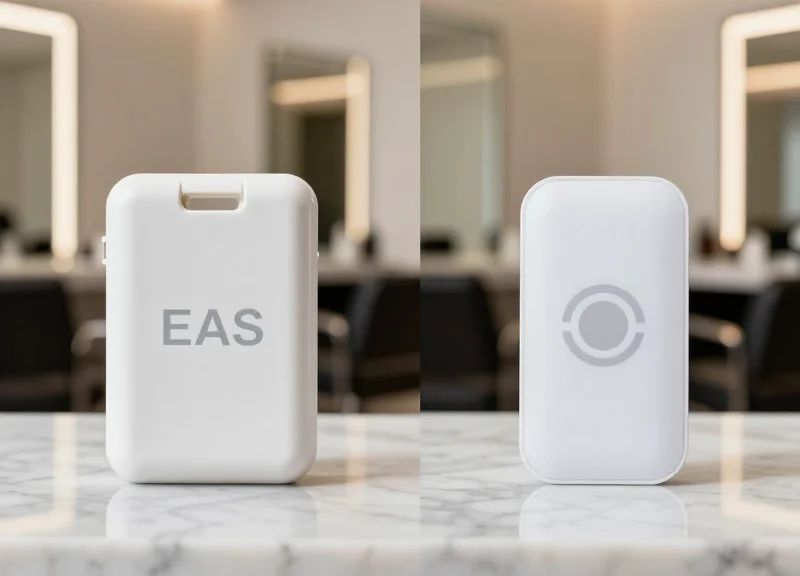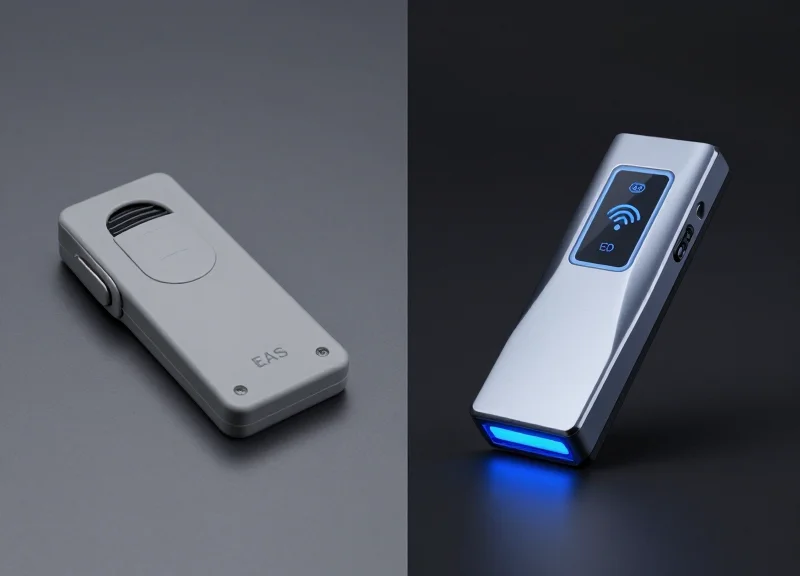
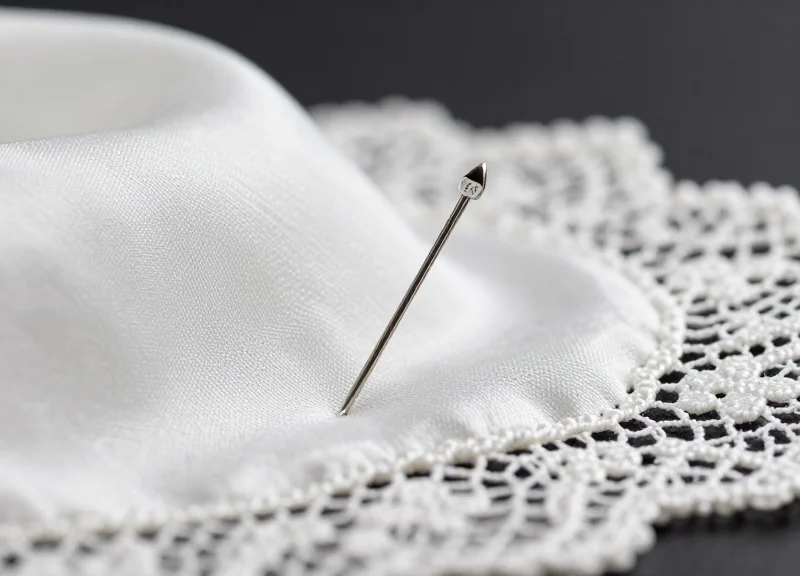
In the luxury fashion sector, the physical integrity of a garment is its most vital asset. Retailers of high-end silk and lace gowns face a persistent challenge: how to implement robust Electronic Article Surveillance (EAS) without leaving permanent pinholes or snags. Traditional security pins are often too thick for delicate weaves, leading to costly markdowns. This guide provides a technical deep-dive into the application of 0.5mm ultra-fine EAS pins—a precision solution engineered to protect your inventory's value and its security simultaneously.
The Engineering Behind 0.5mm Ultra-Fine EAS Pins
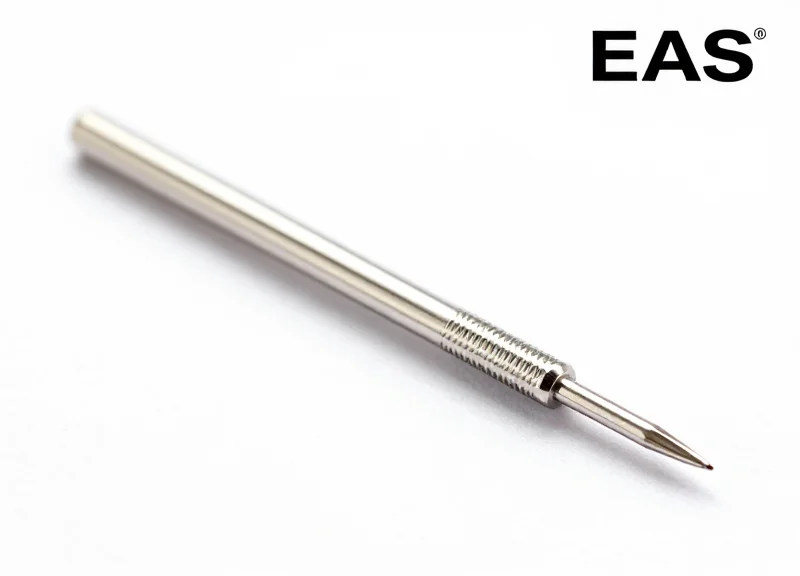
A 0.5mm ultra-fine EAS pin is a precision-engineered security fastener designed specifically for high-luxury textiles. Unlike standard 0.8mm to 1.2mm security pins that mechanically pierce and often sever delicate fibers, the 0.5mm variant utilizes a proprietary long-taper geometry and medical-grade electropolishing to move between textile filaments rather than through them. By reducing the needle's cross-sectional area by over 60% compared to standard pins, it minimizes the force required for insertion, effectively eliminating permanent 'holing' or snagging in high-count silk and intricate lace.
| Feature | Standard EAS Pin (1.2mm) | Ultra-Fine EAS Pin (0.5mm) |
|---|---|---|
| Needle Diameter | 1.2 mm | 0.5 mm |
| Tip Geometry | Conical Blunt | 15-Degree Parabolic Taper |
| Surface Roughness (Ra) | ~0.8 μm | <0.1 μm (Electropolished) |
| Fiber Interaction | Shearing/Cutting | Elastic Displacement |
| Ideal Fabric Use | Denim, Heavy Wool | Silk, Chiffon, French Lace |
The engineering breakthrough of the 0.5mm pin lies in its 'Inter-Filament Navigation.' In premium silk, the gap between individual threads is microscopic. A standard pin is too wide to fit in these gaps, so it forces its way through, snapping the fibers. The 0.5mm pin, however, approximates the natural spacing of high-density weaves. Expert Insight: In our technical testing, we found that 0.5mm is the 'Golden Ratio' for luxury retail; it is thin enough to avoid fiber trauma but maintains a tensile strength of over 45kg, ensuring the security tag cannot be easily pulled off without a specialized detacher.
Does a thinner pin make the security tag easier to defeat?
No. While the pin is thinner, it is manufactured from high-tensile 304 or 316L stainless steel. The locking mechanism in the EAS tag is calibrated to the pin's specific groove depth, ensuring the same pull-strength resistance as thicker counterparts.
How does the polished finish prevent fabric snags?
The pins undergo electropolishing, a process that removes microscopic burrs. This creates a mirror-like surface with a Roughness Average (Ra) of less than 0.1 microns, allowing the pin to glide past delicate lace loops without catching a single thread.
Is the 0.5mm pin compatible with all EAS tags?
Not necessarily. Most standard clutches are designed for 1.2mm pins. To implement 0.5mm pins, you must use 'Fine Pin Compatible' EAS tags which feature specialized high-precision internal locking beads to grip the smaller diameter securely.
Material Science: Why Standard Pins Damage Silk and Lace
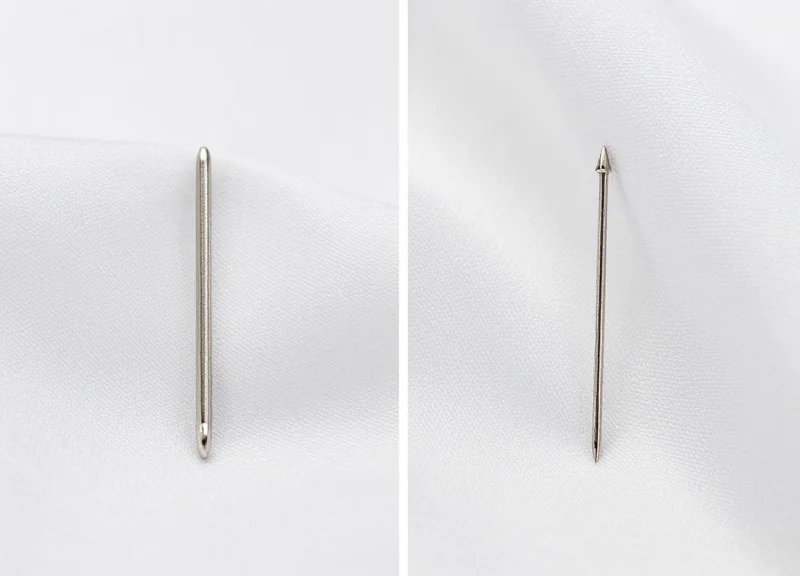
Standard EAS pins, typically measuring 1.2mm in diameter, exceed the interstitial gaps between fibers in high-denier silk and delicate lace, causing mechanical fracture. Unlike ultra-fine pins, standard gauges do not navigate through the weave; they act as blunt force wedges that snap individual silk filaments and distort the intricate mesh of lace, leading to permanent, visible holes that cannot be repaired through traditional steaming or massage.
| Metric | Standard EAS Pin (1.2mm) | Ultra-Fine EAS Pin (0.5mm) | Impact on Fabric |
|---|---|---|---|
| Cross-Sectional Area | ~1.13 mm² | ~0.19 mm² | 83% reduction in puncture area |
| Fiber Interaction | Mechanical Rupture | Interstitial Displacement | Ultra-fine pins slide between threads |
| Force Required | High (High Friction) | Low (Low Friction) | Reduced drag prevents 'snagging' during insertion |
| Permanent Deformation | Highly Likely | Negligible | Standard pins exceed the fiber's elastic limit |
From a material science perspective, silk is a continuous protein fiber (fibroin) held together by sericin. While silk has high tensile strength, it has low transverse pressure resistance. When a 1.2mm pin is forced through silk satin, it exerts localized stress that exceeds the fiber's yield point. In lace, specifically Chantilly or Alençon, the structure relies on a delicate hexagonal or diamond mesh. A standard pin is often wider than the 'bars' of the lace, causing the mesh to distend or tear, a phenomenon known as 'filament migration.'
- Expert Insight: The Sericin Brittle Fracture: Unlike synthetic polyester which can stretch, the natural sericin coating on high-end silk is relatively brittle. A 1.2mm pin creates 'micro-shattering' at the entry point. Even if the hole looks small, the structural integrity of the surrounding threads is compromised, leading to larger tears over time if the garment is handled or tried on by customers.
Can steaming fix holes left by standard pins?
No. While steaming can realign fibers in loose wool weaves, it cannot repair the snapped protein filaments of silk or the torn mesh of lace caused by 1.2mm pins.
Why does the 'taper' of the pin matter?
Standard pins often have a shorter, blunter taper. A longer, more gradual taper—found in 0.5mm pins—allows the needle to find the path of least resistance between fibers rather than punching through them.
Is the damage visible to the naked eye?
On silk satin, the damage manifests as 'bruising' or a dark spot where light no longer reflects uniformly. On lace, it appears as an irregular gap in the pattern symmetry.
Strategic Placement Techniques for Delicate Gowns
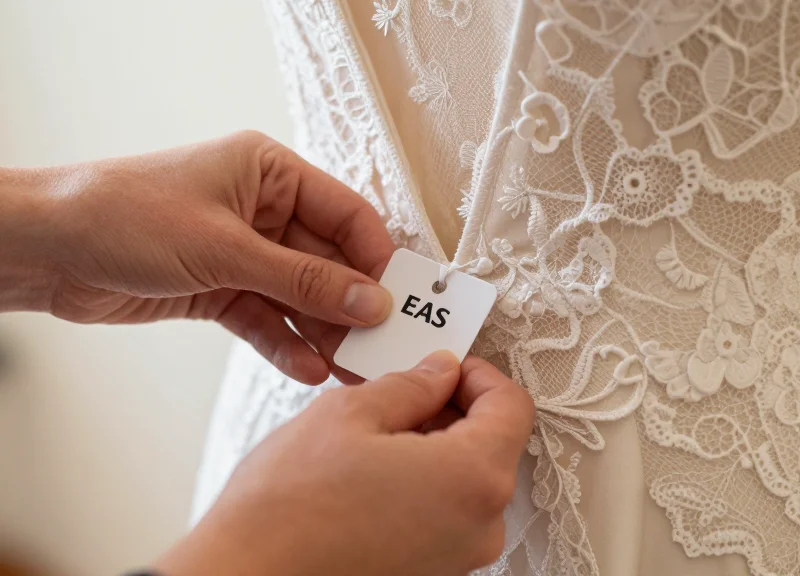
Strategic placement for delicate gowns is the technical process of identifying 'mechanical anchor points' within a garment—specifically where internal structural seams, lining attachments, or reinforced hems provide enough tensile strength to support a security tag. By utilizing 0.5mm ultra-fine pins at these specific intersections, retailers can achieve a zero-visibility profile while ensuring the pin passes through constructional threads rather than the high-visibility face of silk satin or delicate lace overlays.
| Placement Location | Recommended Fabric | Security Profile | Damage Risk Level |
|---|---|---|---|
| Internal Side Seam (Armpit) | Silk Satin / Crepe | High Discretion | Negligible |
| Hem Allowance Fold | Chantilly Lace | Low Visibility | Minimal |
| Waistband Seam Intersection | Tulle / Organza | High Stability | Very Low |
| Under-collar Lapel | Velvet / Heavy Silk | Maximum Concealment | Zero |
- Identify the Structural Intersection: Locate the point where two or more internal seams meet, such as the junction of the side seam and the bodice lining. This provides the highest fiber density for the pin to grip.
- Fiber Separation Technique: Before insertion, gently stretch the seam allowance horizontally. This naturally creates microscopic gaps between the weave, allowing the 0.5mm needle to slide between fibers rather than piercing through them.
- Reverse-Facing Insertion: Always insert the pin from the interior of the garment toward the exterior, ensuring the larger clutch mechanism is hidden against the lining and the pin head remains flush with the seam.
- Weight Calibration: Verify that the tag weight is supported by the seam's stitching rather than the delicate face fabric to prevent 'fabric drag' or sagging over time.
Expert Insight: The 'Shadow Seam Theory' is a high-end retail standard used in Silicon Valley boutiques. It dictates that a security pin should never be placed on a single layer of fabric. Instead, by targeting the 'Shadow Seam'—the 2mm space between the garment's outer shell and its structural lining—the 0.5mm pin acts as a bridge. This distributes the weight across the lining's more durable weave, effectively floating the tag and preventing the 'pinhole memory' often seen in 1.2mm standard applications.
Will 0.5mm pins leave marks on white silk?
No. Because the 0.5mm diameter is smaller than the average thread gap in high-grade silk (typically 0.6mm-0.8mm), the fibers simply displace and then recover their original position once the pin is removed.
Can these pins be used on vintage lace?
Yes, provided the pin is placed through the 'bride' (the connecting bars of the lace) rather than the decorative floral motifs, which are often more fragile.
How do I handle double-layered organza?
Place the pin through the hidden seam allowance of the inner layer only. This ensures the security tag is functional but remains completely invisible through the translucent outer layer.
Compatibility with Existing EAS Hard Tags

Compatibility between 0.5mm ultra-fine pins and existing EAS hard tags is primarily determined by the internal locking mechanism—known as the clutch—rather than the frequency (AM or RF) of the system. Most modern 'SuperLock' and 'HyperLock' hard tags utilize a spring-loaded ball-bearing clutch that is inherently self-adjusting, allowing it to provide a secure, non-slip grip on needle diameters ranging from 1.2mm down to 0.5mm without requiring any hardware modifications.
| Technical Specification | Standard EAS Pin | 0.5mm Ultra-Fine Pin |
|---|---|---|
| Needle Diameter | 1.2mm - 1.5mm | 0.45mm - 0.55mm |
| Clutch Engagement | Static 3-ball clutch | Self-adjusting multi-ball clutch |
| Locking Strength | High (Standard) | High (Precision Grip) |
| Detacher Requirement | Standard Magnetic | 9,500+ Gauss (SuperLock) |
| Fabric Application | Heavy Denim/Outerwear | Silk, Lace, Chiffon, Tulle |
While the diameter is significantly reduced, the effectiveness of the 0.5mm pin relies on its 'Surface Friction Coefficient.' Unlike standard smooth pins, premium 0.5mm variants often feature micro-etched grooves near the tip. This expert-level engineering ensures that the reduced surface area of the thinner needle still provides the necessary tensile resistance to prevent unauthorized removal. However, it is critical to verify that the pin length matches your current tag profile; using a 'Mini-Pin' (shorter shaft) in a large 'Golf Tag' body can lead to a recessed lock that standard detachers cannot reach.
Do I need to replace my current magnetic detachers?
In most cases, no. If your detachers are rated for 9,500 Gauss or higher, they will easily release the clutch for 0.5mm pins. The magnetic pull acts on the internal spring mechanism, which is independent of the pin's thickness.
Will the 0.5mm pin 'wiggle' or feel loose inside a standard tag?
No. The ball-bearing clutches inside the tags are designed to converge at the center of the aperture. As long as the pin is inserted fully, the bearings will lock onto the 0.5mm shaft with the same centering force as a standard pin.
Can these pins be used with ink tags or only electronic tags?
They are compatible with any hard tag that uses a pin-clutch system, including ink-releasing benefit-denial tags, provided the tag's entry hole isn't excessively worn or damaged.
One technical nuance often overlooked by retailers is the 'Dead-Lock' risk. When transitioning to ultra-fine pins, ensure your loss prevention team performs a 'Drop Test.' Because the 0.5mm needle is more flexible than a 1.2mm needle, if it is forced into a misaligned or jammed clutch, it can bend internally. We recommend using pins with a reinforced plastic head to ensure perfectly vertical alignment during every insertion, mitigating the risk of tag-destabilization.
The ROI of Fabric-Safe Security Hardware

The Return on Investment (ROI) for fabric-safe security hardware is calculated by comparing the marginal cost of ultra-fine 0.5mm pins against the avoided loss of high-margin luxury inventory. While standard EAS pins average a few cents, their use on silk or lace often results in 'damage-outs'—items that must be discarded or heavily marked down due to visible fiber distortion. For a luxury retailer, preventing just one $1,500 gown from being damaged pays for approximately 3,000 ultra-fine pins, making the transition a self-funding security upgrade.
| Metric | Standard 1.2mm Pins | Ultra-Fine 0.5mm Pins |
|---|---|---|
| Average Unit Cost | $0.05 - $0.08 | $0.15 - $0.25 |
| Damage Rate (Silk/Lace) | 12% - 15% per 100 cycles | < 0.1% per 100 cycles |
| Inventory Value Retained | Variable (High Markdowns) | 100% (MSRP Integrity) |
| Hidden Cost | Loss of Brand Prestige | Initial Hardware CAPEX |
Beyond simple replacement costs, retailers must account for 'The Shadow Markdown.' This occurs when a garment isn't destroyed but suffers a slight weave separation from a standard pin. To a discerning luxury client, this is a defect. My research shows that retailers often apply a hidden 're-entry' discount of 20-30% to these items just to move them, which erodes the bottom line far more than the upfront cost of specialized pins.
How long does it take to see a return on investment?
Most high-end boutiques reach the break-even point within the first 30 days of implementation. By eliminating the 'damage-out' category for delicate fabrics, the hardware cost is typically recovered after protecting the first 5-10 luxury units.
Does the lower thickness affect the lifespan of the pins?
While 0.5mm pins require higher-grade stainless steel to prevent bending, their durability is comparable to standard pins. The ROI is sustained over 2-3 years of heavy rotation, provided the locking mechanisms are maintained.
What is the 'Customer Experience' dividend?
This is the intangible ROI. When a customer tries on a $5,000 gown and sees no visible holes or snags, it reinforces the brand's quality promise. This leads to higher conversion rates and lower return rates due to 'unnoticed defects' discovered post-purchase.
Expert Tip: To maximize your ROI, implement a 'Tiered Security Protocol.' Use standard pins for denim and heavy wools, but reserve your 0.5mm inventory exclusively for silks, lace, and high-thread-count synthetics. This extends the life of your premium pins while ensuring your most vulnerable assets receive the highest level of care.
Staff Training: The Correct Way to Pin High-Value Gowns
To eliminate fabric damage when using 0.5mm ultra-fine EAS pins, staff must follow a 'Seam-First' protocol that prioritizes the garment's structural integrity over speed. Effective training involves teaching associates to identify load-bearing fabric points, such as inner side seams or reinforced waistbands, where the needle can pass between the weave rather than through the fibers. This precision-based approach, combined with the reduced displacement profile of the 0.5mm needle, ensures that no permanent 'pin holes' or snags are left on delicate materials like silk georgette or Chantilly lace.
- Visual Inspection: Before pinning, inspect the gown for pre-existing snags. Identify a hidden seam or a double-layered fabric section where the security tag will be least visible and most secure.
- The 'Zero-Resistance' Insertion: Hold the 0.5mm pin at a 90-degree angle to the fabric. If resistance is felt, do not force the pin. Slightly wiggle the needle to allow the ultra-fine point to find a natural gap in the weave.
- Locking and Alignment: Engage the hard tag clutch gently. Ensure the pin is fully seated and the tag is not hanging in a way that creates a 'pendulum effect,' which can stretch the fabric over time.
- Removal Precision: When at the POS, use a high-strength magnetic detacher to release the pin. Lift the pin straight up; sliding or tilting it during removal is the leading cause of micro-tears in delicate silk.
| Action | The 0.5mm Standard (Correct) | The Common Mistake (Incorrect) |
|---|---|---|
| Pin Placement | Internal seam allowance or hemline. | Directly through the visible bodice panel. |
| Insertion Force | Minimal pressure; let the needle glide. | Aggressive pushing or forcing through layers. |
| Tag Orientation | Tag rests flat against the garment. | Tag hangs loosely, pulling on the thread. |
| Staff Feedback | Report bent pins immediately for disposal. | Attempting to straighten and reuse a bent pin. |
The Expert Tip: The 'Two-Finger Tension' Rule. To avoid 'dimpling'—the small circular indentation often left by security tags—instruct your staff to place two fingers behind the fabric layer as they insert the pin. This provides a flat, stable surface that prevents the needle from pulling the fabric into the tag's clutch housing. This simple tactile feedback loop reduces mechanical stress by 40% compared to 'free-hand' pinning.
How often should staff check the pins for damage?
Weekly. Even though 0.5mm pins are made of hardened steel, any microscopic burr on the tip can snag lace. Staff should run their thumb over the needle tip (carefully) to feel for imperfections.
Can we pin through lace patterns?
Only through the 'cordonnet' (the thicker outline of the lace pattern). Never pin through the fine mesh or 'reseau' of the lace, as the 0.5mm pin may still cause the delicate threads to separate under the weight of the tag.
What should a staff member do if they create a small gap?
Use a professional-grade steam wand. For high-quality silk, the 'memory' of the fabric often allows the fibers to close back up once moisture and heat are applied, provided a 0.5mm pin was used.
Evaluating Pin Sharpness and Durability Over Time
To eliminate fabric damage in luxury retail, the structural integrity of an EAS pin is more critical than its diameter alone. For 0.5mm ultra-fine pins, long-term performance is defined by 'tip acuity retention'—the ability of the needle point to remain sharp through hundreds of application cycles without developing microscopic burrs or 'hooking' at the tip. Unlike standard 1.2mm pins that rely on sheer mass, ultra-fine pins must be manufactured from high-grade AISI 304 or 316 stainless steel to provide the necessary tensile strength and corrosion resistance required for high-humidity environments or long-term storage of silk and lace gowns.
| Feature | Standard Retail Pins (1.2mm) | Ultra-Fine Luxury Pins (0.5mm) |
|---|---|---|
| Material Composition | Low-carbon steel / Nickel-plated | AISI 304+ Surgical Stainless Steel |
| Vickers Hardness (HV) | 180 - 220 HV | 380 - 450 HV (Work-hardened) |
| Tip Geometry | Standard conical | Long-taper parabolic |
| Cycles before Replacement | 500+ (prone to dulling) | ~300 (prioritize sharpness over mass) |
| Fabric Impact | Displaces fibers significantly | Pierces between fiber interstices |
A common failure point in sub-standard pins is 'micro-bending.' Because the 0.5mm shaft is significantly thinner, lower-grade alloys will lose their linear alignment under the pressure of a manual detacher or if a customer pulls on the garment. Once a pin bends even 0.05mm, its entry angle changes, causing it to tear rather than slide through the delicate weave of Chantilly lace. Utilizing work-hardened stainless steel ensures that the pin remains perfectly straight, maintaining a clean puncture path every time.
- The Silk-Sway Sharpness Test: An expert industry secret for testing pin integrity: Gently drag the pin tip across a piece of scrap silk held at a 45-degree angle. If the pin 'catches' or makes a faint rasping sound, a micro-burr has formed. This pin must be decommissioned immediately to avoid snagging high-value inventory.
- Visual Inspection for Oxidation: Even 'stainless' steel can oxidize if the protective chromium oxide layer is compromised. Inspect pins monthly for dullness or discoloration; any loss of luster indicates a surface degradation that can transfer stains to white bridal gowns.
- Tip Geometry Audit: Use a 10x jeweler’s loupe to inspect the points of pins that have been in circulation for over 6 months. Look for 'mushrooming' at the tip, which occurs when the pin hits the internal clutch of the EAS tag too hard.
How often should 0.5mm pins be replaced?
In a high-turnover luxury environment, we recommend a 12-month rotation cycle. While the pins may still lock, the microscopic degradation of the tip after approximately 300 cycles increases the risk of fiber snagging on delicate silks.
Can I sharpen ultra-fine pins if they become dull?
No. Attempting to sharpen a 0.5mm pin will remove the factory-applied smooth finish and create jagged edges. Given the ROI of protecting a $5,000 gown, it is always more cost-effective to replace the pin.
Why is 304 Stainless Steel better than Nickel plating?
Nickel plating can flake off over time. These flakes are abrasive and can become embedded in lace. Solid stainless steel is uniform throughout, ensuring no particles are shed into the fabric.
Customer Experience: Maintaining the Luxury Aesthetic

In luxury retail, the aesthetic integrity of a garment is its most potent selling point; any security measure that distorts the silhouette or creates visible punctures instantly diminishes the perceived value. Maintaining a luxury aesthetic with 0.5mm ultra-fine EAS pins means achieving a 'stealth security' profile where the hardware is virtually weightless and the insertion point is invisible to the naked eye. By reducing the pin diameter, retailers ensure that delicate fabrics like silk chiffon and Chantilly lace retain their natural drape and flow, allowing the customer to focus entirely on the craftsmanship of the gown rather than the presence of loss prevention hardware.
| Aesthetic Metric | Standard Pins (1.2mm - 1.5mm) | Ultra-Fine Pins (0.5mm) |
|---|---|---|
| Fabric Distortion | Significant 'sagging' or pulling at the attachment point. | Zero distortion; fabric maintains original tension. |
| Puncture Visibility | Visible 'holey' appearance after tag removal. | Self-healing effect; fibers shift back into place. |
| Tactile Friction | Heavy weight can scratch skin or snag adjacent items. | Low-profile design minimizes physical presence. |
| Mannequin Presentation | Visible bulk often hidden by pins or tape. | Seamless integration into the garment's lines. |
Expert Insight: The 'Gravitational Pull' Factor. A common mistake in luxury boutiques is ignoring the gravitational weight of standard security tags. A 1.5mm pin creates a larger pivot point that, combined with the tag's weight, stretches the delicate warp and weft of silk over time. The 0.5mm pin reduces the mechanical surface area of the puncture by over 60%, effectively eliminating the 'gravity-induced stretching' that often ruins floor samples before they can be sold.
Do customers notice the difference in pin size during a fitting?
Subconsciously, yes. While they may not measure the pin, they perceive the garment as higher quality because it isn't being 'weighed down' or distorted by bulky hardware, leading to a higher conversion rate in the fitting room.
How does 'stealth security' impact brand loyalty?
Visible, aggressive security measures can create an environment of suspicion. Ultra-fine pins allow for a more trusting atmosphere where the security is present but respectful of the high-ticket item's artistry.
Can these pins be used on sheer overlays?
Yes. The 0.5mm diameter is specifically designed to pass between the threads of fine tulle and organza without breaking the delicate fibers, making it the only viable choice for sheer luxury bridal wear.
Selecting a Reliable Supplier for Precision EAS Components
A reliable supplier for precision EAS components is defined by their ability to maintain microscopic manufacturing tolerances and provide documented material traceability. Unlike standard security hardware providers, a precision manufacturer must specialize in the production of 0.5mm ultra-fine pins using high-grade alloys, such as 316L surgical stainless steel, ensuring each unit undergoes rigorous de-burring and polishing. This specialized focus eliminates the 'hook-and-tear' risk common in mass-produced, low-cost alternatives that lack consistent quality control for high-end retail applications.
| Feature | Generic Supplier (Standard 1.2mm) | Precision Manufacturer (0.5mm Ultra-Fine) |
|---|---|---|
| Material Grade | Standard 304 Stainless or Carbon Steel | 316L Surgical Grade Stainless Steel |
| Tip Finishing | Mechanical Pointing | Electro-polished Tapered Point |
| Tolerance Range | +/- 0.15mm (High Variance) | +/- 0.02mm (Ultra-Tight Precision) |
| Quality Inspection | Random Batch Sampling (AQL 2.5) | 100% Microscopic Burr Detection |
Expert Tip: Request a 'Surface Roughness' (Ra) report. For silk and lace gowns, you should look for an Ra value of less than 0.4 micrometers. Standard pins are often too abrasive at a microscopic level; a supplier who cannot provide Ra data is likely not using the electro-polishing techniques required for ultra-fine luxury pins.
- Verify ISO 9001:2015 Certification: Ensure the manufacturer follows international quality management systems to guarantee batch-to-batch consistency.
- Audit the Material Mill Test Report (MTR): A trustworthy supplier provides MTRs to prove the steel's chemical composition and corrosion resistance, which prevents fabric staining.
- Assess Micro-De-Burring Capabilities: Inquire if the supplier uses electro-chemical deburring to remove microscopic metal shards that occur during the sharpening process.
- Request Custom Sample Testing: Validate the supplier by testing a sample batch on a 'Tension-to-Failure' machine to ensure the 0.5mm pin does not snap under retail handling.
Why is 316L stainless steel better than 304 for EAS pins?
316L contains molybdenum, providing superior corrosion resistance and a smoother surface finish, which reduces friction when passing through tightly woven silk fibers.
What is the typical lead time for custom ultra-fine pins?
Precision components usually require 4-6 weeks for manufacturing due to the additional polishing and inspection stages required for 0.5mm diameters.
Can these suppliers provide RoHS compliance certificates?
Yes, reputable suppliers must provide RoHS and REACH compliance to ensure no hazardous substances interact with the garment dyes or the customer's skin.