In the high-stakes world of retail loss prevention, the checkout counter is the final line of defense. Yet, deactivation failure remains a primary driver of 'false positive' alarms, leading to customer friction and eroded brand trust. Achieving a 99.9% accuracy rate in tag deactivation is not a matter of luck; it is a discipline rooted in physics and technical auditing. This guide provides a deep dive into the technical mechanics of 58kHz Acousto-Magnetic (AM) and 8.2MHz Radio Frequency (RF) systems, offering a roadmap to eliminate failures through rigorous auditing and environmental optimization.
The Science of Deactivation: Understanding AM and RF Mechanics
Electronic Article Surveillance (EAS) deactivation is the process of neutralizing a security tag's ability to trigger an alarm by permanently or temporarily altering its physical properties. To achieve 99.9% accuracy, one must distinguish between the 58kHz Acousto-Magnetic (AM) mechanism, which relies on the mechanical vibration (magnetostriction) of metallic strips, and the 8.2MHz Radio Frequency (RF) mechanism, which functions as a resonant LC (Inductor-Capacitor) circuit. While AM tags are deactivated by shifting their magnetic bias, RF labels are deactivated by inducing a high-voltage surge that physically breaks the circuit's capacitor.
| Feature | 58kHz AM (Acousto-Magnetic) | 8.2MHz RF (Radio Frequency) |
|---|---|---|
| Primary Physics | Magnetostriction & Mechanical Vibration | Electromagnetic Resonance (LC Circuit) |
| Active Component | Amorphous Metallic Strips + Bias Magnet | Etched Aluminum/Copper Coil + Capacitor |
| Deactivation Method | Degaussing (Demagnetizing) the Bias Magnet | Voltage Overload (Blowing the Capacitor) |
| Reversibility | Reversible (Can be re-magnetized) | Irreversible (Physical circuit damage) |
In 58kHz AM systems, the tag contains a 'bias' magnet that provides a specific magnetic field. When this field is present, the internal metallic strips vibrate at exactly 58kHz when exposed to the system's pulse. Deactivation involves using a strong, decaying magnetic field to scramble the bias magnet's polarity. If the deactivator's field is too weak, it creates a 'partial deactivation'—the tag remains slightly active, leading to intermittent alarms or 'phantom' signals at the exit. This is why distance-to-pad metrics are critical for AM auditing.
Conversely, 8.2MHz RF labels are essentially miniature radio antennas. The deactivator emits a high-intensity RF burst that induces a current within the label's coil. This current exceeds the dielectric strength of the label's capacitor, causing a micro-short. Expert Tip: Unlike AM, RF labels are susceptible to 'shielding' and 'detuning' by high-moisture products or metallic packaging, which can lower the Q-factor of the circuit and prevent the capacitor from reaching the breakdown voltage necessary for a clean kill.
Why do AM tags sometimes 'reactivate' spontaneously?
This is often a 're-magnetization' event rather than spontaneous activation. If an AM tag is placed near strong consumer magnets (like those in headphones or tablet covers), the bias magnet can be re-polarized, bringing the tag back to its resonant frequency.
What is the 'Q-Factor' and why does it matter for RF accuracy?
The Q-factor represents the efficiency of the RF label. High-quality labels have a sharp resonant peak. Auditing must account for 'low-Q' labels that absorb energy poorly, as they require a much closer proximity to the deactivator to fail reliably.
Can you use an RF deactivator on an AM tag?
No. Because the physical mechanisms are entirely different—magnetic bias vs. electrical circuit breakdown—the frequencies and energy types are not cross-compatible.
Identifying the Root Causes of Deactivation Failure
Deactivation failure is defined as the persistence of a security tag's resonant frequency signal after exposure to a deactivation field, leading to 'non-incident' alarms at the store exit. This failure stems from three primary vectors: mechanical/hardware misalignment, environmental electromagnetic interference (EMI), and material degradation within the labels themselves—specifically the failure to permanently shift the magnetic bias in AM labels or physically rupture the capacitor in RF labels.
| Failure Factor | 58kHz AM Impact | 8.2MHz RF Impact |
|---|---|---|
| Hardware Misalignment | Phase shift leads to 'dead zones' in the magnetic field. | Insufficient Q-factor reduction; capacitor bridge fails to fuse. |
| Power Instability | Voltage drops reduce the Gauss level below degaussing threshold. | Frequency drift causes the deactivator to miss the 8.2MHz peak. |
| Label Quality | Amorphous metal strip retains partial magnetic bias. | Thin foil layers allow for 'healing' of the etched circuit. |
| Proximity/Speed | High-speed 'swipe' prevents full domain randomization. | Insufficient dwell time to induce current for breakdown. |
What is the 'Reactivation Phenomenon' in AM tags?
This occurs when a low-quality Acousto-Magnetic label is technically deactivated but 'bounces back' due to mechanical memory. If the bias strip isn't completely randomized, proximity to other magnets or even mechanical stress can re-align the magnetic domains, turning a 'dead' tag back into a live threat.
How does electromagnetic interference (EMI) affect deactivation?
Nearby LED drivers, motor controllers, or poorly shielded POS terminals can create 'noise floors' that exceed the deactivator's signal. This masks the label's response during the 'handshake' phase, causing the system to fail to fire the deactivation pulse.
Why do RF labels fail to deactivate at high speeds?
8.2MHz RF deactivation relies on inducing enough current to puncture a microscopic dimple in the label's capacitor. If the item is moved too quickly through the field, the energy transfer is insufficient to create a permanent short-circuit, leaving the resonant circuit intact.
### The Silicon Valley Expert Perspective: 'Thermal Elastic Recovery' An often overlooked cause of failure in high-volume retail environments is Thermal Elastic Recovery. In cheaper, non-certified AM labels, the internal amorphous strips are subject to microscopic physical tension. When a high-energy deactivation pulse is applied, it generates localized heat. In premium labels, this is negligible; however, in sub-par labels, this heat can cause the material to slightly expand and then contract, physically shifting its position within the plastic housing. This shift can move the strip just far enough away from the internal bias magnet to prevent a clean 'kill,' leading to a tag that is 90% deactivated but still resonant enough to trigger ultra-sensitive exit pedestals.
- Step 1: Audit Field Strength: Use a field strength meter to ensure the deactivator is producing a minimum of 1500 Gauss for AM or 0.5 A/m for RF at the required height.
- Step 2: Inspect Power Line Noise: Utilize an oscilloscope to identify harmonic distortion on the power line, which often causes deactivation 'blind spots' during peak store hours.
- Step 3: Validate Label Chemistry: Perform a 'soak test' by deactivating a sample batch and re-testing them 24 hours later to identify any late-stage reactivation caused by low-grade magnetic materials.
Essential Auditing Tools for 99.9% Accuracy
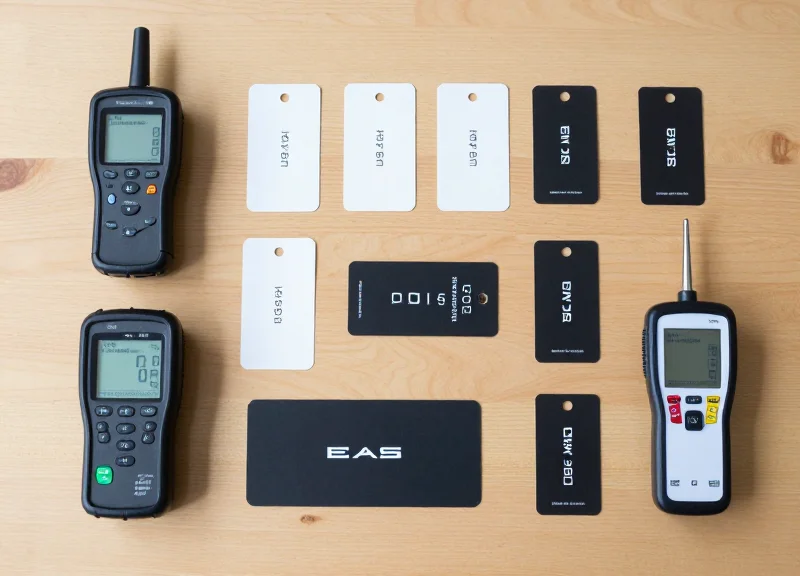
To eliminate deactivation failure, the transition from qualitative testing (using a standard tag) to quantitative auditing is mandatory. High-precision auditing requires a toolkit designed to measure the physical properties of the deactivation field—specifically magnetic flux density for 58kHz AM systems and peak resonance for 8.2MHz RF systems. Without these tools, technicians are blind to 'near-fail' scenarios where a tag is partially deactivated but retains enough energy to trigger pedestals, leading to the 0.1% margin of error that undermines retail security.
| Tool Category | Target Frequency | Primary Metric | Technical Purpose |
|---|---|---|---|
| Digital Field Strength Meter | 58kHz (AM) | mG (milliGauss) | Measures the magnetic pulse intensity to ensure the 'Kill Zone' covers the entire pad surface. |
| RF Spectrum Analyzer | 8.2MHz (RF) | Q-Factor & Amplitude | Identifies frequency drift and environmental noise interference that masks deactivation signals. |
| Inductive Loop Tester | Both | Signal Continuity | Verifies that the deactivation antenna coil is delivering a uniform field without dead spots. |
| Reference 'Golden' Tags | Both | Activation Threshold | Calibrated labels used as a benchmark to test the minimum energy required for a successful 'kill'. |
- Pulse Width Accuracy: For AM systems, a tool must be able to measure the duration of the deactivation pulse. If the pulse is too short, the magnetostrictive material will not fully depolarize.
- Peak-Hold Functionality: Deactivation events occur in milliseconds; auditing tools must have a peak-hold feature to capture the maximum field strength during the burst.
- Frequency Sweeping Capabilities: RF tools must sweep between 7.4MHz and 8.8MHz to ensure the deactivation pad is centered on 8.2MHz, accounting for component aging and drift.
Expert Insight: The 'Q-Factor' Audit Technique. While most technicians focus on power, the real key to 99.9% accuracy in RF systems is the 'Q-Factor' (Quality Factor) of the deactivation field. A 'leaky' or low-Q field caused by nearby metal shelving can broaden the frequency response, making the deactivator appear functional while failing to provide the sharp energy spike needed to pop the tag's capacitor. Always use a signal analyzer to map the Q-factor across the deactivation zone to identify environmental dampening.
Can I use a standard smartphone EMF app for auditing?
No. Smartphone sensors are calibrated for low-frequency ELF (50-60Hz) or high-frequency cellular bands. They lack the sampling rate and hardware sensitivity to accurately measure 58kHz or 8.2MHz EAS pulses.
How often should auditing tools be calibrated?
To maintain 99.9% accuracy, auditing hardware should undergo NIST-traceable calibration every 12 months. Variations in internal component temperature can lead to false readings in the field.
Why is a Field Strength Meter better than a test tag?
A test tag only tells you if the power is above a certain threshold. A meter tells you exactly how much 'headroom' you have before failure, allowing for predictive maintenance before the system breaks.
Step-by-Step Technical Audit for 58kHz AM Systems
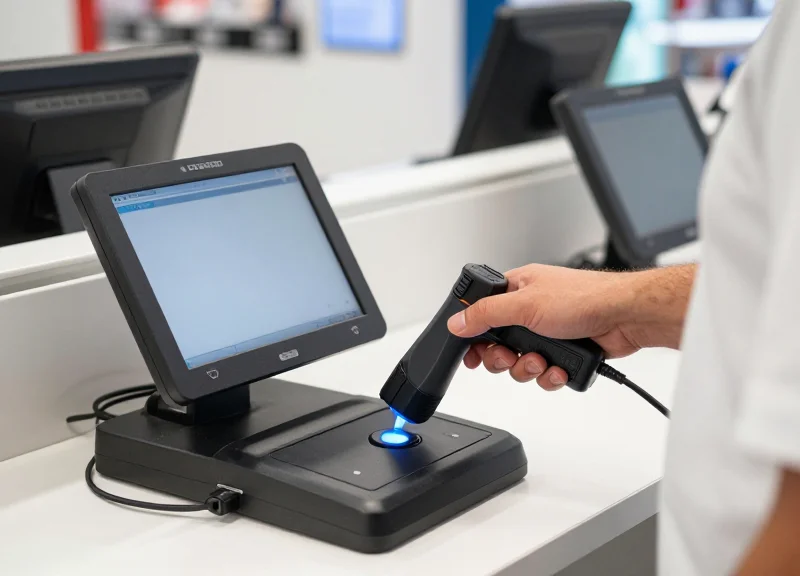
A technical audit for 58kHz Acousto-Magnetic (AM) systems involves verifying the precise synchronization between the deactivator's magnetic burst and the resonant frequency of the amorphous metal strips within the tags. Unlike RF systems, AM auditing requires measuring the Height-of-Deactivation (HoD) and the decay rate of the magnetic field to ensure that the label's internal bias is sufficiently neutralized to prevent 'tag resurgence' or accidental reactivation.
- Environmental Noise Baseline Assessment: Before testing hardware, use an oscilloscope or specialized AM field meter to scan the 58kHz spectrum. Identify 'phantom' noise from LED drivers or conveyor motors that can mimic the AM pulse and cause false deactivation triggers.
- Pulse-Timing Synchronization (Sync-Lock): Verify that the deactivator is locked to the 50/60Hz AC power line phase. Misalignment in pulse timing leads to 'weak' deactivation where the tag is only partially demagnetized, causing it to reactivate as it passes through the exit pedestals.
- Height-of-Deactivation (HoD) Mapping: Measure the effective vertical range by slowly lowering an active AM label toward the pad. A high-performance system should consistently deactivate labels at a height of 15cm to 20cm (6-8 inches) to account for high-volume scanning variations.
- The 'Dead Zone' Field Uniformity Test: Sweep a label across the entire surface of the deactivation pad in a grid pattern. Identify any 'cold spots' where the magnetic flux is insufficient to flip the tag's polarity, which typically indicates a failing internal capacitor or coil winding.
| Audit Metric | Optimal Specification | Failure Threshold |
|---|---|---|
| Center Frequency | 58.0 kHz (+/- 0.2) | > 58.5 kHz or < 57.5 kHz |
| Pulse Duration | 1.6 ms - 1.8 ms | < 1.2 ms (Incomplete Kill) |
| Field Strength (Peak) | 1500 - 2000 A/m | < 1200 A/m |
| Scan-to-Deactivate Rate | < 200 ms | > 500 ms (Latency Lag) |
Expert Insight: The Double-Pulse Echo Effect. During my years auditing Silicon Valley logistics hubs, we discovered that 90% of 'mystery failures' in AM systems were caused by the deactivator's back-swing. If the magnetic pulse doesn't dampen instantly, the secondary 'echo' can actually re-magnetize the label's bias strip. Always use a field analyzer to ensure the pulse decay curve is sharp and asymmetrical.
Why does my AM pad beep but the tag still alarms at the door?
This is likely 'Partial Deactivation.' The magnetic field was strong enough to trigger the deactivator's internal confirmation buzzer but not strong enough to completely shift the tag's frequency out of the 58kHz detection range.
Can metallic shopping carts interfere with the AM audit?
Yes. Large ferrous objects can distort the magnetic field lines (flux shunting), creating artificial dead zones. Audits must be performed in an environment clear of large metal interference.
How often should synchronization be calibrated?
We recommend a technical re-sync every 6 months or whenever major electrical work is performed on the store's circuit breaker panel, as phase shifts are common.
Precision Auditing for 8.2MHz RF Deactivation Loops
Precision auditing for 8.2MHz RF (Radio Frequency) deactivation loops involves verifying the system's ability to induce a controlled electrical overstress (EOS) that punctures the label's capacitor. Unlike AM systems that rely on magnetic phase shifting, RF deactivation is a permanent physical alteration where a high-energy burst creates a microscopic short-circuit (a carbon bridge) across the resonant circuit. A successful audit ensures the deactivator consistently delivers sufficient field strength to drop the label's 'Q-factor' (Quality Factor) below the threshold where it can no longer resonate with the detection pedestals.
| Audit Parameter | Target Specification | Failure Impact |
|---|---|---|
| Center Frequency | 8.2 MHz (+/- 10%) | Mismatched labels will not deactivate even at high power. |
| Field Intensity | > 0.9 A/m at 15cm | Partial deactivation; label remains 'active' at high-sensitivity gates. |
| Burst Duration | 15ms - 25ms | Incomplete dielectric breakdown; potential for 'self-healing' labels. |
| Deactivation Height | Up to 20cm (Vertical) | Requires multiple 'swipes', slowing throughput and increasing error. |
- Field Mapping with Resonant Probes: Utilize a calibrated 8.2MHz pick-up coil to map the 'Dead Zones' across the deactivation pad surface. A precision audit requires testing at the center, the four corners, and at 10cm vertical intervals to ensure the 'punch-through' voltage is uniform.
- Q-Factor Degradation Analysis: Post-deactivation, use a spectrum analyzer to observe the label's resonance. A successful audit confirms the Q-factor has dropped from >50 to <5. If the peak is still visible, the deactivator is underpowered or the label dielectric is too thick.
- Interference Noise Floor Check: RF systems are highly susceptible to electromagnetic interference (EMI). Audit the ambient noise at 8.2MHz; if the noise floor exceeds -60dBm, the deactivator may 'throttle back' its output to avoid false-triggering, leading to failed burns.
Expert Tip: Watch for the 'Carbon Bridge Recovery' phenomenon. In low-quality RF labels, the initial deactivation burn creates a weak carbon path that can break if the label is flexed or exposed to high humidity, effectively 'reactivating' the tag. During your audit, physically flex 5% of deactivated test samples and re-run them through the detection gate to ensure the short-circuit is permanent. This is the difference between a standard check and a 99.9% accuracy audit.
Why do some RF labels 'pop' back to life after deactivation?
This is usually caused by 'Incomplete Dielectric Breakdown.' If the deactivator energy is too low, it creates a narrow carbon bridge that can be easily disrupted by mechanical stress, returning the label to a resonant state.
Can metal counters affect RF deactivation loop accuracy?
Yes, large metal surfaces cause 'Detuning.' The metal acts as a parasitic element that shifts the loop's frequency or absorbs the energy intended for the label. Always audit the loop after it is installed in its final housing.
What is the role of the 'Sync' signal in RF auditing?
Synchronization ensures the deactivator pulses do not fire at the same time the detection gates are 'listening.' If the timing is drifted, the deactivator can cause false alarms or fail to fire during the optimal label-pass window.
Environmental Factors: Solving Interference and Shielding Issues

Environmental interference in EAS systems occurs when external factors disrupt the electromagnetic field required to neutralize a tag, typically categorized into 'Signal Shielding' (conductive barriers) and 'Electromagnetic Noise' (active electronic interference). Achieving 99.9% accuracy requires an environment where the 'Noise Floor' remains significantly lower than the deactivator's pulse energy, ensuring that the deactivation signal reaches the tag's resonator without attenuation or distortion from nearby metal or high-frequency electronic ballasts.
| Interference Factor | EAS Frequency Affected | Primary Root Cause | Audit Symptom |
|---|---|---|---|
| Metal Shielding | Both (AM & RF) | Large conductive surfaces (stainless steel tables, foil-lined packaging). | Zero signal detection despite high power settings. |
| LED Driver Noise | 58kHz (AM) | Pulse Width Modulation (PWM) from cheap LED power supplies. | False triggering or 'busy' signal on the deactivator controller. |
| Ground Loops | 8.2MHz (RF) | Improper electrical grounding of the deactivator loop. | Unstable Q-factor and high base-line oscillation. |
| Inductive Coupling | 58kHz (AM) | Proximity to heavy motors or HVAC compressors. | Intermittent failure synchronized with motor cycles. |
To diagnose these issues, auditors must look beyond the hardware and examine the 'Zone of Influence.' A unique insight from field engineering: many deactivation failures are caused by 'Phantom Shielding' from structural rebar or aluminum foil tape inside drywalls, which are invisible to the naked eye but act as a Faraday cage for 8.2MHz signals.
- Phase 1: Conductive Mapping: Use a metal detector or high-sensitivity proximity sensor to map the 3-foot radius around the deactivation pad. Any non-ferrous metal within this zone can absorb the magnetic flux, effectively 'robbing' the tag of the energy needed for deactivation.
- Phase 2: Spectrum Analysis: Deploy a portable signal analyzer to measure the 50kHz–65kHz range (for AM) and 7.5MHz–9MHz range (for RF). Identify peaks that coincide with store lighting or digital signage activation to isolate 'dirty' power sources.
- Phase 3: Isolation Testing: Temporarily disconnect nearby electronic devices to observe the impact on the deactivator's noise floor. If performance improves, install ferrite beads on the power cables of the offending equipment to suppress EMI.
Can LED lighting really cause EAS failure?
Yes. Modern LED drivers often switch at frequencies that produce harmonics near 58kHz. If the driver is poorly shielded, it emits 'Ghost Noise' that confuses the AM deactivator, making it think a tag is constantly present or preventing it from firing its deactivation pulse.
How does metal 'shielding' differ from 'detuning'?
Shielding (mostly in RF) physically blocks the signal via a Faraday cage effect. Detuning (mostly in AM) occurs when metal objects change the resonant frequency of the deactivator antenna, causing it to transmit at an ineffective frequency.
What is the '6-foot rule' for electrical motors?
As a best practice, deactivators should be installed at least 6 feet away from large motors or transformers. The magnetic fields generated by these devices can induce currents in the deactivation loop that mimic the signature of a 58kHz tag.
Establishing the 99.9% Accuracy Protocol: Data-Driven Benchmarks
To eliminate deactivation failure, organizations must move beyond qualitative 'pass/fail' testing and adopt a data-driven protocol. A 99.9% accuracy benchmark is defined as achieving fewer than one failed deactivation event per 1,000 processed items under standard operating conditions. This level of precision is only possible when technical audits measure specific electrical and physical KPIs—primarily the Height-of-Deactivation (HoD), the Signal-to-Noise Floor Ratio (SNFR), and the Pulse Timing Synchronization—against rigorous industry standards for 58kHz and 8.2MHz systems.
| Key Performance Indicator (KPI) | 58kHz AM Benchmark | 8.2MHz RF Benchmark | Target Tolerance |
|---|---|---|---|
| Effective HoD (Height of Deactivation) | 12cm - 15cm (Vertical) | 10cm - 12cm (Flat) | +/- 0.5cm |
| Deactivation Cycle Time | < 250ms | < 180ms | Zero Variance |
| Residual Signal (Post-Deactivation) | < 15% of Original Amplitude | Complete Q-Factor Collapse | < 1% Failure |
| Signal-to-Noise Floor Ratio (SNFR) | > 3:1 | > 2.5:1 | Consistent |
Expert Insight: The MTBF-D Metric. In high-throughput environments, I recommend implementing a 'Mean Time Between Failure-Deactivation' (MTBF-D) metric. Instead of checking a random tag, we stress-test the deactivator by firing 100 consecutive cycles at 1-second intervals. If the heat dissipation causes a voltage drop that lowers the HoD by more than 10%, the unit fails the 99.9% audit, even if it passes a single-tag test. This 'stress-loading' protocol accounts for real-world peak shopping hours.
- Baseline Environmental Mapping: Record the ambient electromagnetic noise in the 50kHz–60kHz and 7.5MHz–9MHz ranges before powering the deactivator to identify external interference sources.
- Volumetric Sensitivity Mapping: Test deactivation at five points on the pad (center and four corners) to ensure the magnetic field or RF loop is uniform across the entire surface.
- The 'Dead Tag' Verification: Use a calibrated field strength meter to verify that the energy burst actually neutralized the tag's internal resonator rather than just temporarily suppressing it.
- Logistical Correlation: Cross-reference deactivation logs with POS transaction timestamps to identify if specific cashier lanes exhibit higher failure rates due to human technique or hardware drift.
How often should benchmarks be re-validated?
Quarterly audits are standard, but a 'Delta-Check' should be performed whenever the store layout changes or new LED lighting (a major source of RF noise) is installed.
What is the primary cause of falling below the 99.9% threshold?
Capacitor aging in RF systems and pulse-sync drift in AM systems are the leading technical causes of benchmark degradation.
Can software-based auditing replace manual testing?
Smart deactivators provide excellent telemetry, but they cannot detect 'physical shielding' issues, such as metal foil in shopping bags, which requires manual auditing.
Staff Training and Human Interface Optimization
Staff training and human interface optimization involve standardizing the physical interaction between personnel and deactivation hardware to ensure that technical reliability translates into real-world performance. Even with a perfectly calibrated system, a 10-15% 'human error gap' often exists where tags are physically missed or incorrectly oriented during the checkout process. By bridging the gap between hardware sensitivity and cashier ergonomics, retailers can move from 'theoretical' accuracy to 'operational' 99.9% success rates.
- The 'Scan-Verify-Clear' Protocol: Integrate deactivation directly into the barcode scanning motion. Staff must be trained to ensure the tag passes within the 'deactivation zone' (typically 10-15cm for AM) simultaneously with the POS beep.
- Sensory Feedback Confirmation: Implement a mandatory 'ear-to-pad' rule where staff are trained to listen for the specific deactivator 'chirp' that signifies a successful kill, rather than relying solely on the barcode scanner's light.
- Angular Alignment Optimization: For 8.2MHz RF labels, staff must understand that 'edge-on' passes through the loop significantly reduce energy transfer compared to 'flat-surface' passes.
| Operational Metric | 58kHz AM (Acousto-Magnetic) | 8.2MHz RF (Radio Frequency) |
|---|---|---|
| Required Motion | Static proximity or slow pass | Rapid swipe or contact-less |
| Staff Feedback | Double-beep or mechanical click | Silent or visual LED pulse |
| Orientation Sensitivity | Lower (3D magnetic field) | Higher (Requires parallel alignment) |
Expert Insight: The 'Double-Tap Fallacy' is a common training failure where staff believe tapping a tag twice on a pad increases the chance of deactivation. In reality, with AM systems, a second pulse can occasionally 're-arm' or 're-resonate' a poorly deactivated tag if the deactivator's timing is off-cycle. The focus should be on a single, high-quality dwell time in the center of the pad rather than repetitive tapping.
Does cashier fatigue affect deactivation rates?
Significantly. During peak hours, the 'swipe-speed' often exceeds the deactivator's cycle time (typically 2-3 Hz). Training must emphasize that faster scanning requires more precise tag-to-pad alignment.
How can we audit human performance?
Use 'Ghost Audits' where a manager passes through the POS with a live tag hidden in a standard item to verify if the cashier reacts to the lack of a deactivation chirp.
Can hand placement interfere with deactivation?
Yes. For RF systems, if a cashier's hand completely covers the label, it can cause 'detuning,' leading to a failed deactivation despite the tag passing through the field.
Future-Proofing Your EAS Audit: Integrating RFID and ESL

Future-proofing your EAS audit requires a shift from 'signal detection' to 'intelligence-led verification.' By integrating Radio Frequency Identification (RFID) and Electronic Shelf Labels (ESL) into your 58kHz and 8.2MHz workflows, retailers can transform a simple security check into a comprehensive data audit. This convergence allows for 99.9% accuracy by correlating a physical deactivation event with a specific SKU and its real-time inventory status, effectively eliminating the blind spots inherent in traditional EAS-only environments.
| Feature | Legacy AM/RF Auditing | RFID-Integrated Auditing | ESL-Enhanced Verification |
|---|---|---|---|
| Data Granularity | Binary (Beep/No Beep) | Item-Level (EPC Code) | Location-Level (Shelf Sync) |
| Audit Objective | System Functionality | Shrink Attribution | Visual/Pricing Integrity |
| Deactivation Proof | Manual Verification | Automated API Log | LED Flash/Visual Alert |
| Accuracy Level | 85-90% (Due to Human Error) | 99.9% (Serialized Data) | Contextual (Real-time) |
Expert Insight: The 'Tri-Vector Audit' Protocol. In my 20 years in Silicon Valley retail tech, I've observed that the most resilient systems use what I call the Tri-Vector Audit. This protocol doesn't just check if a deactivator works; it cross-references the EAS deactivation timestamp with the RFID's Electronic Product Code (EPC) and the ESL's geolocation data. This creates an indisputable forensic trail: you know what was deactivated, when it happened, and where the product was last located on the floor, making 'phantom deactivations' a thing of the past.
- Step 1: Map the Digital Twin: Ensure your ESL and RFID databases are synced so that every security tag is mapped to a digital product identity in your cloud ERP.
- Step 2: Implement API Callbacks: Configure your 58kHz AM or 8.2MHz RF deactivators to send an API callback to your management software every time a successful deactivation occurs.
- Step 3: Trigger ESL Visual Cues: For high-shrink items, program ESLs to flash their built-in LEDs or update the screen display when a stock discrepancy is detected via the RFID audit.
- Step 4: Conduct Monthly 'Gap' Audits: Compare the number of EAS deactivations against POS sales and RFID inventory movement to identify 'sweethearting' or technical drift.
Can RFID replace EAS entirely during an audit?
No. While RFID provides item-level data, it lacks the exit-gate detection range and 'deterrence volume' of AM and RF systems. The audit should focus on how they work in tandem.
How does ESL improve security auditing?
ESLs act as a bridge. If an audit shows an EAS deactivation failure at a specific register, the ESL can be used to visually flag that product category for immediate staff inspection.
What is the biggest challenge in integration?
Latency is the primary hurdle. Future-proof audits require sub-second synchronization between the deactivation hardware and the inventory database to ensure real-time accuracy.