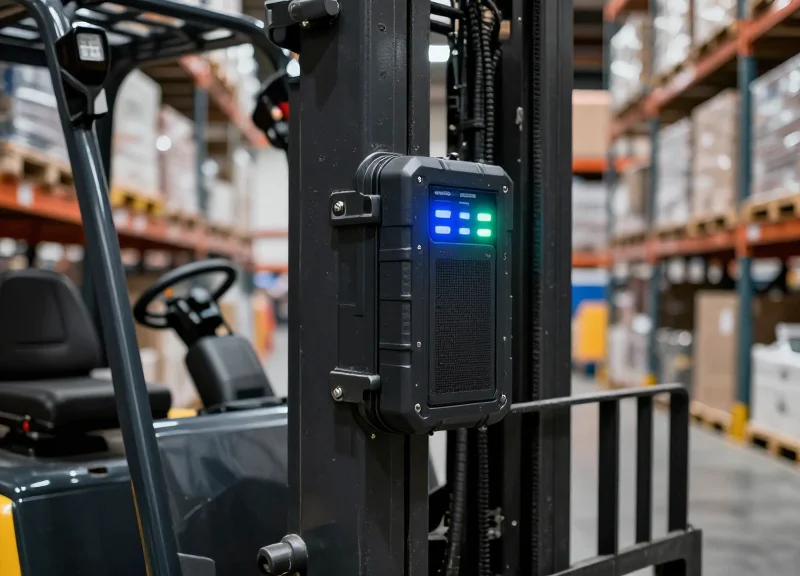
In the rapidly accelerating world of logistics, high-traffic distribution centers face a common bottleneck: the speed and accuracy of data capture. As we approach 2026, the traditional handheld approach is no longer sufficient. Forklift-mounted RFID readers have emerged as the gold standard for automated inventory tracking. However, not all readers are created equal. To withstand the harsh, vibration-heavy environment of a moving lift truck while maintaining 99.9% read accuracy, certain technical specifications are non-negotiable. This article dives deep into the elite features required for the next generation of warehouse efficiency.
The Evolution of Forklift RFID in 2026 Logistics
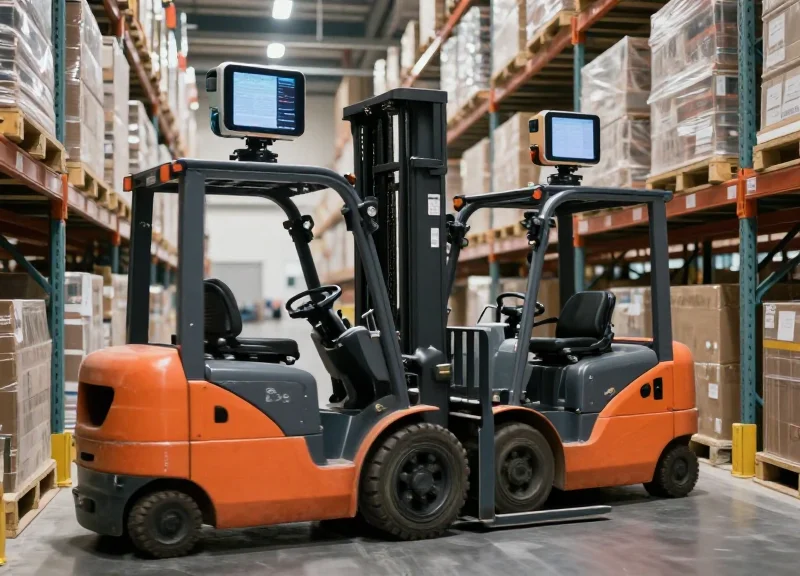
The evolution of forklift RFID in 2026 is defined by the transition from simple data collection to 'Autonomous Edge Intelligence.' In high-traffic distribution centers, the forklift has evolved into a sophisticated mobile data hub that reconciles physical inventory with digital records in real-time, eliminating manual scanning bottlenecks. This shift is driven by the need for 100% visibility in hyper-automated environments where human intervention is no longer a viable method for error correction.
| Feature | Legacy RFID (Pre-2023) | Next-Gen RFID (2026+) |
|---|---|---|
| Primary Role | Passive Data Capture | Active Mobile Data Hub |
| Processing | Cloud-Dependent | On-Device Edge AI |
| Accuracy | 92-95% (Prone to stray reads) | 99.9% (Spatial Filtering) |
| Connectivity | Standard Wi-Fi | Private 5G / Wi-Fi 6E |
In the 2026 landscape, high-traffic hubs no longer view the RFID reader as a peripheral accessory. Instead, it is the core sensor of the 'Mobile Edge.' Modern rugged readers now integrate directly with the forklift's telemetry and the warehouse execution system (WES). This allows for 'Directional Spatial Awareness'—an original 2026 breakthrough where the reader uses phase-array antenna logic to distinguish between a pallet being actively moved and thousands of stationary tags on nearby racking, effectively silencing the noise that plagued earlier deployments.
Why is 'Edge AI' critical for 2026 forklift readers?
Edge AI allows the reader to process tag data locally on the forklift, filtering out false positives and cross-reads from adjacent aisles instantly without waiting for back-and-forth cloud communication, which is too slow for high-velocity traffic.
How does the 'Mobile Data Hub' concept change operations?
It turns every forklift into a roaming audit tool. As the vehicle moves through the DC, it silently updates the WMS with the precise 3D coordinates of every SKU it passes, creating a self-healing inventory map.
What is the impact of Private 5G on RFID hardware?
Private 5G provides the ultra-low latency and massive device density required for hundreds of forklifts to stream high-definition inventory telemetry simultaneously without the signal drop-outs common in older Wi-Fi networks.
Expert Tip: To future-proof your 2026 strategy, look for 'Software-Defined Radio' (SDR) capabilities. Readers equipped with SDR can be updated via firmware to support new protocols or frequency adjustments without requiring a physical hardware swap-out, providing a significantly higher ROI over a 5-year equipment lifecycle.
Feature 1: MIL-STD-810H Vibration and Shock Resistance

In the context of 2026 logistics, a 'rugged' label is no longer sufficient; enterprise hardware must be validated by the MIL-STD-810H standard. This U.S. Department of Defense testing protocol ensures that an RFID reader can withstand the unique environmental stressors of a forklift, specifically the constant low-frequency vibrations of electric motors and the high-impact 'shocks' that occur every time a vehicle crosses a dock plate or hits a floor expansion joint. Without this certification, the internal oscillators and solder joints of a standard industrial reader will likely fail within the first 12 to 18 months of high-traffic use.
| Stress Factor | Standard Industrial Reader | MIL-STD-810H Rated Reader |
|---|---|---|
| Vibration Profile | General sweeping frequencies; prone to harmonic resonance. | Method 514.8: Rigorous random vibration testing mimicking heavy machinery. |
| Shock Endurance | Basic drop test from 3-4 feet onto soft surfaces. | Method 516.8: Functional shock tests (40g) across multiple axes and orientations. |
| Internal Build | Standard PCB mounting with plastic housing. | Dampened mounting plates and reinforced thermal bonding for components. |
| Expected Lifespan | 12-24 months in high-traffic environments. | 5+ years of continuous 24/7 forklift mounting. |
Expert Insight: Beware the 'Solder Creep' Phenomenon. My two decades in Silicon Valley hardware engineering have shown that the real killer of forklift RFID isn't a single crash, but 'solder creep' caused by micro-vibrations. In 2026, as distribution centers move to harder polyurethane wheels for higher speed, these vibrations have moved into higher frequency ranges. MIL-STD-810H testing specifically targets these frequencies, ensuring that the internal connections don't microscopically fracture—a failure that is often misdiagnosed as a software 'glitch' but is actually a fundamental mechanical breakdown.
Is an IP67 rating the same as MIL-STD-810H?
No. An IP67 rating only measures protection against dust and water ingress. It tells you nothing about the device's ability to survive the structural violence of being bolted to a moving forklift. You need both ratings for a truly resilient deployment.
Why is MIL-STD-810H specifically mentioned for 2026 centers?
The move toward 24/7 automated and high-speed human-operated fleets increases the duty cycle of the hardware. Standard gear cannot handle the cumulative G-force exposure of 20,000+ hours of operation without the structural reinforcement required by the 810H standard.
Does this standard affect RFID read range?
Indirectly, yes. Vibration can cause internal antenna connectors to loosen or shift, leading to 'signal drift' or total read failure. A MIL-STD-810H reader maintains its calibrated read-zone accuracy despite constant motion.
Feature 2: Advanced Interference Mitigation for Metal Environments
Advanced interference mitigation is the ability of an RFID system to maintain 99.9% read accuracy in environments dominated by 'RF-unfriendly' materials like carbon steel and aluminum. In 2026, high-traffic distribution centers utilize readers that combine hardware-level shielding with software-driven algorithms to filter out 'ghost reads' and multipath interference. This ensures that a forklift reader only captures the tags directly on its load, ignoring the thousands of surrounding tags reflected off metal racking or neighboring vehicles.
In a modern warehouse, metal is everywhere—from the forklift's own chassis to the structural I-beams and high-density racking. Standard RFID readers often struggle with 'multipath' effects, where radio waves bounce off metal surfaces and reach the antenna at different times, causing signal cancellation or false positives. To combat this, 2026-grade readers must employ sophisticated signal processing that treats the warehouse environment as a dynamic, three-dimensional map rather than a simple proximity zone.
| Mitigation Technique | How It Works | Operational Impact |
|---|---|---|
| Adaptive Transmit Power | Real-time adjustment of RF output based on tag feedback loops. | Eliminates 'aisle-hopping'—reading tags in the next row over. |
| Dynamic RSSI Filtering | Algorithms that ignore signals below a specific Received Signal Strength Indicator threshold. | Filters out weak, reflected signals from distant metal surfaces. |
| Phase-Angle Analysis | Measuring the phase shift of returning radio waves to determine motion. | Distinguishes between a pallet on the move and static inventory on a rack. |
The Expert Perspective: Spatial Gating and The 'Faraday' Fallacy. A common mistake is assuming that simply increasing reader power solves connectivity issues in metal environments. In reality, high-power 'blasting' in a steel-dense facility creates an echo chamber of interference. My recommendation for 2026 is to look for 'Spatial Gating' capabilities. This uses Time-of-Flight (ToF) data to create a virtual 'bubble' around the forklift blades. Any tag outside this 1.5-meter radius is electronically discarded, regardless of how brightly it reflects off a steel beam. This transition from 'proximity reading' to 'precision localization' is what separates top-tier rugged readers from legacy industrial hardware.
Why does metal cause 'ghost reads' in RFID systems?
Metal surfaces act as mirrors for RF energy. A signal can bounce off a steel rack and energize a tag behind the forklift, which then bounces back to the reader. Without interference mitigation, the system cannot tell if the tag is on the forks or 20 feet away.
What role do circularly polarized antennas play?
Unlike linear antennas, circular polarization sends waves in a corkscrew pattern. This is non-negotiable for forklifts because it allows the reader to pick up tags regardless of their orientation relative to the metal racking, significantly reducing 'dead spots'.
How does 2026-era 5G deployment affect warehouse RFID?
With the proliferation of private 5G networks in logistics, RFID readers now require high-selectivity SAW (Surface Acoustic Wave) filters to prevent spectral 'noise' from cellular signals from drowning out the relatively weak backscatter of an RFID tag.
Feature 3: Integrated GPIO and Edge Computing Capabilities
In the high-velocity distribution centers of 2026, a forklift RFID reader is no longer just a passive data collector; it is a localized intelligence hub. Integrated General Purpose Input/Output (GPIO) refers to the hardware interface that allows the reader to interact directly with the forklift’s physical environment—triggering sensors, lights, or locks—while Edge Computing provides the onboard processing power to filter and analyze data at the source. Together, these features transform the reader into a real-time decision engine that operates independently of the central server, ensuring that high-speed logistics aren't slowed down by millisecond-level network delays.
- Automated Visual Cues: Using GPIO to trigger green/red LED stacks or audible alarms immediately upon a successful or failed pallet scan, providing instant feedback to the operator without waiting for a round-trip server response.
- Motion-Triggered Reading: Connecting the reader to the forklift's transmission or a proximity sensor via GPIO to only activate the RFID antennas when the vehicle is in motion or near a dock door, extending hardware life and reducing electrical interference.
- Safety Interlocks: Integrating with the vehicle’s control system to prevent movement if a 'Hazardous Material' tag is detected in a non-compliant zone, enforcing safety protocols at the edge.
| Capability | Legacy Cloud-Dependent Readers | 2026 Edge-Enabled Readers |
|---|---|---|
| Data Processing | Raw tag data streamed to central server | Local filtering and deduplication at the mast |
| Latency | 200ms - 2s (Network dependent) | <10ms (Local execution) |
| Bandwidth Usage | High (Constant stream of 'heartbeats') | Low (Only sends validated event changes) |
| Offline Functionality | Non-functional during Wi-Fi drops | Continues to cache and process locally |
The true ROI of Edge Computing in 2026 lies in 'Data Sanitization.' In a high-traffic warehouse, a forklift may pass thousands of tags it isn't meant to read. A standard reader floods the network with this 'noise.' An edge-capable reader uses complex algorithms to identify the 'True Read'—the specific pallet on the forks—based on RSSI (Received Signal Strength Indicator) trends and phase angles, discarding the rest before the data ever leaves the forklift. Expert Tip: Look for readers that support 'Containerized Edge Logic' (like Docker), which allows your IT team to deploy custom Python or C# scripts directly to the reader for proprietary workflow automation.
Why is GPIO essential for forklift safety?
GPIO allows the reader to interface with load sensors. If the RFID reader detects a weight on the forks but no corresponding RFID tag, it can trigger an immediate dashboard alert to prevent 'dark' inventory movements.
Does edge computing replace the need for a WMS?
No, it complements the Warehouse Management System (WMS). The edge reader handles the 'tactical' immediate actions, while the WMS handles the 'strategic' record-keeping and inventory orchestration.
How does this reduce 'Ghost Reads'?
Edge algorithms can analyze tag velocity. If a tag's signal strength isn't changing relative to the forklift's movement, the edge logic determines it is a stationary shelf tag and ignores it, preventing false inventory updates.
Feature 4: Seamless Connectivity (Wi-Fi 6E, 5G, and Bluetooth 5.3)

In the high-velocity logistics landscape of 2026, a forklift is no longer just a vehicle; it is a mobile edge-computing node. Seamless connectivity via Wi-Fi 6E, 5G, and Bluetooth 5.3 is non-negotiable because it eliminates the 'roaming lag' that traditionally plagues warehouse RFID systems. These protocols provide the high bandwidth and ultra-low latency required to synchronize thousands of tag reads per second with the Warehouse Management System (WMS) in real-time, even as the vehicle transitions between access points at high speeds.
| Protocol | Key Benefit for 2026 DCs | Primary Use Case |
|---|---|---|
| Wi-Fi 6E | Access to the 6GHz band, eliminating interference from legacy 2.4/5GHz devices. | High-density indoor pallet tracking and real-time inventory updates. |
| Private 5G | Ultra-reliable low-latency communication (URLLC) over massive areas. | Seamless coverage for multi-acre outdoor yards and automated cross-docking. |
| Bluetooth 5.3 | Enhanced periodic advertising and low-energy peripheral syncing. | Connecting mobile printers, wearable scanners, and operator feedback displays. |
The most significant hurdle for forklift-mounted RFID readers has historically been the 'handover'—the moment a device disconnects from one access point and searches for the next. In a 1-million-square-foot facility, a forklift moving at 15 mph can experience a connection drop every 30 seconds. Wi-Fi 6E introduces multi-user MIMO and OFDMA enhancements that allow for sub-10ms handovers, ensuring that not a single RFID tag read is lost in the transit buffer.
Why is the 6GHz band in Wi-Fi 6E critical for RFID?
The 6GHz spectrum provides 1,200 MHz of additional bandwidth. Unlike 2.4GHz or 5GHz, which are cluttered with legacy handhelds and IoT sensors, 6GHz is a 'clean' highway that ensures RFID data packets are never queued behind lower-priority traffic.
Can 5G replace Wi-Fi in the warehouse entirely?
While private 5G offers superior range and mobility, most 2026 facilities use a hybrid approach. 5G is the backbone for yard management and outdoor operations, while Wi-Fi 6E remains the cost-effective standard for high-density indoor rack environments.
What role does Bluetooth 5.3 play in the forklift ecosystem?
BT 5.3 allows the RFID reader to act as a localized hub, instantly syncing with the driver’s HUD or a rugged tablet without draining battery or causing RF interference with the primary data uplink.
Expert Insight: The 15-MPH Roaming Rule. In 2026, the benchmark for a top-tier RFID reader is its ability to maintain a 'Stateful Connection' during roaming. When a forklift moves at 22 feet per second, a standard 150ms roaming delay creates a 3.3-foot 'data blind spot.' In high-speed sorting, this is the difference between a successful cross-dock and a misrouted pallet. Modern readers must support 'Fast Transition' (802.11r) and 'Radio Resource Management' (802.11k) to keep the data link alive without interruption.
Feature 5: Smart Power Management and Battery Protection
In 2026, the complexity of forklift power systems—transitioning from traditional lead-acid to high-voltage lithium-ion and hydrogen fuel cells—requires RFID readers to act as intelligent power conditioners. Smart power management refers to a reader's ability to handle extreme input voltage fluctuations (spikes and sags) and implement deep-sleep protocols that protect the vehicle's primary starting or traction battery. Without these protections, the high-torque demand of a forklift’s hydraulic lift can cause a momentary voltage drop that reboots a standard reader, leading to data loss and operational latency.
| Feature | Standard Industrial Reader | Rugged Forklift-Grade Reader (2026) |
|---|---|---|
| Input Voltage Range | Fixed 12V or 24V | Wide Range (9V – 60V DC) |
| Surge Protection | Minimal / External Fuse | Built-in ISO 7637-2 Pulse Protection |
| Ignition Sensing | Manual On/Off Only | Dedicated Ignition Sense (V-Ignition) |
| Idle Draw | Constant 5W - 10W | Ultra-Low Sleep (<0.5W) with Timer |
Expert Insight: The 'Ignition Sense' Ghosting Solution. A common failure point in large fleets is the 'phantom drain.' Leading 2026 readers now incorporate a third wire for ignition sensing. This allows the reader to stay powered for a software-defined 'grace period' after the forklift is turned off—ensuring all edge data is uploaded to the cloud—before entering a hard sleep mode that prevents a dead battery on Monday morning. If your reader doesn't have a dedicated V-Ignition line, you are risking fleet-wide downtime.
Why do RFID readers frequently reboot on electric forklifts?
Electric forklifts create massive electromagnetic interference and voltage 'sags' when the hydraulic pumps engage. Rugged readers use internal capacitors to 'bridge' these millisecond power drops, maintaining continuous operation.
Is a separate DC-to-DC converter necessary?
For readers designed in 2026, the answer is usually no. Top-tier rugged readers integrate wide-input power supplies that handle 36V, 48V, or even 80V systems directly, reducing installation complexity and points of failure.
Can smart power management extend hardware lifespan?
Absolutely. By filtering out 'dirty power' and high-voltage transients common in industrial DC loops, the internal components of the RFID reader are shielded from thermal stress, often doubling the device's mean time between failures (MTBF).
- Verify Wide-Input Compatibility: Ensure the reader supports the highest potential voltage of your fleet (including charging peaks).
- Configure Intelligent Shutdown Timers: Set the software to allow a 15-minute post-ignition buffer for data synchronization.
- Test Under Load: Validate that the reader remains powered during maximum hydraulic lift and simultaneous acceleration.
Why IP67/IP68 Ratings are Mandatory for Industrial Durability
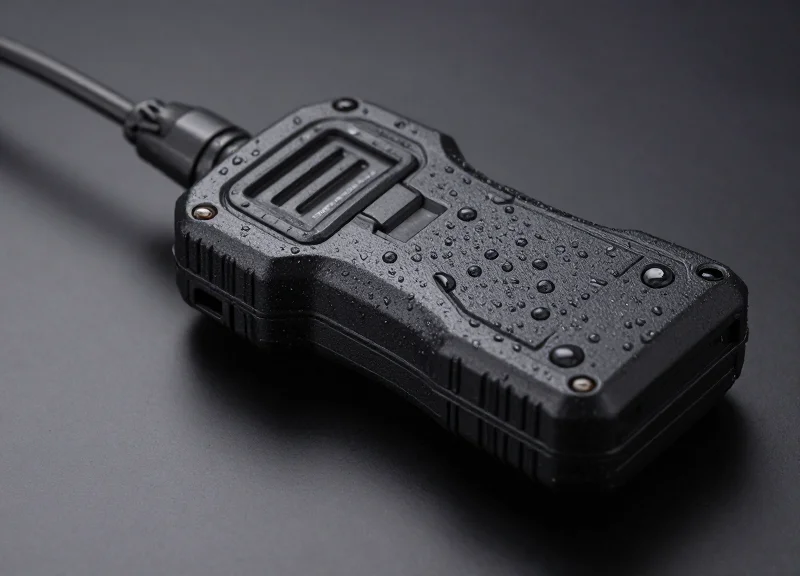
In high-traffic distribution centers, IP67 and IP68 ratings are the only certified standards that guarantee an RFID reader can survive the daily rigors of forklift operations. An IP67 rating ensures the device is completely dust-tight and can withstand immersion in water up to 1 meter for 30 minutes, while IP68 signifies protection against continuous immersion under higher pressure. For a forklift reader, these ratings are not just about water resistance; they represent a hermetic seal against fine particulates, hydraulic fluids, and the destructive 'internal rain' caused by rapid temperature fluctuations during loading dock transitions.
| Ingress Protection Level | Dust Protection | Liquid Protection | Ideal 2026 Use Case |
|---|---|---|---|
| IP65 | Dust-tight | Water jets (nozzles) | Light indoor warehouse only |
| IP67 | Dust-tight | Temporary immersion (1m) | Standard loading docks and cross-docks |
| IP68 | Dust-tight | Continuous immersion/High pressure | Outdoor yards and extreme wash-down areas |
The most overlooked threat in 2026 logistics is the 'Loading Dock Micro-climate.' When a forklift moves from a 70°F humidity-controlled warehouse into a 95°F humid outdoor trailer, a vacuum effect is created inside the reader's housing. Without a true IP67/68 seal—and more importantly, a specialized pressure equalization vent—this vacuum pulls moisture-laden air through the cables and connectors. Over time, this results in internal condensation that corrodes sensitive RFID circuitry from the inside out, leading to intermittent signal loss and eventual hardware failure.
Is IP65 sufficient for forklift-mounted readers?
Generally, no. While IP65 protects against splashes, it lacks the seal integrity required to prevent moisture ingress during the high-velocity air movement and pressure changes experienced on a moving forklift.
Does a higher IP rating affect RFID read range?
No, the IP rating refers to the mechanical housing. However, a higher rating ensures that the internal antenna connections remain free of corrosion, which maintains peak read performance over the device's lifespan.
How does dust impact RFID readers in distribution centers?
Fine concrete dust and cardboard particulates act as abrasives and insulators. Without an IP6X dust-tight seal, these particles penetrate the casing, causing overheating and potential short circuits on the PCB.
Expert Tip: For 2026 deployments, look beyond the IP rating and ask about 'Thermal Shock Resilience.' The best-in-class rugged readers now feature internal PTFE (Gore-Tex) membranes. These allow the device to 'breathe' and equalize pressure while maintaining an IP68 seal, effectively preventing the internal condensation that kills standard industrial electronics during seasonal shifts.
Strategic Integration: Linking Forklift Readers with DragonGuard RFID Ecosystems
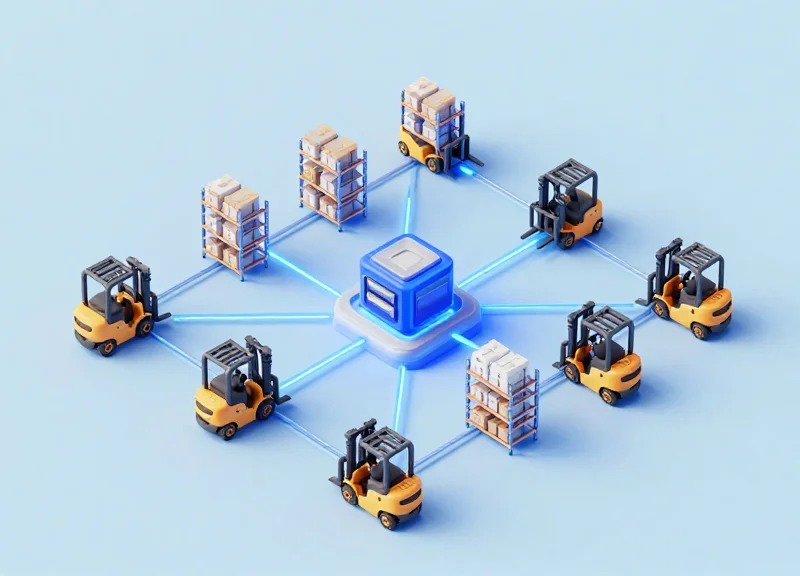
Strategic integration is the deliberate orchestration of rugged forklift readers, specialized industrial tags, and central management software to eliminate data silos and create a transparent, real-time supply chain. By linking forklift-mounted hardware directly into the DragonGuard RFID ecosystem, distribution centers move beyond simple 'read-and-record' operations to a proactive model where every asset movement is validated against warehouse management systems (WMS) in milliseconds. This holistic approach ensures that the forklift is not just a vehicle, but a mobile data hub that synchronizes the physical movement of goods with their digital twins.
The Veteran's Insight: The 'Self-Correcting Warehouse' Concept. In my two decades of infrastructure scaling, the most significant shift for 2026 is the transition from passive monitoring to active edge validation. A DragonGuard-integrated reader doesn't just tell you where a pallet is; it utilizes edge-logic to check if that pallet should be there. If a driver attempts to drop a high-value SKU in the wrong zone, the ecosystem triggers an immediate cabin alert. This 'Self-Correcting' capability reduces picking errors to near-zero, a feat impossible with standalone readers that lack deep ecosystem synergy.
| Feature | Siloed RFID Approach | DragonGuard Integrated Ecosystem |
|---|---|---|
| Data Latency | Batch processing or delayed sync | Real-time edge-to-cloud synchronization |
| Error Handling | Post-event reporting | Immediate preventative alerts (Edge-logic) |
| Hardware Management | Manual individual updates | Centralized OTA (Over-the-Air) firmware |
| Scalability | Complex re-configuration needed | Plug-and-play node expansion |
- Hardware Handshake: Initialize the forklift reader using the DragonGuard universal protocol to ensure full command-set compatibility between the antenna array and the reader engine.
- Middleware Abstraction Layer: Route raw RFID data through an edge-based middleware that filters 'noise' and redundant reads before passing clean, actionable packets to the ERP.
- Tag-to-Reader Optimization: Configure specific power profiles on the reader to match the sensitivity of DragonGuard high-memory tags, ensuring 99.99% read rates in high-metal environments.
- Unified Dashboard Sync: Connect the mobile reader to the central monitoring hub, allowing facility managers to view forklift health and inventory throughput on a single pane of glass.
Does this ecosystem support third-party RFID tags?
Yes, while optimized for DragonGuard high-performance tags, the ecosystem follows global EPC Gen2 standards, allowing you to integrate existing tag inventory without a total 'rip-and-replace' strategy.
How does integration handle dead zones in massive DCs?
The integration utilizes local edge storage. If a forklift moves out of Wi-Fi 6E/5G range, the reader buffers the data locally and performs a high-speed 'burst' sync as soon as connectivity is restored.
What is the primary benefit for 2026 high-traffic centers?
The main benefit is 'Velocity Transparency.' In high-traffic environments, knowing exactly where assets are at 15mph is the only way to maintain the throughput levels required for modern e-commerce fulfillment.
Cost vs. Reliability: The ROI of Premium Rugged Hardware
In high-traffic distribution centers, the true cost of an RFID reader is not the figure on the purchase order; it is the Total Cost of Ownership (TCO) over its operational lifespan. While economy-grade readers offer lower upfront CAPEX, they often fail within 18 months due to 'micro-traumas'—the cumulative effect of forklift vibrations, power surges, and thermal cycling. Premium rugged hardware is engineered to withstand these variables, ensuring that your initial investment translates into 99.9% uptime. In the 2026 logistics landscape, where labor costs and throughput demands are at an all-time high, the cost of a single hour of downtime for one forklift can exceed the price difference between a consumer-grade and a premium industrial reader.
| Metric | Economy-Grade Reader | Premium Industrial Reader (2026 Std) |
|---|---|---|
| Initial Unit Cost | $800 - $1,200 | $2,200 - $3,500 |
| Annual Failure Rate | 12% - 18% | < 0.5% |
| Expected Lifespan | 1.5 - 2 Years | 5 - 7 Years |
| Hidden Costs | Re-installation, IT Support, Downtime | Minimal (Firmware Updates Only) |
| 3-Year TCO | $4,500+ | ~$3,000 |
Expert Insight: The 'Maintenance Fatigue' Factor. Beyond the spreadsheets, there is a hidden operational drain known as Maintenance Fatigue. In a facility with 50+ forklifts, using low-tier hardware forces your IT and maintenance teams into a perpetual state of 'break-fix' cycles. This prevents your technical talent from focusing on high-value optimization tasks, such as data analytics or automation scaling. By choosing premium hardware, you are not just buying a reader; you are buying the 'organizational bandwidth' to innovate rather than just survive.
How do I calculate the ROI of an RFID upgrade?
Calculate the hourly revenue generated by a forklift, then multiply it by the historical downtime caused by hardware failures. Add the cost of replacement units and labor for re-installation. Usually, premium hardware pays for itself within the first 14 months of operation.
Does premium hardware offer better data accuracy?
Yes. Higher-end readers feature advanced signal processing (DSP) and superior filtering, which reduces 'phantom reads' and missed tags. Accuracy translates directly to inventory integrity, preventing costly shipping errors.
What is the most common point of failure in cheap readers?
Internal solder joint fatigue caused by low-frequency vibrations is the #1 killer. Premium units use dampened internal mounting and military-spec components to eliminate this risk.