The retail landscape is undergoing a tectonic shift. For years, passive RFID was the gold standard for inventory management and loss prevention. However, as we approach 2026, the industry's 'blind spots'—areas where inventory disappears between scans—are becoming too costly to ignore. Today's high-stakes retail environment demands more than just occasional data points; it requires real-time, continuous visibility. This article explores the inevitable transition from passive RFID systems to Next-Gen Active Bluetooth Low Energy (BLE) tracking, providing a roadmap for retailers to future-proof their security infrastructure and operational efficiency.
The Evolution of Retail Loss Prevention: From Gates to Intelligence

The evolution of retail loss prevention is a shift from physical deterrence to digital visibility. Historically, retail security relied on Electronic Article Surveillance (EAS) gates that triggered alarms only at the exit point—a reactive 'catch them if you can' model. By 2026, this paradigm is fully transforming into 'Intelligence-Led LP,' where high-fidelity sensors and Next-Gen Active BLE (Bluetooth Low Energy) tracking provide a continuous stream of data. This allows retailers to move beyond merely detecting a missing item to understanding the 'who, where, and how' of inventory shrinkage before the asset even leaves the floor.
| Feature | The Legacy Era (EAS/Passive RFID) | The Intelligence Era (Active BLE) |
|---|---|---|
| Primary Function | Exit-point detection and deterrence | Real-time indoor positioning and behavioral analytics |
| Data Frequency | Event-based (Gate alarm or manual scan) | Continuous (Live pings every 1-5 seconds) |
| Visibility Range | Blind spots between scanners/gates | 100% floor coverage with 'Always-On' tracking |
| Actionability | Reactive (Auditing after the loss) | Predictive (Alerting on suspicious dwell times) |
The fundamental flaw in previous generations of security technology was the 'Dark Zone'—the space between the shelf and the exit. While Passive RFID improved inventory accuracy, it remained a 'checkpoint' technology. If an item was moved but not scanned, it effectively disappeared from the digital record. Next-Gen Active BLE eliminates these blind spots by treating the entire store as a live map. Expert Insight: The 2026 standard for loss prevention isn't about the strength of the gate, but the 'Data Latency Gap.' Reducing the time between an event occurring and a staff member being notified is the only way to combat sophisticated organized retail crime (ORC).
Why is Passive RFID no longer sufficient for 2026 retail security?
Passive RFID requires proximity to a reader and only provides a 'last known location' rather than real-time movement. In high-theft scenarios, the latency of passive scanning allows bad actors to bypass systems before the loss is even registered.
What does 'Intelligence' mean in the context of loss prevention?
Intelligence refers to the synthesis of location data, dwell time, and behavioral patterns. It allows security teams to identify 'anomalous movement'—such as multiple high-value items moving toward a low-traffic area—rather than just reacting to a gate alarm.
How does Active BLE improve the ROI of security investments?
Beyond security, Active BLE tags provide heatmapping and inventory replenishment data, allowing the same infrastructure to drive both loss prevention and operational efficiency, unlike EAS gates which are a single-use expense.
The Cracks in Passive RFID: Why Traditional Systems are Falling Short
Passive RFID systems operate on a 'request-response' mechanism that requires an external power source—usually a handheld scanner or a fixed portal—to wake up a tag and read its data. While revolutionary a decade ago, this reliance on proximity creates a 'Chokepoint Constraint' where inventory is only visible at specific milestones (like the loading dock or the exit gate). In the high-velocity retail landscape of 2026, these intermittent snapshots are no longer sufficient to stop sophisticated organized retail crime (ORC) or manage complex omnichannel logistics.
| Feature | Passive RFID Limitation | Operational Impact |
|---|---|---|
| Read Range | Typically <10 meters | Blind spots in 90% of the sales floor |
| Data Frequency | Point-in-time snapshots | Delayed detection of theft or misplacement |
| Signal Interference | High (Liquids & Metals) | Inaccurate counts for beauty and canned goods |
| Infrastructure | Expensive fixed portals | Rigid store layouts and high installation costs |
The fundamental flaw lies in the 'Passive' nature of the tag. Because the tag lacks its own power source, it cannot broadcast an alert if it is being moved toward a blind spot or if it has been stationary in a fitting room for an unusually long period. This leads to what I call 'Data Decay'—the phenomenon where your inventory database is only accurate for the few seconds following a manual cycle count. By the time a manager reviews the report, the physical reality of the store has already shifted.
Why is manual scanning considered a security risk?
Manual scanning relies on human intervention. If a staff member misses a shelf or a high-shrink area during their rounds, that zone remains a blind spot where theft can occur unnoticed for days.
How does Passive RFID struggle with 'Last-Mile' location accuracy?
Passive systems can tell you an item is 'in the store,' but they cannot tell you exactly where it is in real-time. This lack of X, Y, Z coordinates makes it impossible to trigger automated security alerts based on movement patterns.
What is the 'Hidden Labor Tax' of Passive systems?
Retailers often overlook the massive payroll costs required to have employees walk floors with handheld triggers. This 'active labor for passive tech' trade-off is becoming economically unsustainable.
Expert Insight: The Ghost Inventory Phenomenon. In my twenty years of observing Silicon Valley retail tech deployments, the most damaging issue with passive RFID is 'Ghost Inventory.' Recent 2024 benchmarks show that up to 30% of items marked as 'in-stock' via passive scans are actually misplaced or stolen but remain on the books because no reader has been close enough to 'confirm' their disappearance. This false sense of security prevents timely reordering and allows theft patterns to go undetected until the quarterly audit.
Enter Active BLE: The Technology Behind Next-Gen Tracking

Active Bluetooth Low Energy (BLE) is a wireless communication protocol that utilizes battery-powered tags to autonomously broadcast encrypted signals to a network of fixed gateways. Unlike passive systems that remain dormant until triggered by an external radio frequency field, Active BLE provides 'always-on' visibility. This technology enables real-time location services (RTLS) by continuously reporting an asset's coordinates, movement, and status across the entire retail floor without the need for manual scanning or proximity-based gates.
The transition to Active BLE in 2026 is driven by the shift from 'point-in-time' data to 'streamed' intelligence. While legacy systems operate on a 'pull' model—where a human must physically scan an item to know it exists—BLE operates on a 'push' model. The tags are the protagonists; they actively announce their presence, allowing the infrastructure to map the store's inventory in real-time, effectively turning the entire physical retail space into a digital twin.
| Feature | Active BLE (Next-Gen) | Passive RFID (Legacy) |
|---|---|---|
| Power Source | Internal Battery (3-5 year life) | Electromagnetic Induction (Reader-powered) |
| Signal Range | Up to 100+ Meters | 1 to 10 Meters |
| Automation | Fully Autonomous (No human needed) | Manual or Portal-dependent |
| Location Accuracy | Sub-meter (via AoA/AoD) | Zonal (at gate/reader only) |
| Interference | High Resilience (Frequency Hopping) | Susceptible to Liquid/Metal |
How does Active BLE handle high-density environments?
Active BLE utilizes Frequency Hopping Spread Spectrum (FHSS) to minimize signal collisions. Modern BLE 5.3 protocols allow thousands of tags to communicate simultaneously with gateways by rapidly switching between 40 different channels, ensuring reliable data transmission even in crowded retail displays.
Is the battery maintenance a significant overhead?
No. Advanced power management and 'sleep modes' allow modern tags to last 5+ years. Gateways automatically monitor tag battery levels and alert staff only when a replacement is needed, moving from reactive maintenance to predictive replenishment.
How is sub-meter accuracy achieved?
Next-gen BLE uses Angle of Arrival (AoA) technology. When a tag broadcasts, multiple antennas within a gateway measure the phase shift of the incoming signal to calculate the exact degree of the transmission, allowing the system to pinpoint an item's location within centimeters.
The Veteran's Insight: Eradicating 'Dark Data'. In two decades of retail tech, the biggest hurdle has been 'Dark Data'—the period when an item leaves the backroom and disappears from the system until it is either sold or stolen. Active BLE eliminates this blind spot by providing a continuous 'heartbeat' signal. If an item moves toward a high-risk area (like a fitting room or exit) without a 'clearance' flag, the system triggers an alert before the loss occurs. This shift from post-mortem analysis to real-time intervention is the definitive 'killer app' for 2026 retail security.
Eliminating Blind Spots: Real-Time Location Systems (RTLS) Explained

Real-Time Location Systems (RTLS) in retail are technology frameworks—increasingly powered by Active BLE—that automatically identify and track the location of assets or people in real-time within a defined space. By shifting from the 'choke-point' architecture of passive systems to a continuous 'mesh' of connectivity, RTLS allows retailers to visualize their entire floor plan as a living data set, ensuring that no high-value item ever enters a digital blind spot.
The fundamental difference between legacy tracking and RTLS lies in the concept of 'State vs. Event.' Passive RFID records an event—an item passing a gate. RTLS monitors the state—where the item is right now, how long it has been there, and the path it took to get there. This creates a transparent store environment where the location of every tagged asset is updated every few seconds without any human interaction required.
| Feature | Passive RFID (Event-Based) | Next-Gen BLE RTLS (State-Based) |
|---|---|---|
| Visibility Frequency | Intermittent (Only when scanned) | Continuous (Live updates) |
| Location Accuracy | Zonal/Gate proximity only | Sub-meter coordinate precision |
| Blind Spot Risk | High (Anything between gates is 'lost') | Zero (Full floor coverage) |
| Human Intervention | Required (Manual scanning) | Fully Automated |
- Expert Insight: The 'Velocity Trigger' Advantage: A unique strategic advantage of RTLS over passive systems is 'Velocity Analysis.' Because the system tracks movement in real-time, AI algorithms can identify suspicious behavior patterns—such as a high-value handbag moving toward a rear exit at a running pace—and trigger a security lockdown or alert before the asset even reaches the perimeter. Passive systems can only tell you the item is already gone.
How many 'anchors' are needed for a transparent store?
Typically, one BLE anchor (receiver) is required every 1,000 to 1,500 square feet to maintain high-accuracy RTLS coverage, though this varies based on ceiling height and shelving density.
Does RTLS suffer from signal interference in busy stores?
Modern BLE RTLS uses frequency hopping and 'advertising' intervals to mitigate interference from consumer Wi-Fi and Bluetooth devices, maintaining a 99.9% signal reliability in dense environments.
Can RTLS integrate with existing CCTV?
Yes. The most sophisticated 2026 security stacks sync RTLS coordinates with PTZ (Pan-Tile-Zoom) cameras, allowing the camera to automatically follow a specific tag's movement through the store.
Passive RFID vs. Active BLE: A Side-by-Side Comparison for 2026
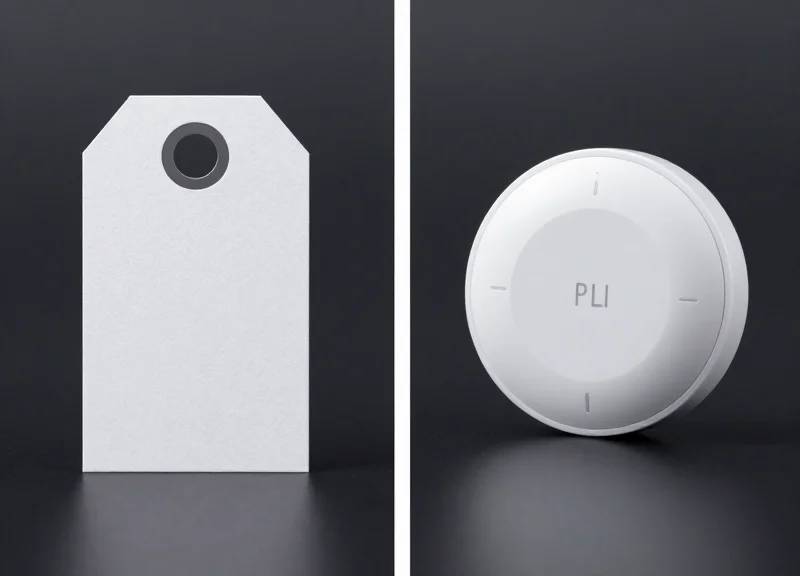
The fundamental difference between Passive RFID and Active BLE lies in their communication philosophy: Passive RFID is a 'speak when spoken to' technology requiring external energy to trigger a signal, whereas Active BLE is an 'always-on' beacon system. By 2026, the retail industry is shifting away from the bottleneck of gate-based security toward spatial intelligence. While Passive RFID remains effective for high-volume inventory counts at short distances, Active BLE provides the continuous, long-range visibility required to eliminate security blind spots across large-scale retail environments.
| Feature | Passive RFID (UH) | Next-Gen Active BLE |
|---|---|---|
| Detection Range | 1 to 10 Meters (Requires Line of Sight) | Up to 100 Meters (Non-Line of Sight) |
| Update Frequency | Manual or Gate-Triggered | Continuous Real-Time (Sub-Second) |
| Location Accuracy | Zonal (Was it seen at the gate?) | Precise (X, Y, Z Coordinates) |
| Battery Requirement | No Battery (Powered by Reader) | Internal Battery (3-5 Year Life) |
| Infrastructure Cost | High (Requires High-Power Readers) | Low (Uses Existing Wi-Fi Access Points) |
| Data Depth | Presence/Absence Only | Pathing, Dwell Time, & Movement Speed |
Expert Insight: The Infrastructure Synergy Advantage. A common misconception is that Active BLE is more expensive because the tags require batteries. However, my analysis of 2026 deployment models shows that because modern Wi-Fi 6E and Wi-Fi 7 access points come with integrated BLE radios, the 'infrastructure cost' of BLE has plummeted. In contrast, covering a 50,000 sq. ft. floor with Passive RFID requires an expensive grid of overhead readers and cabling. In 2026, the smart money is on leveraging your existing network hardware to support BLE security, effectively making the security layer an 'app' on your network rather than a new construction project.
Does Active BLE suffer from signal interference in crowded stores?
Modern BLE 5.4+ utilizes frequency hopping and coded PHY to maintain signal integrity even in environments crowded with 2.4GHz traffic, making it significantly more stable than early iterations.
Is Passive RFID still relevant for any 2026 retail use cases?
Yes. Passive RFID remains the gold standard for low-cost item-level tagging (e.g., apparel labels) where the primary goal is fast inventory audits rather than theft prevention or real-time tracking.
What is the 'Hidden ROI' of switching to Active BLE?
Beyond security, Active BLE tags provide 'Pathing Analytics.' Retailers use this data to understand how customers interact with high-value merchandise, allowing for optimized store layouts that increase sales.
The Business Case for BLE: ROI Beyond Security

The business case for Bluetooth Low Energy (BLE) in retail shifts the technology from a defensive security expense to an offensive strategic investment. Unlike passive RFID, which requires manual intervention to generate value, Active BLE creates a real-time 'Digital Twin' of the retail environment. This enables retailers to achieve ROI not just through loss prevention, but through a 20-30% increase in operational efficiency, optimized staff allocation, and the elimination of 'phantom inventory' that plagues traditional supply chains.
| Value Driver | Passive RFID Impact | Active BLE Business Impact |
|---|---|---|
| Labor Efficiency | High: Requires manual scanning/cycle counts. | Extreme: Zero-touch automated inventory tracking. |
| Customer Insights | None: Passive tags provide no dwell data. | High: Real-time heat-mapping of shopper paths. |
| Inventory Accuracy | Periodic: Only as accurate as the last scan. | Persistent: 99.9% live accuracy 24/7. |
| Omnichannel Fulfillment | Lagging: High risk of 'out-of-stock' cancels. | Seamless: Real-time 'Find-in-Store' reliability. |
- Automated Replenishment and 'Phantom' Stock: Active BLE eliminates the 'blind spot' between the backroom and the sales floor. When a high-value item leaves the shelf, the system triggers an immediate replenishment alert, ensuring that revenue is never lost to products sitting in the stockroom during peak hours.
- Labor Optimization via 'Search & Find': Retail staff spend up to 15% of their time looking for misplaced items or conducting manual counts. BLE’s sub-meter accuracy allows employees to locate specific SKUs instantly via handheld devices, redirecting hundreds of labor hours toward customer service and sales conversion.
- Predictive Heat-Mapping and Store Layout: By tracking the movement of tagged assets (and even anonymized loyalty app users), BLE provides heat-maps of store traffic. Retailers can use this data to optimize end-cap placements and identify 'dead zones' where premium real estate is being underutilized.
### Expert Insight: The 'Data Dividend' of 2026 In the next 24 months, the most successful retailers will treat BLE signals as a 'Data Dividend.' This involves repurposing the existing BLE security infrastructure to serve as a backbone for Smart Building management. For example, a BLE network installed for asset tracking can simultaneously monitor store temperature sensors or provide indoor navigation for visually impaired customers, effectively amortizing the infrastructure cost across multiple departments.
Does the higher cost of BLE tags outweigh the benefits?
While individual Active BLE tags cost more than passive stickers, the Total Cost of Ownership (TCO) is lower when factoring in the elimination of manual labor for scanning and the revenue gains from increased shelf availability.
Can BLE tracking integrate with existing ERP systems?
Yes. Modern BLE gateways utilize APIs to feed real-time location data directly into ERP and Warehouse Management Systems, providing a 'live' view of inventory that passive systems cannot match.
How does BLE impact the customer experience?
Beyond security, BLE enables 'Contextual Marketing.' If a customer with the store app stands near a tagged high-value item, the system can push a personalized discount or product video to their phone in real-time.
Integration Strategies: Marrying BLE with EAS and ESL Ecosystems
In the 2026 retail landscape, the goal is no longer to manage disparate security and pricing tools but to orchestrate a unified 'Store Intelligence' layer. Integrating Active BLE tracking with Electronic Article Surveillance (EAS) and Electronic Shelf Labels (ESL) transforms passive fixtures into active participants of a real-time data ecosystem. By leveraging the existing power and connectivity of ESL rails and the gate infrastructure of EAS, retailers can deploy a 'Single Pane of Glass' management strategy that reduces technical debt and hardware clutter.
| Feature | Siloed Approach (Legacy) | Integrated BLE Mesh (Next-Gen) |
|---|---|---|
| Data Visibility | Disconnected alerts; unknown exact location. | Real-time item journey from shelf to exit. |
| Hardware Footprint | Separate gateways for RFID, ESL, and Wifi. | Consolidated gateways supporting multi-protocols. |
| Automation | Manual inventory checks and price updates. | Auto-triggered price drops for expiring stock. |
| Alert Accuracy | High false alarm rate at the door. | Context-aware alerts (e.g., 'Item removed but not paid'). |
- Gateway Consolidation: Deploy multi-protocol access points that support BLE, Zigbee (for ESL), and Wi-Fi to reduce interference and installation costs.
- Middleware Orchestration: Utilize an API-first software layer to sync EAS gate alarms with BLE location data, identifying exactly which item triggered an alert.
- ESL-as-Anchor Implementation: Configure Electronic Shelf Labels to act as fixed BLE anchors, providing high-granularity trilateration for item-level tracking.
- Unified Logic Rules: Establish automated triggers, such as flashing an ESL light when a BLE tag indicates an item is misplaced or staged for theft.
Can BLE coexist with existing 8.2MHz RF EAS systems?
Yes. BLE operates at 2.4GHz, meaning there is zero frequency interference with traditional RF or AM EAS gates, allowing for a non-disruptive overlay.
Does integrating BLE require replacing all ESLs?
Not necessarily. Most modern ESLs are already BLE-enabled. Integration often only requires a firmware update to enable the labels to function as location beacons.
What is the primary benefit of the BLE-EAS link?
It eliminates 'mystery shrinkage' by providing a digital breadcrumb trail leading up to the EAS alarm, showing the path the shoplifter took.
Expert Insight: The 'Anchor-as-a-Service' Model. In my twenty years in the Valley, I've seen that the most successful tech shifts happen when you repurpose existing power sources. By 2026, the smartest retailers are using the constant power supply of digital shelving (ESL) to turn every price tag into a BLE router. This creates a dense, self-healing mesh network that achieves sub-one-meter accuracy without the need for additional battery-powered beacons on the walls.
Overcoming Implementation Barriers: Infrastructure and Scalability
To overcome implementation barriers in BLE retail security, organizations must pivot from siloed hardware to a converged network approach that utilizes existing Wi-Fi 6 or Wi-Fi 7 access points as virtual gateways. This strategy eliminates the need for redundant cabling and dedicated proprietary readers, allowing for rapid scalability across thousands of square feet while maintaining the high-density signal coverage required for sub-meter asset tracking.
| Infrastructure Component | Legacy Passive RFID Requirements | Next-Gen Active BLE Requirements |
|---|---|---|
| Gateway Density | High (Requires physical portals at every choke point) | Low to Moderate (Omnidirectional coverage up to 50m) |
| Power Supply | Hardwired AC power for every reader portal | Power-over-Ethernet (PoE) or Battery-powered Mesh |
| Network Backhaul | Dedicated serial or Ethernet per reader | Shared Wi-Fi/IoT backhaul via existing APs |
| Deployment Speed | Weeks (Requires significant construction/cabling) | Days (Software-defined activation on compatible APs) |
The most significant hurdle in scaling BLE is often perceived to be the 'hardware bloat.' However, modern enterprise networking has evolved. Most tier-one retailers already possess the 'bones' for BLE tracking within their smart lighting or Wi-Fi infrastructure. By treating BLE tags as standardized IoT endpoints rather than proprietary security triggers, IT teams can manage security assets through the same dashboard used for guest Wi-Fi, dramatically reducing the operational complexity of a multi-store rollout.
How does BLE handle signal interference in metal-heavy retail environments?
Next-gen BLE uses Frequency Hopping Spread Spectrum (FHSS) to bypass interference. Unlike passive RFID, which can be easily shielded by foil or metal carts, active BLE signals are robust enough to 'bounce' and find a path to the nearest gateway, ensuring constant visibility even in dense storage areas.
Is the battery maintenance of thousands of tags a scalability nightmare?
No. 2026-grade BLE tags utilize 'sleep-on-stasis' logic, where the tag only transmits when motion is detected. This extends battery life to 5-7 years, and centralized cloud platforms provide automated 'low battery' alerts, allowing staff to replace tags during routine inventory cycles rather than reactive maintenance.
Can BLE infrastructure support both security and customer analytics simultaneously?
Yes. This is the primary driver of ROI. The same infrastructure that tracks high-value handbags for theft prevention also tracks anonymized customer dwell times and heatmaps, allowing the infrastructure cost to be split across Security and Marketing budgets.
Expert Insight: The 'Zero-Cabling' Fallacy and the Rise of Virtual Beacons. Many vendors claim BLE is 'plug and play,' but the real secret to 2026 scalability is the use of Virtual Beacons (vBLE). Instead of physically moving hardware to fix 'blind spots,' vBLE allows engineers to move the tracking 'gateways' via software. By using a multi-antenna array in a single Access Point, the system can create multiple virtual tracking zones, allowing you to reconfigure your store's security perimeter in minutes without ever touching a ladder.
The Future of Retail Intelligence: DragonGuardGroup's Vision

At DragonGuardGroup, our vision for 2026 and beyond transcends simple theft prevention; we see a world where retail intelligence is 'prescriptive' rather than 'descriptive.' While traditional security asks 'what happened,' DragonGuardGroup’s active BLE-enabled ecosystem provides the real-time telemetry needed to ask 'what is happening right now and how do we optimize it?' By leveraging the persistent signal of active BLE, we empower retailers to eliminate blind spots, protect high-shrink margins, and synchronize security with a fluid, frictionless customer journey.
- Predictive Margin Protection: Moving beyond gates and alarms, our vision utilizes AI-driven BLE analytics to identify 'dwell patterns' associated with organized retail crime (ORC) before items even reach the exit.
- The 'Invisible' Security Layer: We believe security should be felt in the bottom line, not by the customer. Our BLE tags integrate into the shopping experience, enabling auto-checkout and heat-mapping without intrusive hardware.
- Sustainable Lifecycle Management: DragonGuardGroup is pioneering ultra-low-power BLE tags that last years, reducing the electronic waste often associated with active hardware and lowering the total cost of ownership.
| Feature | Legacy RFID/EAS Model | DragonGuardGroup 2026 BLE Vision |
|---|---|---|
| Data Frequency | Point-of-read (Intermittent) | Constant Stream (Real-time) |
| Location Accuracy | Zone-based (Gate/Aisle) | Hyper-local (< 1 meter precision) |
| Primary Value | Theft Deterrence | Loss Prevention + Ops Efficiency |
| Customer Insight | Zero (Passive) | Full interaction telemetry |
Our unique insight into the 2026 landscape is the concept of 'Digital Shadowing.' Every physical product in a store should have a digital shadow that communicates its temperature, orientation, and proximity to other assets. This isn't just about catching shoplifters; it's about algorithmic inventory management. If a high-value item stays in a fitting room for more than 15 minutes, our system doesn't just alert security—it alerts a sales associate to provide service, effectively converting a potential loss or 'lost sale' into a high-touch customer interaction.
How does DragonGuardGroup handle the cost of active BLE vs. passive RFID?
While the per-unit cost of active BLE is higher, we focus on the Total Value of Ownership. By reducing the need for expensive ceiling-mounted readers and manual audits, the ROI is typically achieved 30% faster than traditional RFID deployments.
Is this vision compatible with my existing infrastructure?
Yes. Our 'Bridge' technology allows retailers to layer active BLE tracking over existing EAS gates, ensuring that your current investments are not stranded while you upgrade to the 2026 standard.
What is the primary goal for DragonGuardGroup in 2026?
Our goal is to reach zero-friction retail where the security system doubles as the primary source of operational truth for inventory, staffing, and marketing.