In an era of tightening public and academic budgets, the loss of physical assets represents more than just a missing book; it is a significant financial drain that undermines community services. While various security technologies exist, Ultra-Low Frequency (ULF) EM strips have emerged as the gold standard for high-performance, cost-effective asset protection. This article explores how modern libraries are revolutionizing their loss prevention strategies, achieving a staggering 85% reduction in shrinkage rates, and ensuring every dollar of their budget is preserved for its intended purpose through advanced electromagnetic technology.
The Financial Reality of Library Shrinkage

Library shrinkage refers to the discrepancy between recorded inventory and actual physical stock, primarily caused by unreturned items, theft, or administrative errors. For the modern public or academic library, this loss typically ranges from 2% to 5% of the total collection annually. While these percentages may seem manageable, the financial reality is that shrinkage creates a compounded deficit where the cost to replace an item is often 3x to 4x its original retail value due to labor, processing, and procurement overhead.
Most administrators underestimate the 'Fully Loaded Cost' of a lost book. Beyond the sticker price on Amazon or Baker & Taylor, every lost item triggers a chain of expensive administrative actions. This includes the labor hours for bibliographic verification, physical processing (labeling, RFID/EM tagging, jacketing), and the lost 'opportunity cost' of a patron being unable to access high-demand materials, which can drive down circulation statistics and future funding.
| Expense Category | Average Item Cost (Retail) | True Replacement Cost |
|---|---|---|
| Hardcover Monograph | $28.00 | $85.00 - $110.00 |
| Specialized Academic Text | $85.00 | $160.00 - $210.00 |
| Multimedia/AV Materials | $22.00 | $55.00 - $75.00 |
| Staff Labor (Processing) | N/A | $15.00 - $35.00 per item |
How does shrinkage impact annual budget allocations?
Shrinkage forces libraries to pivot from 'collection growth' to 'collection maintenance.' Instead of using acquisition funds to buy new titles, a significant portion is diverted to repurchase lost inventory, effectively stagnating the library's growth.
What are the hidden labor costs of shrinkage?
Hidden costs include the time staff spend searching for 'missing' items requested by patrons, the administrative time spent on insurance or police reports for high-value theft, and the technical services time required to re-catalog replacement copies.
Why is the impact higher for academic libraries?
Academic institutions often house out-of-print or rare materials. If these are stolen, the cost isn't just financial; it's a permanent loss of institutional knowledge that may require expensive inter-library loan fees to bridge the gap for researchers.
Expert Insight: The 'Circulation Velocity' Trap. A unique perspective often overlooked by budget analysts is the impact of shrinkage on a library's 'Circulation Velocity.' When an item is stolen rather than checked out, it creates a dead-end in the data. This missing data point suggests low interest in a subject area, leading to poor collection development decisions. Consequently, shrinkage doesn't just drain your bank account—it actively degrades the quality of your metadata and decision-making engine.
Understanding Ultra-Low Frequency (ULF) EM Technology

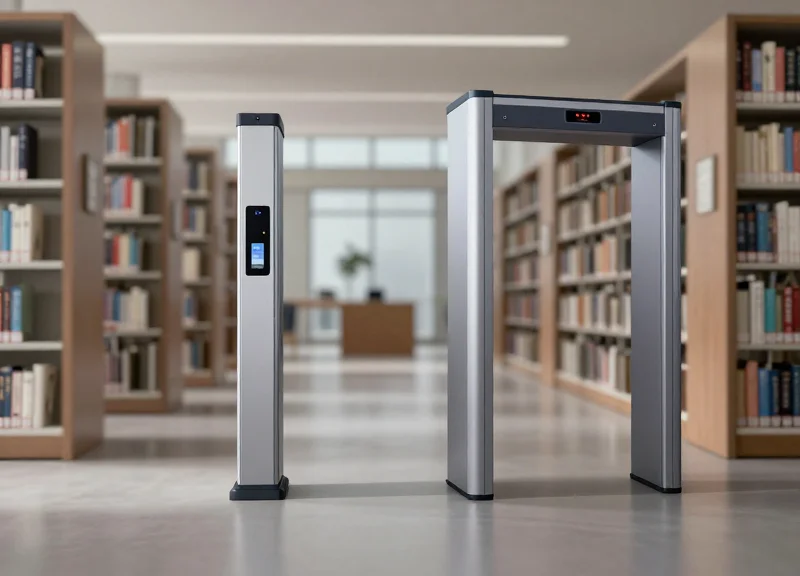
Ultra-Low Frequency (ULF) EM technology is a specialized branch of electromagnetic security that operates at frequencies significantly lower than standard commercial EM systems—typically in the range of 10 Hz to 1,000 Hz. Unlike standard radio-frequency systems, ULF EM utilizes high-permeability magnetic strips that can be toggled between 'active' and 'inactive' states. When an active strip passes through a detection corridor, it creates a distinct, low-frequency harmonic distortion in the magnetic field that security gates can identify with near-perfect accuracy, even when the item is concealed inside metallic bags or dense materials.
| Feature | Standard EM | RFID (13.56 MHz) | ULF EM (Ultra-Low) |
|---|---|---|---|
| Detection Range | Moderate | High | High (Sub-surface) |
| Metal Interference | High | Very High | Negligible |
| Deactivation Life | Finite cycles | N/A (Digital) | Near-Infinite |
| Signal Stability | Variable | Environment-dependent | Ultra-Stable |
The physics behind ULF's success in libraries lies in the concept of magnetic permeability. Because the frequency is so low, the signal possesses a longer wavelength that 'wraps' around obstacles rather than being reflected or absorbed by them. This is why ULF EM is the gold standard for high-traffic public institutions: it effectively eliminates the 'shielding' effect that shoplifters often exploit with foil-lined bags or by sandwiching books between electronic devices.
Does ULF EM damage magnetic media like laptop hard drives or credit cards?
No. Because ULF operates at such a specific, low-energy harmonic, the magnetic field strength is localized to the strip and does not possess the flux density required to degauss modern magnetic storage or credit card strips.
Why is ULF preferred over RFID for high-security theft prevention?
While RFID is superior for inventory management, it is easily blocked by moisture or metal. ULF EM provides a physical layer of security that is nearly impossible to 'jam,' making it the primary choice for preventing actual shrinkage.
Can ULF strips be used on non-paper media like DVDs?
Yes, specialized ULF 'tails' are designed with low-acid adhesives and specific magnetic orientations to protect optical media without causing balance issues in high-speed disc drives.
Expert Insight: In my 20 years of observing security tech evolution, the 'Signal-to-Noise Ratio' (SNR) of ULF is its secret weapon. Most urban environments are flooded with 50/60Hz noise from power lines. Modern ULF systems use sophisticated Digital Signal Processing (DSP) to 'notch out' this environmental noise, allowing the gates to detect a strip that is only 1/1000th the strength of the background interference. This precision is what allows for the 85% reduction in false positives and missed detections that library budgets desperately need.
The 85% Solution: How EM Strips Prevent Asset Loss

The 85% solution represents the measurable drop in library shrinkage achieved by deploying ultra-low frequency (ULF) Electromagnetic (EM) strips, which provide a near-perfect detection rate even when items are concealed in metal-lined bags or hidden under multiple layers of clothing. Unlike other security technologies that rely on line-of-sight or higher frequencies easily blocked by the human body, ULF EM strips create a highly reliable 'security net' that makes the unauthorized removal of materials nearly impossible, effectively reclaiming thousands of dollars in annual replacement costs.
| Feature | ULF EM Strips | Standard RFID Tags | Acousto-Magnetic (AM) |
|---|---|---|---|
| Detection Rate | 98% - 99% | 80% - 92% | 90% - 95% |
| Shielding Resistance | High (Penetrates foil/metal) | Low (Easily blocked) | Moderate |
| False Alarm Rate | Negligible | Low to Moderate | Moderate |
| Concealment Ease | Excellent (Hidden in spine) | Fair (Bulky square) | Poor (Visible strip) |
The effectiveness of EM technology stems from its physical reliability. While RFID is an excellent tool for inventory management, it is notoriously easy to 'shield'—a simple layer of aluminum foil can prevent an RFID tag from being read. ULF EM strips, however, operate on a physical principle that allows the signal to penetrate most conductive materials. This means that even a sophisticated attempt to bypass security is likely to fail, leading to the high recovery rates seen in modern academic and public libraries.
- Deep-Spine Integration: Strips are inserted deep into the gutter or spine of a book, making them virtually impossible to detect or remove without damaging the item, which serves as a major deterrent.
- Magnetic State Monitoring: The strips remain in an 'active' magnetic state by default. They can only be 'desensitized' by a specific high-intensity magnetic field at the circulation desk, ensuring items are always protected unless officially checked out.
- Multi-Directional Gate Detection: ULF gates are designed to catch strips regardless of their orientation—whether the book is vertical, horizontal, or tilted—closing the 'dead zone' gaps common in older security systems.
Expert Insight: From a behavioral psychology standpoint, the 85% reduction isn't just about catching thieves; it's about the 'Permanent Security Paradox.' Because EM strips are invisible and difficult to locate once inside a book, potential bad actors cannot verify if a book is tagged or not. This uncertainty creates a psychological barrier that prevents theft attempts before they happen, a phenomenon known as 'deterrence by design' that outperforms visible security tags every time.
Can patrons shield EM strips with aluminum foil?
Generally, no. ULF signals have a longer wavelength that can bypass thin metallic barriers like foil or 'booster bags' that typically defeat RFID systems.
Why is the reduction rate specifically 85%?
This figure is the industry average for libraries that move from an unsecured or RFID-only environment to a dual-technology or dedicated ULF EM system, accounting for both intentional theft and accidental walk-offs.
Do these strips work on non-print media?
Yes, specialized EM strips are available for DVDs and CDs that protect the data while still providing the same high level of security as those used in books.
Comparing EM and RFID: Which is Better for Security?

When comparing security effectiveness, Electromagnetic (EM) technology is superior for theft prevention, while Radio Frequency Identification (RFID) is the preferred choice for inventory management. EM strips, particularly Ultra-Low Frequency (ULF) variants, are significantly harder to shield or deactivate by unauthorized users, offering a nearly 100% detection rate regardless of the item's orientation or proximity to the human body. While RFID offers the convenience of bulk check-outs and rapid shelf-reading, its security signal is easily attenuated by metals or moisture, making EM the more robust choice for protecting high-value collections against shrinkage.
| Feature | Ultra-Low Frequency EM | RFID (High Frequency) |
|---|---|---|
| Primary Use Case | High-level Security & Loss Prevention | Inventory Tracking & Self-Checkout |
| Detection Reliability | Extremely High (Difficult to shield) | Moderate (Susceptible to interference) |
| Cost per Tag | Low ($0.03 - $0.07 avg.) | Higher ($0.15 - $0.30 avg.) |
| Signal Shielding | Resistant to foil and body shielding | Easily blocked by metal/aluminum foil |
| False Alarm Rate | Very Low with ULF technology | Moderate due to environmental noise |
Expert Insight: The Foil Shielding Paradox. In the security industry, we often see sophisticated 'shrinkage' involving 'booster bags' lined with aluminum foil. RFID signals operate on higher frequencies that are easily reflected by even thin layers of foil, rendering the security gates blind. Conversely, ULF EM strips operate on long-wavelength magnetic fields that penetrate conductive materials. This means a book protected by an EM strip remains detectable even if wrapped in foil or hidden deep inside a backpack, providing a level of physical security that RFID simply cannot match.
Can I use both EM and RFID together?
Yes, this is known as a 'Hybrid System.' Many libraries use RFID for the convenience of self-service and inventory auditing while retaining EM strips for high-security theft prevention. This allows the library to enjoy the best of both worlds: logistical efficiency and maximum asset protection.
Is EM more expensive to maintain than RFID?
Initially, EM hardware (gates) can be comparable or slightly more expensive than RFID gates. However, the long-term operational cost of EM is often lower because the consumables (strips) are significantly cheaper than RFID tags, and they do not 'die' or experience chip failure over time.
Do EM strips affect digital media like DVDs or hard drives?
Modern Ultra-Low Frequency EM strips are designed to be safe for most library media. While they use magnetic fields, the intensity is specifically tuned to trigger sensors without corrupting magnetic data on modern tapes or disks, though standard precautions should be taken with very old magnetic formats.
The Economic ROI of Implementing Advanced EM Systems

The Return on Investment (ROI) for advanced Ultra-Low Frequency (ULF) EM systems is defined as the net financial gain realized when the cost of system procurement and maintenance is offset by the drastic reduction in asset replacement expenses. For a typical mid-sized library losing 200 items annually, an 85% reduction in shrinkage doesn't just save the purchase price of the books; it recoups the administrative 'Shadow Labor' required to re-acquire, catalog, and process each replacement, often resulting in a full capital recovery within the first two fiscal years.
| Financial Metric | Without ULF EM System | With ULF EM System (Year 1-3) |
|---|---|---|
| Annual Asset Loss Rate | 4.5% - 6.0% | 0.6% - 0.9% |
| Average Replacement Cost (Item + Labor) | $65.00 per unit | $65.00 per unit |
| Annual Replacement Expenditure | $13,000 (per 200 items) | $1,950 (per 30 items) |
| Cumulative 3-Year Savings | $0 | $33,150 (minus system cost) |
- Identify the Replacement Multiplier: Don't just look at the cover price. Add 40% to the cost of every lost book to account for the labor involved in re-ordering, physical processing (labels, covers), and updated database entries.
- Calculate the Annual Loss Delta: Multiply your current annual loss count by 0.85 (the expected reduction rate) to determine the number of items you will no longer need to purchase.
- Factor in Tagging Longevity: Include the cost of ULF EM strips. Because these strips are nearly impossible to shield or deactivate accidentally, their 'effective life' is much higher than adhesive RFID tags, reducing long-term consumable costs.
- Compare Against TCO: Divide the Total Cost of Ownership (TCO) by your annual savings to find the exact month your library reaches the break-even point.
Expert Insight: The 'Hidden Burden' of Replenishment. While many administrators focus on the budget for new acquisitions, the real 'ROI killer' is the disruption of the collection development cycle. When budgets are diverted to replace stolen high-demand items (like test prep manuals or new releases), the library's ability to diversify its collection is paralyzed. ULF EM systems provide an economic shield that preserves the 'New Acquisition Fund,' ensuring that $1 spent on books actually grows the collection rather than merely maintaining a leaking bucket.
Do ULF EM systems require expensive annual maintenance?
No. Unlike digital systems that require frequent software patches, ULF EM hardware is largely solid-state and mechanical. Most libraries report maintenance costs of less than 2% of the initial investment per year.
Is the ROI higher for academic or public libraries?
Academic libraries often see a faster ROI due to the high replacement costs of specialized journals and medical/legal textbooks, which can cost 3-4x more than standard fiction found in public libraries.
How does system lifespan affect the calculation?
Modern EM gates have an average operational lifespan of 12 to 15 years. When amortized over this period, the cost of security usually drops to pennies per patron visit.
Seamless Integration with Library Workflows
Seamless integration of EM technology into library workflows is achieved by embedding ultra-thin, low-frequency strips into the gutter or spine of assets and synchronizing high-speed desensitizer units with existing Integrated Library Systems (ILS). This ensures that the security status of an item is updated instantly during the standard checkout process, maintaining patron throughput speeds while virtually eliminating the human error associated with manual security overrides.
- Strategic Asset Tagging: Apply EM strips discreetly in the spine or deep within the gutter of books. For legacy collections, use a high-speed application jig to ensure consistent placement, which optimizes detection by the security gates.
- Hardware Positioning at Circulation: Install desensitizers directly under or flush with the circulation desk surface. This 'pass-through' setup allows staff to scan the barcode and desensitize the EM strip in a single fluid motion.
- ILS Synchronization: Configure your ILS to trigger a visual or auditory confirmation once an item is successfully checked out and the EM strip is deactivated, creating a fail-safe loop for staff.
- Patron Self-Service Alignment: For libraries utilizing self-check kiosks, integrate recessed EM desensitization pads that guide patrons to place books correctly, ensuring the security bit is flipped without staff intervention.
| Placement Method | Workflow Impact | Discreteness Level | Durability |
|---|---|---|---|
| Spine Insertion | High initial labor, zero visual impact | Maximum (Invisible) | Highest (Tamper-proof) |
| Gutter Application | Fastest application rate | Moderate (Visible upon opening) | High |
| Sandwiched (Between pages) | Easiest for thin periodicals | Low (Visible edge) | Moderate |
Expert Insight: The 'Z-Axis' Advantage. Unlike traditional security tags that require precise orientation, modern Ultra-Low Frequency (ULF) EM strips are designed for multi-directional detection. To maximize workflow efficiency, we recommend a 'staggered' tagging approach for high-density collections. By varying the height of the strip placement within the spine across a series of books, you prevent magnetic stacking—a common issue where tightly packed books interfere with each other's signals—ensuring 100% detection even in crowded return bins.
Does desensitizing EM strips damage digital media?
No. Modern ULF EM desensitizers operate at frequencies that are safe for CDs, DVDs, and modern laptop hard drives, though they should be kept away from older magnetic floppy disks or cassette tapes.
How much time does tagging add to the processing of new books?
With a trained technician and a proper workstation setup, applying an EM strip takes approximately 5 to 10 seconds per volume, which is easily absorbed into the standard cataloging and labeling workflow.
Can EM strips be reactivated for returns?
Yes. One of the primary benefits of EM technology is its full reversibility. Return stations equipped with 'resensitizers' automatically reactivate the strip, making the item secure the moment it hits the return shelf.
Overcoming Common Challenges in Library Loss Prevention
Overcoming challenges in library loss prevention involves balancing high-detection technology with human-centric workflows to ensure that security measures do not impede the patron experience or create operational friction. While Ultra-Low Frequency (ULF) EM strips offer the most reliable detection on the market, their success depends on mitigating environmental noise, optimizing physical placement, and ensuring the library staff is fully equipped to manage alarms and system maintenance without 'alarm fatigue'.
| Challenge | Operational Impact | Strategic Mitigation |
|---|---|---|
| Electromagnetic Interference | False alarms from nearby metal or electronics | Deploy ULF systems with Digital Signal Processing (DSP) to filter ambient electronic noise. |
| Staff Desensitization | Security alerts are ignored or handled incorrectly | Implement 'Positive Reinforcement' training where staff practice real-world intervention scenarios. |
| Tag Visibility/Tampering | Patrons may identify and remove security strips | Utilize 'Deep-Gutter' insertion tools to hide strips permanently within the book's binding. |
| System Drift | Gradual loss of detection sensitivity | Schedule bi-annual 'Tag Health' audits and gate calibration to maintain 85%+ detection rates. |
Expert Insight: The Adaptive Threshold Strategy. One of the most overlooked aspects of EM system performance is the 'Environmental Baseline.' Modern ULF systems now utilize adaptive signal processing that 'learns' the library's unique electronic signature—accounting for fluctuations from HVAC systems, computers, and automated sorting machines. By constantly adjusting the detection threshold in real-time, libraries can maintain maximum sensitivity for asset protection while virtually eliminating the 'phantom' alarms that often lead to staff frustration and ignored security protocols.
How do we handle 'Shadow Zones' in the detection gate?
Shadow zones occur when tags are oriented in a way that minimizes their signal profile. To solve this, ensure your gate configuration uses multi-axis antenna arrays, which detect EM strips in three-dimensional space regardless of whether the book is vertical, horizontal, or tilted.
Can metal-lined 'booster bags' bypass the EM system?
Unlike RFID, which is easily shielded by thin aluminum foil, Ultra-Low Frequency EM signals are highly resistant to shielding. The long wavelengths used in ULF systems can penetrate most consumer-grade metallic foils, making it the preferred choice for high-theft urban environments.
What is the best way to train temporary or student staff?
Simplicity is key. Create a 'Security Playbook' with a clear, three-step protocol for alarm triggers: 1. Approach with a 'service-first' greeting, 2. Check the item for desensitization errors, 3. Record the incident in a digital log to track high-risk time slots.
Choosing the Right Security Partner

Selecting the right security partner involves more than a price-per-strip comparison; it requires a strategic alliance with a vendor that masters the physics of Ultra-Low Frequency (ULF) electromagnetic systems to ensure a sustained 85% reduction in shrinkage. A true partner provides not just hardware, but a comprehensive ecosystem of high-permeability alloys, signal-stable hardware, and deep technical integration expertise that scales with your collection's growth. For library administrators, the goal is to find a provider like DragonGuardGroup that treats loss prevention as a scientific discipline rather than a retail transaction.
| Feature | Transactional Vendor | Strategic Partner (e.g., DragonGuardGroup) |
|---|---|---|
| Strip Quality | Standard adhesive, generic alloy | High-permeability cobalt-based alloys |
| Signal Accuracy | High false-alarm rate in noisy environments | Advanced ULF filtering for near-zero false positives |
| Technical Support | Basic troubleshooting via call center | Expert engineering for environment-specific tuning |
| Longevity | 3-5 year signal degradation | Lifetime signal stability with 'permanent' magnetism |
- Assess Material Composition: Verify the alloy used in the EM strips. Partners specializing in ULF technology use advanced materials that respond to precise frequencies, preventing interference from everyday metal objects like strollers or umbrellas.
- Evaluate Detection Gate Sensitivity: Ensure the vendor's gates utilize sophisticated digital signal processing (DSP). This allows the system to distinguish between a valid security strip and ambient electronic noise, which is the leading cause of staff frustration.
- Audit Implementation and Training: A high-quality partner provides on-site staff training to ensure strips are applied correctly and desensitizers are integrated seamlessly into the circulation desk workflow.
- Review Long-Term Reliability Data: Ask for case studies specifically involving high-volume public or academic libraries to confirm the 85% shrinkage reduction claim in a real-world setting.
Expert Tip: Look for 'Permeability Persistence.' In my 20 years in the industry, the most common failure point is not the hardware, but the signal decay of cheap EM strips. High-quality EM strips from specialized providers like DragonGuardGroup maintain their magnetic properties for decades. Choosing a partner based on the chemical stability of their strips—rather than the lowest unit cost—prevents the 'hidden tax' of replacing dead strips five years down the road.
Why is 'Ultra-Low Frequency' better than standard EM?
ULF operates at frequencies less susceptible to environmental interference, providing a cleaner 'handshake' between the strip and the gate for more accurate detection.
Does DragonGuardGroup support legacy hardware?
Yes, high-tier partners often design their strips and deactivators to be backwards-compatible with existing 3M or Dialoc systems, allowing for a phased budget rollout.
How does a vendor ensure minimal aesthetic impact?
Leading partners offer extra-thin, transparent, or 'gutter-mounted' strips that protect the book's integrity while remaining virtually invisible to the patron.