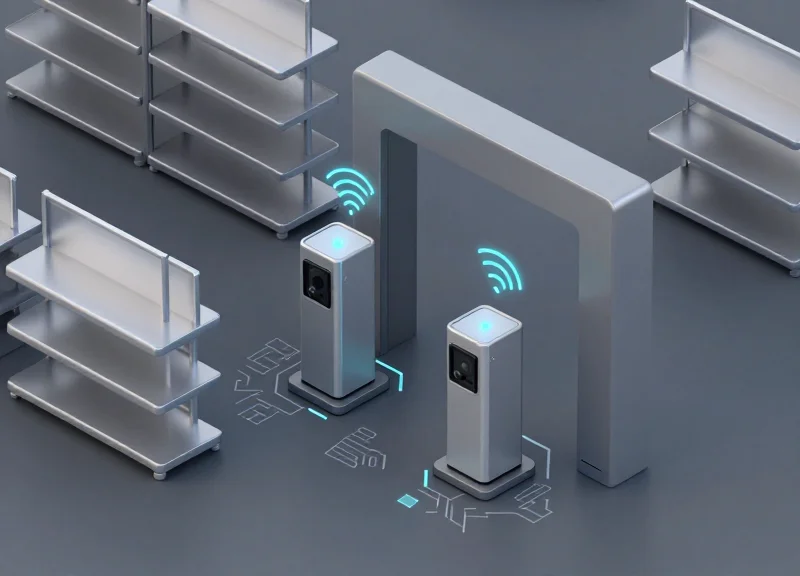
As we approach 2026, the retail landscape is facing an unprecedented surge in professional shoplifting tactics, notably the use of sophisticated signal jammers. While RFID has revolutionized inventory tracking, it often falls short as a primary physical security barrier against hardened criminals. This article explores why the evolution of EAS—specifically integrated with Jammer Defense—provides a more robust shield for retailers than standard RFID alone, ensuring your loss prevention strategy is ready for the challenges of tomorrow.
The Evolution of Retail Theft: Heading Toward 2026

As we approach 2026, the retail industry is navigating a critical paradigm shift: theft has evolved from a 'shrinkage problem' to a sophisticated 'signal war.' This evolution is defined by the professionalization of shoplifting, where Organized Retail Crime (ORC) syndicates utilize military-grade technology to exploit the inherent weaknesses of standard tracking systems. While traditional RFID and Electronic Article Surveillance (EAS) were designed to detect unauthorized item movement, modern criminals are now focusing on 'Signal Suppression'—the act of using portable jammers and shielded materials to render these security barriers invisible. To survive the 2026 landscape, retailers must transition from passive inventory monitoring to active signal defense.
| Feature | Legacy Theft (Pre-2020) | Modern/Future Theft (2026 Outlook) |
|---|---|---|
| Primary Threat | Individual Shoplifters | Organized Retail Crime (ORC) Syndicates |
| Tooling | Concealment (Pockets/Bags) | Frequency Jammers & Booster Bags |
| Primary Method | Stealth/Hiding items | Signal Interruption & Bulk Sweeping |
| Objective | Personal Use / Small Scale Resale | High-Velocity Liquidated Inventory |
| Security Vulnerability | Human Error | Electronic Blind Spots |
The 'Zero-Trust' Signal Insight: My two decades in Silicon Valley security have shown that when technology becomes affordable for retailers, it becomes even more affordable for criminals. The unique threat of 2026 is the democratization of RF jamming hardware. We are entering the 'Zero-Trust' era of Loss Prevention: security systems can no longer assume their signal environment is safe. A modern EAS system that does not actively monitor for frequency interference is effectively an unlocked door.
Why is standard RFID failing against modern theft?
Standard RFID relies on the reader being able to 'see' the tag. Professional thieves now use 'Booster Bags' lined with conductive foil or low-power jammers that create an electromagnetic shield, preventing the tag signal from ever reaching the gate.
What is the role of Organized Retail Crime (ORC) in 2026?
ORC has transformed theft into a business model. These groups use 'scouts' to identify stores with outdated EAS tech and 'sweepers' who can clear a shelf in seconds, knowing their jammers will prevent alarms from sounding.
Is 'Signal Jamming' really a common threat?
Yes. Portable jammers that disrupt the 8.2MHz (AM) or 58kHz (RF) frequencies used by traditional EAS are now easily accessible online, making jammer detection a mandatory feature for 2026 security deployments.
- Phase 1: Technological Reconnaissance: Criminals identify stores using legacy RFID or single-frequency EAS systems that lack interference detection.
- Phase 2: Signal Suppression: Thieves enter the premises with active jamming devices to create a 'dead zone' around their person or the exit gates.
- Phase 3: High-Velocity Extraction: Items are 'swept' into shielded bags and exited without triggering any visual or audible alerts from the primary security system.
Understanding the Jammer Threat in Modern Retail

A signal jammer is a portable electronic device designed to emit high-power radio frequency (RF) interference that overpowers the communication between security tags and pedestals. By creating a 'noise cloud' around a shoplifter, these devices lower the signal-to-noise ratio to a point where Electronic Article Surveillance (EAS) systems cannot distinguish the 'ping' of a stolen item from the surrounding digital chaos. In the 2026 retail landscape, these devices have evolved from bulky, homemade units to sleek, mass-produced gadgets that can fit in a pocket, posing a critical threat to legacy security infrastructures.
The vulnerability of standard systems lies in their physics. Most traditional RF (8.2 MHz) and RFID (860–960 MHz) systems rely on a clear path for data transmission. Because these frequencies are standardized, criminals can easily tune a jammer to the exact wavelength used by a retailer's gate. When the jammer is active, it creates an invisible 'blackout zone' that allows tagged high-value goods to pass through the exit without triggering a single alarm.
| Technology Type | Typical Frequency | Jamming Vulnerability | Primary Bypass Method |
|---|---|---|---|
| Standard RF | 8.2 MHz | Extreme | Narrow-band frequency noise injection |
| Standard RFID | 860 - 960 MHz | High | Broadband signal saturation & collision |
| Acousto-Magnetic | 58 kHz | Moderate | Magnetic field distortion |
| Next-Gen EAS | Multi-Band | Ultra-Low | N/A (Built-in Jammer Detection) |
How do jammers differ from 'booster bags'?
While booster bags use physical aluminum lining to shield signals (Faraday cages), jammers are active electronic disruptors that transmit noise to drown out the tag's signal digitally.
Why is RFID particularly vulnerable to jamming?
RFID operates on a complex 'talk-back' protocol. Even a small amount of signal interference can cause a 'collision' of data packets, making it impossible for the reader to identify the tag's presence.
Can standard pedestals detect when they are being jammed?
Most legacy systems are 'blind' to jamming; they simply remain silent because they think no tag is present. Only next-gen systems with integrated spectrum analysis can identify a jamming attempt in progress.
Expert Insight: The 'Front-End Saturation' Risk. An original technical concern for 2026 is not just the loss of the signal, but 'receiver desensitization.' High-power jammers can actually saturate the front-end amplifier of an older RFID reader, causing a temporary hardware freeze or logic error that requires a manual system reboot. This means a single jammer can effectively 'shut down' a store's exit security for several minutes, even after the criminal has left the premises.
The Core Limitations of Standard RFID in Active Loss Prevention
Standard RFID (Radio Frequency Identification) is fundamentally an inventory management tool, not a dedicated security protocol. While it provides exceptional item-level visibility, its core limitation in active loss prevention lies in its passive communication nature and vulnerability to 'signal masking.' Because RFID readers operate on specific, narrow frequency bands (typically UHF 860-960 MHz), they are easily neutralized by inexpensive signal jammers or conductive shields like 'booster bags' that prevent the tag from responding to the reader's signal, leaving the system blind to high-value assets exiting the store.
| Feature | Standard RFID (UHF) | Next-Gen EAS with Jammer Defense |
|---|---|---|
| Primary Purpose | Inventory Accuracy & Supply Chain | Active Theft Deterrence & Security |
| Signal Robustness | Low (Easily masked by foil/jammers) | High (Multi-layered frequency response) |
| Jammer Detection | None (System remains silent) | Active (Triggers alarm on interference) |
| Detection Range | Variable (Susceptible to 'dead zones') | Consistent (Optimized for exit portals) |
A critical 'Security-Inventory Gap' exists because RFID tags are designed to be small and cost-effective, meaning they lack the sophisticated logic to distinguish between a natural signal collision and intentional malicious interference. In my 20 years of observing retail tech transitions, the most common mistake is assuming that 'visibility equals protection.' If an Organized Retail Crime (ORC) operative uses a wideband jammer, your RFID system won't just fail to alarm; it will fail to even log that the item has left the building, effectively 'deleting' the theft from your real-time analytics.
Can RFID tags be blocked by simple aluminum foil?
Yes. Standard RFID tags rely on electromagnetic waves that cannot penetrate conductive materials. 'Booster bags' lined with foil create a Faraday cage, rendering the RFID pedestal completely unable to 'see' the tag.
Why doesn't the RFID system alarm when it loses a signal?
RFID systems are 'polling' systems. If a tag doesn't respond, the system assumes it is still in the store but out of range. Unlike Jammer-Defense EAS, it does not recognize the 'noise' of a jammer as a threat.
Is RFID still useful in 2026 for security?
It is useful for post-event forensics and inventory reconciliation, but it should never be the primary 'gatekeeper' against professional shoplifters who use electronic countermeasures.
The 'Signal Noise Floor' problem: In a modern retail environment, the airwaves are crowded. Standard RFID readers are programmed to filter out background noise. Sophisticated jammers exploit this by raising the noise floor just enough that the RFID reader cannot distinguish a tag's weak backscatter from the surrounding static. Without a dedicated 'Jammer Defense' layer, your security system is essentially a lock that can be picked by anyone with a $50 device from the dark web.
Next-Gen EAS: More Than Just an Alarm
In the 2026 security landscape, Next-Gen EAS (Electronic Article Surveillance) is defined not by its ability to beep at a door, but by its capacity for intelligent signal discrimination and proactive threat detection. Unlike legacy systems that rely on simple resonance, modern Acousto-Magnetic (AM) and advanced Radio Frequency (RF) systems utilize Digital Signal Processing (DSP) to distinguish between a legitimate security tag, environmental electronic noise, and the malicious interference of a signal jammer. By operating as a high-fidelity sensor network, Next-Gen EAS provides a 'security-first' architecture that remains functional even when the store's inventory-grade RFID systems are being actively suppressed.
| Feature | Legacy EAS (Pre-2020) | Next-Gen EAS (2026 Outlook) |
|---|---|---|
| Signal Analysis | Analog threshold detection | AI-driven Digital Signal Processing (DSP) |
| Jammer Resilience | Vulnerable; fails silently | Active Jammer Defense (AJD) with alerts |
| False Alarms | High (triggered by carts/electronics) | Ultra-low (intelligent noise filtering) |
| Connectivity | Standalone/Offline | IoT-enabled cloud reporting & diagnostics |
- Acousto-Magnetic (AM) Dominance: Operating at 58kHz, AM systems remain the gold standard for high-theft environments because the signal is significantly harder to shield with common boosters or foil-lined 'booster bags' compared to standard 8.2MHz RF.
- Dynamic Ambient Noise Tuning: Modern pedestals continuously map the store's 'electronic signature,' allowing them to ignore interference from LED lighting and HVAC systems that frequently cause false alarms in older models.
- Integrated Jammer Detection: Rather than simply failing when a signal is blocked, Next-Gen systems detect the specific 'noise pattern' of a portable jammer and trigger a discrete silent alert to floor security before the thief even attempts to exit.
Expert Insight: The 'Hidden Cost' of False Alarms in 2026. One of the most critical advancements in Next-Gen EAS is the reduction of 'alarm fatigue.' When security systems trigger falsely due to poor signal discrimination, staff members begin to ignore all alerts. Research suggests that for every 10% decrease in false alarms, security intervention rates for legitimate theft increase by nearly 25%. Next-Gen EAS prioritizes signal integrity to ensure that when the alarm sounds, it is an actionable event, not environmental noise.
Can Next-Gen EAS work alongside my existing RFID inventory system?
Yes. The most effective 2026 strategies use a 'Dual-Shield' approach: RFID for inventory accuracy and Next-Gen AM-EAS for active loss prevention. They occupy different frequency spectrums and do not interfere with one another.
Why is AM preferred over RF for jammer defense?
AM (58kHz) uses a pulsed technology that is much more difficult to saturate or 'mask' with consumer-grade jammers compared to the continuous wave frequency of standard RF (8.2MHz).
The Game Changer: Integrated Jammer Defense
Integrated Jammer Defense is a sophisticated security layer within next-gen Electronic Article Surveillance (EAS) systems that utilizes Digital Signal Processing (DSP) and AI-driven algorithms to identify the specific electromagnetic signatures of signal jammers. By distinguishing between environmental electronic noise and deliberate interference, these systems can detect a 'silent' shoplifter equipped with a jamming device the moment they approach the store perimeter, effectively neutralizing the primary weapon used by organized retail crime (ORC) syndicates.
As we head toward 2026, the industry is moving away from simple threshold-based alarms to 'Intelligent Signal Fingerprinting.' Modern systems no longer just listen for a tag; they actively monitor the health of the radio frequency environment. When a jammer attempts to 'flood' the frequency to mask a security tag, the system recognizes this sudden rise in specific noise patterns as a malicious event rather than a technical glitch.
| Feature | Standard RFID/EAS | Next-Gen Jammer Defense |
|---|---|---|
| Reaction to Jammers | System goes 'blind' or fails to trigger. | Triggers immediate preemptive alert. |
| Detection Timing | At point of exit (if at all). | At the threshold or entrance perimeter. |
| Signal Analysis | Binary (Tag present/not present). | Spectrum analysis for intentional interference. |
| Staff Notification | None; theft goes unnoticed. | Instant alert to mobile apps or CCTV. |
- Continuous Baseline Mapping: The system creates a digital twin of the store's background electronic noise, accounting for LEDs, Wi-Fi, and nearby machinery.
- Anomaly Identification: Algorithms scan for 'high-coherence' noise—the signature of a low-cost or professional-grade jammer trying to overwhelm the 58kHz or 8.2MHz bands.
- Pre-Entry Alerting: Because the detection radius for a high-powered jammer is wider than a standard tag, the system often identifies the threat 3-5 feet before the individual reaches the pedestals.
Expert Insight: The 'Shadow Signal' Strategy. A unique technical advantage of 2026-ready systems is their ability to detect 'dead zones.' Instead of just looking for the jammer's broadcast, the system monitors its own cross-pedestal communication. If the communication link between the master and slave pedestals is suddenly severed while other environmental signals remain constant, the AI flags a 'shadowing' event—a high-probability indicator of a sophisticated shielding or jamming attempt that standard RFID systems physically cannot detect.
Will jammer defense cause more false alarms?
No. Advanced algorithms use pattern matching to distinguish between a jammer and legitimate electronic interference like a faulty smartphone charger or a motorized scooter.
Can the system detect jammers hidden in bags?
Yes. Jamming devices must broadcast a signal to be effective; next-gen EAS identifies that broadcast regardless of whether the device is in a pocket, a lead-lined bag, or a backpack.
Does this work with both AM and RF systems?
While available in both, it is most effective in Acousto-Magnetic (AM) systems due to the specific physics of the 58kHz frequency which is harder to 'ghost' without detection.
Comparative Analysis: EAS vs. RFID in High-Shrink Environments

In high-shrink environments, the primary differentiator between Next-Gen EAS and standard RFID is the 'Defensive Density'—the ability to maintain detection integrity in the face of active interference. While RFID excels at granular inventory visibility, it lacks the signal robustness required to withstand Organized Retail Crime (ORC) tactics like signal jamming and the use of foil-lined bags. Next-gen Electronic Article Surveillance (EAS), particularly when equipped with Jammer Defense, provides a hardened security perimeter that operates on different physical principles, ensuring that professional theft attempts are intercepted rather than simply recorded as missing inventory after the fact.
| Feature | Standard RFID (UHF) | Next-Gen EAS (AM/RF) with Jammer Defense |
|---|---|---|
| Primary Use Case | Inventory Accuracy & Supply Chain | Loss Prevention & Perimeter Security |
| Signal Strength | Low Power (Easily Shielded) | High Power (Burst-based/Acousto-Magnetic) |
| Jammer Resilience | Vulnerable (System goes silent) | Active Detection (Alarms on interference) |
| Detection in Metal/Liquid | Poor (Subject to detuning) | Superior (Maintains accuracy in dense carts) |
| ORC Countermeasures | Minimal (Passive defense) | Proactive (Detects boosters & jammers) |
The fundamental flaw in relying solely on RFID for high-shrink zones is the 'False Security Paradox.' Retailers often mistake high data-read rates for high security. However, professional shoplifters utilize portable 860-960 MHz jammers to create a localized dead zone around RFID tags. In contrast, 2026-spec EAS systems utilize intelligent pulse-listen technology that identifies the specific 'electronic noise' generated by a jammer. Instead of failing silently, the system triggers a pre-emptive alert to floor staff, shifting the dynamic from reactive recovery to proactive deterrence.
Can RFID eventually replace EAS for total loss prevention?
Unlikely in high-theft sectors. While RFID is perfect for 'what' was stolen, its physical limitations in high-interference environments make it easy to bypass. A hybrid approach is best, but EAS remains the 'muscle' of the operation.
Why does EAS perform better against 'Booster Bags'?
Standard RFID tags are easily neutralized by even a single layer of aluminum foil. Next-gen EAS pedestals often include integrated Metal/Foil detection loops that sense the presence of the shield itself, not just the tag inside it.
Is the cost of Next-Gen EAS justified compared to RFID?
In environments where shrink exceeds 2%, the ROI on EAS is typically realized 30% faster than RFID due to its immediate impact on preventing professional theft rather than just documenting it.
Expert Insight: The Concept of 'Shadow Shrinkage'. A critical oversight in modern retail is 'Shadow Shrinkage'—the gap between when an item is stolen and when the RFID system registers the loss during a cycle count. In high-shrink environments, this delay allows professional thieves to hit the same location multiple times before the security vulnerability is even identified. Next-gen EAS eliminates this gap by providing real-time, physical intervention. By 2026, we expect the most resilient retailers to treat RFID as their 'Accountant' and Jammer-Defended EAS as their 'Security Guard'—two distinct roles that should never be confused.
Why Hybrid Systems are the Real Future of DragonGuard Solutions

Hybrid systems represent the ultimate evolution in loss prevention, combining the surgical item-tracking precision of RFID with the 'brick-wall' physical security of Acousto-Magnetic (AM) or Radio Frequency (RF) EAS equipped with jammer defense. By layering these technologies, DragonGuard creates a 'zero-gap' environment where data and defense act as a single, unified force against professional shoplifting. This synergy ensures that while RFID handles inventory flow and supply chain intelligence, the EAS layer provides an unhackable barrier that detects active interference and unauthorized exits in real-time.
| Feature | Standalone RFID | Standalone EAS | DragonGuard Hybrid |
|---|---|---|---|
| Item-Level Data | Excellent | None | Excellent |
| Jammer Resistance | Low | Moderate | High (Active Defense) |
| Shrink Reduction | Moderate | High | Superior (Predictive) |
| Omnichannel Sync | High | None | High |
The real power of the DragonGuard Hybrid system lies in 'Signal Layering.' While RFID provides the 'Who' and the 'What'—identifying the specific SKU being moved—the EAS component provides the 'How' and 'When' of the physical threat. This architecture prevents the most common failure point in modern retail: a professional thief using a signal jammer to walk past an RFID reader that is effectively blinded by frequency interference. In a hybrid setup, the moment a jammer is activated, the EAS layer triggers an alert, regardless of whether the RFID tag is readable.
Can hybrid systems reduce false alarms?
Yes. By cross-referencing EAS triggers with real-time RFID inventory status, the system can distinguish between a legitimate security threat and a tagging error or incomplete deactivation.
Is the ROI higher than single-technology deployments?
Absolutely. The dual benefit of 99% inventory accuracy and drastically reduced professional theft losses typically leads to a shorter payback period compared to standalone systems.
How does it handle professional 'sweeps'?
When multiple items are removed from a shelf simultaneously, the RFID layer alerts staff to potential bulk theft, while the EAS system primes its jammer-detection sensors for an impending exit attempt.
Expert Insight: To truly maximize your investment, implement 'Dynamic Thresholding.' This advanced DragonGuard feature allows the system to automatically increase jammer detection sensitivity and alarm volume when the RFID layer detects multiple high-value items moving toward a specific exit point simultaneously. This 'context-aware' security is something standalone RFID or legacy EAS simply cannot match.
Cost-Benefit Analysis: ROI of Upgrading to Intelligent EAS
The Return on Investment (ROI) for next-gen Intelligent EAS systems is measured not just in lower shrink rates, but in the recovery of high-value margins that are typically lost to 'professional' theft tactics. While standard RFID excels at inventory accuracy, it offers a negative ROI in high-security scenarios where signal jammers are used, as the technology becomes a 'silent failure' point. Intelligent EAS with jammer defense typically reaches a break-even point within 12 to 18 months by specifically targeting the 20% of theft incidents (ORC) that account for over 70% of total retail value loss.
| Financial Metric | Legacy RFID-Only | Intelligent EAS + Jammer Defense |
|---|---|---|
| Initial CAPEX | Moderate to High | High |
| Detection Rate (Professional) | 15-30% (Easily Jammed) | 95-99% (Hardened) |
| Annual Shrink Reduction | 5-10% | 25-45% |
| System Lifespan | 3-5 Years (Tech Obsolescence) | 7-10 Years (Future-Proof) |
| Estimated ROI Period | 24-36 Months | 12-18 Months |
The Resilience Multiplier: An original insight often overlooked by procurement teams is the 'Resilience Multiplier.' In 2026, the cost of a single successful ORC 'sweep'—where a crew uses a jammer to clear a high-value shelf—can exceed $5,000. Because Intelligent EAS triggers an 'interference alarm' the moment a jammer is activated (even before a product is moved), it transforms security from a reactive cost center into a proactive loss prevention shield. This proactive detection prevents the 'clean sweep' entirely, preserving stock levels that directly impact top-line sales revenue.
- Identify Your 'High-Velocity' Shrink Zones: Audit categories like electronics, designer apparel, and cosmetics where professional theft is most frequent.
- Calculate the 'Silent Failure' Cost: Estimate the value of goods lost despite having RFID or legacy EAS in place; this represents your 'Jammer Gap.'
- Factor in Operational Efficiencies: Next-gen systems reduce the time staff spends investigating false alarms, which can save up to 15% in labor hours per week.
- Amortize Across the 2026 Security Landscape: Project your savings based on the increasing prevalence of signal-blocking tech used by organized crime groups.
Does jammer defense cause more false alarms?
No. Intelligent systems use AI-driven signal processing to differentiate between environmental noise and active jamming attempts, actually reducing false positives compared to legacy AM systems.
Can I integrate this with my existing RFID tags?
Yes. Most modern Intelligent EAS pedestals are hybrid-ready, allowing you to keep your RFID inventory benefits while adding a robust layer of physical security.
What is the primary driver of ROI for this tech?
The primary driver is the 'Stop-Loss' on high-value items that are otherwise invisible to standard sensors when a thief uses a $50 signal jammer bought online.
Implementing Your 2026 Security Roadmap
To successfully implement a 2026 security roadmap, retailers must transition from passive tag-detection to proactive signal intelligence, focusing on deploying next-gen EAS systems with jammer defense that identify theft precursors before the 'alarm' event. This strategic shift requires auditing current RF vulnerabilities, upgrading hardware at high-risk ingress points, and integrating real-time jammer alerts into the store's central security operations center (SOC).
- Conduct a 'Signal Audit': Before installing new hardware, use a spectrum analyzer to map the existing RF noise floor of your store. This identifies 'blind spots' where legacy RFID or EAS systems are currently failing due to environmental interference or structural shielding.
- Deploy Jammer-Defense at Perimeter Zones: Prioritize the installation of next-gen EAS pedestals at main entrances and loading docks. These units should be configured to trigger a 'silent alert' to floor staff the moment a wide-band jammer signal is detected, even if no tags are present.
- API Integration with Video Management Systems (VMS): Connect your EAS jammer alerts to your CCTV system. This allows for 'Event-Tagging,' where the camera automatically zooms and follows a person of interest the moment a jamming device is activated near the entrance.
- Staff Protocol Recalibration: Train Loss Prevention teams on 'Pre-Crime' response. Unlike a standard alarm, a jammer alert means a professional is likely on-site. The response should be tactical observation rather than a standard receipt check.
| Phase | Focus Area | Technology Requirement | Objective |
|---|---|---|---|
| Phase 1 | Infrastructure Audit | RF Baseline Mapping | Identify current detection gaps |
| Phase 2 | Hardening | Jammer-Resistant EAS | Neutralize professional theft tools |
| Phase 3 | Data Integration | Hybrid EAS/RFID Cloud | Consolidate security and inventory data |
| Phase 4 | Optimization | AI-Driven Predictive Analytics | Forecast shrink trends based on alert frequency |
Expert Insight: The most overlooked aspect of 2026 security is 'RF Baseline Profiling.' Every retail environment has a unique digital fingerprint of ambient noise. Modern EAS systems with jammer defense use machine learning to 'learn' this baseline. Our unique perspective is that by 2026, the best systems won't just detect jammers; they will filter out legitimate electronic noise from handheld devices and automatic doors, reducing false positives by up to 90% compared to 2023-era sensors.
Can next-gen EAS work with my existing RFID tags?
Yes, modern hybrid systems can detect standard RF EAS tags while simultaneously providing jammer defense and data-rich RFID inventory tracking, allowing for a phased transition.
Is jammer defense necessary for smaller boutique stores?
Professional 'ORC' (Organized Retail Crime) groups increasingly target high-value boutiques precisely because they often lack the hardened security infrastructure of major big-box retailers.
What is the typical ROI for a jammer-defense upgrade?
Most retailers see a return on investment within 12-18 months by significantly reducing high-value 'sweep' thefts that bypass standard RFID and legacy EAS systems.