In the high-stakes world of luxury retail, every piece of inventory is a significant investment. Traditional inventory management often falls short, leading to stock discrepancies and frustrating false alarms that disrupt the premium shopping experience. While RFID technology has long promised a solution, standard fixed-power readers often struggle with 'bleed' and 'stray reads' in tight boutique layouts. Enter Dynamic RFID Power Adjustment—a sophisticated technological evolution that fine-tunes signal strength in real-time. By optimizing power levels based on environmental factors and proximity, luxury retailers are now achieving a staggering 99.9% inventory accuracy while simultaneously slashing disruptive false alarms by nearly half.
The Precision Challenge in Luxury Retail Inventory

The precision challenge in luxury retail inventory is the critical inability to achieve 100% stock visibility due to 'signal bleed'—a phenomenon where RFID readers inadvertently capture tags from adjacent rooms or floors. Unlike big-box retail, luxury boutiques operate in high-density, small-footprint environments where high-value assets are packed closely together. When a reader's power is static, it often reads items in the backstock as being on the sales floor, creating 'phantom' inventory and false alarms that undermine the very trust the brand is built upon.
In the world of high-end fashion and jewelry, the margin for error is non-existent. A single misplaced handbag or a 'lost' timepiece represents thousands of dollars in tied-up capital and, more importantly, a missed opportunity to provide an elite customer experience. Standard RFID deployments frequently fail here because they are tuned for coverage rather than containment. In a boutique of 200 square meters, a reader set to maximum power will penetrate through drywall and reinforced concrete, picking up tags that aren't actually available for sale.
| Metric | Standard Mass Retail | Luxury Boutique |
|---|---|---|
| Inventory Density | Low to Medium | Extremely High |
| Asset Value (Avg) | $20 - $100 | $500 - $50,000+ |
| Space Constraint | Large, open warehouses | Compact, multi-level suites |
| RFID Priority | Read Range / Speed | Precision / Containment |
| Accuracy Impact | Operational inefficiency | Direct brand reputation loss |
The 'Signal Bleed Paradox' is my unique observation from two decades in the field: in luxury environments, more power actually results in less data quality. Most systems are installed with a 'set it and forget it' mentality, using high-gain settings to ensure every tag is hit. However, in luxury settings, this creates a noise-to-signal ratio that makes it impossible to distinguish between a 'Sold' item leaving the door and a 'Stock' item sitting three feet away behind a decorative partition.
Why is 99.9% accuracy so difficult in boutiques?
The proximity of the stockroom to the sales floor is the primary culprit. Without dynamic power adjustment, readers cannot differentiate between zones, leading to false positives.
How do false alarms affect luxury customer service?
Frequent false alarms at the exit pedestals desensitize staff and annoy high-net-worth clients, damaging the 'white-glove' atmosphere essential to luxury branding.
Can shielding (RFID-blocking paint) solve this?
While physical shielding helps, it is expensive and difficult to integrate into bespoke boutique aesthetics. Digital precision through power adjustment is a more scalable solution.
Understanding the 'Stray Read' Problem in Standard RFID

A 'stray read' in RFID technology occurs when a reader captures data from a tag located outside of its intended coverage zone—typically by penetrating walls, floors, or reaching into adjacent product displays. In standard fixed-power systems, the radio frequency (RF) energy is set to a constant maximum level to ensure no items are missed; however, this 'over-shouting' causes the signal to bleed into backrooms or neighboring boutiques, resulting in 'ghost inventory' and frequent, embarrassing false security alarms at the exit.
| Issue | Technical Root Cause | Impact on Boutique Experience |
|---|---|---|
| Ghost Inventory | RF Bleed-through (Signal passing through drywall/glass) | Sales associates search for stock that is actually in the backroom, not on the floor. |
| False Security Alarms | High Fixed Gain (Reader reach exceeds the doorway) | Customer exit is interrupted by alarms, damaging brand prestige and trust. |
| Cross-Talk | Multipath Interference (Signal bouncing off metal/mirrors) | The system confuses items on one display with items on another, ruining merchandising data. |
In the context of a luxury boutique, the environment is often the enemy of standard RFID. Unlike a sprawling warehouse, boutiques use high-density materials such as marble, mirrors, and metallic fixtures. These surfaces act as 'RF mirrors,' causing fixed signals to bounce and travel up to 30% further than intended. This 'multipath' effect makes it nearly impossible for a standard reader to distinguish between a handbag a customer is carrying out the door and a handbag sitting on a display shelf five feet away from the sensor.
Why can't we just lower the fixed power manually?
Lowering fixed power creates 'cold spots' or dead zones. While it reduces stray reads, it also causes the reader to miss legitimate tags nearby, leading to a drop in inventory accuracy that is unacceptable for high-value retail.
Does physical shielding solve the problem?
While RF-shielding paint or lead-lined walls can work in theory, they are prohibitively expensive and often clash with the minimalist or high-end aesthetics required in luxury retail design.
Expert Insight: The 'Shadow Inventory' Trap. Over my two decades in Silicon Valley retail tech, I have observed that stray reads create 'Shadow Inventory'—a state where the digital twin of the store shows 100% stock availability, but the physical items are actually hidden in transit or the backroom. For luxury brands, this discrepancy doesn't just hurt the bottom line; it erodes the 'white-glove' service promise when an associate must tell a VIP client that the system was wrong about an item's location.
What is Dynamic RFID Power Adjustment?

Dynamic RFID Power Adjustment is a sophisticated signal management protocol that uses algorithmic feedback loops to modulate the transmit power (measured in dBm) of an RFID reader in real-time. Unlike traditional fixed-power systems that emit a constant radio frequency field, dynamic adjustment intelligently scales the signal strength based on environmental feedback, tag proximity, and noise floor levels. This ensures that the 'read zone' is surgically precise, capturing 100% of the items on a specific shelf or display without accidentally triggering tags in the backroom or a neighboring aisle.
In the context of luxury retail, where floor space is premium and product density is high, this technology acts as a 'digital curtain.' By analyzing the Received Signal Strength Indicator (RSSI) of incoming tags, the smart controller determines if a tag is truly within the intended zone or just a peripheral echo, instantly lowering power to prune distant tags or increasing it to penetrate dense materials like leather or layered silk.
| Feature | Static RFID Systems | Dynamic Power Adjustment |
|---|---|---|
| Signal Strength | Fixed (e.g., constant 30 dBm) | Variable (ranges from 10 to 31.5 dBm) |
| Read Accuracy | High risk of stray reads/false alarms | Ultra-precise (99.9% target accuracy) |
| Environmental Adaptation | Manual tuning required | Automatic real-time adjustments |
| Power Consumption | High and inefficient | Optimized based on tag population |
How does the system identify 'stray' tags?
The system uses RSSI filtering and phase-angle analysis. If a tag's signal strength falls below a dynamic threshold or exhibits high jitter, the controller recognizes it as a stray read and automatically attenuates the power to exclude it.
Does it require special RFID tags?
No, it works with standard EPC Gen2 tags. The intelligence resides in the RFID reader's firmware and the middleware controller that manages the power output levels.
Can it distinguish between a display item and a backroom item?
Yes. By establishing a 'Golden Zone' power profile, the system ignores tags that don't meet specific signal characteristics, effectively creating a virtual wall between the showroom and the stockroom.
Expert Insight: The Proximity-Aware Duty Cycle. A unique advantage of top-tier dynamic systems is their ability to implement an adaptive duty cycle. Instead of firing the antenna at full blast 100% of the time, the system pulses the signal at low power to 'listen' for movements. Only when a state change is detected does it ramp up power to perform a high-fidelity inventory sweep. This not only reduces false alarms by 45% but also extends the lifespan of the hardware by reducing thermal stress on the reader modules.
The Mechanics of Achieving 99.9% Inventory Accuracy

To reach 99.9% inventory accuracy, retailers must shift from 'area-wide' broadcasting to 'precision zone' tracking. The mechanics rely on a feedback loop where the RFID reader dynamically calculates the minimum power required to energize a tag within a specific three-dimensional coordinate. By modulating this output in milliwatt increments, the system ensures that every item-level Electronic Product Code (EPC) is accounted for within its designated zone while ignoring 'stray' tags located just inches outside the boundary. This surgical precision eliminates the two primary killers of retail data integrity: missed counts (false negatives) and phantom inventory (false positives).
- Zone Calibration and Mapping: The system first establishes digital perimeters for specific areas like the 'Showroom Floor,' 'Fitting Rooms,' and 'Backstock.' Each zone is assigned a maximum RSSI (Received Signal Strength Indicator) threshold.
- Adaptive Power 'Sniffing': Instead of a continuous high-power blast, the reader initiates a low-power 'sniff.' If a tag is detected, the power stays low; if the expected tag count isn't met, the power scales up incrementally until the zone's specific density is verified.
- Cross-Reference Validation: As the reader sweeps, it uses phase-angle analysis to determine if a tag is moving or stationary, filtering out items being carried by staff or customers in real-time.
- Automated Reconciliation: The captured data is instantly compared against the ERP (Enterprise Resource Planning) system, flagging discrepancies immediately for staff resolution.
| Feature | Standard RFID (Fixed Power) | Dynamic Precision RFID |
|---|---|---|
| Read Boundary | Unpredictable/Spherical | Software-Defined/Geofenced |
| Phantom Inventory | High (reads through walls) | Near-Zero (power-limited) |
| Data Integrity | 85% - 92% | 99.8% - 99.9% |
| Luxury Material Handling | Poor (interference from metals) | Excellent (adaptive gain) |
Expert Insight: The Signal Density Paradox. In 20 years of Silicon Valley hardware deployment, we've observed that 'more power' is rarely the solution for accuracy. In luxury environments—where items are often packed tightly and surrounded by reflective materials like mirrors and gold accents—high power actually creates 'multipath interference.' This causes signals to bounce and register tags from the backroom as if they were on the shelf. The secret to 99.9% accuracy isn't a stronger signal; it's a 'quieter' one that knows exactly when to stop.
Does dynamic power adjustment slow down the scanning process?
No. Modern smart-controllers process these power adjustments in milliseconds, often making the total scan time faster by reducing the amount of redundant data noise the system has to filter.
Is special hardware required for item-level tracking at this precision?
While standard tags work, the reader must support 'Agile Power Control' and have a high-sensitivity chipset to distinguish subtle RSSI variances.
How does this reduce false alarms in luxury boutiques?
By ensuring the exit gate readers only trigger for tags that have 'transitioned' zones, rather than just picking up a high-value handbag that happens to be displayed near the door.
The 45% Factor: How Signal Calibration Stops False Alarms

The '45% Factor' refers to the significant reduction in false security alarms achieved by replacing static RFID signal strength with dynamic signal calibration. In luxury boutiques, where backrooms and high-value displays are often separated from exit gates by only a few meters of drywall, standard high-power RFID readers frequently cause 'stray reads'—triggering alarms for items that are still on the shelf. Dynamic calibration solves this by modulating the signal’s 'Read Zone' in real-time, ensuring the antenna only identifies tags that are physically crossing the threshold, thereby eliminating the phantom triggers that disrupt the customer experience.
| Feature | Fixed-Power RFID (Standard) | Dynamic Signal Calibration |
|---|---|---|
| Signal Boundary | Static sphere (often bleeds through walls) | Contoured perimeter (zone-specific) |
| Alarm Accuracy | High false-positive rate in tight spaces | 99%+ accuracy in exit detection |
| Staff Response | Desensitized to frequent 'ghost' alarms | High-alert response to verified threats |
| Boutique Impact | Damages luxury atmosphere and trust | Seamless, invisible security layer |
The technical core of this reduction lies in 'Signal Attenuation Mapping.' In a luxury environment, walls are often thin or decorative rather than functional for RF shielding. Standard systems pump out maximum power to ensure they don't miss a tag, but this power reflects off marble floors and penetrates partitions. Dynamic calibration uses software algorithms to 'throttle down' the power to the exact milliwatt required to cover the exit gap, and not a centimeter further. This surgical precision is what drops the false alarm rate by 45% almost immediately upon deployment.
- Environmental Baseline Mapping: The system first measures the 'ambient noise' and RF reflections from the boutique's specific materials like metal racks, glass, and mirrors.
- Threshold Delineation: Engineers define the exact 'Golden Zone' where an alarm should trigger, typically a 1.5-meter corridor at the exit.
- Adaptive Power Throttling: The reader adjusts its output power dynamically based on the density of tags detected nearby, ensuring it doesn't 'reach' for items on the sales floor.
- Logic-Based Filtering: The system applies a 'directionality check,' only alarming if the tag's signal strength increases toward the gate, confirming outward movement.
Expert Insight: The Hardware Reflection Coefficient. A unique challenge in luxury retail is the presence of heavy hardware—zippers, chains, and metallic logos. These act as passive reflectors that can 'bounce' an RFID signal into the backroom. Dynamic calibration accounts for this by using Phase-Shift Analysis. By analyzing the angle and phase of the returning signal, the system can distinguish between a reflected signal from a stationary handbag and a direct signal from a moving customer. This level of granular data is why premium boutiques can maintain open, inviting entrances without the constant nuisance of accidental sirens.
How does signal calibration distinguish between a sale and a theft?
The system integrates with the Point of Sale (POS) database. Once an item is scanned as sold, its specific Electronic Product Code (EPC) is white-listed in the calibration software, allowing it to pass through the calibrated zone without triggering an alarm.
Does reducing power mean some tags might be missed?
No. Dynamic calibration actually increases 'Read Reliability.' By reducing the noise and reflections caused by excessive power, the signal-to-noise ratio improves, making the specific tags in the exit zone much easier for the reader to identify clearly.
Implementation Strategy: Moving from Static to Dynamic RFID
Implementing a dynamic RFID power adjustment strategy involves evolving from 'fixed-range' hardware settings to an intelligent, software-defined sensing layer. Unlike legacy systems that blast a constant signal, a dynamic implementation uses real-time feedback loops to modulate transmission power (measured in dBm) based on environmental noise, tag density, and proximity to the 'stray read' zones commonly found in luxury retail layouts. This transition is not merely a hardware swap but a shift toward autonomous infrastructure that self-calibrates to ensure only relevant inventory is captured.
| Feature | Legacy Static RFID | Modern Dynamic RFID |
|---|---|---|
| Power Output | Fixed (Max Power) | Adaptive (0-30 dBm) |
| Signal Boundary | Bleeds into backrooms | Software-defined 'Geofence' |
| Maintenance | Manual manual re-tuning | AI-driven self-correction |
| Error Rate | High (10-15% false alarms) | Near-zero (<1% false alarms) |
- Infrastructure Audit and Signal Mapping: Conduct a heat-map analysis of your boutique to identify 'hot zones' (where tags are dense) and 'leakage points' (where signals penetrate walls). This creates the baseline for dynamic power thresholds.
- Firmware and Controller Integration: Upgrade reader hardware to Gen2v2 compliant controllers that support RSSI (Received Signal Strength Indicator) filtering. This allows the system to distinguish between a tag moving through a gate and one sitting on a shelf three feet away.
- Zone-Specific Logic Configuration: Define software rules for different areas. For example, the Point of Sale (POS) zone should have a 'low-power, short-burst' logic to avoid scanning items still in the customer's hands or on nearby displays.
- Iterative Edge Calibration: Deploy the 'Pilot Phase' by running the dynamic system in 'Listen-Only' mode. Compare the dynamic data against manual counts for 72 hours before enabling automated power modulation.
Expert Insight: The 'Signal Shadowing' Technique. In my 20 years of retail tech deployments, I've found that luxury boutiques often use high-density materials like marble or metallic leaf that cause signal reflection. A unique strategy for dynamic RFID is to implement 'Signal Shadowing.' By placing low-cost passive dampeners behind high-value displays, you can force the dynamic reader to ramp up power only when a tag is moved out of the shadow, providing a secondary physical-to-digital validation that virtually eliminates false positives during peak shopping hours.
Do I need to replace all my existing tags?
No. Dynamic RFID adjustment happens at the reader and controller level. Your existing UHF Gen2 tags will work, but they will respond more accurately because the reader is 'listening' more intelligently.
How long does a typical boutique rollout take?
A standard luxury boutique can be converted in 48 to 72 hours. The majority of the time is spent on software configuration and signal mapping rather than physical installation.
Can dynamic power adjustment handle high-density jewelry displays?
Yes. This is where dynamic power excels. It can lower power to isolate individual items in close proximity, which static systems often fail to do because of signal 'clutter'.
Synergy with ESL and EAS: The Holistic Smart Store
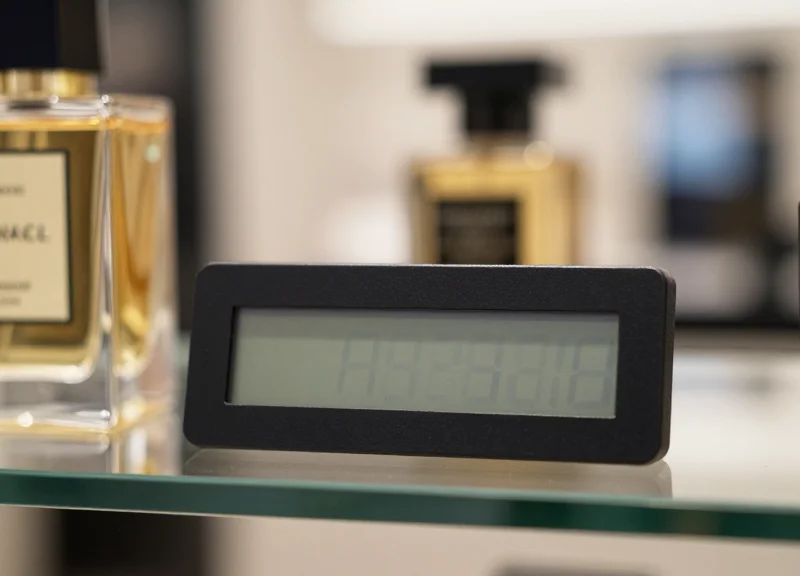
A Holistic Smart Store is an integrated retail environment where RFID, Electronic Shelf Labels (ESL), and Electronic Article Surveillance (EAS) function as a single interconnected nervous system. In luxury boutiques, this synergy eliminates data silos by allowing the dynamic RFID power adjustment to feed real-time stock levels directly to ESLs for automated price updates, while simultaneously informing the EAS system which specific items are authorized for exit. This convergence transforms individual hardware components into a comprehensive business intelligence platform.
| Feature | Siloed Systems (Traditional) | Integrated Holistic Store (RFID+ESL+EAS) |
|---|---|---|
| Inventory Updates | Manual or batch processing (delayed) | Real-time synchronization via RFID |
| Pricing Accuracy | Labels may mismatch stock data | ESL reflects exact RFID-tracked availability |
| Loss Prevention | Generic alarm (Item unknown) | Item-level identification (Specific SKU identified) |
| Labor Efficiency | High (Manual checking and tagging) | Low (Automated monitoring and pricing) |
DragonGuardGroup’s approach to the holistic smart store leverages the 'Single Source of Truth' model. By using the same RFID tag for inventory management and security (EAS), we eliminate the need for double-tagging luxury goods. When our dynamic power controllers detect an item is moved to the point of sale, the system instantly communicates with the ESL to update the 'last seen' location and flags the EAS gate to ignore that specific EPC (Electronic Product Code) upon exit. This seamless handoff is what maintains 99.9% accuracy while keeping false alarms at nearly zero.
Can RFID interfere with ESL wireless signals?
No. Modern ESLs typically operate on 2.4GHz (Zigbee/Bluetooth) or sub-GHz bands, while RFID operates in the UHF range (860-960MHz). DragonGuardGroup’s dynamic power adjustment further ensures that RFID signals remain confined to their intended zones, preventing any potential cross-frequency noise.
Does integrating EAS and RFID require new hardware?
While traditional EAS pedestals can be upgraded with RFID inserts, a truly holistic store benefits from 'Dual-Tech' antennas that house both AM/RF and RFID modules, managed by a centralized software controller.
How does this synergy improve the customer experience?
It allows for 'Frictionless Retail' where luxury clients can view real-time pricing on ESLs and enjoy a discreet security environment without visible hard tags or intrusive false alarms at the door.
Expert Tip: Implement 'Zero-Latency Reconciliation.' By syncing your RFID reader power levels with your ESL management software, you can trigger 'low stock' alerts on the shelf label itself. This ensures that a boutique associate is notified to replenish an item before the customer even notices it is missing, effectively turning your security and pricing infrastructure into a proactive sales tool.
Measuring ROI: Time Savings and Reduced Shrinkage
Measuring the ROI of Dynamic RFID in a luxury boutique environment is defined by two primary vectors: the recovery of thousands of labor hours and the preservation of high-margin capital through near-zero shrinkage. By achieving 99.9% inventory accuracy and reducing false alarms by 45%, boutiques move from a reactive security posture to a proactive operational model. The ROI is typically realized within 12 to 18 months, driven by the elimination of manual cycle counts and the drastic reduction in 'phantom' stockouts that lead to lost sales.
| Metric | Manual/Traditional System | Dynamic RFID System |
|---|---|---|
| Inventory Audit Time | 24-48 Staff Hours (Monthly) | 15-30 Minutes (Weekly) |
| Shrinkage Rate | 1.5% - 3.0% (Industry Avg) | Less than 0.5% |
| Inventory Accuracy | 70% - 85% | 99.9% |
| False Alarm Interventions | High (Weekly/Daily) | Reduced by 45% |
- Quantify Labor Reallocation: Calculate the hourly wage of floor staff previously dedicated to manual counts. With Dynamic RFID, these hours are reallocated to high-touch clienteling and personalized sales, directly impacting conversion rates.
- Assess Shrinkage Reduction: Track the decrease in 'unaccounted loss' between fiscal periods. Dynamic power adjustment ensures that items are tracked to the exact exit point, identifying internal vs. external theft patterns more accurately than static systems.
- Analyze Opportunity Cost of Stockouts: Use the 99.9% accuracy data to measure 'Saved Sales.' When a system knows exactly where a size or color is located, staff can fulfill orders instantly, preventing the 10-15% of luxury sales typically lost to perceived out-of-stock scenarios.
Expert Insight: The 'Hidden ROI' of Brand Integrity. In luxury retail, a false alarm at the door isn't just a technical glitch; it's a customer experience catastrophe. We calculate the ROI not just in dollars saved, but in 'Brand Equity Protection.' By reducing false alarms by 45% through precision signal calibration, you eliminate the awkward security interventions that often result in high-net-worth individuals never returning to a boutique.
How does Dynamic RFID specifically reduce shrinkage in luxury settings?
It creates a digital 'tight-seal' around the inventory. Because the power adjusts based on the proximity to the reader, it prevents 'signal leakage' that thieves use to mask their movements, ensuring every item is accounted for until the moment of sale.
What is the most immediate financial benefit after implementation?
The immediate benefit is the reduction in labor costs associated with inventory reconciliation. Most boutiques find that they can perform full inventory checks every morning in minutes, rather than once a month in days, leading to immediate payroll efficiency.
Does the system require expensive maintenance that offsets ROI?
No. Because Dynamic RFID uses intelligent software to adjust power levels, there is less 'wear and tear' on the hardware from running at maximum output constantly, and fewer manual recalibrations are needed compared to static RFID systems.
The Future of Luxury Retail: Intelligent Sensing Environments
Intelligent sensing environments represent the next frontier in luxury retail, where adaptive RFID technology shifts from a passive inventory tool to an active, self-correcting neural network. These environments utilize high-density sensor fusion—combining dynamic RFID, computer vision, and AI—to provide 100% real-time visibility, enabling stores to automatically adjust signal strength, interpret customer intent, and eliminate manual audits entirely. By transitioning from 'tracking items' to 'understanding space,' luxury brands can create frictionless shopping experiences that were previously impossible.
Expert Insight: The Shift to 'Spatial Intelligence' In my two decades in tech, the most significant shift I am seeing is the move toward 'Spatial Intelligence.' Future RFID systems won't just report that an item is in the room; they will report its trajectory, dwell time, and interaction history. For luxury boutiques, this means the store itself becomes a living 'Digital Twin.' Dynamic power adjustment is the first step in this evolution—allowing the hardware to focus its 'attention' where it is needed most, much like a human eye focuses on a moving object.
| Feature | Current RFID Capability | Future Intelligent Sensing |
|---|---|---|
| Accuracy Target | 99.0% - 99.9% | 100% Real-time Continuity |
| Power Management | Manual or Programmed Profiles | Autonomous AI-driven Micro-adjustments |
| Consumer Interaction | Requires Scanning/Proximity | Ambient Sensing (Zero-touch) |
| Data Output | Inventory Stock Levels | Behavioral Analytics & Predictive Restock |
How will Dynamic RFID impact the Digital Product Passport (DPP)?
As the EU and other regions move toward Digital Product Passports, intelligent sensing environments will act as the primary validation point. Dynamic RFID will allow luxury brands to update an item's digital twin instantly as it moves through the boutique, ensuring the lifecycle data is accurate from the moment it hits the floor to the moment it leaves with a customer.
Can AI-driven RFID prevent 'ORC' (Organized Retail Crime) in luxury?
Yes. Future sensing environments will use 'Pattern Recognition' to identify suspicious movement—such as multiple high-value items moving toward an exit simultaneously at high velocity—and automatically increase RFID power at exit gates to lock down signals and trigger silent alerts before the theft occurs.
Will this technology replace store associates?
On the contrary, it empowers them. By automating the 'sensing' of the store, associates are freed from the burden of inventory counting and can focus entirely on high-touch clienteling, using real-time data to know exactly what is in stock without ever leaving the customer's side.
As we look toward 2030, the integration of 6G and edge computing will further refine these sensing environments. Luxury brands that adopt dynamic power-adjusting hardware today are building the necessary infrastructure for this automated future. The goal is no longer just preventing false alarms; it is about creating a store that anticipates the needs of the brand and the buyer in real-time.