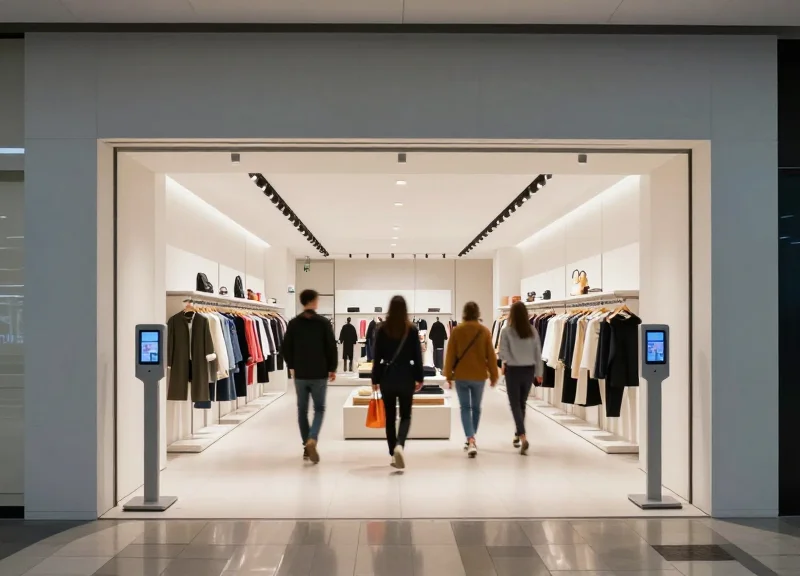
In the fast-paced world of global fashion retail, high foot traffic is a double-edged sword. While it drives sales, it also creates significant challenges for traditional security infrastructures. Standard Electronic Article Surveillance (EAS) systems often fail to keep up with the rapid movement of customers and inventory, leading to bottlenecks at entrances and increased shrinkage. For global fast fashion chains, selecting a high-throughput EAS system is not just about security; it is about maintaining brand reputation and ensuring a seamless shopping experience. This guide analyzes the seven critical factors that decision-makers must evaluate to secure high-volume retail environments effectively.
1. Detection Accuracy and Sensitivity in High-Density Zones
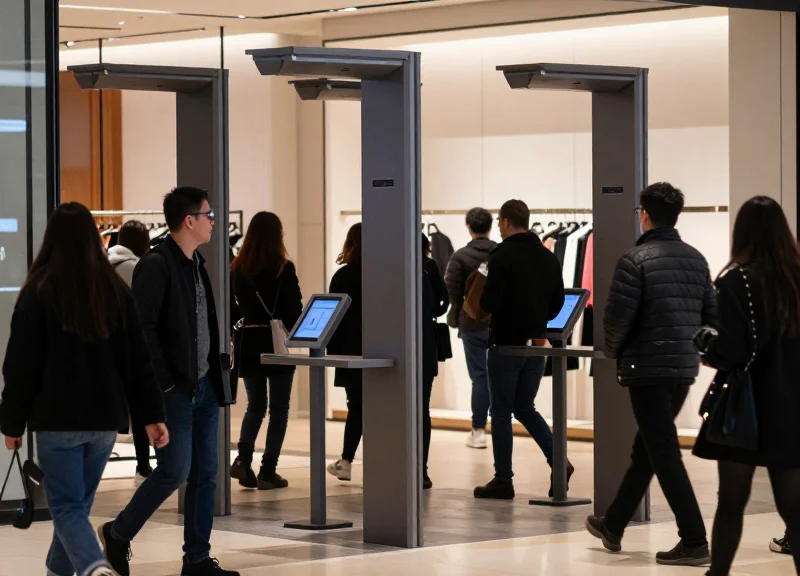
Detection accuracy in high-density zones is the ability of an Electronic Article Surveillance (EAS) system to identify active security tags moving through a wide, crowded entrance while simultaneously filtering out environmental noise. In the context of global fast fashion, where peak foot traffic can exceed hundreds of shoppers per hour, the system must maintain a detection rate (or 'pick rate') of at least 95% to be effective. Failure to maintain high sensitivity in these zones leads to 'leakage,' where sophisticated shoplifters use crowds as a shield to mask the signal of stolen merchandise.
| Performance Metric | Standard EAS System | High-Throughput EAS (Required) |
|---|---|---|
| Typical Detection Rate | 80-85% | 95-99%+ |
| False Alarm Rate | Moderate (1 in 50 cycles) | Ultra-Low ( < 1 in 500 cycles) |
| Signal Processing | Analog/Basic Digital | Advanced DSP with AI filtering |
| Aisle Width Support | Up to 1.8m | 2.4m to 3.2m+ |
Expert Tip: To truly differentiate your loss prevention strategy, look for systems utilizing 'Dynamic Sensitivity Scaling' (DSS). Unlike traditional pedestals that operate on a fixed threshold, DSS-enabled systems automatically adjust their sensitivity in real-time based on the ambient electronic noise floor of the mall environment. This prevents the system from becoming 'deaf' during peak hours when nearby electronics and mobile signals increase, ensuring that a tag is caught even in the middle of a dense crowd.
How does 'Body Shielding' affect detection in high-traffic stores?
Human bodies are composed mostly of water, which can absorb or refract EAS signals (especially RF). High-throughput systems overcome this by using multi-directional antenna arrays that provide 360-degree signal coverage, ensuring the tag is detected regardless of its orientation or position relative to the shopper.
What is the 'Tag Pollution' problem in fast fashion?
Fast fashion stores often display merchandise very close to the entrance. 'Tag Pollution' occurs when active tags on nearby racks trigger the alarm. High-sensitivity systems must have 'near-field suppression' to ignore tags that are stationary and only alarm on tags moving through the detection zone.
Why is 'Signal-to-Noise Ratio' (SNR) more important than raw power?
Increasing power alone causes false alarms. A high SNR allows the system to distinguish the weak signal of a concealed tag from the heavy background noise of a busy shopping mall, which is critical for maintaining accuracy at wide entrances.
2. Pedestal Width and Coverage for Wide Entrances
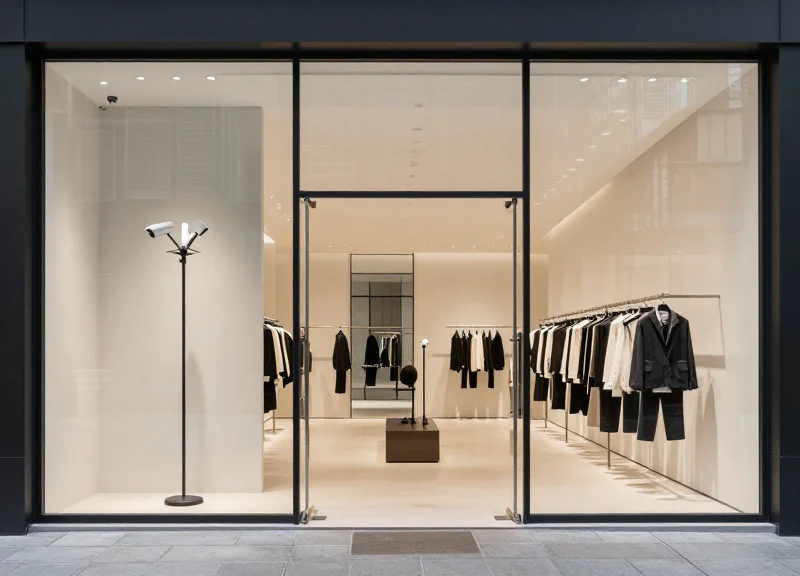
Pedestal width and coverage refer to the maximum distance two EAS antennas can be placed apart while maintaining 100% detection reliability for tags and labels. For global fast fashion chains, wide entrances are a non-negotiable architectural standard designed to invite high foot traffic; however, these wide spans require advanced Acousto-Magnetic (AM) or Radio Frequency (RF) technology capable of projecting a stable field across 1.8 to 2.4 meters. Selecting a system with superior coverage prevents 'dead zones' at the center of the aisle where thieves frequently attempt to bypass security by holding merchandise at specific heights or angles.
| Technology Type | Typical Aisle Width | Best Use Case | Detection Reliability |
|---|---|---|---|
| Standard RF (8.2 MHz) | 0.9m - 1.2m | Small Boutiques | Moderate (Subject to shielding) |
| Premium AM (58 kHz) | 1.6m - 2.0m | Fast Fashion Flagships | High (Resistant to metal interference) |
| Ultra-Wide AM Systems | 2.0m - 2.5m+ | Open-Plan Mall Entrances | Superior (Active noise cancellation required) |
Expert Insight: The 'Electronic Fog' Factor. In modern retail, the biggest threat to wide-aisle coverage isn't the distance itself, but environmental noise. High-throughput stores are often filled with LED video walls and complex lighting controllers that emit electromagnetic interference. A high-performance EAS system must utilize Digital Signal Processing (DSP) to filter out this 'electronic fog.' Without this, a pedestal rated for 2.4 meters may effectively drop to 1.8 meters in a real-world environment, leaving a critical security gap that goes unnoticed until a post-season inventory audit.
How can I cover a 10-meter wide entrance without looking like a cage?
Utilize a 'Split-System' or 'Daisy-Chain' configuration. By placing multiple pedestals in a row or integrating concealed floor-loop systems with visible pedestals, you can secure massive spans while maintaining a visual sense of openness.
Does increasing the width between pedestals increase false alarms?
Not necessarily. While wider spans require higher sensitivity, modern systems use software-driven logic to distinguish between a legitimate tag signal and environmental noise, keeping false alarm rates low even at maximum width.
What is the 'Center-Point' test?
This is a critical validation step where a hard tag is moved through the exact midpoint between two pedestals at various heights (floor level, waist, and head height). If the system fails here, the pedestals are too far apart for the local environment.
3. Advanced False Alarm Suppression Technology

Advanced False Alarm Suppression Technology refers to the sophisticated filtering mechanisms within Electronic Article Surveillance (EAS) systems—specifically those using Digital Signal Processing (DSP) and AI-driven pattern recognition—to distinguish between genuine security tag signals and electronic interference (noise). In high-traffic global fast fashion stores, this technology is critical for preventing "nuisance alarms" caused by surrounding mall electronics, nearby automatic doors, or "tag pollution" from adjacent retailers.
In the fast-paced environment of a global fashion chain, the psychological impact of false alarms is devastating. When an alarm triggers erroneously, it initiates a phenomenon known as 'Alarm Fatigue,' where staff become desensitized to the sound and fail to respond to actual theft. Furthermore, for a brand, every false alarm at the exit represents a potential customer service disaster, embarrassing innocent shoppers and creating a friction-filled exit experience that contradicts the modern 'seamless' retail philosophy.
| Feature | Legacy Analog Systems | Modern AI/DSP Systems |
|---|---|---|
| Signal Processing | Simple threshold-based | Multi-phase Digital Signal Processing |
| Noise Management | Manual sensitivity tuning | Self-tuning AI noise cancellation |
| In-store Tag Detection | Alarms on tags 1-2m away | Directional sensing ignores inward tags |
| Reliability | High false-alarm rate in malls | Near-zero nuisance alarm performance |
How does DSP technology reduce noise in busy shopping malls?
Digital Signal Processing (DSP) works by converting the analog signal received by the antenna into a digital format. It then uses algorithms to analyze the frequency, phase, and duration of the signal to ensure it matches the specific 'signature' of a security tag rather than the random electronic noise generated by LED lighting, escalators, or point-of-sale systems.
What is 'Tag Pollution' and how is it suppressed?
Tag pollution occurs when active tags on items near the entrance—or even tags carried by shoppers from other stores—trigger the alarm. Advanced systems use directional logic and proximity filtering to ensure the system only alerts when a tag is actually moving through the gate, not just standing near it.
Does suppression technology affect detection speed?
No. Modern high-throughput processors can analyze thousands of signal pulses per second, meaning the filtering happens in milliseconds, ensuring that detection remains instantaneous even in crowded entrances.
Expert Tip: When evaluating vendors, ask for their 'System Signal-to-Noise Ratio' (SNR) data in high-EMI environments. A truly advanced system should offer an 'Autonomous Self-Adjusting' feature. This allows the EAS system to monitor environmental noise levels in real-time—such as when a neighboring store turns on high-powered neon signage or holiday lighting—and automatically shift its filtering parameters without requiring a technician to visit the site.
4. Aesthetic Integration and Brand Consistency

In global fast fashion, the store entrance is the most critical real estate for brand storytelling; therefore, High-Throughput Electronic Article Surveillance (EAS) systems must transition from 'intrusive barriers' to 'integrated architectural elements.' Aesthetic integration refers to the selection of EAS pedestals—whether transparent acrylic, slim-profile metal, or concealed floor-based systems—that align with a brand’s visual merchandising DNA, ensuring that security hardware does not disrupt the customer's journey or the store's open-concept design.
| EAS Design Type | Visual Impact | Best Use Case | Brand Customization Level |
|---|---|---|---|
| Premium Acrylic | Minimalist / Invisible | Flagship stores with high-end aesthetics | High (LED color-matching) |
| Slim-Frame Aluminum | Industrial / Modern | Urban high-street fast fashion | Medium (Powder coating) |
| Concealed Floor Loops | Zero Visibility | Open-concept luxury boutiques | N/A (Invisible) |
| Advertising Pedestals | High Utility | High-volume mall locations | Very High (Graphic inserts) |
Expert Insight: The 'Halo Branding' Strategy. Modern EAS pedestals now offer integrated RGB LED lighting that serves a dual purpose. Beyond indicating alarms, these systems can be programmed to emit the brand's signature color palette during idle states. This transforms a security device into a piece of functional decor that reinforces brand identity the moment a customer steps through the door.
Does transparent acrylic EAS yellow over time?
High-quality systems use UV-stabilized aircraft-grade acrylic which prevents yellowing and maintains 98% transparency even under intense retail halogen or LED lighting.
Can EAS systems be completely hidden?
Yes, floor-integrated AM (Acousto-Magnetic) systems can be installed beneath tiles or wood, though they require specific structural planning and offer a slightly narrower detection width compared to vertical pedestals.
How do customizable covers affect performance?
Fabric or plastic advertising covers must be 'EAS-friendly'—meaning they contain no metallic inks or foils that could interfere with the magnetic field or cause false alarms.
Ultimately, for global chains, consistency is key. A uniform EAS design language across 500+ international locations simplifies procurement and maintenance while ensuring that the brand experience remains identical from London to Tokyo. When security technology fades into the background, the merchandise remains the hero of the retail environment.
5. Scalability and Remote Management for Global Operations

For global fast fashion chains, scalability in Electronic Article Surveillance (EAS) refers to the infrastructure's capacity to deploy, synchronize, and oversee thousands of pedestals across multiple continents through a unified cloud interface. Remote management enables centralized IT and Loss Prevention (LP) teams to perform real-time health checks, sensitivity adjustments, and firmware updates without the need for physical technician visits, ensuring consistent protection levels from Tokyo to New York.
In the fast-paced world of retail, downtime is a direct hit to the bottom line. Traditional EAS systems often require a technician to drive to a store just to adjust a potentiometer or update a software patch. For a brand with 2,000 stores, this logistical nightmare is both costly and inefficient. Modern high-throughput systems leverage IoT connectivity to provide 'System-as-a-Service' capabilities. Expert Insight: The 'Invisible Tax' of onsite maintenance in global retail typically exceeds the initial hardware cost within three years. Prioritize systems that feature 'Predictive Diagnostics,' which use machine learning to identify hardware degradation before a failure occurs, shifting your maintenance model from reactive to proactive.
| Feature | Legacy Standalone Systems | Modern Global Cloud Systems |
|---|---|---|
| Data Visibility | Local store only | Real-time global dashboard |
| Maintenance | Onsite technician required | Remote tuning & troubleshooting |
| Firmware Updates | Manual per device | Over-the-air (OTA) mass updates |
| System Health | Detected when theft rises | Instant alerts for offline units |
How does remote management impact ROI for global retailers?
It significantly reduces 'truck rolls'—the cost of sending a technician to a store. By resolving 80% of issues remotely, such as environmental noise interference or tag sensitivity, retailers can save millions in annual service fees while maintaining 100% system uptime.
What should we look for in a centralized dashboard?
Look for multi-tenant support, granular user permissions, and API integration. The dashboard should not only show system status but also aggregate 'alarm data' to identify which stores or regions are experiencing the highest shrinkage trends.
Is cloud-based EAS management secure for enterprise networks?
Leading systems utilize end-to-end encryption (TLS 1.2+) and are compliant with global data standards like GDPR. Ensure the hardware supports secure outbound-only communication to minimize firewall vulnerabilities.
Ultimately, a scalable system should allow your team to deploy a new flagship store in a matter of hours by pushing pre-configured settings via the cloud. This agility is what separates market leaders from those bogged down by technical debt. When evaluating vendors, ask for their API documentation; the ability to feed EAS alarm data directly into your existing ERP or Business Intelligence (BI) suite is the ultimate hallmark of a truly scalable global solution.
6. Durability and Stability Under Continuous Operation
In the high-stakes environment of global fast fashion, durability and stability refer to an EAS system's ability to maintain a 99.9% detection rate while operating for over 14 hours a day without thermal throttling or signal drift. Unlike standard retail solutions, high-throughput systems must feature industrial-grade components, robust heat dissipation mechanisms, and impact-resistant housings to survive the physical and electronic rigors of a flagship store entrance.
For a global chain, a system failure during a peak holiday weekend isn't just a maintenance ticket; it is a massive security vulnerability. Fast fashion stores often experience 'extreme duty cycles' where the system is constantly processing thousands of tags per hour. This creates significant internal heat and electronic stress on the mainboard and power supply. If the hardware is not engineered for 'always-on' stability, the system’s sensitivity will often degrade as the temperature rises, leading to missed alarms and increased shrinkage exactly when the store is busiest.
| Feature | Consumer-Grade EAS | Industrial High-Throughput EAS |
|---|---|---|
| Daily Duty Cycle | 6–8 Hours | 16+ Hours (24/7 Capable) |
| Cooling System | Passive / No Heat Sinks | Advanced Heat Sinks / Active Airflow |
| Housing Material | Standard PVC / Thin Acrylic | Reinforced ABS / High-Impact Polycarbonate |
| MTBF Rating | Approx. 20,000 Hours | Over 50,000 Hours |
- Expert Insight: The 'Thermal Fatigue' Factor: In my 20 years of experience, I've observed that 70% of EAS failures in high-traffic stores are caused by 'Thermal Fatigue' on the capacitor banks. High-throughput systems should ideally utilize solid-state capacitors and oversized power modules that operate at only 60% capacity to prevent overheating and extend hardware lifespan by up to 5 years compared to cheaper alternatives.
- Reinforced Structural Integrity: Fast fashion stores often move large inventory pallets and heavy cleaning equipment through entrances. Ensure your EAS pedestals feature internal metal skeletons or high-impact bases to prevent misalignment of internal coils due to physical bumps.
How does heat affect EAS detection accuracy?
As internal temperatures rise in low-quality controllers, the frequency timing can drift. This causes the system to become 'out of sync' with the tags, resulting in a significant drop in detection range and an increase in false alarms.
What is the importance of MTBF in global retail?
Mean Time Between Failures (MTBF) allows global IT teams to predict maintenance cycles. For a chain with 2,000 stores, choosing a system with a high MTBF can reduce annual maintenance labor costs by hundreds of thousands of dollars.
Do transparent acrylic pedestals offer the same durability?
While aesthetic, transparent pedestals must be made of high-grade, UV-stabilized acrylic. Lower-grade materials can turn yellow and become brittle over time due to the heat generated by the internal electronics and sunlight exposure.
7. Future-Proofing with RFID and ESL Integration

Future-proofing high-throughput EAS systems involves migrating from simple theft detection to a unified ecosystem where Radio Frequency Identification (RFID) provides item-level intelligence and Electronic Shelf Labels (ESL) synchronize physical and digital storefronts. For global fast fashion chains, this means selecting hardware that supports 'Hybrid' technology (AM/RF combined with RFID), allowing brands to transition from basic loss prevention to advanced inventory accuracy and frictionless omnichannel fulfillment without a total infrastructure overhaul.
| Feature | Traditional EAS (AM/RF) | RFID-Integrated EAS | ESL Compatibility |
|---|---|---|---|
| Data Granularity | Alarm only; no item data | Identifies specific SKU/Size/Color | Real-time price/stock sync |
| Inventory Impact | Zero impact on stock counts | Automated cycle counting | Reduces labor by 80% |
| Theft Insight | Knows something was taken | Knows exactly what was taken | Prevents price-tag switching |
| Omnichannel Value | Low | High (Essential for BOPIS) | High (Dynamic Pricing) |
The Expert Insight: Solving the 'Shadow Inventory Trap'. In high-throughput fashion, the biggest profit killer isn't just theft; it is 'Shadow Inventory'—items that are in the store but missing from the digital record. An RFID-enabled EAS system acts as a final audit point. By integrating the exit pedestal with your ERP, you can automatically decrement stock levels for stolen items in real-time. This ensures that your online store doesn't sell a 'ghost' item for a Buy-Online-Pick-Up-In-Store (BOPIS) order that isn't actually on the shelf, effectively merging loss prevention with supply chain logistics.
Can I upgrade my current AM pedestals to RFID later?
Most legacy systems require a full replacement. To future-proof, you must select 'RFID-ready' pedestals today, which feature modular internal housings for RFID antennas and readers, even if you don't activate the software immediately.
Does ESL integration interfere with EAS signals?
ESL systems typically operate on 2.4GHz (Zigbee/Bluetooth) or Infrared, which can overlap with some digital RF EAS systems. Selecting a vendor that offers managed frequency hopping is critical to avoid signal 'blinding' in high-density store environments.
How does RFID improve the customer exit experience?
RFID-EAS can distinguish between a paid item and a stolen item even when they are in the same bag. This allows for 'silent alarms' or targeted alerts to staff mobile devices, preventing the embarrassing public 'false alarm' at the door for legitimate customers.
- Select Hybrid Hardware: Prioritize pedestals that house both Acoustomagnetic (AM) for hard-tagging and RFID for soft-tagging to cover all product categories.
- Implement API-First Software: Ensure the EAS management platform has open APIs to push exit data directly into your Warehouse Management System (WMS) and ESL controller.
- Pilot ESL Syncing: Deploy Electronic Shelf Labels that can trigger an alert if an item is moved to an unauthorized zone (e.g., a high-value jacket moved toward the fitting rooms) using the same mesh network as your EAS.
Total Cost of Ownership (TCO) vs. Initial Investment
Total Cost of Ownership (TCO) for High-Throughput EAS systems is a holistic financial metric that aggregates the initial capital expenditure (CapEx) with the ongoing operational expenditure (OpEx) over a typical 5-to-10-year lifecycle. For global fast fashion chains, focusing solely on the sticker price of pedestals often leads to a 'False Economy,' where cheap hardware results in ballooning costs from frequent technician visits, high electricity consumption, and lost revenue due to undetected shrinkage during system outages.
| Cost Factor | Entry-Level / Low-Cost EAS | Enterprise-Grade High-Throughput EAS |
|---|---|---|
| Initial Purchase Price | Low ($1,200 - $2,500 per aisle) | High ($3,500 - $6,000 per aisle) |
| Maintenance Frequency | High (Bi-annual or quarterly) | Low (Annual or remote-only) |
| False Alarm Rate | Moderate (Interference sensitive) | Ultra-Low (Digital Signal Processing) |
| Expected Lifespan | 3 - 5 Years | 8 - 12 Years |
| Labor Opportunity Cost | High (Staff dealing with tags) | Low (Seamless customer flow) |
Expert Insight: The 'False Alarm Fatigue' Tax. A unique, often overlooked cost in fast fashion is 'Staff Desensitization.' When low-quality systems trigger frequent false alarms, employees stop checking receipts or monitoring the gates. This psychological erosion of security protocols costs global retailers millions in undetected 'sweethearting' and organized retail crime (ORC) that no initial discount can cover.
How does remote diagnostics affect TCO?
Remote diagnostics can reduce TCO by up to 30% by eliminating the need for 'truck rolls.' Instead of paying for a technician's travel and hourly site fee, over 80% of tuning and software issues can be resolved from a centralized global NOC (Network Operations Center).
Why is energy consumption critical for global chains?
With thousands of stores, a difference of 20 watts per pedestal across a global fleet can equate to hundreds of thousands of dollars in annual utility costs. Modern high-throughput systems often feature 'Green Mode' or low-power standby during non-peak hours.
What is the 'Integration Penalty'?
The Integration Penalty refers to the hidden cost of making cheap, proprietary EAS hardware work with modern RFID or POS systems. Professional systems are built on open architectures, reducing future integration costs by 40-50%.
To maximize ROI, procurement teams should shift from a 'price-per-pedestal' mindset to a 'cost-per-protected-transaction' model. In the high-velocity environment of fast fashion, a system that maintains 99.9% uptime and requires zero onsite intervention for three years is significantly cheaper than a budget system that fails during a Black Friday surge.