In the high-stakes world of modern manufacturing, real-time visibility is no longer a luxury—it is a survival requirement. Work-in-Progress (WIP) tracking often suffers from data silos and latency issues that prevent agile decision-making. This guide explores the technical bridge between physical RFID hardware and digital enterprise systems, focusing on the critical aspect of signal synchronization to ensure your ERP and MES reflect the ground reality of your factory floor with maximum precision and zero lag.
The Strategic Role of RFID in Modern WIP Management
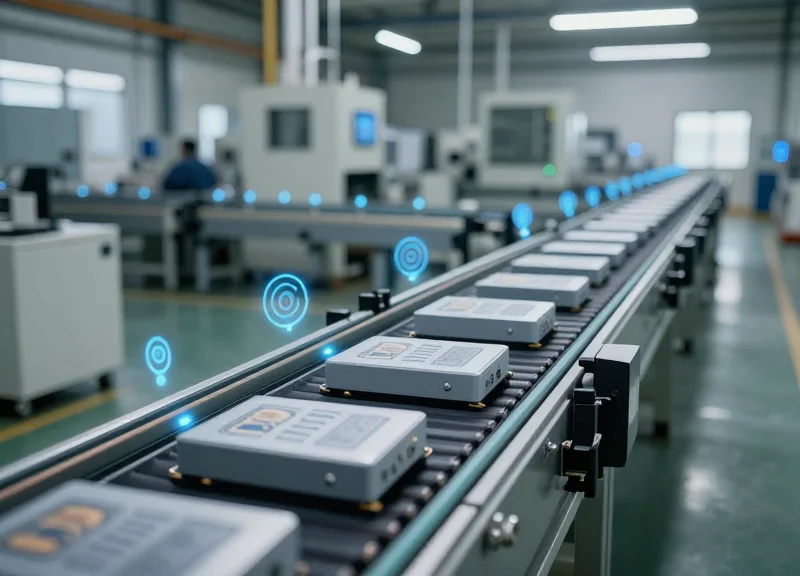
In modern manufacturing, the strategic role of RFID in Work-in-Process (WIP) management is to act as the primary catalyst for 'Physical-to-Digital Convergence.' Unlike traditional tracking methods, RFID provides a continuous, automated data stream that eliminates the visibility 'black holes' common in complex assembly lines. By embedding intelligence directly into components and sub-assemblies, manufacturers can achieve 99.9% data accuracy and sub-second latency in status updates, providing the high-fidelity signal required for advanced ERP and MES orchestration.
| Feature | Legacy Barcode Systems | Modern RFID WIP Systems |
|---|---|---|
| Data Acquisition | Manual, Line-of-sight required | Automated, Non-line-of-sight |
| Processing Speed | 1 item at a time (sequential) | Hundreds of items per second (bulk) |
| Data Integrity | Prone to human error/missed scans | Systematic, sensor-driven accuracy |
| Environment | Easily damaged/obscured tags | Resilient to grease, heat, and paint |
| Strategic Output | Historical batch reporting | Real-time event-driven insights |
Beyond simple tracking, the unique value of RFID lies in its ability to facilitate a 'Live Digital Twin' of the shop floor. Most competitors view RFID as a better barcode; however, the true strategic advantage is the elimination of 'Data Latency.' In a standard barcode environment, the ERP system is often 15 to 60 minutes behind the physical reality of the factory floor. RFID synchronization reduces this gap to milliseconds, allowing the MES to trigger automated replenishment or reroute production dynamically when bottlenecks are detected. This is the difference between reactive management and autonomous manufacturing.
How does RFID reduce the 'Ghost Inventory' problem?
Ghost inventory occurs when the ERP shows items that aren't physically present or vice versa. RFID's automated gate-readers ensure that every movement is logged without human intervention, ensuring the digital record exactly matches the physical floor state.
Can RFID handle the harsh environments of heavy manufacturing?
Yes. While barcodes fail when covered in oil or dust, high-memory UHF RFID tags are designed for rugged environments, including high-heat paint ovens and chemical baths, maintaining data integrity throughout the entire WIP lifecycle.
What is the primary ROI driver for RFID in WIP?
The largest driver is the reduction in cycle time. By identifying bottlenecks in real-time and automating the data hand-off between production stages, manufacturers typically see a 15-25% improvement in throughput without adding additional labor.
Identifying the Signal Latency Challenge

Signal latency in RFID-integrated WIP management is the temporal gap between the physical detection of a tag at the edge and the finalized commit of that data into a system of record like an ERP or MES. While RFID hardware captures data in milliseconds, the journey to the database often encounters 'friction points'—network overhead, middleware processing, and database locking—that can create a 5-to-30-minute delay. In high-velocity manufacturing, this 'data stale-date' renders real-time optimization impossible, as the system is essentially managing the ghost of production past rather than the reality of the shop floor.
To solve synchronization issues, one must first categorize the sources of delay. We typically see latency categorized into three distinct layers: Physical Edge Latency (tag collision and reader filtering), Transport Latency (network hop counts), and Application Latency (ERP API ingestion and logic validation).
| Latency Tier | Typical Delay | Primary Cause | Impact on Production |
|---|---|---|---|
| Hard Real-Time | < 100ms | Edge PLC/Sensors | Immediate machine-level interlocking. |
| Near Real-Time | 1s - 10s | Middleware / MQTT Brokers | Accurate WIP tracking and buffer monitoring. |
| Batch/Delayed | 5m - 1hr+ | Legacy ERP API / Batch Jobs | Inventory drift and planning inaccuracies. |
Expert Insight: The 'Latency Tax' on JIT Manufacturing. Most organizations overlook the 'Data Gravity' effect. As your RFID deployment scales to thousands of tags, the volume of data generated creates a processing tax. If your MES is configured for synchronous processing—where the system waits for the ERP to acknowledge every scan before moving to the next—you are intentionally throttling your throughput to match the speed of your slowest database query.
Why does 'stale' data lead to production bottlenecks?
When ERP data lags behind the physical floor, the system may trigger unnecessary reorders for parts already in stock or fail to identify a machine breakdown until a downstream station runs dry. This leads to 'Shadow WIP,' where inventory exists physically but is invisible to the planning software.
What is the primary technical bottleneck in RFID-to-ERP integration?
The bottleneck is rarely the RFID reader; it is typically the ERP’s API rate limits or the middleware's inability to handle asynchronous data streams. Legacy ERPs designed for manual entry struggle with the high-frequency 'heartbeat' of automated RFID scans.
Can network jitter affect WIP accuracy?
Yes. Jitter can cause data packets to arrive out of sequence. If a 'Work-Out' signal is processed before a 'Work-In' signal due to network instability, it creates logical errors in the MES that require manual reconciliation.
The Architectural Framework: Hardware, Middleware, and Software

The architectural framework for RFID-ERP integration is a tripartite ecosystem designed to convert physical movement into digital intelligence. It consists of the Edge Layer (Hardware) for data capture, the Interoperability Layer (Middleware) for signal processing, and the Application Layer (Software/ERP/MES) for business execution. A robust framework ensures that shop floor signals are filtered, aggregated, and transmitted with sub-second latency, preventing the 'data storm' effect that often crashes enterprise databases when raw RFID pings are sent directly to an ERP.
| Component Layer | Primary Function | Key Performance Indicator (KPI) |
|---|---|---|
| Hardware (Edge) | Data Capture & Signal Emission | Read Accuracy Rate |
| Middleware (Logic) | Filtering, Aggregation & Translation | Processing Latency |
| Software (Core) | Contextualization & Business Logic | Transaction Integrity |
Expert Insight: In my two decades of optimizing shop floor systems, I have observed that most failures occur because architects treat middleware as a simple pass-through pipe. To achieve true signal synchronization, your middleware must utilize 'Semantic Filtering.' This means the system should ignore 99% of redundant pings from a stationary WIP tag and only fire a 'northbound' message to the ERP when a meaningful state change—such as a station transition or a process completion—is detected.
- Signal Acquisition: Fixed readers or handheld scanners capture the Unique Identifier (UID) of the RFID tag attached to the WIP item.
- Edge Processing: The middleware layer validates the signal, removes duplicate reads, and checks the signal strength to confirm the item is actually moving through a designated portal.
- Data Normalization: The raw hex data is converted into a standard format (such as JSON or XML) that the ERP or MES can interpret, often appending timestamps and location IDs.
- Transactional Handshake: The processed data is pushed via API or MQTT to the ERP, triggering a real-time update of the production schedule and inventory records.
Why can't I connect my RFID reader directly to my ERP?
Direct connection lacks the 'buffer' and logic needed to filter out noise. Without middleware, a single stationary tag could trigger thousands of redundant database updates per minute, leading to massive system latency.
What is the 'Golden Record' in this architecture?
The Golden Record is the synchronized state where the physical location of the WIP perfectly matches the digital entry in the MES, maintained by the middleware's validation rules.
Communication Protocols: MQTT vs. REST API vs. OPC-UA
In the context of RFID-driven Work-in-Process (WIP) tracking, communication protocols serve as the digital nervous system, dictating how efficiently data moves from the reader to the ERP or MES. The choice of protocol directly impacts 'Signal Synchronization'—the ability of the digital system to reflect the physical floor in near real-time. While legacy systems relied on polling-based architectures, modern high-speed production environments require event-driven or robust industrial frameworks to prevent data bottlenecks and ensure transactional integrity.
| Feature | MQTT (Message Queuing Telemetry Transport) | REST API (Representational State Transfer) | OPC-UA (Open Platform Communications) |
|---|---|---|---|
| Architecture | Publish/Subscribe (Event-driven) | Request/Response (Stateless) | Client/Server (Object-oriented) |
| Payload Size | Extremely Small (Binary/JSON) | Medium to Large (JSON/XML) | Medium (Binary/XML) |
| Latency | Ultra-Low (Real-time) | Higher (Dependent on overhead) | Low (Optimized for PLC) |
| Network Usage | Low bandwidth, high efficiency | High bandwidth overhead | Moderate to high |
| Best Use Case | High-volume tag reads, mobile readers | Direct ERP integration, cloud apps | Factory floor automation, PLC sync |
- MQTT: The Lightweight Scalability King: MQTT is the preferred protocol for high-density RFID environments. Because it uses a publish/subscribe model, readers only push data when a 'change of state' occurs (e.g., a tag entering a new zone), drastically reducing unnecessary network traffic compared to constant polling.
- REST API: The Enterprise Standard: REST is the lingua franca of web-based ERP and MES systems. It is easiest to implement for developers but carries higher overhead. It is best suited for low-frequency, high-data-integrity checkpoints where a confirmed 'handshake' with the database is mandatory.
- OPC-UA: The Industrial Powerhouse: For WIP systems that must interact directly with PLCs or robotic cells, OPC-UA provides a secure, vendor-neutral framework. It excels at semantic data modeling, allowing the RFID data to be contextualized with machine-level telemetry.
Expert Tip: The 'Edge-to-Enterprise Pivot' is the most robust architectural pattern. Use MQTT for the high-frequency 'Edge to Middleware' jump to maintain millisecond latency, then utilize a Middleware-based 'Protocol Proxy' to batch and transform those signals into authenticated REST calls for the ERP. This prevents the ERP from being overwhelmed by raw telemetry while ensuring every critical WIP movement is recorded as a verified transaction.
{ "topic": "factory/line1/station4/rfid", "payload": { "tag_id": "E280113020002095DE9403F2", "timestamp": "2023-10-27T10:15:30Z", "rssi": -58, "action": "entry" } }Edge Computing: Filtering Signal Noise at the Source

Edge computing in RFID WIP management refers to the decentralized processing of tag data at the hardware or gateway level, intended to filter redundant signals and eliminate 'noise' before it reaches the MES or ERP systems. By executing logic locally, organizations can reduce network bandwidth consumption by up to 90% and prevent the application layer from being overwhelmed by duplicate pings (multi-reads) from stationary tags. This ensures that every signal reaching your enterprise software is an actionable 'event' rather than just a raw sensor observation.
| Data Attribute | Raw RFID Signal | Edge-Processed Event |
|---|---|---|
| Frequency | Continuous (hundreds per second) | Discrete (single event on state change) |
| Data Volume | High (MBs of redundant hexadecimal) | Low (KBs of structured JSON/MQTT) |
| System Load | Heavy (requires database deduplication) | Negligible (ready for business logic) |
| Accuracy | Subject to 'stray' reads from adjacent bins | Validated via RSSI and proximity filters |
- Deduplication and Debouncing: The edge gateway identifies when the same tag is read multiple times by one or more antennas within a specific millisecond window, collapsing these into a single 'sight' record.
- RSSI Threshold Filtering: By analyzing the Received Signal Strength Indicator (RSSI), the edge device discards 'stray reads'—tags that are nearby but not actually entering the workstation, preventing false WIP updates.
- Directional Logic Application: Using dual-antenna arrays, the edge processor determines the sequence of reads to identify movement direction (e.g., 'Inbound to Assembly' vs. 'Outbound to QA').
To implement effective signal synchronization, your edge logic must move beyond simple 'if-then' statements. The goal is to create a 'Stateful Filter' that understands the context of the manufacturing floor. Expert Tip: Implement a 'Time-on-Antenna' (ToA) threshold. If a tag is read for less than 500ms, it is likely a 'pass-by' or environmental reflection and should be discarded automatically to maintain data integrity.
def process_rfid_edge(tag_id, rssi, antenna_id):
    # Filter out weak signals likely from stray tags
    if rssi < -65:
        return None

    # Check if tag is already in local cache to prevent duplicates
    if not is_duplicate(tag_id, timestamp):
        # Aggregate raw read into a structured JSON event
        return {
            'event_type': 'WORKSTATION_ENTRY',
            'part_id': tag_id,
            'location': antenna_id,
            'timestamp': get_iso_time()
        }
    return None
Can edge computing handle encryption?
Yes, modern edge gateways can encrypt data locally using TLS/SSL before transmission, ensuring that sensitive WIP data is secured before it ever touches the corporate network.
What happens if the network goes down?
Edge devices typically feature 'Store-and-Forward' capabilities, caching filtered data locally and syncing it with the MES once the connection is restored, preventing data loss.
Does this require special RFID tags?
No, filtering is a function of the reader's firmware or the gateway software, meaning it works with standard passive UHF Gen2 tags.
Mapping RFID Data Fields to ERP Business Logic
Mapping RFID data fields to ERP business logic is the critical process of translating raw, low-level Electronic Product Codes (EPC) and telemetry into high-level, actionable business transactions. This synchronization ensures that a physical movement on the shop floor—captured as a hexadecimal string—triggers the correct state change within your Enterprise Resource Planning (ERP) or Manufacturing Execution System (MES), such as a 'Work-in-Process (WIP) Movement,' 'Material Consumption,' or 'Production Completion' event. Without a precise mapping layer, the ERP remains a 'blind' system of record, unable to reflect the real-time physical reality of the production environment.
| RFID Data Attribute | ERP/MES Logical Entity | Business Process Impact |
|---|---|---|
| EPC (Electronic Product Code) | Unique Serial Number / SKU | Ensures individual unit traceability and prevents duplicate inventory counts. |
| Reader/Antenna ID | Work Center / Functional Location | Automates location tracking and validates that items are at the correct routing step. |
| Timestamp (ISO 8601) | Transaction Date/Time | Calculates precise lead times, identifies bottlenecks, and feeds OEE metrics. |
| RSSI (Signal Strength) | Certainty/Proximity Logic | Determines if an item is truly at a station or just 'passing by' in the aisle. |
To execute this effectively, developers must implement a Semantic Middleware layer. This layer acts as the 'Rosetta Stone' between the hardware's LLRP (Low-Level Reader Protocol) outputs and the ERP’s RESTful or SOAP endpoints. The most robust integrations utilize a lookup table that binds a specific EPC range to a current Work Order ID (WOID) at the moment of 'Commissioning'—the point where a blank tag is first associated with a physical component.
{
  "event_type": "WIP_MOVE",
  "payload": {
    "epc_id": "303425789C0A8B0000000123",
    "target_erp_field": "WorkCenter_ID",
    "new_value": "CNC-04",
    "associated_wo": "WO-8872-B",
    "timestamp": "2023-10-27T14:22:01Z"
  }
}- Step 1: Tag Commissioning: Link the physical EPC to a specific Part Number or Work Order in the ERP database during the initial labeling phase.
- Step 2: Logical Zoning: Group specific Reader IDs into 'Logical Zones' that represent ERP work centers (e.g., Readers A and B = Assembly Line 1).
- Step 3: State Transition Rules: Define the logic that triggers a transaction: for example, an item entering 'Zone 4' must have completed 'Zone 3' or an error flag is raised.
Expert Tip: The 'Transient State Buffer' Strategy. Most generic guides suggest immediate ERP updates upon scan. However, in high-interference environments, tags can 'flicker' between two readers at a boundary. I recommend implementing a 3-5 second buffer at the middleware level. Only when a signal is consistently read at a new station for a defined duration should the ERP 'Move' transaction be finalized. This prevents 'database thrashing' and ensures your lead-time analytics aren't corrupted by phantom movements.
How do you handle 'Stray Reads' from adjacent lines?
Utilize RSSI filtering and 'Read Count' thresholds in your mapping logic to ensure only the strongest, most consistent signal triggers a business event.
Can one EPC map to multiple ERP records?
Technically yes, through parent-child nesting (e.g., an EPC for a pallet mapping to multiple EPCs for individual units), which is essential for aggregate movements.
Advanced Synchronization Techniques: Handling Time-Stamping

To achieve sub-millisecond accuracy in RFID-enabled production lines, systems must transition from 'arrival-time' logging to 'event-time' synchronization. Advanced time-stamping involves embedding a high-precision temporal marker at the edge—the moment the tag hits the reader’s RF field—rather than relying on the timestamp generated when the data finally hits the ERP database. This ensures that even if network congestion delays a packet by several seconds, the Work-in-Progress (WIP) sequence remains historically accurate for auditing and process-flow logic.
| Protocol/Method | Precision Level | Best Use Case | Implementation Complexity |
|---|---|---|---|
| NTP (Network Time Protocol) | 1-10 Milliseconds | Standard inventory tracking | Low |
| PTP (Precision Time Protocol) | Microseconds | High-speed automated sorting | High (Requires PTP hardware) |
| Middleware Delta-Correction | Variable | Heterogeneous hardware environments | Medium |
| Edge-Injection Stamping | Hardware-specific | Real-time WIP sequencing | Medium |
A common pitfall in distributed RFID systems is 'Clock Drift,' where the internal oscillators of fixed readers deviate from the central MES server over time. To mitigate this, we implement a 'Source-of-Truth' hierarchy. The middleware layer acts as a synchronization broker, periodically polling reader health and calculating a 'drift offset' for each device. This offset is then applied to incoming payloads to normalize them to UTC before they reach the ERP business logic.
{
  "event_id": "XP-99821",
  "epc": "3034000123456789ABCDEF01",
  "timestamps": {
    "edge_event_utc": "2023-10-27T10:15:30.0042Z",
    "middleware_received_utc": "2023-10-27T10:15:30.0581Z",
    "drift_correction_ms": -2.4
  },
  "sequence_number": 4502
}
Why should I use sequence numbers alongside timestamps?
Timestamps can collide or arrive out of order due to network jitter. Sequence numbers provide a hard logic gate to ensure that Step A is processed before Step B, regardless of minor timing discrepancies.
How does ISO 8601 impact ERP integration?
Using the ISO 8601 format (including 'Z' for UTC) is non-negotiable. It prevents 'Timezone Chaos' when a manufacturing facility in one region reports data to an ERP server located in another.
What is the 'Jitter Buffer' strategy?
This is an expert-level technique where the middleware holds data for a few milliseconds (a buffer) to re-order packets based on their edge-timestamp before pushing them to the MES, preventing 'phantom' out-of-sequence errors.
Expert Tip: The Monotonic Clock Advantage. When programming middleware for RFID, always use monotonic clocks for calculating intervals between scans. Unlike system clocks, monotonic clocks never jump backward (which can happen during an NTP sync), ensuring that your 'Time-on-Station' metrics are never skewed by a sudden server time update.
Security and Integrity in Data Transmission
Security in RFID synchronization ensures that Work-in-Process (WIP) data moving from the edge to the core remains immutable, authenticated, and private. In an industrial environment, data integrity is the safeguard against 'phantom inventory' and production bottlenecks; it prevents unauthorized data injection and ensures that the EPC (Electronic Product Code) captured at a read point is exactly what is recorded in the ERP or MES. This involves a combination of Transport Layer Security (TLS) for encryption and cryptographic checksums for data validation.
| Security Layer | Primary Technology | Function in RFID Integration |
|---|---|---|
| Transport | TLS 1.2/1.3 | Encrypts the data stream between Middleware and ERP/MES to prevent eavesdropping. |
| Authentication | OAuth 2.0 / JWT | Ensures only authorized middleware instances can push data to the enterprise API. |
| Integrity | HMAC (Hash-based Message Auth) | Verifies that the WIP payload has not been altered or corrupted during transit. |
| Encryption at Rest | AES-256 | Protects buffered RFID data stored on edge devices or local middleware databases. |
Expert Tip: Implement 'Integrity Pinning' at the Edge. Most systems rely on the network protocol to handle errors, but in high-interference manufacturing zones, packet loss can occur subtly. By generating a SHA-256 hash of the RFID batch at the middleware level and requiring the ERP to verify that hash before committing the transaction, you create a fail-safe against 'bit rot' and partial data writes.
- Packet-Level Checksumming: Utilize CRC (Cyclic Redundancy Check) at the hardware layer to ensure the air-interface transmission between tag and reader is clean before it ever hits the network.
- Payload Schema Validation: Before transmission, validate the JSON or XML payload against a strict schema to ensure no malformed data (e.g., negative inventory counts) is sent to the MES.
- Mutual TLS (mTLS) Handshaking: Require both the client (Middleware) and the server (ERP) to provide digital certificates, ensuring a trusted 'handshake' that prevents Man-in-the-Middle (MITM) attacks.
How do we prevent data loss during a network outage?
Implement a 'Store-and-Forward' architecture. Middleware should buffer validated, encrypted data locally and use a transactional acknowledgement (ACK) from the ERP before purging its local cache.
Is encryption necessary for internal shop-floor networks?
Yes. Modern industrial espionage and the rise of internal ransomware threats make 'air-gapping' insufficient. Encrypting WIP data protects competitive manufacturing intelligence.
What is the impact of security on latency?
While encryption adds overhead, using hardware-accelerated AES and optimized TLS 1.3 minimizes latency to sub-millisecond levels, which is negligible for WIP synchronization.
{
  "header": {
    "transaction_id": "RFID-99821",
    "timestamp": "2023-10-27T10:00:00Z",
    "hash_signature": "e3b0c44298fc1c149afbf4c8996fb92427ae41e4649b934ca495991b7852b855"
  },
  "payload": {
    "epc": "3034257BF400B7800004CB2F",
    "location": "Zone_A_Exit",
    "status": "WIP_COMPLETE"
  }
}
Scalability Considerations for Enterprise Deployment
Enterprise-grade scalability in RFID WIP (Work-in-Process) systems is defined by the architecture's ability to maintain sub-second latency while processing thousands of tag reads per second across multiple global sites. Rather than merely increasing server capacity (vertical scaling), a resilient deployment utilizes horizontal scaling and asynchronous data pipelines. This ensures that a surge in production at a single facility does not create a bottleneck for the entire global ERP/MES environment, allowing for a seamless 'Signal Fabric' that grows alongside the organization's physical footprint.
| Scalability Vector | Common Bottleneck | Enterprise Solution |
|---|---|---|
| Data Ingestion | Synchronous API blocking | Message Brokers (Kafka/RabbitMQ) |
| Geographic Reach | WAN Latency/Packet Loss | Distributed Edge Gateway Clusters |
| Database Performance | Locking during heavy writes | NoSQL or Time-Series Sharding |
| Logic Processing | Monolithic ERP constraints | Stateless Microservices |
Expert Insight: The 'Regional Buffer' Strategy. In twenty years of Silicon Valley deployments, the most common failure point is 'Signal Storms'—where thousands of sensors fire simultaneously during a shift change. To mitigate this, implement a regional buffering layer. By sharding data ingestion by physical site IDs before it hits the global MES, you isolate local network jitter and ensure that a regional outage doesn't cause a global system hang. This 'localized-first' approach allows the system to continue operating in offline mode, syncing the delta once connectivity is restored.
- Implement Asynchronous Message Queuing: Decouple the RFID readers from the ERP by using a high-throughput broker like Apache Kafka. This allows the hardware to fire data at its maximum rate without waiting for a confirmation from the slower ERP database.
- Leverage Stateless Containerization: Deploy your synchronization logic within Docker or Kubernetes. If processing latency increases, the system can automatically spin up new instances to handle the load dynamically.
- Database Partitioning and Sharding: Segment data based on Site ID or Timestamp. This prevents single-table locks and allows queries to be distributed across multiple database nodes, significantly improving read/write speeds.
How does scalability impact total cost of ownership (TCO)?
While distributed architectures have higher upfront complexity, they lower TCO by preventing costly production downtime and allowing for 'pay-as-you-grow' cloud infrastructure utilization.
Can legacy ERP systems handle this volume of data?
Rarely. This is why a middleware layer is essential; it aggregates and filters raw RFID pings into high-level business events (e.g., 'Work Order Started') before passing them to the ERP.
What is the role of 'Edge Intelligence' in scaling?
Edge intelligence reduces the data load by 90% by performing 'delta-only' reporting, ensuring only meaningful state changes are transmitted across the enterprise network.