In the hyper-competitive world of global logistics, throughput is the ultimate metric. However, as conveyor speeds accelerate to handle 500+ parcels per minute, traditional RFID systems often hit a 'technical ceiling' known as read collisions. When hundreds of tags enter a reader's field of vision simultaneously, signal interference and data packet overlaps can lead to missed reads and operational bottlenecks. This guide provides a deep dive into the technical optimizations required to eliminate these collisions, ensuring 100% accuracy in high-density, high-velocity industrial environments.
The Mechanics of RFID Read Collisions in High-Volume Sorting
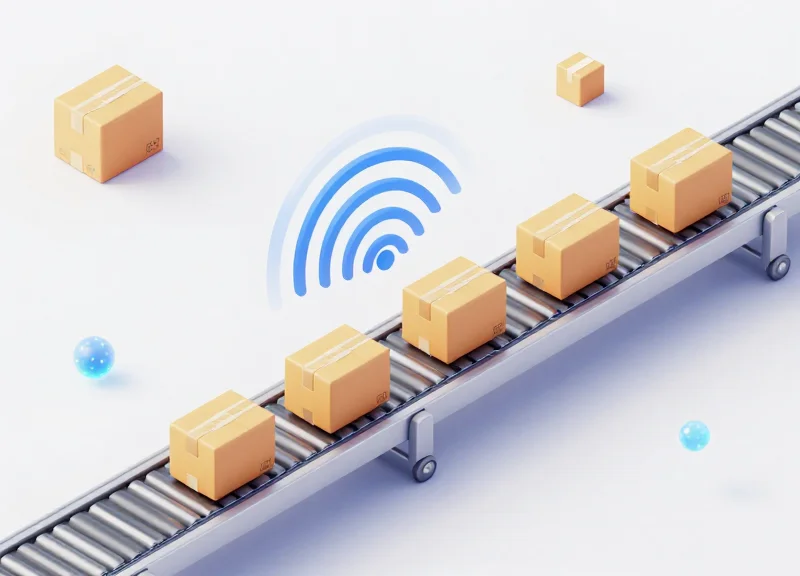
RFID read collisions occur when multiple tags or readers transmit signals simultaneously on the same frequency, causing electromagnetic interference that prevents the reader from successfully decoding any individual ID. In high-speed conveyor environments moving 500+ parcels per minute, the 'read zone' becomes saturated with hundreds of backscatter signals every millisecond. This congestion leads to two primary failure modes: Tag-to-Reader collisions, where multiple tags respond to a query at once, and Reader-to-Reader collisions, where overlapping fields from adjacent sorter lines drown out the weak backscatter of individual parcel tags.
| Collision Type | Physical Root Cause | Impact on High-Speed Sorters |
|---|---|---|
| Tag-to-Tag | Multiple tags backscattering in the same time slot. | Increased 'No-Reads' due to signal garbling (destructive interference). |
| Reader-to-Reader | Signal from one antenna overpowering the return signal of another. | Ghost reads or total blinding of sensors in multi-lane facilities. |
| Shielding/Masking | Dense liquid or metal contents blocking RF energy. | Under-counting of parcels even when collisions are technically resolved. |
In a 500 PPM scenario, the window of opportunity for a successful 'handshake' between the tag and reader is incredibly narrow—often less than 50 milliseconds. When the EPCglobal Gen2 protocol's 'Slotted Aloha' algorithm fails to clear the queue fast enough, tags enter a state of perpetual collision, effectively becoming invisible to the system. This isn't just a software lag; it is a physical limitation of how fast the electromagnetic field can be modulated and sampled.
How does parcel density trigger the 'Capture Effect'?
The Capture Effect occurs when one tag's signal is significantly stronger than others, allowing the reader to decode it while ignoring the rest. In high-volume sorting, this leads to 'selective blindness' where larger or closer parcels are read, but smaller, nested items are consistently missed.
Why does conveyor speed exacerbate signal-to-noise ratios (SNR)?
As parcels move faster, the dwell time in the antenna's 'sweet spot' decreases. This forces the reader to use faster (and thus more noise-sensitive) link profiles, reducing the margin for error when multiple signals overlap.
What is the role of Dense Reader Mode (DRM)?
DRM is a spectral mask that prevents readers from interfering with one another by shifting their transmissions into specific channels. Without it, the floor of a high-speed facility becomes an 'RF storm' where no single device can hear a tag's weak response.
Expert Insight: Most engineers attempt to solve collisions by increasing power, but at 500+ parcels per minute, this actually worsens the problem by expanding the read zone and bringing more 'background' tags into the queue. The secret to high-speed accuracy isn't raw power; it's 'Zone Narrowing'—using phased-array antennas to create a surgical read window that limits the number of tags competing for a slot at any micro-second.
Calculating the Communication Window for 500+ PPM
The communication window represents the total duration an RFID tag remains within the active RF field of an antenna at a specific power threshold. In high-speed sorting environments processing 500+ parcels per minute (PPM), this window shrinks to milliseconds, making the 'Time-on-Tag' the most critical variable in your system architecture. If the conveyor moves too fast or the field is too narrow, the reader cannot complete the inventory round or handle the anti-collision arbitration before the tag exits the zone, resulting in a 'no-read' error.
| Conveyor Speed (m/s) | Interrogation Zone Length (m) | Available Time-on-Tag (ms) | Max Inventory Rounds |
|---|---|---|---|
| 2.0 | 1.0 | 500 | ~15-20 |
| 3.0 | 0.8 | 266 | ~8-10 |
| 4.5 | 0.6 | 133 | ~4-5 |
To calculate your specific window, use the fundamental formula: Tw = L / V, where Tw is the time window, L is the effective length of the RF field, and V is the velocity of the conveyor. However, for 500+ PPM, you must also account for the 'Dead Zone' created by parcel spacing and the 'Singulation Overhead' required by the EPC Gen2 Q-algorithm.
- Determine Effective Field Length: Measure the 3dB beamwidth of your antenna at the specific height of the parcels. This is your 'active' zone, typically smaller than the total visual footprint of the antenna.
- Calculate Maximum Velocity: Convert your PPM target into meters per second. For 500 PPM with a 0.6m parcel pitch (parcel + gap), the belt must move at 5 meters per second.
- Account for Protocol Latency: Factor in the time required for the Select, Query, and ACK commands. At high speeds, these protocol 'handshakes' take up a larger percentage of the available window.
Expert Tip: The '10ms Rule' for High-Speed Logistics. In my 20 years of RF engineering, I have found that at 500+ PPM, you must achieve a successful singulation within the first 10ms of field entry. Why? Because multi-path interference and parcel shadowing often corrupt the signal at the edges of the field. If you don't 'catch' the tag in the center of the main lobe (the highest gain area), your read success rate will plummet below the required 99.9%.
Does parcel orientation affect the communication window?
Yes. Polarized antennas and tag orientation can effectively shorten the 'L' value in your formula if the tag is poorly aligned, reducing the time-on-tag by up to 40%.
How does the 'Q' parameter impact high-speed windows?
A high Q-value increases the number of slots in an inventory round, which can prevent collisions but also risks 'timing out' the window if the tag moves too fast through the field.
Can I extend the window with more antennas?
Yes, overlapping antenna fields effectively increases the 'L' (length) variable, but this requires careful synchronization to avoid reader-to-reader interference.
Optimizing Anti-Collision Protocols: Aloha vs. Binary Tree
Anti-collision protocols are the foundational algorithms that resolve signal interference when multiple RFID tags attempt to respond to a reader simultaneously. In high-speed conveyor environments processing 500+ parcels per minute, the choice between probabilistic methods like Slotted Aloha and deterministic methods like Binary Tree is critical. For modern logistics, the industry standard is the EPC Gen2v2 protocol, which utilizes an 'Adaptive Slotted Aloha' approach to dynamically manage the 'Q-parameter,' ensuring that the communication window is never wasted on empty slots or excessive collisions.
| Feature | Slotted Aloha (Probabilistic) | Binary Tree (Deterministic) |
|---|---|---|
| Efficiency Mechanism | Tags pick a random slot to respond. | Reader systematically splits tag IDs into groups. |
| Performance with High Tag Density | Highly efficient if 'Q' is tuned; degrades if overloaded. | Consistent but can be slower due to multiple iterations. |
| Implementation Complexity | Low; standard for EPC Gen2v2 hardware. | High; requires more intensive logic on the reader side. |
| Best Use Case | Variable parcel flow and high-speed belts. | Inventorying a static, fixed-count group of items. |
To maximize throughput at 500+ PPM, the technical focus shifts to the EPC Gen2v2 Q-algorithm. The Q-parameter determines the number of slots in a query round (2^Q). If Q is too small, collisions skyrocket; if Q is too large, the reader wastes time listening to silence. For high-speed belts, engineers should prioritize 'Adaptive Q,' where the reader adjusts the slot count in real-time based on the success or failure of the previous slot. This ensures that even as parcel spacing fluctuates, the reader maintains the highest possible 'Good Read' frequency.
- The 'Empty Slot' Tax: In high-speed operations, an empty slot is as damaging as a collision. A unique expert insight is to set the 'Q-Decrease' increment slightly higher than the 'Q-Increase' increment. This forces the reader to be more aggressive in shrinking the slot window when parcels are sparse, saving precious milliseconds for when a dense cluster of tags enters the field.
- Session Strategy: Utilize Session 2 (S2) or Session 3 (S3) for high-speed belts. Unlike S0, which allows tags to reset immediately, S2/S3 prevents a tag that has already been read from responding again for a set period, effectively removing it from the 'collision pool' and clearing the airwaves for unread tags.
Why is Aloha preferred over Binary Tree for conveyors?
Aloha is significantly faster at identifying a subset of tags within a very short timeframe. Since a parcel on a 2m/s belt only stays in the read zone for a fraction of a second, the speed of Aloha's random access outweighs the 100% certainty of Binary Tree's methodical search.
What is the ideal Q-parameter for 500 PPM?
There is no static 'ideal' number, but for typical parcel densities, starting with a Q-value of 4 (16 slots) and allowing the reader's algorithm to float between 3 and 7 is standard. Over-fixing Q to a high value like 15 will cause the reader to fail at high belt speeds due to excessive idle time.
Hardware Selection: High-Gain Antennas and RF Shielding Tunnels
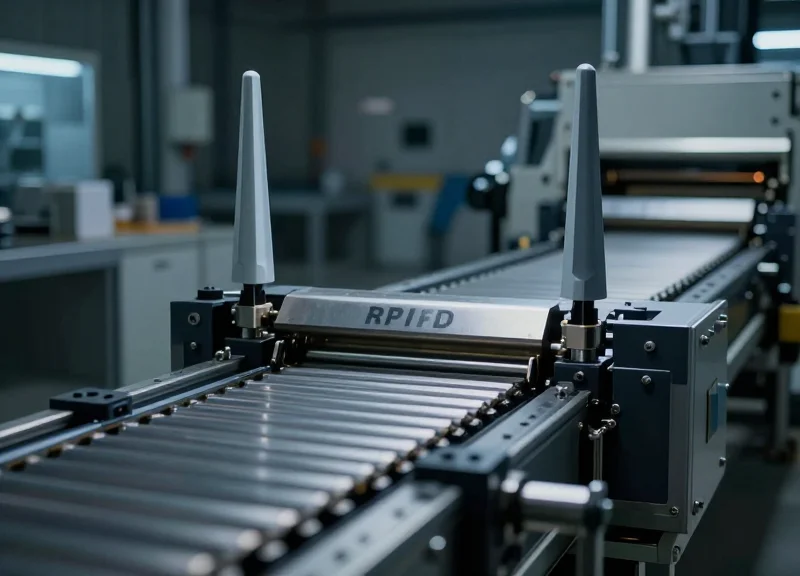
To eliminate read collisions at speeds exceeding 500 parcels per minute, hardware selection must move beyond basic connectivity to 'Spatial Signal Isolation.' This involves using high-gain (typically 9dBic or higher) circular polarized antennas to maximize the 'Time-on-Tag' regardless of parcel orientation, while simultaneously deploying RF shielding tunnels. These tunnels act as a physical layer of the anti-collision protocol, ensuring the reader's energy is strictly confined to a defined 'Read Zone,' preventing the hardware from attempting to process tags on parallel belts or in the queue, which would otherwise exhaust the air interface bandwidth.
| Component | Technical Specification | Impact on High-Speed Throughput |
|---|---|---|
| Antenna Polarization | Circular (RHCP/LHCP) | Eliminates 'dead spots' caused by tag orientation mismatch at high velocity. |
| Antenna Gain | 8.5 - 9.5 dBic | Provides the necessary 'punch' to energize tags in milliseconds. |
| Shielding Material | Conductive Aluminum + RF Absorber | Prevents signal leakage (EMI) and multi-path reflections that cause ghost reads. |
| Beam Width | 60° to 70° (Azimuth/Elevation) | Defines a sharp entry/exit boundary for the 500+ PPM timing window. |
Expert Insight: The 'Absorber-First' Strategy. Most engineers rely solely on metal shielding to block signals. However, in high-speed environments, metal causes 'RF Ricochet,' where signals bounce off the tunnel walls and hit tags at the wrong time, leading to collisions. To truly optimize for 500+ PPM, you must line the interior of your tunnel with carbon-loaded microwave absorbers. This converts stray RF energy into heat rather than reflecting it, creating a 'clean' electromagnetic environment that allows the reader to focus 100% of its processing power on the parcel currently in the aperture.
- Define the RF Aperture: Calculate the physical length of the tunnel based on belt speed (e.g., 2.5m/s) to ensure a minimum of 30ms of dwell time within the RF field.
- Implement Phased Array Placement: Position antennas in a 'Staggered Gate' configuration (top, bottom, and sides) to ensure 360-degree coverage as the parcel moves through the tunnel.
- Apply RF Shrouding: Extend the tunnel entry and exit 'brushes' (conductive fringes) to dampen the signal transition zones, preventing the reader from 'seeing' parcels before they enter the tunnel.
Why aren't linear antennas used for high-speed belts?
Linear antennas require the tag to be perfectly aligned with the antenna's E-field. At 500+ PPM, parcel orientation is unpredictable; circular polarization is mandatory to ensure the tag energizes regardless of its angle.
Does high gain increase the risk of collisions?
If used without shielding, yes. High gain increases the read range, which can pick up distant tags. In a shielded tunnel, high gain is beneficial because it ensures a rapid 'wake-up' of the tag precisely when it enters the zone.
What is the role of the 'RF Floor' in high-speed sorting?
The RF Floor refers to the ambient noise level. By using shielded tunnels, we lower the RF floor, allowing the reader to distinguish the weak signal of a moving tag from background noise with much higher confidence.
Software-Level Filtering and Edge Data Processing

Software-level filtering in high-speed RFID systems is the digital layer of defense that utilizes Received Signal Strength Indicator (RSSI) values and timestamp telemetry to distinguish 'target tags' from 'noise' or 'ghost reads.' At speeds of 500+ parcels per minute, the system must process thousands of tag events per second, necessitating a shift from simple cloud-based logging to sophisticated edge-based algorithms that make millisecond-decisions on whether a tag belongs to the current package on the belt or a stray item in the background.
- RSSI Thresholding: Setting a minimum signal strength floor to ignore tags detected from neighboring conveyor lines or distant storage bins.
- Timestamp Correlation: Matching the tag read time with a photoelectric sensor (trigger) to ensure the RFID event occurs exactly when the parcel is in the 'Golden Zone' of the antenna.
- Moving Average Peak Analysis: Instead of a single read, the system tracks the RSSI curve as a tag moves through the field. The peak of the bell curve identifies the precise moment the parcel is centered under the antenna.
- De-Duplication at the Edge: Filtering out redundant reads of the same EPC code within a micro-window (e.g., 50ms) to prevent data pipelines from being overwhelmed.
| Feature | Cloud-Only Processing | Edge-Based Processing |
|---|---|---|
| Latency | 200ms - 1s (Variable) | < 10ms (Deterministic) |
| Bandwidth Usage | High (All raw reads sent) | Low (Only validated events sent) |
| Failure Mode | Total stop if internet drops | Autonomous local operation |
| Decision Speed | Too slow for 500+ PPM | Optimized for high-velocity sorting |
Expert Insight: In my 20 years of hardware-software integration, I've found that the 'Peak RSSI Parabola' is more reliable than absolute thresholds. At 500+ PPM, the environment is dynamic; a parcel with high moisture content might have a lower RSSI than a dry one, even if it's closer. By tracking the rate of change in signal strength rather than just the raw dBm, you can achieve 99.9% identification accuracy even in RF-noisy environments.
if (current_rssi > rssi_threshold && timestamp - trigger_time < max_window_ms) {
  if (current_rssi > last_peak_rssi) {
    update_parcel_record(epc, current_rssi);
  }
} else {
  discard_as_ghost_read();
}
What are 'Ghost Reads' in RFID?
Ghost reads occur when an antenna unintentionally picks up tags from a nearby conveyor or a worker's handheld scanner. Software filters use RSSI and 'read count' density to ignore these outliers.
Why is Edge Computing mandatory for high-speed lines?
At 8.3 parcels per second, any network latency or cloud jitter can cause the sorter to miss its window. Edge processing allows the RFID reader or a local industrial PC to trigger the diverter arm instantly.
Can software filtering compensate for poor antenna placement?
To an extent, yes, but it is not a silver bullet. Software should be used to polish a clean signal, not to try and find a needle in a haystack of poor physical RF shielding.
Tag Orientation and Packaging Material Considerations
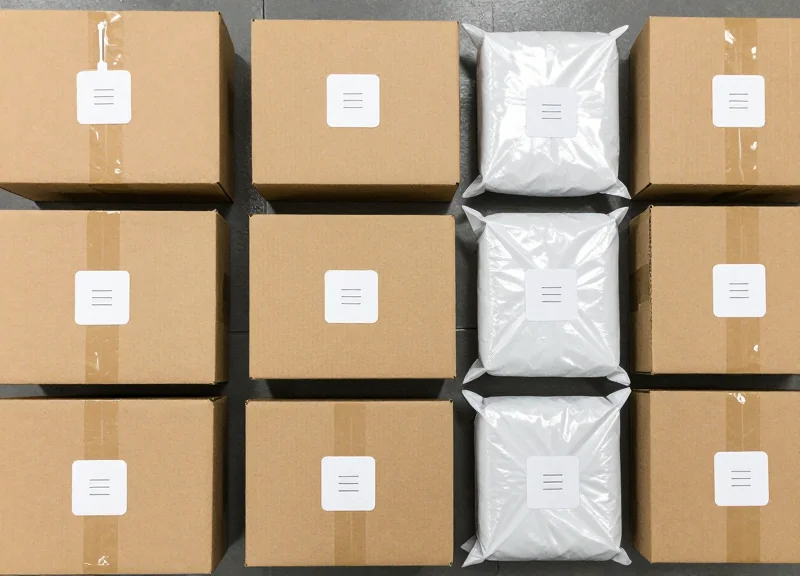
In high-speed RFID environments processing 500+ parcels per minute, tag orientation and packaging materials represent the 'physical layer' constraints that even the most advanced anti-collision algorithms cannot overcome. Successful identification depends on ensuring the RFID inlay's radiation pattern aligns with the reader antenna's polarization while managing the dielectric effects of the parcel's contents. At these velocities, a misaligned tag or an unshielded liquid container doesn't just result in a weak read; it usually results in a complete 'no-read' because the communication window expires before the tag can successfully backscatter its ID.
| Material Type | RF Interaction | Impact on High-Speed Read Rate | Optimization Strategy |
|---|---|---|---|
| Corrugated / Paper | Transparent | Low impact; ideal for high speed. | Standard inlay placement. |
| Liquids / Gels | Absorption | High; attenuates signal significantly. | Use 'Flag' tags or spacers. |
| Metals / Foils | Reflection | Extreme; causes signal nulls/multipath. | On-metal (mount-on-metal) tags. |
| High-Density Plastics | Detuning | Moderate; shifts tag resonant frequency. | Broadband tuned inlays. |
Expert Tip: The Dielectric Shift and Broadband Tuning. A common failure point in high-speed sorting is the 'Dielectric Shift.' When a parcel moves at 2+ meters per second, the proximity to varying belt materials and neighboring parcels can rapidly shift the tag's resonant frequency. To mitigate this, we recommend selecting Broadband Inlays (e.g., those designed to operate across the 860-960 MHz range). These inlays are less sensitive to the 'detuning' effect caused by being applied to different materials, ensuring a stable RSSI (Received Signal Strength Indicator) regardless of whether the parcel contains apparel or dry electronics.
What is the 'Golden Rule' for tag orientation in 360-degree tunnels?
Always utilize dual-dipole or 'omni-directional' tags for parcels with unknown orientation. This ensures that at least one dipole is energized by the reader's field, regardless of how the parcel was tossed onto the conveyor.
How does moisture in cardboard affect high-speed reads?
High humidity or damp corrugated boxes act as a partial RF absorber. In these cases, increasing the reader's power (within local regulatory limits) or using high-sensitivity chips like the Impinj Monza R6 or NXP UCODE 9 is essential to maintain the link budget.
Where is the best place to apply a tag on a multi-material parcel?
Avoid corners or edges where the inlay might be folded. Place tags at least 5cm away from any metal components or liquid containers within the packaging to prevent near-field coupling that can kill the tag's performance.
- Standardize Inlay Placement: Work with shippers to define a 'sweet spot' on the parcel face, typically the top-right quadrant, to minimize the variance in distance between the tag and the overhead antennas.
- Polarization Matching: Match the antenna's circular polarization with tags that have a wide aperture to ensure that the 'searchlight' effect of the antenna captures the tag even during rapid movement.
- Conduct Dielectric Testing: Use a vector network analyzer (VNA) to test how your specific packaging materials detune your chosen RFID tags before deploying at scale.
The Role of Reader Synchronization in Multi-Lane Setups
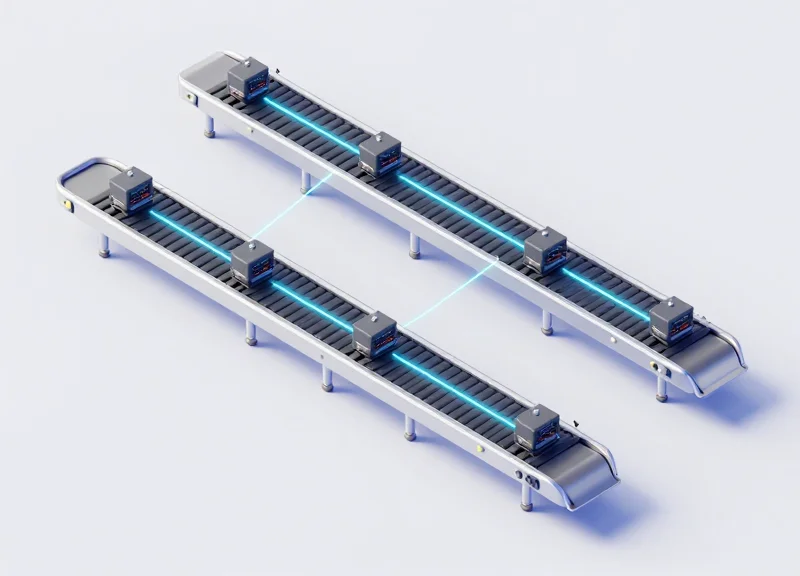
Reader synchronization is the process of coordinating the radio frequency (RF) transmission cycles of multiple RFID readers to prevent 'Reader-to-Reader Interference' (RRI). In high-speed, multi-lane conveyor environments, unsynchronized readers often emit signals simultaneously on overlapping or adjacent frequencies, creating a noise floor that drowns out the weak backscatter signals from tags. Effective synchronization ensures that adjacent readers either transmit at different times (Time Division) or operate on non-interfering channels (Frequency Division), which is essential for maintaining a 500+ PPM throughput without data loss.
In a dense logistics hub, the 'Near-Far Problem' is the primary enemy. A reader on Lane A might be transmitting at 30dBm (1 Watt), while the tag response it is trying to hear on Lane A is arriving at -80dBm. If the reader on Lane B, just six feet away, transmits at the same time, its high-power signal will completely blind Lane A’s receiver. Synchronization mitigates this by turning the facility into a single, cohesive RF ecosystem rather than a collection of independent, clashing devices.
| Method | Mechanism | Best For | Latency |
|---|---|---|---|
| Dense Reader Mode (DRM) | Spectral masking and channel spacing | General multi-reader warehouses | Moderate |
| NTP/Software Sync | Network-based clock alignment | Non-critical timing (>100ms) | High (Network Jitter) |
| Hardwired GPIO Sync | Physical 'Heartbeat' cable via GPIO pins | Ultra-high-speed (500+ PPM) | Near-Zero |
| LLRP Control | Software-defined 'Stop/Start' triggers | Dynamic lane routing | Low to Moderate |
Expert Insight: The 'Master-Follower' Pulse Architecture. For 500+ PPM environments, software-level synchronization via the network is often insufficient due to packet jitter. The gold standard used in Silicon Valley's most advanced automated hubs is a hardware-triggered pulse. By daisy-chaining readers via their GPIO (General Purpose Input/Output) ports, a 'Master' reader sends a 5V TTL pulse that triggers the 'Follower' readers to scan in precise, staggered windows of 20-50 milliseconds. This ensures that no two readers within a 15-meter radius are ever 'hot' at the same microsecond, virtually eliminating the noise floor issues that plague large-scale deployments.
Can I use shielding instead of synchronization?
While RF shielding tunnels (covered in Section 3) help, they cannot block 100% of reflections in a multi-lane setup. Synchronization is required to handle the residual 'leakage' that bounces off metal rollers and neighboring parcels.
Does synchronization slow down the read rate?
Technically yes, as it introduces a 'duty cycle' where readers wait their turn. However, at 500+ PPM, the bottleneck is usually data collision, not airtime. Synchronized reads are far more efficient than repeated, failed attempts caused by interference.
What is the maximum number of readers I can synchronize?
Using standard EPC Gen2 DRM, you can effectively manage up to 50 readers in a single dense environment. For larger setups, physical distance and frequency hopping patterns must be combined with hardwired synchronization.
Real-World Performance Benchmarks and Testing
In a high-speed RFID conveyor environment, performance is measured by the system's ability to maintain a 99.9% read accuracy while processing items at linear speeds often exceeding 2.5 meters per second. Successful benchmarking goes beyond simple 'tag counts'; it involves a multi-dimensional analysis of the 'Read Window'—the nanosecond timeframe where a tag enters, resides within, and exits the RF field. For a system targeting 500+ parcels per minute, the technical benchmark is a throughput of approximately 8.33 items per second with a processing latency of less than 40 milliseconds per unique ID.
| Key Performance Indicator (KPI) | Industry Standard | High-Speed Optimized Goal | Impact on Operations |
|---|---|---|---|
| Read Accuracy (First Pass) | 95.0% - 98.0% | > 99.9% | Reduces manual rework and sortation errors. |
| System Latency | 150ms - 300ms | < 50ms | Ensures diverters act accurately on high-speed belts. |
| Tag Throughput | 200 items/min | 500 - 800 items/min | Enables higher facility throughput and ROI. |
| False Positive Rate | < 2.0% | < 0.1% | Prevents ghost reads from adjacent lanes or bins. |
Expert Insight: The '1,000-Parcel Stress Test' Baseline. When benchmarking, never rely on a 100-item sample. In Silicon Valley logistics hubs, we utilize a 1,000-parcel continuous loop. This reveals 'Thermal Drift'—a phenomenon where reader performance marginally degrades as the internal processor heats up under constant collision-resolution cycles. If your accuracy drops by even 0.2% after 30 minutes of continuous operation, your heat dissipation or cooling protocols in the RFID tunnel are insufficient for high-speed duty cycles.
- Phase 1: Zero-Load Baseline: Run the belt at target speed with zero tags to establish the ambient RF noise floor and ensure no 'ghost reads' are triggered by conveyor motor EMI.
- Phase 2: Single-Tag Latency Test: Pass a single tag through the center of the field to measure the 'Time to First Read' (TTFR) and define the optimal trigger zone for downstream actuators.
- Phase 3: High-Density Saturation: Introduce 50+ tags simultaneously into the read zone. This tests the anti-collision algorithm's efficiency in resolving the Q-parameter and handling 'hidden nodes'.
- Phase 4: Maximum Velocity Stress: Gradually increase belt speed to 110% of the target (e.g., 550 parcels/min) to identify the 'Break Point' where RSSI levels become too unstable for consistent decoding.
How do you account for 'Dead Zones' during high-speed testing?
We use 'Golden Tags'—precisely calibrated reference tags—placed in the most difficult orientations (e.g., perpendicular to the antenna) to map the weakest points in the RF tunnel.
Does conveyor material affect the benchmark results?
Absolutely. Carbon-black reinforced belts can actually attenuate RF signals. Benchmarking must be performed on the actual production belt, not a clean lab simulator.
What is the acceptable variance for RSSI in high-speed environments?
Ideally, RSSI variance should remain within a +/- 3dBm range. Fluctuations greater than 6dBm usually indicate multipath interference or tag detuning caused by proximity to liquids/metals.