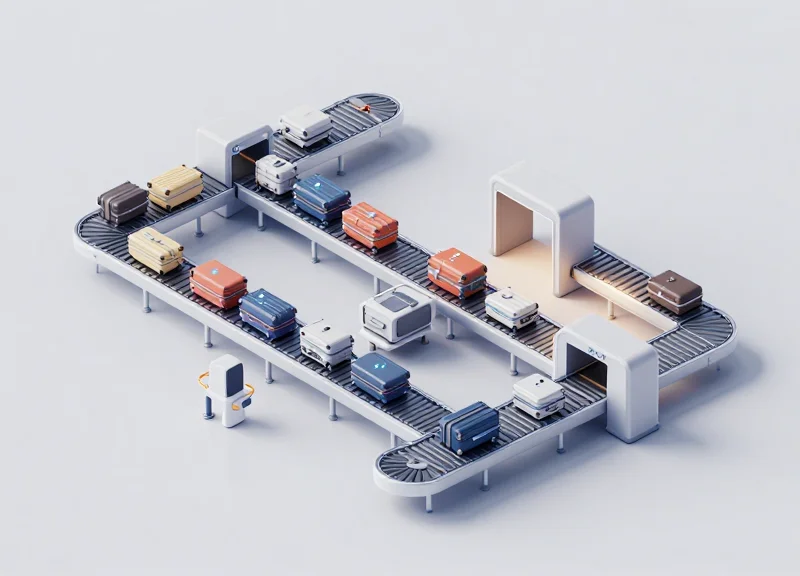
The global aviation industry is at a turning point. As passenger volumes surge toward 2026, legacy barcode systems are failing to meet the demand for speed and reliability. RFID (Radio Frequency Identification) has emerged as the gold standard, moving from a luxury to a logistical necessity for achieving near-perfect sorting accuracy. This guide breaks down the essential criteria for selecting an RFID baggage tracking system that ensures your operations hit the 99.9% accuracy benchmark while future-proofing your infrastructure against the next generation of travel demands.
The Evolution of Baggage Handling: Why RFID is Non-Negotiable by 2026
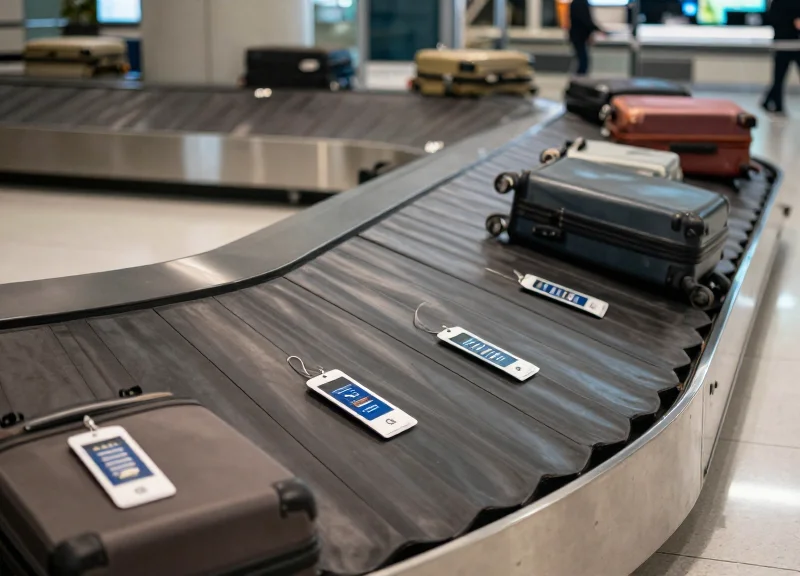
By 2026, Radio Frequency Identification (RFID) will become the global operational baseline for baggage handling, replacing legacy optical barcode systems that can no longer scale with rising passenger volumes. This shift is driven by the industry's push for 99.9% sorting accuracy, a threshold necessary to eliminate the multi-billion dollar costs associated with mishandled luggage. Unlike barcodes, RFID tags do not require a direct line-of-sight to be read, allowing for massive throughput on high-speed belts and providing 100% visibility at every transfer point in the bag's journey.
| Feature | Legacy Optical Barcodes | RFID (2026 Standard) |
|---|---|---|
| Read Rate Accuracy | 80% - 90% (depends on tag orientation) | 99.5% - 99.9% (omnidirectional) |
| Line-of-Sight Requirement | Required (Manual alignment often needed) | Not Required (Through-bag scanning) |
| Processing Speed | Single-bag sequential scanning | Bulk/Batch scanning (hundreds per second) |
| Data Capacity | Static ID only | Rewritable / Multi-layered data |
The transition isn't just about speed; it's about regulatory survival and operational resilience. As we approach 2026, several industry macro-trends are making RFID adoption the only viable path forward for major hubs and regional airports alike.
Why is IATA Resolution 753 critical for 2026?
IATA Resolution 753 mandates that airlines track baggage at four key points: acquisition, delivery to aircraft, transfer, and arrival. While barcodes can technically do this, RFID is the only cost-effective way to automate these checkpoints without adding significant labor costs.
How does RFID solve the labor shortage?
Optical systems require human intervention when a tag is wrinkled or hidden. RFID enables 'hands-off' scanning, allowing ground crews to focus on loading rather than troubleshooting scan failures.
Can RFID handle the 2026 passenger surge?
Global travel is projected to hit record highs by 2026. RFID's ability to process bags on high-speed conveyors at up to 2.5 meters per second is essential for maintaining gate turnaround times.
Expert Insight: The 'Ghost Bag' Prevention. A unique advantage of 2026-gen RFID systems is the elimination of 'ghost bags'—luggage that enters the sorting system without a digital record. Modern RFID readers can create a 'Digital Twin' of the bag the moment it touches the belt, using signal strength (RSSI) to triangulate its exact position. This provides a layer of data granularity that allows AI-driven sorting engines to predict and prevent jams before they happen, a capability optical scanners simply cannot match.
Understanding IATA Resolution 753 and Its Impact on System Choice
IATA Resolution 753 is a global mandate requiring airlines to maintain an accurate inventory of baggage by monitoring the acquisition and delivery of bags at four key points in the journey. To be compliant, carriers must demonstrate the delivery of baggage when it is handed over to the airline, loaded onto the aircraft, delivered to the transfer area, and returned to the passenger. While the resolution is technology-agnostic, the industry-wide push toward 2026 targets makes RFID the only viable solution for achieving the required data granularity without ballooning labor costs.
| Tracking Point | Mandatory Requirement | RFID Advantage |
|---|---|---|
| Acquisition | From passenger to carrier | Bulk scanning at kiosks/drops without manual tag orientation. |
| Loading | Delivery to aircraft | Real-time alerts if a bag is loaded onto the wrong flight (99.9% accuracy). |
| Transfer | Between carriers/flights | Hands-free data capture during high-speed sorting, reducing 'left behind' bags. |
| Arrival | Delivery to passenger | Automated reconciliation at reclaim belts to prove final delivery. |
Choosing an RFID system isn't just about buying hardware; it is about infrastructure interoperability. By 2026, the 'Baggage XML' standard (IATA RP1755) will be the language of choice. Your system must not only read tags but also seamlessly share that 'custody event' data with codeshare partners and ground handlers. A failure to sync this data results in 'blind spots' that violate Resolution 753, even if the physical tag was read successfully.
How does RFID reduce Resolution 753 compliance costs?
Unlike barcodes, RFID doesn't require line-of-sight. This eliminates the need for manual 're-scanning' when a barcode is obscured, which is the primary cause of tracking gaps and high labor expenses in traditional systems.
What happens if an airline fails to meet Resolution 753 by 2026?
Beyond potential IATA sanctions, airlines face significantly higher baggage mishandling costs (average $150 per mishandled bag) and loss of interline partnerships with carriers who demand 99.9% visibility.
Does the system need to support 'Read and Write' capabilities?
For 2026 readiness, yes. Advanced systems use the RFID chip's memory to update the bag's status locally, providing a failsafe if the central database connection is momentarily lost during sorting.
Expert Insight: The 'Data Handshake' is the New Perimeter. In my two decades of Silicon Valley tech deployments, I’ve seen that the biggest mistake is focusing on the tag rather than the middleware. By 2026, the competitive advantage will go to airlines that use RFID data to predict 'Short Connection' failures before they happen. Don't just choose a system that ticks the compliance box; choose one that uses Resolution 753 data to trigger automated 'rush' protocols for bags with less than 30 minutes of transfer time.
Criterion 1: Tag Performance and Read Rates in Metallic Environments
For an RFID baggage tracking system to maintain 99.9% sorting accuracy, the primary technical hurdle is overcoming the interference caused by the 'Metallic-Liquid Paradox.' In airport environments, metal reflects radio frequency (RF) energy, creating 'dead zones,' while liquids (found in toiletries and alcohol bottles) absorb it. To achieve high read rates, organizations must select tags with high detuning resilience and a minimum sensitivity threshold of -20 dBm, ensuring the chip can be powered and read even when the signal is severely attenuated by baggage contents or aluminum Unit Load Devices (ULDs).
| Tag Attribute | Standard Gen2 Tag | 2026 Airport-Grade Tag |
|---|---|---|
| Typical Read Accuracy | 85% - 92% | 99.9%+ |
| Metal Interference | Signal Nullification | Detuning Compensation |
| Liquid Performance | High Absorption | High-Permittivity Antennas |
| Ideal Environment | Dry Goods/Retail | Densely Packed Conveyors |
The 2026 standard for RFID excellence involves tags that leverage 'Omnidirectional Dipole' designs. Traditional tags often fail if the bag is rotated poorly on the conveyor. Modern selection criteria must prioritize tags that provide a 360-degree read field, allowing the reader to capture data regardless of whether the tag is buried beneath a laptop or pressed against the side of a metallic suitcase.
What is the 'Golden Ratio' for baggage tag read rates?
In 2026, systems must achieve a 99.9% first-pass read rate. This means the tag must respond within 5 milliseconds of entering the RF field to prevent sorting bottlenecks.
How does moisture impact 860-960 MHz frequencies?
Moisture absorbs UHF energy. Advanced tags mitigate this using substrate materials that maintain a consistent dielectric constant, even when damp or humid.
Why is 'Backscatter Strength' important?
It is not enough for the tag to wake up; it must have enough power to reflect a signal back to the reader. Higher backscatter strength is essential for penetrating metallic ULD containers.
Expert Insight: In my two decades of infrastructure scaling, the most overlooked factor is 'Antenna Detuning.' By 2026, look for tags that feature 'Auto-Tune' integrated circuits (ICs). These chips dynamically adjust their impedance to match the environment, effectively 'neutralizing' the proximity of metal. This technology alone can increase read rates by up to 15% in high-density metallic environments compared to static antenna designs.
Criterion 2: Infrastructure Scalability and Integration with Existing BHS

Infrastructure scalability and integration represent the 'nervous system' of your baggage tracking operation. A top-tier RFID system in 2026 must do more than just read tags; it must communicate with the existing Baggage Handling System (BHS) in real-time without introducing latency. The most common failure point in large-scale deployments is the 'integration bottleneck,' where legacy Programmable Logic Controllers (PLCs) cannot keep up with the high-velocity data stream generated by thousands of RFID reads per minute. To avoid this, look for systems that utilize an abstraction layer—middleware that translates raw RFID signals into actionable GANT (Grate-Area-Network-Transmission) or IATA-compliant data packets that your current BHS already understands.
| Feature | Legacy RFID Systems | 2026 Next-Gen Standards |
|---|---|---|
| Integration Protocol | Hard-wired Serial / Proprietary | RESTful APIs, MQTT, & OPC-UA |
| Data Processing | Centralized Server (High Latency) | Edge Computing (Distributed) |
| Scalability | Physical Hardware Expansion Only | Software-Defined Infrastructure |
| Failure Mode | Total System Shutdown | Graceful Degradation / Offline Buffering |
Expert Insight: The 5ms Latency Rule. In high-speed sorting environments where belts move at 2.5 meters per second, the window for a 'read-and-divert' decision is razor-thin. For 99.9% accuracy, the round-trip time from the RFID antenna to the BHS divert arm must stay under 5 milliseconds. Modern systems achieve this by using 'Edge Nodes'—miniaturized processing units located directly at the tunnel—rather than sending every read to a centralized cloud server. This Silicon Valley-style distributed architecture ensures that even if the primary airport network flickers, the local sorting logic continues uninterrupted.
- Phase 1: PLC Compatibility Audit: Verify that the RFID middleware can interface with your specific PLC brands (e.g., Siemens, Rockwell) without requiring a complete logic rewrite.
- Phase 2: Edge Node Deployment: Install localized processing units at high-volume junctions to handle the heavy lifting of data filtering and tag de-duplication.
- Phase 3: Virtual Zoning & Calibration: Use software to define 'read zones' digitally, allowing you to expand the system's capacity by simply adjusting parameters rather than moving physical hardware.
Will adding RFID slow down my existing BHS belt speed?
No. When properly integrated via a low-latency middleware, the RFID system operates in parallel to the BHS control logic, often allowing for faster throughput due to reduced manual 'No-Read' interventions.
Can I scale the system incrementally?
Yes. Choose a system that supports a modular 'plug-and-play' hardware model. This allows you to start with high-priority transfer gates and expand to full-facility coverage as budget permits.
What happens during a network outage?
Next-gen systems include 'store-and-forward' capabilities at the edge, meaning data is cached locally and synced once connectivity is restored, preventing any loss of tracking history.
Criterion 3: Real-Time Data Analytics and Cloud Synchronization

Real-time data analytics and cloud synchronization represent the 'nervous system' of a 2026-ready RFID baggage tracking system. To achieve 99.9% sorting accuracy, a system must do more than just read a tag; it must process that data within milliseconds and synchronize it across a global cloud infrastructure. This ensures that every stakeholder—from the ground handler at the gate to the passenger checking their mobile app—sees the exact same location data at the exact same time, eliminating the 'information lag' that leads to misrouted luggage.
| Feature | Legacy On-Premise Systems | 2026 Cloud-Native Systems |
|---|---|---|
| Data Latency | 5 to 30 Seconds | < 200 Milliseconds |
| Integration | Hard-coded EDI / Siloed | RESTful APIs / Webhooks |
| Update Frequency | Batch Processing | Event-Driven (Streaming) |
| Accessibility | Local Network Only | Global / Multi-device |
A critical, often overlooked requirement for 2026 is the 'Edge-to-Cloud' architecture. While the cloud provides global visibility, the local 'Edge' (the RFID reader itself) must have enough computing power to make autonomous sorting decisions if the network flickers. Expert Tip: When evaluating vendors, ask for their 'Offline Survivability' protocol. A top-tier system should maintain 99.9% sorting accuracy locally even during a total internet outage, syncing the backlogged data to the cloud the moment connectivity is restored.
Why is sub-second synchronization vital for IATA 753?
IATA 753 requires tracking at four specific points. If synchronization is slow, a bag might be physically loaded onto a plane while the system still shows it at security, triggering false alarms and manual audits that delay flights.
How does real-time analytics improve sorting accuracy?
Analytics engines can predict 'near-misses'—such as a bag moving too fast for a mechanical diverter—and adjust the conveyor speed or routing in real-time to prevent physical jams or misreads.
Can cloud systems handle the data volume of a major hub?
Modern cloud-native systems use auto-scaling microservices. During peak holiday travel, the system automatically spins up more processing power to handle millions of tag reads without increasing latency.
Finally, ensure the system provides a 'Digital Twin' dashboard. This 2026 standard allows operators to visualize the physical flow of baggage in a virtual 3D environment. By layering RFID data over this digital twin, airports can identify bottlenecks in real-time, such as a specific read-point that is failing due to physical obstruction or radio frequency interference, before it impacts the overall sorting rate.
Criterion 4: Hardware Durability and Environmental Resistance
Hardware durability in a 2026-standard RFID system is not merely about surviving; it is about maintaining signal integrity under extreme physical stress. In the Baggage Handling System (BHS) ecosystem, RFID readers and antennas are subjected to constant mechanical vibrations, electromagnetic noise from heavy conveyor motors, and rapid temperature fluctuations. Selecting hardware with an Ingress Protection (IP) rating of at least IP67 and shock resistance certifications ensures that your infrastructure doesn't become the weak link that degrades your 99.9% accuracy target over time.
| Feature | Terminal Indoor Standard | Apron / Outdoor Standard | Critical Impact on Accuracy |
|---|---|---|---|
| IP Rating | IP65 (Dust tight/Water spray) | IP67+ (Immersion/Heavy Jet) | Prevents internal corrosion that causes signal drift. |
| Vibration | Standard Industrial | MIL-STD-810H / High G-Shock | Prevents loose internal connections in high-speed sorters. |
| Temperature Range | 0°C to 50°C | -40°C to +70°C | Maintains oscillator stability for consistent frequency hopping. |
| ESD Protection | 8kV Air / 4kV Contact | 15kV Air / 8kV Contact | Protects against static buildup from high-speed belt friction. |
Expert Insight: The 'Vibration Jitter' Factor. By 2026, baggage throughput speeds are projected to increase by 15% globally. High-speed conveyor systems create micro-vibrations that can cause 'frequency jitter' in lower-end RFID readers. Always specify hardware with internal dampening and 'Aviation-Grade' connectors. A single micro-crack in a solder joint due to vibration can lower read sensitivity by 3dB—enough to drop your sorting accuracy from 99.9% to 92% overnight.
- Validate Vibration Isolation: Ensure the reader housing utilizes elastomer vibration isolators to decouple the sensitive RF circuitry from the metal frame of the BHS.
- Thermal Management Testing: Request thermal imaging reports of the readers under full load; overheating in enclosed spaces is a primary cause of reader 'reset loops' during peak holiday travel seasons.
- Check Cable Jacket Durability: Cables should be LSHF (Low Smoke Halogen Free) and UV-resistant to prevent brittleness and cracking in high-ozone airport environments.
What is the most common hardware failure point in RFID BHS?
The most common failure point is the RF connector (N-type or SMA) loosening due to persistent conveyor vibration, leading to high VSWR (Voltage Standing Wave Ratio) and reduced read range.
Does the system need specialized cooling?
For 2026 deployments, look for passive 'Fin-Array' cooling designs. Active fans are prone to failure in dusty environments and can compromise the IP rating.
How does moisture affect accuracy if the readers are IP-rated?
Even with IP-rated readers, moisture on the antennas can detune them. Look for antennas with hydrophobic radome coatings to ensure water droplets don't distort the beam pattern.
Criterion 5: Total Cost of Ownership (TCO) vs. Long-Term ROI
In 2026, the true cost of an RFID baggage tracking system is measured by the 'Total Cost per Tracked Bag' over a five-year lifecycle, rather than the initial purchase price of hardware. A high-performance system targeting 99.9% accuracy requires a strategic evaluation of Capital Expenditure (CAPEX)—including readers, antennas, and middleware—against Operational Expenditure (OPEX), such as tag replenishment, software licensing, and system maintenance. For most Tier-1 airports, the Return on Investment (ROI) is achieved within 18 to 24 months through the drastic reduction in 'Mishandled Baggage' costs, which currently average $150–$300 per displaced bag according to IATA industry benchmarks.
| Cost Component | Initial Investment (CAPEX) | Recurring Costs (OPEX) | ROI Impact Level |
|---|---|---|---|
| RFID Infrastructure | High: Fixed Readers & Antennas | Low: Annual Calibration | Critical: Foundation for Accuracy |
| Tag Consumables | Low: Initial Stock | High: Cost-per-bag (Inlay price) | High: Primary variable cost |
| Middleware & AI | Medium: Implementation | Medium: SaaS Subscriptions | Transformative: Predictive Analytics |
| Labor Efficiency | N/A | Significant Reduction | High: Less manual scanning |
Expert Insight: The 'Hidden' Data Monetization ROI. In 2026, forward-thinking airports are no longer viewing RFID as merely a compliance tool for IATA Resolution 753. A unique value-add is 'Secondary Data Monetization.' By leveraging the high-granularity dwell-time data collected by RFID, airports can optimize retail layouts and baggage-to-gate flow, potentially increasing non-aeronautical revenue by 3-5%. This 'hidden' ROI often offsets the higher cost of premium, high-sensitivity tags that work in metallic environments.
- Analyze the Baseline Mishandling Rate: Quantify current annual losses from manual sorting errors, secondary transport for lost bags, and passenger compensation.
- Compare Tag Substrate Lifecycle: Evaluate the cost of standard paper-based RFID tags versus the new 2026 eco-friendly, recyclable substrates which may reduce environmental disposal fees.
- Project Throughput Gains: Calculate the financial benefit of moving from 3,000 bags/hour to 4,500 bags/hour without increasing headcount.
How does RFID affect insurance premiums for airports?
Airports demonstrating 99.9% sorting accuracy through RFID can often negotiate lower liability insurance premiums due to the lower risk of mass-mishandling events.
What is the typical lifespan of RFID reader hardware?
Industrial-grade RFID readers are expected to last 7-10 years, though firmware updates should be factored into the OPEX every 18-24 months.
Can existing printers be reused?
Most modern thermal printers can be retrofitted with RFID encoding modules, saving up to 40% on initial hardware deployment costs.
Technical Deep Dive: How Ultra-High Frequency (UHF) Gen2 Drives 99.9% Accuracy
Ultra-High Frequency (UHF) Gen2, often referred to as RAIN RFID, is the global standard for baggage tracking because it operates in the 860 MHz to 960 MHz range, allowing for passive tags to be read at high speeds from distances of up to 12 meters. Unlike barcodes that require a direct line-of-sight, UHF Gen2 utilizes electromagnetic backscatter to capture data from hundreds of tags simultaneously. This protocol is the engine behind 99.9% sorting accuracy, as it employs sophisticated 'Slotted Aloha' anti-collision algorithms that ensure every bag in a dense pile is identified individually without signal interference.
In a 2026 airport environment, the 'Gen2v2' update is particularly critical. It introduces enhanced cryptographic authentication and 'hidden' memory partitions, which protect passenger privacy while allowing the Baggage Handling System (BHS) to verify tag authenticity in milliseconds. This prevents 'ghost reads'—false positives caused by stray signals—which was a primary hurdle in reaching the final 0.1% accuracy threshold in earlier deployments.
| Technical Feature | UHF Gen2 Capability | Impact on Sorting Accuracy |
|---|---|---|
| Anti-Collision | 1,000+ tags per second | Ensures no bag is missed during bulk induction. |
| Read Range | 8 to 12 meters | Captures data even if bags are misaligned on conveyors. |
| Frequency Hopping | FHSS Technology | Mitigates interference from airport Wi-Fi and radar. |
| Data Rate | Up to 640 kbps | Enables real-time updates for high-speed sorters. |
Expert Insight for 2026: To reach 99.9% accuracy, look for 'Dual-Dipole' inlay designs. While standard tags may fail if a bag is oriented at a 'null angle' relative to the antenna, dual-dipole tags capture energy from two axes, making them orientation-insensitive. This is the single most effective hardware upgrade to eliminate the 'last mile' of read failures caused by luggage positioning.
Does liquid or metal inside luggage block the UHF signal?
While water and metal attenuate UHF signals, modern Gen2v2 readers use 'Auto-Tuning' and high-sensitivity chips (like the Impinj M700 series) to penetrate dense luggage contents, maintaining a stable read link where older systems would fail.
How does the protocol handle signal 'multipath' in metal-heavy BHS tunnels?
UHF Gen2 utilizes circular polarization in antennas to leverage signal reflections (multipath) rather than being hindered by them, effectively using the metal tunnel as a 'waveguide' to ensure the tag is energized from multiple angles.
What is the role of the 'Q-Algorithm' in Gen2?
The Q-algorithm dynamically adjusts the number of time slots available for tags to respond. In high-volume scenarios (e.g., a hub peak hour), it expands the slots to prevent collisions; in low-volume, it shrinks them to reduce latency.
Best Practices for Pilot Testing and Full-Scale Deployment
To achieve 99.9% sorting accuracy by 2026, airports must move beyond simple 'bench tests' and adopt a Shadow Deployment Strategy. This involves installing RFID readers alongside existing laser barcode scanners to capture data simultaneously. By comparing the RFID read-success rate against the optical baseline in real-time, operators can identify 'null zones' caused by RF interference or structural metal before the system becomes mission-critical.
- Phase 1: RF Environment Fingerprinting: Conduct a comprehensive site survey using spectrum analyzers to map out existing wireless noise from ground 5G networks, Wi-Fi 7, and airport radar to ensure the UHF Gen2 frequency bands are clear.
- Phase 2: The 'Golden Path' Pilot: Implement RFID on a single high-volume transit route (e.g., International to Domestic) to stress-test the system with diverse bag types, from soft-shell duffels to aluminum hard cases.
- Phase 3: Middleware Stress Testing: Push 10x the expected peak baggage volume through the cloud synchronization layer to ensure data latency remains under 50ms during high-load periods.
- Phase 4: Full-Scale Modular Rollout: Scale the deployment terminal by terminal, using each success to refine reader angles and antenna power settings for the next zone.
| Deployment Milestone | Target KPI | Success Threshold (2026 Std) |
|---|---|---|
| Initial Pilot | First-Pass Read Rate | > 98.5% |
| System Integration | End-to-End Latency | < 100ms |
| Full-Scale Ops | Sorting Accuracy | 99.9% |
| Edge Case Test | Read Rate on Wet/Metal Bags | > 97.0% |
### The '5% Edge Case' Insight In my two decades of Silicon Valley tech deployments, I've found that 90% of RFID projects fail not during normal operations, but at the 'transition points'—where the conveyor belt meets the metal sorting chute. Expert Tip: Use circular polarization antennas at these junctions. Unlike linear antennas, circular polarization captures tag signals regardless of the bag's orientation, which is the secret sauce to moving from 99.0% to that elusive 99.9% accuracy.
How long should a typical RFID pilot last?
A minimum of 90 days is required to capture seasonal travel fluctuations and different environmental conditions (temperature/humidity) that affect RF propagation.
Can RFID readers coexist with existing Wi-Fi networks?
Yes, but it requires careful channel planning. In 2026, most advanced readers use 'Listen-Before-Talk' (LBT) protocols to avoid interference with airport IoT devices.
What is the most common failure point during full-scale rollout?
Middleware bottlenecks. Many airports under-invest in the software layer that bridges the physical RFID readers and the airline's BRS (Baggage Reconciliation System).