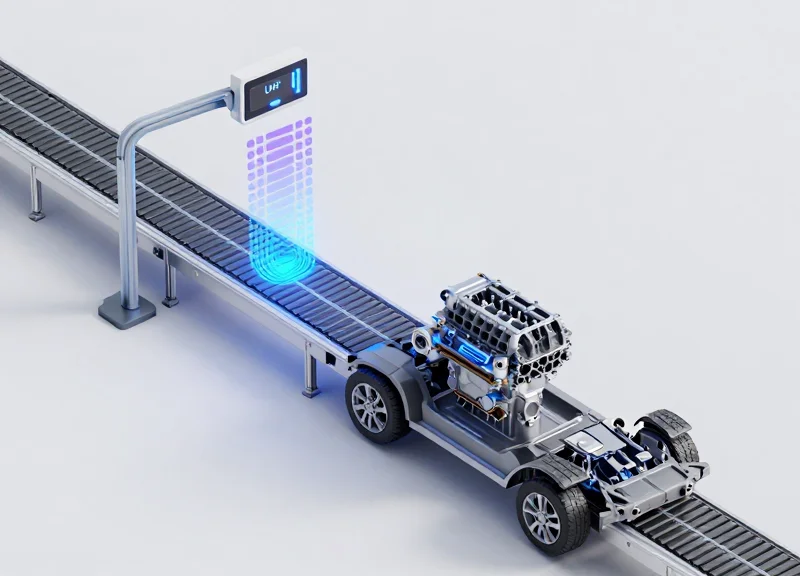
In the high-stakes world of automotive manufacturing, every millisecond counts. The engine-to-chassis pairing process is a critical juncture where timing and precision intersect. Achieving a seamless 0.5-second read-and-pair cycle using UHF RFID technology requires more than just high-end hardware; it demands meticulous calibration and strategic shielding. This guide explores the engineering nuances of optimizing UHF RFID readers to eliminate interference and ensure flawless data capture on a moving assembly line, ensuring that every engine meets its matched chassis with surgical accuracy.
The Challenge of 0.5s Pairing in Automotive Assembly

In high-velocity automotive manufacturing, 0.5-second pairing refers to the critical synchronization window where a UHF RFID reader must identify, validate, and link a specific engine tag to its corresponding chassis tag as they pass a fixed workstation. This 'Golden Moment' of data acquisition is the backbone of Just-In-Time (JIT) production. If the reader fails to capture the data within this 500ms timeframe, the entire assembly line risks a hard stop, resulting in thousands of dollars per minute in lost productivity. The challenge lies not just in the speed of the read, but in ensuring 99.99% accuracy amidst a dense environment of reflective metal and electromagnetic interference.
| Metric | Legacy RFID Standards | Modern 0.5s High-Speed Line |
|---|---|---|
| Validation Window | 2.0 - 5.0 Seconds | Less than 0.5 Seconds |
| Conveyor Speed | 10-15 meters/min | 30+ meters/min |
| Error Tolerance | Low (Manual override possible) | Zero (Full automation required) |
| Environment | Controlled/Static | Dynamic/High Metal Density |
The primary technical hurdle is the 'Multipath Interference' effect. In a chassis marriage station, UHF radio waves bounce off aluminum engine blocks and steel frames, creating 'phantom reads' or signal nulls. When you compress the read window to 0.5 seconds, you lose the luxury of multiple retry cycles. The reader has approximately 100ms to wake the tag, 200ms to read the EPC (Electronic Product Code) memory, and 200ms to transmit and verify that data against the Manufacturing Execution System (MES). Any latency in the reader's firmware or a poorly calibrated antenna gain can cause the system to miss the tag entirely as it moves out of the narrow 'sweet spot' of the read zone.
Why is 0.5 seconds the industry benchmark?
Modern Takt times demand that components move through stations at higher speeds to meet global production targets. A 0.5s window allows for a high-density line where vehicles are spaced closer together without risking a read collision between the current chassis and the following one.
What happens if a 'mismatch' occurs instead of a 'no-read'?
A mismatch—where an engine is paired with the wrong chassis—is a catastrophic quality failure. It leads to incorrect ECU flashing and long-term warranty liabilities. This is why high-speed calibration focuses as much on 'Shielding' as it does on 'Sensitivity'.
Does metal interference increase at higher speeds?
The interference remains constant, but the time available for the reader's anti-collision algorithms to filter out 'noise' from 'signal' is drastically reduced, making the impact of metal interference feel more acute.
Expert Insight: Many engineers mistakenly believe that increasing 'Transmit Power' is the solution to high-speed pairing. In reality, over-powering a 0.5s line often creates 'RF Overspill,' causing the reader to pick up tags from 10 meters away on the buffer line rather than the tag directly in front of it. The secret to 0.5s precision isn't power; it is the surgical application of RSSI (Received Signal Strength Indicator) filtering to create a digital 'curtain' that only accepts signals within a specific decibel range relevant to the 0.5s transit path.
Understanding UHF RFID Physics in Metallic Environments

UHF RFID (860-960 MHz) relies on electromagnetic backscatter, where the reader's signal provides both power and a communication medium for the tag. In an automotive assembly environment, metal acts as a near-perfect reflector, causing signals to bounce and overlap. This creates a 'multipath' environment where waves arrive at the tag or reader at different times and phases, resulting in either constructive interference (strong signals) or destructive interference (null zones) that can lead to missed reads during the critical 0.5s pairing window.
| Parameter | Open Space Performance | Metallic Assembly Environment |
|---|---|---|
| Signal Propagation | Predictable Line-of-Sight (LoS) | Complex Multipath Reflections |
| Dielectric Loading | Minimal Impact | High risk of detuning tag antennas |
| Signal Loss | Follows Inverse Square Law | Unpredictable due to 'Null Zones' |
| Read Rate Stability | High / Constant | Fluctuates with machinery movement |
The most significant hurdle in engine-to-chassis pairing is the 'Faraday Cage' effect. When an RFID tag is placed between large metallic components like an engine block and a vehicle frame, the metal can effectively shield the tag from the reader's energy. To overcome this, engineers must account for the 'Standing Wave Ratio'—a phenomenon where the reflected wave and the incident wave create stationary areas of zero energy. If a tag sits in a null point during the 0.5s window, the pairing fails despite having high transmit power.
Why does metal detune RFID tags?
When a tag is close to metal, the parasitic capacitance between the antenna and the metal surface changes the antenna's resonant frequency, causing it to reflect less power back to the reader.
What is the 'Near-Field' vs 'Far-Field' impact?
In metallic environments, near-field coupling can be used to bypass reflections, but for pairing parts across 1-2 meters, we must manage far-field multipath through precise antenna positioning.
How does polarization help?
Circularly polarized antennas are preferred in metallic zones because they can capture signals that have changed orientation after bouncing off metal surfaces.
Expert Insight: The 'Ghost Tag' Phenomenon. In highly reflective environments, a reader may pick up tags from adjacent cells—meters away—because the metal floor and ceiling act as a waveguide. This is why 'shielding' is not just about blocking interference, but about mathematically shaping the 'Read Zone' using RF absorbers (like carbon-loaded foam) at specific reflection points to terminate the signal before it travels to the next station. Don't just turn up the power; use absorbers to define the 0.5s boundary.
Hardware Selection: Choosing the Right Antennas and Readers
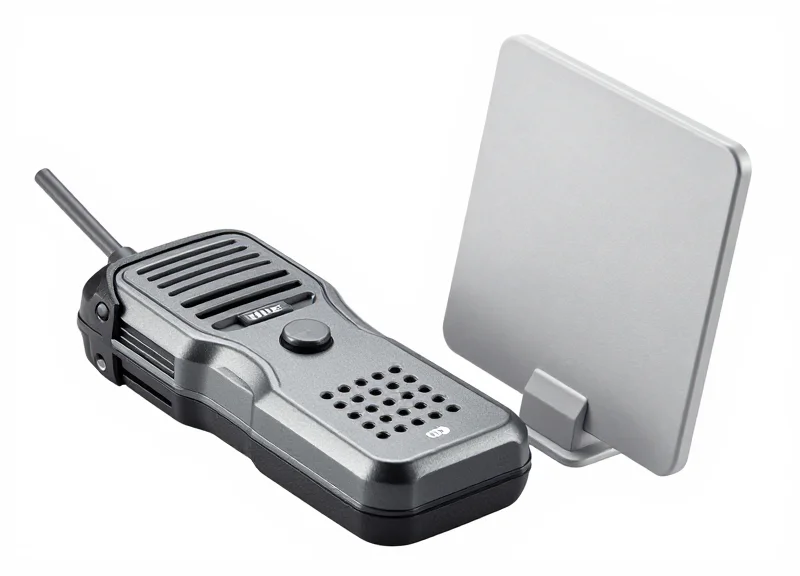
To achieve a precise 0.5-second engine-to-chassis pairing, hardware selection must prioritize Read-Cycle Latency (RCL) and Multipath Rejection. You need a high-performance fixed UHF RFID reader with a processor capable of handling at least 300+ tag reads per second and circular-polarized antennas that mitigate the 'dead zones' common in metallic assembly environments. Standard retail-grade RFID hardware will fail here; industrial-grade components with specialized shielding and high-speed GPIO triggering are non-negotiable for sub-second synchronization.
| Component | Required Specification | Why It Matters for 0.5s Pairing |
|---|---|---|
| RFID Reader | Quad-core 1.2GHz+ / Linux-based OS | Ensures on-reader data processing to minimize network backhaul latency. |
| Antenna Type | Circular Polarized (9 dBic Gain) | Maintains tag readability regardless of engine/chassis orientation and metal reflections. |
| RF Sensitivity | -80 dBm to -85 dBm | Allows for precise 'tight' read zones that prevent cross-talk from neighboring lines. |
| GPIO Response | < 10ms Latency | Enables instantaneous triggering from the PLC (Programmable Logic Controller). |
Expert Insight: The 'Race Condition' of Buffer Management. In my 20 years in the field, I’ve seen the biggest failure point isn't the read speed, but the Reader's Reporting Mode. For 0.5s pairing, you must disable 'Inventory Mode' (which buffers tags) and enable 'Real-Time Event Reporting.' This ensures the tag data is pushed to the PLC the microsecond it is energized, rather than waiting for a poll cycle that might take 200ms—nearly half of your total time window.
Why is Circular Polarization better than Linear in this scenario?
Linear antennas require the tag and antenna to be perfectly aligned. In engine-to-chassis pairing, vibrations and mechanical tolerances can shift orientations; Circular Polarization ensures the RF field reaches the tag from multiple angles, essential for a 0.5s lock.
Do I need Near-Field or Far-Field antennas?
For 0.5s precision, a 'Short-Range Far-Field' setup is best. You need the energy of Far-Field to penetrate through gaps in the engine block, but the power must be attenuated to create a 'bubble' no larger than 1 meter to avoid reading the wrong chassis.
Is PoE (Power over Ethernet) sufficient for these readers?
While PoE is convenient, for high-speed industrial pairing, use PoE+ (802.3at) or a dedicated DC power supply. High-gain bursts required for rapid metal-environment reads can cause voltage drops on standard PoE, leading to dropped packets.
# Example: Configuring Reader for Low-Latency Reporting via LLRP
# Setting the Reader to 'Immediate' report mode to bypass internal buffers
SET_READER_CONFIG:
  ROReportSpec:
    ROReportTrigger: 'Upon_N_TagReports_Or_End_Of_ROSpec' (N=1)
    TagReportContentSelector:
      EnableTimestamp: True
      EnableAntennaID: True
      EnablePeakRSSI: True
Step-by-Step Calibration for Ultra-Low Latency
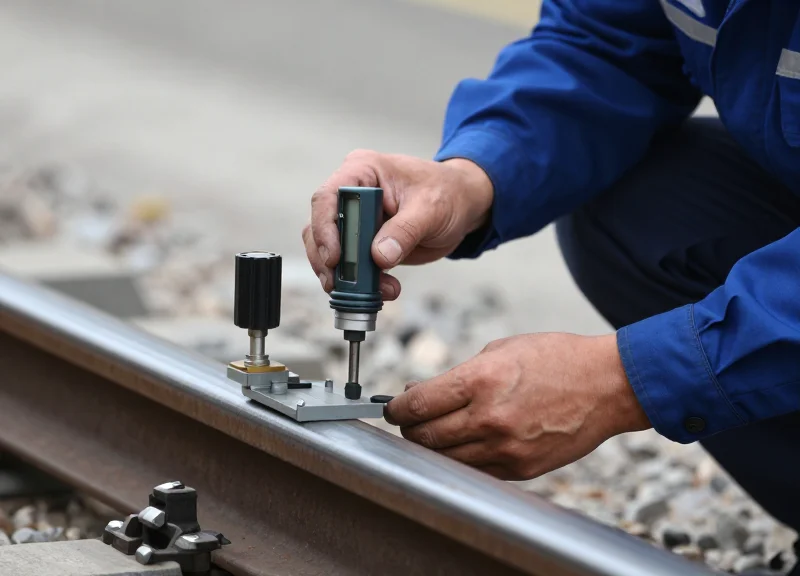
Calibrating UHF RFID readers for ultra-low latency requires shifting from 'maximum sensitivity' to 'precision selectivity.' In a 0.5-second pairing window, the reader must ignore reflections from the metallic assembly environment and isolate the target tag within milliseconds. This is achieved through a combination of Received Signal Strength Indicator (RSSI) thresholding, surgical power adjustments, and the optimization of Gen2 air interface parameters to minimize collision overhead.
| Parameter | Standard Setting | Low-Latency Optimized | Impact on Speed |
|---|---|---|---|
| Inventory Cycle | Variable/Auto | Fixed 25ms - 40ms | Reduces wait time for tag reports |
| Session (S0-S3) | S2 (Persistence) | S0 (Immediate) | Tags respond instantly on every cycle |
| RSSI Threshold | Disabled | -55dBm to -65dBm | Filters out distant/reflected signals |
| Q-Algorithm | Dynamic Q | Fixed Q (0 to 2) | Eliminates empty slot overhead for single tags |
- Establish the RSSI Floor: Place the target engine tag at the exact pairing point. Use a diagnostic tool to monitor the RSSI. If the tag reads at -45dBm, set your 'Read Filter' to -55dBm. This 10dB buffer ensures that stray signals from 1 meter away—which naturally drop in power—never enter the processing queue.
- Optimize Session and Target Logic: For 0.5s pairing, switch to Session 0 (S0). Unlike S2, which waits for a tag to 'rest,' S0 allows the tag to be read continuously. This ensures that the moment the engine enters the field, the reader doesn't wait for a refresh cycle to validate the presence.
- Minimize the Inventory 'Q' Factor: Since engine-to-chassis pairing usually involves only 1 or 2 tags in the field, set a Fixed Q of 0 or 1. This instructs the reader to look for only 1-2 slots per cycle, preventing the processor from wasting milliseconds scanning for hundreds of non-existent tags.
- Fine-Tune RF Power and Pulse: Lower the transmit power until the tag is just barely readable at the required distance, then increase by 3dB. This 'Minimum Viable Power' strategy reduces the 'bloom' of the RF field, preventing it from bouncing off the chassis and reading tags further down the line.
Expert Tip: Implement 'Buffer-Zeroing' at the middleware level. In high-speed automotive lines, the bottleneck is often the reader’s internal buffer holding 'stale' reads from the previous cycle. Force a buffer flush every 200ms to ensure the pairing logic is acting on real-time data, not a cached tag from a chassis that passed by 3 seconds ago.
Why is S0 better than S2 for 0.5s pairing?
S0 does not require a 'flag flip' or persistence time. In a fast-moving line, S2 might 'silence' a tag that we need to confirm multiple times within that half-second window to ensure data integrity.
How do I handle 'Multipath Ghosting'?
Use a Circularly Polarized antenna and set a strict RSSI filter. If a signal is weaker than your calibrated floor, the reader's firmware should drop the packet before it even reaches your application layer.
What is the ideal read rate for this application?
Aim for a 'Read Success Rate' of 40-60 reads per second. This provides enough data points to statistically confirm the tag's identity and position within the 0.5s window while allowing for brief interference dips.
Advanced Shielding Strategies to Prevent Crosstalk

In high-speed automotive assembly, RFID crosstalk occurs when a reader captures tags from an adjacent workstation or a passing chassis further down the line, corrupting the 0.5-second pairing window. Effective advanced shielding prevents this by creating a 'RF-Quiet Zone' using a combination of reflective metallic barriers to bounce signals away and microwave-absorptive materials to eliminate stray energy. By isolating the electromagnetic field to a strict three-dimensional footprint, engineers can ensure that the reader communicates exclusively with the components currently inside the pairing station.
| Material Type | Primary Function | Best Use Case |
|---|---|---|
| Carbon-Loaded Foam | Broadband Absorption | Lining the interior of the read-cell to prevent multipath reflections. |
| Ferrite-Backed Shielding | Magnetic Suppression | Suppressing surface currents on nearby metal machinery or conveyor rails. |
| Conductive Fabric/Foil | RF Reflection | Creating lightweight, flexible curtains for entry and exit points. |
| Aluminum Honeycomb | Directional Isolation | High-strength barriers that allow airflow while blocking UHF waves. |
- Identify the 'Bleed' Vectors: Use a handheld spectrum analyzer to map signal strength outside the intended read zone. Identify areas where RSSI values exceed -70 dBm, as these are the primary sources of potential crosstalk.
- Implement Geometric Obscuration: Position physical barriers so there is no direct line-of-sight between the reader and the next station's tags. Even a 2mm aluminum sheet can attenuate the signal by 30dB if placed correctly.
- Apply Pyramidal Absorbers to Reflection Points: Mount carbon-filled pyramidal foam on the wall opposite the antenna. This prevents the signal from 'bouncing' off the factory wall and back into the engine block from an unintended angle.
Expert Insight: To truly master 0.5s pairing, apply the '10-Degree Tilt Rule.' Never mount shielding barriers perfectly parallel to the engine block or the antenna face. A 10 to 15-degree offset prevents the formation of standing waves between the shield and the target. Standing waves create unpredictable 'hot spots' of signal intensity that can trigger false reads or cause signal nulls, both of which are fatal to sub-second calibration.
Will standard warehouse fencing block UHF signals?
No. Standard chain-link or wire mesh fencing has gaps larger than the UHF wavelength (approx. 33cm), allowing signals to pass through easily. You need solid metal or specialized mesh with openings smaller than 1/10th of the wavelength.
Do I need to shield the floor?
In many automotive plants, concrete floors contain rebar that reflects RF. If you experience inconsistent reads near the bottom of the engine, applying an RF-absorbent mat to the floor directly under the pairing zone is highly recommended.
How does shielding impact reader power settings?
Proper shielding allows you to increase reader power (Transmit Power) without the risk of reading tags in the next bay, effectively widening your 'sweet spot' within the 0.5s window while maintaining strict isolation.
Optimizing Read Zones: Polarization and Beam Angle Tuning
In the high-stakes environment of a 0.5-second engine-to-chassis pairing window, optimizing the read zone is a matter of spatial geometry and electromagnetic alignment. Polarization refers to the orientation of the electric field's oscillation, while the beam angle (or 3dB beamwidth) defines the conical or fan-shaped area where the antenna's signal is strongest. To achieve sub-second precision, the antenna's polarization must match the tag's orientation to maximize energy transfer, and the beam angle must be tightly constrained to prevent the reader from 'seeing' tags on the next chassis in the queue.
| Polarization Type | Ideal Use Case | Power Efficiency | Alignment Sensitivity |
|---|---|---|---|
| Linear (Vertical/Horizontal) | Fixed tag orientation on engines | High (Focused energy) | Extreme (Must match tag exactly) |
| Circular (LHCP/RHCP) | Variable or unknown tag angles | Moderate (-3dB loss vs Linear) | Low (Consistent read regardless of rotation) |
| Dual-Linear | High-speed precision tracking | Very High | Minimal (Captures both axes) |
Expert Tip: The 'Cross-Polarization Penalty' is the most common cause of failed 0.5s pairings. If you use a linear antenna and the engine tag is tilted just 45 degrees, you lose 50% of your power. At 90 degrees, you lose nearly 99% (20dB+). For chassis pairing, where vibration is constant, I recommend a high-gain circular antenna with a narrow beamwidth (less than 60 degrees) to compensate for minor mechanical shifts while maintaining enough power to energize the tag instantly.
- Identify Tag Polarization: Analyze the engine tag's internal antenna structure. Most industrial UHF tags are linearly polarized along their longest axis.
- Map the 3dB Beamwidth: Physically mark the floor where the antenna's signal strength drops by half (-3dB). This is your 'hot zone' for the 0.5s pairing.
- Adjust Antenna Skew: Tilt the antenna 15-20 degrees toward the incoming engine to begin the handshake before the part reaches the center-point of the station.
- Verify with RSSI Heatmapping: Run a series of tests to ensure the Received Signal Strength Indicator (RSSI) is peak at the exact moment of engine-to-chassis mating.
Why not just use a wider beam angle?
Wider beam angles increase the risk of 'false positives' from nearby parts. In a 0.5s window, the reader must ignore everything except the specific part in the pairing zone.
Can I mix LHCP and RHCP antennas?
Avoid mixing Left-Hand and Right-Hand Circularly Polarized antennas in a single zone as they can create destructive interference patterns that cause dead spots.
How does height affect the beam angle?
The further the antenna is from the track, the larger the footprint (read zone). For precision, mount antennas as close to the tag path as safety clearances allow.
Software Integration: Synchronizing RFID Data with PLC Systems

Software integration in high-speed engine-to-chassis pairing is the process of mapping raw UHF RFID Electronic Product Codes (EPCs) to Programmable Logic Controller (PLC) tags through industrial communication protocols. To achieve a 0.5s response time, the system must bypass traditional database middleware and utilize direct, deterministic communication between the RFID reader and the PLC (such as EtherNet/IP or PROFINET). This ensures that the 'Match/No-Match' decision is executed at the edge, preventing network jitter from stalling the assembly line.
| Protocol | Typical Latency | Best Use Case | Integration Method |
|---|---|---|---|
| PROFINET IRT | <1ms | High-speed Siemens environments | GSDML File / TIA Portal |
| EtherNet/IP | 2-10ms | Allen-Bradley / Rockwell setups | EDS File / Add-On Instructions |
| Modbus TCP | 20-50ms | Legacy or simple sensor logic | Register Mapping |
| MQTT/JSON | 100ms+ | Cloud analytics (Not for 0.5s pairing) | Broker Subscription |
- Data Filtering at the Reader Level: Configure the RFID reader to filter duplicate tags and RSSI noise internally. Sending only the 'Strongest Signal' EPC to the PLC reduces the data payload and processing overhead.
- Implementing a 'Heartbeat' Handshake: Establish a bi-directional watchdog timer between the reader and PLC. If the PLC doesn't receive a heartbeat within 50ms, the system triggers a 'Read Fail' state to prevent unverified parts from moving forward.
- Trigger-Synchronized Reading: Use a physical photo-eye sensor wired to the PLC to trigger the RFID reader via a discrete input. This ensures the reader is only active when the engine is in the 0.5s 'Sweet Spot,' minimizing RF clutter.
Expert Tip: To hit the 0.5s benchmark, implement 'Buffer Swapping.' Instead of waiting for a single tag response, have the PLC read from a continuously updated cyclic buffer. This allows the PLC to scan the memory address in its own scan cycle (typically 1-5ms) without waiting for a synchronous request-response round trip from the reader.
IF (RFID_Trigger AND NOT RFID_Busy) THEN
    RFID_Command := 1; // Execute Read
END_IF;

IF (RFID_Data_Ready) THEN
    Engine_ID := RFID_EPC_Buffer;
    Match_Result := Compare(Engine_ID, Chassis_Expected_ID);
    RFID_Command := 0; // Reset for next cycle
END_IF;
How do we handle multiple tags in the field of view?
Apply an RSSI (Received Signal Strength Indicator) filter in the software. The PLC should only accept the EPC with the highest decibel return, which identifies the part physically closest to the antenna.
Can we use a PC-based middleware for this pairing?
While possible, it is discouraged for 0.5s requirements. The OS overhead (Windows/Linux updates, background tasks) introduces non-deterministic latency that can cause intermittent pairing failures.
Testing and Validation: Simulated Stress Runs
Simulated stress runs are rigorous validation protocols designed to push UHF RFID readers beyond their standard operating limits to identify the 'saturation point' where the 0.5s engine-to-chassis pairing requirement fails. By artificially replicating peak production throughput—often at 120% of maximum line speed—engineers can ensure that the reader’s Digital Signal Processor (DSP) and the connected PLC can handle the high-concurrency data bursts without packet loss or latency drift.
- Baseline Performance Characterization: Measure the individual read-to-response time for a single engine-chassis pair moving at standard speed to establish a 'clean room' latency baseline.
- Peak Burst Simulation: Introduce rapid-fire tag presentations using a rotating test jig or a high-speed conveyor loop to simulate a 'tailgating' scenario where parts arrive faster than the 0.5s window.
- RF Noise Injection: Operate neighboring heavy machinery (welding robots, high-torque motors) during the test to validate that the shielding and RSSI thresholds hold up under electromagnetic interference.
- Buffer Exhaustion Analysis: Run the system continuously for 4 hours at peak load to ensure that the reader's internal memory buffer or the PLC's input stack does not overflow, which causes delayed pairing signals.
| Metric | Target Value | Failure Threshold | Mitigation Strategy |
|---|---|---|---|
| Pairing Latency | <450ms | >500ms | Optimize RSSI filters or upgrade DSP cycles |
| Read Success Rate | 99.99% | <99.90% | Adjust antenna beam angle or polarization |
| False Positive Rate | 0% | >0.1% | Increase shielding or tighten 'Keep-Out' zones |
| System Jitter | <20ms | >50ms | Isolate PLC network traffic/prioritize RFID packets |
Expert Insight: The 'Thermal Throttling' Trap. A unique phenomenon often overlooked in validation is the thermal impact on reader performance. During high-intensity 0.5s pairing cycles, the reader’s processor can generate significant heat. In many factory environments, this causes the reader to 'throttle' its processing power to prevent hardware damage, resulting in latency spikes from 400ms to 750ms after an hour of operation. Always perform stress runs in the actual ambient temperature of the assembly line to account for this thermal drift.
Why does my pairing fail only during shift changes?
This is often due to 'Mass Tag Discovery.' During shift changes, more personnel with RFID badges or mobile devices enter the zone, flooding the reader with irrelevant data. Re-calibrate your 'Select' flags to ignore non-industrial EPC patterns.
Is a software-only simulation enough?
No. Software simulations cannot account for the physical multipath interference and RF nulls present on a metallic assembly line. Physical stress runs are mandatory for 0.5s precision.
What is the most common cause of jitter during stress runs?
Network congestion between the reader and the PLC. Ensure your RFID data is on a dedicated VLAN or use a direct PROFINET/EtherNet/IP connection to bypass office-network traffic.
Maintenance Protocols for Long-Term RFID Accuracy
In the high-stakes environment of engine-to-chassis pairing, where 0.5s latency is the threshold between success and a line stoppage, maintenance must be treated as a predictive science rather than a reactive chore. Over time, factors such as mechanical vibration, accumulation of metallic dust, and industrial EMI (Electromagnetic Interference) can cause 'Calibration Drift.' This phenomenon subtly degrades the Signal-to-Noise Ratio (SNR), eventually pushing the read time outside the acceptable window. Maintaining 100% accuracy requires a rigorous protocol that treats the RF environment as a living, changing entity.
| Frequency | Protocol Task | Impact on 0.5s Pairing |
|---|---|---|
| Daily | Visual Inspection & Cleaning | Removes metallic shavings or oil that attenuate RF signal strength. |
| Weekly | RSSI Baseline Audit | Identifies signal degradation before it causes read failures. |
| Monthly | Cable & Connector Torque Check | Prevents intermittent signal loss caused by line vibrations. |
| Quarterly | Firmware & Middleware Optimization | Ensures processing logic is running at peak efficiency for low latency. |
Expert Tip: The 'Ghost Signal Audit'. One of the most overlooked causes of RFID degradation is the introduction of new equipment on the factory floor. Every quarter, perform a scan of the read zone with no tags present. If your reader picks up 'noise' or 'ghost signals,' it indicates that new industrial machinery is leaking RF interference. Adjusting your RSSI filter thresholds to stay 10dB above this new noise floor is critical for maintaining that 0.5s discovery speed.
How does metallic dust affect UHF RFID performance over time?
Metallic dust acts as a microscopic shield. When it accumulates on the antenna radome or the tag surface, it can reflect waves away from the target, increasing the number of read cycles required and breaking the 0.5s latency requirement.
Why is firmware updating necessary for RFID accuracy?
Manufacturers frequently release 'Air Interface' optimizations. These updates refine the reader's anti-collision algorithms, allowing the system to distinguish the correct engine tag from surrounding metal reflections more quickly.
What is the primary indicator that a reader needs recalibration?
Monitor your 'Read Cycle Count.' If the reader previously identified a tag in 2 cycles but now requires 5 or more to validate the ID, your signal margin is shrinking, and a recalibration of the gain and threshold is urgent.
Finally, document every adjustment in a centralized 'RF Logbook.' By tracking how RSSI values change in relation to environmental temperature or humidity, maintenance teams can develop a seasonal calibration profile, ensuring the engine-to-chassis pairing remains precise through every shift, all year round.