In the age of digital transformation, physical libraries and archives face the daunting challenge of maintaining 100% inventory visibility. Traditional barcode systems are labor-intensive and prone to human error, often leading to 'lost' books that are simply misplaced on the wrong shelf. This guide provides a deep technical dive into achieving near-perfect 99.9% accuracy using advanced RFID technology. By integrating high-performance hardware with intelligent middleware, organizations can revolutionize shelf navigation, automate sorting, and ensure real-time tracking that meets the highest industrial standards of precision.
The Evolution of Library Logistics: Beyond Barcodes

The evolution of library logistics represents a fundamental shift from reactive manual scanning to proactive spatial intelligence. While barcodes require individual line-of-sight interactions, RFID (Radio Frequency Identification) enables bulk processing and real-time visibility, allowing libraries to transcend the physical limitations of legacy tracking and move toward 99.9% inventory accuracy. This transition is not merely an upgrade in scanning speed; it is a re-engineering of the library's data architecture, moving from static cataloging to a dynamic, living inventory.
For decades, the barcode was the gold standard of inventory management. However, in a high-volume library environment, the barcode acts as a logistical bottleneck. It necessitates human intervention for every single transaction, leading to 'shelf-drift'—the phenomenon where items are technically 'in stock' in the database but physically misplaced on the shelf, rendering them effectively lost. RFID eliminates this friction by leveraging electromagnetic fields to automatically identify and track tags attached to objects without requiring a direct line of sight or manual orientation.
| Feature | Barcode Technology | RFID (UHF Gen2) |
|---|---|---|
| Read Mechanism | Optical (Line-of-Sight Required) | Radio Wave (Non-Line-of-Sight) |
| Scanning Speed | 1 item per 2-4 seconds | Up to 700-1,000 items per second |
| Data Capacity | Low (Fixed ID Only) | High (Read/Write/Extended Memory) |
| Durability | Low (Susceptible to wear/tears) | High (Encapsulated and protected) |
| Automation Potential | Manual intervention required | Fully autonomous shelf-scanning |
A unique insight into this evolution is what I call the 'Counter-Entropy Factor.' In barcode-based systems, library inventory suffers from natural entropy; the more a collection is used, the less accurate the catalog becomes because manual audits are too labor-intensive to perform frequently. RFID reverses this by allowing for daily, autonomous shelf-auditing. By utilizing mobile RFID readers or fixed overhead sensors, a library can reconcile its physical holdings against its digital database in minutes rather than months, effectively eliminating the 'Ghost Book' problem where catalog entries exist for missing physical items.
Why is 99.9% accuracy impossible with barcodes?
Barcode accuracy is tethered to human performance. Factors like fatigue, missed scans, and 'buried' books that are physically behind others create a permanent margin of error that manual audits can never fully close.
How does RFID improve 'Data Density'?
Unlike a 1D barcode that only contains a pointer to a database entry, modern RFID tags can store transactional history, security status, and precise shelf-coordinate metadata directly on the item itself.
What is the primary technical barrier to RFID adoption?
Historically, the cost per tag and electromagnetic interference (EMI) from metal shelving were barriers. However, the development of UHF Gen2 'On-Metal' tag variants and localized shielding has solved these technical hurdles.
Strategic Hardware Selection: Tags, Readers, and Antennas
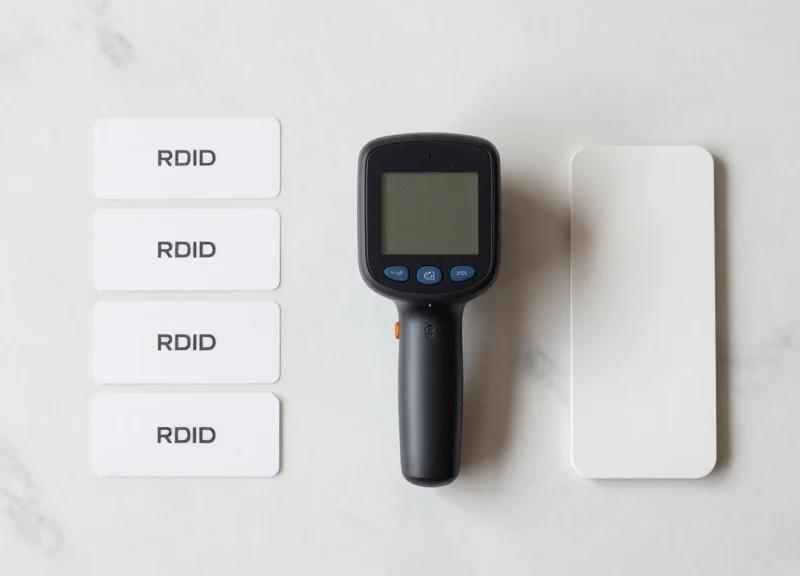
To reach a 99.9% accuracy threshold in real-time book tracking, hardware selection must move beyond 'off-the-shelf' solutions toward a specialized Ultra-High Frequency (UHF) Gen2 architecture. The primary challenge in library logistics is the 'Dense Tag Environment,' where hundreds of tags are packed within millimeters of each other, often adjacent to metal shelving that causes signal reflection (multipath) or absorption (attenuation). Strategic selection focuses on components that offer high 'Read Sensitivity' and 'Circular Polarization' to ensure tag readability regardless of the book's orientation or the shelf's material composition.
| Component | Critical Specification | Why it Matters for 99.9% Accuracy |
|---|---|---|
| RFID Tags | Impinj Monza R6-P / NXP UCODE 8 | High auto-tune capabilities compensate for detuning caused by paper density. |
| Fixed Readers | 4-Port PoE+ with -80dBm Sensitivity | Detects weak backscatter signals from 'shadowed' books in the middle of a shelf. |
| Antennas | Circularly Polarized (Low-Profile) | Eliminates 'blind spots' caused by book spine orientation variations. |
| Cabling | LMR-400 Low Loss Coaxial | Minimizes signal dB loss between the reader and the shelf edge. |
Expert Insight: The RSSI Filtering Edge. While most implementations focus on maximizing read power, the secret to 99.9% accuracy is actually 'Received Signal Strength Indicator' (RSSI) thresholding. By using hardware that supports fine-grained RSSI data, you can programmatically ignore 'stray reads' from the shelf behind or above the target area. This prevents the system from reporting a book as 'present' on Shelf A when it is actually located on Shelf B, a common failure point in high-density tracking.
- Tag Placement Optimization: Select tags with a 'long-aspect ratio' design. These should be placed vertically on the inside back cover, at least 2cm away from the spine to avoid the 'edge effect' where signal quality drops at the book's boundary.
- Reader Density Calculation: Avoid the 'One-Reader-Per-Library' trap. For 99.9% accuracy, implement a distributed architecture where one 4-port reader manages no more than 8-10 meters of shelving to maintain high power density.
- Antenna Beam-Shaping: Use antennas with a narrow vertical beamwidth (approx. 30-40 degrees) but wide horizontal coverage. This 'curtain' effect ensures books are only read when they are physically on the designated shelf.
Can I use standard retail tags for books?
No. Standard tags are often detuned by the high dielectric constant of thick paper stacks. Use tags specifically tuned for 'Class 1 Gen 2' library standards which feature high-interference rejection.
Is metal shelving a deal-breaker?
Not with the right strategy. Use 'On-Metal' spacers or ensure the antenna is mounted with a 5-degree tilt to use the metal shelf as a reflector rather than a shield.
Why circular polarization over linear?
Linear antennas require the tag to be perfectly aligned with the signal. Circular polarization sends the signal in a 'corkscrew' pattern, catching tags even if the book is tilted or placed upside down.
Infrastructure Design: Optimizing Antenna Placement for Full Coverage

Optimizing antenna placement for RFID shelf navigation involves engineering a continuous 'interrogation zone' where signal nulls are eliminated through spatial diversity and beam-forming. To reach 99.9% accuracy, infrastructure must account for the high density of media and the shielding effects of metal shelving. This is achieved by deploying a mix of high-gain circular polarized antennas that provide multi-axial coverage, ensuring that tags are energized and read regardless of whether they are placed on the spine, the cover, or deep within a stack.
| Mounting Configuration | Best For | Signal Characteristic | Coverage Efficiency |
|---|---|---|---|
| Lateral (Side-Mount) | Narrow Aisles | High Penetration | Excellent for spine-facing tags |
| Overhead (Portal) | High Traffic Areas | Wide Field of View | Moderate; prone to top-shelf shadowing |
| Under-Shelf (Discrete) | Dense Stacks | Proximity Focused | Superior for localized inventory accuracy |
| Bistatic (Separated Tx/Rx) | Metallic Environments | Reduced Interference | Highest for eliminating dead zones |
- RF Site Survey and Path Loss Mapping: Before installation, use a spectrum analyzer to map the ambient noise floor and identify existing 900MHz interference sources within the library architecture.
- Calculating Beam Overlap: Design the antenna spacing so that the 3dB beamwidth of adjacent antennas overlaps by at least 25%. This ensures no 'blind spots' exist as a reader moves between zones.
- Cross-Polarization Deployment: Alternate the orientation of antennas along a shelf row. Using a mix of left-hand and right-hand circular polarization (LHCP/RHCP) helps capture tags that may be skewed or tilted.
- Multipath Mitigation: Utilize RF-absorbing materials on the backside of metal end-caps to prevent signal bounce, which can cause 'ghost reads' of items on adjacent aisles.
The Veteran's Tip: The '30-Degree Tilt' Rule. Most installers mount antennas perfectly flush or at 90-degree angles. However, in dense book environments, mounting antennas at a 15 to 30-degree inward tilt creates a 'crossover' wave pattern. This specific geometry forces the RF wave to strike the book tag at an oblique angle, which significantly increases the likelihood of energizing the IC chip in tags that are tightly compressed between high-acidity paper pages—a common failure point in library logistics.
How do metal shelves affect antenna placement?
Metal acts as a reflector and a shield. To overcome this, use 'Near-Field' antennas for bottom shelves or utilize the shelf itself as a ground plane to direct the RF energy upward into the books.
What is the ideal height for overhead RFID antennas?
For standard 7-foot shelving, antennas should be mounted 8 to 9 feet high. Any higher, and the Inverse Square Law significantly degrades the power density reaching the bottom-row tags.
Should I use linear or circular polarized antennas?
Circular is mandatory for book tracking. Linear antennas require the tag and antenna to be perfectly aligned; circular antennas create a corkscrew wave that reads tags in any orientation.
Achieving 99.9% Accuracy: Signal Filtering and Anti-Collision Protocols

To reach the 99.9% accuracy threshold in book tracking, a system must master the 'Air Interface' where hundreds of tags compete for a reader's attention. This is achieved by combining robust hardware-level anti-collision protocols with sophisticated software filtering logic. The goal is to maximize the Signal-to-Noise Ratio (SNR) and ensure that the reader selectively processes only the tags within the intended three-dimensional shelf zone, effectively ignoring 'stray reads' from neighboring aisles or metal interference in the environment.
| Protocol Type | Mechanism | Best Use Case |
|---|---|---|
| Slotted ALOHA | Reader divides time into discrete slots; tags transmit randomly within these slots to minimize overlap. | High-speed mobile scanning (e.g., handheld inventory audits). |
| Binary Tree Walking | Reader interrogates tags by bitwise ID matching, narrowing down the field until a single tag responds. | Static shelf monitoring with extremely high tag density. |
| RSSI Filtering | Filters tags based on Received Signal Strength Indicator values to determine physical proximity. | Eliminating 'cross-talk' from books on the opposite side of a shelf wall. |
| Phase Angle Analysis | Measures the phase of the backscattered wave to detect tag movement and direction. | Real-time sorting and shelf-placement verification. |
While hardware protocols prevent data collisions, software logic is what ensures data integrity. Implementing a 'RSSI Threshold Gate' is critical. By setting a dynamic signal floor, the system can automatically discard weak signals that originate from tags beyond the target shelf's focal point. Furthermore, 'Read Count Persistence' logic prevents the system from logging a book as 'moved' until it has been detected across multiple read cycles, filtering out momentary signal reflections.
- Initialize Q-Algorithm Parameters: Configure the reader to use the EPC Gen2 Q-algorithm, which dynamically adjusts the number of slots available based on the level of collision detected in real-time.
- Apply RSSI Smoothing: Implement a weighted moving average for the Received Signal Strength Indicator (RSSI). This prevents 'signal flickering' where a tag appears to drop out due to environmental interference.
- Set the Occupancy Logic: Define a 'Minimum Read Threshold' (e.g., a tag must be read 5 times in 2 seconds) to confirm the item's presence and eliminate ephemeral ghost reads.
- Execute Directional Logic: If using sorting belts, use the phase difference between two antennas to determine the direction of travel, ensuring the sorting arm triggers with millisecond precision.
Expert Insight: The 'Shadow Zone' Heuristic. Most developers fail by assuming more power equals better reads. In reality, 99.9% accuracy is often achieved by reducing power to create a hyper-defined 'Read Zone.' At our firm, we utilize a technique called 'Temporal Persistence Filtering.' Instead of relying on a single powerful read, we look for 'Data Consistency' over a 500ms window. If a tag's RSSI varies by more than 15% in that window, it is flagged as a reflection rather than a direct line-of-sight read. This single heuristic can reduce false positive sorting errors by up to 40% in metal-heavy library environments.
How do we handle books with metallic or foil covers?
Foil covers act as Faraday cages. We utilize 'Tag-on-Metal' (ToM) spacers or specific dipole antennas that leverage the foil as an extension of the antenna, turning a physical obstacle into a signal booster.
Can RFID protocols differentiate between two books touching each other?
Yes. While physical contact can cause 'detuning,' modern anti-collision algorithms like Tree Walking are designed to isolate individual EPC (Electronic Product Code) headers even when tags are millimetres apart.
What is the biggest cause of accuracy drops?
Multipath interference. This occurs when the signal bounces off floor tiles or metal carts, creating 'ghost' tags. RSSI filtering combined with circular polarization in antennas is the primary defense against this.
Real-Time Middleware Integration with SIP2 and NCIP

Middleware integration is the architectural 'nervous system' that bridges the gap between raw hardware signals and the Integrated Library System (ILS). In a 99.9% accuracy environment, the middleware does not simply pass data through; it filters, aggregates, and validates thousands of RFID tag reads per second, converting them into single, actionable business transactions. By utilizing Standard Interchange Protocol (SIP2) for legacy speed and National Information Standards Organization Circulation Interchange Protocol (NCIP) for complex data exchange, the system ensures that the physical location of a book perfectly mirrors its digital status in real-time.
| Feature | SIP2 (Standard Interchange Protocol) | NCIP (Circulation Interchange Protocol) |
|---|---|---|
| Primary Protocol | Socket-based (TCP/IP) | XML/SOAP or HTTPS |
| Data Complexity | Low (Fixed-length strings) | High (Extensible schema) |
| Best Use Case | High-speed check-in/check-out | Detailed item lookups and inter-library shifts |
| State Handling | Stateless (Requires external logic) | Stateful (Rich object definitions) |
- Event Debouncing and Filtering: The middleware must implement a 'cooling period' for tag reads to prevent a single book from triggering multiple ILS updates if it sits near the edge of an antenna's range.
- Asynchronous Message Queuing: To prevent ILS bottlenecks, use a message broker (like RabbitMQ or Kafka) to queue RFID events, ensuring that spikes in traffic don't result in dropped packets.
- Protocol Translation: Convert raw Electronic Product Codes (EPC) into the standard barcode or item ID formats required by the SIP2 '09' check-in or '11' item status messages.
- Two-Way State Validation: Perform a 'Check-Before-Write' logic where the middleware queries the ILS via NCIP to confirm an item's current status before attempting a location update.
09N20231027 14350020231027 143500AP|AO|AB302140001234|AC|Expert Insight: Beware of the 'Silent Fail' in legacy SIP2. Most SIP2 implementations do not natively support robust error-handling for shelf-location updates. To reach 99.9% accuracy, your middleware should implement a 'Negative Acknowledgement' (NAK) retry logic. If the ILS fails to confirm a location change within 200ms, the middleware should re-queue the event rather than assuming the update was successful. This prevents 'ghost books' that appear on the shelf physically but remain 'In Transit' in the database.
Can I use both SIP2 and NCIP simultaneously?
Yes. Most high-performance systems use SIP2 for rapid-fire circulation tasks (check-in/out) and NCIP for background synchronization and detailed metadata updates.
How does middleware handle 'stray' reads from nearby shelves?
Through Received Signal Strength Indicator (RSSI) filtering. The middleware discards any reads that fall below a specific decibel threshold, ensuring only the strongest (closest) signal triggers a location update.
Does the ILS need to be modified for this integration?
Generally no, provided the ILS supports standard SIP2 or NCIP extensions. The middleware acts as the 'adapter' that makes the RFID hardware look like a standard peripheral to the ILS.
Automated Sorting Workflows: Minimizing Latency in Returns
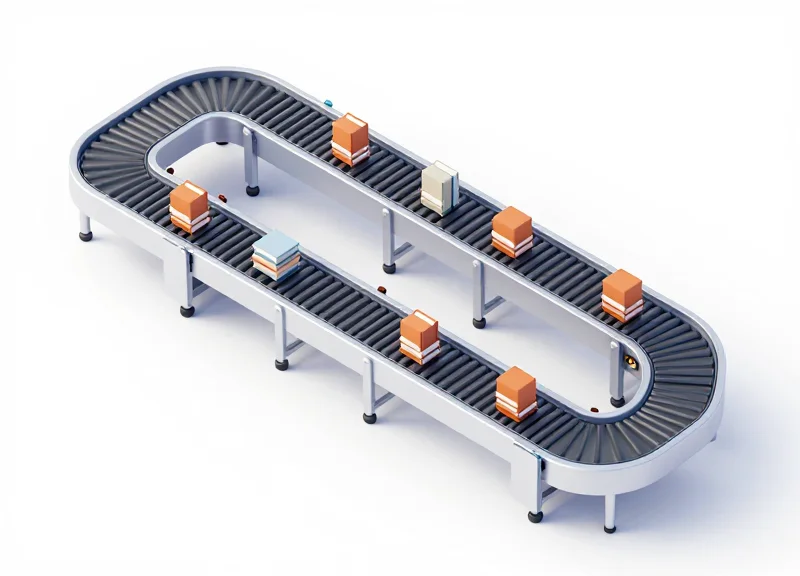
Automated sorting workflows are the mechanical and logical engine of a modern library, designed to eliminate the 'return-to-shelf' delay. By integrating high-speed RFID read stations with programmable logic controllers (PLCs) and diverter gates, a return system can identify, check-in, and route a book to its specific branch or shelf-category bin in milliseconds. The goal of a low-latency system is to achieve near-instantaneous status updates in the Library Management System (LMS), ensuring that items are marked as 'Available' the moment they cross the return threshold, thereby maximizing circulation velocity.
- Detection & Capture: As an item enters the return chute, high-gain shielded antennas capture the RFID tag data. Unlike retail point-of-sale, return antennas must handle 'stacked' items where multiple tags may enter the field simultaneously.
- Asynchronous LMS Handshake: The middleware sends a SIP2 'Check-in' message. To minimize latency, the conveyor does not stop; the system uses a 'Look-Ahead' buffer to process the response while the book is in transit to the first diverter.
- Dynamic Routing Logic: Based on the LMS response (e.g., Hold for Pickup, Damaged, or Return to Shelf), the PLC calculates the precise timing required to activate the pneumatic or electric diverter arm.
- Bin Confirmation: A secondary RFID sensor or photo-eye at the mouth of the target bin confirms the item has successfully exited the main sorter line, closing the transaction loop.
| Component | Latency Target | Critical Success Factor |
|---|---|---|
| RFID Read/Identification | < 200ms | Shielding to prevent cross-reads from adjacent bins. |
| SIP2/NCIP Check-in Loop | < 500ms | Local middleware caching of high-frequency item IDs. |
| Diverter Actuation | < 100ms | High-speed solenoids with millisecond-precision timing. |
| Status Propagation to Web OPAC | < 2s | Websocket-based real-time database updates. |
Expert Insight: Implementing Dynamic Bin Load Balancing. A common bottleneck occurs when a single 'popular' bin fills up, halting the entire sorter. We recommend implementing 'Dynamic Bin Allocation' in your middleware. When Bin A reaches 90% capacity, the system automatically redirects the overflow to an adjacent Bin B and updates the staff sorting app in real-time. This prevents mechanical downtime and reduces the physical strain on staff by spreading the sorting load across the floor.
{
  "event": "item_returned",
  "tag_id": "E004015021A3B2C1",
  "timestamp": "2023-10-27T10:15:30Z",
  "action": "check_in",
  "routing_logic": {
    "if_hold": "divert_gate_01",
    "if_available": "divert_gate_05",
    "default": "manual_review_bin"
  }
}
How do you handle items that fail to read?
The system should include a 'Reject Bin' at the end of the conveyor line. If the RFID tag is damaged or the LMS returns an error, the item is defaulted to this bin for manual processing, preventing the entire line from jamming.
Can the system handle multi-part items like DVD box sets?
Yes, by using 'Parent-Child' tag linking in the middleware. The sorter only clears the item for shelving if all expected tags in the set are identified within the same read window.
What is the ideal conveyor speed for 99.9% accuracy?
The sweet spot is typically between 0.5 to 0.8 meters per second. Going faster risks 'missed' reads due to tag dwell time, while slower speeds create intake backlogs.
Smart Shelf Navigation: Solving the Misplaced Item Problem
Smart shelf navigation is the process of using Ultra-High Frequency (UHF) RFID technology to create a real-time 'digital twin' of physical shelving units. Unlike standard inventory checks that merely confirm an item is present in the building, smart navigation systems use Received Signal Strength Indicator (RSSI) data and phase-based algorithms to determine the exact X, Y, and Z coordinates of every book. This transforms a static library into a searchable spatial database, allowing staff to locate 'ghost' items—books that are checked in but shelved incorrectly—with GPS-like accuracy.
- Spatial Mapping: The system first defines the shelf architecture within the middleware, assigning unique identifiers to every shelf tier and bay.
- Data Acquisition: Autonomous robots or handheld 'wands' scan the shelf faces, capturing tag data along with the reader's own trajectory via LIDAR or IMU sensors.
- Triangulation and Localization: Algorithms analyze the signal peaks to determine the item's position relative to the reader's path, pinpointing the book's sequence on the shelf.
- Exception Reporting: The middleware compares the detected sequence against the Library Management System (LMS) call numbers and flags any items out of alphabetical or numerical order.
| Feature | Handheld RFID Readers | Autonomous Shelf Robots |
|---|---|---|
| Precision | High (depends on operator speed) | Ultra-High (consistent velocity) |
| Frequency | On-demand / Weekly | Continuous / Nightly |
| Labor Requirement | Manual Operation | Zero (Unattended) |
| Data Visualization | List-based alerts | 3D Heatmaps & Real-time Maps |
Expert Insight: Moving Beyond RSSI to PDoA. Most generic RFID systems rely on signal strength (RSSI) to locate items, but in dense book environments, signal reflection (multipath) makes RSSI notoriously unreliable. To achieve true 99.9% accuracy, implement Phase Difference of Arrival (PDoA). By measuring the change in the phase of the backscattered radio wave as the reader moves, the system can calculate the distance and angle of a tag with sub-centimeter resolution, distinguishing between two thin books shelved side-by-side even when their RSSI signatures are nearly identical.
Can RFID find books hidden behind other books?
Yes. UHF RFID signals can penetrate paper and most bindings. However, if a book is tucked behind a metallic object or another RFID-shielded material, the signal may be attenuated, requiring high-sensitivity reader settings.
How does the system handle metal shelves?
Metal shelves can act as reflectors, causing signal interference. We use circular polarized antennas and specialized calibration to turn these reflections into an advantage, effectively 'illuminating' the tags from multiple angles.
Is a robot necessary for a small collection?
Not necessarily. For smaller footprints, handheld readers with 'Geiger counter' modes are more cost-effective. Robots are recommended for collections exceeding 50,000 items where manual shelf-reading becomes logistically impossible.
Security and Privacy: Encrypting RFID Data Streams
Securing RFID data streams in a library environment involves more than simple password protection; it requires the implementation of the EPC Gen2V2 (V2) standard, which facilitates cryptographic authentication and encryption between the tag and the reader. To achieve 99.9% accuracy without compromising security, libraries must deploy mutual authentication protocols that ensure only authorized readers can access sensitive item metadata. This prevents 'skimming'—where unauthorized parties read tag IDs—and 'cloning,' where a tag's identity is duplicated to bypass security gates or misdirect sorting workflows.
| Security Feature | Legacy EPC Gen2 | Modern EPC Gen2V2 (Secure) |
|---|---|---|
| Authentication | One-way (Reader to Tag) | Mutual Symmetric Authentication |
| Data Transmission | Cleartext (Plaintext) | Encrypted via AES-128 |
| Privacy Mode | None / Basic Kill Command | Untraceable (Hides Tag Memory) |
| Cloning Resistance | Low (Fixed EPC) | High (Dynamic Response) |
Expert Insight: Temporal Identifier Rotation. A common oversight in library RFID security is the use of static identifiers that allow for long-term tracking of an asset. For maximum privacy, we recommend implementing 'Temporal Identifier Rotation' within your middleware. By rotating the 'alias' of a high-value item at the middleware level after every successful check-in/check-out cycle, you ensure that even if an adversary captures air-interface packets, they cannot build a historical movement profile of a specific book or the person carrying it.
- Initialize Cryptographic Keys: Load unique 128-bit AES keys into the secure vault of the RFID tags (e.g., NXP UCODE DNA) and the corresponding Hardware Security Module (HSM) in the reader.
- Establish Secure Session: The reader issues a challenge to the tag; the tag responds with a calculated MAC (Message Authentication Code) to prove its identity without revealing its internal secret.
- Encrypted Air Interface: Enable the 'Privileged Mode' to encrypt the communication channel, ensuring that data like the item's SIP2-linked ID is never transmitted in the clear.
// Pseudo-code for Secure Reader Challenge-Response
def authenticate_tag(reader, tag):
    nonce = generate_random_nonce()
    tag_response = tag.calculate_mac(nonce, session_key)
    if verify_mac(tag_response, nonce, hsm_key):
        reader.open_secure_channel()
        return tag.read_encrypted_data()
    else:
        raise SecurityException("Unauthorized Tag Access Attempt")
Does encryption impact the 99.9% read accuracy?
Modern chips with dedicated crypto-engines perform handshakes in milliseconds. While there is a slight overhead compared to cleartext, it does not impact accuracy if the reader's anti-collision algorithms are tuned for the slightly longer duty cycle.
Is on-tag encryption necessary if the database is secure?
Yes. The 'Air Interface' is the most vulnerable point. Without on-tag encryption, an attacker with a high-gain antenna can intercept book IDs from several meters away, bypassing your database security entirely.
How does GDPR affect RFID implementation?
GDPR considers tracking data 'personal' if it can be linked to an individual. Encrypting the tag ID ensures that even if a tag is scanned outside the library, it cannot be linked back to a user's borrowing history.
System Maintenance and Long-Term Scalability
Sustaining a 99.9% accuracy rate in real-time RFID tracking requires a transition from reactive troubleshooting to a proactive, software-defined maintenance model. Long-term scalability is achieved by decoupling the physical sensing layer from the data processing layer, utilizing edge computing to filter noise locally while leveraging cloud-native microservices to handle the global collection state. This ensures that as a library expands its inventory, the increase in data throughput does not degrade system latency or read precision.
| Maintenance Tier | Frequency | Key Action Item | Impact on Accuracy |
|---|---|---|---|
| Signal Integrity Audit | Quarterly | RSSI (Received Signal Strength Indicator) baseline recalibration | Prevents 'dead zones' caused by physical shelf shifts. |
| Firmware Orchestration | Bi-Annually | Over-the-air (OTA) updates to reader DSP algorithms | Improves tag-collision arbitration in dense environments. |
| Hardware Stress Test | Annually | Coaxial cable impedance and antenna VSWR testing | Reduces signal reflection and energy loss. |
| Database Sharding | As Needed | Horizontal partitioning of tag-event logs | Maintains sub-millisecond query speeds for real-time UI. |
Expert Insight: The 'Thermal Drift' Factor. One often-overlooked variable in high-precision RFID is thermal expansion in high-density metal shelving. Minor temperature fluctuations can alter the resonance of antenna mounts or cable connectors. We recommend implementing automated 'Gain Control Loops' within your middleware that adjust reader power levels based on ambient environmental sensors, ensuring the 99.9% accuracy threshold remains stable across all seasons.
- Automated Health Monitoring: Deploy SNMP (Simple Network Management Protocol) agents on every RFID reader to monitor CPU load, memory usage, and heartbeat signals, triggering instant alerts before a hardware failure impacts tracking.
- Decoupled Logic Layers: Use a message broker (like RabbitMQ or Kafka) between the RFID readers and the Library Management System. This allows you to scale the number of readers without overloading the backend database.
- Standardized Tag Provisioning: Enforce a strict EPC (Electronic Product Code) memory map for all new acquisitions to ensure compatibility with future reader generations and specialized sorting hardware.
How do we handle firmware updates without system downtime?
Use a 'Blue-Green' deployment strategy for reader clusters. Update one zone of the library at a time, ensuring the redundant middleware instance handles failover while the primary is being patched.
Can the system handle a 2x increase in book volume?
Yes, provided the middleware is containerized (e.g., Docker/Kubernetes). Scaling vertically by adding more readers is simple, but scaling horizontally via software clusters is what prevents data bottlenecks during peak return hours.
What is the lifespan of an RFID tag in a high-circulation environment?
Passive UHF tags typically last 10+ years. Maintenance focus should be on 'tag health' audits during sorting, where readers flag tags with weak backscatter for proactive replacement.