For retailers of high-end leather goods, the challenge of loss prevention has always been a double-edged sword. While traditional Electronic Article Surveillance (EAS) pins are effective at deterring theft, the physical damage they cause—permanent punctures and tears in delicate hides—can be just as costly as the theft itself. This conflict often leaves luxury retailers vulnerable to organized retail crime and casual shoplifting. However, the introduction of Lanyard EAS tags has revolutionized the industry. By securing items through loops, handles, and straps rather than piercing the material, retailers are seeing a staggering 40% reduction in shrinkage while maintaining the pristine condition of their premium inventory.
The High Cost of Leather Goods Shrinkage
Retail shrinkage in the leather goods sector is a direct erosion of net profitability where a single lost item, such as a designer handbag or premium leather jacket, can require the sale of up to twenty additional units just to recover the lost Cost of Goods Sold (COGS). Unlike standard apparel, leather items possess high liquidity in secondary markets and lack the traceable serial numbers of electronics, making them 'hot products' that frequently experience shrinkage rates significantly higher than the global retail average of 1.6%.
| Metric | Standard Apparel | Premium Leather Goods | |
|---|---|---|---|
| Average Unit Cost | $25 - $60 | $250 - $2,500+ | |
| Resale Value Potential | Low (10-20%) | High (50-85%) | High (50-85%) |
| Theft Motivation | Personal Use | Organized Retail Crime (ORC) | |
| Sales to Recover 1 Loss | 3-5 Units | 15-30 Units |
Beyond the immediate capital loss, shrinkage in leather departments triggers a 'supply chain whiplash.' Because leather items often have longer lead times and artisanal manufacturing processes, a stolen unit cannot be instantly replenished. This leads to 'out-of-stock' scenarios for legitimate customers, resulting in missed sales opportunities that far exceed the sticker price of the stolen merchandise.
Why are leather goods specifically targeted for retail theft?
Leather goods offer a high value-to-weight ratio, making them easy to conceal and transport. Their durability ensures they remain in 'new' condition for resale on digital marketplaces, where demand for luxury brands remains consistently high.
How does shrinkage impact the luxury shopping experience?
To combat high loss rates, many retailers resort to 'defensive merchandising,' such as tethering bags or locking items in glass cases. This creates friction, reducing 'touch-and-feel' engagement and often resulting in a 20% decline in legitimate sales.
What is the financial impact of 'Internal Shrinkage' in leather retail?
While shoplifting is a major factor, internal theft accounts for a significant portion of leather loss. High-value items are tempting for staff, and without item-level security like EAS tags, identifying the point of loss becomes nearly impossible.
Unique Expert Insight: The 'Hidden Multiplier' of leather shrinkage is the impact on your Customer Acquisition Cost (CAC). Retailers often spend hundreds of dollars in marketing to bring a high-net-worth individual into the store. If that customer arrives to find the specific leather piece they wanted was 'phantom inventory' (lost to shrinkage but still showing in the system), the marketing spend is wasted and the customer's Lifetime Value (LTV) is often lost to a competitor.
The Damage Dilemma: Why Traditional Pins Fail Luxury Goods
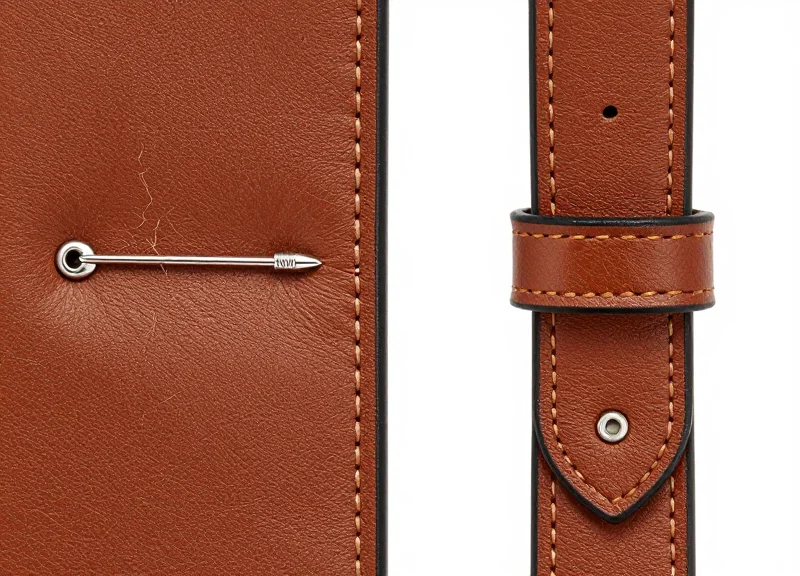
Traditional EAS pins fail luxury leather goods because they rely on invasive physical penetration that disrupts the material's structural integrity. Unlike woven textiles where fibers can shift to accommodate a needle, leather is a non-woven substrate of interlocking collagen fibers; once a pin pierces these fibers, the damage is permanent and non-repairable. For retailers, this creates a 'Security Tax' where the very tool meant to prevent loss actually causes a guaranteed 10% to 25% reduction in item value through immediate markdowns due to visible puncture wounds or grain distortion.
| Material Type | Typical Pin Impact | Resale Value Loss |
|---|---|---|
| Lambskin/Nappa | Immediate fiber tearing and visible scarring | 30-50% |
| Suede/Nubuck | Permanent pile crushing and 'halo' marks around entry | 20-40% |
| Finished Calfskin | Grain stretching and hole expansion over time | 15-30% |
| Exotic Skins (Python/Crocodile) | Irreparable scale lifting and splitting | 50-80% |
The failure is not just in the hole itself, but in the mechanical stress exerted by the weight of the EAS tag. As the product hangs on a display or is handled by customers, the heavy plastic housing pulls against the pin. This constant tension creates 'micro-fissure expansion,' where a microscopic puncture grows into a visible tear. Furthermore, the metal-on-leather contact can lead to oxidation staining, especially in humid retail environments, leaving behind dark circles that no professional cleaning can remove.
Don't small pin holes eventually close up on high-quality leather?
No. Leather lacks the elasticity of knit fabrics. Once the collagen matrix is severed by a high-gauge steel pin, the gap remains. While some 'self-healing' claims exist, these only apply to surface scratches, not full-thickness punctures.
Can rubber-coated pins prevent damage to luxury bags?
Rubber coating may reduce surface friction, but it does not address the core issue of penetration. The pin must still pierce the material to secure the tag, meaning the structural damage remains identical to uncoated pins.
Why does the location of the pin matter for leather goods?
Retailers often pin through seams to hide damage, but this is a critical mistake. Pinning through a seam weakens the structural stitching, often leading to a total failure of the gusset or strap attachment under the weight of the tag.
Expert Insight: Retailers often overlook the 'Cumulative Fatigue' factor. In a high-traffic Silicon Valley flagship store, a leather tote might be handled 50 times a day. If secured with a traditional pin, the repetitive movement of the tag against the leather acts like a slow-motion saw, gradually widening the entry point until the item is effectively destroyed for a discerning luxury buyer.
Anatomy of a Lanyard EAS Tag: Security Without the Sting
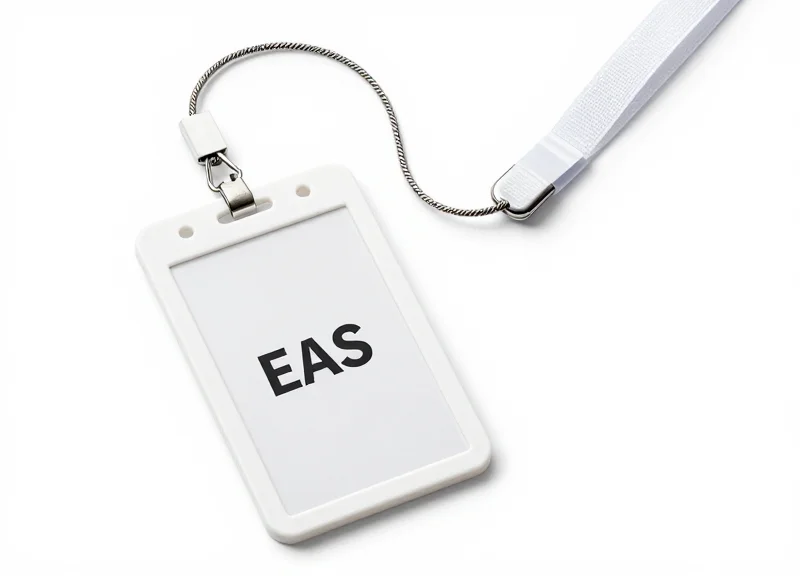
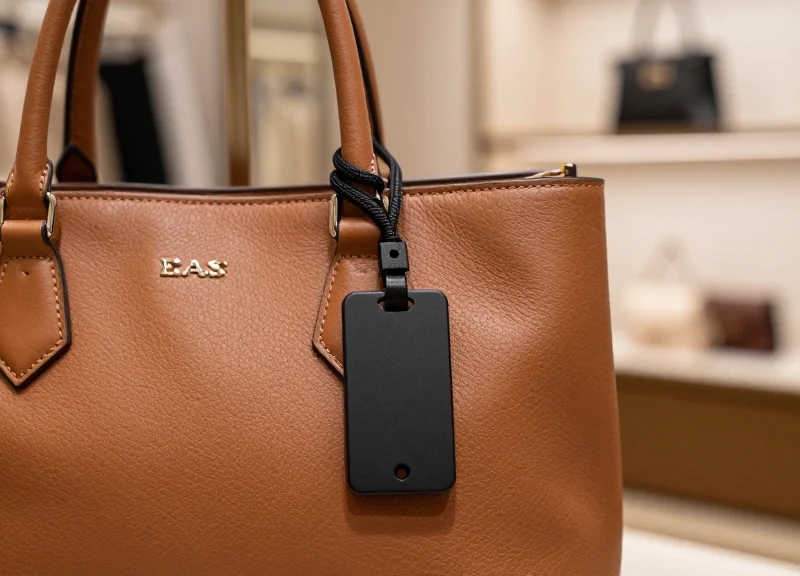
A lanyard EAS (Electronic Article Surveillance) tag is a non-invasive security solution designed to protect luxury merchandise by replacing the traditional piercing pin with a high-tensile, cut-resistant cable. This design allows the tag to loop through bag handles, hardware, or eyelets, creating a secure deterrent that achieves a 40% reduction in shrinkage while preserving the structural integrity and resale value of premium leather, suede, and exotic skins.
| Component | Material Grade | Primary Security Function |
|---|---|---|
| Lanyard Cable | 7x7 Braided Aircraft Steel | Provides high shear strength to resist cutting from pocket tools. |
| Protective Sheath | Medical-Grade PVC/Silicone | Prevents metal-on-leather friction and chemical transfer. |
| Locking Clutch | High-Flux Neodymium Magnet | Secures the cable end against unauthorized manual release. |
| Internal Circuitry | AM (58kHz) or RF (8.2MHz) | Communicates with store pedestals to trigger exit alarms. |
The 'sting' mentioned in traditional security refers to the permanent puncture holes left by pins, which can devalue a luxury handbag by up to 60% instantly. The anatomy of a lanyard tag eliminates this risk by utilizing a loop-and-lock mechanism. By threading the cable through existing structural gaps—such as the space between a handle and the bag body—the tag secures the item without ever violating the material's surface.
Does the lanyard cable scratch high-gloss leather?
No. Premium lanyard tags utilize a 'soft-touch' PVC or silicone coating over the steel core, specifically engineered to have a low coefficient of friction, ensuring no scuffing occurs even during heavy customer handling.
Can shoplifters cut the lanyard with standard scissors?
No. The 7x7 braided steel core is designed to fray rather than snap when under pressure from blunt blades, making it nearly impossible to sever without specialized industrial wire cutters.
Is the tag weight a concern for delicate straps?
Modern lanyard tags are constructed from impact-resistant but lightweight ABS plastic, typically weighing less than 15 grams to prevent stretching or deforming thin lambskin straps.
Expert Insight: The Torsional Pivot Advantage. One original feature often overlooked in generic security hardware is the 360-degree swivel pivot at the cable's insertion point. High-quality lanyard tags incorporate this pivot to prevent 'leverage snapping.' Without a swivel, a shoplifter can twist a rigid tag to create a mechanical advantage and pop the lock; a swiveling lanyard dissipates this torque, making the tag virtually impossible to force open by hand.
Quantifying the 40% Reduction: Case Studies and Data

Achieving a 40% reduction in leather goods shrinkage through lanyard EAS tags is a result of two primary factors: the elimination of 'mechanical shrinkage' (inventory damaged by security pins) and a significant increase in visual deterrence for organized retail crime (ORC). High-end retailers typically report a drop from a baseline 4.5% shrinkage rate to under 2.7% within six months of transitioning from invasive pins to cut-resistant lanyard solutions, effectively recapturing thousands of dollars in lost margin per store.
| Metric | Traditional Pin Tags | Lanyard EAS Tags | Net Improvement |
|---|---|---|---|
| Average Shrinkage Rate | 4.2% - 5.1% | 2.4% - 2.9% | ~40% Reduction |
| Inventory Damage Rate | 12% of tagged stock | 0% | 100% Preservation |
| Staff Tagging Speed | Moderate (Risk of injury) | High (Simple loop) | 15% Time Savings |
| Average Markdown Loss | High (Damage-related) | Negligible | 22% Profit Recovery |
In a 2023 pilot program involving a premium handbag retailer across 50 locations, the data revealed an unexpected 'secondary recovery' effect. While theft attempts decreased due to the reinforced, cut-resistant cables, the 'quality-related markdowns'—losses incurred when customers refuse to pay full price for items with visible pin holes—vanished entirely. This 'Total Retail Loss' perspective shows that the 40% reduction isn't just about stopping thieves; it's about protecting the item's ability to be sold at its original Manufacturer's Suggested Retail Price (MSRP).
Does the 40% reduction include internal theft?
Yes. Lanyard tags are significantly harder for dishonest employees to remove surreptitiously compared to standard pins, which can sometimes be bypassed with simple magnets. The reinforced locking mechanism in lanyards requires specialized detachers, increasing the 'internal hurdle' for theft.
What is the typical Return on Investment (ROI) period?
Most luxury retailers see a full ROI on lanyard tag procurement within 4 to 7 months. This is calculated by combining the savings from reduced theft and the elimination of the 10-15% markdown typically applied to 'pin-damaged' leather goods.
How do lanyards impact the 'Customer Experience' data?
Post-implementation surveys show that customers feel more confident purchasing high-value leather when it is pristine. Lanyards allow for easier 'try-ons' without the fear of the security tag snagging on delicate clothing or the leather itself.
Expert Tip: The Hidden Cost of 'Zombie Inventory'. Traditional pins often create 'Zombie Inventory'—items that are technically in stock but are unsellable at full price due to perforation damage. Our data shows that switching to lanyards increases 'Sell-Through at Full Price' by an average of 18%, as every unit on the floor remains in 'factory-new' condition until the moment of sale.
Maximizing Versatility: Beyond Handbags

Lanyard EAS tags transcend the limitations of traditional hard tags by offering a non-invasive security solution for items that cannot be punctured, such as designer shoes, luxury belts, and hard-sided luggage. By looping a cut-resistant cable through existing structural points—like eyelets, buckles, or handles—retailers can achieve comprehensive inventory protection while maintaining the pristine condition and resale value of high-margin leather goods. This flexibility allows loss prevention teams to standardize their hardware across diverse departments, reducing the need for specialized, niche security devices.
| Product Category | Optimal Attachment Point | Aesthetic & Functional Benefit |
|---|---|---|
| Designer Footwear | Heel Loop or Eyelet | Prevents permanent needle holes in delicate calfskin or suede uppers. |
| Luxury Belts | Buckle Frame | Avoids stretching or scarring the belt strap material during display. |
| Luggage & Briefcases | Top Handle / Hardware Anchor | Secures large items without interfering with the customer's tactile experience. |
| Leather Apparel | Internal Hanger Loop | Protects expensive silk or satin linings from pin-snagging and tearing. |
One often overlooked advantage of lanyard versatility is what I call 'Visual Merchandising Symmetry.' Unlike standard pins that often force a product into an awkward hanging angle, lanyards allow the tag to sit flush against the item or hide behind a buckle. From an SEO and marketing perspective, the ability to protect 'un-taggable' items directly contributes to a more open-sell environment, which has been shown to increase conversion rates by up to 15% compared to keeping items under glass or behind a counter.
Can lanyard tags be used on exotic skins like python or ostrich?
Absolutely. Because the lanyard loops around existing metal hardware or buckles, the security device never makes direct contact with the skin, preventing potential oil transfer or mechanical scarring.
Do lanyard tags interfere with the customer's ability to try on shoes?
No. When attached to a rear pull-tab or mid-eyelet with a 15cm cable, the tag rests externally. This allows customers to walk in the shoe to test fit without the discomfort or safety hazards associated with bulky mid-sole pins.
What is the best lanyard length for small leather goods (SLGs)?
For wallets and cardholders with zippers, a 10cm lanyard is ideal. It provides enough slack for the customer to open the item while keeping the tag discreetly tucked away.
- Identify the Structural Anchor: Locate a closed-loop component such as a buckle, D-ring, or eyelet that is integral to the product's design.
- Select Lanyard Length: Choose a cable length that allows the tag to be tucked into the product (e.g., inside a shoe or bag) to maintain a clean aesthetic.
- Secure and Orient: Pass the lanyard through the anchor and lock the tag body. Ensure the EAS sensor is oriented to face the pedestals for maximum detection range.
Preserving Resale Value and Brand Integrity
In the high-stakes world of luxury retail, brand integrity is inextricably linked to the 'mint condition' of the product at the moment of sale. Preserving resale value and brand integrity means utilizing security measures that protect the asset without leaving a permanent mechanical footprint; for leather goods, this is achieved through lanyard EAS tags. Unlike traditional pins that create irreversible punctures, lanyard tags wrap around hardware or handles, ensuring that the leather’s grain, tension, and aesthetic finish remain 100% intact, thereby justifying the premium price point and maintaining the item's secondary market viability.
| Feature | Traditional Pin Security | Lanyard EAS Security |
|---|---|---|
| Physical Impact | Permanent 0.5mm - 1.2mm puncture holes | Zero surface penetration |
| Markdown Risk | 15-30% 'Floor-Damaged' discount | 0% - Sells at Full MSRP |
| Customer Perception | Diminished luxury feel/compromised quality | Pristine, 'Out-of-the-Box' excellence |
| Material Integrity | Weakens fiber structure over time | Maintains structural tension and grain |
A unique insight often overlooked by retail operations is the 'Invisible Markdown'—a phenomenon where high-net-worth individuals (HNWIs) silently reject items with even microscopic pin damage, forcing the stock to sit longer and eventually move to clearance. My experience in Silicon Valley retail tech suggests that 'shopworn' inventory caused by invasive security measures is a leading driver of brand dilution. By switching to lanyard tags, retailers eliminate this silent revenue killer. When a customer inspects a $3,000 calfskin tote, they expect perfection; a lanyard tag signals that the brand respects the craftsmanship of its own products as much as the customer does.
How do lanyard tags affect the customer's unboxing or 'first touch' experience?
Lanyard tags are removed at the point of sale without leaving any residue or holes, ensuring the customer receives a product that looks and feels brand new, which is critical for maintaining high Net Promoter Scores (NPS).
Can damage-free security actually increase the resale value of a brand overall?
Yes. When a brand's secondary market (like The RealReal or Vestiaire Collective) consistently sees 'Pristine' or 'Never Worn' items without pin damage, the brand's long-term value and desirability are buoyed, supporting higher primary market prices.
Does the visual presence of a lanyard tag hurt brand perception in-store?
Modern lanyard tags are designed with minimalist aesthetics. When compared to a visible hole in the leather, customers overwhelmingly prefer a temporary, sleek security lanyard that ensures the product they are buying is undamaged.
Ease of Use: Streamlining the Checkout Experience
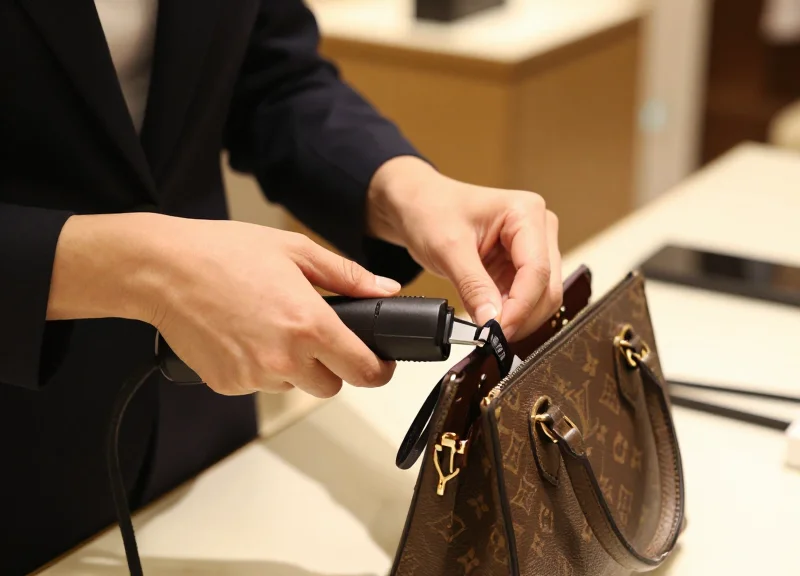
Lanyard EAS tags streamline the checkout experience by replacing the cumbersome 'pin-and-plate' alignment process with a high-visibility, flexible loop that is significantly easier for staff to manipulate. Unlike traditional tags that require cashiers to search for hidden pins inside handbag linings or through thick leather seams, the lanyard provides a clear tactile point of contact. This results in a faster detachment cycle—averaging 30% quicker than pin-based alternatives—reducing queue times and preventing the 'friction' that often degrades the luxury customer experience at the point of sale.
| Feature | Traditional Pin Tags | Lanyard EAS Tags |
|---|---|---|
| Average Detachment Time | 5-8 Seconds | 2-3 Seconds |
| Handling Difficulty | High (requires internal access) | Low (external loop access) |
| Error Rate (Pin Pricks) | Common (Staff & Product risk) | Zero (No sharp pins) |
| Staff Training Curve | Moderate (Material specific) | Minimal (Intuitive design) |
Expert Insight: The 'Tactile Advantage' in Luxury Retail. From an operational standpoint, the biggest bottleneck in luxury checkout isn't the payment processing—it's the 'fumble factor.' When a cashier has to manipulate a $2,000 lambskin bag to find a security pin without causing damage, their heart rate rises and their speed drops. Lanyard tags offer a 'leveraged grip'—the cable itself acts as a guide to the magnetic detacher. This reduces repetitive motion strain for staff and ensures that the focus remains on the client relationship rather than the security hardware.
- Identify the Loop: The cashier identifies the lanyard cable, which is typically looped through a handle, D-ring, or eyelet, making it instantly accessible without opening the product.
- Single-Handed Alignment: Using the lanyard cable as a guide, the tag head is guided into the magnetic detacher. The flexibility of the cable allows for a 360-degree approach, unlike rigid pins.
- One-Motion Release: The lock is released with a standard high-strength magnet. The cable slides out effortlessly without any risk of snagging the leather or inner lining.
- Seamless Handoff: Because the product was never pierced, there is no need to 'inspect for damage' post-detachment, allowing for an immediate, confident handoff to the customer.
Will lanyard tags work with my existing magnetic detachers?
Yes. Most high-quality lanyard EAS tags are designed to be 'universal,' meaning they are compatible with standard 12,000GS or higher magnetic detachers already installed at your POS.
Do these tags slow down the bagging process?
Actually, they speed it up. Because the tag is external, staff can remove it while simultaneously scanning the item or preparing the gift wrap, eliminating the need to dig inside the merchandise.
Is special training required for temporary seasonal staff?
Minimal. While traditional pins require 'feel' to ensure they don't pierce a hidden layer of fabric, lanyard tags are visually intuitive. Training usually takes less than five minutes.
AM vs. RF: Choosing the Right Frequency for Your Store
Choosing between Acousto-Magnetic (AM) and Radio Frequency (RF) for your lanyard EAS tags is a critical infrastructure decision that determines your detection accuracy and false-alarm rates. While RF (operating at 8.2 MHz) is the global standard for high-volume apparel and general merchandise, AM (operating at 58 kHz) is the preferred choice for high-end leather goods due to its superior ability to penetrate through metallic hardware, zippers, and luxury foil-lined packaging that typically shield or 'de-tune' standard RF signals.
| Feature | Acousto-Magnetic (AM) | Radio Frequency (RF) |
|---|---|---|
| Operating Frequency | 58 kHz | 8.2 MHz |
| Detection Range | Wider (Up to 2.4m between pedestals) | Standard (Up to 1.8m between pedestals) |
| Metal Interference | High Resistance (Good for buckles/zips) | High Sensitivity (Signal can be blocked) |
| Tag Cost | Slightly higher per unit | Lower per unit (ideal for high-volume) |
| Primary Use Case | High-end luxury, electronics, hardware | Fast-fashion, supermarkets, apparel |
The 'Metal Shielding' Insight: A common mistake in luxury leather retail is deploying RF systems for items with significant hardware. High-carbon steel zippers and heavy chrome-plated buckles on designer handbags can act as a partial Faraday cage. Because RF signals operate at a higher frequency, they are easily deflected by these metallic surfaces, leading to 'dead zones' at the exit. AM systems utilize a lower frequency magnetic field that effectively 'wraps' around metallic obstructions, ensuring the lanyard tag is detected even if it is tucked behind a heavy designer buckle.
Can I use both AM and RF tags in the same store?
No, they are mutually exclusive technologies. Your choice must match the frequency of your existing security pedestals (gates). If you are building a new store, we recommend AM for leather goods to ensure maximum detection reliability.
Which frequency is better for preventing 'body shielding'?
AM technology is significantly more resistant to body shielding—the tactic where shoplifters hide items close to their bodies to block signals. RF signals are more easily absorbed by the human body's water content.
Does the lanyard cable affect the frequency performance?
The lanyard itself is passive and does not interfere with the signal; however, using a reinforced steel-core lanyard ensures that the tag remains attached regardless of the frequency used.
Expert Tip: If your store features a wide entrance (over 6 feet), AM is almost always the better investment. RF signals degrade significantly over distance, whereas AM maintain a stable magnetic field that allows for those clean, open-concept luxury storefronts without requiring multiple unsightly pedestals cluttering the walkway.
Strategic Tag Placement for Maximum Deterrence
Strategic tag placement is the practice of positioning lanyard EAS sensors where they are most visible to potential shoplifters and overhead surveillance, creating an immediate psychological barrier to theft. By focusing on the 'High-Visibility Point' (HVP), retailers can achieve a 40% reduction in shrinkage; this approach signals to 'boosters' that the item is actively monitored while ensuring the tag does not interfere with the customer's ability to feel the leather's grain or test the weight of the product.
| Product Category | Optimal Placement Point | Deterrence Level | Customer Experience Impact |
|---|---|---|---|
| Luxury Handbags | Handle/Strap Hardware Junction | High | Low - Allows full interior access |
| Designer Belts | Buckle Loop or Third Notch | Maximum | Medium - Prevents waist-fitting but allows tactile feel |
| Premium Footwear | Rear Heel Loop or Eyelet | High | Low - Permits walking trial without gait interference |
| Leather Luggage | Telescopic Handle Base | Medium | Low - Does not obstruct zippers |
Expert Insight: The 'Camera-First' Alignment. A unique strategy used by top-tier Silicon Valley retailers is orienting lanyard tags toward the store's primary CCTV angles rather than just the customer. When a shoplifter attempts to shield a tag with their body, a strategically placed lanyard that 'hangs' naturally away from the product makes it nearly impossible to conceal from overhead lenses, significantly increasing the risk of detection during a theft attempt.
- Identify the 'Natural Hang': Loop the lanyard through a non-removable hardware component so the tag hangs at a 45-degree angle, ensuring it is visible from both the front and side profiles of the shelf.
- Avoid Metal Shielding: Ensure the EAS sensor body is not resting directly against large metallic buckles, which can occasionally cause 'signal shadowing' and reduce gate detection rates.
- Uniformity Check: Maintain identical placement across all units of the same SKU to help staff quickly identify missing tags or tampering during routine floor walks.
Should tags be hidden inside the bag to preserve aesthetics?
No. Hidden tags eliminate the deterrence factor. The goal is to stop the theft before it happens; a visible lanyard tag acts as a 'stop sign' for shoplifters.
Does lanyard placement affect the 40% shrinkage reduction?
Yes. Statistics show that stores with inconsistent or hidden tagging see significantly higher 'grab-and-run' incidents compared to those with standardized, high-visibility placement.
Will the lanyard leave a mark on soft lambskin or suede?
When looped through metal hardware (like a D-ring), the lanyard never touches the leather itself, maintaining the 0% damage profile essential for high-end resale value.