
In the fast-paced world of logistics and retail, high-density item stacking is a logistical necessity that often creates a nightmare for RFID accuracy. Signal shielding, or the 'shadow effect,' occurs when closely packed items block or reflect RF energy, preventing tags in the center of a pallet or stack from being energized. As industry veterans, we understand that achieving 100% read rates isn't just about turning up the power; it is about a sophisticated orchestration of hardware placement, firmware tuning, and environmental management. This guide provides a deep technical dive into overcoming these challenges to ensure your data remains flawless.
The Physics of Shielding: Why High-Density Stacks Fail
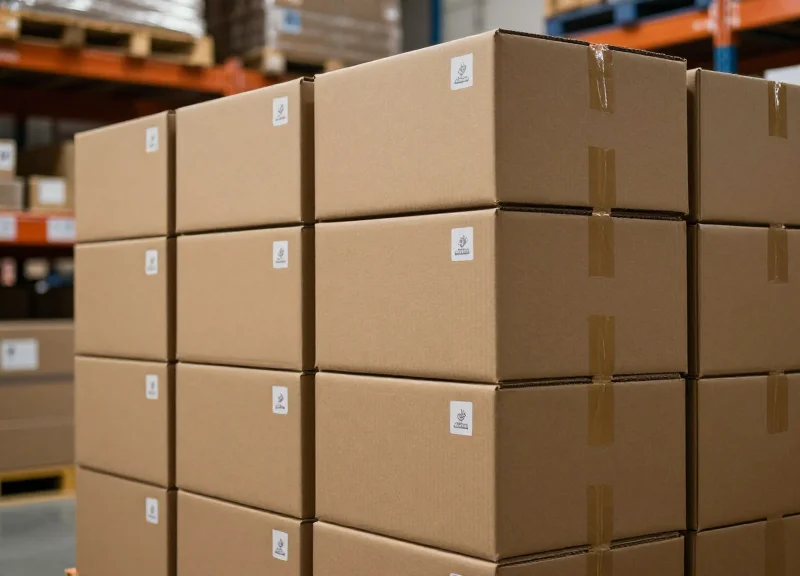
Signal shielding in high-density RFID stacks occurs when electromagnetic energy is absorbed, reflected, or refracted by closely packed items, preventing the reader's signal from reaching internal tags or the tag's response from returning to the antenna. This failure is primarily driven by RF attenuation—the gradual loss of signal intensity as it passes through a medium—and electromagnetic shadowing, where the outer layers of a stack act as a physical barrier that creates 'RF dead zones' within the core of the pallet or container.
| Material Class | Dielectric Constant (er) | RF Impact Level |
|---|---|---|
| Air (Ideal) | 1.0 | No Interference |
| Cardboard / Dry Paper | 2.0 - 3.5 | Low to Moderate Attenuation |
| Plastics (PE/PP) | 2.2 - 2.6 | Low Refraction |
| Glass | 4.0 - 10.0 | Significant Refraction |
| Water / Liquids | 80.0 | Extreme Absorption |
| Conductive Metals | Infinite | Total Reflection / Shielding |
Beyond simple blockage, the 'Dielectric Loading Effect' is the hidden killer of accuracy in dense environments. When RFID tags are sandwiched in high-density stacks, the proximity of materials with high dielectric constants shifts the tag's resonant frequency. An inlay tuned for 915 MHz in open air may shift to 850 MHz when packed tightly, effectively 'detuning' the tag so it can no longer communicate with the reader, even if the RF signal manages to penetrate the stack.
What is the 'Shadowing Effect' in RFID?
Shadowing occurs when items on the periphery of a stack absorb or reflect so much energy that a 'shadow' is cast over the items in the center. In dense cardboard or plastic packaging, the cumulative loss can reach 20-30dB, reducing signal strength by 99% before it reaches the middle of the pallet.
How does moisture affect high-density reads?
Even trace amounts of moisture in cardboard (hygroscopy) significantly raise its dielectric constant. This leads to higher RF absorption, turning a standard pallet into a localized 'Faraday-like' cage that traps energy instead of allowing it to propagate to the inner tags.
Why does increasing reader power often fail to fix the problem?
Simply increasing transmit power (Tx) often exacerbates the problem by increasing multipath interference and noise floor levels. The higher power reflects off the outer layers, creating destructive interference patterns (nulls) that make the internal 'blind spots' even more difficult to penetrate.
Expert Tip: To overcome physics-based shielding, focus on 'Circular Polarization' and 'Spatial Diversity.' Instead of overpowering the stack, utilize multiple antenna angles to exploit small RF 'fissures' or gaps between items, allowing the signal to bounce into the center of the stack via multipath propagation rather than trying to punch through it directly.
Optimizing Antenna Polarization: Circular vs. Linear
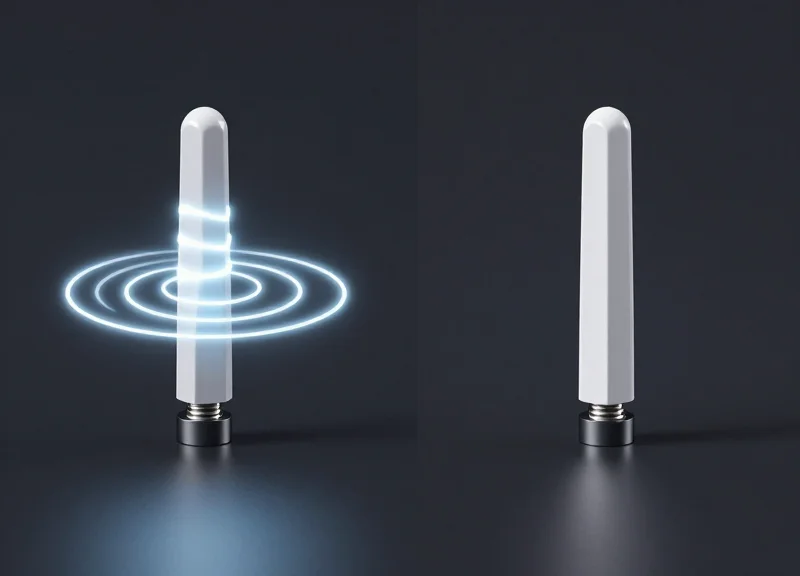
In high-density RFID environments, the choice between circular and linear polarization determines whether a reader identifies every tag or suffers from chronic missed reads. Linear polarization offers the longest read range but requires tags to be perfectly aligned with the antenna's electric field. Circular polarization, by contrast, emits RF energy in a corkscrew pattern, allowing it to energize tags in any orientation—a non-negotiable requirement for dense stacks where tag placement is inherently chaotic.
| Feature | Linear Polarization | Circular Polarization |
|---|---|---|
| E-Field Orientation | Single Plane (Horizontal or Vertical) | Rotating (360 Degrees) |
| Effective Range | High (Maximized Power) | Moderate (Split Power) |
| Orientation Sensitivity | Extremely High | Low (Orientation Independent) |
| High-Density Suitability | Poor (Misses misaligned tags) | Excellent (Captures all angles) |
When dealing with high-density stacks, such as palletized consumer goods or library returns, you cannot guarantee that every tag's inlay will be parallel to your antenna. Linear antennas create 'blind spots' for any tag rotated 90 degrees relative to the signal. Circular polarization solves this by ensuring that the electromagnetic wave eventually intersects the tag's antenna regardless of its physical tilt, making it the industry standard for automated sorting and dense inventory management.
- Expert Tip: The 3dB Penalty Rule: When switching from linear to circular polarization, you must account for a 3dB loss in peak gain because the power is split into two orthogonal planes. In high-density tuning, compensate for this by increasing the reader's power output (dBm) or using a high-gain circular antenna to ensure the 'on-tag' energy remains above the activation threshold.
- Why not always use Linear?: While linear provides more 'punch' for long-distance, single-tag reads, its failure rate in dense stacks is high. If a tag is perpendicular to a linear field, it receives near-zero energy, leading to a 'null' result even if the tag is only inches away.
Can I mix linear and circular antennas?
Yes. This is often called 'spatial diversity.' Using a linear antenna for long-range approach and circular antennas for the dense focal point can maximize read rates, though it requires careful power balancing to avoid reader collision.
How does polarization affect backscatter?
Circular antennas are more resilient to multipath interference (reflections off metal or liquids), which is common in high-density stacks, because the reflected signal's handedness changes, allowing the antenna to filter out late-arriving noise.
Advanced Reader Power Tuning: The Sweet Spot for Sensitivity
Findin g the 'Sweet S pot' i n RFID tunin g mean s ident ifying the pr ecise trans mit po wer (dBm ) and recei ve se nsiti vity t hresh old th at ma ximiz es tag energiz ation witho ut ov ersat urati ng th e envi ronme nt wi th re flec tive n oise. In hig h-den sity st acks, exces sive p ower causes 'RF flood ing,' where multi -path refle ctions off me tallic or liq uid-c ontai ning i tems creat e pha se ca ncell ation, leadi ng to blin d spo ts an d dec rease d re ad ac curac y.
| Sett ing Type | Impact o n High-D ensity St acks | Recomme nded Adju stment |
|---|---|---|
| Tr ansmi t Pow er (dBm) | Hi gher powe r inc rease s pen etrat ion bu t r aise s the n oise floo r. | St art low (20d Bm) and i ncrem ent by 1d B unt il d ead zone s d isap pear. |
| R eceiv e Sen sitiv ity (dB m) | De termi nes the f ainte st sig nal t he r eader can 'h ear.' | Se t to -70dB m or hi gher to fil ter o ut w eak, errat ic b ounce d si gnals. |
| D well Tim e | Th e du ratio n th e re ader sta ys o n a singl e an tenna. | In creas e to 100- 200m s to allow f or s ignal stabi liza tion in d ense pack s. |
Mo st eng ineer s make the mi stake of assu ming hi gher power equal s bet ter re ads. Ho wever, the Inv erse Squa re La w of Inter ferenc e sugg ests th at d oubli ng you r po wer quadru ples the bac kscat ter n oise in a cl utter ed env ironm ent. The u nique insig ht h ere i s 'L ess i s Mor e': by redu cing po wer to the mi nimum nece ssary to ac tivat e the dee pest tag, you d rasti cally impr ove t he Si gnal- to-No ise R atio (SN R), allo wing the r eader to d istin guish betwe en legi timat e tag resp onses and RF e choes.
- Baseli ne Sc annin g: Se t th e re ader to a mod erate powe r le vel (25 d Bm) and reco rd RSS I (Rece ived Si gnal Stre ngth Indi cator ) va lues for all v isibl e ta gs.
- Ident ifying Sat urati on Points: In creas e po wer unti l RSSI va lues plat eau. Thi s i s you r m aximu m ef fecti ve po wer; any thing beyo nd th is point onl y a dds nois e.
- Adju sting Rec eive Thres holds: Ra ise the rece iver sens itivi ty f loor (e.g., f rom -80d Bm to -65d Bm). This 'de afen s' the r eader to w eak, multip ath r eflec tions whil e fo cusin g on str ong, direc t-lin e si gnals.
- Val idati ng th e F ringe: Te st r eads on the corn ers a nd b ottom of the st ack; if tags ar e mi ssed, sligh tly i ncrea se tr ansmi t po wer rath er th an lowe ring the rece iver floor.
Why a re m y tags 'gho sting' in the s ystem ?
Gho sting or phan tom r eads o ccur when powe r is too h igh, caus ing the r eader to pick up ta gs fr om a djacen t doc k do ors or bins. Lower ing t ransm it po wer and incr easin g the rece ive thres hold u suall y fi xes t his.
How does d ielect ric c onsta nt a ffect tuni ng?
Hig h-die lectri c ma teria ls (li ke w ater) abs orb RF. For t hese stack s, you may n eed higher tr ansmi t po wer bu t a lowe r Re ad R ate (Gen2 sessi on s etting s) to allow tags m ore t ime to char ge.
Implementing Anti-Collision Algorithms and Session Logic

In high-density environments, signal collision occurs when multiple tags attempt to respond to a reader's query simultaneously, resulting in an RF 'wash' that renders data unreadable. Implementing Anti-Collision Algorithms and Session Logic allows the reader to orchestrate the response timing of thousands of tags using the EPCglobal Gen2v2 protocol. By effectively silencing 'already-read' tags, the system clears the RF spectrum, allowing weaker or partially shielded signals from the center of a stack to finally reach the antenna.
The engine behind this orchestration is the Q-Algorithm, a dynamic Slotted Aloha protocol. In a dense stack, a static Q-value leads to inefficiency; instead, the reader should utilize an adaptive Q-algorithm. This allows the reader to expand the number of 'slots' (time intervals) when it detects high collision rates and contract them as the population is successfully inventoried, ensuring that even the most obscured tags have a dedicated window to broadcast.
| Session | Persistence | Best Use Case | Behavior |
|---|---|---|---|
| S0 | None | Single item tracking | Tags respond every time they are energized. |
| S1 | 500ms - 5s | Fast moving conveyors | Tags stay 'quiet' briefly after being read. |
| S2/S3 | Minutes/Indefinite | High-Density Stacks | Tags remain in 'State B' even if power is momentarily lost. |
Expert Tip: The 'Target B' Rotation Strategy. In extreme density scenarios—such as 500+ items packed tightly—use Session 2 with a 'Target B' filter. Because S2 persistence remains active even during brief power drops caused by shadowing, you can physically rotate or shift the stack while the reader is active. The reader will ignore the tags it has already successfully 'flipped' to State B, focusing 100% of its RF energy and processing cycles on the shielded tags that only become visible as the physical orientation of the stack changes.
What is the 'Inventory Flag' in Gen2v2?
Each tag has an A and B flag for every session. When a reader identifies a tag, it 'flips' it from A to B. By setting the reader to only search for 'Target A' tags, you ensure that identified items stop talking, leaving the airwaves clear for unidentified items.
How does Session 2 handle 'Ghosting'?
Ghosting occurs when a tag is momentarily shielded and loses power. Session 2 persistence ensures the tag remembers it was already read for several minutes, preventing it from waking up and 'colliding' with unidentified tags once power is restored.
What is the ideal Q-Value for 1,000+ items?
Start with an initial Q of 15 (which creates 32,768 slots). While this seems high, it significantly reduces initial collisions in dense environments, allowing the reader to more quickly whittle down the population to a manageable level.
Physical Geometry: Gate and Portal Configurations

In high-density RFID environments, the physical geometry of your portal is the most critical factor in overcoming the 'Shadow Zone'—the interior area of a stack where tags are physically shielded by surrounding items. To achieve 100% accuracy, hardware must be configured in a multi-axial array that ensures volumetric illumination. This means designing a read zone where signal vectors intersect from multiple heights and angles, effectively encircling the stack with RF energy to find paths through the gaps between products.
| Configuration Type | Antenna Count | Best Use Case | Coverage Characteristic |
|---|---|---|---|
| Standard Dual-Sided | 4 Antennas | Uniform pallets with low liquid/metal content. | Good lateral coverage; weak at top/bottom centers. |
| The 'V-Portal' (Staggered) | 6 Antennas | Mixed SKU floor loads and tall stacks. | Reduced null zones via non-parallel wave fronts. |
| 360 Surround Tunnel | 8+ Antennas | High-density pharmaceutical or apparel cases. | Complete volumetric saturation; minimizes orientation sensitivity. |
- Identify the 'Critical Path' Dimensions: Measure the maximum height, width, and transit speed of the stack. The read zone must extend 20% beyond the stack boundaries to account for beam divergence.
- Implement Spatial Diversity: Place antennas at varying heights (e.g., 2ft, 4ft, and 6ft) on both sides of the portal. Avoid perfect symmetry, as perfectly aligned antennas can lead to standing wave nulls.
- Tilt for Depth Penetration: Angle the top antennas downward at 15-20 degrees and the bottom antennas upward. This 'cross-fire' geometry forces the RF signal into the interstitial spaces of the stack.
Expert Tip: Utilize 'Staggered Height Phasing.' In my 20 years of field deployments, I have found that placing antennas at identical heights on opposite sides of a gate often creates destructive interference patterns that hide tags in the exact center of the pallet. By offsetting the right-side antennas by 10-15 centimeters relative to the left-side antennas, you shift the phase centers and effectively 'vibrate' the read field across the interior of the stack, catching tags that would otherwise remain in a dead zone.
How far apart should portal antennas be placed?
Generally, antennas should be between 8 to 12 feet apart. Any wider and you lose the power density required for high-density penetration; any narrower and you risk 'near-field' coupling issues.
Does floor material affect portal geometry?
Yes. Concrete with heavy rebar acts as a ground plane, reflecting signals. We recommend elevating the bottom antenna at least 18 inches off the floor to prevent unwanted signal bounce.
Can I use floor-embedded antennas?
For high-density stacks, floor antennas are highly effective as they address the 'bottom-up' shielding that occurs when products are stacked directly on wooden pallets.
Mitigating Material Interference: Metal and Liquid Strategies

Mitigating material interference in RFID systems involves neutralizing the 'RF-opaque' properties of metals, which reflect signals and cause multipath interference, and liquids, which absorb UHF energy via dielectric loss. In high-density stacks, achieving 100% accuracy requires a two-pronged approach: hardware isolation (using specialized on-metal or spacer tags) and software-level signal filtering to distinguish between valid tag responses and parasitic reflections. Without these strategies, signal shielding effectively creates 'dead zones' within a pallet or container where tags remain invisible to the reader regardless of power settings.
| Material Type | Interference Mechanism | Recommended Tag Class | Tuning Focus |
|---|---|---|---|
| Conductive Metals | Reflection / Detuning | On-Metal (PCB) / Foam Spacer | Multipath Mitigation / RSSI Thresholding |
| Aqueous Liquids | Absorption / Attenuation | Flag Tags / Encapsulated Spacers | High-Gain Penetration / Low-Frequency Shift |
| Composite Stacks | Hybrid Blockage | Near-Field / Far-Field Hybrid | Antenna Diversity / Spatial Multiplexing |
- Material-Specific Tag Mapping: Select tags with a 'spacer' or 'stand-off' design. For metals, the tag needs a physical gap or a ferrite backing to prevent the metal surface from becoming part of the antenna and detuning its resonant frequency.
- RSSI Threshold Calibration: In reflective metal environments, readers often pick up 'ghost reads' from bounced signals. Set a minimum RSSI (Received Signal Strength Indicator) floor to ignore weak, reflected signals that originate outside the intended read zone.
- The 5mm Rule for Liquids: For liquid-filled containers, ensure a minimum of 5mm air gap between the tag antenna and the liquid surface using 'flag tags' that extend away from the packaging, reducing signal absorption.
Expert Insight: The 'Reflection Harvesting' Technique. While metal is usually the enemy, veteran integrators use 'Reflection Harvesting' in high-density stacks. By positioning a secondary, passive metallic reflector behind a liquid-filled stack, you can bounce the RF signal back through the gaps in the stack, effectively double-exposing the tags to the energy field. This requires circular polarization to ensure that the phase-reversed reflected wave doesn't cancel out the primary wave.
Why do standard inlay tags fail on metal containers?
Metals are conductive; when a standard tag is placed directly on metal, the surface shorts the antenna’s magnetic field, shifting the resonant frequency away from the 860-960 MHz range.
Can RFID read through a stack of water bottles?
Generally no, if using standard inlays. Water absorbs UHF waves. Accuracy is only achieved by tagging the exterior or using 'flag tags' that maintain a dielectric buffer between the liquid and the antenna.
How does humidity affect high-density liquid stacks?
High ambient humidity can create a thin moisture film on all surfaces, increasing overall signal attenuation across the entire stack, necessitating a 10-15% boost in reader transmit power.
Software-Level Filtering and RSSI Analysis

Software-level filtering is the process of using the Received Signal Strength Indicator (RSSI)—a measurement of the power present in a received radio signal—to programmatically isolate tags within a specific physical zone. By setting RSSI thresholds, developers can effectively 'digitally prune' the read zone, ensuring that only tags with a signal strength corresponding to the high-density stack are processed, while ignoring low-power stray reads from adjacent pallets or distant inventory.
In a high-density environment, raw read data is often cluttered with noise from multipath interference and signal leakage. While physical shielding and power tuning establish the foundation, software filtering acts as the final precision lens. By analyzing the dBm (decibel-milliwatts) values returned by the reader, you can identify the 'sweet spot' where your target tags reside.
| RSSI Range (dBm) | Signal Categorization | Action Recommendation |
|---|---|---|
| -30 to -50 dBm | Strong / Direct Line of Sight | High confidence; likely the primary target stack. |
| -55 to -70 dBm | Moderate / Marginal | Potential stray or shielded tag; require secondary validation. |
| -75 dBm and lower | Weak / Noise / Leakage | Discard; likely environmental noise or reflections. |
- Baseline Data Collection: Run the reader with no filters to map the RSSI distribution of your target stack versus known stray tags in the vicinity.
- Threshold Optimization: Apply a software filter that ignores any tag with an RSSI below a specific floor (e.g., -65 dBm) to eliminate 90% of environmental noise.
- Temporal Filtering (Read Count): Require a minimum 'Read Count' over a specific window. A stray tag may reflect once, but a target tag in the beam should report consistently.
- Smoothing Algorithms: Implement a moving average for RSSI values to prevent accidental exclusion due to momentary signal fading or multipath nulls.
Expert Insight: The 'RSSI Delta' Strategy. Do not rely solely on static thresholds. In high-density stacks, a tag at the center of the pallet might have a lower RSSI than a stray tag in clear line-of-sight five meters away. The most advanced systems use 'RSSI Delta'—monitoring the change in signal strength as the reader moves or the pallet passes through a portal. A target tag will show a distinct Gaussian curve (rising and falling) in signal strength, whereas a stationary stray tag will maintain a flat, low-level signal profile.
Can RSSI alone guarantee 100% accuracy?
No. RSSI is highly sensitive to environmental factors like humidity and metal. It should be used in conjunction with phase angle analysis and temporal filtering for maximum precision.
Does a higher RSSI always mean a closer tag?
Not necessarily. A tag further away with a high-gain antenna or better orientation may report a higher RSSI than a closer tag that is shielded or poorly oriented.
How does software filtering impact reader performance?
Modern readers handle filtering at the firmware level (LLRP), meaning there is minimal latency. However, complex post-processing on a host server can introduce minor delays if not optimized.
Validation Protocols: The Stress-Test Methodology
Validation protocols in high-density RFID deployments are systematic stress tests designed to identify the 'point of failure' rather than just confirming basic functionality. Unlike standard pilot testing, a stress-test methodology focuses on isolating variables such as tag orientation, material density, and throughput speed to ensure that the 100% accuracy threshold is maintained even under sub-optimal operational conditions. This rigorous approach transforms a subjective 'it works' into an objective, data-backed performance guarantee.
- Baseline Calibration (Phase Zero): Establish a control group by reading a single layer of tags in a static environment. This sets your gold-standard RSSI and Phase angle readings before density variables are introduced.
- The Incremental Density Ramp: Increase the number of tags in the stack by 25% increments. At each stage, record the time-to-completion (TTC) and the number of 'low-strength' reads that fall near the noise floor.
- Velocity and Latency Testing: Move the high-density stack through the read zone at speeds 20% faster than your highest projected operational throughput to ensure the anti-collision algorithm can keep pace with the physical movement.
- Blind Spot Rotation: Rotate the stack on three axes (X, Y, Z). If any orientation drops below 100%, it indicates a gap in antenna polarization or a need for increased power in specific quadrants.
| Stress Variable | Test Condition | Failure Metric |
|---|---|---|
| Tag Proximity | Physical contact between tags | Detuning/Frequency Shift |
| Environmental Noise | Active machinery/Bluetooth interference | Dropped Packet Rate > 2% |
| Material Saturation | Liquid or Metal within the stack | RSSI Variance > 15dBm |
| Peak Volume | 110% of maximum expected stack size | Time-to-Completion > 3 seconds |
Expert Tip: Implement the '10% Oversaturation Rule.' Silicon Valley logistics giants often validate their systems using a decoy stack that is 10% larger than the actual maximum production load. If the reader maintains 100% accuracy on 550 tags when the production limit is 500, you have built a 'performance buffer' that accounts for environmental degradation over time (e.g., antenna wear or shifting cable resistance).
What is the 'Ghost Tag' trap in stress testing?
A Ghost Tag read occurs when the reader captures a tag outside the test zone due to signal bounce. High-density testing must include 'Stray Tag' validation to ensure you aren't just reading 100% of the target, but 0% of the surrounding environment.
How many cycles constitute a statistically significant test?
For mission-critical high-density stacks, we recommend a minimum of 100 successful consecutive passes without a single missed tag. A failure at pass 99 requires a full reset of the validation cycle after hardware adjustments.
Should we test with 'aged' tags?
Yes. Stress testing should involve a mix of brand-new tags and tags that have undergone physical handling. Real-world 100% accuracy accounts for slightly degraded antennas or bent inlays within the stack.