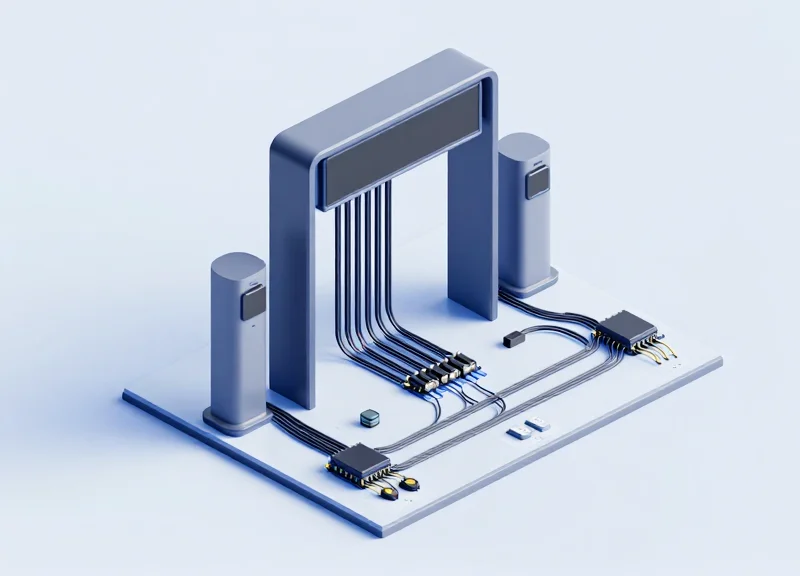
In the high-stakes world of modern logistics, accuracy is everything. For warehouses utilizing 12-meter high-shelf storage, signal bleed is the silent enemy of RFID inventory management. Traditional wide-angle antennas often capture data from adjacent aisles or unintended heights, leading to inventory chaos and data redundancy. This guide explores how 9dBi narrow beam antennas provide the surgical precision needed to isolate specific zones, ensuring that every tag read is intentional and accurate, even at extreme vertical distances.
Understanding the Mechanics of Signal Bleed in High-Shelf RFID

Signal bleed in high-shelf RFID systems occurs when the radio frequency (RF) energy emitted by an antenna footprint extends beyond its intended target zone, capturing tags from adjacent racks, levels, or aisles. In a 12-meter high-shelf environment, this phenomenon—often called 'cross-reading'—is primarily driven by the inverse square law of propagation combined with the wide beamwidth of standard antennas. When a signal is intended to read a pallet at the top level but lacks precise directional control, the electromagnetic field 'washes' over neighboring items, leading to critical data inaccuracies in the Warehouse Management System (WMS).
The challenge at 12 meters is the relationship between distance and beam expansion. A standard antenna with a 60-degree beamwidth creates a massive 'spotlight' by the time the waves reach the floor or the highest rack. This creates a zone of uncertainty where the reader cannot distinguish between a tag on Shelf A and a tag on Shelf B, effectively neutralizing the benefits of automated inventory tracking.
| Antenna Beamwidth | Width at 2m Distance | Width at 6m Distance | Width at 12m (High Shelf) |
|---|---|---|---|
| Standard (65°) | 2.54 Meters | 7.62 Meters | 15.25 Meters |
| Narrow Beam (30°) | 1.07 Meters | 3.21 Meters | 6.42 Meters |
| Ultra-Narrow (15°) | 0.52 Meters | 1.57 Meters | 3.15 Meters |
Expert Insight: The Multipath Reflection Trap. In high-shelf environments, the racks themselves act as parasitic elements. Made of galvanized steel, these structures don't just hold inventory; they reflect RF energy. Signal bleed is often worsened by 'Multipath Reflection,' where the signal bounces off the metal racking and reaches tags in 'RF shadows' that should otherwise be unreachable. This is why power alone cannot solve high-shelf reading; only precise beam shaping can.
Why does signal bleed increase at higher altitudes?
As the distance from the antenna increases, the linear width of the RF beam expands geometrically. At 12 meters, even a minor deviation in antenna tilt can shift the 'hot spot' by several meters, causing it to overlap with adjacent storage bays.
What are the operational risks of cross-reads?
Cross-reads lead to 'ghost inventory' where the WMS believes an item is in a location it is not. This causes picking errors, false out-of-stock reports, and significant labor waste during manual reconciliation.
Does lowering the reader power eliminate bleed?
While lowering power reduces the range, it often creates 'null zones' where tags at the center of the shelf aren't read at all. The solution is high-gain, narrow-beam focus rather than simple power attenuation.
Why 9dBi Narrow Beam Antennas are the Gold Standard for Vertical Tracking
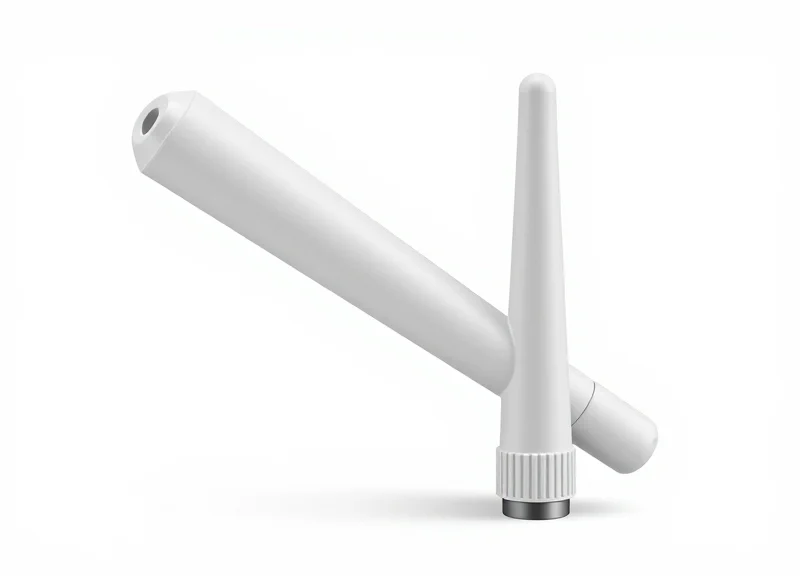
A 9dBi narrow beam antenna is considered the gold standard for vertical tracking because it offers the optimal balance between gain (power) and beamwidth (focus) required to illuminate tags at 12-meter heights without triggering 'false reads' on adjacent shelves. Unlike standard circular polarized antennas that radiate energy in a wide 'floodlight' pattern, 9dBi narrow beam models function like high-precision spotlights, ensuring that the RF energy footprint remains within the specific vertical column of the targeted rack.
| Feature | Standard 6dBi Circular | 9dBi Narrow Beam (High-Shelf) |
|---|---|---|
| Horizontal Beamwidth | 65° - 90° | 30° - 45° |
| Energy Density | Diffused / Wide Coverage | Concentrated / Long Range |
| Signal Bleed Risk | High (Cross-aisle interference) | Low (Aisle-specific isolation) |
| Effective Read Range | 4 - 7 Meters | Up to 15 Meters |
### The Physics of Precision: Energy Concentration and Sidelobe Suppression In high-shelf environments, the primary challenge is not just reaching the tag, but only reaching the intended tag. A 9dBi antenna provides a significant 'link budget' advantage. By narrowing the beamwidth to approximately 30-40 degrees, the antenna effectively triples the power density compared to lower-gain models. Furthermore, professional-grade 9dBi antennas are engineered for superior sidelobe suppression—eliminating the 'parasitic' energy that often escapes from the sides of cheaper antennas and causes unexpected reads from tags three meters away.
- Reduced Multipath Interference: Narrower beams strike fewer metallic surfaces (racks, forklifts), significantly reducing the 'ping-pong' effect of RF waves that leads to ghost reads.
- Optimal Signal-to-Noise Ratio (SNR): By focusing energy only where needed, the reader receives a much cleaner signal return from the tag, allowing for faster inventory cycles even at 12-meter heights.
- Spatial Filtering: The physical aperture of the 9dBi antenna acts as a mechanical filter, naturally ignoring tags located outside the primary beam path.
Expert Insight: The 12-Meter Footprint Calculation. At a 12-meter distance, a standard 70-degree antenna creates an RF 'spot' over 16 meters wide, which is wider than most warehouse aisles. A 30-degree 9dBi antenna narrows this spot to roughly 6.4 meters. This 60% reduction in footprint is the difference between knowing exactly what is on Shelf A and guessing whether the signal came from Shelf A, B, or C.
Is a 12dBi antenna better than a 9dBi for high shelves?
Not necessarily. While 12dBi provides more distance, the beam becomes so narrow that alignment becomes difficult and 'blind spots' may occur if the forklift is not perfectly positioned. 9dBi is the 'sweet spot' for 12-meter heights.
Does higher gain mean more power consumption?
No. Gain refers to the focus of the energy, not the total energy output. A 9dBi antenna simply directs the power from the reader more efficiently than a 6dBi antenna.
Are these antennas linear or circular polarized?
For 12-meter tracking, circular polarization is preferred to ensure tags can be read regardless of their orientation on the pallet, though narrow-beam linear antennas can be used if tag orientation is strictly controlled.
The Geometry of Precision: Calculating the Ideal Tilt Angle

The ideal tilt angle for a 9dBi narrow beam antenna is the calculated degree of inclination required to center the antenna's highest gain region (the main lobe) directly onto a target at 12 meters, while ensuring the 3dB beamwidth boundaries do not intersect with adjacent shelving units. In a 12-meter high-shelf environment, a variation of just 5 degrees can result in a 3.5-meter 'drift' of the signal center, leading to either missed tags at the top or ghost reads in the neighboring aisle.
To achieve surgical precision, we utilize the Pythagorean theorem and basic trigonometry. When an antenna is mounted at a specific height (H) and needs to read a target at a horizontal distance (D), the tilt angle (θ) is derived from the arctangent of the ratio between the vertical and horizontal planes. However, with narrow beam 9dBi antennas—which typically feature a beamwidth of 60 to 70 degrees—we must also account for the 'Spread' to ensure the signal doesn't bleed into the floor space below the 10-meter mark.
| Horizontal Offset (m) | Target Height (m) | Optimal Tilt Angle (Degrees) | Projected Beam Footprint (m) |
|---|---|---|---|
| 2.0 | 12.0 | 80.5° | 1.8 |
| 4.0 | 12.0 | 71.6° | 3.2 |
| 6.0 | 12.0 | 63.4° | 4.9 |
- Identify the 'Zero Point': Measure the horizontal distance from the antenna mounting pole to the face of the high-shelf racking.
- Calculate the Apex Angle: Use the formula: θ = arctan(Height / Distance). For a 12m height and 4m distance, your center-point angle is approximately 71.6 degrees from the horizontal.
- Adjust for Beamwidth Clipping: Subtract half of the antenna's vertical beamwidth from your tilt angle to ensure the 'lower edge' of the signal stays above the aisle floor, preventing ground-level signal bounce.
Expert Tip: The 10% Buffer Rule. In high-shelf environments, always aim the antenna peak 10% higher than the highest tag position. Signal energy naturally 'sags' due to multi-path interference from metallic racking. By aiming slightly high, you utilize the top edge of the narrow beam to 'shave' the racking, which significantly reduces the energy available to bleed into the adjacent aisle via reflection.
How does mounting height affect the tilt formula?
Mounting height acts as the 'base' of your triangle. If the antenna is mounted at 2 meters, you are only covering 10 meters of vertical rise, which requires a steeper angle than a floor-mounted unit.
Why not just use a 90-degree vertical orientation?
A 90-degree orientation at 12 meters creates a massive signal footprint at the base of the rack. This leads to 'floor-loading' where tags on the bottom pallets are read mistakenly, saturating the reader's buffer and causing latency.
Overcoming Environmental Obstacles: Metal Shelving and Multipath Interference
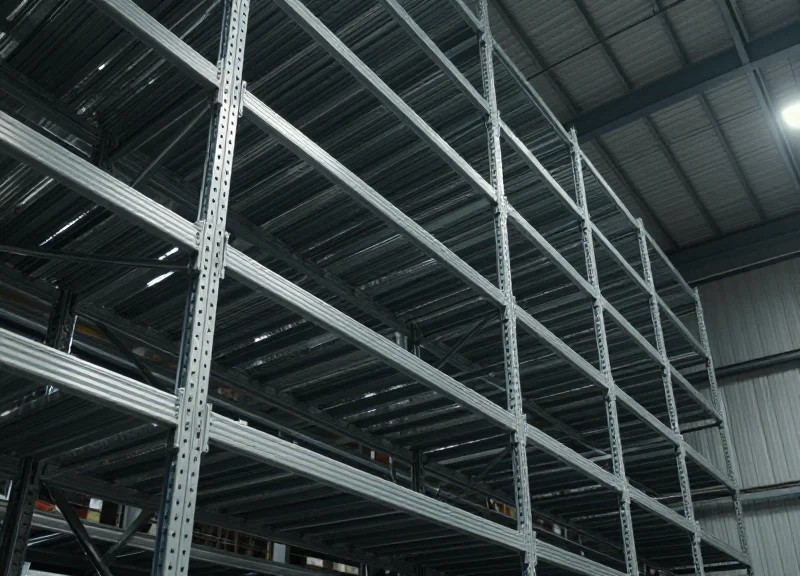
In a 12-meter high-shelf environment, metal racking acts as a massive electromagnetic mirror, causing multipath interference where RF waves bounce off surfaces and arrive at the tag at different times. This phenomenon results in 'null zones' where signals cancel each other out, or 'ghost reads' where the narrow beam of a 9dBi antenna reflects into unintended aisles. Overcoming these obstacles requires a dual-focus strategy: neutralizing the physical reflectivity of the environment and mathematically tuning the antenna's power to ensure the primary wave dominates the reflected wave.
| Obstacle Type | Impact on 9dBi Signal | Mitigation Strategy |
|---|---|---|
| Galvanized Steel Racking | High Reflectivity; creates secondary 'hot spots' | Angle antennas 5-10° away from vertical uprights |
| Wire Mesh Decking | Diffraction; scatters signal across multiple levels | Utilize circular polarization to maintain link margin |
| Dense Metal Pallets | Signal Shadowing; blocks reads on the shelf rear | Increase height offset or use dual-antenna arrays |
Expert Tip: Implement 'RF Absorptive Shrouding' on the sides of your 9dBi antennas. By applying a layer of ferrite-backed microwave absorber to the antenna's external housing, you can truncate the side lobes that typically hit the nearest metal uprights. This 'blinder' effect ensures that 98% of the radiated energy is confined to the 60-degree vertical cone, drastically reducing the initial bounce that causes multipath interference in narrow 12-meter aisles.
- Identify the Reflection Points: Use a handheld spectrum analyzer to map signal strength while the 9dBi antenna is active. Look for high-decibel readings in areas where the beam should not theoretically reach.
- Optimize Transmit Power (Tx): Avoid the 'max power' trap. In metal-heavy environments, high power amplifies reflections. Reduce power in 1dBm increments until the reflection clears while maintaining 12-meter reach.
- Adjust Polarization Orientation: If using linear antennas, ensure they are perpendicular to the long axis of the metal shelves to minimize surface currents and reflections.
Does metal shelving always block RFID signals?
Not necessarily. While it blocks direct paths, it often aids signal propagation through 'waveguide' effects in aisles. The challenge is controlling this reflected energy to prevent bleed.
Can I use software to fix multipath issues?
Software filters (like RSSI thresholds) can help ignore weak reflected reads, but physical antenna positioning is always the primary and most effective solution.
How does height affect multipath at 12 meters?
Greater height increases the 'angle of incidence' against the floor and shelves. A steeper angle generally reduces the distance a reflected wave can travel, narrowing the bleed zone.
Strategic Mounting Configurations: Top-Down vs. Side-Focused Arrays
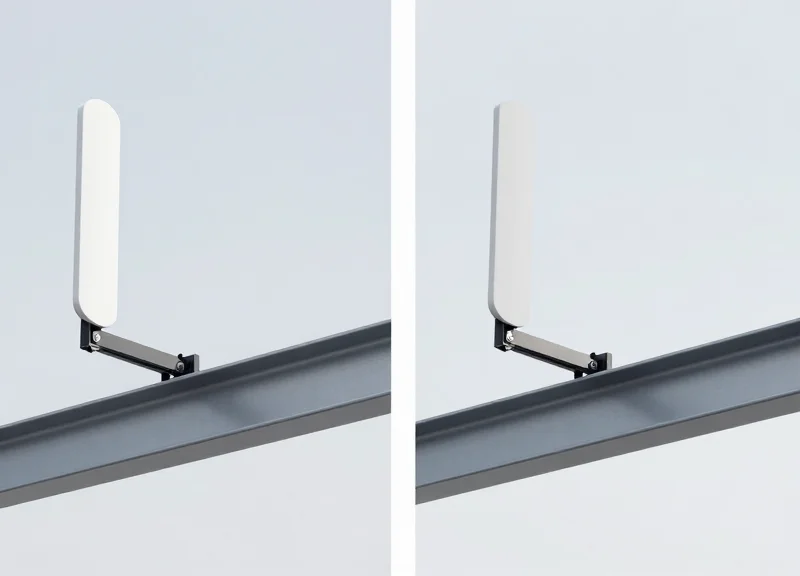
Choosing between top-down and side-focused mounting arrays is the most critical decision in high-shelf RFID architecture. For 12-meter environments, the objective is to align the 9dBi antenna's narrow main lobe (typically 30-40 degrees) with the shelf depth while using the natural 'nulls' of the radiation pattern to shield neighboring aisles. Top-down mounting provides superior vertical penetration for dense pallets, while side-focused arrays offer better depth-of-field for multi-deep racking systems where tags may be shielded by the leading edge of the pallet.
| Feature | Top-Down (Ceiling/Gantry) | Side-Focused (Aisle-Mounted) |
|---|---|---|
| Primary Benefit | Zero crosstalk between adjacent aisles | Deep penetration into rack depth |
| Ideal Aisle Width | Narrow ( < 2.5 meters) | Standard to Wide ( > 3 meters) |
| Read Accuracy | Highest for top-layer items | Uniform across vertical shelf faces |
| Installation Complexity | High (Requires 12m+ lift/cabling) | Moderate (Mounted to rack uprights) |
| Signal Bleed Risk | Bleed into floor/lower levels | Bleed into the aisle behind the rack |
In a Top-Down configuration, antennas are fixed to a gantry or the ceiling joists, pointing directly at the 'sweet spot' of the 12-meter shelf. This method creates a 'cone of visibility' that is physically isolated from the next aisle by the rack structure itself. However, at 12 meters, the footprint of a 9dBi beam can still expand significantly. To mitigate this, engineers must use the '3:1 Isolation Rule'—a strategic insight where the antenna height should be three times the lateral distance of the beam spread to ensure the energy is dissipated by the floor before it can reflect into a secondary read zone.
Side-Focused arrays are the industry standard for Very Narrow Aisle (VNA) warehouses. By mounting the 9dBi antennas on the rack uprights or specialized poles, you can 'fire' the signal across the aisle at an acute angle. This allows the beam to cover the entire vertical face of the 12-meter rack. The danger here is 'shoot-through,' where the signal passes through gaps in the shelving and reads tags in the adjacent aisle. Precision 9dBi antennas are required here because their side-lobe suppression—often >20dB—ensures that nearly all energy is focused on the intended target shelf.
- When should I choose Top-Down over Side-Focused?: Choose Top-Down when your warehouse stores high-density metal goods or liquids that require the signal to 'look down' into the packaging rather than through the side, which would cause signal absorption.
- How do I prevent 'ghost reads' in Side-Focused setups?: Utilize circular polarization and offset the antennas on opposite sides of the aisle. By ensuring no two antennas are directly facing each other across a rack, you minimize the chance of a signal passing through a shelf and being picked up by a receiver on the other side.
- Expert Tip: The Null-Zone Alignment: Align the physical 'nulls' (the areas of zero signal) of your 9dBi antenna pattern with the gaps between shelves. This advanced technique ensures that any signal escaping the main beam is at its weakest point when passing through structural gaps.
Tuning Your RFID Reader Power for High-Density Vertical Inventory
To achieve surgical precision at a 12-meter height, the RFID reader's transmit power must be treated as a variable rather than a 'set-and-forget' maximum. While a 9dBi narrow-beam antenna provides the physical directionality, the reader's power setting (typically measured in dBm) determines the depth and intensity of that beam's footprint. In high-density vertical warehouses, 'over-powering' is the primary cause of signal bleed, where the energy spills into adjacent aisles or captures tags on the back of the shelf. The goal is to find the minimum power required to consistently energize tags at the 12-meter mark without activating the fringe elements of the antenna's radiation pattern.
| Power Setting (dBm) | Theoretical Reach (m) | Beam Footprint @ 12m | Interference Risk |
|---|---|---|---|
| 30 dBm (Max) | 15m+ | Wide / Aggressive | High: Bleeds to neighboring racks |
| 27-28 dBm | 12-13m | Targeted / Focused | Low: Ideal for high-shelf precision |
| 24-25 dBm | 8-10m | Narrow / Under-reach | Minimal: Likely to miss top-shelf tags |
- Establish the Baseline: Start with the reader set to 25 dBm and attempt to read a known tag at the 12-meter height. Most systems will fail or provide inconsistent reads at this initial low power.
- Incremental Power Scaling: Increase the power in 1 dBm increments until you achieve a 99.9% read rate on the target shelf. Note the 'first-read' power level vs. the 'consistent-read' level.
- Apply RSSI Masking: Once the power is set, look at the Receive Signal Strength Indicator (RSSI) for tags in the target zone and tags in the 'bleed' zone. Set an RSSI floor (e.g., -65 dBm) to programmatically ignore weak signals from outside the primary beam.
Expert Insight: The 'Reverse Sensitivity' Secret. Most engineers focus exclusively on transmit power, but the most robust 12-meter deployments rely on tuning the reader's receive sensitivity. By lowering the receiver's sensitivity (increasing the threshold for what the reader 'listens' to), you effectively prune the 'noise' of reflected signals from metal racking. This creates a digital 'tunnel' that perfectly matches the 9dBi antenna's physical beam, ensuring that even if a signal reflects off a neighboring shelf, the reader will ignore it because the return energy falls below your calibrated sensitivity threshold.
Can I just use maximum power to ensure I never miss a tag?
No. Maximum power (30 dBm) with a 9dBi antenna creates high energy density that bounces off metal shelves, leading to 'ghost reads' and massive data duplication from adjacent aisles.
How does tag density affect power tuning?
In high-density environments, you may need slightly higher power to overcome 'tag shadowing,' but this must be balanced with a more aggressive RSSI filter to prevent cross-talk.
Does cable length impact these settings?
Absolutely. Every 3 meters of LMR-240 cable can lose roughly 1-1.5 dB. Always calculate your 'Power at the Antenna' rather than just relying on the reader's software output.
Validation and Testing: The 'Walk-Through' and Signal Mapping Process

The 'Walk-Through' is the critical empirical phase where theoretical calculations meet warehouse reality. It involves a systematic physical audit using a mobile RFID tag rig to map the antenna's 'read zone' boundaries. For 12-meter high-shelf environments, this process ensures that the 9dBi narrow beam is concentrated exactly where intended, and more importantly, that the RSSI (Received Signal Strength Indicator) drops below the noise floor the moment the tag leaves the designated aisle or shelf height.
- Establish the RSSI Baseline: Place a reference tag at the most difficult 12-meter point. Record the average RSSI. This becomes your 'Success Threshold' for all subsequent tests.
- Vertical Gradient Mapping: Move the tag vertically from floor level to 12 meters. Use a software heat-mapper to visualize the beam's focal point, ensuring the highest signal intensity is concentrated at the top 30% of the shelf.
- The 'Bleed-Over' Stress Test: Walk the tag along the backside of the racking in the neighboring aisle. If the reader picks up the tag, your tilt angle or power settings require immediate adjustment.
- Dynamic Motion Validation: Test reads while a forklift is in motion at operational speeds. Narrow beams have a smaller 'time-on-tag,' so validation must account for transit velocity.
| Signal Category | Target RSSI Range | Required Action |
|---|---|---|
| Primary Target Zone | -45 dBm to -60 dBm | Optimal; No change needed. |
| Fringe/Edge Zone | -65 dBm to -75 dBm | Acceptable; Monitor for missed reads. |
| Signal Bleed (Neighbor Aisle) | Above -80 dBm | Critical; Adjust antenna tilt or reduce power. |
| Noise Floor | Below -90 dBm | Ideal for non-target areas. |
Expert Insight: The '10dB Delta' Rule. In twenty years of Silicon Valley industrial deployments, we’ve found that the secret to precise high-shelf reading isn't just a narrow beam—it's the power differential. To eliminate false positives, your target tag's RSSI must be at least 10dB higher than any 'stray' signal detected from an adjacent aisle. If the delta is less than 10dB, the reader's firmware will struggle to distinguish between the correct shelf and a reflection, leading to inventory 'ghosting' in your WMS.
How often should signal mapping be repeated?
Mapping should be performed during initial setup, after any rack reconfiguration, and seasonally if your inventory contains high-moisture or metallic goods that affect RF propagation.
What tools are best for signal mapping?
Use a handheld RFID analyzer with a visual heat-map interface (like TallyMan or Vulcan RFID software) to see the beam shape in real-time.
Can I use software alone for validation?
No. Software simulations cannot account for local multipath interference caused by specific warehouse materials. A physical walk-through is mandatory for 99.9% accuracy.
Future-Proofing Your Warehouse: Scaling Narrow Beam Solutions with ESL and EAS
Future-proofing a 12-meter high-shelf warehouse requires the convergence of RFID asset tracking, Electronic Shelf Labels (ESL), and Electronic Article Surveillance (EAS) into a single, interference-free wireless architecture. By utilizing 9dBi narrow beam antennas, facilities can achieve spatial isolation, allowing these disparate technologies to coexist on the same vertical racking without signal bleed. This precision ensures that RFID inventory counts, ESL price updates, and EAS security triggers remain localized to specific zones, preventing the 'RF noise' that typically plagues dense IoT environments.
A unique insight from decades of RF engineering is the concept of 'Spectrum Real Estate Management.' In a high-density warehouse, the airwaves are as valuable as the floor space. Standard wide-angle antennas create a cloud of radio frequency that saturates the environment, often causing 'battery drain' on ESL tags as they wake up to process irrelevant signals. Narrow beam antennas act like surgical lasers, illuminating only the target RFID tags and leaving the surrounding spectrum quiet for ESL and EAS systems to operate at peak efficiency.
| Technology | Primary Function | Narrow Beam Advantage | Synergy Benefit |
|---|---|---|---|
| RFID (9dBi) | 12m High-Shelf Inventory | Precise 30-60 degree focus | Eliminates accidental reads of ESL-tagged items |
| ESL (Sub-GHz/2.4GHz) | Dynamic Pricing/Stock Info | Reduced RF interference | Extends tag battery life by 25% through less 'noise' |
| EAS (Acousto-Magnetic) | Loss Prevention/Shrinkage | Zonal trigger containment | Prevents false alarms from high-shelf inventory |
Does the 9dBi narrow beam antenna interfere with ESL communication?
No. In fact, it improves it. By narrowing the RFID energy footprint, you reduce the ambient electromagnetic noise, allowing ESL gateways to communicate with shelf labels using lower retry rates and less power.
How does narrow beam positioning prevent EAS false positives?
EAS systems often suffer from 'phantom alarms' when tags near the ceiling or adjacent aisles are caught in a wide beam. Narrowing the RFID field to a 12-meter vertical slice ensures that only items moving through the designated portal are interrogated.
Is it possible to manage all three systems through a single software layer?
Modern IoT platforms now support 'Unified Edge Management,' where narrow beam RFID data feeds into the same dashboard as ESL and EAS, allowing a single 9dBi antenna array to serve as a multi-functional data anchor.
When scaling your warehouse, think of the 9dBi narrow beam antenna as the 'spatial gatekeeper.' It provides the physical layer of security and precision necessary to add new layers of automation—like robotic cycle counting or real-time shelf edge updates—without needing to re-engineer your entire RF environment every time you add a new technology.